Krokus: The Life Story Behind Switzerland's Hard Rock Heroes
In this post
- Solothurn in the Seventies: Where the Noise Began
- Marc Storace Joins and the Sound Finds Its Voice
- Headhunter and the American Dream
- The Hard Years: Change, Grunge, and Staying Alive
- The Return Home: Rock the Block and a Swiss Comeback
- Farewell Tours, New Records, and a Band That Keeps Playing
- What Krokus Means to Swiss Rock
- My Take:
There is a kind of rock music that does not ask for permission. It is loud, it is fast, and it is built for a crowd that wants to shout along. Krokus made that kind of music, and they made it from Switzerland, a country that most people do not link with hard rock. For more than forty years, they played that music in clubs, in halls, and in stadiums, and they earned a place among the hardest working rock bands in Europe. They were never the most fashionable band, and they were never the band that critics loved most, but they were the band that fans could count on, night after night, year after year.
The band began in Solothurn, a small Swiss town, in the mid 1970s, when hard rock was still young and bands like AC/DC and Led Zeppelin were showing the world what a guitar could do. Krokus listened to those bands, and they wanted to make the same kind of noise, with the same kind of energy, but with their own Swiss stamp on it. They were not a copy. They were a band that learned from the best and then found their own way, through hard work, through long tours, and through a refusal to give up when the music world changed around them.
Their best known years came in the early 1980s, when their album Headhunter reached the charts in America and their songs were played on rock radio around the world. They toured with some of the biggest bands of the time, they played to crowds of thousands, and they became the most successful Swiss rock band in history. Then the music world changed, grunge came, and many hard rock bands faded. Krokus did not fade. They kept going, they kept recording, and they kept playing to fans who never left them.
What makes their story worth telling is the long road, not only the peak. It is the story of a band that started in a small town, that worked its way up through small clubs, that found fame in America, that lost it, and that found it again at home in Switzerland, where they are still loved as heroes. This is the story of that road, and of the men who walked it together, with guitars loud and hearts full.
Solothurn in the Seventies: Where the Noise Began
Krokus was formed in Solothurn, Switzerland, in 1975, by Chris von Rohr, who played bass and sang in the early days, and by other young musicians who shared a love of hard rock. Solothurn is a quiet town, known for its old buildings and its calm streets, and it was not an obvious place for a loud rock band to begin. That was part of the point. The band had to work harder to be heard, because there was no big music scene around them, no large record industry, and no easy road to fame. They had to make their own road, and they did it with rehearsals, with small gigs, and with a belief that their music was worth hearing.
Chris von Rohr was the driving force in those early years. He was a musician with a strong will, a man who knew what he wanted the band to sound like, and who was willing to work for it. He played bass, he sang, and he wrote songs, and he pushed the band to be tighter, louder, and more professional. The early line up changed often, as young bands do, with members coming and going, but von Rohr stayed, and his vision stayed with him. He wanted Krokus to be a real rock band, not a hobby, and he treated every rehearsal as if it were a step toward a larger stage.
The band’s first album, Krokus, was released in 1976, and it was a modest start. It showed a band that was still finding its sound, a band that loved progressive rock as much as hard rock, and a band that was learning how to record. It did not sell in large numbers, and it did not make the band famous, but it gave them a record to sell at gigs, and it gave them a reason to keep going. A first album is often a promise, not a finished work, and Krokus kept that promise by working harder in the years that followed.
They played in Switzerland and in nearby countries, in clubs where the audience was small and the sound was rough, and they learned the craft of live performance. A rock band learns more on stage than in a rehearsal room, because the stage teaches you how to hold a crowd, how to recover when something goes wrong, and how to play the same song with fresh energy every night. Krokus learned those lessons in small rooms, and the lessons stayed with them when the rooms grew larger. The small town taught them to be humble, and the small stages taught them to be strong.
Marc Storace Joins and the Sound Finds Its Voice
The most important change in the early history of Krokus came when Marc Storace joined the band as lead singer. Storace was born in Malta in 1951 and raised in Switzerland, and he had a voice that was made for hard rock, high, strong, and full of feeling. He had sung in other bands, and he knew how to hold a crowd with his voice alone. When he joined Krokus, the band found the voice it had been missing, and the sound became clearer, harder, and more direct.
With Storace in front, Chris von Rohr moved to bass and backing vocals, and the band began to write songs that fit the new singer. The album Metal Rendez-vous, released in 1980, was the first real sign of the new Krokus. It included songs like Heatstrokes and Bedside Radio, and it showed a band that had learned how to write a hard rock song with a strong chorus, a driving guitar, and a voice that could carry it. The album sold well in Switzerland and in other parts of Europe, and it gave the band a new confidence.
The next album, Hardware, released in 1981, continued the same path, with songs that were built for the stage and for the radio. The band toured more, they played larger venues, and they began to be noticed outside Switzerland. They were not yet famous in America, but they were building a name in Europe, and they were learning how to be a professional touring band, with long days on the road, with nights in small hotels, and with the discipline that a tour demands. That discipline is often invisible to fans, but it is the base of any long career in rock music.
Storace became the face of the band, and his voice became its mark. He sang with a power that few singers could match, and he performed with an energy that made every show feel like a celebration. He also became a songwriter with the band, and his ideas helped to shape the songs that would make Krokus famous. The partnership between von Rohr and Storace was the heart of the band, and it would carry them through the best years of their career, and through the hard years that followed.
Headhunter and the American Dream
The peak of Krokus came with the album Headhunter, released in 1983. The album was produced with a clear aim, to break into the American market, and it worked. The title track and the song Screaming in the Night became hits on American rock radio, and the album reached the charts in the United States. The band also recorded a cover of the Sweet song Ballroom Blitz, which became a popular track and showed that they could take a classic song and make it their own, with a harder sound and a stronger beat.
Headhunter was a hard rock album in the classic style, with loud guitars, strong drums, and a singer who could hit high notes without losing power. It sounded like the best American hard rock of the time, but it was made by a Swiss band, and that was part of its charm. American fans did not care where the band came from. They cared about the sound, and the sound was right. Krokus toured America with big bands, they played in large halls, and they saw their name on posters in cities they had only dreamed of as young men in Solothurn.
The album that followed, The Blitz, released in 1984, continued the success, with the song Midnite Maniac becoming a hit on American radio and on the new music television channel MTV. The band made videos, they appeared on television, and they became a name that rock fans in America knew. For a Swiss band, that was a remarkable achievement, because very few Swiss rock bands had ever reached that level in America. Krokus had done it through hard work, through a strong album, and through a live show that made people want to come back.
Those years were the brightest in the band’s history, but they were also hard. Touring America is not easy, with long drives, with nights away from home, and with pressure to keep the success going. The band worked hard, and they enjoyed the success, but they also learned that fame can be fragile, and that a band must keep making good records if it wants to stay at the top. Headhunter gave them a peak, and it gave them a memory that would stay with them for the rest of their lives.
The Hard Years: Change, Grunge, and Staying Alive
After the mid 1980s, the music world began to change, and Krokus felt the change. Hard rock became less popular, and new styles like grunge and alternative rock took over the charts and the radio. Many bands from the early 1980s faded in that period, because their sound no longer fit the fashion, and because record labels no longer wanted to support them. Krokus faced the same problem, and they had to decide whether to change their sound or to stay true to it.
The band went through changes in its line up, with members leaving and new members joining, and Chris von Rohr left the band for a time. Marc Storace stayed, and he kept the band going, but the road was harder. They released albums like Change of Address in 1986 and Heart Attack in 1988, and later Stampede in 1990 and To Rock or Not to Be in 1995, but none of them reached the success of Headhunter. The band still had fans, and they still played live, but the large American tours and the big chart hits were gone.
That period tested the band in a way that success had not. It is easy to keep going when everyone loves you and the records sell. It is hard to keep going when the records do not sell and the crowds are smaller. Krokus kept going because they loved the music, because they loved playing together, and because they had fans in Switzerland and in Europe who never left them. They played in clubs and in festivals, they kept writing songs, and they kept the name alive, even when the music world had moved on.
In time, the original members began to come back together, and the band found a new strength in its history. They realised that they did not need to chase the American charts again. They needed to be the best Krokus they could be, for the fans who had stayed with them. That realisation gave them a new freedom, and it set the stage for a return that would surprise many people who had thought the band was finished.
The Return Home: Rock the Block and a Swiss Comeback
In the early 2000s, Krokus made a strong return in Switzerland with the album Rock the Block, released in 2003. The album went to number one in Switzerland, and it showed that the band still had a large and loyal audience at home. The songs were hard, direct, and full of energy, and they reminded fans of the best of the band’s early work, while also sounding fresh and modern. The success of Rock the Block was a turning point, because it proved that Krokus did not need America to matter. They mattered at home, and that was enough to build a new chapter.
The band continued with albums like Hellraiser in 2006 and Hoodoo in 2010, and each record kept the hard rock sound that fans loved. They toured in Europe, they played at festivals, and they became a regular presence on the Swiss rock scene. They were no longer a young band trying to break into America. They were a veteran band, with a history and a fan base, and they played with the confidence that comes from knowing who you are and what you do best. That confidence made their live shows stronger, because they no longer had anything to prove to anyone except themselves.
They also became a symbol of Swiss rock, a band that had taken Swiss music to the world and brought it back home with pride. Young Swiss rock bands looked up to Krokus, because they had shown that a band from a small town could reach the American charts, and that a band could survive the hard years and come back. That example mattered, because it gave young musicians a reason to believe that their own small town was not a limit, but a starting point. Krokus had started in Solothurn, and they had gone far, and that road was open to others too.
The return was not only about records. It was about the band playing together again, with the original spirit intact, and with a new sense of joy. They had been through the peak and the fall, and they had come out the other side with their love of music intact. That is a rare thing in rock music, where many bands break up when the fame fades, and it is a large part of why Krokus are still respected today. They did not quit when it was hard, and they did not pretend to be something they were not when they came back.
Farewell Tours, New Records, and a Band That Keeps Playing
In the 2010s, Krokus announced farewell tours, and many fans thought the band was coming to an end. They released the album Dirty Dynamite in 2013, which also reached number one in Switzerland, and the album Big Rocks in 2017, a collection of cover songs that showed their love of classic rock. They played farewell shows, and they said goodbye to the road, but the goodbye did not last. The band kept coming back, because the fans kept asking for more, and because the members still loved to play together.
They toured again, they played at festivals, and they kept the name alive. In 2019 and in the years that followed, they played shows that were billed as farewell concerts, and yet the band continued, because a farewell in rock music is often more of a pause than an end. The members had spent most of their lives in the band, and it was hard to walk away from something that had given them so much. They found a way to keep playing without the pressure of a full tour, by choosing shows that mattered and by playing for fans who wanted to see them one more time.
The band also faced loss and change, as all long lived bands do, with members leaving and with the passing of time. They kept the core of the sound, with Marc Storace’s voice at the front, and they kept the hard rock spirit that had defined them from the start. They did not try to sound young again. They sounded like themselves, a veteran band with a long history, and that honesty made their later shows feel real and moving. Fans came not only to hear the old songs, but to celebrate a band that had been part of their lives for decades.
Today, Krokus are still remembered as the most successful Swiss hard rock band, and their songs are still played on rock radio, at festivals, and in the homes of fans who grew up with them. They may not tour as much as they once did, but their music is still alive, and their story is still told. They are a band that started in a small town, reached the world, fell back, and rose again at home, and that story is worth remembering for anyone who loves rock music.
What Krokus Means to Swiss Rock
Krokus matters to Swiss rock because they proved that a Swiss band could compete with the best hard rock bands in the world. Before them, Swiss rock was a small scene, and few bands had reached beyond the borders of Switzerland. Krokus broke that limit, and they showed that a band from Solothurn could play on the same stage as the biggest American bands, and could hold its own. That achievement opened a door for other Swiss bands, and it gave Swiss rock a new confidence.
They also matter because they stayed true to hard rock when the fashion changed. In the 1990s, when many bands changed their sound to fit grunge or pop, Krokus kept playing hard rock, even when it was not popular. That loyalty cost them some success, but it earned them respect, because fans knew that the band was not chasing a trend. They were playing the music they loved, and that love was clear in every record and every show. In a music world that often rewards fashion over feeling, that loyalty is a rare and valuable thing.
Their story also shows the value of hard work and of staying together. A band is a team, and a team that stays together through good years and bad years can achieve more than a team that breaks at the first sign of trouble. Krokus stayed together, in different forms, for more than forty years, and that staying power is a large part of their legacy. They did not give up when the charts turned against them, and they did not give up when members left. They kept going, and that persistence is a lesson for any young band that dreams of a long career.
In the end, Krokus are remembered not only for Headhunter, but for the whole journey, for the small clubs in Solothurn, for the American tours, for the hard years, and for the return home. That journey is the real story, and it is a story that still inspires rock fans in Switzerland and around the world. A band that starts in a small town can go far, if it works hard, if it stays true, and if it never stops playing the music it loves.
My Take:
When I think about Krokus, the first thing I feel is respect for a band that never pretended to be something it was not. They were a hard rock band, they played hard rock, and they did not apologise for it. In a world where many bands change their sound every few years to follow the latest fashion, Krokus kept their sound, and they kept it loud. That takes courage, because it means you will lose some fans when the fashion changes, and you will be called old fashioned by people who do not understand your music. Krokus did not care. They played the music they loved, and they trusted that the fans who loved it would stay. That trust was right, and it is why they are still loved today.
I admire Marc Storace’s voice more than almost any other part of the band. His voice is high, strong, and full of feeling, and it can carry a song even when the guitars are loud and the drums are fast. I have heard many rock singers who shout to be heard, and I have heard many who whisper to be cool, but Storace sings with a power that feels natural, as if the voice was made for this music. When he sings Screaming in the Night, I do not think about technique. I think about a man who is giving everything he has to a song, and that feeling is what makes rock music work. A great rock singer does not only hit the notes. He makes you feel the song in your chest, and Storace does that every time.
I also think about Chris von Rohr, and I think about the work he did to keep the band going in the early years. A band needs someone who will push, who will organise, who will say that a rehearsal matters and that a small gig matters, even when no one is watching. Von Rohr was that person for Krokus, and without him, the band might never have left Solothurn. I respect that kind of work, because it is often invisible. Fans see the singer on stage, they hear the guitars, but they do not see the person who booked the gig, who drove the van, who made sure the band was ready. Von Rohr did that work, and he did it for years, and the band’s success is his success too.
What I find sad in their story is the way the music world turned against hard rock in the 1990s. Krokus had worked for years to reach America, they had made great records, and then suddenly the radio did not want their sound any more. That must have been hard, to watch a style you love become unfashionable, and to know that it is not because your music got worse, but because the fashion changed. I think many bands in that period felt the same pain, and many of them broke up. Krokus did not break up, but they paid a price, in smaller crowds and in fewer records, and I think that price was unfair. A good song does not become a bad song because the year changes, and Headhunter is still a good album today, even if the radio no longer plays it.
I love their return in Switzerland, because it shows that home matters. They went to America, they reached the charts, and then they came back to Switzerland and found that their own people still loved them. That is a beautiful thing, to be loved at home after you have tried to conquer the world. I think many artists forget home when they become famous, and they chase the next big market, and they lose the fans who loved them first. Krokus did not forget home. They came back, they played for Swiss fans, and they reached number one in Switzerland again. That tells me that they knew where they belonged, and that they were not too proud to come back and start again.
I think about the farewell tours, and I smile, because a farewell tour in rock music is rarely a real farewell. Bands say goodbye, and then they come back, because the stage is their home and the fans are their family. Krokus said goodbye more than once, and they kept coming back, and I do not blame them. If you have spent your life playing music, and people still want to hear you, why would you stop? I hope they keep playing as long as they want to, and I hope the fans keep coming, because a band that has given so much deserves to be heard for as long as they have the strength to play.
If I have a criticism, it is that they never quite got the respect they deserved outside Switzerland. In America, they were known for a few songs, and then they were forgotten when the fashion changed. In Europe, they were known as a hard rock band, but they were not always placed among the greats. I think that is unfair, because their best work is as good as many bands who are remembered more fondly. Headhunter is a strong album, Metal Rendez-vous is a strong album, and Rock the Block is a strong album. I wish more people outside Switzerland knew those records, and I hope this story helps a few more people discover them.
I also think about the young rock bands in Switzerland today, and I hope they look at Krokus and learn the right lesson. The lesson is not to copy the sound, because the sound belongs to Krokus and to the 1980s. The lesson is to work hard, to play live, to stay together, and to be patient. Krokus did not become famous in one night. They worked for years in small clubs, they made records that did not sell, and they kept going. That patience is the real lesson, and it is a lesson that is still true today, when many young bands want fame in a week and give up when it does not come. Fame takes time, and a long career takes even more time, and Krokus proved it.
I think about the sound of their guitars, and I think about how simple it is. There is no trick, no clever effect, just a loud guitar, a strong drum, and a voice that can carry it. That simplicity is a strength, because it means the music can be played live, night after night, without losing its power. I have heard many bands who sound great on a record and weak on stage, because their sound depends on studio tricks. Krokus sounded great on stage, because their sound was real, and that is why their fans kept coming back. A live show is the true test of a rock band, and Krokus passed that test for more than forty years.
I feel a warmth when I think about their fans, because Krokus fans are loyal in a way that is rare. They did not leave when the band fell from the charts, they did not leave when the members changed, and they did not leave when the band said farewell. They stayed, they bought the new records, and they came to the shows. That loyalty is a two way street. The band stayed loyal to the music, and the fans stayed loyal to the band. I think that is the best kind of relationship in music, a relationship built on trust and on shared love, not on fashion or on hype.
For a young reader, I think the lesson from Krokus is to keep going when it gets hard. Do not quit because the fashion changes, do not quit because the crowd gets smaller, and do not quit because someone tells you your music is out of date. Keep playing the music you love, keep working on your craft, and trust that the people who love it will find you again. Krokus kept going, and they found their audience again in Switzerland, and they reached number one again. That is a hopeful message for anyone who has ever felt that their time has passed. Your time has not passed if you are still willing to work.
I also think their story teaches us about Switzerland, and about small countries in general. People often think that great rock music only comes from America or Britain, but Krokus shows that great rock can come from a small town in Switzerland, from a band that had no big industry behind them, only hard work and a love of loud guitars. That is a hopeful message for any young musician in a small place. Your place does not limit you. Your work does not need a big city to be born. It needs a rehearsal room, a guitar, and a will to keep playing.
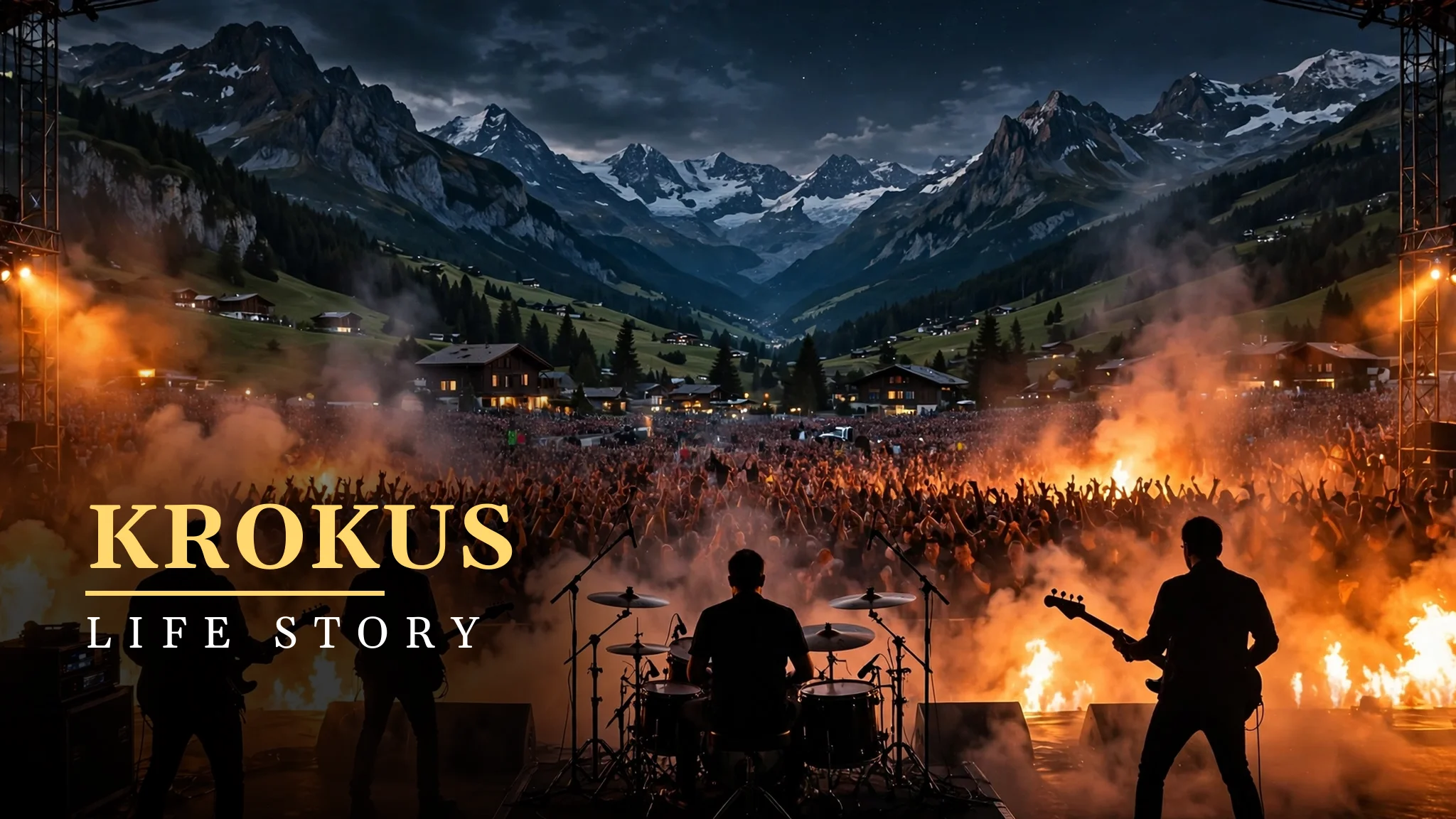
In the end, I keep coming back to the image of Krokus on stage, with the guitars loud, the crowd shouting, and the mountains of Switzerland behind them. That image is the band, a Swiss band that plays American style hard rock with a Swiss heart, and that is a beautiful mix. I hope they are remembered for that mix, for their hard work, and for their refusal to quit. They are not the most famous hard rock band in the world, but they are one of the most honest, and honesty in rock music is worth more than fame. I will keep listening to Headhunter, I will keep telling people about Krokus, and I will keep believing that a band that works this hard deserves to be heard.
I also think about the guitars, and I want to say something about the simple pleasure of a loud guitar played well. In a world where music is often made on a computer, with sounds that no human hand has touched, the sound of a real guitar, played by a real person, feels honest. Krokus never hid behind computers. They played their guitars, they turned the volume up, and they let the sound fill the room. That honesty is part of why their fans love them, because the fans know that what they hear on the record is what they will hear on stage. There is no trick, no secret, only hard work and loud guitars, and I find that refreshing in a time when so much music feels fake.
Another thing I notice is how the band handled change in its members. Many bands break up when a member leaves, because the chemistry is gone and no one knows how to replace it. Krokus lost members, they gained new ones, and they kept going, because the idea of the band was stronger than any one person. That idea was simple, to play hard rock, to play it well, and to play it for fans who love it. When a band has a clear idea, it can survive change, because new members can learn the idea and make it their own. Krokus proved that, and I think it is a lesson for any team, in music or in any other work. A clear idea can hold a team together when people change.
I think about the towns and cities where Krokus played, and I think about the fans who drove for hours to see them, who stood in the rain at festivals, who sang along to every word. Those fans are the real story of Krokus, because a band is nothing without the people who listen. The band gave the fans loud music and honest shows, and the fans gave the band their loyalty, their money, and their time. That exchange is the heart of rock music, and it is why a band like Krokus can last for more than forty years. It is not about the charts. It is about the people in the room, shouting along to a song they love.
I also wonder what Krokus will mean in fifty years, when the members are gone and only the records remain. I believe the records will still be played, because hard rock does not go out of date in the way that pop music does. A hard rock song from 1983 can still sound fresh today, because it is built on a guitar, a drum, and a voice, and those things do not age. Young listeners who find Headhunter for the first time will hear the same energy that fans heard in 1983, and they will understand why the band mattered. That is the best kind of legacy, a record that still works when the world around it has changed completely.
Finally, I want to say that Krokus taught me that success is not only about reaching the top. It is also about staying, about coming back, and about playing for the people who love you, even when the world has moved on. They reached the top in America, they fell, and they came back in Switzerland, and that second success was just as real as the first. I hope that when I face a hard time in my own life, I remember Krokus, and I keep going, and I trust that the people who love my work will still be there when I come back. That is a hopeful thought, and it is one that I will carry with me long after I finish this story.
Frequently Asked Questions
Where was Krokus formed and when did the band start?
Krokus was formed in Solothurn, Switzerland, in 1975, led in the early years by Chris von Rohr. The band began in small clubs, released a first album in 1976, and built its sound through years of live work before finding wider fame.
Who is the lead singer of Krokus?
The lead singer most associated with Krokus is Marc Storace, who joined the band in the late 1970s and gave it a high, powerful voice. He sang on the band’s best known albums, including Metal Rendez-vous and Headhunter, and he has remained the frontman through the band’s later years.
What is Krokus’s most famous album?
Their most famous album is Headhunter, released in 1983, which brought the band success on American rock radio and in the charts. It includes the title track and Screaming in the Night, and it remains the record most fans name first.
Did Krokus have success in America?
Yes, Krokus had real success in America in the early 1980s, with Headhunter and The Blitz reaching rock radio and the charts. They toured the United States with big bands, and their cover of Ballroom Blitz became widely known there.
Why did Krokus fade in the 1990s?
Krokus faded in the 1990s because hard rock lost popularity when grunge and alternative rock took over the charts and radio. The band kept recording and playing, but the large American tours and chart hits of the early 1980s did not return in that period.
Did Krokus make a comeback in Switzerland?
Yes, Krokus made a strong comeback at home with Rock the Block in 2003, which reached number one in Switzerland. Later albums like Dirty Dynamite also reached number one, and the band became celebrated again as Swiss rock heroes.
Is Krokus still playing today?
Krokus have announced farewell tours and played farewell shows, but they have kept returning to the stage for selected concerts and festivals. Their music is still played on rock radio, and they are remembered as Switzerland’s most successful hard rock band.


