Led Zeppelin: The Life Story Behind the Rock Gods
In this post
- Jimmy Page and the Birth of a New Band
- Robert Plant, John Bonham, and a Thunderous Sound
- Led Zeppelin II, III, and the Rise to the Top
- Stairway to Heaven and the Untitled Fourth Album
- Houses of the Holy, Physical Graffiti, and the Peak
- Loss, the End, and the Decision Not to Replace Bonham
- What Led Zeppelin Leave Behind
- My Take:
Led Zeppelin are one of the loudest, boldest, and most powerful rock bands in history, and they are also one of the most mysterious. They made music that was heavy and soft at the same time, they played concerts that shook stadiums, they sold hundreds of millions of records, and they did it without ever releasing a single from their albums in Britain, without ever appearing on many television shows, and without ever explaining themselves very much. They let the music speak, and the music spoke loudly enough for the whole world to hear.
The band was formed in London in 1968, when the guitarist Jimmy Page, who had played with the Yardbirds, brought together the singer Robert Plant, the bass player John Paul Jones, and the drummer John Bonham. Those four men were very different, but together they made a sound that no one had heard before, a mix of blues, folk, rock, and something wild and magical that seemed to come from another world. They made eight studio albums in twelve years, and then they stopped, when John Bonham died, because they knew that no one could replace him.
What makes their story worth telling is the sheer power of their music and the mystery around it. They wrote Stairway to Heaven, Whole Lotta Love, Kashmir, Black Dog, and Immigrant Song, songs that are still played on the radio, still sung by fans, and still studied by musicians. They played concerts that became legends, they flew in private planes, they lived like rock stars, and they left behind a legacy that has never faded. This is the story of how four musicians from Britain became Led Zeppelin, and how Led Zeppelin became rock gods.
Jimmy Page and the Birth of a New Band
Jimmy Page was born on 9 January 1944 in Heston, in west London, and he grew up loving the guitar, learning to play by listening to records and by practising for hours every day. He became a session musician in London in the 1960s, playing on records for many different artists, and he learned how a studio worked, how a song was built, and how a guitar could make many different sounds. He was a quiet, serious, and very talented musician, and he was respected by other guitarists for his skill, his taste, and his ability to play many styles, from blues to folk to rock.
In 1966, he joined the Yardbirds, a famous British band that had already had hits with songs like For Your Love, and he played with them for two years, learning how to be in a touring band and how to play in front of large crowds. When the Yardbirds broke up in 1968, Page was left with the rights to the band’s name and with a set of concert dates that he had to honour, and he decided to form a new band to play those dates. He called it the New Yardbirds at first, and he looked for a singer, a bass player, and a drummer who could play the heavy, powerful music he had in mind.
He found Robert Plant, a young singer from the West Midlands who had a high, powerful voice and who loved blues and folk music, and he found John Bonham, a drummer from the same area who played with enormous power and who became one of the greatest drummers in rock history. He also found John Paul Jones, a talented bass player and arranger who had worked as a session musician and who could play bass, keyboards, and many other instruments. Those four men rehearsed together, and they knew straight away that they had something special, a sound that was loud, tight, and full of energy.
The band changed its name to Led Zeppelin, a name that came from a joke about a lead balloon, and they recorded their first album in late 1968, in only a few weeks, with Page producing it himself. The album was full of blues, rock, and folk, and it showed a band that was already confident and powerful. They toured America, they played in small clubs and then in larger venues, and they built a following of fans who loved their loud, exciting sound. They were not a pop band, and they were not trying to be. They were a rock band, and they were going to be the loudest and the best.
Robert Plant, John Bonham, and a Thunderous Sound
Robert Plant was born on 20 August 1948 in West Bromwich, in the West Midlands, and he grew up loving blues, folk, and rock music, singing in local bands and dreaming of a career as a singer. He had a voice that was high, strong, and full of feeling, and he could sing a soft folk song and a loud rock song with equal power. He was also a charismatic performer, with long blonde hair, a bare chest, and a stage presence that made him a rock star from the start. He was young, he was confident, and he was ready to sing for the world.
John Bonham was born on 31 May 1948 in Redditch, in Worcestershire, and he grew up loving drums, playing in local bands, and developing a style that was powerful, fast, and full of groove. He was a big, strong man, and he hit the drums hard, but he also had a sense of swing and a musicality that made his playing more than just loud. He became known as Bonzo, and he was widely regarded as one of the greatest drummers in rock history, a musician who could drive a band forward and who could also play with subtlety and feeling.
John Paul Jones was born on 3 January 1946 in Sidcup, in Kent, and he was the quietest member of the band, a musician who had worked as a session player and arranger and who could play many instruments. He was the musical backbone of the band, arranging the songs, playing bass and keyboards, and giving the music its depth and its structure. He was not a showman, and he did not seek attention, but without him, the band would not have sounded the same, because he brought a musical intelligence that balanced the wild energy of the other three.
Together, the four men made a sound that was like thunder. Page played guitar riffs that were heavy and memorable, Plant sang with a voice that soared above the music, Jones played bass and keyboards that gave the songs their shape, and Bonham played drums that hit like a hammer. They rehearsed, they toured, and they recorded, and they became known as one of the most powerful live bands in the world. They played long concerts, with long solos, and they made their audiences feel the music in their bodies as well as in their ears.
Led Zeppelin II, III, and the Rise to the Top
In 1969, Led Zeppelin released their second album, Led Zeppelin II, which included the hit Whole Lotta Love, a song with a famous guitar riff and a wild middle section that showed the band at its most exciting. The album reached number one in the UK and the United States, and it made them one of the biggest bands in the world. They toured constantly, playing in America, Britain, and Europe, and they built a reputation as a live band that was louder, longer, and more exciting than almost anyone else. They were not a band for a quiet evening. They were a band for a stadium, for a crowd, and for a night of noise.
In 1970, they released Led Zeppelin III, an album that showed a different side of the band, with acoustic songs, folk influences, and a quieter, more thoughtful sound. The album included the song Immigrant Song, with its famous opening cry, and it also included gentle songs like That’s the Way, which showed that the band could play soft music as well as loud music. The album was a success, and it showed that Led Zeppelin were not only a heavy rock band. They were musicians who could play many styles, and who were not afraid to try new things.
The band’s success brought money, fame, and a wild lifestyle. They flew in private planes, they stayed in expensive hotels, they partied hard, and they became known as rock stars who lived life to the full. They also worked hard, recording albums, touring the world, and writing new songs, and they were always looking for new sounds, new ideas, and new ways to make their music bigger and better. They were at the top of the rock world, and they knew it, but they also knew that they had to keep working to stay there.
By the early 1970s, Led Zeppelin were one of the biggest bands on earth, and they were selling out stadiums and arenas in America and in Britain. They had a loyal fan base, they had a string of hit albums, and they had a reputation as a band that could do no wrong. They were also becoming more mysterious, because they did not give many interviews, they did not release singles in Britain, and they did not appear on television very often. They let their music and their concerts speak for them, and that mystery made them even more interesting to their fans.
Stairway to Heaven and the Untitled Fourth Album
In 1971, Led Zeppelin released their fourth album, which had no title and no band name on the cover, only four symbols, one for each member of the band. The album is now known as Led Zeppelin IV, and it is one of the best-selling albums in history, with songs like Black Dog, Rock and Roll, and Stairway to Heaven. Stairway to Heaven became one of the most famous songs ever recorded, a long, beautiful song that starts quietly with an acoustic guitar and builds slowly to a loud, powerful climax, with Plant singing about a lady who is sure that all that glitters is gold.
The album was a huge success, and it made Led Zeppelin one of the biggest bands in the world. They toured the album, they played Stairway to Heaven at every concert, and they became known as a band that could make music that was both popular and artistic. The song was never released as a single in Britain, but it was played on the radio so often that it became one of the most requested songs in history. It is still played today, still sung by fans, and still regarded as one of the greatest rock songs ever made.
The fourth album also showed the band’s range, from the hard rock of Black Dog to the folk of Going to California to the blues of When the Levee Breaks. They were not a one-trick band. They could play many styles, and they could do it well. They worked with the producer and engineer who helped them to get a big, clear sound, and they spent time in the studio trying new ideas, new instruments, and new arrangements. They were perfectionists, and they wanted their records to sound as good as possible.
The success of the fourth album made them even more famous, and it also made them more private. They did not want to be pop stars, and they did not want to be interviewed about their personal lives. They wanted to be musicians, and they wanted their music to be the story. That attitude made them mysterious, and it also made them respected, because they were not chasing fame for its own sake. They were chasing great music, and they found it, again and again, in the studio and on stage.
Houses of the Holy, Physical Graffiti, and the Peak
In 1973, Led Zeppelin released Houses of the Holy, an album that included the songs The Song Remains the Same, Over the Hills and Far Away, and D’yer Mak’er, a reggae-influenced track that showed the band trying a new sound. The album was a success, and it was followed by a huge tour of America, where they played in stadiums and broke attendance records. They were now one of the biggest live acts in the world, and their concerts were events, with long sets, with light shows, and with audiences of tens of thousands of people.
In 1975, they released Physical Graffiti, a double album that is now regarded as one of their best works, with songs like Kashmir, a long, epic track with a driving rhythm and a string arrangement, and Trampled Under Foot, a funky, danceable song that showed the band could play with groove as well as with power. The album was a huge success, and it showed a band that was at the peak of its creativity, making music that was ambitious, varied, and full of ideas. They were not repeating themselves. They were growing, and they were taking their fans with them.
The mid-1970s were also a time of personal problems. Robert Plant was injured in a car accident in 1975, and he had to recover, and the band took a break from touring. Jimmy Page was struggling with drug use, and the band’s lifestyle was taking a toll on their health and on their relationships. They were still making great music, but they were also living a hard life, and it was beginning to show. They were rock stars, but they were also human beings, and they were paying a price for their fame.
In 1976, they released the film and album The Song Remains the Same, which showed them in concert at Madison Square Garden in New York, and in 1979, they released In Through the Out Door, their last studio album with John Bonham. The album included the song All My Love, a tribute to Plant’s son Karac, who had died in 1977 at the age of five, a loss that had deeply affected Plant and the whole band. The album was a success, but it was also a sign that the band was changing, and that the wild years were coming to an end.
Loss, the End, and the Decision Not to Replace Bonham
On 25 September 1980, John Bonham died after a night of heavy drinking, at the age of thirty-two, and his death shocked the band and their fans around the world. Bonham was not only the drummer. He was the heart of the band’s sound, a musician whose power and groove had driven their music for twelve years, and he was a friend to the other three members. His death was a tragedy, and it left the band with a question that had no good answer: could Led Zeppelin continue without him, and should they even try?
The band decided that they could not replace him, and in December 1980, they announced that Led Zeppelin was over. They said that they could not continue without Bonham, and that the band would not exist without him. It was a brave and honest decision, and it showed how much they respected him and how much they valued what the four of them had made together. Many bands would have found a new drummer and kept going, but Led Zeppelin did not, because they knew that Bonham was irreplaceable, and that the band was the four of them, not three of them plus someone else.
After the break-up, the three surviving members went their separate ways. Robert Plant became a successful solo artist, with hit albums and tours, and he also worked with other musicians, including Alison Krauss, with whom he won Grammy Awards. Jimmy Page worked on solo projects, on film soundtracks, and on reissues of the band’s albums, and he remained a respected guitarist. John Paul Jones worked as a producer, as a composer, and as a musician with other bands, and he kept a lower profile, but he continued to make music.
The band reunited only a few times, most famously in 2007, when they played a tribute concert in London for the Atlantic Records founder Ahmet Ertegun, with Bonham’s son Jason playing drums in his father’s place. The concert was a huge success, and it showed that the music still had power, and that the fans still loved it. It was a one-off show, however, and the band did not tour again, because they knew that the magic of the original four could not be recreated. They left the legacy as it was, and they were right to do so.
What Led Zeppelin Leave Behind
Led Zeppelin left behind a body of music that is still loved today. They sold more than two hundred million records around the world, they had many number one albums, and they made songs that are still played on the radio, still sung by fans, and still studied by musicians. Stairway to Heaven, Whole Lotta Love, Kashmir, Black Dog, and Immigrant Song are all classics, and they are all part of the soundtrack of rock music. Their albums are still bought, still streamed, and still loved by new generations who were not born when the band broke up.
Their legacy is also about power and mystery. They were a band that played loud, that lived hard, and that did not explain themselves. They let their music speak, and their music spoke to millions of people. They showed that a rock band could be both popular and artistic, that it could play blues, folk, and rock, and that it could make music that was both heavy and beautiful. They also showed that a band could be a family, and that when a member of that family died, the band should stop, out of respect and out of love.
For young musicians, Led Zeppelin are an example of what is possible if you are talented, if you work hard, and if you believe in your own sound. They started in a rehearsal room in London, they recorded their first album in a few weeks, they toured the world, and they became legends. They did it with talent, with hard work, and with a love of music. They also did it with mystery, with style, and with a sense of adventure. They were not perfect, and their story has sad parts, but their music remains, and it will remain for as long as people listen to rock music.
My Take:
When I think about Led Zeppelin, the first thing I think about is power. Their music hits you in the chest, it shakes the room, and it makes you feel alive. When I hear Whole Lotta Love, I hear a guitar riff that is simple, loud, and perfect. When I hear Kashmir, I hear a song that is epic, driving, and full of mystery. When I hear Stairway to Heaven, I hear a song that starts quietly and builds to a climax that still gives me chills. I think their power is the reason they have lasted so long, because power is something you feel, not something you think about, and their music makes you feel it.
I admire Jimmy Page most of all, because he was the architect of the band. He formed it, he produced its records, he wrote its riffs, and he had a vision of what it could be. He was a quiet, serious musician, but he had a big idea, and he made it happen. He brought together three other talented musicians, he gave them a sound, and he led them to become one of the greatest bands in history. I respect that kind of vision, because it takes more than talent to build a band. It takes a plan, it takes patience, and it takes the ability to bring people together.
I also think about Robert Plant, because his voice is one of the greatest in rock history. He could sing high, he could sing soft, he could sing loud, and he could make a song feel alive. When I hear him sing Stairway to Heaven, I hear a voice that is both beautiful and powerful, and I hear a singer who understands the song he is singing. He was also a charismatic performer, with long hair, a bare chest, and a stage presence that made him a rock star. I think he is one of the best frontmen ever, and I think his voice is a major reason why Led Zeppelin’s music has lasted.
I think about John Bonham, too, because he was the heart of the band’s sound. He was a drummer who played with enormous power, but also with groove and with feeling. He was not just loud. He was musical, and his drumming gave the band its drive and its soul. His death at thirty-two was a tragedy, and it ended the band, because the other members knew that no one could replace him. I think that decision shows respect, and it shows love. They could have found another drummer, but they did not, because they knew that Bonham was irreplaceable. I admire that.
I think about John Paul Jones, because he is often overlooked, and he should not be. He was the quiet member, the arranger, the bass player, and the keyboard player, and he gave the band its musical depth. He was not a showman, but he was a brilliant musician, and his work is all over their records, from the bass line in Black Dog to the keyboards in No Quarter to the arrangement in Kashmir. I think he deserves more credit than he often gets, because without him, the band would not have sounded the same. He was the glue that held the music together.
There is a part of their story that I find sad, and that is the wild life they lived. They partied hard, they used drugs, and they lived like rock stars, and that life took a toll on their health and on their relationships. Jimmy Page struggled with drugs, Robert Plant lost his young son Karac, and John Bonham died after a night of drinking. Those are sad stories, and they show that fame and money do not protect you from pain. I wish they had lived more gently, and I wish Bonham had lived longer. Their music is great, but their personal stories remind me that rock and roll can be dangerous.
I also think about the mystery around the band. They did not give many interviews, they did not release singles in Britain, and they did not explain their symbols or their songs. That mystery made them more interesting, but it also made them harder to know. I think they liked it that way, because they wanted the music to speak for itself. I respect that, but I also think it is a shame, because I would like to know more about what they were thinking when they made those records. Their silence is part of their legend, and it is also part of their sadness.
If I have a criticism, it is that Led Zeppelin sometimes borrowed too much from other musicians, especially from American blues artists, without always giving them full credit. They were inspired by the blues, and they took blues songs and made them their own, but some of the original writers were not properly credited at first. I think that is a flaw in their story, and it is one that should be acknowledged honestly. They were great musicians, but they were also part of a music business that did not always treat black blues musicians fairly. I think it is important to remember that, and to give credit to the blues artists who inspired them.
Another thing I think about is how their music has lasted. They broke up in 1980, more than forty years ago, and yet their songs are still played every day, still sung by fans, and still loved by teenagers who were not born when the band existed. That is a rare thing. Most music fades after a few years. Led Zeppelin’s music does not fade. It stays, because the songs are well written, because the playing is superb, and because the feelings in them are true. I think that is the best test of great music. It lasts, and it keeps finding new listeners.
I think about their influence, too. They changed the way rock bands sounded, the way albums were made, and the way concerts were staged. They showed that a band could be heavy and soft, that it could play blues and folk, and that it could make music that was both popular and artistic. Many bands that came after them learned from them, from hard rock to heavy metal to alternative rock, and many still do. They opened a door, and many other artists walked through it. That is a legacy that goes beyond their own songs.
For a young reader, I think the lesson from Led Zeppelin is about vision and about working together. Jimmy Page had a vision, he found three other talented musicians, and they made something together that none of them could have made alone. They listened to each other, they helped each other, and they pushed each other to be better. That is a useful lesson for anyone who works in a team. You do not have to be the same as the people you work with. You have to respect them, listen to them, and work with them. That is how great things are made.
I also think their story teaches something about knowing when to stop. When John Bonham died, they stopped. They did not try to replace him, they did not try to keep going for the money, and they did not pretend that the band could be the same without him. They stopped, out of respect and out of love. That is a brave decision, and it is one that has protected their legacy. Their music remains pure, because they did not dilute it with a lesser version of the band. I respect that very much.
In the end, I think Led Zeppelin will be remembered as one of the greatest rock bands ever, not only because they sold the most records, but because they made the best music, because they played the loudest concerts, and because their songs still make people feel alive. They were four musicians from Britain who became rock gods, and they became gods because they were talented, because they worked hard, and because they made music that spoke to people. I love their music, I respect their story, and I will keep listening to them for as long as I can.
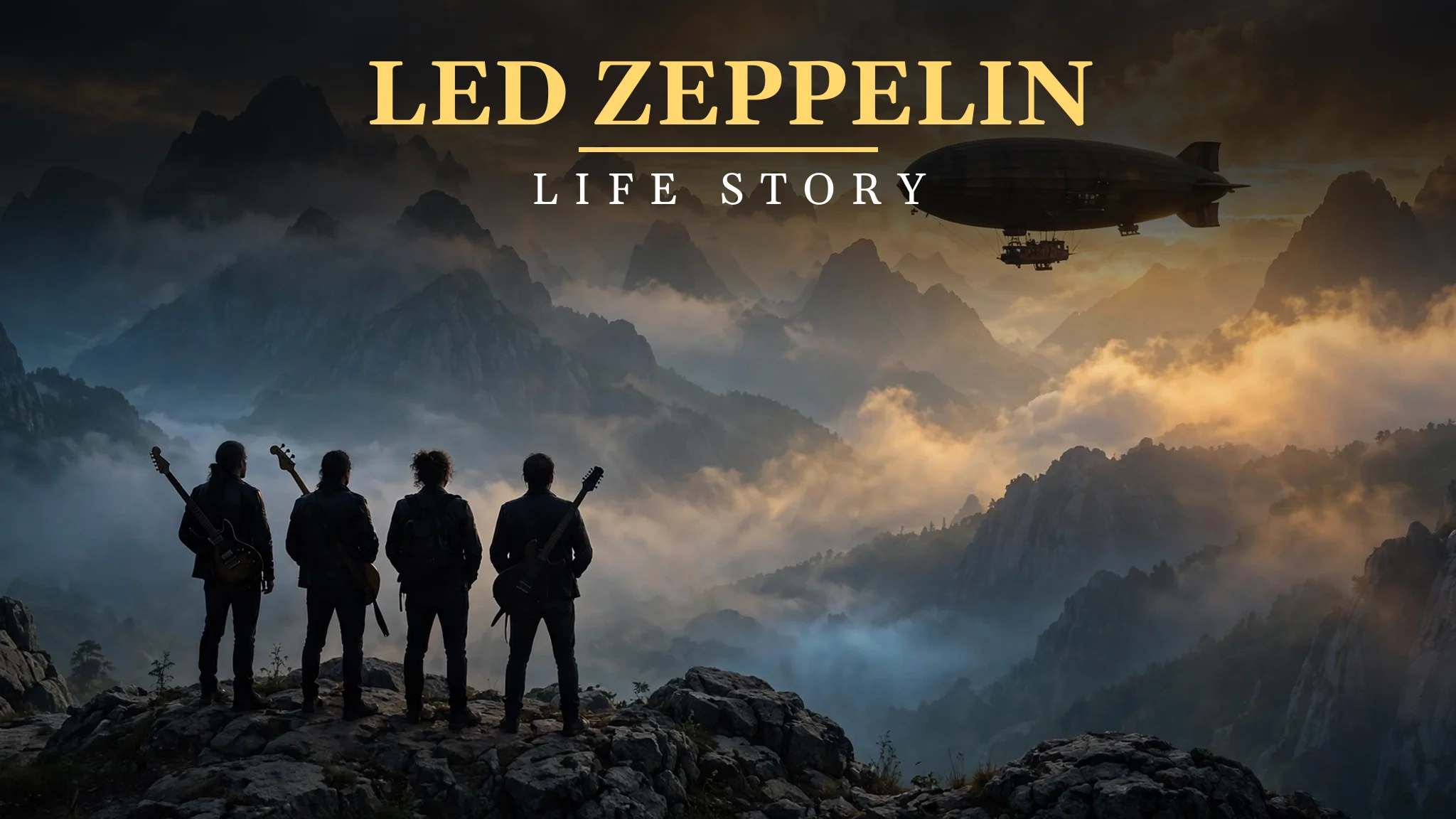
One more thought stays with me. When I think about Led Zeppelin, I think about the image of four men on a mountain, watching an airship drift over the peaks, and I think about how that image captures their music: big, mysterious, powerful, and a little bit magical. Their music is like that airship, floating above the world, beautiful and strange, and it is still there, still flying, still loved. I think that is a beautiful image, and it is one I will always remember.
I also think about the 2007 reunion concert, when Jason Bonham played drums in his father’s place, and the band played together one last time in London. It was a moving moment, because it showed that the music still had power, and that the fans still loved it, and that the son could honour his father by playing his drums. It was also a sad moment, because it showed that the original band could never be together again. I think that concert was the right way to say goodbye, with music, with love, and with respect.
I also think about their live shows, because they were legendary in a way that few bands have matched. They played for three hours or more, they played long solos, they played songs that stretched and changed every night, and they made their audiences feel that they were part of something special. A Led Zeppelin concert was not a neat pop show. It was a loud, long, wild night of music, and it left people exhausted and happy. I wish I could have seen them live, because I think it would have been one of the great experiences of my life.
I think about their albums as a whole, too. They made only eight studio albums, which is not many for a band of their size, but every one of them is worth listening to, from the first album to the last. They did not make filler records, they did not make lazy records, and they did not repeat themselves. Each album tried something new, each album had a different sound, and each album showed a band that was growing. That quality over quantity is something I admire, because it shows that they cared about the music more than about the money.
I also think about the way they handled fame. They were famous, they were rich, and they were worshipped by fans, but they did not give many interviews, they did not appear on television often, and they did not explain themselves. That privacy protected them, but it also made them mysterious, and that mystery became part of their legend. I think they were right to protect their privacy, because fame can be dangerous, and they had already seen how it could hurt people. They let the music do the talking, and the music talked loudly enough.
Finally, I want to say something about their fans. Led Zeppelin fans are among the most loyal in music, and they have kept the band’s music alive for more than forty years after the break-up. They buy the records, they go to tribute concerts, they teach their children the songs, and they argue about which album is best. That loyalty is a sign of how much the music means to people, and it is a legacy that no amount of money can buy. I am glad to be one of those fans, and I am glad that their music is still here.
One last thought stays with me, about the name Led Zeppelin itself. It was a joke about a lead balloon, a thing that would never fly, and yet it became the name of a band that flew higher than almost any other. That is a nice irony, and it is a reminder that you should not listen to people who tell you that your idea will never work. Jimmy Page had an idea, he believed in it, and he made it fly. I think that is a hopeful message for anyone with a dream.
Frequently Asked Questions
How did Led Zeppelin get their name and who formed the band?
Jimmy Page formed the band in 1968 after the Yardbirds broke up, bringing together Robert Plant, John Paul Jones, and John Bonham, and the name Led Zeppelin came from a joke about a lead balloon that would go down badly.
What is Stairway to Heaven and why is it so famous?
Stairway to Heaven is the long, beautiful song from their untitled fourth album in 1971, starting quietly with acoustic guitar and building to a powerful climax, and it became one of the most played and most loved rock songs ever recorded.
Who were the four members of Led Zeppelin?
The band was Jimmy Page on guitar, Robert Plant on vocals, John Paul Jones on bass and keyboards, and John Bonham on drums, four very different musicians who together made a thunderous and magical sound.
Why did Led Zeppelin break up in 1980?
They broke up after drummer John Bonham died on 25 September 1980 at thirty-two, and the surviving members decided they could not replace him, announcing in December 1980 that the band was over.
Did Led Zeppelin ever play together again after breaking up?
They reunited only a few times, most famously in 2007 for a tribute concert in London where Jason Bonham, John’s son, played drums, but they did not tour again as a band.
What was Led Zeppelin’s best-selling album?
Their untitled fourth album, known as Led Zeppelin IV, released in 1971 with Stairway to Heaven, Black Dog, and Rock and Roll, is one of the best-selling albums in history.
How many records did Led Zeppelin sell?
They sold more than two hundred million records around the world, with many number one albums in the UK and the United States, making them one of the best-selling bands of all time.


