Laibach: The Life Story Behind Slovenia's Industrial Band
In this post
- A Band Born in a Mining Town
- Neue Slowenische Kunst and the Art of Provocation
- Opus Dei, Let It Be, and World Fame
- Kapital, NATO, and the Years of Change
- North Korea, The Sound of Music, and Later Work
- A Band That Asks Questions
- Spectre, Zarathustra, and a Band That Keeps Thinking
- Laibach on Stage: Theatre, Uniforms, and Ritual
- Laibach and the Meaning of Their Name
- My Take:
Laibach is not a normal band. They do not smile for the camera, they do not write simple love songs, and they do not try to be liked. They wear uniforms, they use strong images, and they make loud industrial music that sounds like factories, marching, and machines. Some people find them frightening. Some people find them funny. Many people find them fascinating, because no other band looks or sounds quite like them. They have been making music for more than forty years, and they are still one of the most talked-about groups from Slovenia.
The band began in 1980 in Trbovlje, a mining town in what was then Yugoslavia. The members were young artists who wanted to make art that asked hard questions about power, about politics, and about the world around them. They used the images of totalitarian regimes, not because they supported those regimes, but because they wanted people to think about how power works. That choice made them famous, and it also made them controversial. Their concerts were banned, their name was banned, and the authorities did not know what to do with them.
What makes their story interesting is how long they have lasted. Many bands that shock people fade away fast. Laibach did not fade. They made albums, they toured the world, they played in North Korea, they made a version of The Sound of Music, and they kept changing their sound while keeping their ideas. This is the story of a band from a small mining town that became a world-famous art project, and how they turned controversy into a long career.
A Band Born in a Mining Town
Laibach was formed in 1980 in Trbovlje, a town in Slovenia that was then part of Yugoslavia. Trbovlje was a mining town, a place of coal, of industry, and of hard work. The young men who formed the band grew up in that world, and they saw the factories, the mines, and the strong hand of the state around them. Yugoslavia was a socialist country, ruled by a single party, and public life was controlled in many ways. The band members wanted to make art that spoke about that world, and they wanted to do it in a bold and direct way.
The name Laibach is the old German name for Ljubljana, the capital of Slovenia. The name was chosen on purpose, because it had a history linked to the German occupation of Slovenia during the Second World War. The authorities in Yugoslavia did not like the name, and they banned the band from using it. The band used it anyway, and that act of defiance became part of their identity. They were not a band that asked for permission. They were a band that made their own rules.
The early members of the group included Milan Fras, who became the singer, and other artists and musicians who shared their ideas. They were not only musicians. They were artists, designers, and thinkers, and they saw the band as a work of art, not only as a way to make pop songs. They made posters, they made stage designs, and they created a whole visual world around the music. That visual world was as important as the sound, and it made their concerts feel like a piece of theatre.
In those early years, the band played only a few concerts, and many of them were stopped by the authorities. Their music was loud, their images were strong, and the state did not trust them. But the band kept working, and they began to build a small following of young people who were interested in new art and new music. They were a band for people who wanted to think, not only to dance.
Neue Slowenische Kunst and the Art of Provocation
In 1984, Laibach helped to form a group called Neue Slowenische Kunst, which means New Slovenian Art in German. The group brought together musicians, painters, designers, and theatre artists, and they worked as a collective. They shared ideas, they made art together, and they presented themselves as a single movement. The group was a way for the band to work with other artists, and it gave their work a larger meaning. They were not only a band. They were part of a cultural project.
The art of Laibach was based on a simple idea. They took the images of power, of the state, of the military, and of totalitarian art, and they used them in their own work. They wore uniforms, they used strong symbols, and they made their concerts look like official ceremonies. Some people thought they supported those ideas. The band said they did not. They said they were showing how power works, by using its images in a new way. That idea was called over-identification, and it was meant to make people think, not to make them follow.
This approach made Laibach very controversial. In Yugoslavia, the authorities banned their concerts and their name. In other countries, some people refused to book them, and some critics accused them of being fascists. The band denied that, and they said their work was art, not politics. They did not join a political party, and they did not support any regime. They used the images of power to ask questions about power, and they left the answers to the audience.
The controversy also made them famous. People who had never heard their music had heard their name, and they wanted to see what the band was really like. The band used that attention to make more art, to make more music, and to tour in more countries. They turned a ban into a story, and that story helped them to build a career outside Yugoslavia. They were a band that the state tried to stop, and that made them interesting to the rest of the world.
Opus Dei, Let It Be, and World Fame
Laibach’s first albums were released in the 1980s, and they showed a band with a strong and unusual sound. Their music mixed industrial noise, electronic sounds, and classical music, and it was very different from pop music of the time. They made an album called Nova Akropola in 1985, and then Opus Dei in 1987. Opus Dei was a turning point for the band, because it brought them to a wider audience in Europe and in America. The album included a version of the song Life Is Life, by the Austrian band Opus, and it became one of their best-known songs.
In 1988, they released an album called Let It Be, which was a full version of the Beatles album of the same name. They did not copy the Beatles. They remade the songs in their own style, with heavy drums, with loud voices, and with a military feel. The album was a joke, a piece of art, and a serious work all at the same time. It showed that the band could take something familiar and turn it into something strange and new. People who loved the Beatles were surprised, and people who loved Laibach were delighted.
The band also made music for films, for theatre, and for other projects. They worked on a version of Macbeth, they made music for a film about the Yugoslav wars, and they kept changing their sound. They were not afraid to try new things, and they did not stay in one style. Their music could be loud and industrial, or it could be quiet and classical, and both sides were part of who they were.
By the end of the 1980s, Yugoslavia was falling apart, and Slovenia became an independent country in 1991. Laibach were now a band from a new country, and they were known around the world. They toured in Europe, in America, and in other places, and they built a loyal following. They were no longer a banned band from a small town. They were a world-famous art group, and they had made their name by being bold and different.
Kapital, NATO, and the Years of Change
In the 1990s, Laibach continued to make albums and to tour. They released Kapital in 1992, an album about money, about capitalism, and about the new world after the Cold War. The album was a comment on the changes in Europe, and it showed that the band was still thinking about politics and about power. They did not stop asking questions when Yugoslavia ended. They asked new questions about the new world that came after it.
They also released NATO in 1994, an album that took songs from different countries and remade them in their own style. The album was about war, about the military alliance, and about the way nations use music and images. It was a bold project, and it showed that the band was still willing to take risks. They did not make safe albums. They made albums that made people think, and that was their strength.
During the 1990s, the band’s line-up changed, and new members joined. Milan Fras remained the singer, and he became the face of the band. Other members came and went, but the idea of Laibach stayed the same. The band was a collective, a project, and a work of art, and it was larger than any one person. That idea helped them to last, because they did not depend on one star. They depended on the work itself.
The band also began to work more with film and with theatre. They made music for films, they performed in theatres, and they worked with artists in different countries. They were not only a rock band. They were an art group that worked in many forms, and that gave them many chances to create. They toured less in some years, and they worked on other projects, but they never stopped completely. They kept making music, and they kept their audience.
North Korea, The Sound of Music, and Later Work
In 2015, Laibach made history by becoming the first Western band to perform in North Korea. They played two concerts in Pyongyang, the capital of North Korea, and they performed songs from The Sound of Music, the famous musical film. The concerts were a major news story around the world, and they showed how far the band had come. A band that had once been banned in Yugoslavia was now playing in one of the most closed countries in the world.
The North Korea concerts led to a new album, The Sound of Music, released in 2018. The album included versions of songs from the musical, such as Do-Re-Mi and Edelweiss, remade in Laibach’s style. The album was both a joke and a serious work. It took a sweet and innocent musical and turned it into something strange and powerful. People who knew the band understood the humour, and people who did not know the band were surprised by the beauty of the songs.
The band also released Spectre in 2014, an album about politics and about the world today, and Also Sprach Zarathustra in 2017, an album based on the music of Richard Strauss and the ideas of Friedrich Nietzsche. Each album showed a band that was still thinking, still creating, and still willing to take risks. They did not repeat their old work. They made new work, and they kept their ideas fresh.
In recent years, Laibach have continued to tour and to make music. They have performed in many countries, they have worked on new projects, and they have kept their audience. They are now one of the longest-running bands from Slovenia, and they are respected as artists around the world. They are not a band for everyone, but for the people who love them, they are one of the most important groups in modern music.
A Band That Asks Questions
Laibach is a band that has lasted for more than forty years, and that is a rare thing. They have lasted because they are not only a band. They are an art project, a collective, and a group of artists who ask hard questions. They ask about power, about politics, about history, and about the way people follow leaders. They do not give simple answers. They make art that makes people think, and that is why they are still relevant today.
Their music is not easy to listen to, and it is not meant to be. It is loud, it is strange, and it is full of ideas. But it is also beautiful in its own way, and it has a power that simple pop music does not have. They have shown that music can be art, that a concert can be theatre, and that a band can be a way to talk about the world. That is a big achievement, and it is why they are respected by artists and by fans around the world.
They are also a band from Slovenia, a small country that many people do not know well. Laibach have put Slovenia on the map for many music fans, and they have shown that a small country can make big art. They are proud of their home, and they have kept their Slovenian identity even as they have toured the world. They are a band from Trbovlje, and they have never forgotten where they came from.
Today, Laibach are still working, still touring, and still making art. They are not a band that lives in the past. They are a band that looks to the future, and they keep asking questions about the world we live in. For anyone who wants to understand how art and music can challenge power, Laibach is a band worth listening to, and a story worth knowing.
Spectre, Zarathustra, and a Band That Keeps Thinking
In 2014, Laibach released Spectre, an album that took its name from the idea of a ghost, a spirit that haunts the world. The album was about politics, about power, and about the way the world is changing, and it showed that the band was still asking hard questions. The songs were strong, they were electronic, and they were full of the band’s trademark sound. Spectre was not a nostalgic album. It was a modern album, made by a band that was still looking forward, and it was praised by fans and by critics who had followed Laibach for many years.
Three years later, they released Also Sprach Zarathustra, an album based on the music of Richard Strauss and the ideas of the philosopher Friedrich Nietzsche. The album was a bold project, because it took a famous piece of classical music and remade it in Laibach’s style. It was also a serious work, because Nietzsche’s ideas about power, about morality, and about the future are complex and difficult. Laibach did not simplify those ideas. They made music that tried to capture them, and they invited listeners to think about them. It was a challenging album, and it showed that the band was still willing to take risks.
These later albums show a band that has not stopped growing. They could have repeated their old sound, and they could have lived on their reputation, but they did not. They kept making new music, they kept working with new ideas, and they kept changing their sound. That is a rare thing for a band that has been together for more than forty years. Many bands become a tribute to themselves. Laibach did not. They stayed a living project, and that is why they are still relevant today.
The band has also worked on music for theatre and for film in these later years, and they have performed in many countries. They are not a band that only plays for old fans. They are a band that still finds new listeners, people who are interested in art, in politics, and in music that challenges them. That ability to find new listeners, even after four decades, is a sign of a band that has something real to say, and that says it well.
Laibach on Stage: Theatre, Uniforms, and Ritual
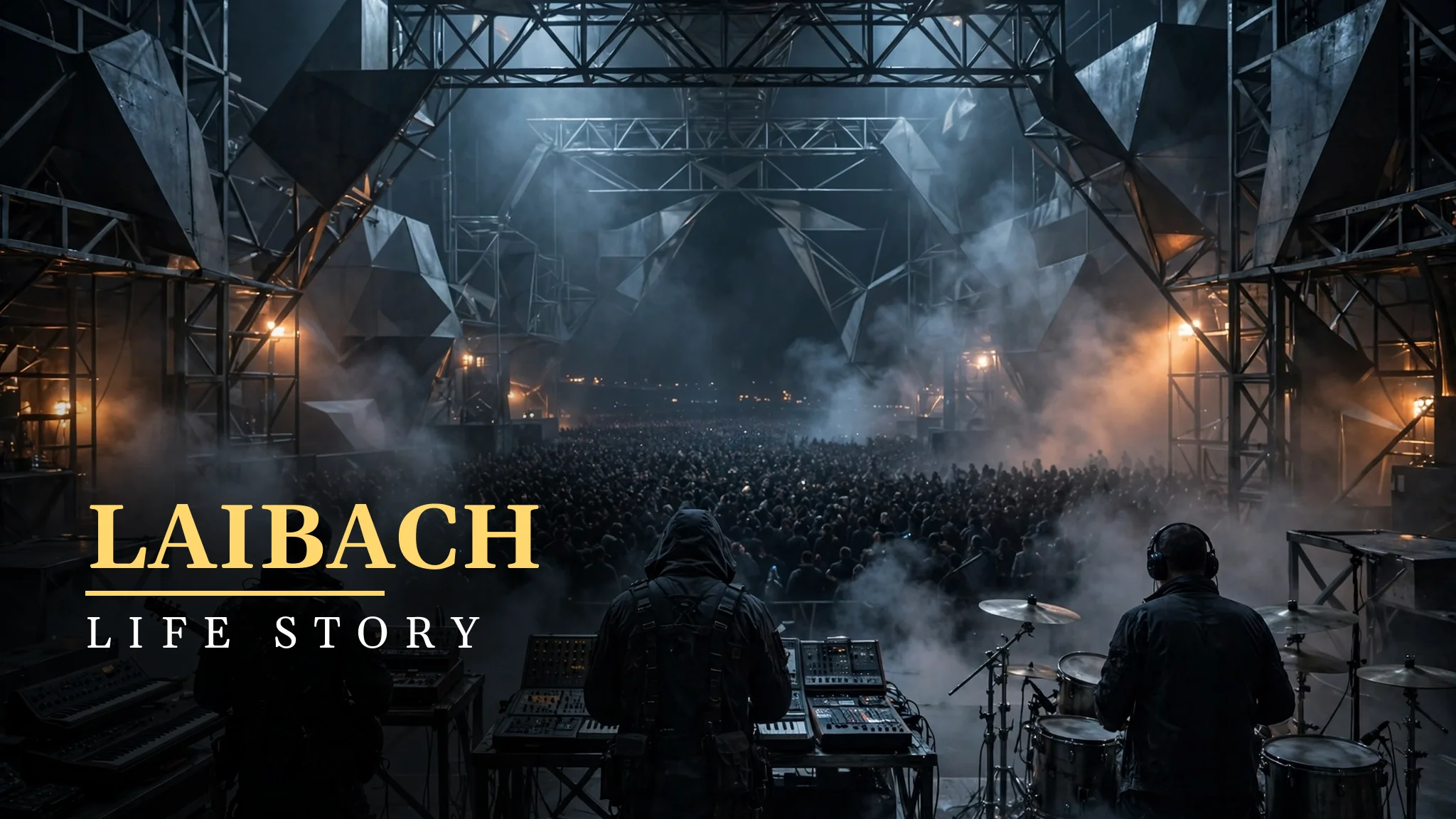
A Laibach concert is not like a normal rock concert. It is more like a piece of theatre, or a ritual, or a ceremony. The band members wear uniforms, they stand in formation, and they perform with a discipline that feels military. The stage is often dark, the lights are strong, and the music is loud. The audience does not only listen. They watch, they think, and they feel the power of the performance. It is an experience that stays with people long after the concert has ended.
The visual side of Laibach has always been as important as the music. They design their own posters, their own stage sets, and their own costumes, and they create a whole world around the band. That world is based on the images of power, of the state, and of history, and it is meant to make people think. The band does not explain everything. They let the images speak, and they let the audience decide what they mean. That is a brave way to perform, because it trusts the audience to think for themselves.
Over the years, their stage shows have changed, but the core idea has stayed the same. They use uniforms, they use strong symbols, and they use discipline to create a feeling of power. Some people find that feeling frightening, and some find it exciting, but no one finds it boring. A Laibach concert is an event, and it is different from any other concert. It is art, it is music, and it is theatre, all at the same time, and that is why people travel far to see them.
Today, the band continues to perform, and their concerts are still powerful. They play in large halls and in small clubs, and they bring the same intensity to each show. They are older now, but they have not lost their energy. They are still a band that believes in the power of performance, and they still use that power to ask questions about the world. For anyone who has seen them live, the experience is unforgettable, and it is a big part of why Laibach has lasted so long.
Laibach and the Meaning of Their Name
The name Laibach is itself a piece of art, and it is worth understanding. Laibach is the old German name for Ljubljana, the capital of Slovenia, and it was the name used during the German occupation of Slovenia in the Second World War. The band chose that name on purpose, because it carried a difficult history, and because it made people think about that history. The Yugoslav authorities banned the name, and they tried to stop the band from using it, but the band kept it, and that act of keeping a banned name became a central part of their identity.
The name is a good example of how Laibach work. They take something from history, something that is uncomfortable, and they use it in their art to make people think. They do not hide the past. They bring it into the present, and they ask the audience to face it. That is a brave way to make art, because it means that the band will always be controversial, and that some people will misunderstand them. But it is also an honest way to make art, because it does not pretend that history did not happen.
Today, the name Laibach is known around the world, and it is associated with a band that is bold, artistic, and unafraid. The ban did not work. The name survived, the band survived, and the ideas behind the name are still being discussed. That is a victory for art, and it is a reminder that a name, like a song, can be a form of resistance. Laibach chose their name, they kept it, and they made it famous, and that is a story in itself.
My Take:
I think Laibach is one of the most interesting bands I have ever learned about. They are not a band that tries to make you happy. They are a band that tries to make you think, and that is a very different job. When I first heard about them, I did not understand what they were doing. They wore uniforms, they used strong images, and their music sounded like machines. It felt strange and even a little frightening. But when I learned more about them, I began to see that the strangeness was the point. They were not supporting power. They were showing how power looks, and they were asking us to think about it.
I admire them because they were brave. In Yugoslavia in the 1980s, it was not safe to be bold. The state controlled public life, and a band that used the wrong name or the wrong images could be banned. Laibach were banned, and they kept going. They did not apologise, they did not change their name to something safe, and they did not stop making art. That takes courage, and I respect it. Many bands would have given up after the first ban. Laibach turned the ban into part of their story, and they kept working.
I think their idea of over-identification is clever, even if it is hard to understand at first. They took the images of power and used them so strongly that people had to ask what was real and what was art. That is a smart way to make people think. If you only tell people that power is dangerous, they may not listen. If you show them power in a new way, they have to think for themselves. I think that is a good lesson for any artist. You do not have to tell people what to think. You can show them something, and let them decide.
What I find most impressive is how long they have lasted. Many bands that shock people fade away after a few years, because shock alone is not enough. Laibach did not fade, because they had more than shock. They had ideas, they had music, and they had a vision. They made albums about money, about war, about NATO, and about the world after the Cold War, and each album had something to say. They did not repeat themselves. They kept asking new questions, and that is why they are still here after more than forty years.
I think their North Korea concerts are a perfect example of who they are. They were the first Western band to play in North Korea, and they played songs from The Sound of Music. That is a strange choice, and it is also a brilliant choice. The Sound of Music is a sweet musical about a family that escapes from the Nazis, and Laibach turned it into a strange and powerful performance in a country that is closed to the world. It was art, it was humour, and it was a serious comment on power, all at the same time. I think only Laibach could have done that.
I also think about their home town, Trbovlje, and how a band from a small mining town became world famous. That is a hopeful story. It shows that you do not have to be from London or New York to make important art. You can be from a small town, you can see the world around you, and you can make art that speaks to people everywhere. Laibach saw the mines, the factories, and the state, and they turned what they saw into music. That is a lesson for anyone who feels that their home is too small or too ordinary to matter.
There is something I find sad in their story, and it is the way they were misunderstood. Many people thought they were fascists, or that they supported totalitarian regimes, when in fact they were doing the opposite. They were artists who were trying to warn people about power, and they were accused of supporting it. That must have been painful, and it must have been frustrating. I think it is a warning about how art can be misunderstood, especially when it is bold and strange. An artist who takes risks will always be misunderstood by some people, and that is a price they have to pay.
I think about what young artists can learn from Laibach. The first lesson is to be bold. Do not be afraid to make art that is strange or difficult. The second lesson is to think deeply. Do not only make music that sounds good. Make music that says something. The third lesson is to work as a collective. Laibach were not only one singer. They were a group of artists who worked together, and that gave their work more power. The fourth lesson is to last. Do not give up after the first ban, the first bad review, or the first misunderstanding. Keep working, and keep asking questions.
I also admire the way they have changed their sound over the years. They started with industrial noise, they made classical music, they made pop songs in their own style, and they made music for films and theatre. They did not stay in one box. They tried many things, and each one taught them something new. I think that is a good way to be an artist. You should not be afraid to change, and you should not be afraid to fail. Laibach were not afraid, and that is why their work is still fresh.
When I listen to their version of Life Is Life, I hear both humour and seriousness. The original song is a simple pop song, and Laibach turned it into a loud and powerful anthem. It is funny, because it is so different from the original, and it is also serious, because it shows how a simple song can become a piece of propaganda. I think that is a clever piece of art, and it shows how Laibach think about music. They do not just play songs. They think about what songs mean, and how they are used.
I think about their album Let It Be, and how they remade the Beatles. That is a brave thing to do, because the Beatles are loved by millions of people. To remake their album in a heavy and military style is to ask a question about what the Beatles mean. Are they a symbol of peace, or are they a symbol of something else? Laibach did not answer that question. They let the listener decide, and that is a good way to make art. You do not have to give the answer. You only have to ask the question well.
If I have a criticism, it is that their work is not easy to understand, and that can be a barrier. Some people will hear their music and feel confused or even angry, and they will not stay to learn more. I think that is a pity, because their work is worth understanding. But I also think that difficulty is part of who they are. They do not want to be easy. They want to be challenging, and that is their choice. I respect that choice, even if it means that fewer people will love them.
In the end, I think Laibach teaches us that art can be a way to talk about power, about history, and about the world, and that a band can be more than a band. They started in a mining town, they were banned, they were misunderstood, and they kept going. They played in North Korea, they made an album of The Sound of Music, and they are still making art today. That is a remarkable story, and it shows that a group of artists who believe in their ideas can last for decades, even when the world does not understand them at first.
I also think about the way they use humour, even when their work looks serious. Their version of The Sound of Music is funny, because it takes a sweet musical and turns it into something dark and strange. Their version of Let It Be is funny, because it takes the Beatles and turns them into a military march. That humour is important, because it shows that Laibach are not humourless. They are artists who know how to laugh, even when they are talking about serious things. I think that humour makes their work more human, and more interesting.
I think about their home country, Slovenia, and how a small country can make such big art. Slovenia is a small place, but it has a strong culture, and Laibach are a big part of that culture. They have put Slovenia on the map for music fans around the world, and they have shown that you do not have to be from a big country to make important work. I think that is a hopeful message for artists in small places everywhere. Your home may be small, but your ideas can be large, and they can travel far.
I also think about the risk they took with the name Laibach. The name was banned, and they used it anyway. That is a small act of defiance, but it is also a big one, because a name is an identity. To keep a banned name is to say that you will not let the state decide who you are. I admire that. It shows that art can be a form of resistance, not with violence, but with persistence. They kept their name, they kept their ideas, and they kept working, and in the end, the ban did not stop them.
When I listen to their music, I sometimes feel uncomfortable, and I think that discomfort is the point. Art should not always make us comfortable. Sometimes it should make us think, and thinking can be uncomfortable. Laibach make me think about power, about history, and about how easily people follow leaders. That is not a comfortable thought, but it is an important one. I am grateful to a band that is willing to make me uncomfortable, because it helps me to see the world more clearly.
I think about young artists who want to be like Laibach, and what they should learn. The first lesson is to have ideas. Do not only make music that sounds good. Make music that says something. The second lesson is to work as a group. Laibach were a collective, and they shared ideas, and that made their work stronger. The third lesson is to be patient. A career that lasts forty years is not built in one year. It is built over decades, with hard work and with persistence. The fourth lesson is to be brave. Take risks, use bold images, and do not be afraid to be misunderstood.
I also think about the way they have been misunderstood, and how painful that must be. To be called a fascist when you are trying to warn people about fascism is a cruel irony, and it must have hurt. But they did not stop, and they did not change their art to please their critics. They kept explaining their ideas, and they kept making their work, and over time, more people understood them. I think that is a lesson in persistence. If you believe in your ideas, keep working, and the world will catch up, even if it takes a long time.
Another thing I notice is how they have used classical music in their work. They have taken Strauss, they have taken the Beatles, and they have taken songs from The Sound of Music, and they have remade them in their own style. That is a clever way to make art, because it takes something familiar and makes it strange. It makes the listener hear a familiar song in a new way, and that new hearing can change how they think about the original. I think that is a smart and creative approach, and it shows how well Laibach understand music and history.
Finally, I think about the future of Laibach, and whether they will keep going. They are older now, but they are still making music, still touring, and still asking questions. I hope they keep going for many more years, because the world still needs artists who ask hard questions. We need bands that do not only entertain us, but that make us think. Laibach do that, and they have done it for more than forty years. That is a remarkable achievement, and it is one that deserves to be celebrated.
I also think about the name Laibach, and how a single word can carry so much history. The band chose a name that was banned, and they kept it, and that choice says a lot about who they are. They are artists who do not run from difficult history. They face it, they use it, and they ask us to think about it. That is a brave thing to do, and it is a thing that few bands would dare to do. I respect them for it, even when their work makes me uncomfortable, because that discomfort is a sign that the art is working.
Finally, I think about the simple fact that Laibach are still here, still making music, and still asking questions after more than forty years. That is a long time for any band, and it is an even longer time for a band that was banned, misunderstood, and controversial. They survived because they believed in their ideas, because they worked as a collective, and because they never stopped creating. That persistence is inspiring, and it is a lesson for any artist who feels that the world does not understand them. Keep working, keep believing, and keep asking questions. The world may catch up, and even if it does not, the work itself is worth doing.
Frequently Asked Questions
Where and when was Laibach formed?
Laibach was formed in 1980 in Trbovlje, a mining town in Slovenia, which was then part of Yugoslavia. The band grew out of the industrial life of the town and the political world around them.
Why were Laibach banned in Yugoslavia?
Their name, the German name for Ljubljana, and their use of strong images of power were not liked by the authorities. The band were banned from using their name and from playing concerts, but they continued to work and to build a following.
What is Neue Slowenische Kunst?
Neue Slowenische Kunst, meaning New Slovenian Art, is a collective formed in 1984 that brought Laibach together with painters, designers, and theatre artists. The group worked as a single cultural movement, sharing ideas and making art together.
What are Laibach’s best-known albums?
Their best-known albums include Opus Dei from 1987, Let It Be from 1988, Kapital from 1992, and The Sound of Music from 2018. Opus Dei brought them wider fame in Europe and America.
Did Laibach really play in North Korea?
Yes, in 2015 Laibach became the first Western band to perform in North Korea, playing two concerts in Pyongyang. They performed songs from The Sound of Music, and the concerts were reported around the world.
Are Laibach still making music today?
Yes, Laibach are still active after more than forty years. They continue to tour, to release albums, and to work on art, film, and theatre projects, and they remain one of Slovenia’s best-known musical groups.


