Leo Tolstoy: The Life Story Behind the War and Peace Author
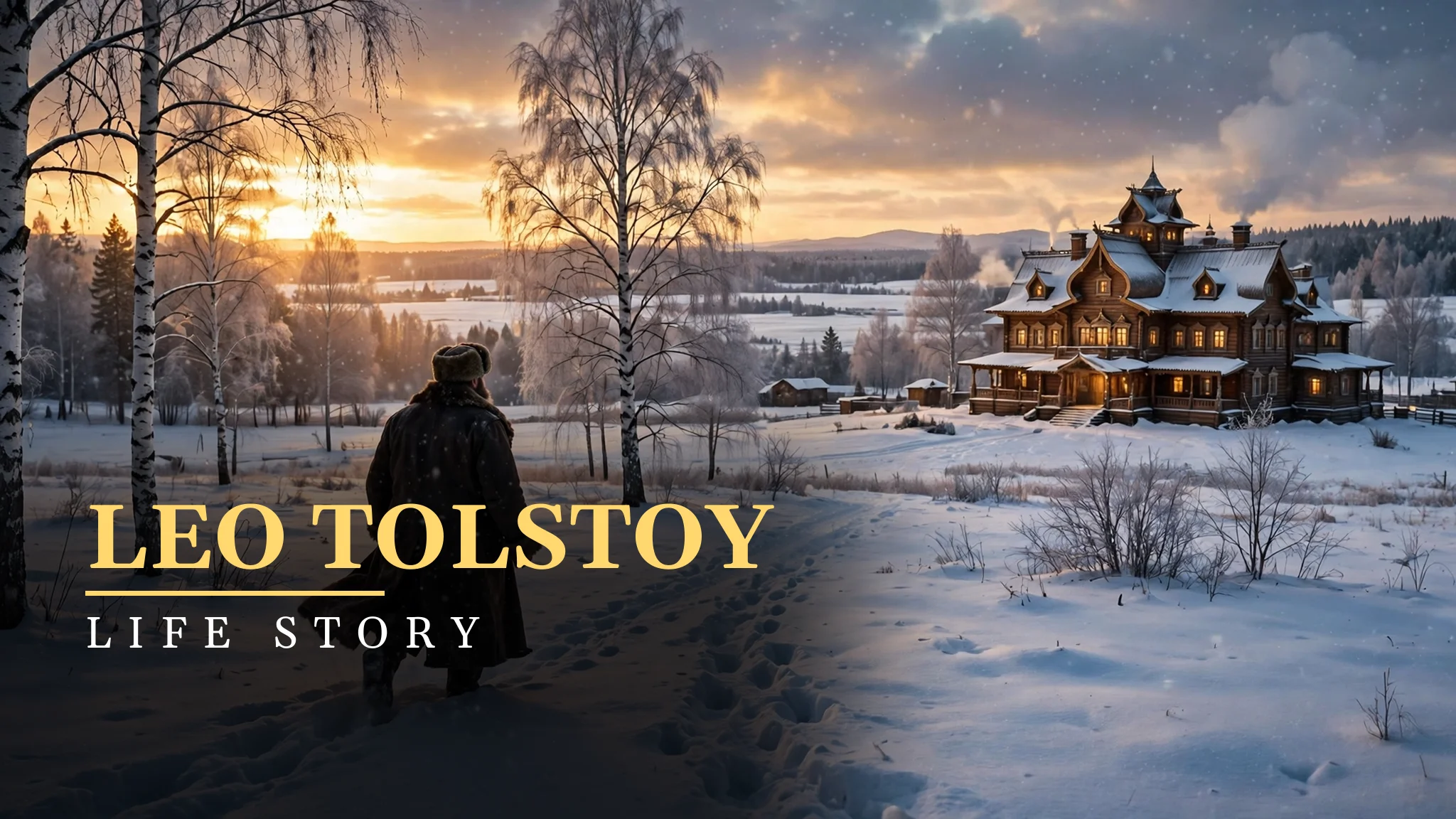
In this post
- Yasnaya Polyana, an Orphan, and a Young Count
- The Crimea, Sevastopol, and a Writer Made by War
- War and Peace: A Novel That Contains a World
- Anna Karenina and the Woman on the Train
- The Crisis, the Faith, and the Last Thirty Years
- The Flight, Astapovo, and a Death That Shocked the World
- The Grave in the Woods and the Books That Remain
- My Take:
Leo Tolstoy wrote the longest and most famous novels in the world, and then he decided that novels were not enough. He was a count, a landowner, a soldier, and a father of thirteen children, and he wrote War and Peace, a book about Russia’s war with Napoleon, and Anna Karenina, a book about a woman who left her husband for love. These two books are often called the greatest novels ever written, and they are read in schools and universities all over the world. Yet in the middle of his life, Tolstoy had a crisis of faith, and he turned away from the life of a rich novelist to become a preacher of a simple, hard, Christian life, a life without wealth, without violence, and without the church itself.
He is a man of great contradictions. He was born into wealth, and he gave his wealth away in his mind, if not always in fact. He wrote about love, and his marriage was often unhappy. He preached peace, and he had been a soldier who fought in wars. He believed in the simple life of a peasant, and he lived in a great house with servants. These contradictions do not make him a hypocrite. They make him human, and they make his books richer, because he wrote about the struggle between what a person believes and what a person does, and he knew that struggle from the inside.
This is the story of a boy who lost his parents young, who became a soldier, who wrote two of the greatest novels in history, and who spent the last thirty years of his life trying to live by a faith that his own family and the church could not accept. It is a story about Russia, about war, about love, and about a man who never stopped asking what life meant.
Yasnaya Polyana, an Orphan, and a Young Count
Lev Nikolayevich Tolstoy, known in English as Leo Tolstoy, was born on 9 September 1828 at Yasnaya Polyana, his family’s estate in Russia, south of Moscow. He was the fourth of five children born to Count Nikolai Tolstoy and Princess Maria Volkonskaya. His mother died when he was two years old, and his father died when he was nine, so Leo grew up as an orphan, raised by relatives and by servants on the great estate. Yasnaya Polyana was a large place, with woods, fields, and a big house, and Leo loved it deeply. It was his home for most of his life, and it is the place where he wrote his great books, and where he is buried today.
As a boy, Leo was not a brilliant student, and he was not a happy child. He was shy, he had a large nose and ears that he was ashamed of, and he felt awkward among other children. He was raised by his aunt, and he was taught at home by tutors, learning French, German, and English, as well as Russian. He read a great deal, and he was drawn to books about history, about religion, and about the lives of great men. He also loved the peasants who worked on the estate, and he watched them with interest. He saw how they lived, how they worked, and how they suffered, and those observations stayed with him for the rest of his life.
In 1844, he went to Kazan University to study law and Eastern languages, but he did not finish his degree. He found the teaching dull, and he left the university after three years, without a qualification. He returned to Yasnaya Polyana, where he tried to manage the estate and to improve the lives of the peasants who worked on it. He was young, he was idealistic, and he wanted to be a good landowner, but he did not know how. He spent money, he gambled, and he lived the life of a rich young man in Moscow and St. Petersburg, going to balls, drinking, and wasting time. It was a life without a clear purpose, and Leo felt its emptiness keenly.
In 1851, he joined the army, following his elder brother Nikolai, and he was sent to the Caucasus, in the south of Russia, where Russian soldiers were fighting local tribes. The army gave him discipline, and it gave him something to write about. He began to write stories about his life as a soldier, and his first published work, Childhood, appeared in 1852, when he was twenty-four. It was a success, and it showed that he had a gift for writing about memory, about family, and about the inner life of a child. He went on to write Boyhood and Youth, and he began to be known as a promising young writer. The army had given him a subject, and writing had given him a purpose.
The Crimea, Sevastopol, and a Writer Made by War
In 1854, Tolstoy was sent to the Crimea, where Russia was fighting Britain, France, and Turkey in the Crimean War. He served at Sevastopol, a port city under siege, and he saw war at close hand: the noise of the guns, the wounded men in the hospitals, the fear and the courage of ordinary soldiers. He wrote about what he saw in Sevastopol Sketches, a series of stories published in 1855 and 1856, which made his name known across Russia. The sketches were honest about war. They did not praise it as glorious. They showed it as dirty, frightening, and sad, and they showed the bravery of the common soldier, not the generals. That honesty was new, and readers recognised it as true.
The war changed Tolstoy. He had gone into the army as a young man looking for adventure, and he came out of it as a writer who had seen death and who wanted to understand what it meant. He left the army in 1856, and he travelled in Europe, visiting Paris, Berlin, and London, and meeting writers and thinkers. He was not happy with what he saw. He found the great cities full of wealth and poverty side by side, and he felt that Europe had lost its way. He returned to Russia, to Yasnaya Polyana, and he began to think about how to live, and how to write, in a way that was true to what he had learned in the war.
He also began to think about education. He opened a school for peasant children on his estate, and he tried to teach them in a free and natural way, without the strict discipline of the schools of his time. He believed that children learned best when they were interested, and when they were not forced, and he wrote about his ideas on education in articles that were read widely. The school was a success for a time, but it was hard to keep going, and it closed after a few years. Still, it showed a side of Tolstoy that would become central to his later life: a belief that the simple people, the peasants, knew more about how to live than the rich and the educated, and that a writer should learn from them, not teach them.
In 1862, Tolstoy married Sophia Behrs, known as Sonya, the daughter of a Moscow doctor. She was eighteen, he was thirty-four, and the marriage would last for forty-eight years, until his death. Sonya became his wife, his secretary, his copyist, and the mother of his thirteen children, of whom eight lived to adulthood. She copied his manuscripts by hand, again and again, including War and Peace, which she copied seven times. It was a huge task, and it shows how central she was to his work. Without her, the great novels might never have been finished in the form we know them today.
War and Peace: A Novel That Contains a World
In the 1860s, Tolstoy began to write the book that would make him famous all over the world: War and Peace. It was published in parts between 1865 and 1869, and it is a huge novel, with more than five hundred characters, set during Russia’s war with Napoleon, from 1805 to 1812. The book follows several families, the Rostovs, the Bolkonskys, and the Bezukhovs, through war, love, marriage, and death, and it mixes their stories with long passages about history, about war, and about the nature of power. It is not a simple novel. It is a world in itself, and readers who enter it feel that they have lived in Russia for seven years.
The heart of the book is Pierre Bezukhov, a clumsy, kind, searching man who inherits a fortune and who tries to find meaning in his life, through war, through marriage, and through a search for truth. Pierre is Tolstoy himself in many ways: a man who has everything and who is still unhappy, a man who looks for answers in books, in religion, and in the lives of ordinary people. Beside him are Natasha Rostova, a lively young woman who grows into a wife and a mother, and Prince Andrei Bolkonsky, a proud soldier who learns, through wounding and through love, that life is more than glory. These characters are not heroes in the usual sense. They are people, with faults and doubts, and they grow and change in ways that feel real.
Tolstoy’s view of history in War and Peace is radical. He argued that great men, like Napoleon, did not make history. History was made by the small actions of millions of ordinary people, by soldiers, by peasants, by the weather, by chance. That idea was new, and it shocked many readers, but it is central to the book. The battles in War and Peace are not described as the plans of generals. They are described as confusion, noise, and fear, and the outcome depends on things no general can control. That honesty about war, learned at Sevastopol, is what makes the book great, and it is why it is still read today, more than 150 years after it was written.
The book was a success, and it made Tolstoy famous, but it also exhausted him. He had spent six years writing it, and he had poured his whole life into it. When it was finished, he was tired, and he was ready for a new subject. He found it in a story he had heard about a woman who left her husband for a lover, and who paid a terrible price for it. That story became Anna Karenina, his second great novel, and it would take him another seven years to write.
Anna Karenina and the Woman on the Train
Anna Karenina, published in parts between 1875 and 1877, is a novel about love, marriage, and society in Russia. It tells the story of Anna, a beautiful married woman who falls in love with Count Vronsky, a young officer, and who leaves her husband and her son for him. Society turns against her, her lover grows cold, and in the end, in despair, she throws herself under a train. It is a tragic story, and it is told with a compassion that makes Anna a sympathetic figure, even when her choices are wrong. Tolstoy does not judge her harshly. He shows her as a woman who wanted love, and who found that love, in her world, had a price that was too high to pay.
Beside Anna’s story is the story of Levin, a landowner who, like Tolstoy, searches for meaning in work, in the land, and in faith. Levin’s story is the other half of the novel, and it is the half that is closest to Tolstoy’s own life. Levin marries Kitty, he works on his estate, he struggles with doubt, and in the end he finds a kind of peace in a simple faith, in the goodness of ordinary life. The two stories, Anna’s and Levin’s, are opposites: one ends in death, the other in a quiet hope. Together, they make a novel that is about the whole of life, about love and work, about sin and forgiveness, and about the search for meaning.
Anna Karenina is often called the greatest novel ever written, and it is easy to see why. The opening line, Happy families are all alike; every unhappy family is unhappy in its own way, is one of the most famous lines in literature. The book is long, but it is never dull, because Tolstoy writes about people with such care that the reader feels they know them. He writes about a train journey, a ball, a harvest, a birth, and a death, and each scene feels real, because he had lived it, or seen it, or thought about it deeply. The book made Tolstoy’s name even greater, and it confirmed him as the greatest living writer in Russia, and perhaps in the world.
But the success of Anna Karenina did not make Tolstoy happy. As he finished the book, he fell into a crisis. He had wealth, fame, a family, and a great estate, and yet he felt that his life had no meaning. He thought about death, he thought about suicide, and he began to ask the questions that would shape the rest of his life: Why do we live? What is the meaning of life? What should a person do? Those questions led him away from novels, and towards a new kind of writing, and a new kind of life.
The Crisis, the Faith, and the Last Thirty Years
In the late 1870s, Tolstoy went through a spiritual crisis that changed everything. He wrote about it in A Confession, published in 1882, in which he described his despair, his search for meaning, and his discovery of a simple Christian faith, based on the Sermon on the Mount, on love, on non-violence, and on a life without wealth or power. He rejected the Orthodox Church, which he believed had become rich and corrupt, and he preached a faith that was personal, simple, and hard. He believed that a person should not resist evil with violence, that a person should give up wealth, and that a person should live like a peasant, working with their hands.
He tried to live by that faith. He gave up hunting, he stopped drinking and smoking, he wore peasant clothes, he worked in the fields, and he made his own shoes. He also gave up his copyrights, or tried to, so that his books could be read by anyone for free. His wife Sonya opposed this, because the family needed the money from his books, and the argument over money and copyright became a source of bitterness in their marriage. Sonya felt that Tolstoy was giving away the family’s livelihood for an idea, and Tolstoy felt that Sonya did not understand his faith. The marriage, which had once been happy, grew strained, and the last years of their life together were unhappy.
In these years, Tolstoy wrote new kinds of books: The Death of Ivan Ilyich, published in 1886, a short novel about a man who realises, as he dies, that his life has been empty; The Kreutzer Sonata, published in 1889, a dark story about jealousy and marriage; and Resurrection, published in 1899, his last long novel, about a man who tries to make amends for a wrong he did as a young man. These books are shorter and harder than War and Peace and Anna Karenina, but they are full of moral force, and they show a writer who was no longer interested in telling a good story for its own sake. He wanted to change his readers, to make them think about their lives, and to make them live better.
His ideas influenced people all over the world, including Mahatma Gandhi, who wrote to Tolstoy and who called him a teacher. Tolstoy’s belief in non-violence, in simple living, and in resistance to evil without violence, became a part of Gandhi’s own philosophy, and through Gandhi, it influenced the struggle for India’s independence. That is a remarkable legacy for a Russian count who lived on an estate in the countryside, and it shows how far his ideas travelled, even when his own family and his own church rejected them.
The Flight, Astapovo, and a Death That Shocked the World
In his last years, Tolstoy’s life at Yasnaya Polyana became unbearable. He quarrelled with Sonya over money, over his followers, who came to the estate to live by his ideas, and over his will, in which he wanted to give his books to the public. He felt trapped in a house that was too rich, in a life that was too comfortable, and in a marriage that had become a source of pain. In the night of 28 October 1910, at the age of eighty-two, he left Yasnaya Polyana in secret, with his daughter Alexandra and his doctor, taking a train to the south. He was ill, he was old, and he did not know where he was going. He only knew that he had to leave.
He fell ill on the train, with pneumonia, and he was taken off at a small station called Astapovo, where he was put in the stationmaster’s house. News of his flight spread around the world, and reporters came to Astapovo, waiting for news. Sonya arrived, but Tolstoy, in his illness, did not want to see her, and she was kept from his room. He died on 20 November 1910, at the age of eighty-two, in a small house at a railway station, far from the great estate where he had been born. It was a sad and lonely death, and it shocked the world, because it seemed a fitting end to a life that had been full of contradiction: a rich man who died poor, a famous writer who died in a stationmaster’s house, a husband who died apart from his wife.
He was buried at Yasnaya Polyana, in a quiet place in the woods, without a church service, as he had wished, in a simple grave with no stone. His grave is still there today, a green mound in the forest, visited by readers from all over the world. It is a fitting place for a man who loved the land, who believed in a simple life, and who wrote two of the greatest novels ever written. His books are still read, his ideas are still discussed, and his life is still a puzzle: a count who wanted to be a peasant, a novelist who wanted to be a prophet, and a man who never stopped asking what life meant, even when the answer hurt him.
The Grave in the Woods and the Books That Remain
Tolstoy’s grave at Yasnaya Polyana is a simple green mound in the woods, with no stone and no cross, and it is visited by readers from all over the world. People come to stand by it in silence, because they feel that the man who wrote War and Peace and Anna Karenina is still there, in the land he loved. The estate itself is now a museum, and visitors can see the house where he wrote, the study where he worked, and the school where he taught peasant children. It is a quiet place, and it feels far from the noise of the world, which is fitting for a man who spent his life searching for a quiet truth.
His books remain, and they are read in schools, in universities, and in homes all over the world. War and Peace is still the great novel about war and about history, and Anna Karenina is still the great novel about love and about society. Readers who open them for the first time find a world that feels real, because Tolstoy wrote about people with a care that few writers have matched. He wrote about a ball, a battle, a harvest, and a death, and each scene feels true, because he had lived it, or seen it, or thought about it for a long time. That is why his books last, and why they will go on lasting, long after the arguments about his faith have faded.
My Take:
I find Leo Tolstoy both inspiring and troubling, and I think that is the right way to feel about him, because he was a man of great contradictions. The inspiring part comes first, because his books are among the greatest ever written. War and Peace contains a whole world, with hundreds of characters, battles, balls, births, and deaths, and it feels real in a way that few books do. Anna Karenina contains a story of love and loss that has moved readers for more than a hundred years. I have read both books, and I have felt that I lived inside them, that I knew Pierre, Natasha, Anna, and Levin as if they were people I had met. That is a rare gift, and it is why Tolstoy is still read today, in every country, by people who have never seen Russia.
What I admire most is his honesty about war. He had seen war at Sevastopol, and he knew that it was not glorious. It was dirty, frightening, and sad, and the men who fought it were ordinary soldiers, not heroes in a painting. He wrote about war that way, and he made his readers see it truly. That honesty takes courage, because in his time, most writers praised war and praised generals. Tolstoy did the opposite. He said that generals did not make history, that ordinary people did, and that battles were confusion, not plans. That idea was radical, and it is still radical today, because it tells us that the small actions of ordinary people matter more than the speeches of great men. I believe that, and I am grateful to Tolstoy for saying it so clearly.
I also admire his search for meaning. He had wealth, fame, a family, and a great estate, and yet he felt that his life had no meaning, and he asked why. That is a brave question to ask, because it is easier to live comfortably and not to ask it. He asked it, and he spent thirty years trying to answer it, through faith, through simple living, and through writing. He did not find a simple answer, and his life became harder because of the search, but the search itself matters. A person who asks what life means, and who tries to live by the answer, is a person who takes life seriously, and I respect that, even when I do not agree with the answer he found.
His marriage to Sonya is a part of his story that moves me and saddens me at the same time. She copied War and Peace seven times by hand, she raised thirteen children, she ran the estate, and she kept his work alive. Without her, the great novels might never have been finished. Yet in his later years, he turned away from her, he quarrelled with her over money and over his faith, and he left her in the night, dying at a railway station without her beside him. That is a painful end to a long marriage, and it shows that even a great man can be unkind to the person closest to him. I do not judge him harshly for it, because marriage is hard, and faith can divide even loving people, but I do feel sadness for Sonya, who gave so much and who was left alone at the end.
I think about his faith a great deal, because it is both beautiful and hard. He believed in love, in non-violence, in a simple life, and in giving up wealth. Those are beautiful ideas, and they influenced Gandhi, and through Gandhi they influenced the world. But they are also hard ideas to live by, especially for a man with a family, an estate, and a fortune. Tolstoy tried to live by them, and he found that his family needed money, that his estate needed managing, and that his followers needed guidance. He could not give up everything, and he knew it, and that knowledge made him unhappy. I think his faith was sincere, but I also think it was impossible to live fully, and that impossibility is part of his tragedy. He wanted to be a peasant, but he was a count, and no amount of wearing peasant clothes could change that.
There is a part of his story that I find hard to accept, and that is the way he treated his family in his later years. He gave his followers more attention than his wife, he argued about money in public, and he left home in secret, at eighty-two, while he was ill. I understand that he felt trapped, and I understand that he wanted to live by his faith, but I also think about Sonya, who had been his partner for forty-eight years, and who was kept from his room as he died. That is a sad image, and it stays with me. A great writer can also be a difficult husband, and Tolstoy was both. His books are great, but his later life shows that greatness in art does not always mean greatness in daily life, and that is a lesson worth remembering.
I also think his books are not easy to read, and I want to be honest about that. War and Peace is very long, with hundreds of characters, and with long passages about history that some readers find slow. Anna Karenina is long, too, and it has parts that are hard for a modern reader, especially the parts about farming and about Levin’s search for faith. I do not say this to put readers off. I say it because a reader who starts War and Peace should know that it is a long journey, and that it will take time. The journey is worth it, but it is not a light book, and it should not be read in a hurry. Tolstoy wrote for readers who had time, and who were willing to live inside a book for weeks. That is a different kind of reading from today, and it is worth trying, even if it is hard.
What I learn from him, in the end, is that a person can be great and flawed at the same time, and that the flaws do not erase the greatness. Tolstoy was a great writer, a brave soldier, a searching soul, and a difficult husband. He wrote books that changed literature, he asked questions that still matter, and he influenced Gandhi and the world. He also quarrelled with his wife, he gave away his family’s money in his mind, and he died alone at a railway station. Both parts are true, and a reader must hold them together. That is what it means to look at a life honestly, without making the person into a saint or a villain.
I also learn from him that the search for meaning is not a waste of time, even when it does not give a clear answer. He searched for thirty years, and he did not find peace, but the search itself produced great books, great ideas, and a life that still teaches us today. A person who asks why we live, and who tries to live by the answer, is a person who takes life seriously, and that seriousness is rare. I would tell any young person who feels that life has no meaning to read Tolstoy, not for the answer, but for the company. He asked the same question, and he did not give up asking it, even when it hurt him.
I think about Yasnaya Polyana, too, because it is the place where his life began and ended, and where his books were written. It is a large estate, with woods and fields, and a house that is now a museum. Visitors can walk in the woods where he walked, see the study where he wrote, and stand by his grave, a simple green mound with no stone. That grave is fitting for a man who believed in a simple life, and who wanted to be buried without ceremony. It is a quiet place, and it reminds me that a great life does not need a grand monument. It needs a quiet place, a few trees, and the books that remain.
If I could speak to him, I would thank him for War and Peace and Anna Karenina, and I would tell him that his books are still read, still loved, and still taught in schools all over the world. I would tell him that his idea about history, that ordinary people make it, is still believed, and that his faith in non-violence influenced Gandhi and the world. I would also tell him, gently, that Sonya deserved more kindness in his last years, and that a great man should also be a kind husband. I do not know if he would listen, and I do not expect him to. But I think it is worth saying, because a life should be judged whole, not only by its books, but by its daily acts of love.
In the end, I see Leo Tolstoy as a man who asked the hardest questions, who wrote the greatest novels, and who never found peace, and who kept asking anyway. That is a life worth admiring, and a life worth learning from, even when it is painful to look at. He was a count who wanted to be a peasant, a novelist who wanted to be a prophet, and a husband who wanted to be free, and he never fully became any of those things. Yet in the trying, he made books that will live for ever, and he left a grave in the woods that readers still visit, in silence, because they feel that the man who lies there understood something about life that the rest of us are still trying to learn.
I also think about the readers who come to Tolstoy for the first time, and who open War and Peace with a feeling of fear, because the book is so long. I would tell them not to be afraid. Read it slowly, a little each day, and let the characters become your friends. Pierre, Natasha, Andrei, Anna, Levin: they will stay with you long after you finish the book, and they will teach you something about life that no other book can teach. That is the gift of a great novel, and Tolstoy gave it to the world twice, in War and Peace and in Anna Karenina. Few writers give it once. He gave it twice, and that is why he is still read today.
I also think about the way his books are read by people who have never been to Russia, and who feel that they know it from his pages. A reader in another country can open War and Peace and feel the cold, the snow, and the fear of a battle, because Tolstoy wrote about it with such detail and such feeling. That is a rare gift, to make a place live in words for people who have never been there, and it is why his books are translated into many languages and read all over the world. Russia was his country, but his books belong to everyone, because war, love, and the search for meaning are the same in every country.
I think about his school for peasant children once more, because it shows a side of him that is easy to miss among the great novels. He opened a school on his estate, he taught children in a free and natural way, and he believed that children learned best when they were interested, not when they were forced. That belief is still held by good teachers today, and it shows that Tolstoy was not only a novelist. He was a man who cared about education, about children, and about the future, and who tried, in his own small way, to make the world better, one classroom at a time.
I also think about the way his books are read by soldiers, by prisoners, and by people who are far from home, because his words speak to people who are suffering, and who are looking for meaning. A soldier in a war, a prisoner in a cell, a person who has lost someone they love: these people read Tolstoy, and they find in his books a man who understood suffering, and who wrote about it with honesty. That is a rare thing for a writer to achieve, and it is why his books are still read in hard places, long after they were written.
Frequently Asked Questions
When was Leo Tolstoy born?
Leo Tolstoy was born on 9 September 1828 at Yasnaya Polyana, his family’s estate in Russia, south of Moscow. He was the fourth of five children, and he lost his mother when he was two and his father when he was nine.
What are Leo Tolstoy’s most famous books?
His most famous books are War and Peace, published between 1865 and 1869, and Anna Karenina, published between 1875 and 1877. Both are often called among the greatest novels ever written, and they are read all over the world.
What is War and Peace about?
War and Peace is a huge novel set during Russia’s war with Napoleon, from 1805 to 1812. It follows several Russian families through war, love, and marriage, and it argues that history is made by ordinary people, not by great men like Napoleon.
What is Anna Karenina about?
Anna Karenina tells the story of Anna, a married woman who leaves her husband for her lover, Count Vronsky, and who is rejected by society. Beside her story is that of Levin, a landowner searching for meaning, who finds a quiet peace in work and faith.
Why did Tolstoy have a spiritual crisis?
In the late 1870s, after finishing Anna Karenina, he felt that his life had no meaning, despite his wealth and fame. He turned to a simple Christian faith, based on love and non-violence, and he tried to live like a peasant, giving up wealth and comfort.
How did Leo Tolstoy die?
He died on 20 November 1910 at Astapovo railway station, at the age of eighty-two, after leaving his home at Yasnaya Polyana in secret. He had fallen ill with pneumonia on a train, and he died in the stationmaster’s house, apart from his wife.
Did Tolstoy influence Gandhi?
Yes, his ideas about non-violence and simple living influenced Mahatma Gandhi, who wrote to Tolstoy and called him a teacher. Through Gandhi, Tolstoy’s ideas helped shape the struggle for India’s independence.


