León Gieco: The Life Story Behind Argentina's Folk Rock Star
In this post
León Gieco is the conscience of Argentine music, a folk rock singer whose songs have spoken for the poor, for the victims of injustice, and for the hope of a better country for more than fifty years. His voice is rough, warm, and honest, and his harmonica and guitar have become part of the sound of Argentina. His most famous song, Sólo le pido a Dios, is a prayer for peace and for justice, and it has been sung by people across Latin America, in churches, at protests, and in moments of grief and hope. He is not a pop star. He is a folk singer, a man who sings about what matters, and his audience loves him for it.
His life is a story of a small town, of a journey to the big city, and of a career that has never lost its sense of purpose. He was born in Cañada Rosquín, a small town in the province of Santa Fe, and he grew up listening to the Beatles, to Bob Dylan, and to the folk music of Argentina. He moved to Buenos Aires, he became a star, and he used his fame to speak about human rights, about the disappeared, and about the need for memory and justice. He has been threatened, he has been exiled, and he has kept singing, and his songs are still needed today.
This is the story of how a boy from a small town became the folk rock star of Argentina, and why his voice still matters.
A Boy From Cañada Rosquín
León Gieco was born Raúl Alberto Antonio Gieco on 20 November 1951 in Cañada Rosquín, a small town in the province of Santa Fe. His family was of Italian origin, and his father worked on the railway, so the young León grew up in a modest home, close to the life of a small Argentine town. He heard the folk music of the countryside, he heard the radio, and he heard the new rock music that was coming from England and America, and all of those sounds went into his young mind.
As a boy he learned to play the guitar, and he began to write songs. He was inspired by Bob Dylan, the great American folk singer, and by the Beatles, and he wanted to make music that was both modern and rooted in the life of his country. He was a sensitive, thoughtful young man, and he felt the injustices of the world deeply. He did not want to sing only about love. He wanted to sing about the things that mattered, about the poor, about the land, and about the need for a better life.
He formed his first bands in his hometown, and he began to perform in the region. He was not a star yet, but he was a young man with a guitar and a harmonica and a gift for songs, and he was ready to take his music to a wider audience. His small town had given him his roots, and he would carry those roots with him for the rest of his life.
Buenos Aires and the First Songs
In the early 1970s, Gieco moved to Buenos Aires, and he soon became part of the growing rock scene of the city. He recorded his first album, León Gieco, in 1973, and it included the song El fantasma de Canterville, a song about a ghost that became a hit. His music was a mixture of folk and rock, with his harmonica and his guitar at the centre, and his voice was rough and honest. He was not a polished singer. He was a folk singer, and his roughness was part of his charm.
He also became part of the group PorSuiGieco, a folk rock supergroup with Charly García, Nito Mestre, and María Rosa Yorio, and the group’s music showed the best of Argentine folk rock. Gieco’s songs were about the countryside, about the city, and about the life of ordinary people, and they were sung with a warmth that made them feel true. He was building a career, and he was building a reputation as a singer who cared about his country.
His early albums made him a star in Argentina, but they were only the beginning. He was a young man with a guitar and a conscience, and he was about to write the song that would define his life.
Sólo le Pido a Dios
In 1978, during the military dictatorship in Argentina, Gieco wrote his most famous song, Sólo le pido a Dios, which means I Only Ask God. The song is a prayer, a simple list of things he asks God for: that war will not touch him, that the future will not be uncertain, that the poor will not be forgotten, and that the disappeared will be remembered. It is a quiet, beautiful song, and it became an anthem for people who were suffering under the dictatorship and for people who were hoping for peace.
The song was dangerous to sing at the time, because it spoke about the disappeared, the people who had been taken by the military government and never seen again. Gieco sang it anyway, and his courage made him a symbol of resistance. The song was recorded by many artists, and it became one of the most loved songs in Latin America. It is still sung today, at concerts, at memorials, and in moments of grief and hope, and it is a reminder of the power of a simple, honest song.
Sólo le pido a Dios is not a loud protest song. It is a prayer, and its power comes from its gentleness. Gieco understood that a quiet song can be more powerful than a shout, and that a prayer can be a form of protest. The song is his greatest work, and it is one of the great songs of Latin American music.
Exile, Return, and the Fight for Memory
During the dictatorship, Gieco was threatened, and he was forced to leave Argentina for a time. He lived in exile, and he performed in other countries, carrying his songs with him. He was not the only artist in exile, and he was part of a community of musicians who had been forced to leave their homes. His exile was hard, but he kept singing, and his songs became a voice for the people who had been silenced.
He returned to Argentina after the return of democracy in 1983, and he became a leading voice in the fight for memory and justice. He sang about the disappeared, he performed at concerts for human rights, and he worked with organisations that sought the truth about the dictatorship. His song La memoria, about the need to remember, became another anthem, and his concerts became gatherings of people who believed in justice.
He also worked with the Mothers of the Plaza de Mayo, the mothers of the disappeared, and he supported their search for their children. His music was not only entertainment. It was a form of witness, a way of saying that the past must not be forgotten, and that the future must be built on truth. He was a singer who understood that a song can be a form of memory, and that memory is a form of justice.
The Later Years and the Music of the Land
In the years that followed, Gieco continued to record and to perform, and he released albums that showed his music growing and changing. He made the album De Ushuaia a La Quiaca, a journey through the folk music of Argentina, from the far south to the far north, and it showed his love for the folk traditions of his country. He worked with folk musicians from all over Argentina, and he recorded their songs with respect and with love.
He also made the album Bandidos rurales, and he continued to write songs about the land, about the people, and about the need for justice. His music remained rooted in folk, but it also embraced rock, and it showed a musician who was still learning and still growing. He performed in stadiums, in small towns, and in villages, and his concerts were always full of warmth and of feeling.
His later work also included songs about the environment, about the Indigenous peoples of Argentina, and about the need to protect the land. He was a singer who cared about the world, and his caring was visible in his music. He was not a star who lived in a bubble. He was a man who travelled, who listened, and who sang about what he saw.
The Folk Rock Star Today
Today, León Gieco is still recording and still performing, and his songs are still needed. He is one of the most respected musicians in Argentina, and his voice is still strong. He has received honours for his music and for his work for human rights, and he is treated as a national treasure. His concerts are still full of people who come to hear his songs, and his music is still taught to young folk singers.
His legacy is the songs themselves, and the conscience they carry. He showed that a folk singer could be a rock star, and that a rock star could be a voice for justice. His music is a reminder that a song can be a prayer, a protest, and a memory, all at the same time. That is his gift, and it is a gift that still matters.
The Harmonica and the Guitar
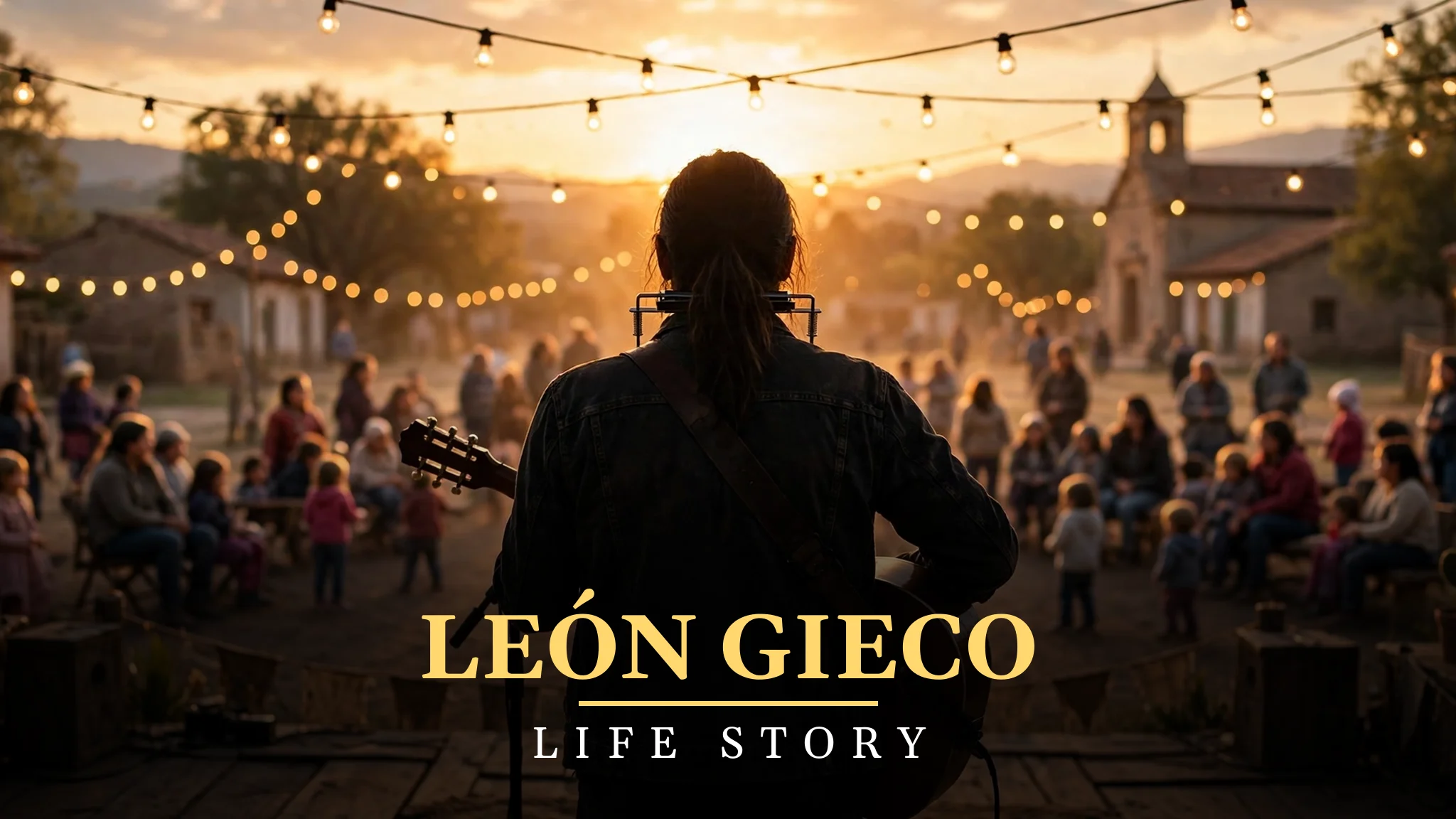
León Gieco’s harmonica is one of the most recognisable sounds in Argentine music, and it is the instrument that gives his songs their folk feeling. He plays the harmonica with a warmth and a simplicity that makes it sound like a human voice, and he uses it to carry melodies, to add colour, and to give his songs a sense of the countryside. His harmonica is not a showy instrument. It is a humble one, a small instrument that a traveller can carry in a pocket, and Gieco plays it with a love that makes it sound grand.
His guitar is the other half of his sound, and he plays it with a simple, direct style that serves the song. He does not play fast or complicated parts. He plays chords and melodies that support his voice, and he lets the words do the work. His guitar and his harmonica together create a sound that is intimate, honest, and full of feeling, and it is a sound that has become synonymous with Argentine folk rock.
He learned to play both instruments by listening to folk musicians and to Bob Dylan, the great American folk singer who also played guitar and harmonica together. Dylan’s influence is clear in Gieco’s music, and it is a proud influence, because Dylan showed that a singer with a guitar and a harmonica could change the world. Gieco took that lesson and made it Argentine, and he created a sound that was both international and local.
His harmonica playing has influenced many Argentine musicians, and his style is still studied by young folk players who want to learn how to play with honesty. He showed that a small instrument could carry a big message, and that a simple sound could be more powerful than a complex one. His harmonica is his voice, and it speaks as clearly as his singing does.
His guitar and harmonica are also symbols of his life as a travelling musician. He has travelled across Argentina, from the far south to the far north, and he has carried his instruments with him, playing in small towns, in villages, and in cities. His instruments are portable, and they are humble, and they are perfect for a singer who wants to go where the people are, rather than waiting for the people to come to him.
Today, his harmonica and his guitar are still with him, and his concerts are still built around them. He is a folk singer in the truest sense, a man with a guitar and a harmonica, singing about what matters, and his sound is as fresh today as it was when he started. That is a great legacy, and it is one that will last as long as people keep listening.
Gieco and the Young Musicians
León Gieco has always been generous with young musicians, and he has used his fame to help a new generation of Argentine artists. He has recorded with young folk singers, he has invited them to share his stage, and he has supported their work with his time and his encouragement. He understands that music is not a prize to be kept, but a gift to be passed on, and he has passed it on with an open heart.
He has also worked with musicians from many parts of Argentina, and his project De Ushuaia a La Quiaca was a journey through the folk music of the whole country, in which he recorded with local musicians in every region. That project was not only a record. It was a school, a way of learning from the folk traditions of Argentina, and of sharing them with a wider audience. Young musicians who worked with him on that project learned from a master, and they carried those lessons into their own work.
His influence on young musicians is also a matter of example. He showed them that a singer could be honest, that a singer could care about justice, and that a singer could use his voice for good, and that example has inspired many. Young folk singers in Argentina speak of Gieco as a teacher, and they try to follow his path, not by copying him, but by being as honest as he was.
He has also supported young musicians through concerts, through festivals, and through his presence at events that celebrate Argentine folk music. He is a familiar figure at folk gatherings, and his presence is a sign of respect for the tradition and for the young people who carry it forward. He is not a distant star. He is a part of the folk community, and he is loved for it.
His work with young musicians is part of his legacy, and it shows a man who understands that a culture lives only if it is passed on. He has passed his music on, and he has helped others to find their own voices, and that is a generous and important work. His songs will live on, not only in his own recordings, but in the voices of the young singers he helped.
Today, young folk musicians in Argentina still look to Gieco as a model, and they still sing his songs. His generosity has created a living tradition, and his influence will last as long as Argentine folk music lasts. That is a great achievement, and it is one that deserves to be celebrated.
Gieco and the Mothers of the Plaza de Mayo
León Gieco’s support for the Mothers of the Plaza de Mayo is one of the most important parts of his life, and it shows a singer who understood that music must serve justice. The Mothers were women whose children had disappeared during the military dictatorship, and they gathered every Thursday in the Plaza de Mayo in Buenos Aires, wearing white headscarves, to demand to know what had happened to their sons and daughters. Their protest was quiet, dignified, and brave, and it became a symbol of resistance in Argentina.
Gieco stood with them, and he sang for them, and he used his fame to help their cause. He performed at their events, he recorded songs about the disappeared, and he spoke about their search for truth. His song La memoria, about the need to remember, became an anthem for their cause, and his concerts became gatherings of people who believed in justice. He was not a distant supporter. He was a friend, and he was present, and his presence mattered.
His work with the Mothers was dangerous at the time, because the military government did not want people to speak about the disappeared. Gieco sang about them anyway, and he did it with a quiet courage that made his songs more powerful. He understood that a song can be a form of witness, and that a singer can give a voice to people who have been silenced. His music was not only entertainment. It was a form of solidarity, and it was a way of saying that the Mothers were not alone.
The Mothers’ search for their children continues today, and Gieco’s support for them continues too. He has performed at anniversaries, he has spoken about their cause, and he has kept their memory alive in his songs. His work with them is a part of his legacy, and it shows a man who has never forgotten why he sings. He sings for justice, and he sings for memory, and he sings for the mothers who never stopped searching.
His relationship with the Mothers is also a lesson about the role of an artist in society. An artist can be more than an entertainer. He can be a witness, a friend, and a voice for those who cannot speak for themselves. Gieco understood that, and he lived it, and his music is stronger for it. His songs are not only beautiful. They are also true, and they are true because they were sung for real people, in real pain, with real hope.
Today, the Mothers are honoured in Argentina, and their white headscarves are a symbol of courage. Gieco’s songs are a part of that story, and they are sung at memorials, at concerts, and at gatherings that remember the disappeared. His voice is a part of their history, and it will be remembered as long as their story is told.
His work with the Mothers is a reminder that a song can be a prayer, a protest, and a memory, all at the same time, and that a singer who stands with the mothers of the disappeared is a singer who understands what music is for. Gieco understood it, and he lived it, and his legacy is richer for it.
His songs are also taught in schools in Argentina, where young people learn about the history of their country through his music, and where teachers use Sólo le pido a Dios to talk about peace, about memory, and about the need for justice. That is a powerful role for a song, to be a lesson as well as a work of art, and it shows that Gieco’s music has become a part of the education of a nation. His voice is not only heard on the radio. It is heard in classrooms, and it is shaping the way a new generation understands its past.
My Take:
I think León Gieco is one of the most important singers in Latin America, because he understood that a song can be a form of conscience. He did not sing only about love or about dancing. He sang about the poor, about the disappeared, about the need for memory, and about the hope for peace, and he sang with a voice that was rough, warm, and honest. I think that is a rare and beautiful thing, and it is a gift that the world needs now as much as it ever did.
What moves me most is Sólo le pido a Dios, and the courage it took to write and to sing that song. Argentina was living under a military dictatorship, people were disappearing, and it was dangerous to speak openly. Gieco wrote a prayer, a quiet song, and he asked God for simple things: that war would not touch him, that the poor would not be forgotten, and that the disappeared would be remembered. That is a brave song, and it is a beautiful song, and it became an anthem because it said what millions of people were feeling but could not say. I think that is the highest purpose of a song. It can say what people are afraid to say, and it can say it with beauty and with love.
I also think about his small town, Cañada Rosquín, and about how it shaped him. He was not from Buenos Aires, and he did not pretend to be. He was from a small town in Santa Fe, and his songs carry the feeling of that town with them. He travelled the whole country, from Ushuaia to La Quiaca, and he recorded the folk music of every region, and he did it with respect and with love. I think that is a lesson for anyone who comes from a small place. Your home is not a limitation. It is a gift, and it can be the source of your greatest work. Gieco’s small town gave him his roots, and his roots gave him his voice.
His exile moves me, because he was forced to leave his country, and yet he kept singing. He carried his songs with him, and he became a voice for the people who had been silenced. I think exile is one of the hardest things a person can go through, and Gieco faced it with dignity. He did not stop, he did not give up, and he came home when he could, and he used his voice to fight for memory and justice. That is a story of courage, and it is a story that should be remembered.
I also admire his work for the Mothers of the Plaza de Mayo, and for the cause of the disappeared. He did not only sing about justice. He stood with the mothers, he performed at their events, and he used his fame to help them. That is a singer who understands that fame is a responsibility, and who uses it well. I think that is a model for any artist. Your talent is not only for yourself. It is for the people who need a voice, and you should use it for them.
His later work, travelling the country and recording its folk music, is one of my favourite parts of his story. He went from the far south to the far north, he listened to folk musicians in every region, and he recorded their songs with respect. That is a beautiful act of love for a country, and it is a reminder that a nation’s music is not only in its big cities. It is in its villages, in its fields, and in its small towns, and it deserves to be heard. Gieco heard it, and he shared it, and that is a great gift.
If I had to take one lesson from his life, it would be this: sing about what matters, and do not be afraid to be gentle. Gieco sang about justice, about memory, and about peace, and he sang with a quiet, prayerful voice, not with anger. His gentleness was his strength, and it made his songs more powerful, not less. I think we can all learn from that. Speak the truth, speak it with love, and do not be afraid to be quiet. A quiet song can change the world, and León Gieco proved it.
I also think about his harmonica, and about how a small instrument can carry a big message. He plays it with warmth and simplicity, and it sounds like a human voice, and it gives his songs a feeling of the countryside. I think that is a lesson about taking a humble tool and making it great. You do not need the grandest instrument. You need the instrument you love, and the will to play it honestly, and Gieco did that with his harmonica and his guitar for more than fifty years.
I think about the young musicians he has helped, and about the generosity of it. He recorded with them, he shared his stage, and he used his fame to help them find an audience, and he did it without holding back. I think that is a beautiful way to grow old as an artist, not by holding on to the spotlight, but by sharing it. Many famous people are afraid to share the stage, because they think it will make them smaller. Gieco understood the opposite. Sharing the stage made him bigger, because it showed his generosity.
I also think about his journey from Ushuaia to La Quiaca, and about what it means to travel a whole country to hear its music. He went from the far south to the far north, he listened to folk musicians in every region, and he recorded their songs with respect. That is a beautiful act of love for a country, and it is a reminder that a nation’s music is not only in its big cities. It is in its villages, in its fields, and in its small towns, and it deserves to be heard. Gieco heard it, and he shared it.
I think about Sólo le pido a Dios, and about the courage it took to write it. Argentina was living under a dictatorship, people were disappearing, and it was dangerous to speak. Gieco wrote a prayer, a quiet song, and he asked God for simple things, and that song became an anthem. I think that is the highest purpose of a song, to say what people are afraid to say, and to say it with beauty and with love. His gentleness was his strength, and it made his song more powerful, not less.
I also think about his exile, and about the pain of leaving home. He was forced to leave Argentina, and he lived far from the country he loved, and he kept singing. I think that is a hard thing to do, and I admire him for it. Exile is one of the hardest things a person can go through, because home is not only a place. It is the food, the language, the streets, and the people you love. To lose that and to keep singing is a kind of strength that is hard to put into words.
I think about the Mothers of the Plaza de Mayo, and about Gieco’s support for them. He did not only sing about justice. He stood with the mothers, he performed at their events, and he used his fame to help them search for their children. That is a singer who understands that fame is a responsibility, and who uses it well. I think that is a model for any artist. Your talent is not only for yourself. It is for the people who need a voice.
I also think about his small town, Cañada Rosquín, and about how it gave him his roots. He was not from Buenos Aires, and he did not pretend to be. He was from a small town in Santa Fe, and his songs carry the feeling of that town with them. I think that is a lesson for anyone who comes from a small place. Your home is not a limitation. It is a gift, and it can be the source of your greatest work.
I think about Bob Dylan, and about the influence he had on Gieco. Dylan showed that a singer with a guitar and a harmonica could change the world, and Gieco took that lesson and made it Argentine. I think that is a beautiful example of how influence works. You do not copy your hero. You learn from him, and then you make something that is your own, in your own language, about your own country. Gieco did that, and his music is proof of it.
I also think about the song La memoria, and about the need to remember. He sang about memory, about the importance of not forgetting the past, and about the need for truth. I think that is a message the world needs now as much as it ever did. We live in a time when people want to forget, when they want to move on without facing the truth, and Gieco’s song reminds us that memory is a form of justice, and that forgetting is a form of injustice.
I think about his later years, and about how he is still singing, still travelling, and still caring about the world. He is not a star who retired to a comfortable life. He is a man who is still working, still listening, and still singing about what matters. I think that is a rare and admirable thing, and it is a sign of a life lived with purpose. He has never lost his sense of why he sings, and that is why his songs still matter.
I finish by thinking about the simplest lesson of his life, which is to sing about what matters, and to do it gently. Gieco sang about justice, about memory, and about peace, and he sang with a quiet, prayerful voice, not with anger. His gentleness was his strength, and it made his songs more powerful. I think we can all learn from that. Speak the truth, speak it with love, and do not be afraid to be quiet. A quiet song can change the world, and León Gieco proved it.
I also think about the Mothers of the Plaza de Mayo, and about Gieco’s support for them. They were women whose children had disappeared, and they gathered every week to demand the truth, wearing white headscarves, and Gieco stood with them, sang for them, and used his fame to help their cause. I think that is a powerful thing, that a singer can be a friend to people in pain, and that a song can be a form of solidarity. His music was not only entertainment. It was a way of saying that the Mothers were not alone.
I think about the danger of that support, and about the courage it took. The military government did not want people to speak about the disappeared, and Gieco sang about them anyway, quietly and with dignity. I think that is a brave act, and it is a lesson about the role of an artist. An artist can be a witness, and a singer can give a voice to people who have been silenced, and Gieco did that, and his songs are stronger for it.
I also think about the white headscarves, and about how they became a symbol of courage. A simple piece of cloth, worn by mothers searching for their children, became one of the most powerful images in Argentine history, and Gieco’s songs are a part of that story. I think that is a reminder that small, quiet acts can be more powerful than loud ones, and that a mother’s love is one of the strongest forces in the world.
I finish by thinking about memory, and about why it matters. Gieco sang about the need to remember, and his song La memoria is an anthem for that cause. I think we live in a time when people want to forget, when they want to move on without facing the truth, and his song reminds us that forgetting is a form of injustice. Remember the past, honour the mothers, and sing the truth, even when it is hard. That is what León Gieco did, and that is why his voice still matters.
Frequently Asked Questions
Who is León Gieco?
León Gieco is an Argentine folk rock singer, born in 1951 in Cañada Rosquín, Santa Fe. He is famous for the song Sólo le pido a Dios and for his work for human rights and memory in Argentina.
What is León Gieco’s most famous song?
His most famous song is Sólo le pido a Dios, written in 1978 during the military dictatorship. It is a prayer for peace and justice, and it has become one of the most loved songs in Latin America.
Why did León Gieco go into exile?
Gieco was threatened during the military dictatorship in Argentina because his songs spoke about the disappeared and about justice. He left the country for a time and performed abroad before returning after democracy was restored.
What is the song La memoria about?
La memoria is a song by León Gieco about the need to remember the past, especially the victims of the dictatorship. It became an anthem for the fight for memory and justice in Argentina.
What is De Ushuaia a La Quiaca?
De Ushuaia a La Quiaca is a project by León Gieco in which he travelled through Argentina, from the far south to the far north, recording the folk music of different regions with local musicians.
Is León Gieco still performing?
Yes, León Gieco is still recording and performing, and his songs are still widely loved in Argentina and across Latin America. He is treated as a national treasure and a voice of conscience.


