Lino Ventura: The Life Story Behind France's Tough Guy with a Big Heart
In this post
Lino Ventura looked like a man you would not want to cross in a dark street, and that was exactly why French cinema loved him. He was big, broad, and slow to smile, and when he walked into a scene, the room seemed to change. He played gangsters, policemen, soldiers, and fathers, and he played them all with the same quiet weight. He did not need to shout. He only had to stand still, look at the other actor, and wait. The audience understood at once that this was a man who had lived a hard life, and who did not frighten easily.
What made him different from other tough actors was the softness underneath. Behind the hard face there was a kind, generous man who spent much of his life helping children with disabilities. He did not talk about his charity work to make himself look good. He did it because his own daughter needed help, and because he learned that the state did not do enough for families like his. He built something real with his own hands and his own money, and that work may be the most important thing he ever did.
He came to acting late, at the age of thirty-four, after a life as a wrestler and a worker. He had no training, no drama school, and no famous family behind him. He was an Italian immigrant boy who grew up poor in Paris, and he became one of the biggest stars in French film. His story is about strength, about patience, and about a man who used his fame for something far larger than himself.
An Italian Boy in Paris
Lino Ventura was born Angiolino Giuseppe Pasquale Ventura on 8 July 1919 in Parma, Italy. His father worked as a railwayman, and the family lived a modest life. When Lino was still a boy, his father left for France to find work, and the rest of the family followed. They settled in Paris, where Lino grew up in a working-class neighbourhood, learning French and trying to fit into a new country. He was an immigrant child in a big city, and he learned early that he would have to be strong to survive.
School did not suit him, and he left early to work. He took on hard physical jobs, and he grew into a large, powerful young man. He found his way into wrestling, which was a popular sport in France at the time, and he became a professional wrestler. He fought in rings across the country, and he learned how to use his body, how to take pain, and how to stand up to men who were trying to hurt him. Wrestling also taught him about performance. A wrestler must hold a crowd, must play a role, and must make the audience believe. Those lessons would help him later, in a way he could not have guessed.
He was also a young man during the Second World War, and those years were hard for everyone in France. He worked, he survived, and he kept his family close. He married Odette Lecomte in 1942, and they would stay together for the rest of his life. They had four children, and family became the centre of everything for him. He was not a man who lived for fame or for parties. He lived for work, for his wife, and for his children, and that simple focus stayed with him even when he became famous.
By his early thirties, Ventura was a wrestler with a broken body and a short future in the ring. He had hurt his leg, and his wrestling career was coming to an end. He did not know what to do next. He had no trade, no degree, and no plan. Then, by chance, he met the director Jacques Becker, who was looking for a man who looked like a real gangster for a new film. Ventura had never acted, but Becker saw something in him. That chance meeting changed his life, and it changed French cinema too.
Touchez pas au grisbi: A Star at Thirty-Four
The film was Touchez pas au grisbi, released in 1954, and it starred Jean Gabin, the greatest French actor of his time. Ventura played Angelo, a tough gangster, and he was so convincing that audiences thought he had been acting for years. He had not. He was a wrestler who had walked onto a film set for the first time, and he was holding his own next to Gabin. His size, his face, and his quiet way of speaking made him feel real in a way that trained actors sometimes could not. He was not playing a gangster. He looked like a man who had lived that life.
The film was a success, and directors began to call him. He worked steadily through the 1950s, playing gangsters, policemen, and strong men in crime films. He was not a pretty leading man, and he did not try to be one. He was a character actor with the presence of a star, and that was a rare thing. He learned his craft on film sets, watching older actors, listening to directors, and learning from his mistakes. He was a quick learner, and he had a natural gift for being still on camera. He did not overact. He trusted his face to do the work.
In these early years, he also learned the business of film. He was a professional, he arrived on time, he knew his lines, and he treated the crew with respect. Directors liked working with him because he was reliable, and actors liked him because he was generous on screen. He did not try to steal scenes. He made the other actors look better, and that is a mark of a great supporting actor. He was building a career, film by film, without any fuss or noise.
By the end of the 1950s, Ventura was no longer a wrestler who had tried acting. He was an actor, and a well-known one. He had found a second life, and it was a life that would last for more than thirty years. He had started late, and he had no training, but he had something that cannot be taught: the look of a man who has lived, and the patience to let a scene breathe. French cinema had found one of its great faces.
The King of Crime Films
The 1960s were the great years of Ventura’s career. He starred in Les Tontons flingueurs in 1963, a crime comedy that became one of the most loved French films of all time. He played Fernand Naudin, a man who returns from a life abroad to take care of the business of an old friend, and finds himself dealing with gangsters, old scores, and family trouble. The film was funny, sharp, and full of memorable lines, and Ventura’s calm, weary performance held it together. People in France still quote the film today, and they still remember his face in it.
He also starred in Le Deuxième souffle in 1966, directed by Jean-Pierre Melville, playing a gangster on the run who is caught between the police and his old friends. Melville was a director who loved silence, rain, and long, quiet scenes, and Ventura was perfect for his films. He could walk through a scene without speaking, and the audience would understand everything. He also worked with Melville again in L’Armée des ombres in 1969, a film about the French Resistance during the war. Ventura played a resistance fighter, and the film was serious, dark, and moving. It is now seen as one of the great films about the war.
In 1969, he also starred in Le Clan des Siciliens, alongside Jean Gabin and Alain Delon. The film brought together three generations of French screen stars, and it was a huge success. Ventura played a Sicilian gangster, and he gave the role a quiet dignity that made the character more than a simple villain. He was a man with a code, a family, and a sense of honour, even in a world of crime. Audiences loved the film, and it confirmed Ventura as one of the biggest names in French cinema.
Through the 1960s and 1970s, Ventura made film after film, and he rarely gave a bad performance. He played policemen in some films and criminals in others, and he was believable in both. He played men who were tired, men who were loyal, and men who were trapped by their past. He did not play heroes in the simple sense. He played real men, with real flaws, and that was why people trusted him. He was the kind of actor who made a film feel true, even when the story was about gangsters and crime.
A Father’s Fight: Perce-Neige
Behind the film career, there was a private story that mattered even more to Ventura. His daughter Linda was born with a disability, and Ventura and his wife learned how hard life could be for families in that situation. In France at the time, there were not enough places, not enough help, and not enough understanding for children like Linda. Ventura was a famous man, and he could have paid for private care and said nothing. He chose to do something else.
In 1966, he founded Perce-Neige, a charity to help children and adults with mental disabilities. The name means snowdrop, a small flower that pushes through the snow in early spring. Ventura worked hard for the charity, raising money, opening homes, and speaking in public about the needs of disabled people and their families. He did not do it for praise. He did it because he knew, as a father, what those families went through every day. He gave his time, his money, and his name to the cause, and he kept doing it for the rest of his life.
Perce-Neige grew into a large organisation, opening homes and centres across France where people with disabilities could live with dignity, work, and be part of a community. Ventura visited the homes, he talked to the families, and he listened to their problems. He was not a distant patron who gave money once a year. He was involved, week after week, year after year. Those who worked with him said that he was as serious about Perce-Neige as he was about his films, and perhaps more so.
This work changed how people saw him. He was no longer only the tough man from the crime films. He was a father who had turned his own pain into help for others. He did not talk about his daughter in public to win sympathy. He talked about the cause, about the children, and about what needed to change. His charity work is still going today, long after his death, and it helps thousands of people. For many families in France, the name Lino Ventura means not only films, but also a home, a school, and a life with dignity for their child.
Jean Valjean and the Later Years
In 1982, Ventura took on one of the great roles of French literature when he played Jean Valjean in Les Misérables, based on the novel by Victor Hugo. Valjean is a man who goes to prison for stealing bread, and who spends his life trying to become a good man while being hunted by the law. The role asked for strength, for suffering, and for a deep sense of kindness, and Ventura was perfect for it. He played Valjean as a man who had been broken by life and who had rebuilt himself, and audiences felt that the actor and the character understood each other.
The film was a success, and it showed that Ventura, in his sixties, was still at the top of his art. He had played gangsters for thirty years, and now he was playing a man who wanted to be good. It was a fitting role for a man who had spent his own life helping others. He did not need to act the kindness. It was already there, in his face, in his voice, and in the way he carried himself. The role of Valjean felt like the end of a long journey, from a wrestler to a gangster to a man of conscience.
In his later years, Ventura worked less, and he spent more time with his family and with Perce-Neige. He was a grandfather now, and he enjoyed the quiet life away from film sets. He still took on roles that interested him, and he still gave strong performances, but he did not chase fame. He had already had it, and he knew what it was worth. He was a man who had lived a full life, and who was at peace with what he had done.
He died on 22 October 1987 in Paris, at the age of sixty-eight, after a heart attack. His death was a shock to France, because he had seemed so strong, so solid, and so permanent. Tributes came from across the country, from actors, from directors, and from the families who had been helped by Perce-Neige. He was buried in Paris, and his funeral was attended by many of the people whose lives he had touched, on screen and off it. He left behind films that are still loved, and a charity that is still working.
The Man Behind the Tough Face
Lino Ventura’s legacy is a double one. On screen, he left behind some of the most loved French films of the twentieth century: Touchez pas au grisbi, Les Tontons flingueurs, Le Deuxième souffle, L’Armée des ombres, Le Clan des Siciliens, and Les Misérables. These films are still shown on television, still quoted, and still watched by new generations. His face, his voice, and his quiet way of acting have become part of French culture. He showed that a tough man could also be a tender man, and that a gangster on screen could have a heart.
Off screen, he left behind Perce-Neige, which continues to help people with disabilities and their families across France. The charity has opened many homes, and it has changed the lives of thousands of people. For those families, Ventura is not a film star. He is the man who understood their struggle, because he lived it himself, and who did something about it. That is a legacy that no film award can match, and it is the one that he cared about most.
He also left behind an example of a late start. He was thirty-four when he first acted, and he had no training. He proved that it is never too late to find a new life, if you are willing to work hard and to learn. He proved that a man from a poor immigrant family could become a star, not by pretending to be something else, but by being himself. He did not hide his accent, his size, or his past. He used them, and they made him who he was.
Today, when people in France talk about Lino Ventura, they talk about both sides of him: the tough man on the screen, and the kind man behind it. They remember the gangster who would not back down, and the father who built homes for children who needed them. They remember a man who was strong, loyal, and generous, and who used his strength for others. That is why his name is still spoken with respect, more than thirty years after his death, and why it will be spoken for a long time to come.
The Quiet Man Off Screen
Away from the film set, Ventura was a quiet man who loved simple things. He liked to be at home with his wife Odette, he liked to spend time with his children, and he liked the company of a few close friends. He did not go to many parties, and he did not seek the attention of the press. He was a star who lived like a worker, and he was happy that way. He rose early, he worked hard, and he came home to his family. That simple rhythm was the foundation of his life, and it kept him steady through thirty years of fame.
He was known among film crews as a man of few words, but of great kindness. He arrived on time, he knew his lines, and he treated everyone with respect, from the director to the youngest member of the crew. He did not act like a star. He acted like a colleague, and that made people want to work with him again and again. He was also known for his sense of humour, a dry, quiet humour that came out in small remarks, not in loud jokes. Those who knew him said that he was a man you could trust, a man who kept his word, and a man who did not forget his friends.
His home life was centred on his children, and especially on his daughter Linda. He and Odette learned to care for a child with a disability, and they learned how much love, patience, and hard work it took. They did not complain in public, and they did not ask for pity. They simply did what parents do: they cared for their child, and they tried to give her the best life they could. That experience changed Ventura, and it made him a more serious, more caring man. It also led him to Perce-Neige, and to a lifetime of work for others.
He was also a man who loved Italy, the country of his birth, and France, the country that had taken him in. He carried both with him, and he was proud of both. He spoke French with an Italian warmth, and he never tried to hide where he came from. He was an immigrant who had become French, and he was a Frenchman who had never forgotten Italy. That double identity gave him a depth that showed in his acting, in his face, and in the way he carried himself. He was a man of two countries, and he belonged to both.
Films That Still Speak Today
Ventura’s films are still watched in France today, and they are still loved by new generations. Les Tontons flingueurs is still quoted in cafés, in offices, and in homes, and its lines have become part of the French language. L’Armée des ombres is still shown in schools and in cinemas, as a great film about the Resistance, and about the courage of ordinary people. Le Deuxième souffle is still regarded as one of the finest crime films ever made in France. These films have not aged, because they are about real people, real choices, and real feelings, and Ventura is at the heart of them.
Young actors in France still study his performances, and they learn from his stillness, his patience, and his honesty. He showed that an actor does not need to shout to be powerful, and that a quiet man can hold a screen. Film schools show his work, directors talk about him, and audiences still come to his films. He has become a part of French culture, a face that everyone knows, and a name that everyone respects. That is a rare achievement, and it is one that he earned film by film, over thirty years.
His charity, Perce-Neige, is also still working, and it has grown far beyond what he could have imagined. It has opened homes across France, it has helped thousands of families, and it has changed the way France thinks about disability. When people in France talk about Ventura today, they talk about both sides of him: the actor, and the man who built homes for children. That double legacy is his greatest achievement, and it is one that will last far longer than any film. A film lasts for two hours. A home lasts for a lifetime, and Ventura built many homes.
My Take:
When I think about Lino Ventura, I think first about the fact that he started at thirty-four. Most actors start as children or as young students, and they spend years learning their trade. Ventura was a wrestler with a hurt leg and no plan, and then, by chance, he walked onto a film set and found a new life. I find that deeply hopeful. It tells me that a life is not finished at thirty, or at forty, or at any age. A door can open when you least expect it, and if you are ready to walk through it, everything can change. I think about the people who feel stuck in their jobs, or who think they are too old to try something new, and I wish they knew Ventura’s story. He was not young, he was not trained, and he was not lucky in the usual sense. He was ready, and he was real, and that was enough.
I admire his acting because it was so quiet. He did not wave his arms, he did not shout, and he did not try to impress the audience. He stood still, he looked, and he let the scene come to him. That is a hard thing to do, because most of us want to be noticed, to be loud, to prove that we are there. Ventura proved the opposite. He showed that silence can be stronger than noise, and that a still face can say more than a long speech. When I think about him in Le Deuxième souffle or L’Armée des ombres, I remember the quiet, not the action. I remember a man walking through rain, a man sitting in a room, a man waiting. That patience is rare, and it is something I want to learn from. Not every moment needs words. Some moments need only presence.
What moves me most is Perce-Neige, and I want to be honest about why. Many famous people give money to charity, and that is good. But Ventura did something different. He built a charity because his own daughter needed help, and because he saw that the system was not doing enough. He did not give money and walk away. He stayed, year after year, opening homes, raising money, and talking to families. That is not charity as a photograph. That is charity as a life’s work. I think about the families who found a home for their child because of him, and I think about how much that must have meant to them. A film lasts for two hours. A home lasts for a lifetime. Ventura understood that, and he chose the home.
I also think about his daughter Linda, and about the pain of being a parent of a child with a disability. I do not have that experience, and I do not want to pretend that I understand it fully. But I can see what Ventura did with that pain. He did not hide it, and he did not let it make him bitter. He turned it into help for other families. That is one of the bravest things a person can do: to take the hardest thing in your own life and use it to make life easier for someone else. I respect that more than any film role, and I think it is the real heart of his story.
There is something else I admire about him, and it is his loyalty. He was married to the same woman for forty-five years. He worked with the same directors again and again. He stayed loyal to his friends, to his family, and to his causes. In a world where people change partners, change jobs, and change beliefs every few years, loyalty can look old-fashioned. But Ventura shows that loyalty is not weakness. It is a choice, made again and again, to stay with the people and the things that matter. He stayed with his wife, he stayed with his charity, and he stayed with the kind of films he believed in. That staying power is part of what made him strong.
I feel sad when I think about his death, because he died suddenly, at sixty-eight, of a heart attack. He seemed so strong that people thought he would live for many more years. His death reminds me that strength on the outside does not protect a person on the inside. A big man can have a weak heart. A tough actor can die suddenly. That is a hard truth, and it makes me think about how fragile life is, even for the strongest people. But I also think that Ventura used his years well. He did not waste them. He worked, he loved, he built, and he helped. If a life is measured by what it leaves behind, then his life was long, even if his years were not as many as we wished.
When I compare Ventura with other tough actors, I see a difference. Many tough actors play gangsters and then live like gangsters, or they play heroes and then believe their own image. Ventura played gangsters, but he lived like a father and a worker. He did not confuse the screen with real life. He knew that the films were work, and that real life was family, and charity, and home. That separation is healthy, and it is rare. He did not need the films to feel important. He felt important when he opened a new home for Perce-Neige, when he sat with his family, when he did a job well. That is a good way to live, and it is a way that keeps a person honest.
For a young reader, I think the lesson of Ventura’s life is about using what you have. He had size, he had strength, and he had a face that the camera loved. He used those things to become an actor. But he also had a father’s heart, and he had the pain of seeing his daughter struggle. He used those things too, to build a charity. He did not waste any part of his life. He used the good parts and the hard parts, and he made something from both. That is a lesson for all of us. We all have things we did not choose: a body, a family, a past. The question is not whether those things are perfect. The question is what we will do with them. Ventura did something good with his, and that is why his story matters.
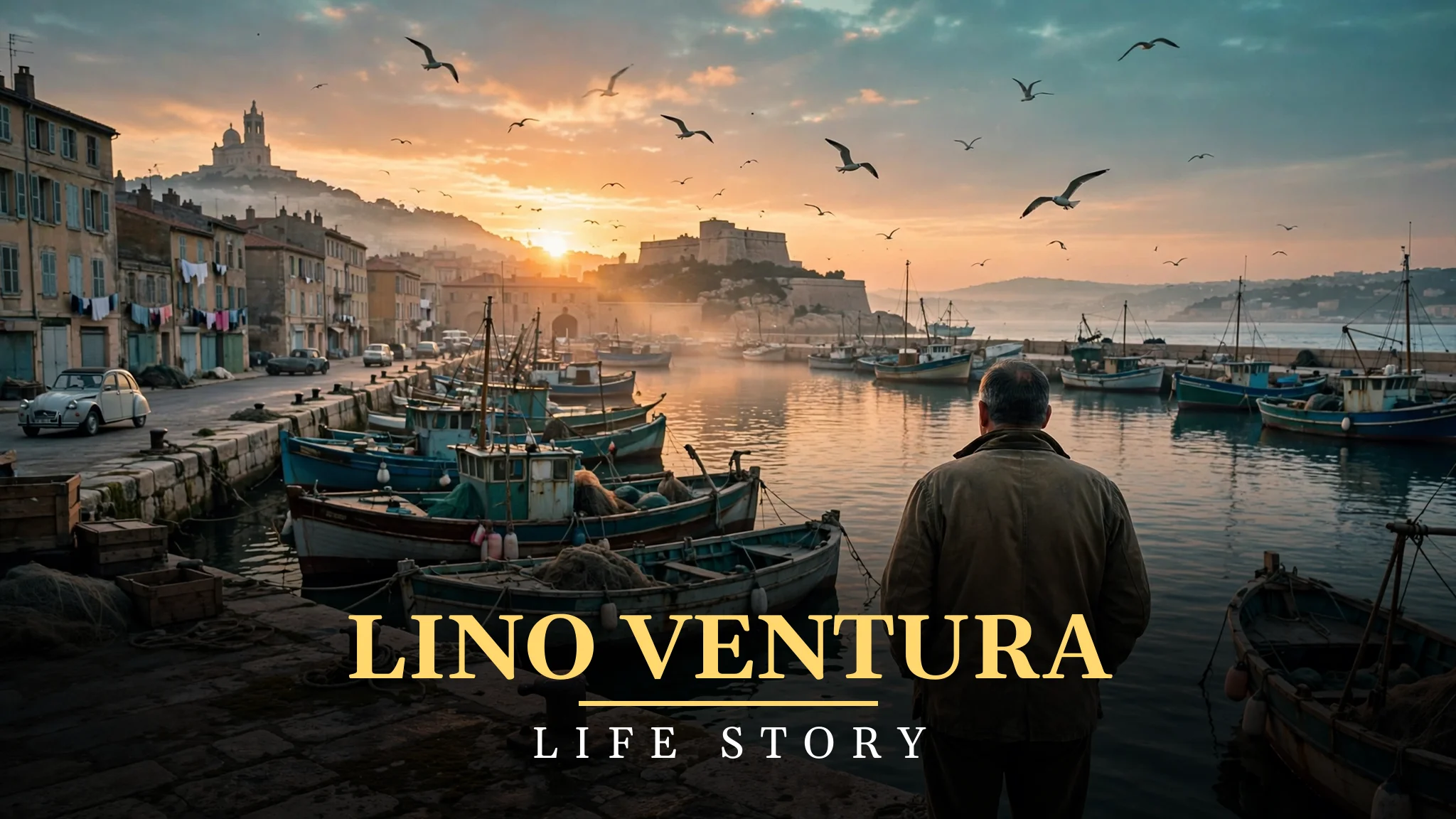
I keep thinking about the harbour in the image of him, the boats, the sunrise, and the man looking out at the water. It fits him, because he was a man who looked out, not only at his own life, but at the lives of others. He looked at children who needed help, and he helped them. He looked at a film set, and he gave his best. He looked at his family, and he stayed. In the end, I think Lino Ventura teaches us that toughness is not about hurting people. It is about standing firm for the people you love, and for the things you believe in. He was tough, yes, but his toughness was in service of kindness. That is the best kind of toughness there is, and it is why I will remember him.
I also think about his films, and about how they have lasted. Les Tontons flingueurs is still quoted today, more than sixty years after it was made, and that is a remarkable thing. A film that is still funny, still loved, and still watched after sixty years is a rare thing, and it shows that Ventura and his colleagues made something true. They did not make a film for one season. They made a film for all seasons, and it has lasted because it is about real people, real humour, and real life. I think about the films I have loved, and about how few of them last, and I admire the ones that do. Ventura’s films last, and that is a sign of their quality.
I think about his face, and about how much it says without words. He had a face that had lived, a face with lines, with weight, and with a quiet sadness behind the strength. That face could not be faked, and it could not be learned in a school. It came from a life of work, of wrestling, of raising children, and of caring for a daughter with a disability. When he looked at the camera, the audience saw that life, and they believed him. I think about the actors today who have smooth faces and perfect smiles, and I wonder if they can show what Ventura showed. A face that has lived is a powerful thing, and Ventura’s face was one of the great faces of French cinema.
I also think about his friendship with Jean Gabin, the greatest French actor of his time. Gabin was the star of Touchez pas au grisbi, and Ventura was the newcomer. Gabin could have ignored him, or treated him as a nobody. Instead, he worked with him, and he respected him. That respect, from a great actor to a beginner, must have meant a great deal to Ventura. I think about the older people who helped me when I was starting out, and about how much their kindness mattered. A word of respect from someone great can change a life, and Gabin gave Ventura that word, not by speaking, but by working with him as an equal. That is a lesson in generosity, and it is one I want to remember.
There is one more thing I want to say about Ventura, and it is about his size. He was a big man, a wrestler, a man who could frighten people with his presence. But he used that size for kindness, not for fear. He used it to protect his family, to help children, and to play men who were strong but gentle. He did not use his strength to hurt people. He used it to help them. I think that is the best use of strength there is. A strong man who helps others is a good man, and Ventura was a good man. His size was not a threat. It was a shelter, for his family, for the children of Perce-Neige, and for the audiences who loved him.
Finally, I think about what it means to be remembered as a good man. Ventura is remembered as a great actor, but he is also remembered as a good father, a good husband, and a good friend. That is a fuller memory than fame alone, and it is a memory that will last. I hope that when people remember me, they remember not only what I did, but how I treated people. Ventura treated people well, and that is why his name is still spoken with love. He was tough, yes, but he was kind, and kindness is the thing that lasts longest of all.
I think about his charity, Perce-Neige, and about the homes it has opened across France. A film lasts for two hours, but a home lasts for a lifetime, and Ventura built many homes. He did not give money and walk away. He stayed, year after year, opening homes, raising money, and talking to families. That is not charity as a photograph. That is charity as a life’s work, and it is the most important thing he ever did. When people in France talk about Ventura today, they talk about the actor, and they talk about the man who built homes for children. That double legacy is his greatest achievement, and it will last far longer than any film.
Finally, I think about the harbour at sunrise, the fishing boats, the gulls, and the man looking out at the water. It is a picture of a man who looks out, not only at his own life, but at the lives of others. He looked at children who needed help, and he helped them. He looked at a film set, and he gave his best. He looked at his family, and he stayed. He was tough, yes, but his toughness was in service of kindness, and that is the best kind of toughness there is.
Frequently Asked Questions
When and where was Lino Ventura born?
Lino Ventura was born Angiolino Giuseppe Pasquale Ventura on 8 July 1919 in Parma, Italy, and he grew up in Paris after his family moved to France. He was the son of Italian immigrants, and he spent his youth in a working-class part of the French capital.
How did Lino Ventura become an actor at the age of thirty-four?
He had been a professional wrestler, but a leg injury ended his wrestling career, and he met the director Jacques Becker, who cast him in Touchez pas au grisbi in 1954. He played a gangster alongside Jean Gabin, and his natural, convincing performance launched a film career that lasted more than thirty years.
What are Lino Ventura’s most famous films?
His most famous films include Touchez pas au grisbi, Les Tontons flingueurs, Le Deuxième souffle, L’Armée des ombres, Le Clan des Siciliens, and Les Misérables, in which he played Jean Valjean. He was known for crime films and for playing strong, quiet men, both gangsters and policemen.
What is Perce-Neige, the charity Lino Ventura founded?
Perce-Neige is a charity Ventura founded in 1966 to help children and adults with mental disabilities, after his own daughter Linda was born with a disability. It opened homes and centres across France where people with disabilities could live with dignity, and it continues to work today, long after his death.
Who was Lino Ventura married to, and how many children did he have?
He was married to Odette Lecomte from 1942 until his death in 1987, a marriage of forty-five years, and they had four children together. Family was the centre of his life, and he stayed close to his wife and children even at the height of his fame.
How did Lino Ventura die?
He died of a heart attack in Paris on 22 October 1987, at the age of sixty-eight. His death was mourned across France, and tributes came from the film world and from the many families helped by his charity Perce-Neige.


