Lola Flores: The Life Story Behind Spain's Fiery Legend
In this post
- A Girl From Jerez
- Madrid, Films, and the Birth of La Faraona
- A Star Across Spain and Latin America
- Family and the Flores Dynasty
- The Later Years and a National Farewell
- A Legend Who Still Burns
- Flamenco, Copla, and the Art of Performance
- A Star on Screen: Films and Television
- The Flores Family Today
- My Take:
Lola Flores was fire. That is the simplest way to describe her, and it is the way Spain has always described her. She was a singer, a dancer, and an actress, but above all, she was a force of nature, a woman who filled a stage with energy, with passion, and with a presence that no one could ignore. She was known as “La Faraona”, the Pharaoh, a name that captured her power and her pride. When she danced, the audience watched in silence. When she sang, the audience listened. When she spoke, the audience laughed, cried, and loved her.
She was born in Jerez de la Frontera, a town in the south of Spain famous for its wine, its horses, and its flamenco. She came from a humble family, and she became one of the most famous women in Spain. Her songs, like “Pena, penita, pena” and “A tu vera”, are still sung today, and her films are still watched. Her daughters, Lolita and Rosario, became stars themselves, and the Flores family became one of the great families of Spanish entertainment.
Her life was long, full, and dramatic, and it ended in 1995, when she died in Madrid. Her funeral was one of the biggest in Spanish history, and her death was mourned by the whole country. This is the story of Lola Flores, a girl from Jerez who became a legend, and whose fire still burns in Spanish culture today.
A Girl From Jerez
María Dolores Flores Ruiz was born on 21 January 1923 in Jerez de la Frontera, a town in the province of Cádiz, in Andalusia. Her family was humble, and her childhood was simple. Her father ran a small bar, and her mother looked after the family. She grew up listening to flamenco, to copla, and to the music of her region, and she began to sing and dance as a small child. Her talent was clear, and people who saw her began to say that she had something special.
As a girl, she performed in local shows, singing and dancing with a confidence that was unusual for someone so young. She was not a shy child. She liked to be on stage, she liked to make people smile, and she had a natural gift for performance. Her family supported her, and they encouraged her to pursue her talent, even though a career in show business seemed like a distant dream for a girl from a small town.
She also learned the traditions of her region, the flamenco, the copla, and the way of life in Andalusia. Jerez was a town of wine, of horses, and of music, and those things shaped her. She carried the spirit of Jerez with her for the rest of her life, and she often spoke about her home town with love. She was a woman from the south, and she was proud of it.
Her early years were hard, because Spain was a poor country, and her family had little money. But she had talent, she had energy, and she had a dream. She knew that she wanted to be a performer, and she worked hard to make that dream come true. She practised, she performed, and she waited for her chance.
Madrid, Films, and the Birth of La Faraona
As a young woman, Lola Flores went to Madrid, where she hoped to build a career. She performed in theatres, she sang in shows, and she began to be noticed. Her style was a mix of singing, dancing, and acting, and it was unlike anything else on the Spanish stage. She was not just a singer. She was a performer who could do everything, and she did it with a fire that no one else could match.
She also began to appear in films, and her beauty and her talent made her a star on screen. Her films, including “Embrujo” in 1947, were popular, and they introduced her to a wide audience. She became known across Spain, and her name, Lola Flores, became synonymous with passion, with flamenco, and with the spirit of Andalusia. She was given the nickname “La Faraona”, the Pharaoh, because of her power, her pride, and her regal presence on stage.
Her songs from this period, including “Pena, penita, pena” and “A tu vera”, became hits, and they are still sung today. “Pena, penita, pena” is a song about sorrow, about a pain that is small but deep, and Lola sang it with a feeling that made the audience cry. “A tu vera”, which means “By Your Side”, is a song about love and devotion, and it became one of her most loved songs. Her voice was strong, her dancing was powerful, and her performances were unforgettable.
By the 1950s, she was one of the most famous women in Spain. She toured the country, she performed in large theatres, and her concerts were major events. She was a star, and she lived like one, with elegance, with style, and with a confidence that inspired her fans. She had come from Jerez, and she had conquered Madrid, and the whole of Spain knew her name.
A Star Across Spain and Latin America
Lola Flores’ fame spread beyond Spain, to Latin America, where her films and her songs were loved. She toured Mexico, Argentina, and other countries, and her audiences there welcomed her with warmth. She was a Spanish star, but she was also a Latin American star, and her music crossed the Atlantic with ease. Her style, which mixed flamenco, copla, and pop, suited the taste of audiences across the Spanish-speaking world.
She continued to make films, to record songs, and to perform on stage, and her career lasted for decades. She was not a singer who had a few good years and then faded. She was a performer who kept going, who kept working, and who kept her audience with her. Her energy never left her, and her fire never went out. She was Lola Flores, and she was always Lola Flores, on stage and off it.
Her personality was as famous as her art. She was known for being direct, funny, and honest, and she spoke her mind. She was not afraid to say what she thought, and her words were often quoted in the press. One of her most famous moments came at a concert, when she asked the audience to leave if they did not love her, saying, “Si me queréis, irse”, which means, “If you love me, go away”. The line became famous, and it captured her spirit: bold, funny, and unafraid.
She was also known for her love of her family, and for her devotion to her children. She was a mother, a wife, and a star, and she tried to balance all three roles. Her life was a mix of public fame and private love, and she lived it with the same passion that she brought to the stage.
Family and the Flores Dynasty
Lola Flores married Antonio González, a guitarist, and they had three children: Lolita, Rosario, and Antonio. Her daughters, Lolita and Rosario, became stars themselves, following in their mother’s footsteps as singers and actresses. Lolita became a popular singer, and Rosario became one of the most successful Spanish singers of her generation, with a career that has lasted for decades. The Flores family became a dynasty in Spanish entertainment, and Lola was its queen.
She was a devoted mother, and she supported her children’s careers. She taught them about music, about performance, and about the importance of hard work. She also taught them about pride, about being true to themselves, and about the value of their Andalusian roots. Her children grew up in a home full of music, and they carried that music with them into their own careers.
Her son Antonio also became a singer, but his life was shorter and sadder. He died in 1995, only a few weeks after his mother, and his death was a shock to the family and to the country. The Flores family has known great joy and great sadness, and Lola’s life was shaped by both. She loved her children deeply, and she was proud of their success.
Her family remains one of the most famous in Spain, and her daughters continue to perform, to record, and to keep her memory alive. They speak about their mother with love, and they carry her spirit with them. Lola Flores was not just a star. She was the mother of a family of stars, and her legacy lives on through them.
The Later Years and a National Farewell
In her later years, Lola Flores continued to perform, to appear on television, and to be a beloved figure in Spain. Her energy was still there, even as she grew older, and her fans still came to see her. She was a legend, and her presence on stage was a reminder of a golden age of Spanish entertainment. She sang her classic songs, she danced, and she talked to her audience with the same warmth and humour that had always defined her.
Her health began to fail in the 1990s, and she faced illness with courage. She continued to work when she could, and she did not hide from the public. Her fans followed her struggle with love, and they hoped for her recovery. She was a fighter, and she fought until the end, with the same fire that had carried her through her whole life.
She died on 16 May 1995 in Madrid, at the age of seventy-two. Her death was a national event, and her funeral was one of the biggest in Spanish history. Thousands of people came to pay their respects, and the whole country mourned. Her coffin was carried through the streets of Madrid, and her fans sang her songs as she passed. It was a farewell fit for a queen, and it showed how deeply she was loved.
Her son Antonio died only a few weeks later, and the double loss was a shock to Spain. The Flores family, and the country, grieved together. Lola’s death was the end of an era, the end of a golden age of Spanish song and dance, and her passing was felt deeply by everyone who had grown up with her music.
A Legend Who Still Burns
Lola Flores’ legacy is her fire, her music, and her family. Her songs are still played on the radio, still sung at celebrations, and still loved by people who were not even born when she was at her peak. Her films are still watched, and her performances are still remembered as some of the greatest in Spanish entertainment. She was a singer, a dancer, and an actress, but above all, she was a force of nature, and her force is still felt today.
She showed that a woman could be powerful, passionate, and proud, and that she could be loved for it. She was not a quiet star. She was a loud one, in the best sense, a woman who filled a room with her presence, and who made everyone feel alive. Her daughters carry that spirit with them, and her grandchildren are now part of the family story as well.
She also showed that a girl from a small town could become a legend, if she worked hard, believed in herself, and never lost her fire. She came from Jerez, she went to Madrid, and she became “La Faraona”, a name that will always belong to her. Her story is a reminder that talent, passion, and hard work can take you from a small bar in Andalusia to the biggest stages in the world.
Today, Lola Flores is remembered as one of the greatest performers in Spanish history, a fiery legend whose songs, dances, and films are still loved. Her fire has not gone out. It burns in her daughters, in her songs, and in the hearts of everyone who ever saw her perform.
Flamenco, Copla, and the Art of Performance
Lola Flores’ art was built on the great traditions of Andalusia: flamenco and copla. Flamenco is the art of the south, a mix of singing, dancing, and guitar, full of passion, pain, and joy, and Lola was one of its greatest performers. She danced with power, she sang with feeling, and she used her whole body to tell the story of each song. Her flamenco was not a museum piece. It was alive, and it was hers, and her audiences felt it in their bones.
Copla, the traditional Spanish song, was the other half of her art. Copla songs are dramatic, romantic, and full of strong feelings, and Lola sang them with a voice that was strong, clear, and unforgettable. Her songs, like “Pena, penita, pena”, are copla at its best: simple words, a beautiful melody, and a feeling that goes straight to the heart. She did not just sing copla. She embodied it, and she made it popular again at a time when many people thought it was old-fashioned.
Her performances were a mix of both traditions, and they were unlike anything else on the Spanish stage. She sang, she danced, she acted, and she talked to the audience, all in the same show. That completeness is what made her special. She was not just a singer, or just a dancer. She was a performer, in the fullest sense of the word, and her shows were events that people remembered for the rest of their lives.
That art has lasted, because flamenco and copla are not fashions. They are traditions, and they speak to something deep in Spanish culture. Lola understood that, and she carried those traditions with her, from Jerez to Madrid, and from Spain to Latin America. Her work is a celebration of Andalusia, of its music, its dance, and its spirit, and it is a gift that she gave to the whole world.
A Star on Screen: Films and Television
Lola Flores was not only a stage performer. She was also a film star, and her films introduced her to audiences who had never seen her on stage. Her film “Embrujo”, released in 1947, was a success, and it showed her as a beautiful, talented actress, as well as a singer and dancer. She made many films in the 1940s, 1950s, and 1960s, and they were popular in Spain and in Latin America. Her films were colourful, dramatic, and full of music, and they captured her fire on screen.
Her work on television was also important, especially in her later years, when she became a beloved figure on Spanish TV. She appeared on variety shows, she talked to the audience, and she shared her humour, her stories, and her warmth. She was not a distant star. She was a familiar face, a woman who felt like a friend, and her television appearances made her loved by a new generation who had never seen her on stage.
Her films and television work also showed her range. She could be funny, she could be sad, she could be dramatic, and she could be tender, and she did it all with the same passion. She was an actress as well as a singer, and her performances on screen are still watched today, by people who want to see what made her so special. A film can capture a moment, and her films captured her at her best, young, beautiful, and full of fire.
That screen legacy is a central part of her story, because it means that new generations can still see her, still hear her, and still feel her energy. A stage performance is gone when the curtain falls, but a film lasts, and Lola’s films ensure that her fire will never go out. They are a gift to the future, and they are one of the reasons she is still remembered today.
The Flores Family Today
Lola Flores’ family is still a central part of Spanish entertainment today, and her daughters carry her legacy with pride. Lolita Flores has had a long career as a singer and actress, and Rosario Flores has become one of the most successful Spanish singers of her generation, with a career that has lasted for decades. Both women learned from their mother, and both carry her spirit: her passion, her humour, and her love of performance. The Flores family is a dynasty, and Lola was its queen.
Rosario’s music, in particular, shows her mother’s influence. She sings with passion, she performs with energy, and she connects with her audience in the same direct, honest way that Lola did. Her concerts are full of fans who love her for herself, and who also remember her mother. When Rosario sings, the audience hears an echo of Lola, and that echo is a beautiful thing. It shows that talent can be passed down, not just through blood, but through teaching, through example, and through love.
Lolita has also built a successful career, as a singer and as a television personality, and she speaks about her mother with love and with pride. She has kept Lola’s memory alive, through her work, through her interviews, and through her own performances. The sisters support each other, and they support their mother’s legacy, together. That family bond is a large part of why the Flores name is still so loved in Spain.
The next generation of the family is also part of the story. Lola’s grandchildren are growing up in a home full of music, and some of them are already showing talent. The Flores family is not just a memory. It is a living tradition, and it continues to grow. Lola’s fire has not gone out. It burns in her daughters, in her grandchildren, and in the songs that are still sung in her name.
That family legacy is one of the best parts of her story. She did not just leave songs behind. She left daughters and grandchildren who carry her art forward, performing on stages she once filled, and honouring her name with every show. When a family carries a legacy together, it becomes stronger, and the Flores family is a proof of that. Lola would be proud to see her daughters, and her grandchildren, carrying her fire into the future.
Today, the Flores family is remembered as one of the great families of Spanish entertainment, and Lola is remembered as its founder, its queen, and its heart. Her daughters honour her, her grandchildren learn from her, and her fans still love her. That is a legacy that will last for generations, and it is one that Lola earned, through her talent, her hard work, and her love for her family.
My Take:
When I think about Lola Flores, the first word that comes to my mind is fire. She was not a quiet singer, and she was not a gentle one. She was fire, and her fire filled every room she entered. I think that is a rare and wonderful thing, because most people learn to be quiet, to be polite, and to hide their feelings. Lola did the opposite. She showed her feelings, she danced with passion, and she sang with a power that made the audience feel alive. I admire that, because it takes courage to be that open, to let people see your fire, and to trust that they will love you for it. They did love her for it, and they still do.
I also think about her nickname, “La Faraona”, and how well it fitted her. A pharaoh is a ruler, a person of power and pride, and Lola ruled the stage like a queen. She did not ask for permission. She took the stage, and she owned it. I think that is an important lesson for women, and for anyone who feels small. You do not have to wait for someone to give you power. You can take it, by being yourself, by working hard, and by refusing to be small. Lola did that, and she became a legend. Her daughters learned that lesson from her, and they have carried it into their own careers.
What I find most moving about her story is her family. She was not just a star. She was a mother, and her daughters, Lolita and Rosario, became stars themselves. That is a beautiful thing, because it shows that her talent was not just hers. It was something she passed on, something she taught, and something she nurtured. She was a teacher as well as a performer, and her classroom was her home. I think that is a lovely part of her legacy. She did not just leave songs behind. She left a family of artists, and they are still singing, still performing, and still keeping her memory alive.
I have to be honest about the sadder parts of her story. Her death in 1995 was a great loss, and the death of her son Antonio only a few weeks later was a double tragedy that shocked Spain. It is painful to think of a family losing a mother and a son in such a short time, and it is a reminder that even the brightest lives can end in sadness. I do not want to dwell on that pain, but I do want to acknowledge it, because it is a real part of her story. Her life was full of joy, but it was also full of loss, and she faced both with the same fire.
I also think about her famous line, “Si me queréis, irse”, and how it captures her spirit. It was a joke, but it was also a truth. She was saying, if you love me, you do not need to stay and watch. You can go, because my love for you is not about applause. It is about something deeper. I think that line shows her humour, her confidence, and her understanding that fame is not the point. The point is the art, the song, and the dance. Applause is nice, but it is not the reason to perform. She performed because she loved it, and that love is what made her great.
I also think about her films, and how they introduced her to audiences who had never seen her on stage. Her film “Embrujo” is still watched today, and it shows a young Lola, beautiful, talented, and full of fire. I think those films are an important part of her legacy, because they captured her at her best, and they allow new generations to see what she was like. A song can be heard, but a film can be seen, and seeing her dance is a different experience from hearing her sing. Both are wonderful, and both are part of who she was.
What I learn from her story is that passion is a gift, and it should not be hidden. Many people are taught to be calm, to be quiet, and to control their feelings. Lola taught the opposite. She taught that passion is beautiful, that it is powerful, and that it can move people. Her dancing, her singing, and her speaking were all full of passion, and that passion is what made her a legend. I think that is a lesson for anyone who feels that they are too much, too loud, or too emotional. You are not too much. You are yourself, and yourself is enough, if you let your fire burn.
In the end, I think Lola Flores matters because she was a force of nature, a woman who filled a stage with fire, and who gave Spain some of its most beloved songs and performances. Her daughters carry her spirit, her songs are still sung, and her name, “La Faraona”, is still spoken with love and respect. She is gone, but her fire is not, and whenever one of her songs is played, or one of her dances is watched, she is with us again, burning bright.
I also think about Jerez, and how the town shaped her. It is a town of wine, of horses, and of flamenco, and growing up there gave her a sense of tradition, of pride, and of the beauty of ordinary life. She carried Jerez with her to Madrid, and her songs, her dances, and her style are full of it. I think that is a large part of her appeal. She was not a singer who came from nowhere. She came from a real place, with real traditions, and she honoured those traditions in everything she did. A singer who remembers where she came from is a singer who stays honest.
I think about her early years, and how hard they must have been. She came from a humble family, her father ran a small bar, and she had little money. But she had talent, she had energy, and she had a dream. She worked hard, she performed in small shows, and she waited for her chance. That patience, and that faith, carried her through the hard years and into success. I find that hopeful, because it means that talent and hard work can still win, even when you start with very little, and even when the world seems to be against you.
I also think about her nickname, “La Faraona”, and how well it fitted her. A pharaoh is a ruler, a person of power and pride, and Lola ruled the stage like a queen. She did not ask for permission. She took the stage, and she owned it. I think that is an important lesson for women, and for anyone who feels small. You do not have to wait for someone to give you power. You can take it, by being yourself, by working hard, and by refusing to be small. Lola did that, and she became a legend. Her daughters learned that lesson from her, and they have carried it into their own careers.
I want to say something about her humour, because it is a central part of her art. She was funny, in her songs and in her interviews, and her humour was warm, not cruel. She joked about herself, about her family, and about life, and her audience laughed with her, not at her. That kind of humour is a gift, because it makes people feel comfortable, and it makes hard truths easier to hear. A performer who can make you laugh and cry in the same show is a rare thing, and Lola was one of them.
I also think about her famous line, “Si me queréis, irse”, and how it captures her spirit. It was a joke, but it was also a truth. She was saying, if you love me, you do not need to stay and watch. You can go, because my love for you is not about applause. It is about something deeper. I think that line shows her confidence, her humour, and her understanding that fame is not the point. The point is the art, the song, and the dance. Applause is nice, but it is not the reason to perform. She performed because she loved it, and that love is what made her great.
I think about her daughters, Lolita and Rosario, and how proud she must have been of them. To see your children become stars, to see them carry your art into a new generation, is a wonderful feeling. She taught them about music, about performance, and about pride, and they learned well. Rosario, in particular, has had a long and successful career, and her music carries her mother’s spirit. I think that is a beautiful part of Lola’s legacy. She did not just leave songs behind. She left a family of artists, and they are still singing, still performing, and still keeping her memory alive.
I also think about her son Antonio, and the sadness of his early death. He died in 1995, only a few weeks after his mother, and his death was a shock to the family and to the country. It is painful to think of a family losing a mother and a son in such a short time, and it is a reminder that even the brightest lives can end in sadness. I do not want to dwell on that pain, but I do want to acknowledge it, because it is a real part of her story. Her life was full of joy, but it was also full of loss, and she faced both with the same fire.
I think about her funeral, and how it showed the depth of her fame. Thousands of people came to pay their respects, and the whole country mourned. Her coffin was carried through the streets of Madrid, and her fans sang her songs as she passed. It was a farewell fit for a queen, and it showed how deeply she was loved. I think that is a fitting end for a woman who gave so much to her country. She was loved in life, and she was loved in death, and her memory is still loved today.
I also think about the young performers who watch her films today, and what they learn. They learn that a performance can be passionate, that a dance can be powerful, and that a song can be sung with the whole heart. They learn that a woman can be strong, proud, and free, and that she can be loved for it. Those are important lessons, and Lola taught them well. Her influence is still felt in Spanish music, in flamenco, and in the work of young artists who look to her as an example.
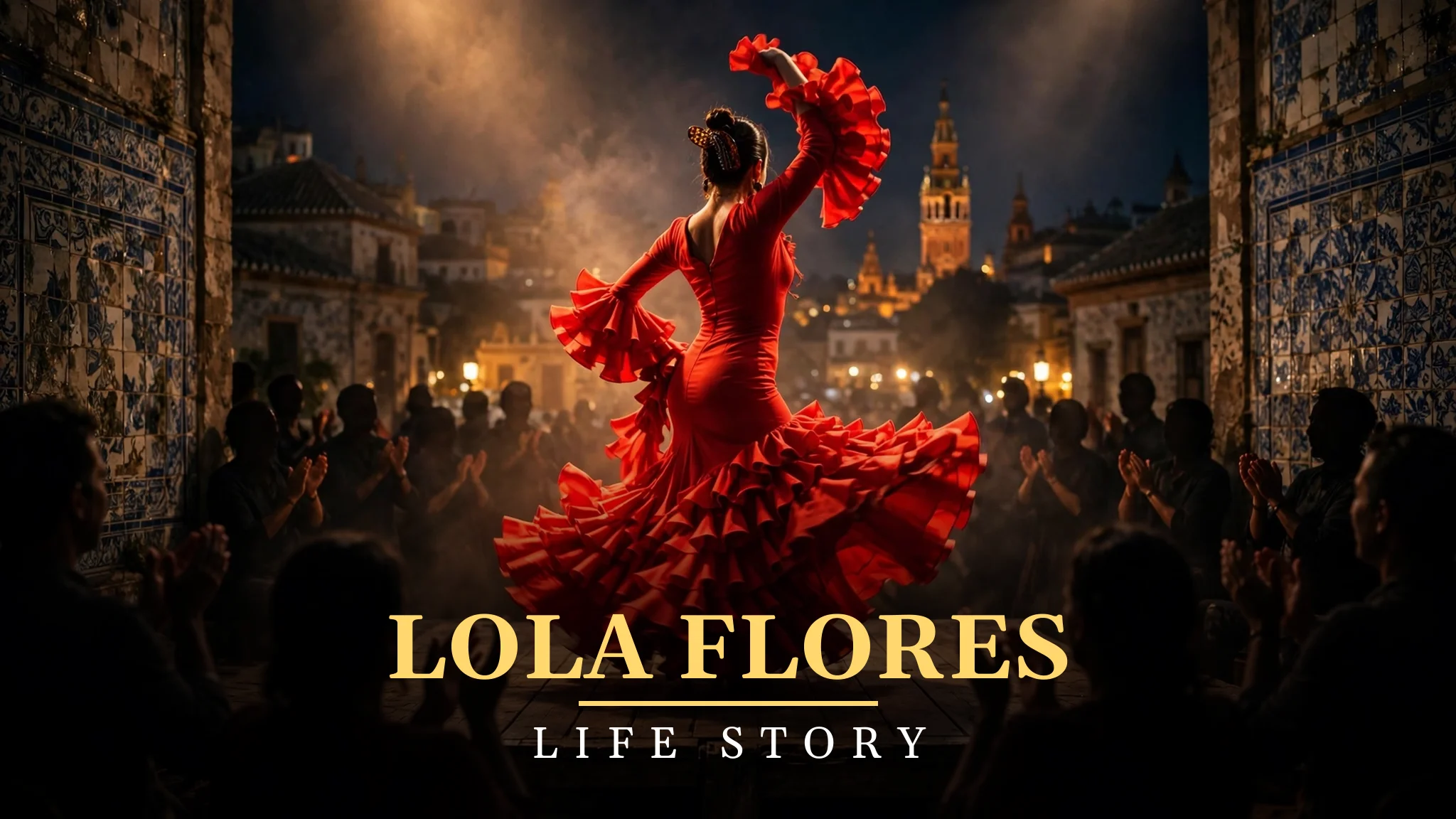
In the end, I come back to the image of a flamenco dancer in a bright red dress, spinning on a wooden stage at night, as the audience claps. That image is the heart of her story, because it shows a woman who is free, who is powerful, and who is joyful. She dances because she loves it, and her love is catching. I hope her fire keeps burning, in her daughters, in her songs, and in the hearts of everyone who ever saw her perform, because the world needs more of that fire, more of that passion, and more of that joy.
I also think about her film “Embrujo”, and how it captured her at her best. The film was made in 1947, when she was only twenty-four, and it showed a young Lola, beautiful, talented, and full of fire. I think those films are an important part of her legacy, because they allow new generations to see what she was like, to hear her sing, and to watch her dance. A song can be heard, but a film can be seen, and seeing her dance is a different experience from hearing her sing. Both are wonderful, and both are part of who she was.
I think about her grandchildren, and about the future of the Flores family. They are growing up in a home full of music, and some of them are already showing talent. I hope they carry their grandmother’s fire, her passion, and her love of performance into the future, because the world needs more of it. A family that keeps its traditions alive is a family that honours its past, and the Flores family does that, with love, with pride, and with music.
I also think about the lesson of her life for young performers. She started with very little, she worked hard, and she became a legend. That is not luck. It is the result of talent, of passion, and of a refusal to give up. Young performers who want a long career should look at Lola, and learn from her: be yourself, work hard, love what you do, and never let anyone make you small. Those are simple lessons, but they are the ones that matter, and Lola lived them, for a lifetime.
Frequently Asked Questions
Where was Lola Flores born?
Lola Flores was born on 21 January 1923 in Jerez de la Frontera, a town in the province of Cádiz in Andalusia, Spain. She grew up there, listening to flamenco and copla, before moving to Madrid to build her career.
Why was Lola Flores called La Faraona?
She was called “La Faraona”, meaning “The Pharaoh”, because of her power, her pride, and her regal presence on stage. The nickname captured her commanding style as a singer, dancer, and actress.
What are Lola Flores’s most famous songs?
Her most famous songs include “Pena, penita, pena” and “A tu vera”. Both are still sung today and are regarded as classics of Spanish copla and flamenco-influenced pop.
Who are Lola Flores’s daughters?
Her daughters are Lolita and Rosario Flores, both of whom became successful singers and actresses in their own right. Rosario, in particular, has had a long and successful career in Spanish music.
What is the famous line Si me queréis, irse?
It is a famous line Lola Flores spoke at a concert, meaning “If you love me, go away”. It was a joke that captured her bold, funny, and confident spirit, and it became one of her most quoted moments.
When did Lola Flores die?
She died on 16 May 1995 in Madrid, at the age of seventy-two. Her funeral was one of the biggest in Spanish history, and her death was mourned across the whole country.


