Lorraine Bracco: The Life Story Behind the Goodfellas Star
In this post
- A Brooklyn Girl With Big Dreams
- Paris, Modelling, and French Films
- Goodfellas and Karen Hill
- The Sopranos and Dr. Melfi
- Memoir, Rizzoli and Isles, and a New Chapter
- The Early Films and a Return to America
- Medicine Man, Hackers, and the 1990s
- The Sopranos Years and Life After Tony
- Riding in Cars with Boys and the Working Actress
- My Take:
Lorraine Bracco has one of the most recognisable voices in American television. It is low, direct, and full of feeling, and when she speaks, you listen. She played Karen Hill in Goodfellas, the wife of a mobster who loves the life and then fears it, and she played Dr. Jennifer Melfi in The Sopranos, the psychiatrist who tries to understand a mob boss. Those two roles alone would make her famous. But her story is much bigger than those two parts.
She began as a model in Paris, far from home, learning a new language and a new life. She worked in French films, she came back to America, and she built an acting career in her thirties, when many actresses are told that their time has passed. She proved them wrong, and she kept working for decades after that.
Her story runs from Brooklyn to Paris and back again, from the fashion world to the film world, from a wife in the mob to a doctor on television, and from a public battle with depression to a new life as an author and a television host. It is the story of a strong, honest woman who never pretended to be anything she was not.
A Brooklyn Girl With Big Dreams
Lorraine Bracco was born on 2 October 1954 in the Bay Ridge area of Brooklyn, New York, to an Italian-American family. Her father worked in the fishing business, and her mother was a homemaker. She grew up in a working-class neighbourhood where family was everything, where people spoke loudly and honestly, and where a girl learned early how to stand up for herself. Brooklyn gave her a toughness that stayed with her for the rest of her life.
As a young girl, she was beautiful, and people told her so, but she was not a child star. She went to school, she lived an ordinary life, and she dreamed of something bigger. She was restless, and she wanted to see the world beyond Brooklyn. When she was still a teenager, she began to model, and the work took her to places she had never imagined.
She left school early, and she moved to Paris in the 1970s to work as a model. It was a bold move for a young woman from Brooklyn, but she was brave, and she wanted to live. Paris was a different world, full of fashion, art, and new ideas, and she threw herself into it. She learned French, she worked with photographers, and she built a career in a city that was far from home.
The Brooklyn years gave her a strong base. She was a working-class girl who knew how to work hard, and she carried that work ethic with her to Paris and beyond. She was not a person who waited for things to happen. She went out and made them happen, and that drive became the heart of her story.
Paris, Modelling, and French Films
In Paris, Bracco became a successful model, working for fashion houses and magazines. She lived in the city for many years, and she learned to speak French fluently. She also began to act, appearing in French films and learning the craft of film acting from the inside. She was not trained in a drama school. She learned by doing, by watching, and by working with directors who trusted her.
She appeared in French films in the late 1970s and early 1980s, and she built a small but real career in European cinema. She also worked as a disc jockey on French radio, a job that showed her love of music and her willingness to try new things. Paris was a school for her, and she learned more there than she could have learned in any classroom.
During these years, she was in a relationship with the actor Harvey Keitel, and they had a daughter, Stella, born in 1985. The relationship ended, but the two remained connected through their daughter, and Bracco raised Stella as a single mother for many years. It was a hard time, but it made her stronger, and it taught her how to balance work and family.
She also began to think about returning to America. She had lived in Paris for a long time, and she loved the city, but she wanted to build a bigger acting career, and she knew that Hollywood was where that career would be. She moved back to the United States in the 1980s, ready to start again in a new place.
Goodfellas and Karen Hill
Bracco’s big break in American film came in 1990, when she played Karen Hill in Goodfellas, Martin Scorsese’s film about the mobster Henry Hill. Karen is Henry’s wife, a young Jewish woman from Long Island who falls in love with a gangster and who loves the excitement, the money, and the power of the life. Then, slowly, she begins to see the fear, the violence, and the lies, and she realises that the life is destroying her family.
Bracco played Karen with a rare honesty. She showed the character’s excitement, her love, her anger, and her fear, and she made the audience understand why a smart woman would stay in such a life. Her performance was powerful, and it brought her an Academy Award nomination for Best Supporting Actress. It was her first major American film role, and it made her famous overnight.
The film became one of the most loved films ever made, and Bracco’s work in it is still praised today. She was not a background wife. She was a full person, with her own story, her own desires, and her own pain. Scorsese gave her the space to play that story, and she took it. Her narration in the film, telling her side of the story, is one of the most memorable parts of Goodfellas.
Goodfellas changed her life. She was now a respected actress, and she was offered many more roles. She had come from Paris, from modelling, and from small French films, and she had arrived in Hollywood with a performance that no one could ignore. She was in her mid-thirties, and she had proved that a woman could start late and still become a star.
The Sopranos and Dr. Melfi
In 1999, Bracco took on the role that would define the second half of her career: Dr. Jennifer Melfi in The Sopranos, the television series about a New Jersey mob boss named Tony Soprano. Dr. Melfi is Tony’s psychiatrist, a professional woman who tries to help a violent man understand himself. She listens to him, she challenges him, and she struggles with her own feelings about treating a criminal.
The role was a perfect fit for Bracco. She played Dr. Melfi with a calm, intelligent manner, and she made the character feel like a real doctor, not like a television stereotype. The scenes between her and James Gandolfini, who played Tony, became the heart of the series, and they are still studied today as examples of great television acting. She was nominated for Emmy Awards for the role, and she became one of the most respected actresses on television.
The Sopranos ran for eight years, from 1999 to 2007, and it changed television forever. It showed that a television series could be as serious and as complex as a great film, and Bracco’s work was a central part of that change. She played a woman who was strong, professional, and moral, and who had to face the hardest questions about her own work. Should she keep treating a man who uses her to become a better criminal? That question haunted her character, and Bracco played that doubt with great skill.
During the series, she also faced personal difficulties, including a long and painful custody battle over her daughter Stella, and a struggle with depression. She spoke about these things openly, and she wrote about them in her memoir, On the Couch, published in 2006. The book was honest and brave, and it helped many people who were facing similar struggles.
Memoir, Rizzoli and Isles, and a New Chapter
After The Sopranos ended, Bracco continued to work in television and film. She appeared in the series Rizzoli and Isles from 2010 to 2016, playing Angela Rizzoli, the mother of a Boston detective. The role was warm, funny, and loving, and it showed a different side of her. She was not a mob wife or a psychiatrist. She was a mother, and she played the part with a humour and a heart that audiences loved.
She also became a television host, travelling to Sicily to buy and restore a house in the town of Sambuca, a project that became the series My Big Italian Adventure. The show was light and joyful, and it showed her love of Italy, her family roots, and her sense of adventure. She was in her sixties, and she was still trying new things, still exploring, and still enjoying life.
She has also worked as an author, writing about her life, her struggles, and her recovery from depression. She has spoken openly about taking medication for depression, and about how therapy helped her. That honesty has helped many people, and it has made her a voice for mental health awareness. She did not hide her pain. She talked about it, and she turned it into something useful for others.
Her personal life has been full and complex. She was married to the actor Edward James Olmos from 1994 to 2002, and she has two daughters, Stella and Margaux. She has lived in New York and in other places, and she has kept her family close. She is a grandmother now, and she speaks with warmth about her family and about the life she has built.
Today, Lorraine Bracco stands as one of the most respected actresses of her generation. She is a woman who started in Paris, who became famous in her thirties, who played two of the most memorable women in film and television history, and who has kept working, learning, and growing ever since. She is strong, honest, and unafraid, and that is why audiences still love her.
The Early Films and a Return to America
After many years in Paris, Bracco returned to the United States in the 1980s, ready to build an acting career in America. Her first major American film role came in Someone to Watch Over Me in 1987, directed by Ridley Scott, a romantic thriller about a detective who protects a wealthy witness. She played a small but important role, and she showed that she could work in a big Hollywood film. It was a new beginning, and it came when she was already in her thirties, an age when many actresses are told that their time has passed.
She also appeared in The Pick-up Artist in 1987, a romantic comedy, and in Sing in 1989, a film about a singing teacher in Brooklyn. These were small films, but they gave her experience in American cinema, and they taught her how Hollywood worked. She was learning a new system, after many years in French film, and she was doing it with patience and with care. She did not rush. She took the parts that came to her, and she made each one better.
The return to America was not easy. She was a single mother, raising her daughter Stella, and she was starting over in a business that is hard for anyone, let alone a woman in her thirties who had spent years abroad. But she had a strength that came from her Brooklyn childhood and from her years in Paris, and she used it. She was not afraid of hard work, and she was not afraid of starting again. That courage is at the heart of her story.
She also worked in television during these years, taking guest roles and building her name. She was a working actress, and she took the work that came to her, learning as she went. By the end of the 1980s, she was ready for the role that would change her life, and she had the skill and the life experience to carry it. Goodfellas was coming, and she was ready.
Medicine Man, Hackers, and the 1990s
In the years around Goodfellas, Bracco appeared in many other films that showed her range. In 1992, she played in Medicine Man, opposite Sean Connery, a film about a scientist searching for a cure in the rainforest. She played a doctor who joins him, and she showed that she could play a strong, intelligent professional woman. The film was an adventure, and her performance gave it a heart that it would not have had without her.
She also appeared in Radio Flyer in 1992, a film about two boys and their dreams, and in Hackers in 1995, playing Margo, a computer security expert, in a film that became a cult favourite among young audiences. She was not a typical action star, but she played Margo with a sharp, direct manner that made the character feel real. She could play a professional woman in any field, and she made each one believable.
In 1995, she also played Mrs. Carroll in The Basketball Diaries, the mother of a young drug addict played by Leonardo DiCaprio. The role was painful and powerful, and Bracco played it with a mother’s love and a mother’s fear. She showed a woman who loves her son, who cannot save him, and who keeps trying anyway. It was a small role, but it was deeply moving, and it showed that she could play a mother with the same honesty she brought to Karen Hill and Dr. Melfi.
The 1990s were busy years for her. She was a respected actress, she was working steadily, and she was building a career that was based on talent, not on glamour. She played mothers, doctors, wives, and professionals, and she made each one feel like a real person. She was not a star who needed to be in every scene. She was an actress who made every scene she was in better.
The Sopranos Years and Life After Tony
The Sopranos ran for eight years, from 1999 to 2007, and those years were the centre of Bracco’s career. She played Dr. Melfi in every season, and her scenes with James Gandolfini became the heart of the show. They would sit in her office, and Tony would talk about his mother, his wife, his children, and his crimes, and Melfi would listen, challenge him, and try to help him understand himself. Those scenes were quiet, serious, and deeply human, and they are still studied today as examples of great television acting.
She was nominated for Emmy Awards several times for the role, and she became one of the most respected actresses on television. But the work was not easy. The show was dark, the hours were long, and the material was heavy. She has spoken about how hard it was to play a woman who was trying to help a man who used her to become a better criminal. That question, whether she was helping or harming, haunted her character, and it haunted Bracco as well. She played that doubt with great skill, and it made Melfi one of the most complex characters on television.
When the show ended in 2007, with one of the most talked-about final episodes in television history, Bracco’s life changed again. She had spent eight years as Dr. Melfi, and she had to find a new chapter. She did, with Rizzoli and Isles, with her memoir, and with her Italian adventure. She did not cling to the past. She moved forward, as she always had, from Brooklyn to Paris, from Paris to Hollywood, and from Hollywood to Sicily. That ability to move forward is the heart of her story.
Today, she is remembered as one of the great television actresses of her time, and as a woman who played two of the most famous women in film and television history. She is strong, honest, and unafraid, and her work will be watched for many years to come.
Riding in Cars with Boys and the Working Actress
In 2001, Bracco played Mrs. Teresa Donofrio in Riding in Cars with Boys, a film about a young mother, played by Drew Barrymore, who grows up too fast and who tries to build a life for herself and her son. Mrs. Donofrio is a tough, loving Italian mother, and Bracco played her with a warmth and a humour that made the character feel real. She was not a background mother. She was a full person, with her own opinions, her own love, and her own strength, and audiences recognised her. It was a role that suited her, because she is a mother herself, and she brought that real feeling to the part.
She also appeared in The Impostors in 1998, a comedy by Stanley Tucci about two out-of-work actors who stow away on a cruise ship, playing a small but memorable role. The film was light and funny, and Bracco showed that she could be a comedian as well as a dramatic actress. She was not afraid to be silly, and she was not afraid to make people laugh. She was a versatile performer, and she took the parts that interested her, whether they were large or small.
She continued to work in films and television through the 2000s, taking roles that showed her range. She played mothers, wives, doctors, and professionals, and she made each one feel like a real person. She was not a star who needed to be in every scene. She was an actress who made every scene she was in better, and directors valued her for that. She was a working actress, and she took her craft seriously, even when the films themselves were small.
Her work in these years is often overlooked, because Goodfellas and The Sopranos are so famous, but it matters, because it shows the full range of her talent. She could play a mother in a drama, a professional in a thriller, and a comic character in a farce, and she could make each one feel true. That is the mark of a great actress, and it is why she has lasted so long. She did not rely on one famous role. She built a career, one part at a time, and she kept working, year after year.
My Take:
When I think about Lorraine Bracco, the first thing I notice is her voice. It is low, it is direct, and it is full of feeling. When she speaks, you believe her. She does not sound like an actress reciting lines. She sounds like a real woman, talking about real things. That voice is her gift, and it is why her two most famous roles, Karen Hill and Dr. Melfi, are so powerful. Both women have to talk about hard things, and Bracco makes you believe every word.
I admire how she started. She left Brooklyn as a teenager, she moved to Paris, and she built a life in a foreign city where she did not even speak the language at first. That takes real courage. Most people stay where they are comfortable. She went to a new country, she learned French, she worked as a model, and she learned how to act in French films. She did not wait for someone to give her a chance. She made her own chance, in a place far from home. I think that is a remarkable thing to do at such a young age.
What I find most interesting is that she became famous in her thirties. In Hollywood, many actresses are told that their time is over by the time they are thirty. Bracco proved that wrong. She played Karen Hill in Goodfellas when she was thirty-five, and she was nominated for an Oscar. She played Dr. Melfi in The Sopranos when she was forty-four, and she became one of the most respected actresses on television. That is a powerful lesson: it is never too late to start, and talent does not have an expiry date. A woman who works hard and who believes in herself can succeed at any age.
Goodfellas is the film I think about most, because Karen Hill is such a difficult character to play. She is a young woman who falls in love with a gangster, and who loves the money, the excitement, and the power. Then she sees the fear, the violence, and the lies, and she realises that the life is destroying her. Bracco plays both sides of that story with honesty. She shows the excitement, and she shows the fear, and she makes the audience understand why Karen stays. That is hard to do, because it asks the audience to understand a woman who is making bad choices. Bracco does it without judging her character, and that is what makes the performance so strong.
I also think about The Sopranos, because Dr. Melfi is one of the great characters in television history. She is a psychiatrist who treats a mob boss, and she has to ask herself whether she is helping him or making him worse. That is a terrible question to live with, and Bracco plays it with great skill. She shows Melfi’s professionalism, her doubt, and her fear, and she makes the character feel like a real doctor, not like a television stereotype. The scenes between her and James Gandolfini are some of the best in the whole series, because they are two people talking honestly about hard things. I think that is the heart of the show, and Bracco is the heart of those scenes.
There is something sad in her story too, and it is the sadness she has spoken about openly. She struggled with depression, and she went through a long and painful custody battle over her daughter. She wrote about these things in her memoir, On the Couch, and she did not hide the pain. I respect that honesty deeply. Many famous people hide their struggles, because they are afraid of looking weak. Bracco talked about her depression, about her therapy, and about the medication that helped her, and she did it to help other people. That is a brave choice, and it has helped many readers who were facing the same problems.
I admire her work in Rizzoli and Isles, because it shows a different side of her. She plays Angela Rizzoli, a warm, funny mother, and she does it with a lightness that is very different from Karen Hill or Dr. Melfi. It proves that she is not only a dramatic actress. She can be funny, she can be warm, and she can play a mother who loves her family. That range is rare, and it is why she has lasted so long. She can play almost any kind of woman, and she can make each one feel real.
Another thing I notice is her love of Italy. She went to Sicily in her sixties, she bought a house, and she made a television show about restoring it. That is a joyful thing to do, and it shows that she is still curious, still adventurous, and still willing to try new things. Many people slow down in their sixties. Bracco went to Italy and started a new project. I love that spirit. It tells me that she is not done living, and that she will keep finding new things to do.
If I have a criticism, it is that Hollywood did not always give her the roles she deserved after Goodfellas. She was nominated for an Oscar, and she should have been offered many leading roles, but the industry often gives women fewer chances than men, especially as they get older. She found her greatest success on television, in The Sopranos, and I am glad she did, but I sometimes wish film had given her more. Still, she made the most of what she was given, and she turned two television and film roles into legends.
I also think about her relationship with Harvey Keitel, and about raising her daughter Stella as a single mother. That must have been hard, especially while she was building a career in a foreign country. But she did it, and she did it well, and Stella grew up to become a successful person in her own right. That tells me something about Bracco as a mother. She is strong, she is determined, and she puts her family first, even when her own life is difficult.
For a young reader, I think the lesson of her life is about starting over. She started in Brooklyn, she started again in Paris, she started again in Hollywood, and she started again after The Sopranos. Each time, she learned something new, and she became stronger. That is a useful lesson: life is not one straight path. It is many paths, and you may need to start over more than once. Bracco did, and she succeeded each time, because she was brave enough to try.
I also think her story teaches something about honesty. She has been honest about her depression, about her family struggles, and about her life, and that honesty has helped other people. In a world where famous people often pretend that everything is perfect, Bracco has told the truth. That truth is more valuable than any perfect image, because it helps real people who are facing real problems.
When I look at her whole life, I see a woman who left home young, who learned a new language, who became a model, who became an actress, who played two of the most famous women in film and television, who wrote a brave book, and who went to Italy in her sixties to start a new adventure. That is a full life, and it is a life built on courage, honesty, and hard work. I think that is why people still love her, and why they will keep loving her.
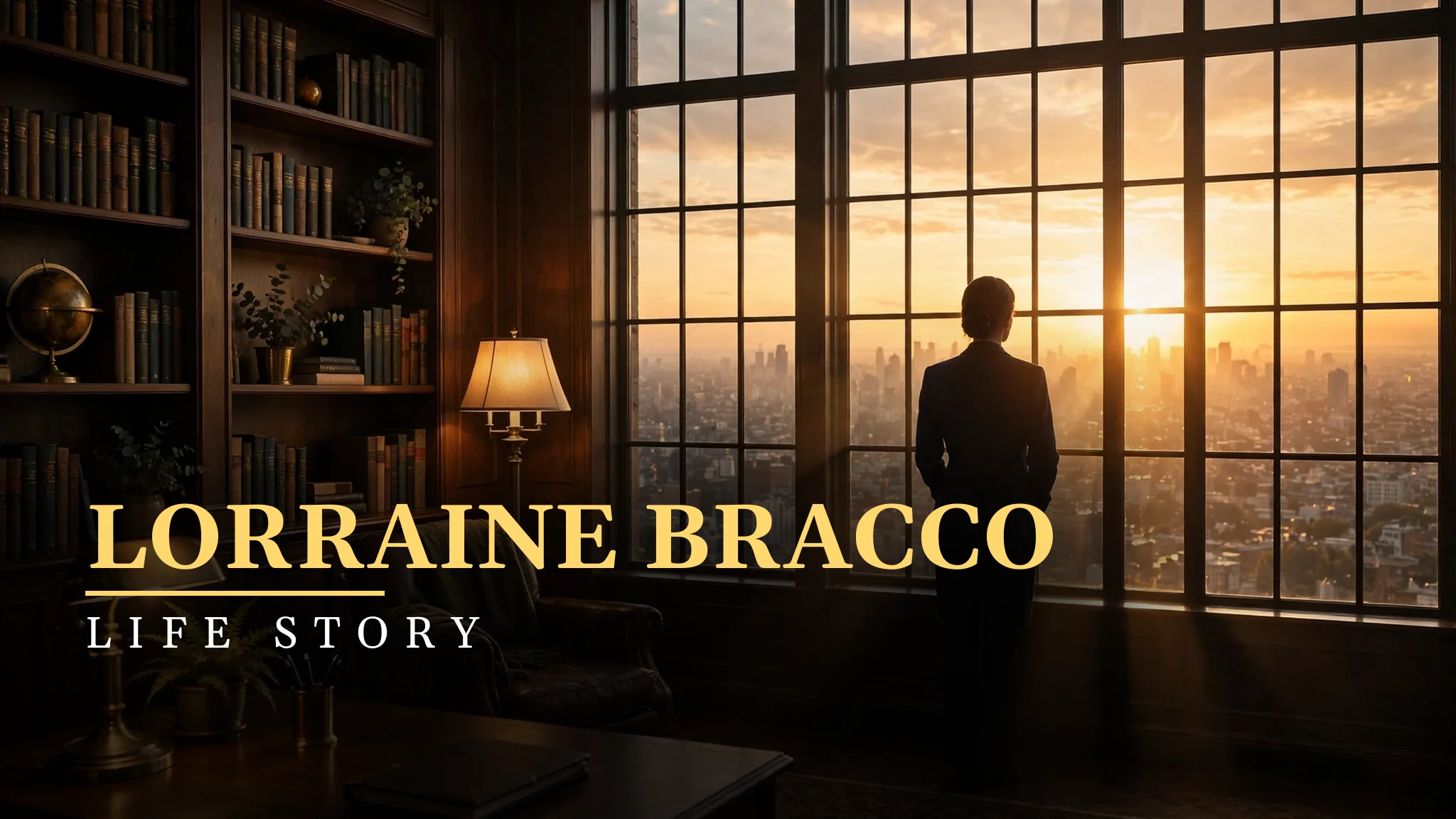
One more thought stays with me. When I picture her, I picture the office in the image for this story: a woman in a dark suit, standing at a huge window at sunset, looking out over a glowing city. That is a good picture of her life, because she has always looked out at the world with courage, and she has never been afraid to see what is coming next. She stands tall, she looks forward, and she keeps going.
I also think about her early return to America, because it shows her courage. She had lived in Paris for many years, she was a single mother, and she came back to the United States in her thirties to start over. That is a hard thing to do. Most people would have stayed where they were comfortable. Bracco started again, in a new country, in a new film industry, and she built a career that made her famous. I think that takes a special kind of strength, the kind that comes from knowing who you are and what you want. She knew she was an actress, and she was not going to let age or circumstance stop her.
Another thing I notice is her role as a mother in The Basketball Diaries, where she plays the mother of a young drug addict. It is a small role, but it is deeply moving, because she shows a woman who loves her son and cannot save him. I think that role tells me something about Bracco herself. She is a mother, and she knows what it means to worry about a child, to love a child, and to feel helpless when that child is in trouble. She brings that real feeling to her acting, and it makes her performances feel true in a way that other actresses cannot match.
I think about her work with James Gandolfini, because their scenes together are some of the finest in television history. They would sit in Dr. Melfi’s office, and Tony would talk, and Melfi would listen, and the whole show would slow down and become deeply human. I think Bracco understood something important about those scenes: that listening is an act of love, and that a good therapist, like a good actress, listens more than she speaks. She played Melfi as a listener, and that listening made the show work. I admire that, because it is a quiet skill, and it is easy to overlook, but it is the heart of great acting.
When I think about her memoir, On the Couch, I feel a deep respect for her honesty. She wrote about her depression, about her therapy, and about a long custody battle over her daughter, and she did not hide the pain. Many famous people write memoirs that make their lives sound perfect. Bracco wrote a book that told the truth, and that truth has helped many people who were facing the same struggles. I think that is a brave and generous thing to do. She turned her pain into something useful, and that is the best thing a person can do with pain.
I also think about her Italian adventure, because it shows that she is still curious and still joyful in her sixties. She went to Sicily, she bought a house, and she made a television show about restoring it. That is a wonderful thing to do, and it shows that she has not stopped living. Many people slow down as they get older. Bracco went to Italy and started a new project, with the same energy she had when she moved to Paris as a teenager. I love that spirit. It tells me that she will keep finding new things to do, for as long as she lives.
I also think about Riding in Cars with Boys, because it shows her as a mother in a way that is deeply moving. She plays Mrs. Donofrio, a tough, loving Italian mother, and she plays the part with a warmth and a humour that makes the character feel real. She is not a background mother. She is a full person, with her own opinions and her own strength, and audiences recognised her. I think that role tells me something about Bracco herself. She is a mother, and she knows what it means to love a child, to worry about a child, and to fight for a child. She brings that real feeling to her acting, and it makes her performances feel true in a way that other actresses cannot match.
Another thing I notice is how much of her work is overlooked because Goodfellas and The Sopranos are so famous. She played mothers, doctors, wives, and professionals in many smaller films, and she made each one feel like a real person. She did not rely on one famous role. She built a career, one part at a time, and she kept working, year after year. That steady work is the reason she has lasted so long. She is not a star who had one great moment. She is an actress who has had many great moments, in films and on television, and who has earned her place through hard work and honesty.
Frequently Asked Questions
Where was Lorraine Bracco born?
Lorraine Bracco was born on 2 October 1954 in the Bay Ridge area of Brooklyn, New York, to an Italian-American family. Her father worked in the fishing business, and she grew up in a working-class neighbourhood where family and honesty mattered.
How did Lorraine Bracco start her career in Paris?
As a teenager, she moved to Paris in the 1970s to work as a model, learned French, and began acting in French films. She lived in the city for many years, worked as a model and a radio disc jockey, and learned the craft of film acting by doing it.
Who did Lorraine Bracco play in Goodfellas?
In Goodfellas from 1990, she played Karen Hill, the wife of mobster Henry Hill, a young woman who loves the excitement and money of the life and then sees its fear and violence. The performance brought her an Academy Award nomination for Best Supporting Actress.
What is Lorraine Bracco’s role in The Sopranos?
In The Sopranos, which ran from 1999 to 2007, she played Dr. Jennifer Melfi, the psychiatrist who treats mob boss Tony Soprano. Her calm, intelligent performance and her scenes with James Gandolfini became the heart of the series, and she was nominated for Emmy Awards.
Did Lorraine Bracco write a book about her life?
Yes, she published a memoir called On the Couch in 2006, in which she wrote honestly about her depression, her therapy, and a long custody battle over her daughter. The book helped many readers who were facing similar struggles.
What did Lorraine Bracco do in Sicily?
In her sixties, she travelled to Sicily, bought and restored a house in the town of Sambuca, and made the television series My Big Italian Adventure about the project. The joyful show reflected her love of Italy and her family roots.
Who are Lorraine Bracco’s children?
She has two daughters, Stella, born in 1985 during her relationship with Harvey Keitel, and Margaux, from her later marriage to Edward James Olmos. She raised Stella as a single mother for many years and has spoken warmly about her family.


