Love Letter That Crashed Computers
In this post
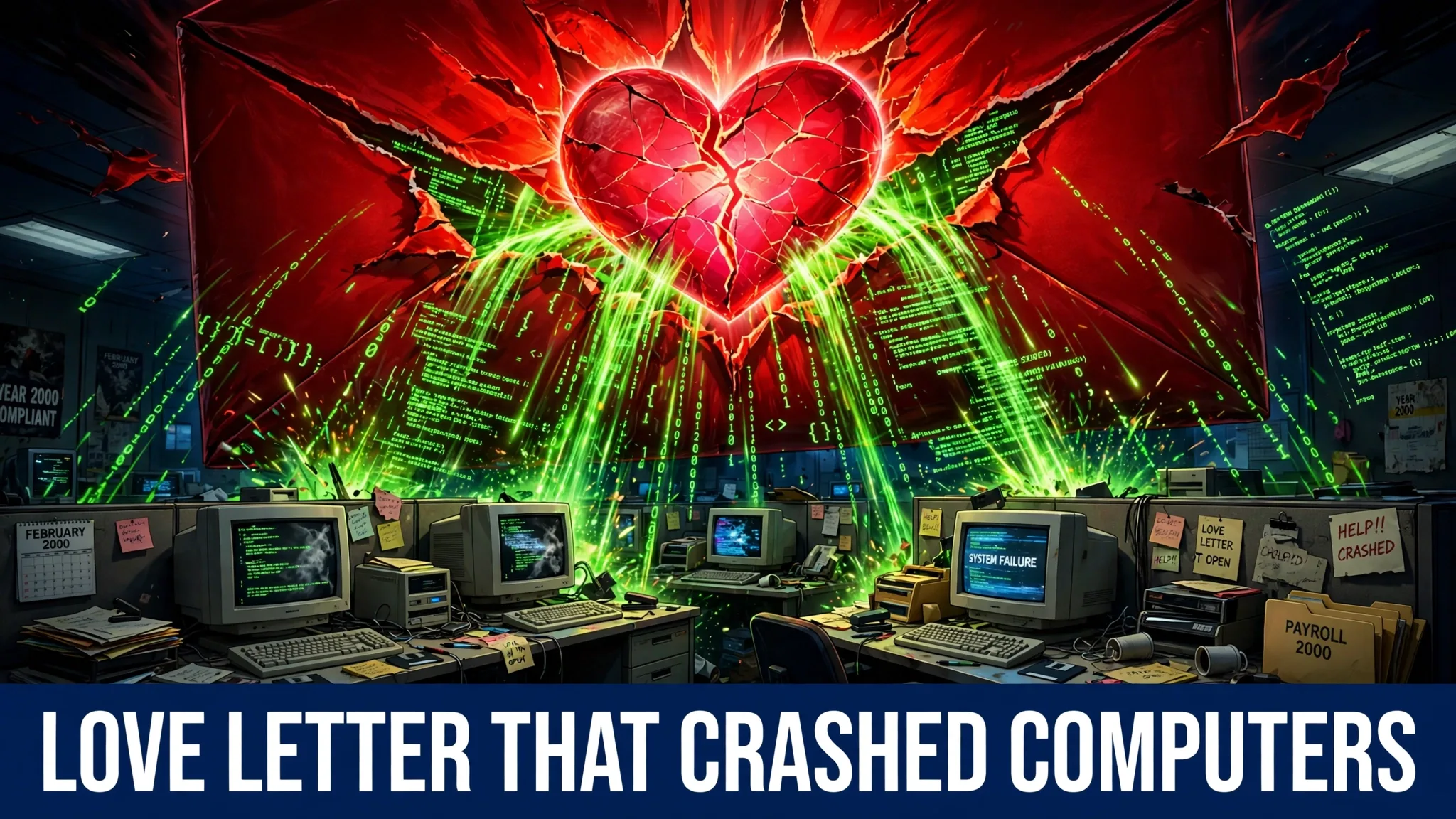
On the morning of 4 May 2000, an office worker somewhere in the world opened her email and found a message with a subject line that almost nobody could walk past: ILOVEYOU.
It had come from a colleague she knew. Attached to it was a small file with a sweet, harmless-looking name: LOVE-LETTER-FOR-YOU. A love letter? For her? From someone at work? Her finger hovered over the mouse for maybe two seconds.
She clicked.
In another country, in a military office, a soldier saw the exact same email sitting in his inbox. It had arrived from a person in his own contacts, inside a system that was supposed to be among the most protected on Earth. He opened it too.
In a government building in London, a secretary got the same message. So did workers in banks, newsrooms, car factories and schools. City after city, desk after desk, the same question burned in every inbox: who loves me?
By the end of that day, the ILOVEYOU virus had raced around the planet — and the only engine it needed was human curiosity.
What the ILOVEYOU virus actually was
The ILOVEYOU virus was a computer worm: a small program built to copy itself from machine to machine without anyone carrying it. It first appeared on 4 May 2000 and began its journey in the Philippines.
It did not look like a weapon. It looked like a love note.
The email itself carried just the subject “ILOVEYOU” and the attachment. The trap was hiding in the attachment’s name: LOVE-LETTER-FOR-YOU.txt.vbs.
Most people only saw the first part — the friendly “.txt”, which made the file look like a plain text document, the safest kind of file there is. Text files cannot run programs. But the real ending of the name was “.vbs”, and that changed everything. A .vbs file is a script — a little program that a Windows computer will happily run when opened. On many computers of that time, the final part of a file name was hidden from view, so the dangerous ending stayed invisible and the innocent-looking “.txt” is all the victim ever saw.
That single trick — a wolf’s name wearing a sheep’s tail — is what turned millions of careful people into clickers.
What happened when you opened the love letter
The moment the attachment opened, the worm worked in two directions at once: outward, to spread, and inward, to damage.
It mailed itself to everyone you knew
The worm opened Microsoft Outlook, the email program used by huge numbers of offices at the time, and read the victim’s entire address book. Then it sent a copy of itself to every single contact in that book.
This is the part that made ILOVEYOU so devastatingly clever. The next victim did not receive a strange message from a stranger. The email arrived from a friend, a boss, a sister, a customer — someone real, someone trusted. And because the subject said ILOVEYOU, it felt personal. Of course a person opens a love letter from someone they know. Almost everybody did.
One opened email could instantly become fifty new emails, and each of those could become fifty more. The worm did not need to break into computers. People carried it inside themselves, click by happy click.
It quietly damaged the computer it landed on
While it was spreading, the worm also hurt the machine it was running on. It searched the computer for picture files, music files and other kinds of documents, and overwrote them — replacing people’s photos and songs with copies of the worm itself.
Imagine opening a folder of family pictures and finding every photo gone, swapped for the same small malicious program wearing your photo’s name. For many victims, those files were simply lost. The love letter did not just visit your computer — it left damage behind.
The damage: a world that had to switch off its email
The spread was so fast and so huge that big organisations took a drastic step: they shut their email systems down completely. No sending, no receiving, nothing. It was the digital equivalent of locking every door in the building because one unwanted guest kept multiplying.
At the time, this was reported at places most people would expect to be unbreakable — including the Pentagon, the CIA and the British Parliament. If the worm could walk into those buildings, it could walk in anywhere.
A commonly cited estimate says around 10 percent of all internet-connected computers in the world were infected. Pause on that number. In the year 2000 the internet was far smaller than today, but a tenth of every connected machine on Earth, hit by one small script that began in the Philippines, was still an astonishing share.
The total bill for the damage and the clean-up was estimated at $10 billion or more — lost work, dead computers, ruined files and armies of technicians scrubbing the worm out of system after system. Both figures are estimates, but even the careful guesses place ILOVEYOU among the most costly computer attacks in history.
To my mind, the scariest part is not the money at all. It is that the worm never forced its way in anywhere. Every single door was opened from the inside, by a person who was simply curious and a little bit hopeful.
The student behind the love letter
Investigators traced the worm back to the Philippines, to a young computer student named Onel de Guzman.
Then the case ran into a wall that nobody expected. At that time, the Philippines had no law against creating a computer virus. Writing and releasing something that damaged computers across the world was not, under the law as it stood there, a crime that could hold. The charges against de Guzman were dropped.
Twenty years later, in a 2020 interview with the BBC, de Guzman said he had not meant for the worm to spread across the whole world. One small program, one young student, one morning in May — and a result bigger than anyone, including its maker, had pictured.
The ILOVEYOU virus changed how the world thinks about email. It is one of the reasons countries strengthened their computer-crime laws, and why security experts still repeat the same lesson today: the most dangerous part of any message is the moment you trust it without looking.
How the same trick can reach you today
The love letter is gone, but its children are in your inbox right now.
The trick never depended on the words “I love you”. It depended on two feelings: trust and curiosity. Modern versions of the same worm-and-scam family wear different costumes:
- A message saying a parcel is waiting for you, with a delivery note attached.
- A fake invoice or bill that looks like it comes from a company you use.
- A prize message claiming you have won something and must open the file or link to claim it.
- An urgent note pretending to be from your bank, your boss or a government office.
The pattern underneath is identical to the year 2000. The message arrives looking familiar or exciting, carries an attachment or a link, and wants one fast, emotional click before your careful brain wakes up. Many of these fakes also arrive from the accounts of real people whose mailboxes were compromised first — so “it came from someone I know” is no longer proof that a message is safe.
How to protect yourself from email viruses
You do not need to be a computer expert to beat this trick. The worm won because people were hurried and trusting. Slow, slightly suspicious readers rarely fall for it.
1. Never open a surprise attachment — even from a friend. If you were not expecting a file, treat it as guilty until proven innocent. Senders get compromised, exactly as they did in 2000. A quick message back — “Did you really send me this?” — costs ten seconds and can save your computer.
2. Look at the full name of every file. The love letter hid behind a double ending: .txt.vbs. Set your computer and phone to show full file names, and train your eye to check the very end of the name before opening anything. If a “photo” or “document” ends in something like .vbs, .exe, .scr or .js, do not open it. Real letters and pictures do not end that way.
3. Be extra careful with emotional subjects. Love, prizes, urgent bills, “your account will be closed”, “your parcel is stuck” — anything made to make your heart beat faster is made to make you skip the checking step. Strong feeling first, click second is the order attackers want. Flip it: check first, feel later.
4. Keep your antivirus and system updated. Modern antivirus tools would stop the original ILOVEYOU script in its tracks, and updates regularly close the doors newer worms use. Turn automatic updates on and let them run. An updated computer is a locked house; an unpatched one has windows left open.
5. Keep copies of your important files somewhere else. ILOVEYOU destroyed photos and music by overwriting them. A backup — on an external drive or a cloud account — turns that kind of disaster into an inconvenience. If a virus ruins the files on your machine, you simply copy your treasures back.
6. If something feels off, stop and ask. Call the company using a number from its real website. Ask a knowledgeable friend. Search for the exact message wording online, because widespread scams get reported quickly. Worms feed on speed and silence. Questions starve them.
Common questions
Was the ILOVEYOU virus really made by one person? Investigators traced it to Onel de Guzman, a young computer student in the Philippines. The charges against him were dropped because the Philippines had no law against making a virus at that time. In a 2020 BBC interview, he said he had not intended it to spread worldwide.
How many computers did the ILOVEYOU virus infect? A commonly cited estimate says about 10 percent of all internet-connected computers in the world were infected. The damage and clean-up costs were estimated at $10 billion or more. Both numbers are estimates, since no one could count every affected machine.
Why did so many smart people open the attachment? Because the email arrived from someone they knew and trusted, and the subject played on pure curiosity. The attachment also looked like a harmless text file, since its real .vbs ending was hidden. The worm was built to be opened by normal, trusting human beings.
Can the ILOVEYOU virus hurt my computer today? The original worm targeted older Windows systems and Microsoft Outlook as they existed in 2000, and modern security tools block it easily. The real danger today is the same trick in new clothes — fake parcel, invoice and prize emails carrying malicious attachments or links.
What should I do if I open a suspicious attachment? Disconnect from the internet, do not open anything else, and run a full scan with updated antivirus software. Change important passwords from a clean device, and tell your contacts to ignore strange messages coming from you, because worms spread through address books.
Sources
- Wikipedia — ILOVEYOU: https://en.wikipedia.org/wiki/ILOVEYOU
- BBC News — ILOVEYOU: The virus that loved everyone: https://www.bbc.com/news/technology-52458765