Ma Sichun: The Life Story Behind China's Talented Star
In this post
Ma Sichun is an actress who does not hide. She does not hide her feelings, she does not hide her struggles, and she does not hide the hard parts of her life. In a world where famous people often show only their best moments, she has shown the difficult ones too, and audiences have loved her for it. She was born in 1988 in Bengbu, a city in Anhui province, and she became famous for the film Soul Mate, in which she won the Golden Horse Award for Best Actress together with her co-star Zhou Dongyu. It was a rare honour, shared between two young women, and it made them both stars.
Her story is not only about awards. It is about growing up in a family connected to film, about starting young, about finding a role that fitted her perfectly, and about facing problems with her health in public, with an honesty that many people found brave. She has spoken openly about depression and about the weight she gained from medication, and she has done so in a country where such things are rarely discussed by famous people. That honesty is part of who she is, and it is part of why her story matters.
This is the story of a talented actress who won early, struggled openly, and kept working. It moves from a childhood in Anhui, through study in Beijing, through early roles in film and television, to the triumph of Soul Mate, and then to the harder years that followed, when she had to learn how to be famous, how to be healthy, and how to be herself, all at the same time.
A Childhood in Bengbu, Close to Film
Bengbu is a city in Anhui province, on the Huai River, a place of ordinary streets, schools, and families. Ma Sichun was born there on 14 March 1988. Her family had a connection to the film world that most children do not have. Her aunt is Jiang Wenli, a well-known Chinese actress, and her mother worked in film as well. Ma Sichun grew up around actors, around film sets, and around the talk of scripts and performances. She saw, from a young age, what an actor’s life looked like, both the glamour and the hard work.
She was a bright and lively child, and she was not afraid of the camera. As a young girl, she appeared in small roles, and she learned how a film set works. She learned that acting is not only about standing in front of a camera and looking pretty. It is about waiting, about repeating a scene many times, and about listening to the director. She learned those lessons early, and they stayed with her.
As a teenager, she had to decide whether she wanted to follow her family into film, or whether she wanted a different life. It was not an easy decision. A family connection can open doors, but it can also bring pressure. People will say that you only got a role because of your family. Ma Sichun knew that, and she decided to prove herself by studying properly. She went to the Communication University of China in Beijing, where she studied broadcasting and acting, and she worked hard to build her own skills, not only her family name.
Her time at university was important. She learned to speak clearly, to present herself, and to understand the media world from the inside. She also learned to be independent. She was no longer only the niece of a famous actress. She was a student, building her own path, and making her own friends. That independence would matter later, when she had to make her own choices about her career and her health.
Early Roles and The Left Ear
After university, Ma Sichun began to work in film and television in earnest. She took roles in dramas and in films, playing young women in love, students, and daughters. She was a natural actress, with a warm face and a way of showing feelings that felt real. Directors liked her, and audiences liked her, but she was not yet a star. She was one of many young actresses trying to build a career in a crowded field.
One of her early notable roles was in The Left Ear, a film released in 2015 about young people, love, and growing up. The film was based on a popular novel, and it was watched by many young people in China. Ma Sichun played a young woman caught in the pains of first love, and she played her with a sincerity that audiences recognised. The film did not make her a star on its own, but it showed that she could carry a serious role in a film about young life, and that she could make the audience feel what her character felt.
She also worked in television, where she played a range of modern young women. Television gave her a steady income and a steady audience, and it taught her how to work fast, how to learn lines quickly, and how to keep her energy up over a long shoot. She was building a career, step by step, and she was learning her craft in the way that most actors learn it: by doing the work, day after day, in front of the camera.
During these years, she was also learning about herself. She was a young woman in her twenties, living in Beijing, working in a demanding industry, and trying to find her place. She was talented, she was hard-working, and she was liked by the people she worked with. But she had not yet found the role that would show the world what she could truly do. That role was coming, and it would change everything.
Soul Mate and a Golden Horse Shared
The role came in 2016, with the film Soul Mate. The film told the story of two girls who become best friends as teenagers, and whose friendship lasts through love, work, and the many changes of adult life. Ma Sichun played Lin Qiyue, one of the two friends, a girl who is warm, loyal, and a little bit wild. Her co-star was Zhou Dongyu, who played the other friend, An Sheng. The two young women had to play a friendship that lasted for years, through happiness and through pain, and they did it with a truth that made audiences weep.
Soul Mate was a great success. It was praised by critics, and it was loved by audiences, especially by young women who recognised their own friendships in the film. The two lead performances were the heart of the film, and they were so closely matched that the judges at the Golden Horse Awards, one of the most important film awards in the Chinese-speaking world, did something rare. They gave the Best Actress award to both women, together. Ma Sichun and Zhou Dongyu shared the prize, and they stood on the stage together, holding the award, crying with joy.
That shared award was a beautiful moment, and it said something important about the film. Soul Mate was not a film about one woman. It was a film about two women, and about a friendship that was bigger than either of them alone. The judges understood that, and they honoured both actresses. For Ma Sichun, it was the greatest moment of her career so far. She was twenty-eight years old, and she had won one of the highest honours in Chinese film. She had proved that she was not only the niece of a famous actress. She was a great actress in her own right.
The award changed her life. She was offered more roles, and better roles, and she became a well-known name across China. She was no longer a young actress trying to be noticed. She was a Golden Horse winner, and directors wanted to work with her. She had reached the top, and she had done it with a film about friendship, about women, and about the kind of love that is not romantic, but is just as deep.
After the Award, the Harder Years
Winning a major award is a wonderful thing, but it also brings a new kind of pressure. After Soul Mate, Ma Sichun was expected to keep winning, to keep choosing great roles, and to keep being the actress everyone admired. That expectation is heavy, and it is hard to carry. She took new roles in film and television, including the film The Shadow Play, and dramas about modern life, but none of them had the same magic as Soul Mate. Some were good, and some were forgettable, and audiences began to wonder if she could find another great role.
At the same time, she was facing problems in her personal life. She began to speak openly about her mental health, about depression, and about the medication she took to treat it. She said that the medication had made her gain weight, and that the weight gain had brought cruel comments from people online. She spoke about this with an honesty that was rare for a famous actress in China. She did not hide her pain. She named it, and she asked for understanding.
That honesty was brave, and it was important. In China, as in many countries, mental health is not often talked about in public, especially not by famous people. People are expected to be strong, to smile, and to hide their problems. Ma Sichun broke that rule. She said that she was struggling, and that she was getting help, and that it was all right to struggle. Many people who had felt alone in their own struggles heard her, and they felt less alone. She became, without trying to, a voice for people who needed one.
The weight gain also became a public issue, in a way that was unfair. People online commented on her body, on her face, and on her clothes, as if her worth as an actress depended on how thin she was. She answered those comments with dignity, and she continued to work. She took roles that suited her as she was, not as people wanted her to be. She showed that an actress can be talented at any size, and that a body is not a measure of a person’s worth. That message matters, and it is one of the most important things she has given to the public.
Love, Work, and Learning to Live in Public
Ma Sichun’s personal life has been much discussed in public, as the personal lives of famous actresses often are. She has had relationships that were talked about online, and she has had to live with the fact that strangers feel free to comment on her love life. She has handled that attention with a mix of openness and privacy. She has shared some things, and she has kept other things to herself. That balance is hard to hold, and she has held it as well as she could.
Her work in recent years has continued, with roles in television dramas and in films. She has played modern women, mothers, and women facing hard choices. She has chosen roles that let her show the depth she has gained from her own life. A woman who has faced depression and come through it understands things about pain that a younger actress cannot understand. Ma Sichun brings that understanding to her roles, and it makes them richer. Her performances now have a weight to them, a sense of a person who has lived, and who knows that life is not always easy.
She has also become known as an actress who is willing to be honest about the film industry itself. She has spoken about the pressure on actresses to look a certain way, about the difficulty of finding good roles for women over thirty, and about the need for better stories about women. She has said these things in a calm and thoughtful way, not in anger, but in the hope that things will change. That hope is shared by many actresses in China, and Ma Sichun’s voice adds weight to it, because she has won a Golden Horse Award, and because she has lived through the pressures she describes.
Her career is now at a stage where she is no longer the young star of Soul Mate. She is a woman in her late thirties, with a great deal of life behind her, and a great deal of work ahead of her. She is still acting, still choosing roles, and still speaking honestly about her life. That honesty is her greatest strength, and it is the reason her story matters beyond the films she has made.
What Honesty Has Cost Her, and Given Her
It is worth asking what Ma Sichun’s honesty has cost her, and what it has given her. It has cost her some privacy, and some comfort. When a famous person speaks about depression, people do not always respond with kindness. Some people say cruel things. Some people say that she is looking for attention. Some people say that she should keep her problems to herself. Ma Sichun has heard those things, and she has kept speaking anyway. That takes courage, and it takes a strong sense of what matters.
What her honesty has given her is harder to measure, but it is real. It has given her the respect of people who have faced the same problems. It has given her a deeper connection with her audience, because they know that she is not pretending. It has given her performances a new depth, because she is drawing on real feelings, not on acting tricks. And it has given her a kind of freedom, the freedom of a person who does not have to hide. Hiding is exhausting. Being honest is also hard, but it is a different kind of hard, and it leaves a person with their dignity intact.
Her story also raises a question about the film industry. Why is it so hard for an actress to be honest about her health? Why does a woman who gains weight face such cruel comments? Why are actresses expected to be perfect, when no real person is perfect? Ma Sichun’s life does not answer those questions, but it asks them, and asking them is a start. If more actresses speak as she has spoken, the industry may slowly change, and the next generation of actresses may find it easier to be themselves.
For now, Ma Sichun continues to work, to live, and to speak. She is a Golden Horse winner, a talented actress, and a woman who has faced hard times in public and kept going. That is a great deal to have achieved by the age of thirty-eight, and it is a story that deserves to be told with respect, not with gossip. Her life is not a scandal. It is a life, with good times and bad times, with success and with struggle, and with an honesty that makes it worth remembering.
The Friendship That Defined Her
It would be wrong to tell Ma Sichun’s story without returning to Soul Mate, and to the friendship at its heart. The film is about two girls who love each other as friends, and whose friendship survives everything that life throws at them. Ma Sichun and Zhou Dongyu played those girls, and their shared award was a recognition of that friendship, both on screen and off it. The two actresses have remained linked by that film, and by that shared moment on the stage, holding one award between them.
That link matters, because it shows that success does not have to be lonely. Two young women can win together. They can share a prize, and the prize can be bigger for being shared. Ma Sichun’s career began, in the eyes of the public, with that shared moment. It was a moment of joy, of tears, and of friendship, and it set the tone for everything that followed. She has had hard years since then, but she has also had that moment, and no one can take it away from her.
Her story is still being written. She is thirty-eight years old, and she has many years of acting ahead of her. If she finds another great role, she will be remembered as one of the finest actresses of her generation. If she does not, she will still be remembered as the woman who won a Golden Horse Award for a film about friendship, and who spoke honestly about her health when it would have been easier to stay silent. Both of those things are worth remembering, and both of them are part of the same person: a talented actress, a brave woman, and a human being who chose honesty over comfort.
The Roles After Soul Mate
After Soul Mate, Ma Sichun took on a series of roles that showed different sides of her talent. She appeared in The Shadow Play, a crime film about a man who returns to his home town and finds that nothing is as it seems. She played a woman caught in a web of secrets, and she played her with a quiet intensity that was different from the warmth of Lin Qiyue. It was a darker role, and it showed that she could do more than play a warm, loyal friend. She could play a woman with secrets, with doubts, and with a complicated inner life.
She also worked in television, playing modern women in dramas about love, work, and family. Those roles were closer to the lives of ordinary viewers, and they asked her to be natural, funny, and real. She played women who go to work, who argue with their partners, and who try to build a life in a big city. Those are not glamorous roles, but they are honest ones, and Ma Sichun played them with the same sincerity she brought to Soul Mate. She did not try to make her characters perfect. She let them be flawed, and that made them believable.
One of the challenges of those years was finding a role as good as Soul Mate. It is hard for any actor to follow a great success, because every new role is compared with the old one. Ma Sichun faced that comparison, and she handled it by not trying to repeat Soul Mate. She looked for different kinds of stories, different kinds of women, and different kinds of directors. Some of those choices worked, and some did not, but each one taught her something, and each one helped her to grow as an actress. She was not afraid to take a risk, even when the risk did not pay off, and that courage is part of what makes her interesting.
Her work in recent years has shown a new depth, a depth that comes from her own life. A woman who has faced depression, who has gained weight, and who has been judged for it, understands things about pain that a younger actress cannot understand. Ma Sichun brings that understanding to her roles, and it makes them richer. Her performances now have a weight to them, a sense of a person who has lived, and who knows that life is not always easy. That weight is not something you can learn from a book. It comes from living, and Ma Sichun has lived, openly, and honestly, in front of the whole country.
My Take:
I think Ma Sichun is one of the bravest actresses in China, and I do not say that only because of her acting. I say it because she spoke openly about depression in a world that tells famous people to smile and hide their pain. That takes a kind of courage that is different from the courage of playing a hard role. Playing a hard role is brave, but it is a kind of bravery that ends when the cameras stop. Speaking about your own mental health is a bravery that does not end. It follows you. People remember it. Some people judge you for it. Ma Sichun did it anyway, and I think that matters more than any award, because it helped people who were suffering in silence to feel less alone.
I want to be careful here, because mental health is a serious subject, and I do not want to make it sound simple. Depression is not sadness. It is not a bad day. It is a heavy, lasting weight that makes ordinary life hard. Ma Sichun has spoken about taking medication, and about gaining weight because of it, and about the cruel comments that followed. I think about how hard that must have been. To be struggling inside, and then to have strangers comment on your body, as if your body were the most important thing about you. That is cruel, and it is unfair, and it happens to women far more than it happens to men. I admire Ma Sichun for answering that cruelty with dignity, and for continuing to work, and for refusing to let other people’s opinions decide her worth.
What I admire most about her acting is the warmth in it. In Soul Mate, she plays Lin Qiyue, a girl who is loyal, funny, and full of life. You can feel the warmth coming through the screen. It is not a performance that tries to impress you with technique. It is a performance that makes you feel like you know her, like she could be your friend. I think that warmth comes from who she is as a person. She is not a cold actress. She is a warm one, and that warmth is rare. Many actors can be clever. Fewer can be warm. Ma Sichun can be warm, and that is why audiences love her, even when her films are not perfect.
I also think about the shared Golden Horse Award, and what it means. Two young women, Ma Sichun and Zhou Dongyu, won the Best Actress prize together. That almost never happens. It happened because the judges could not choose between them, and because the film was about a friendship that was bigger than one person. I find that beautiful. We live in a world that tells women to compete with each other, to fight for the one prize, to see each other as rivals. Soul Mate told a different story. It said that two women can be great together, and that their friendship can be the greatest thing in their lives. Ma Sichun and Zhou Dongyu proved that on screen, and they proved it again when they stood on the stage together, holding one award, crying together. I think that moment will be remembered long after the other details of their careers are forgotten.
There is a sad part to her story, and I want to name it honestly. The sad part is that winning a great award so young can be a burden as well as a joy. After Soul Mate, everyone expected Ma Sichun to keep winning, to keep choosing perfect roles, to keep being the actress she was at twenty-eight. But life does not work that way. People change. They get sick. They gain weight. They make mistakes. They choose the wrong script. Ma Sichun has lived through all of that in public, and the public has not always been kind. I think that is unfair. We should let a person grow, and change, and make mistakes, without deciding that they have failed. Winning an award at twenty-eight does not mean that every year after that must be better. It means that one year was wonderful, and that the person is still a person, with a whole life ahead of her.
I want to say something about her family, and about the pressure of having a famous aunt. Jiang Wenli is a great actress, and having her as an aunt must have opened some doors for Ma Sichun. But it must also have brought a kind of pressure that is hard to describe. People will always say, she only got here because of her family. Ma Sichun answered that by studying hard, by working hard, and by winning a Golden Horse Award on her own merit. No aunt can win an award for you. No family name can make a performance warm and true. Ma Sichun did that herself, and I think she deserves to be judged on her own work, not on her family. I hope she knows that, and I hope the people who doubted her have seen the proof by now.
The lesson I take from Ma Sichun is about honesty, and about what honesty costs and what it gives. Honesty costs comfort. It costs privacy. It costs the easy smile that people expect from a star. But honesty gives something back. It gives dignity. It gives connection. It gives the freedom of not having to pretend. Ma Sichun chose honesty, and she is still standing. She is still working. She is still loved by many people, not in spite of her honesty, but because of it. I think that is a lesson for all of us. We are often afraid to be honest about our struggles, because we think people will judge us. Some people will judge us. But others will feel less alone, and they will thank us, and they will remember our honesty long after they have forgotten our successes. That is a better kind of legacy than fame.
Finally, I want to say that her story makes me think about friendship, and about how rare a true friendship is. Soul Mate is a film about two girls who stay friends through everything. Ma Sichun and Zhou Dongyu played those girls, and their shared award was a tribute to that friendship. In real life, true friendship is just as rare, and just as precious. It is easy to have many acquaintances. It is hard to have one friend who will stay with you through the good years and the bad years. Ma Sichun’s film reminds us to value those friends, to call them, to tell them that they matter. I hope that after reading her story, you will think of your own best friend, and I hope you will tell them what they mean to you. That is what Soul Mate is about, and that is what Ma Sichun’s life, at its best, is about too.
I also think about the way Ma Sichun’s laugh works, because it is such a large part of who she is on screen. In Soul Mate, Lin Qiyue laughs loudly, freely, and without worrying about how she looks. That laugh is infectious, and it makes the audience love her at once. It is not a polite laugh. It is a real laugh, the laugh of a girl who is happy, who is with her best friend, and who does not care who is watching. I think that laugh tells us something important about Ma Sichun. She is not afraid to be joyful, to be loud, and to be herself. In a world where women are often told to be quiet, polite, and small, a loud, joyful laugh is a small act of rebellion. Ma Sichun laughs like that, on screen and, I suspect, in life, and I admire her for it. Joy is not a weakness. It is a strength, and it is one that she shares generously with her audience.
I want to think, too, about what it means to be the niece of a famous actress, and how that shapes a person’s life. Jiang Wenli is a great actress, and having her as an aunt must have opened some doors for Ma Sichun. But it must also have brought a kind of pressure that is hard to describe. Every time she got a role, people would wonder if she got it because of her aunt. Every time she won praise, people would wonder if the praise was for her, or for her family name. That is a heavy weight to carry, and Ma Sichun has carried it with grace. She studied hard, she worked hard, and she won a Golden Horse Award on her own merit. No aunt can win an award for you. No family name can make a performance warm and true. Ma Sichun did that herself, and I think she deserves to be judged on her own work, not on her family. I hope the people who doubted her have seen the proof by now, and I hope Ma Sichun knows that she has nothing left to prove to them.
There is another part of her story that I find moving, and it is the way she has used her fame to talk about things that matter. She has spoken about depression, about medication, and about weight gain, in a country where those things are rarely discussed by famous people. She did not have to do that. She could have stayed silent, smiled for the cameras, and let people think her life was perfect. She chose to be honest, and that honesty helped people. I think about the young woman somewhere in China, struggling with depression, feeling alone, and hearing Ma Sichun say, I struggle too, and it is all right. That young woman would feel less alone, and she might feel brave enough to ask for help. That is a real, human impact, and it is worth more than any award. Ma Sichun’s honesty may have saved lives, in a quiet way, by making it all right to talk about pain. I do not think we should underestimate that. It is one of the most important things she has done, and it is one of the reasons her story matters beyond film.
I want to be honest about something else as well. Ma Sichun’s career after Soul Mate has not been as strong as her career before it, in terms of great roles. She has had good roles, but she has not had another Soul Mate, another film that captures the public’s heart in the same way. That is not her fault. Great films are rare, and they cannot be planned. They happen when the right script, the right director, and the right cast meet at the right time. Ma Sichun had that luck once, at twenty-eight, and she may have it again. She is thirty-eight, and she has many years ahead of her. I hope she finds another great film, because I think she has more to give, and I think the audience is waiting for it. But even if she does not, she has already given us Soul Mate, and that is enough to be remembered by. A single great film can be a legacy, and Soul Mate is hers.
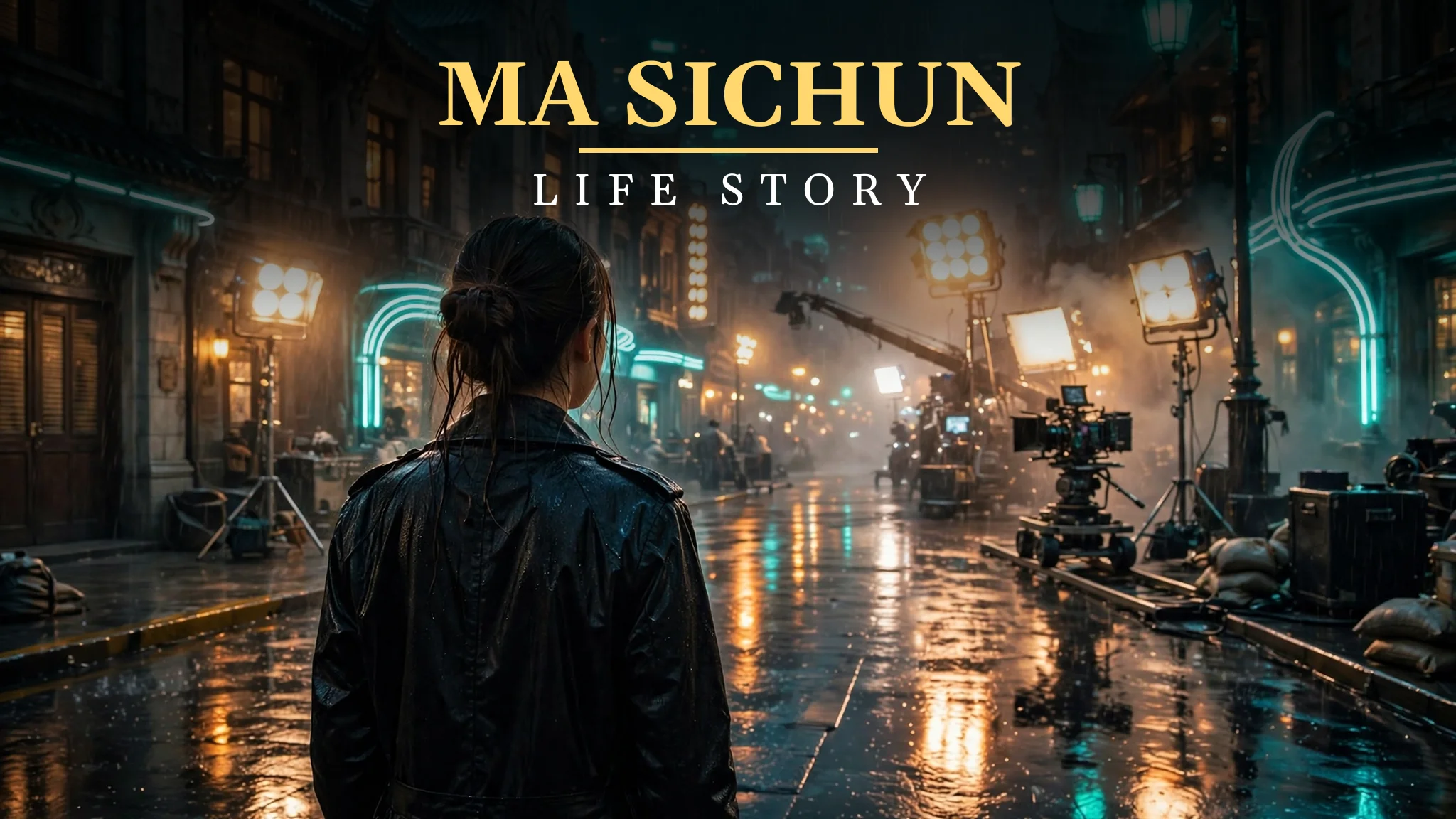
Finally, I want to return to the image of the woman on the rainy film set, standing in the wet street, looking at the lights, which is the image on her cover. That image fits Ma Sichun well, because it shows a woman who is alone, in the rain, in a place built for stories, looking at the lights that will tell her story. She is not running from the rain. She is standing in it, in a wet coat, with her hair tied back, and she is looking forward. That is how she has lived her life: standing in the rain of public attention, of criticism, of illness, and of pressure, and looking forward, with courage. I think that is a beautiful image, and it is a hopeful one. It says that the rain does not last for ever, that the lights are ahead, and that if you keep standing, and keep looking forward, you will find your way. Ma Sichun has done that, and she is still doing it, one day at a time, with honesty and with grace.
I also want to say something about the way Ma Sichun listens to other actors, because listening is one of the quiet skills that makes a performance feel real. In Soul Mate, she does not only deliver her own lines. She listens to Zhou Dongyu, she watches her, and she responds to what she sees. That listening makes their friendship feel true, because a real friendship is built on listening, not only on talking. Many actors forget to listen. They wait for their turn to speak, and they miss what the other person is giving them. Ma Sichun listens, and her listening makes her co-stars better, and it makes the film better. I think that is a lesson for all of us. Listening is not passive. It is active, generous, and hard, and it is one of the most valuable things a person can do, on screen and in life.
Frequently Asked Questions
Who is Ma Sichun and what is she best known for?
Ma Sichun is a Chinese actress born in 1988 in Bengbu, Anhui. She is best known for the film Soul Mate in 2016, for which she shared the Golden Horse Award for Best Actress with her co-star Zhou Dongyu.
Where did Ma Sichun study?
She studied at the Communication University of China in Beijing. Her aunt is the well-known actress Jiang Wenli, but Ma Sichun built her own career through study and work in film and television.
What is Soul Mate about?
Soul Mate is a film about two girls who become best friends as teenagers and whose friendship lasts through love, work, and adult life. Ma Sichun plays Lin Qiyue, one of the two friends, in a performance that won her a shared Golden Horse Award.
Has Ma Sichun spoken about her mental health?
Yes, she has spoken openly about depression and about taking medication for it. She has said that the medication caused her to gain weight, and she has talked honestly about the cruel online comments that followed, becoming a rare public voice on mental health in Chinese entertainment.
Who is Ma Sichun’s famous aunt?
Her aunt is Jiang Wenli, a well-known Chinese actress. Ma Sichun grew up around film because of her family, but she studied acting herself and won her Golden Horse Award on her own merit.
How old is Ma Sichun?
Ma Sichun was born on 14 March 1988, so she was thirty-eight years old in 2026. She won her Golden Horse Award at twenty-eight and has worked in film and television ever since.
What other films has Ma Sichun appeared in?
She appeared in The Left Ear in 2015 before Soul Mate, and later in films such as The Shadow Play, as well as in many television dramas about modern life in China.


