Zhou Dongyu: The Life Story Behind China's Award-Winning Actress
In this post
- A Schoolgirl in Shijiazhuang With No Plans to Act
- Under the Hawthorn Tree and Instant Fame
- Soul Mate and the Award She Shared
- Better Days and the Triple Crown
- The Weight of Being the Best So Young
- What Her Success Means for Ordinary Girls
- A Career Built on Truth, Not Glamour
- The Directors Who Shaped Her
- My Take:
Zhou Dongyu does not look like a film star in the usual way, and that is the first thing to understand about her. She is small, plain, and quiet. She does not have the tall figure or the striking beauty that casting directors usually look for. She looks like an ordinary girl from an ordinary town, and that ordinariness is her greatest gift. When she plays a schoolgirl, a young woman in love, or a girl facing a terrible injustice, audiences believe her at once, because she looks like the girl next door, and she acts like a real person, not like a star.
She was born in 1992 in Shijiazhuang, the capital of Hebei province, a big industrial city near Beijing. She was a schoolgirl with no acting experience when Zhang Yimou, one of the most famous directors in China, chose her from thousands of girls to play the lead in Under the Hawthorn Tree. She was eighteen years old, and she had never acted before. The film made her famous overnight, and it began one of the most remarkable careers in modern Chinese cinema. By her late twenties, she had won the three biggest acting awards in the Chinese-speaking world: the Golden Horse, the Hong Kong Film Award, and the Golden Rooster. Very few actresses have ever done that.
This is the story of how an ordinary girl became an extraordinary actress. It moves from a school in Shijiazhuang, through a lucky audition that changed her life, through the early films where she learned her craft, to the triumph of Soul Mate and the power of Better Days, and then to the years after, when she had to decide what to do with all that success. It is a story about talent, about luck, and about what happens when the two meet in the right person at the right time.
A Schoolgirl in Shijiazhuang With No Plans to Act
Shijiazhuang is the capital of Hebei province, a large city south-west of Beijing, known for its industry and its place on the railway lines that cross northern China. Zhou Dongyu was born there on 31 January 1992. Her family was ordinary. Her mother worked in an insurance company, and her father was a worker. She grew up in a normal home, went to a normal school, and had no connection to the film world. She was a good student, a quiet girl, and a keen dancer in her spare time. She liked to dance, and she was good at it, but she did not dream of becoming an actress. She dreamed, if she dreamed at all, of a normal life.
She was small for her age, and she had a plain, fresh face. People who met her as a teenager would not have guessed that she would become a film star. She did not have the glamour that people associate with actresses. She had something else: a naturalness, a way of being herself without trying to impress anyone. That naturalness would later become the heart of her acting. She did not need to pretend to be ordinary. She was ordinary, and the camera loved her for it.
When she was in high school, a great change came to her life. Zhang Yimou, the director of Hero and House of Flying Daggers, was looking for a young actress to play the lead in his new film, Under the Hawthorn Tree. The film was based on a popular novel about a young girl in the 1970s who falls in love for the first time. Zhang Yimou wanted a girl who looked innocent, who had never acted before, and who could play the part with complete honesty. He held auditions across China, and thousands of girls applied. Zhou Dongyu was one of them, and she was chosen.
It was an extraordinary piece of luck, but it was not only luck. Zhang Yimou saw something in her that other directors might have missed. He saw a girl who did not act like an actress, who did not try to be beautiful, and who could cry, laugh, and love in a way that felt completely real. He chose her, and that choice changed her life for ever. She left school, she went to the film set, and she became, almost overnight, one of the most talked-about young people in China.
Under the Hawthorn Tree and Instant Fame
Under the Hawthorn Tree, released in 2010, told the story of Jing Qiu, a young girl sent to the countryside during the Cultural Revolution, who falls in love with a young man named Lao San. It was a gentle, sad story, about first love in a time when love was not simple. Zhou Dongyu played Jing Qiu with a freshness that audiences had not seen before. She did not act like a trained actress. She acted like a real girl, shy, curious, and full of feeling. People wept in the cinemas, and they remembered her face long after the film ended.
The film was a great success, and Zhou Dongyu became famous at once. She was eighteen years old, and she had never acted before, and now she was on magazine covers, on television, and in the newspapers. It was a lot for a young girl to handle. She had to learn how to be famous while also learning how to act. She went back to school, she studied at the Beijing Film Academy, and she tried to build a real career on the foundation of that first lucky break.
The years after Under the Hawthorn Tree were not easy. Many young actresses who become famous with one film find it hard to find a second good role. They are offered the same kind of part again and again, and they are judged against their first success. Zhou Dongyu faced that problem. She appeared in a number of films and dramas, playing young women in love, students, and daughters. Some of those films were good, and some were forgettable. She was learning, and she was growing, but she had not yet found a role that would show the world how much she had grown since her first film.
She also had to deal with the pressure of being watched. People commented on her looks, on her small size, and on her plain face. Some people said she was not beautiful enough to be a star. She did not answer those comments with anger. She answered them by working harder, by choosing better scripts, and by trusting that her talent would speak for itself. That trust would pay off, but it would take several years, and it would take a film about friendship to do it.
Soul Mate and the Award She Shared
The film that changed everything for the second time was Soul Mate, released in 2016. In it, Zhou Dongyu played An Sheng, one of two girls whose friendship lasts for years, through love, work, and the many changes of adult life. Her co-star was Ma Sichun, who played the other friend, Lin Qiyue. The two young women had to play a friendship that was deep, complicated, and real, and they did it with a truth that made audiences weep. Zhou Dongyu’s performance was wild, free, and full of life. An Sheng is a girl who does not follow the rules, who loves fiercely, and who makes mistakes. Zhou Dongyu played her without fear, and without trying to be likeable.
The film was a great success, and the two lead performances were praised by everyone who saw it. At the Golden Horse Awards, the judges did something rare. They gave the Best Actress award to both women, together. Zhou Dongyu and Ma Sichun stood on the stage together, holding the award, crying with joy. It was a beautiful moment, and it was a recognition that the film belonged to both of them, and that their friendship on screen was the heart of the story.
For Zhou Dongyu, the award was a turning point. She was no longer only the girl from Under the Hawthorn Tree. She was a Golden Horse winner, a serious actress, and a woman who had proved that she could do more than play an innocent schoolgirl. She had shown that she could be wild, that she could be angry, and that she could carry a complex character through a whole film. Directors began to see her in a new way, and they began to offer her the kinds of roles that had once gone to older, more experienced actresses.
Soul Mate also showed something important about Zhou Dongyu’s talent. She is at her best when she plays a real person, with flaws and with feelings, not a perfect heroine. An Sheng is not perfect. She makes bad choices. She hurts the people she loves. But she is real, and Zhou Dongyu made her real. That ability to play an imperfect person with complete honesty is the mark of a great actress, and it is the reason Soul Mate remains one of the most loved Chinese films of recent years.
Better Days and the Triple Crown
If Soul Mate made Zhou Dongyu a star, then Better Days, released in 2019, made her a legend. The film told the story of Chen Nian, a high school girl who is bullied at school, and who finds protection and love in a young man named Xiao Bei, played by Jackson Yee. It was a dark and powerful film, about bullying, about the pressure of school exams, and about the way young people can be hurt by the world around them. Zhou Dongyu played Chen Nian with a quiet strength that held the whole film together.
Chen Nian is a girl who is small, plain, and afraid, but who refuses to give up. She studies hard, she endures the bullying, and she tries to protect herself and the people she loves. Zhou Dongyu played her with a restraint that made the performance even more powerful. She did not cry in every scene. She did not shout. She let the pain show in small ways, in a look, in a silence, in a hand that would not stop shaking. Audiences were moved, and critics were full of praise. The film was a huge success at the box office, and it was talked about across China.
Better Days won Zhou Dongyu the Hong Kong Film Award for Best Actress, and then the Golden Rooster Award for Best Actress, the highest film honour in mainland China. With those two awards, added to her Golden Horse Award for Soul Mate, she had won the three biggest acting prizes in the Chinese-speaking world. She was one of the youngest actresses ever to do that, and one of the very few to hold all three. It was an extraordinary achievement for a woman who was still in her late twenties, and who had started acting with no experience at all.
The triple crown, as it is called, is a rare thing. It means that an actress has been recognised by the film worlds of Taiwan, Hong Kong, and mainland China, three places with different tastes and different traditions. Zhou Dongyu had been recognised by all three, and she had done it with performances that were quiet, honest, and real. She had not won by being glamorous. She had won by being true, and that truth had been seen by judges in three different places, who all agreed that she was the best.
The Weight of Being the Best So Young
Winning all three major awards by the age of twenty-eight is a wonderful achievement, but it also brings a heavy weight. After Better Days, Zhou Dongyu was expected to keep winning, to keep choosing perfect roles, and to keep being the best actress in China. That expectation is hard to carry, especially for a young woman. She took new roles in films and dramas, but none of them had the same power as Better Days. Some were good, and some were ordinary, and audiences began to wonder if she could find another great role.
She also faced the problem that comes with being so good at playing young girls. She was in her late twenties, and she was still being offered schoolgirl roles, because she looked young and because she played them so well. But she was growing older, and she wanted to play adult women, with adult problems. That change is hard for any actress, and it is especially hard for one who became famous as a schoolgirl. She has tried to make the change, taking roles as young mothers, as working women, and as women facing the problems of adult life. Some of those roles have worked, and some have not, but she keeps trying.
There have also been criticisms. Some people have said that her recent films are not as strong as her best work. Some have said that she chooses her scripts badly, or that she is too focused on commercial success. She has not answered those criticisms with anger. She has kept working, and she has kept looking for better scripts. That patience is the same patience she showed as a young girl, when she waited for the right role after Under the Hawthorn Tree. She knows that a career is long, and that one weak film does not end it.
Her private life has been kept mostly out of the public eye. She does not share much about her relationships, and she does not seek attention when she has no work to show. She is known as a quiet and serious person, a woman who takes her work seriously and who does not chase fame for its own sake. That quietness is part of who she is, and it is part of why her acting feels so honest. She does not perform in her private life. She saves her performances for the screen.
What Her Success Means for Ordinary Girls
Zhou Dongyu’s story matters for a reason that goes beyond film. She is an ordinary-looking girl from an ordinary city, and she became one of the most honoured actresses in China. That matters, because it tells ordinary girls everywhere that they do not need to be beautiful in the usual way to succeed. They need to be talented, they need to work hard, and they need a little bit of luck. Zhou Dongyu had all three, and she used them well.
Her success also matters because of the roles she has chosen. She has played girls who are bullied, girls who are poor, girls who are afraid, and girls who fight back. Those are not glamorous roles, but they are real roles, and they speak to the lives of millions of young people in China. A girl who is bullied at school can watch Better Days and see herself on screen. A girl who feels small and plain can watch Under the Hawthorn Tree and see herself too. That kind of recognition is powerful, and it is one of the most important things a film can do.
She has also shown that a small, plain actress can be a leading lady, and that the film world does not need to be limited to tall, beautiful women. That message is important, not only for actresses, but for all women who have been told that they are not pretty enough, not tall enough, or not striking enough. Zhou Dongyu’s career says that those things do not matter as much as people think. What matters is talent, honesty, and the courage to be yourself in front of a camera.
Her story is still being written. She is thirty-four years old, and she has many years of acting ahead of her. She has already achieved more than most actresses achieve in a lifetime, and she has done it by being herself, by working hard, and by choosing roles that matter. If she continues as she has begun, she will be remembered as one of the great actresses of her generation, a woman who proved that an ordinary girl can do extraordinary things, and that the camera loves truth more than it loves beauty.
A Career Built on Truth, Not Glamour
Looking back over Zhou Dongyu’s career, one thing stands out above all others: she has built it on truth, not on glamour. She did not become famous by being the most beautiful girl in the room. She became famous by being the most honest girl in the room. She played a schoolgirl with complete honesty. She played a wild friend with complete honesty. She played a bullied girl with complete honesty. Each time, the audience believed her, because she was not pretending to be someone else. She was finding the truth of the character inside herself, and letting it show.
That approach to acting is not easy. It demands that an actress be open, vulnerable, and willing to show feelings that most people hide. Zhou Dongyu has been willing to do that, again and again, and it is the reason her best performances stay in the mind long after the film ends. People do not remember her for a beautiful dress or a perfect pose. They remember her for a look, for a silence, for a moment when her character’s pain felt like their own pain. That is the highest praise an actress can receive, and it is the praise that Zhou Dongyu has earned many times over.
Her legacy is already secure, even though she is still young. She has won the three biggest awards. She has played in films that millions of people love. She has shown that an ordinary girl can become a great actress. What comes next is less certain, but it is also less important. Whatever she does next, she has already proved what she needed to prove. She has proved that truth is more powerful than glamour, and that a small, plain girl from Shijiazhuang can stand on the greatest stages in Chinese cinema and be recognised as the best. That is a story worth telling, and it is a story that will be told for many years to come.
The Directors Who Shaped Her
Zhou Dongyu has worked with some of the most important directors in Chinese cinema, and each one has shaped her in a different way. Zhang Yimou discovered her, and he taught her how to be natural in front of a camera, how to trust her instincts, and how to let a scene breathe. He did not teach her to act like a star. He taught her to act like a real girl, and that lesson stayed with her for her whole career. She has said, in effect, that Zhang Yimou gave her a start, and that she has carried his teaching with her ever since.
She also worked with Derek Tsang on Better Days, a director who tells stories about young people with great seriousness and care. Tsang asked her to play Chen Nian with restraint, to hold back her feelings, and to let the pain show in small ways. That was a different kind of acting from Soul Mate, where she was wild and free. In Better Days, she had to be quiet, controlled, and still, and she did it beautifully. Working with Tsang taught her that silence can be more powerful than shouting, and that a small gesture can say more than a long speech. That lesson made her a better actress, and it is one of the reasons Better Days is so powerful.
She has worked with other directors as well, in films about love, about family, and about modern life. Each director has asked something different of her, and she has adapted, without losing herself. She does not become a different actress for each director. She brings her own honesty to each film, and she lets the director shape it, guide it, and deepen it. That balance, between being herself and listening to others, is the mark of a professional, and it is one of the reasons directors want to work with her again and again.
That experience with great directors has also given her a wide view of cinema. She has seen how films are made in different styles, how stories are told in different ways, and how a performance can change depending on the director’s vision. She has learned that acting is not a solo art. It is a collaboration, between the actress, the director, the other actors, and the crew. Zhou Dongyu understands that, and she works as part of a team, not as a star above it. That humility is rare, and it is one of the reasons her career has lasted, and will continue to last, for many years.
My Take:
I think Zhou Dongyu is the most hopeful actress in China, and the reason is simple: she looks like an ordinary girl, and she became extraordinary. I do not mean that as an insult. I mean it as the highest praise I can give. The film world is full of beautiful people, and it is easy to think that beauty is the price of entry. Zhou Dongyu proves that it is not. She is small, plain, and quiet, and she has won the three biggest acting awards in the Chinese-speaking world. She did it by being honest, by working hard, and by playing real people in a way that made audiences believe her. I think that is a message that every ordinary girl needs to hear, because most girls are ordinary, and most girls are told, in one way or another, that ordinary is not enough. Zhou Dongyu’s life says that ordinary is enough, if you add talent, work, and courage to it.
What I admire most about her is the way she plays girls who are hurt, and who keep going. Chen Nian in Better Days is bullied at school. She is small, she is afraid, and the world is cruel to her. But she does not give up. She studies, she endures, and she protects the people she loves. I think that performance matters because bullying is real, and it happens in schools everywhere, in China and in every other country. A girl who is bullied can watch Better Days and see herself, and she can see that she is not alone, and that she can survive. That is a powerful thing for a film to do, and it is a powerful thing for an actress to give to the world. Zhou Dongyu gave it, and she gave it without shouting, without overacting, and without asking for pity. She simply showed the truth, and the truth was enough.
I also think about the shared award with Ma Sichun, and what it says about friendship between women. Two young women won the Best Actress prize together for Soul Mate, a film about two girls who stay friends through everything. I find that beautiful, because the world often tells women to compete, to fight for the one prize, to see each other as enemies. Zhou Dongyu and Ma Sichun did the opposite. They shared the prize, and they shared the joy, and they showed that two women can be great together. I think that is a lesson that goes beyond film. In any kind of work, in any kind of life, we do better when we help each other than when we fight each other. Zhou Dongyu’s career began with a shared triumph, and I think that shared triumph set the tone for everything that followed.
There is a sad part to her story, and I want to be honest about it. The sad part is that winning everything so young can be a burden. She won the Golden Horse, the Hong Kong Film Award, and the Golden Rooster before she was thirty. What do you do after that? Where do you go? Every new film is compared to Better Days, and every new performance is judged against the best work of her life. That is a heavy weight for a young woman to carry. I think about how hard it must be to wake up each morning knowing that people expect you to be perfect, and knowing that you are not perfect, because no one is. I hope she has people around her who remind her that she does not need to win another award to be a great actress. She already is one. The awards were a recognition of that, not the reason for it.
I want to say something about luck, because luck is a big part of her story, and I do not want to pretend it is not. She was chosen by Zhang Yimou from thousands of girls. That was luck. She was in the right place at the right time, and she had the right face for the part. But luck alone does not explain her career. Many girls have been chosen by a great director and then disappeared. Zhou Dongyu did not disappear. She studied, she worked, she chose her roles with care, and she grew into a great actress. Luck opened the door, but talent and hard work kept her in the room. I think that is an honest way to look at success. Luck matters, and we should be grateful for it when it comes. But luck is not enough. You have to be ready when it comes, and you have to work after it comes, or the luck will be wasted. Zhou Dongyu was ready, and she worked, and that is why her luck turned into a career.
I also think about what her story says about beauty, and about the pressure on women to look a certain way. Zhou Dongyu is not beautiful in the usual film-star way. She is small, she is plain, and she does not try to be glamorous. Some people have criticised her for that, as if a woman’s worth depended on her looks. I think that criticism is wrong, and I think her career is the answer to it. She has proved that an actress can be great without being beautiful in the usual way. She has proved that the camera loves truth more than it loves beauty. I hope that young girls who watch her films understand that message. You do not need to be tall, or striking, or glamorous to matter. You need to be yourself, and to be honest, and to work hard. That is enough, and Zhou Dongyu is the proof.
The lesson I take from her is about the power of being real. In a world full of filters, of perfect photographs, and of people pretending to be happier than they are, being real is a radical act. Zhou Dongyu is real on screen. She cries real tears. She shows real fear. She lets the audience see her as she is, small and plain and afraid, and she does not apologise for it. I think we need more of that, not only in film, but in life. We need people who are willing to be real, to show their flaws, and to say, this is who I am. It is not perfect, but it is true. Zhou Dongyu says that with her acting, and I think it is one of the most valuable things she has given us.
Finally, I want to say that her story makes me feel hopeful about the future. She is thirty-four years old, and she has already done more than most actresses do in a lifetime. But she is still young, and she still has many years ahead of her. She may find another great role, or she may not. Either way, she has already proved what she needed to prove. She has proved that an ordinary girl from Shijiazhuang can become one of the greatest actresses in China, not by changing who she is, but by being more fully who she is. That is a message I want every young person to hear, in China and everywhere else. You do not need to be someone else to succeed. You need to be yourself, and to work hard, and to trust that the truth will be recognised. Zhou Dongyu trusted that, and the truth was recognised, three times, by three different groups of judges, in three different places. That is not luck. That is a life lived honestly, and it is a life worth admiring.
I also think about the way Zhou Dongyu’s eyes work on screen, because they are such a large part of her acting. Her eyes are small, plain, and honest. They do not sparkle like a movie star’s eyes. They look like the eyes of a real girl, a girl who is thinking, feeling, and trying to understand the world. When she is sad, her eyes fill with tears, but she does not cry loudly. When she is happy, her eyes light up, but only a little, in a quiet way. That subtlety is rare, and it is powerful, because it makes the audience lean in closer, to see what she is feeling. A loud performance pushes the audience away. A quiet performance pulls them in. Zhou Dongyu pulls the audience in, with her eyes, with her silence, and with her honesty. I think that is a gift, and it is one that cannot be taught. You either have it, or you do not, and Zhou Dongyu has it.
I want to think, too, about what it means to be small in a world that values tallness. Zhou Dongyu is small, and she has been told, many times, that she is too small, too plain, too ordinary to be a star. She did not listen. She kept working, kept acting, and kept proving that smallness is not a weakness. A small person can be strong. A small person can be brave. A small person can carry a film on her shoulders, as Zhou Dongyu did in Better Days. I think that is a message that matters, not only for actresses, but for all people who have been told that they are too small, too short, too plain, or too ordinary. You are not too small. You are the right size, and your size does not decide your worth. Zhou Dongyu’s career is the proof. She is small, and she is one of the greatest actresses in China. That is a fact, and it cannot be argued with, no matter how many people say she is too small.
There is another part of her story that I find moving, and it is the way she has handled being a role model. She did not ask to be a role model. She became famous as a schoolgirl, and then as a young woman, and millions of girls looked up to her. They saw themselves in her, because she looked like them, ordinary, small, and plain. That is a heavy responsibility, and Zhou Dongyu has carried it with grace. She has not tried to be perfect. She has not pretended to be someone she is not. She has simply been herself, worked hard, and let her work speak. I think that is the best kind of role model: not a perfect person, but an honest one, who shows that an ordinary girl can do extraordinary things. Young girls who watch her films do not need to be beautiful to succeed. They need to be talented, honest, and hard-working, and Zhou Dongyu shows them that those things are enough.
I want to be honest about something else as well. Zhou Dongyu’s recent films have not all been as strong as Better Days, and some people have said that she is struggling to find good roles as she grows older. I think there is some truth in that, but I also think it is unfair to judge a woman of thirty-four as if her career were over. She is still young. She is still learning. She has the talent, the training, and the experience to find great roles, if she chooses carefully. I hope she takes her time, chooses scripts that matter, and does not rush into films that do not suit her. A great actress does not need to work all the time. She needs to work well, when the right role comes. Zhou Dongyu has worked well before, and I believe she will work well again, when the right script finds her. I hope she waits for it, and I hope we wait with her, patiently, because great work is worth waiting for.
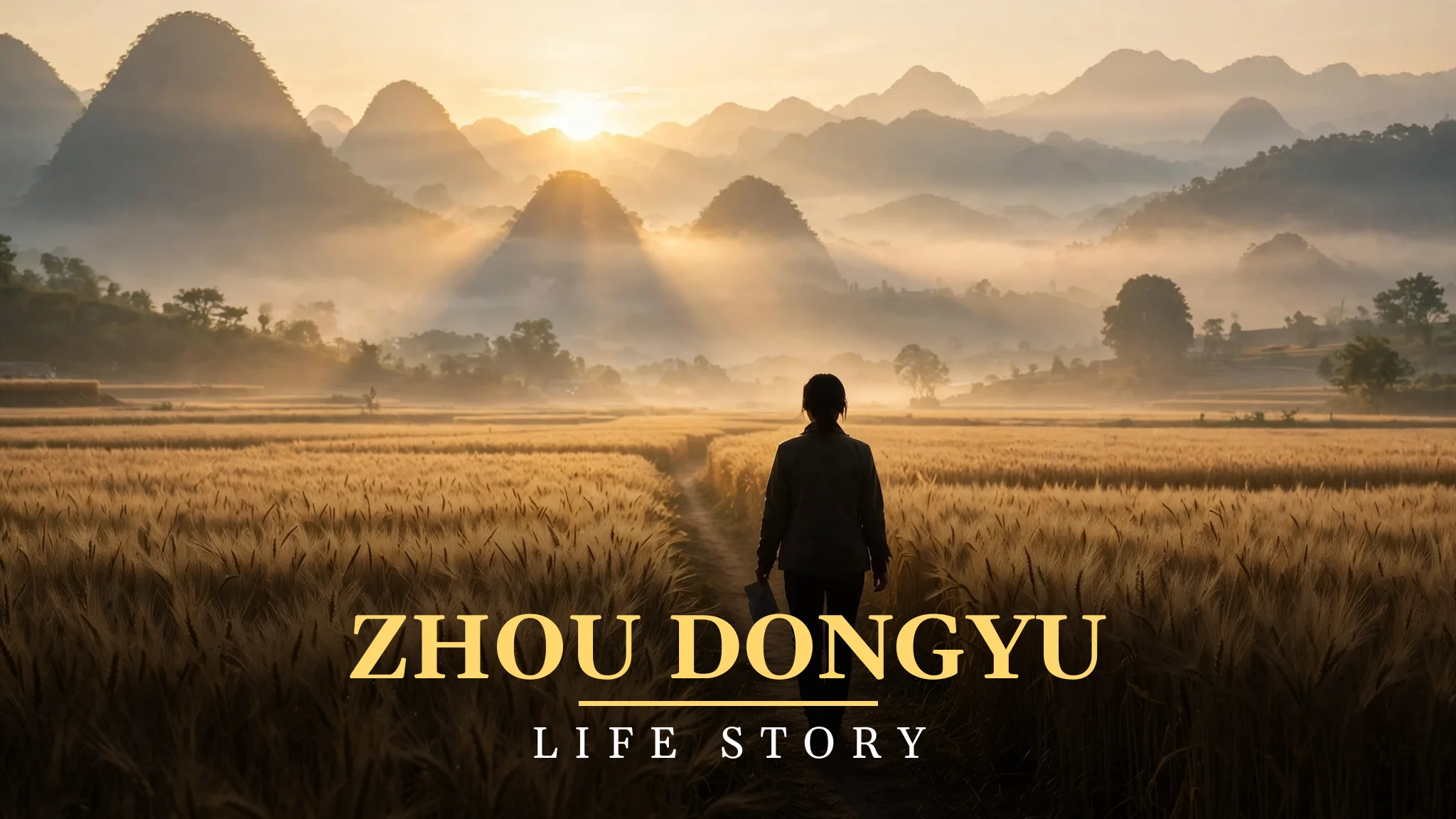
Finally, I want to return to the image of the woman walking through golden wheat fields toward the mountains at sunrise, which is the image on her cover. That image fits Zhou Dongyu perfectly, because it shows a small figure, walking alone, on a narrow path, through a large and beautiful landscape, toward the light. She is not running. She is walking, steadily, with a small paper in her hand, toward the mountains. That is the story of her life, in a way. She started as a small girl in Shijiazhuang, she walked a narrow path through the film world, and she is still walking, toward the light, toward the next great role, toward whatever comes next. I think that is a beautiful image, and it is a hopeful one. It says that the path may be narrow, and the figure may be small, but the landscape is large, and the light is ahead, and if you keep walking, you will reach it. Zhou Dongyu has kept walking, and she is still walking, and I believe she will reach the light, again and again, for many years to come.
Frequently Asked Questions
Who is Zhou Dongyu and how did she become famous?
Zhou Dongyu is a Chinese actress born in 1992 in Shijiazhuang, Hebei. She became famous at eighteen when director Zhang Yimou chose her from thousands of girls to play the lead in Under the Hawthorn Tree in 2010, even though she had never acted before.
What awards has Zhou Dongyu won?
She has won the three biggest acting awards in the Chinese-speaking world: the Golden Horse Award for Soul Mate, the Hong Kong Film Award for Better Days, and the Golden Rooster Award for Better Days. Very few actresses have ever won all three.
What is Better Days about?
Better Days is a 2019 film about Chen Nian, a high school girl who is bullied at school and finds love and protection from a young man named Xiao Bei. Zhou Dongyu’s quiet, powerful performance won her the Hong Kong Film Award and the Golden Rooster Award for Best Actress.
What is Soul Mate about and who co-starred with Zhou Dongyu?
Soul Mate is a 2016 film about two girls whose friendship lasts through love, work, and adult life. Zhou Dongyu played An Sheng, and Ma Sichun played Lin Qiyue. The two actresses shared the Golden Horse Award for Best Actress, a rare honour.
Where did Zhou Dongyu study acting?
After her debut in Under the Hawthorn Tree, she studied at the Beijing Film Academy, China’s top film school, where she trained in acting while building her film career.
How old is Zhou Dongyu?
Zhou Dongyu was born on 31 January 1992, so she was thirty-four years old in 2026. She won her first major award at twenty-four and had won all three major awards by her late twenties.
Why is Zhou Dongyu called an ordinary-looking star?
She is small and plain-looking compared with many film stars, and she looks like an ordinary girl from an ordinary town. That ordinariness is seen as her greatest strength, because it makes her performances as schoolgirls and young women feel completely real and believable.


