Marc Forster: The Life Story Behind Switzerland's Hollywood Director
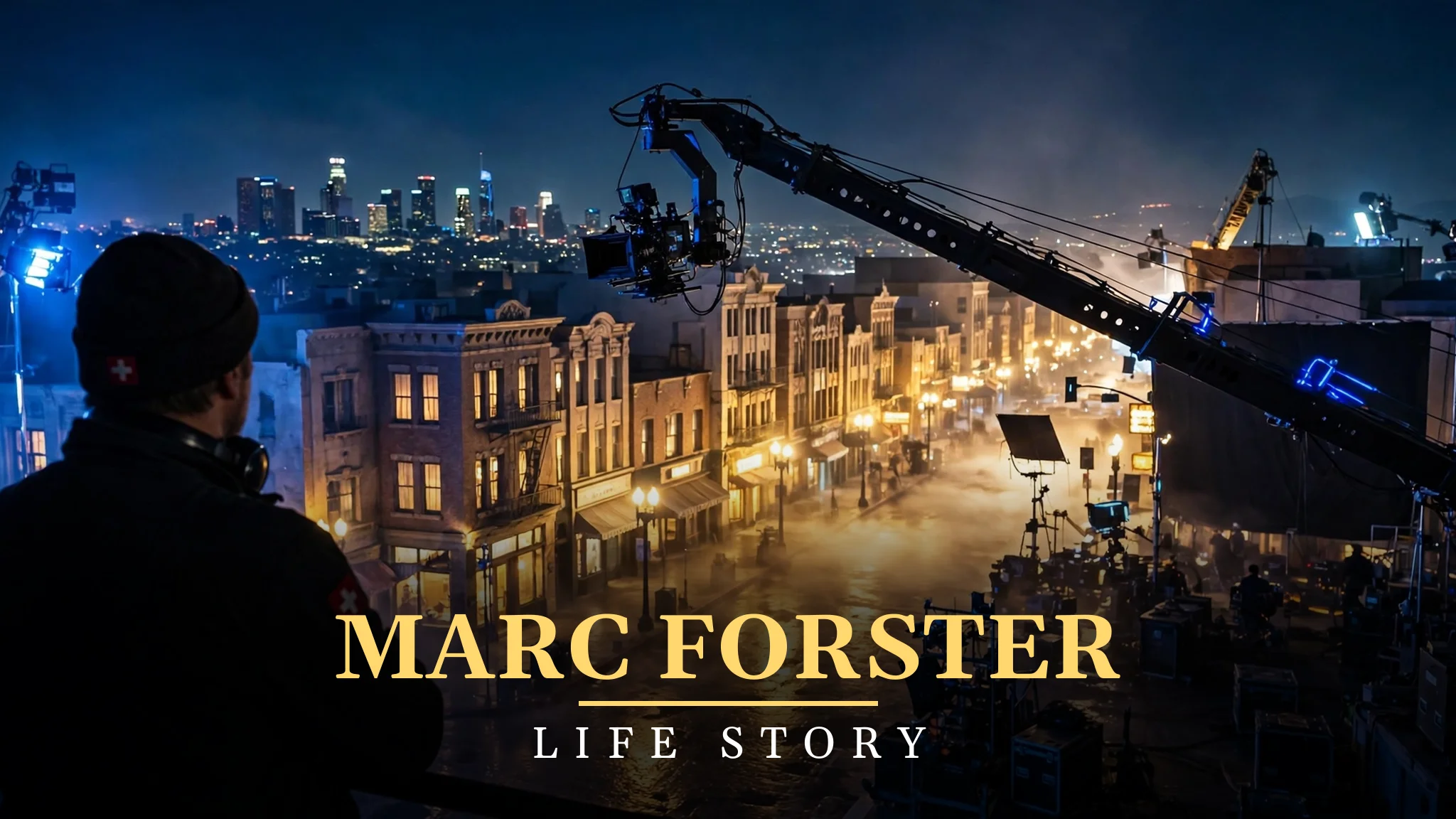
In this post
Some directors make one kind of film, again and again, until the audience knows exactly what to expect. Marc Forster is not one of those directors. He has made a drama about a man on death row, a fantasy about the writer of Peter Pan, a film about a man whose life is being written by a voice only he can hear, a James Bond adventure, a zombie epic, and a gentle story about a toy bear coming to life. The films do not look the same, they do not feel the same, and they do not belong to one genre. What links them is a director who cares about people, about the quiet moments in a life, and about the way a story can make an audience feel something real.
Forster was born in Germany and raised in Davos, Switzerland, a mountain town known for its clean air and its winter sports. He grew up far from Hollywood, in a place where the mountains are high and the winters are long, and he learned to tell stories in a way that was calm, careful, and full of feeling. He moved to America as a young man, he studied film in New York, and he worked his way up through small films, through documentaries, and through years of learning how a film is made, from the first idea to the last day in the editing room.
His breakthrough came with Monster’s Ball in 2001, a film that won Halle Berry an Academy Award and made the world notice a new director. After that, he made Finding Neverland, The Kite Runner, Quantum of Solace, World War Z, Christopher Robin, and A Man Called Otto, films that reached millions of people and that showed a director who could work on a large scale without losing the human heart of the story. This is the story of how a boy from Davos became one of the most versatile directors in Hollywood, and how he kept his Swiss calm in a world that is often loud and fast.
Davos and a Childhood in the Mountains
Marc Forster was born on 27 November 1969 in Illertissen, Germany, and he was raised in Davos, Switzerland, a town in the Swiss Alps known for its ski slopes and its fresh mountain air. Davos is a place where the seasons are strong, where winter brings snow and summer brings green valleys, and where life moves at a slower pace than in a large city. For a child with a love of stories, that pace was a gift. He had time to watch, to listen, and to imagine, and he learned to pay attention to small details, to the way light falls on snow, to the way people talk when they think no one is listening.
His family was not a film family, and he did not grow up on a film set. He grew up in a normal Swiss town, with school, with friends, and with the mountains around him. He loved films from a young age, and he watched them with a care that went beyond simple enjoyment. He noticed how a story was told, how a camera moved, and how music could change the feeling of a scene. That early love of film was not a hobby. It was a calling, and it stayed with him as he grew older, even when the road to Hollywood seemed far away.
As a teenager, he began to think seriously about making films, and he knew that he would need to leave Davos to learn the craft. Switzerland has a film industry, but it is small, and Hollywood was where the largest films were made. He did not leave in a hurry. He took time to learn, to watch, and to prepare, and he kept the calm of his mountain town with him, a calm that would later help him on large film sets where many people are shouting and many things are happening at once. That calm became one of his marks as a director, a man who could stay steady when the set was chaotic.
The years in Davos mattered because they gave him a sense of place and a sense of story. He learned that a good story does not need to be loud to be powerful, that a quiet moment can be more moving than a big action scene, and that people are at the centre of every film, no matter how large the budget. Those lessons, learned in a small town in the Alps, travelled with him to New York and to Los Angeles, and they shaped every film he would later make.
New York, Film School, and the Long Road Up
In 1990, Forster moved to the United States to study film at New York University, one of the most respected film schools in America. New York was a world away from Davos, a large, loud, and fast city, full of people, full of noise, and full of stories. He had to learn a new way of life, a new language of film, and a new way of working with people who came from many different backgrounds. He did not lose himself in the city. He kept his Swiss discipline, he worked hard, and he learned the craft step by step.
At film school, he made short films and he learned how to write, how to direct actors, and how to work with a camera. He also learned how hard it is to make a film, how many people are needed, how much money is needed, and how many things can go wrong. That knowledge is important for any director, because a film is not only an art. It is also a job, with a budget, a schedule, and a team, and a director must manage all of it while also keeping the story alive. Forster learned that balance early, and it served him well in the years that followed.
After film school, he worked on small projects, including documentaries, and he made his first feature film, Loungers, in 1995. The film was small, it was made with a limited budget, and it did not reach a large audience, but it was a start. It showed that he could make a full film, that he could work with actors, and that he could tell a story from start to finish. Many young directors never get that far, because a first film is hard to finish, and Forster finished his, and that gave him the confidence to keep going.
He continued to work, to write, and to look for the right story, and in 2000 he made the film Everything Put Together, a drama about a woman dealing with loss. The film was shown at film festivals, and it was noticed by people in the industry, because it showed a director who could handle a difficult subject with care and with honesty. It was not a big commercial film, but it was a sign that Forster was ready for a larger stage. The next film would prove it, and it would change his life.
Monster’s Ball and a Breakthrough
The breakthrough came with Monster’s Ball, released in 2001. The film told the story of a prison guard, played by Billy Bob Thornton, and a woman, played by Halle Berry, whose husband has been executed, and it dealt with grief, with racism, and with the need for human connection in a hard world. It was a difficult film, with strong emotions and with scenes that were painful to watch, and Forster directed it with a calm and a care that made the story feel real rather than sensational.
Halle Berry won the Academy Award for Best Actress for her performance, becoming the first Black woman to win that award, and the film was praised by critics around the world. For Forster, it was a moment of arrival. He was no longer a young director with a small film. He was a director who had made a film that won an Oscar, and who had shown that he could work with great actors and tell a story that mattered. The film also showed his style, a style that was quiet, that trusted the actors, and that let the audience feel the story rather than being told how to feel.
After Monster’s Ball, Hollywood noticed him, and he was offered larger films. He could have chosen to make the same kind of drama again, but he chose a different path. He chose a film about the writer J. M. Barrie and the creation of Peter Pan, a film that was gentle, magical, and full of wonder. That choice showed that he was not a director who wanted to repeat himself. He wanted to try new things, to tell different kinds of stories, and to learn from each film he made. That willingness to change would define his career.
Monster’s Ball remains one of his most important films, not only because it won an Oscar, but because it showed what he could do with a difficult subject. It showed that he could handle actors, that he could handle emotion, and that he could make a film that was both artistic and human. It was the film that opened the door to Hollywood, and he walked through that door with a calm that came from his years in Davos and in New York, and with a clear idea of the kind of director he wanted to be.
Finding Neverland and the Magic of Storytelling
Finding Neverland was released in 2004, and it became one of Forster’s most loved films. It told the story of J. M. Barrie, the Scottish writer who created Peter Pan, and it showed how Barrie found inspiration in a family of four boys and their mother, played by Kate Winslet. Johnny Depp played Barrie, and the film was warm, sad, and magical, with a story that moved between the real world and the world of imagination. Forster directed it with a light touch, letting the magic grow slowly, and letting the audience believe in it.
The film was nominated for the Academy Award for Best Picture, and it won the Oscar for Best Original Score. It was a success with audiences and with critics, and it showed a different side of Forster, a director who could make a family film that was not simple or childish, but deep and emotional. He treated the story of Peter Pan with respect, and he showed that a film about imagination could also be a film about loss, about grief, and about the need to keep a child’s wonder alive in an adult world.
After Finding Neverland, Forster made the film Stay in 2005, a thriller about a psychiatrist and a patient, and then Stranger than Fiction in 2006, a comedy drama about a man who discovers that his life is being narrated by a voice only he can hear. Stranger than Fiction was a clever and funny film, with Will Ferrell in a serious role, and it showed again that Forster could move between genres, from drama to fantasy to comedy, without losing his touch. Each film was different, and each one showed a new side of his talent.
In 2007, he directed The Kite Runner, based on the best selling novel by Khaled Hosseini, a story about friendship, guilt, and redemption in Afghanistan. The film was praised for its faithful telling of the novel, and for its sensitive handling of a difficult subject. Forster had now made films in many genres, and he had shown that he could handle a large story, a small story, a funny story, and a sad story, all with the same care and the same calm. That range is rare among directors, and it is one of the reasons he was trusted with larger films in the years that followed.
James Bond, World War Z, and the Big Blockbusters
In 2008, Forster directed Quantum of Solace, the James Bond film starring Daniel Craig. It was a large film, with action scenes in many countries, with a big budget, and with the pressure that comes with a famous franchise. Forster approached it in his own way, with a focus on the character of Bond, on his pain and his anger, and on the human story behind the action. The film was a commercial success, and it showed that he could handle a blockbuster without losing the human heart that had marked his earlier films.
After Bond, he directed Machine Gun Preacher in 2011, a drama about a man who becomes a missionary in Africa, and then World War Z in 2013, a large zombie film starring Brad Pitt. World War Z was one of the biggest films of his career, with a large budget, with complex action scenes, and with a production that faced many challenges. Forster worked through those challenges with the same calm he had shown on smaller films, and the film became a large commercial success, earning far more than its budget and becoming one of the most successful zombie films ever made.
World War Z showed that Forster could make a film on the largest scale, with thousands of extras, with digital effects, and with a story that moved across the world. It also showed that he could keep a story clear and human, even when the scale was huge. The film was not only about zombies. It was about a father trying to save his family, about a man trying to find a cure, and about the need to keep hope alive in a dark world. That human centre is what made the film work, and it is what Forster brings to every film he makes, no matter how large the budget.
In the years that followed, he continued to move between large and small films, with a range that few directors can match. He directed Christopher Robin in 2018, a gentle film about Winnie the Pooh and a grown up Christopher Robin, played by Ewan McGregor. The film was warm and nostalgic, and it showed again that Forster could make a family film that was not simple, but deep and moving. He had now made films for children, for adults, for action fans, and for drama lovers, and each one felt like a Marc Forster film, even though they looked so different.
A Man Called Otto, White Bird, and the Later Years
In 2022, Forster directed A Man Called Otto, starring Tom Hanks as a grumpy old man who finds new meaning in life through his neighbours. The film was a remake of a Swedish film, and it became a success with audiences, because it told a simple and moving story about loneliness, about community, and about the need for human connection. Forster directed it with warmth and with humour, and he let Tom Hanks give a performance that was both funny and sad, a performance that reminded audiences why Hanks is one of the great actors of his time.
The film showed that Forster, even after many years in Hollywood, still cared about the same things he had cared about in Monster’s Ball and Finding Neverland, about people, about loss, and about the small moments that make a life worth living. A Man Called Otto was not a large action film. It was a quiet film about an old man and his neighbours, and it was a success because it was honest. That honesty is the thread that runs through all of Forster’s films, from the smallest drama to the largest blockbuster.
In 2024, he directed White Bird, a film about a young boy and a girl in wartime France, based on a graphic novel. The film dealt with kindness, with bullying, and with the need to stand up for others, and it was praised for its sensitive handling of a difficult subject. Forster had now made films about many different times and places, from Afghanistan to France to America, and each one showed his care for the human story at the centre. He had become a director who could tell any story, as long as it had a heart.
Today, Forster continues to work in Hollywood, and he is known as a director who can be trusted with a large film and with a small film, with a franchise and with an original story. He has not become a director who makes only one kind of film, and that is his strength. He has kept the curiosity of a young man from Davos, a man who loves stories and who wants to tell them well, no matter what the genre. His career is still going, and his best film may still be ahead of him.
What Marc Forster Means to Film
Marc Forster matters to film because he showed that a director can move between genres and still keep a clear voice. Many directors find one genre and stay in it, because it is safe and because the audience knows what to expect. Forster did not stay safe. He made a drama, a fantasy, a comedy, a Bond film, a zombie film, and a family film, and each one felt like his work. That range is rare, and it is a lesson for any young director who thinks they must choose one kind of film and never leave it. A good director can tell many kinds of stories, as long as they care about people.
He also matters because he brought a Swiss calm to Hollywood, a calm that helped him on large sets and in difficult productions. Hollywood is a loud and fast place, and many directors get lost in the noise. Forster stayed steady, he listened to his actors, and he kept the story at the centre. That calm is a strength, and it is one that came from his childhood in Davos, from a place where life moves slowly and where people take time to think. It is a reminder that a director does not need to shout to be heard. They need to be clear, and they need to be steady.
His films also matter because they deal with real human feelings, with grief, with love, with hope, and with the need for connection. Monster’s Ball dealt with grief, Finding Neverland dealt with imagination and loss, The Kite Runner dealt with guilt and redemption, and A Man Called Otto dealt with loneliness and community. Those are not small subjects. They are the subjects that matter most in life, and Forster has spent his career telling stories about them, in many different forms, for many different audiences. That is the work of a real storyteller, and it is why his films are still watched and loved today.
In the end, Marc Forster is remembered as a director who came from a small town in the Swiss Alps and became one of the most versatile directors in Hollywood, not by shouting, not by following fashion, but by caring about stories and about people. That journey is the real story, and it is a story that still inspires young filmmakers in Switzerland and around the world. A boy from Davos can make a film that wins an Oscar, can direct James Bond, can tell a story about a bear and a boy, and can do it all with the same calm and the same heart.
My Take:
When I think about Marc Forster, the first thing I admire is his range. I have seen many directors who make one kind of film very well, and I respect them, but I admire a director who can make many kinds of films even more, because it is harder. It is easy to repeat what worked before. It is hard to try something new, to make a fantasy after a drama, to make a comedy after a thriller, to make a zombie film after a film about Peter Pan. Forster did all of that, and he did it well, and that tells me he is not afraid to learn, not afraid to fail, and not afraid to be a beginner again. That courage is rare in Hollywood, where many directors play it safe, and I wish more of them would take the risk that Forster took.
I think about Monster’s Ball, and I think about how hard that film must have been to make. It deals with death, with racism, with grief, and with two people who are broken and who find each other in a dark place. A director who handles that subject badly can make a film that feels cruel or false, but Forster handled it with care, and the result was a film that felt real. Halle Berry won an Oscar for it, and that win was deserved, but the director deserves credit too, because he created the space where she could give that performance. A great director does not only tell actors what to do. He creates a safe place where they can be honest, and Forster did that.
I love Finding Neverland, and I want to say why it matters so much to me. It is a film about imagination, about a writer who sees a world that other people cannot see, and about the need to keep that wonder alive. I think every person who has ever told a story, or who has ever dreamed of a better world, will feel something in that film. Forster directed it with a light touch, he did not force the magic, and he let it grow slowly, like a flower. That patience is a gift, and it is one that many directors lack. They want the magic to be loud and obvious, but Forster knew that real magic is quiet, and that it grows in the heart before it shows on the screen.
I think about Quantum of Solace, and I think about the pressure of directing a James Bond film. Bond is one of the most famous characters in the world, and every Bond film is watched by millions of people who have strong opinions about what Bond should be. A director who takes on Bond must be brave, because if the film fails, the blame will fall on him. Forster took that risk, and he made a Bond film that was darker, more emotional, and more human than many Bond films before it. I respect that choice, because he did not try to copy the old Bond films. He tried to make a Bond film that felt like his film, and that is the only way to make a Bond film that matters.
I feel a little sad when I think about World War Z, because I know the production was difficult, with many problems and many changes, and I know that the film that reached the screen was not exactly the film that Forster first imagined. That must be hard for a director, to work for years on a film and to see it change in ways you did not plan. I admire the way he stayed calm through it, the way he kept working, and the way the film still became a success. That calm is a strength, and it is one that I wish I had in my own life. When things go wrong, I want to be like Forster, steady and clear, and to keep working until the job is done.
I think about A Man Called Otto, and I think about how a simple story can be the most moving. Otto is a grumpy old man, he has lost his wife, he does not want to live, and then his neighbours show him that life is still worth living. That is a simple story, but it is also a deep one, because it is about loneliness, about community, and about the need for human connection. Forster directed it with warmth, and he let Tom Hanks give a performance that was both funny and sad. I think that film will be remembered long after many larger films are forgotten, because it speaks to something that everyone feels, the need to be loved and to be part of a community.
I admire his Swiss background, and I think it matters more than people say. He grew up in Davos, in the mountains, in a place where life is slow and where people take time to think. That slowness is in his films, in the way he lets a scene breathe, in the way he trusts the audience to feel the story without being told how to feel. Hollywood is a fast place, and many films are fast and loud, but Forster’s films have a calm that comes from the mountains. That calm is a gift, and it is one that I hope he never loses, because it is what makes his films different from so many others.
If I have a criticism, it is that some of his films are better than others, and that his range, which is his strength, can also be a weakness. When a director makes many kinds of films, some of them will not work as well as others, and a few of Forster’s films have been less successful, either with critics or with audiences. I think that is the price of taking risks, and I would rather have a director who takes risks and sometimes fails than a director who plays it safe and never fails. Forster took risks, and the films that worked are among the best of their kind, and that is enough for me.
I think about young filmmakers in Switzerland, and I hope they look at Forster and learn the right lesson. The lesson is not to copy his films, because his films belong to him. The lesson is to be curious, to try different kinds of stories, to learn the craft, and to be patient. Forster did not become famous in one night. He studied in New York, he made small films, he worked for years, and then he made Monster’s Ball. That patience is the real lesson, and it is a lesson that is still true today, when many young filmmakers want fame in a week and give up when it does not come. A long career takes time, and Forster proved it.
I also think about the actors who have worked with him, and I think about how many great performances he has helped to create. Halle Berry won an Oscar, Johnny Depp gave one of his most gentle performances, Will Ferrell showed he could be serious, and Tom Hanks gave a performance that was both funny and moving. A director who can help actors give their best is a rare and valuable person, and Forster is that person. He does not shout at actors, he does not force them, he creates a space where they can be honest, and that space is where great performances are born. I respect that, because it is a kind of leadership that is quiet and strong at the same time.
I feel a hope when I think about his future, because he is still working, still making films, and still trying new things. I wonder what he will make next, and I hope it will be a story that surprises me, as his past films have surprised me. I hope he keeps his curiosity, keeps his calm, and keeps his love of stories, because those are the things that have made his career so rich. A director who keeps learning is a director who keeps growing, and Forster has kept learning for more than thirty years. That is a hopeful thought for anyone who loves film.
For a young reader, I think the lesson from Marc Forster is to be curious and to be patient. Do not choose one kind of story and never leave it. Try a drama, try a fantasy, try a comedy, and learn from each one. Do not rush to be famous, and do not be afraid to be a beginner again. Learn your craft, work hard, and trust that the stories you love will find an audience, even if it takes years. Forster learned his craft in New York, he made small films, and he waited for the right story. When it came, he was ready, and that readiness was not luck. It was work, and it is work that anyone can do.
I also think his story teaches us about Switzerland, and about small countries in general. People often think that great films only come from America, but Forster shows that a great director can come from a small town in the Swiss Alps, from a boy who watched films and dreamed of making them. That is a hopeful message for any young person in a small place who dreams of a large stage. Your place does not limit you. Your love of stories does not need a big city to be born. It needs a quiet room, a film to watch, and a heart that is willing to feel.
In the end, I keep coming back to the image of a boy in Davos, watching the snow fall on the mountains, and dreaming of films. That boy grew up to direct James Bond, to make a film about Peter Pan, to tell a story about a man and a bear, and to do it all with the same calm and the same heart. I hope he is remembered for that journey, for his range, and for his care for people. He is not the most famous director in Hollywood, but he is one of the most honest, and honesty in film is worth more than fame. I will keep watching his films, I will keep telling people about them, and I will keep believing that a director who cares this much deserves to be heard.
I also want to say something about the way he handles difficult subjects, because it is a skill that is easy to miss. Monster’s Ball deals with death, The Kite Runner deals with guilt, White Bird deals with bullying and war, and each one could have been handled badly, with too much drama or too little care. Forster handled them with a steady hand, he did not look away from the hard parts, and he did not use them to shock the audience. He used them to tell the truth, and that truth is what makes his films last. I think that is the mark of a mature director, a person who knows that a difficult subject deserves respect, not sensation.
Finally, I want to say that Marc Forster taught me that a film is not about the budget, the stars, or the special effects. A film is about people, about the quiet moments in a life, about the way a person changes when they meet someone new, about the way a story can make you feel less alone. Forster has spent his career telling those stories, in many different forms, and he has done it with a calm and a care that I admire deeply. I hope he keeps telling them, and I hope I keep watching, because the world needs more directors like him, directors who care about people more than about fame.
I also think about the mountain town of Davos, and I think about how a place can shape a person for a whole life. Davos is quiet, it is high, and it is far from the noise of the world, and a child who grows up there learns to listen, to watch, and to wait. Forster took that listening with him to Hollywood, and it is in every film he makes, in the quiet scenes, in the pauses, in the moments when nothing happens and everything is felt. I hope that young people who grow up in quiet places remember that their quiet is not a weakness. It is a strength, and it can become the base of a whole career, as it did for Marc Forster.
One last thought stays with me, and it is about the simple act of telling a story well. In a world where films are often made to be loud, fast, and forgettable, Forster has spent his career telling stories that are quiet, careful, and lasting. That is a choice, and it is a brave one, because a quiet film can be ignored in a loud world. I am glad he made that choice, and I am glad that audiences have found his films, because the world needs more stories that are told with care. I will keep watching, and I will keep hoping that his next film is as honest as the ones before it.
Frequently Asked Questions
Where was Marc Forster born and raised?
Marc Forster was born on 27 November 1969 in Illertissen, Germany, and he was raised in Davos, Switzerland, a mountain town in the Swiss Alps. He grew up far from Hollywood, and he later moved to the United States to study film.
Where did Marc Forster study film?
He moved to the United States in 1990 to study film at New York University. After film school, he worked on small projects and documentaries, and he made his first feature film, Loungers, in 1995.
What was Marc Forster’s breakthrough film?
His breakthrough was Monster’s Ball, released in 2001, a drama starring Billy Bob Thornton and Halle Berry. Berry won the Academy Award for Best Actress for the film, and it made Forster known as a major director in Hollywood.
What films is Marc Forster best known for?
He is best known for Monster’s Ball, Finding Neverland, The Kite Runner, Quantum of Solace, World War Z, Christopher Robin, and A Man Called Otto. His films cover many genres, from drama and fantasy to action and family stories.
Did Marc Forster direct a James Bond film?
Yes, he directed Quantum of Solace in 2008, the James Bond film starring Daniel Craig. The film was a commercial success, and it showed his ability to handle a large franchise film.
What is A Man Called Otto about?
A Man Called Otto, released in 2022 and starring Tom Hanks, is about a grumpy older man who has lost his wife and finds new meaning in life through his neighbours. The film is a warm story about loneliness, community, and human connection.
Is Marc Forster still directing films?
Yes, he continues to direct in Hollywood, including White Bird in 2024, a film about kindness and standing up for others in wartime France. He is known as a versatile director who can work in many genres.


