Maria Bethânia: The Life Story Behind Brazil's Beloved Voice
In this post
Maria Bethânia sings like an actress who has lived every word she speaks. Her voice is deep, warm, and full of drama, and when she sings a song, it feels like a story being told by firelight. She does not rush. She lets each line breathe, she lets the silence between the words speak, and she makes the audience lean forward to hear what comes next. In Brazil, she is one of the most loved singers of all time, a woman whose concerts feel like a ceremony, and whose voice has carried the poetry of her country for more than sixty years.
She was born in Santo Amaro, a small town in Bahia, in 1946, and she is the younger sister of the singer and writer Caetano Veloso. She grew up in a house full of music and books, and she came to Rio de Janeiro as a young woman to sing. In 1965, she stepped onto a stage in a show called Opinião, and she sang a song called “Carcará”, about a bird of the dry north-east. The audience was stunned. A new star had arrived, and she was only nineteen years old.
Her career has lasted from that night to today. She has made dozens of albums, she has filled concert halls across Brazil, and she has sung the work of the finest poets and writers of her country. She is known for her dramatic style, for her love of poetry, and for the deep feeling she brings to every song. This is the story of a girl from Bahia who became the voice of Brazilian poetry in song.
A Girl From Santo Amaro
Maria Bethânia Viana Teles Veloso was born on 18 June 1946 in Santo Amaro, a town in the Recôncavo region of Bahia, in north-eastern Brazil. Her family was large and full of music. Her mother, Dona Canô, loved to sing, and the house was filled with songs, with stories, and with the sounds of Bahia: the drums, the church music, the folk songs of the north-east. Her older brother, Caetano Veloso, would become one of the most famous musicians in Brazil, and the two children grew up together, listening, singing, and dreaming.
Santo Amaro was a small town, but it was rich in culture. The people there sang at festivals, they told stories, and they kept the traditions of Bahia alive. The young Maria Bethânia learned those songs by heart, and she learned to love words. She loved poetry, she loved the sound of a well-spoken line, and she loved the way a song could carry a story. She was a quiet child in some ways, but when she sang, people listened. Her voice was already deep and strong, and it had a quality that made people stop and pay attention.
As a teenager, she moved with her family to Salvador, the capital of Bahia, and there she began to take part in the cultural life of the city. Salvador was full of music, theatre, and poetry, and the young Bethânia drank it all in. She met artists, she went to shows, and she began to think about a life on the stage. Her brother Caetano was already making a name for himself in music, and she watched him with admiration. But she had her own voice, and her own way of singing, and it would soon be heard.
In 1964, she moved to Rio de Janeiro with her brother, and the move changed her life. Rio was the centre of Brazilian music, and a young singer with talent could find a stage there. Bethânia was nineteen, she had a deep voice and a love of poetry, and she was ready. She did not know that within a year, she would be famous. She only knew that she wanted to sing, and that the stage was where she belonged.
Opinião and the Night of Carcará
In 1965, Maria Bethânia was invited to take part in a theatre show called Opinião, a musical review in Rio de Janeiro that spoke about the life of Brazil under a military government. The show was bold and honest, and it gave young artists a chance to speak about their country. Bethânia was given a song to sing called “Carcará”, written by João do Vale and José Cândido. The song was about a bird of prey that lives in the dry lands of the north-east, a bird that survives in a hard place. She sang it with a force that shocked the audience.
Her performance of “Carcará” became famous overnight. She stood on the stage, she sang with her whole body, and the audience felt the heat of the north-east in her voice. The song was about hunger, about survival, about a bird that does not give up, and she sang it as if she had lived it herself. People who were there that night said they had never heard anything like it. A nineteen-year-old girl from Bahia had become a star in a single song.
The show Opinião made her name known across Brazil, and record companies wanted her to make an album. In 1965, she released her first record, Maria Bethânia, and it was a success. The album showed a singer who was not like anyone else: deep, dramatic, and full of feeling. She sang songs about Bahia, about love, about the life of ordinary Brazilians, and she sang them with a care for words that came from her love of poetry. She was not a pop singer. She was an artist, and the country knew it.
Those first years were the start of a long career, but they were also hard years for Brazil. The country was under a military government, and artists faced censorship and fear. Bethânia sang songs that spoke about the life of her people, and she did so with courage. Her voice became a voice for Brazil itself: strong, proud, and full of feeling. The girl from Santo Amaro had become a national treasure, and she was only just beginning.
The Voice of Brazilian Poetry
In the late 1960s and 1970s, Maria Bethânia became known as the great interpreter of Brazilian song. She did not write most of her songs. Instead, she took the work of the finest writers of Brazil, including Chico Buarque, Caetano Veloso, Gilberto Gil, and Milton Nascimento, and she gave their words a life that no one else could give. She sang their songs as if they were poems, and she made audiences feel the weight of every word. Songwriters loved to give her their work, because they knew she would find the heart of it.
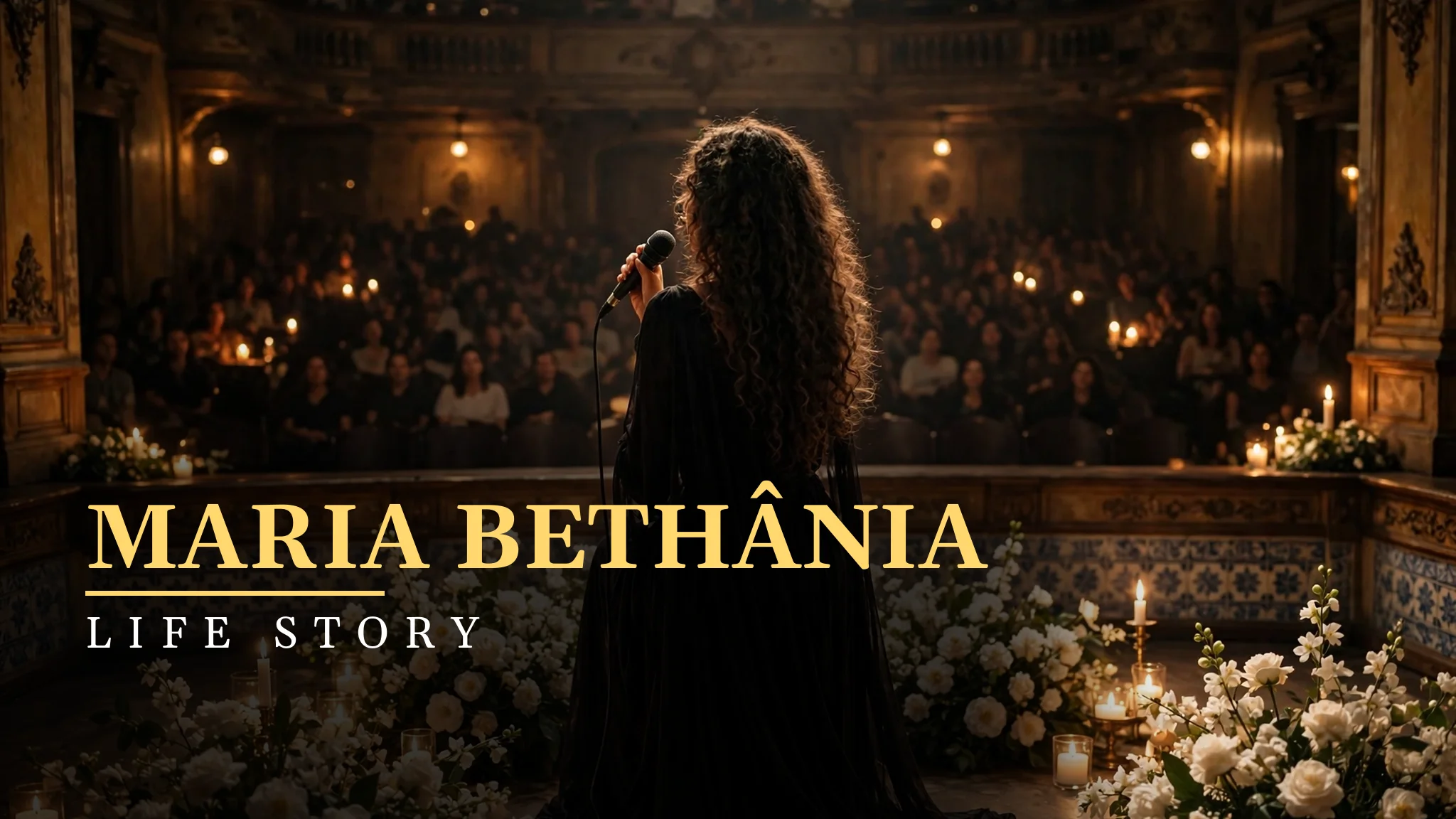
Her concerts became famous for their drama and their intimacy. She did not perform with loud bands or big shows. She stood on a stage with a small group of musicians, and she sang with a power that filled the hall. She spoke to the audience between songs, she read poems, and she created an atmosphere that felt like a ceremony. People came to her concerts not only to hear music, but to feel something deep. Her shows were long, they were emotional, and they left audiences moved.
She recorded many albums in these years, and each one showed a singer growing deeper. Her song “Olhos nos Olhos”, her album Álibi, and her work with the poet Fernando Pessoa are among her most loved. She sang about love in a way that was honest and adult, about desire, about loss, and about the joy of being alive. She was not afraid to sing about the hard parts of life, and her audiences loved her for that honesty. She was a woman singing about a woman’s life, with no shame and no apology.
By the end of the 1970s, she was one of the most respected singers in Brazil. She had a loyal audience that followed her from album to album, from concert to concert. She was not a star of the moment. She was a star for a lifetime, and her voice had become part of the sound of Brazil itself. She had taken the poetry of her country and made it sing, and the country loved her for it.
Decades on Stage: Albums, Concerts, and a Loyal Public
In the 1980s, 1990s, and beyond, Maria Bethânia kept working at a pace that few singers can match. She recorded album after album, and she gave concerts in every part of Brazil. Her album Álibi, released in 1978, was one of the best-selling records in Brazilian history, and it showed that a singer of poetry and drama could also reach a huge audience. She followed it with more fine records, including Mel, Talismã, and Memória da Pele, each one showing a different side of her art.
Her concerts in these years became legendary. She performed in theatres, in concert halls, and in open-air venues, and audiences came from far away to hear her. She sang for hours, and she gave everything she had to each show. She was known for her long, emotional performances, in which she moved from song to song like a storyteller moving from one tale to the next. Her fans, who call themselves her public with pride, followed her from city to city, and they knew every word of her songs.
She also worked with her brother Caetano Veloso, and the two of them gave concerts together that became famous in Brazil. Their shows were a meeting of two great voices from the same family, from the same small town in Bahia, who had both become legends. Audiences loved to see them together, and the concerts were full of warmth, humour, and deep feeling. The brother and sister from Santo Amaro had come a long way, and they had done it together.
In the 2000s and 2010s, she continued to record and to perform, and she remained one of the most loved singers in Brazil. She released albums of new songs, she sang the work of young writers, and she kept her concerts full. She was now in her sixties and seventies, but her voice had not lost its power. It had grown deeper, richer, and more moving with age. She was a living legend, and Brazil treated her as one.
The Drama of a Singer Who Reads Poetry
What makes Maria Bethânia different from other singers is her love of words. She is known as a singer who reads poetry on stage, and her concerts often include poems by Fernando Pessoa, by Brazilian poets, and by the writers whose songs she sings. She speaks the poems slowly, with care, and the audience listens in silence. Then she sings, and the song feels like a continuation of the poem. This mix of poetry and music is her signature, and it has made her concerts feel like something more than a show. They feel like a meeting with art itself.
Her dramatic style comes from the theatre as much as from music. She moves on stage with grace, she uses her hands, she pauses, and she lets the feeling of a song build slowly. She does not rush a line. She lets it land. Audiences say that watching her sing is like watching a great actress perform a play: every word matters, every pause matters, and the whole room holds its breath. That is a rare gift, and it is why her concerts are so loved.
She has also been a singer who honours the writers of Brazil. She has sung the songs of Chico Buarque, of Caetano, of Gil, of Milton Nascimento, and of many others, and she has always given credit to the writers. She has said that a singer is a servant of the song, and that the words come first. That humility, from a star of her size, is remarkable. She does not sing to show off her voice. She sings to serve the song, and the song, in her hands, becomes greater.
Her love of poetry has also made her a cultural figure beyond music. She is invited to read at literary events, she is honoured by universities, and she is seen as a keeper of Brazilian culture. In a country where poetry and song are close cousins, she stands at the meeting point of the two. She is not only a singer. She is a voice for the words of Brazil, and that is a larger role than fame alone.
A Private Life and a Public Voice
Maria Bethânia has always kept her private life private. She has rarely spoken about her personal relationships, and she has not sought the attention of the press for her life away from the stage. She lives in Rio de Janeiro, and she spends her time with family, with friends, and with her work. She is known as a warm and loyal friend, a person who cares deeply about the people close to her. Her brother Caetano has spoken of their closeness, and of the way their family in Bahia shaped them both.
This privacy is part of her strength. In a world where famous people share everything, she has kept something for herself. She gives her audience her voice, her feeling, and her art, but she keeps her private life as her own. Audiences respect that, and they love her for it. They do not come to her concerts to hear gossip. They come to hear her sing, and she gives them everything she has on stage. That is the bargain she has made with her public, and it has lasted for sixty years.
She has also been a singer who has faced the hard times of Brazil with courage. She began her career under a military government, and she sang songs that spoke about the life of her people. She did not hide from the truth, and she did not let fear silence her. Her voice became a voice of resistance in a quiet way: not by shouting, but by singing the truth with beauty and with feeling. That courage has earned her the respect of Brazilians of every age.
Today, she is one of the most honoured artists in Brazil. She has received awards, she has been celebrated in books and films, and her concerts still fill halls. She is a living link to the great years of Brazilian music, and she carries that history with grace. The girl from Santo Amaro is now a legend, and she remains, above all, a singer who loves words, loves poetry, and loves her country.
The Legacy of Brazil’s Beloved Voice
Maria Bethânia’s legacy is the sound of Brazilian poetry in song. She has sung for more than sixty years, and her voice has become part of the memory of Brazil. Her recordings are kept like treasures, and her concerts are remembered by those who were there as moments of deep feeling. She has shown that a singer can be an artist of words, that a song can be a poem, and that a concert can be a ceremony. That is a large gift, and Brazil has not forgotten it.
Her influence on younger singers is very great. Many Brazilian singers have learned from her way of singing, from her care for words, and from her dramatic style. She has shown that a woman can sing about love, about desire, about loss, and about life, with honesty and with power. She has also shown that a singer can have a long career without chasing fashion, by staying true to her art and to her audience. Her loyalty to her public, and their loyalty to her, is one of the great stories of Brazilian music.
She is remembered today as one of the greatest voices in the history of Brazil, a singer who took the poetry of her country and made it sing. Her brother Caetano, her family, and her friends have all spoken of her with love and pride. But the real monument is the music itself. Put on one of her records, close your eyes, and listen to a voice that carries sixty years of feeling. The girl from Santo Amaro is still singing, and Brazil is still listening.
The Concerts That Feel Like Ceremonies
Maria Bethânia’s concerts are famous in Brazil for feeling less like shows and more like ceremonies. She does not rush onto the stage with loud music and bright lights. She walks on quietly, she speaks to the audience, she reads a poem, and then she sings. The hall goes silent, and for two or three hours, the audience listens as if they are in a church, or in a room with a dear friend. People who have been to her concerts say they leave feeling changed, as if they have heard something true about life itself.
Her shows are long, and they are emotional. She sings song after song, moving from love to loss, from joy to longing, like a storyteller moving from one tale to the next. She speaks between songs, she tells stories, and she reads poems by Fernando Pessoa and by Brazilian writers. The audience does not shout or dance. They listen, they cry, and they applaud with a warmth that fills the hall. It is a different kind of concert, a concert of listening, and it has made her one of the most loved performers in Brazil.
She has performed in theatres, in concert halls, and in open-air venues across Brazil, and her fans follow her from city to city. They know every word of her songs, and they sing along softly, as if they are part of the music. Her concerts are not about spectacle. They are about feeling, about words, and about the deep connection between a singer and her audience. That connection has lasted for sixty years, and it is one of the great stories of Brazilian music.
Her brother Caetano has often performed with her, and their concerts together are among the most loved in Brazil. Two voices from the same small town in Bahia, from the same family, singing together on one stage: it is a meeting of two great artists, and audiences feel the love between them. The shows are full of warmth, humour, and deep feeling, and they remind everyone that music is, above all, a family matter, a thing shared between people who love each other.
My Take:
When I think about Maria Bethânia, the first word that comes to my mind is depth. Her voice is not light or quick. It is deep, it is slow, and it carries weight. When she sings a line, you feel that she has lived it, that she understands it, and that she is giving it to you with care. I admire that very much, because in a world of fast music and short attention, she asks us to slow down and to listen. She asks us to hear the words, to feel the silence between them, and to let a song do its work slowly. That is a brave way to sing, and it is the reason her concerts feel like something sacred.
I admire her love of poetry most of all. She does not treat a song as a simple tune. She treats it as a poem, and she gives every word its full value. I think that is a lesson for all of us: words matter, and how we say them matters. She reads poems on stage, she speaks slowly, and she lets the audience feel the beauty of language. In a time when people speak quickly and carelessly, she reminds us that words can be beautiful, and that a well-spoken line can move a room to silence. I find that deeply moving. She is not only a singer. She is a keeper of language, and that is a precious role.
What moves me most about her story is the night she sang “Carcará” in 1965. She was nineteen years old, a girl from a small town in Bahia, standing on a stage in Rio, singing about a bird that survives in a hard, dry land. She sang it with such force that the audience was stunned, and a star was born in a single song. I think about the courage that took. She was young, she was far from home, and she was singing about hunger and survival in a country under a military government. She did not hold back. She gave the song everything she had. That is the moment I return to when I think about her: a young woman, a hard song, and a voice that would not be silenced.
I also think about her relationship with her brother Caetano, because it tells me something true about family and art. The two of them grew up together in Santo Amaro, listening to the same songs, loving the same books, and dreaming the same dreams. They both became legends, and they did it in their own ways: he as a writer and a restless creator, she as an interpreter, a singer of poetry. I find that beautiful. A family can hold two great artists, and each can shine in their own light. Their concerts together are full of warmth, and you can feel the love between them. That is a rare thing in the world of fame, where families often break apart. Theirs did not. It grew stronger, and the music grew with it.
There is a sadness in her story too, and it is the sadness of a country that has known hard times. She began her career under a military government, and she sang in a time of censorship and fear. Her songs spoke about the life of ordinary Brazilians, and she did so with courage. I respect that very much. It is easy to sing when times are good. It is harder to sing when the country is in trouble, and when the truth is dangerous. She sang anyway, and she sang with beauty. That is a form of resistance, and it is a quiet one: not shouting, but singing the truth so beautifully that no one can ignore it. I think that is one of the bravest things an artist can do.
I also admire the way she has kept her private life private. In a world where famous people share everything, she has kept something for herself. She gives her audience her voice and her art, but she does not give them her personal life. I respect that. It shows that a person can be a star and still have a private self, a life away from the stage, a home, a family, a quiet place. Too many stars lose themselves in fame, and they forget who they are when the lights go out. Bethânia has not. She knows who she is, and she protects it. That is a kind of wisdom, and it has helped her career last for sixty years.
If I could speak to a young singer who wants to be like Maria Bethânia, I would say this: learn to love words. Do not rush a song. Listen to the poetry in it, feel the weight of each line, and give the audience time to feel it too. A song is not a race. It is a story, and a story needs time. Bethânia sings slowly, and she sings deeply, and that is why her concerts move people to tears. She does not try to impress with speed or with tricks. She impresses with truth, with feeling, and with a deep respect for the words she sings. That is the path, and it is a hard one, but it is the one that lasts.
I think about her concerts, and I feel a kind of longing to be there. A hall full of people, silent, listening to a woman read a poem, and then sing a song that carries sixty years of feeling. That is not only entertainment. It is a meeting with art, with beauty, and with the soul of a country. Brazil is lucky to have her, and the world is lucky that her records exist. She has given us a voice that will not be forgotten, and a way of singing that teaches us to listen more deeply.
In the end, what stays with me is the voice itself: deep, warm, and full of drama, singing the poetry of Brazil as if each word were a jewel. She began as a nineteen-year-old girl singing about a bird in the dry lands of the north-east, and she became one of the greatest singers her country has ever known. She did it by loving words, by respecting her audience, and by never giving less than everything she had. I am grateful for her music, and I am grateful for the lesson it carries: slow down, listen to the words, and sing them as if they matter, because they do.
I also think about her concerts, and about what they teach us. She does not rush, she does not shout, and she does not try to impress with noise. She walks onto a stage, she reads a poem, she speaks to the audience, and then she sings. The hall goes silent, and for hours, people listen as if they are in a church. That is a rare thing in the world of music, where concerts are often loud, bright, and full of spectacle. Bethânia’s concerts are the opposite: quiet, deep, and full of listening. I find that deeply moving, because it shows that an audience can be trusted to listen, if the art is worth listening to. She trusts her audience, and her audience trusts her. That trust is a beautiful thing.
I think about the way she has kept her private life private, too. While many famous people share every detail of their lives, she has held a part of hers back. She gives her audience her voice and her art, but she does not give them her personal life. I respect that. It shows that a person can be a star and still have a private self, a life away from the stage, a home, a family, a quiet place. Too many stars lose themselves in fame, and they forget who they are when the lights go out. Bethânia has not. She knows who she is, and she protects it. That is a kind of wisdom, and it has helped her career last for sixty years.
There is something else I want to say about her love of poetry. She reads poems on stage, she speaks slowly, and she lets the audience feel the beauty of language. In a time when people speak quickly and carelessly, she reminds us that words can be beautiful, and that a well-spoken line can move a room to silence. I find that deeply moving. She is not only a singer. She is a keeper of language, and that is a precious role. A country that forgets its poetry forgets its soul, and Bethânia has kept Brazil’s poetry alive in song for sixty years. That is a large gift, and Brazil has not forgotten it.
I also think about her relationship with her brother Caetano, because it tells me something true about family and art. The two of them grew up together in Santo Amaro, listening to the same songs, loving the same books, and dreaming the same dreams. They both became legends, and they did it in their own ways: he as a writer and a restless creator, she as an interpreter, a singer of poetry. I find that beautiful. A family can hold two great artists, and each can shine in their own light. Their concerts together are full of warmth, and you can feel the love between them. That is a rare thing in the world of fame, where families often break apart. Theirs did not. It grew stronger, and the music grew with it.
If I could speak to a young singer who wants to be like Maria Bethânia, I would say this: learn to love words. Do not rush a song. Listen to the poetry in it, feel the weight of each line, and give the audience time to feel it too. A song is not a race. It is a story, and a story needs time. Bethânia sings slowly, and she sings deeply, and that is why her concerts move people to tears. She does not try to impress with speed or with tricks. She impresses with truth, with feeling, and with a deep respect for the words she sings. That is the path, and it is a hard one, but it is the one that lasts.
In the end, what stays with me is the voice itself: deep, warm, and full of drama, singing the poetry of Brazil as if each word were a jewel. She began as a nineteen-year-old girl singing about a bird in the dry lands of the north-east, and she became one of the greatest singers her country has ever known. She did it by loving words, by respecting her audience, and by never giving less than everything she had. I am grateful for her music, and I am grateful for the lesson it carries: slow down, listen to the words, and sing them as if they matter, because they do.
I also think about the way her voice is used in Brazil today, in films, in theatres, and in homes. A director who wants a scene to feel deep and true will reach for a Maria Bethânia record. A young singer who wants to learn how to shape a line will study her albums. Most of the people who hear her do not think about fame. They think about feeling, about words, about the beauty of a song sung with care. That is a quiet kind of greatness: to be part of how a country listens, and how it feels. She did not need to be loud to be loved. She needed to be true, and the truth of her voice has made it a part of Brazil itself.
There is one more thing I want to say about her, and it is about the courage it took to sing slowly in a fast world. Her concerts are long, her songs are slow, and she asks the audience to listen, really listen, for hours. That is a brave thing to ask, because the world is full of noise and hurry. But she trusts her audience, and her audience trusts her. That trust has lasted for sixty years, and it is one of the great stories of Brazilian music. A singer who trusts her listeners, and listeners who trust their singer: that is a beautiful bond, and it is one that few artists ever earn.
Frequently Asked Questions
How did Maria Bethânia become famous?
Maria Bethânia became famous in 1965, when she sang the song “Carcará” in the theatre show Opinião in Rio de Janeiro. She was nineteen years old, and her powerful performance of the song about a bird of the dry north-east stunned the audience. The show made her name known across Brazil, and she released her first album the same year.
What is Maria Bethânia best known for?
Maria Bethânia is best known as one of the great interpreters of Brazilian song, a singer with a deep, dramatic voice who gives the words of a song their full weight. She is known for her concerts, in which she reads poetry and sings the work of writers like Chico Buarque, Caetano Veloso, and Gilberto Gil. Her album Álibi, released in 1978, was one of the best-selling records in Brazilian history.
Is Maria Bethânia related to Caetano Veloso?
Yes, Maria Bethânia is the younger sister of Caetano Veloso, one of the most famous musicians in Brazil. They grew up together in Santo Amaro, Bahia, and they have performed together many times. Both became legends of Brazilian music, each in their own way.
What is the song Carcará about?
“Carcará” is a song about a bird of prey that lives in the dry lands of north-eastern Brazil. The bird survives in a hard place, and the song uses it as a symbol of survival, hunger, and strength. Maria Bethânia’s performance of the song in 1965 made it famous, and it remains one of her most loved recordings.
Where is Maria Bethânia from?
Maria Bethânia was born in Santo Amaro, a town in the Recôncavo region of Bahia, in north-eastern Brazil, on 18 June 1946. She grew up in a house full of music, and her mother loved to sing. She later moved to Salvador and then to Rio de Janeiro, where her career began.
Is Maria Bethânia still performing?
Yes, Maria Bethânia has continued to record and perform into her seventies, and she remains one of the most loved singers in Brazil. Her concerts still fill halls, and her albums are still awaited by her loyal public. Her career has lasted more than sixty years, from Opinião in 1965 to the present day.


