Mark Knopfler: The Life Story Behind the Dire Straits Guitarist
In this post
- A Glasgow Boy in Newcastle
- Dire Straits and Sultans of Swing
- Brothers in Arms and World Fame
- Going Solo and Film Music
- Later Albums and a Quiet Legend
- Knopfler and the Guitar of Chet Atkins
- Knopfler Today and the Road Ahead
- Knopfler and the Sound of the North
- Knopfler as a Storyteller in Song
- The Guitar Sound That Changed Rock
- My Take:
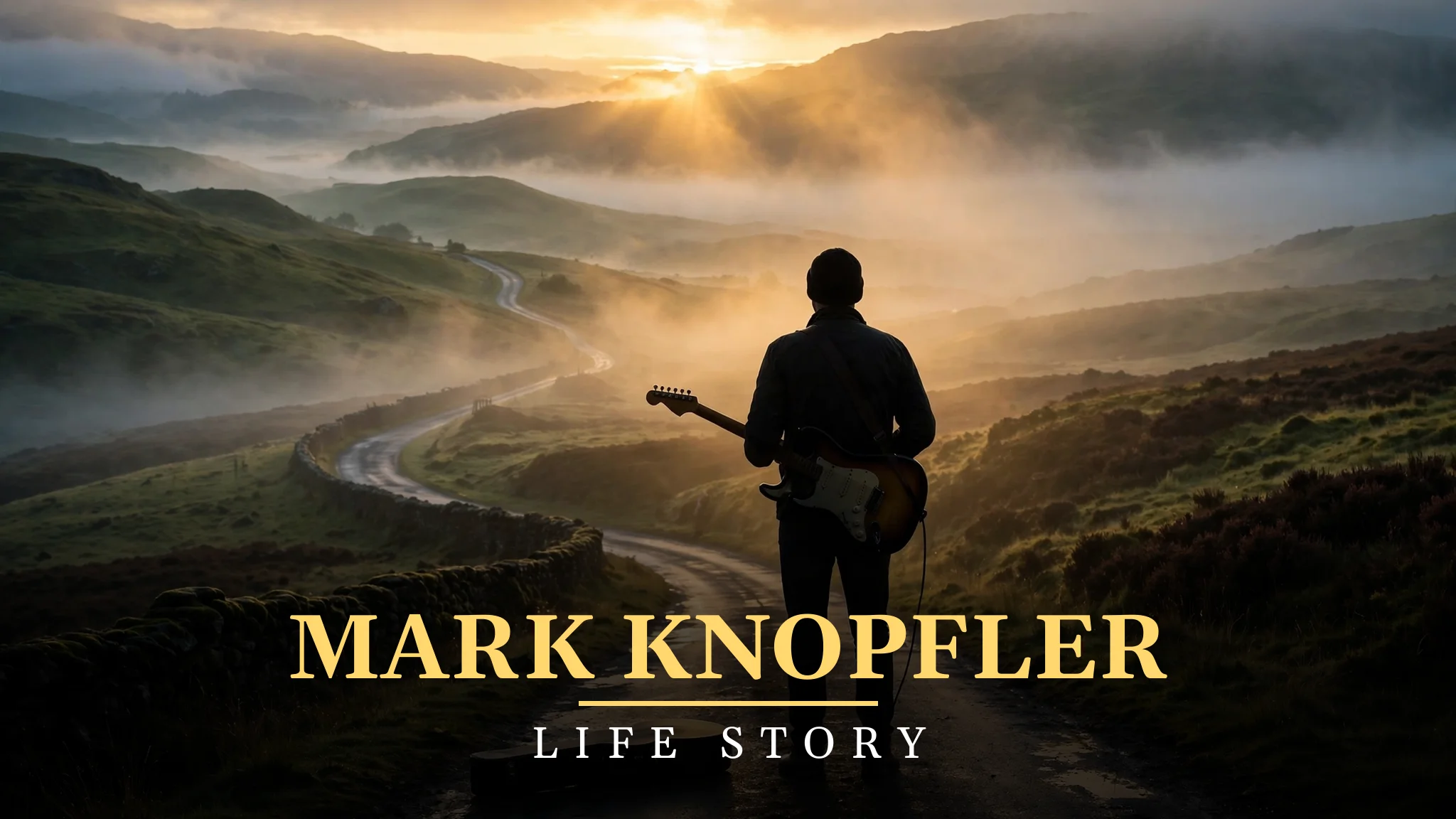
Mark Knopfler plays guitar with his fingers, not with a pick, and that small choice makes his sound unlike anyone else’s. His guitar is soft, clear, and full of stories, and when he sings in his low, warm voice, you feel as if you are listening to a man telling you a tale by a fire. He is the leader of Dire Straits, the writer of Sultans of Swing and Brothers in Arms, and one of the most respected guitarists and songwriters in Britain.
He was born in Glasgow, grew up in Newcastle, and worked as a journalist and a teacher before he became famous. He was not a young rock star. He was a grown man with a job, a family, and a love of music that would not go away. He formed Dire Straits with his brother David, and together they made music that was quiet, thoughtful, and different from the loud punk rock of the late 1970s.
This is the story of a man who became famous late, who wrote songs about ordinary people, who made film music, and who has spent his later years making gentle, beautiful solo albums. It is a story of patience, of craft, and of a guitar that speaks in a soft voice.
A Glasgow Boy in Newcastle
Mark Freuder Knopfler was born on 12 August 1949 in Glasgow, Scotland. His father was a Hungarian architect who had fled Europe, and his mother was an English teacher from Newcastle. The family moved to Newcastle upon Tyne when Mark was young, and he grew up there, in a city with a strong sense of community, with the River Tyne, with shipyards, and with a love of music. He was a bright boy, good at school, and interested in stories, in history, and in the guitar.
At school he was a good student, and he liked English literature. He read novels, he wrote stories, and he thought about words. He also loved music. He listened to the Beatles, to Bob Dylan, and to American blues and country music, and he began to play guitar. He learned by listening to records, by copying the sounds he heard, and by playing with friends. He played with his fingers, not with a pick, because he liked the soft, warm sound that fingers make on strings.
He went to the University of Leeds to study English, and he later trained as a teacher. He worked as a journalist for a local newspaper in Leeds, and then as a teacher in Newcastle. He was a grown man with a job, a wife, and a young family, and music was something he did in the evenings, in pubs and clubs, with his brother David. He was not a rock star. He was a teacher who played guitar, and he was happy with that life, even though he dreamed of more.
His brother David was also a musician, and the two brothers played together in a band called the Café Racers. They played in pubs, they wrote songs, and they learned how to perform. Mark was the leader, the songwriter, and the guitarist, and David played rhythm guitar. They were close, and they shared a love of music, but they also argued, as brothers do. Those arguments would later affect Dire Straits, but for now they were simply two brothers making music together.
He was also a father, with twin sons, and he knew the responsibilities of family life. He did not want to give up his job for a dream that might fail, but he also knew that music was calling him. He was in his late twenties, older than most new rock stars, and he had to decide whether to take a risk. He decided to take it, and that decision changed his life.
Dire Straits and Sultans of Swing
In 1977 Mark and David Knopfler formed Dire Straits with John Illsley on bass and Pick Withers on drums. The band’s name came from their financial situation: they were in dire straits, with little money, living in a small flat in London. They played in pubs, they rehearsed, and they wrote songs. Mark wrote Sultans of Swing, a song about a band playing in a pub, with a guitar solo that is now one of the most famous ever played. The song was about ordinary musicians, playing for a small crowd, and it was a perfect picture of the band’s own life.
The band recorded a demo, and a DJ named Charlie Gillett played Sultans of Swing on BBC Radio London. Listeners loved it, and record companies became interested. Dire Straits signed to Vertigo Records, and they released their first album, Dire Straits, in 1978. The album included Sultans of Swing, and it became a hit in Britain and America. The band were suddenly famous, and Mark, at twenty-nine, was a rock star.
Their second album, Communiqué, was released in 1979, and their third, Making Movies, in 1980, included the song Romeo and Juliet, a beautiful, sad love song that is still one of Knopfler’s best. The band’s music was quiet, thoughtful, and different from punk rock, which was loud and angry at the time. Dire Straits played with restraint, with space, and with a sense of story. Mark’s guitar was at the centre, and his voice was soft and warm.
The band toured the world, playing to larger and larger crowds. Mark was the leader, the songwriter, and the guitarist, and he took that role seriously. He wrote the songs, he arranged the music, and he made decisions about the band’s direction. He was a quiet leader, not a loud one, and he preferred to let the music speak. He was also a perfectionist, and he worked hard in the studio to get the sound he wanted.
He also began to work on film music, writing the score for the film Local Hero in 1983. The film’s theme, Going Home, became one of his most loved pieces of music, a gentle, beautiful tune that captures the feeling of returning to a small Scottish town. The score showed that Knopfler could write music for pictures as well as for songs, and it opened a new career for him as a film composer.
Brothers in Arms and World Fame
In 1985 Dire Straits released Brothers in Arms, an album that became one of the best-selling records in history. The album included Money for Nothing, a song with a powerful guitar riff and a guest vocal by Sting, Walk of Life, a joyful song with a keyboard riff, and the title song, Brothers in Arms, a sad, beautiful song about war and friendship. The album was a huge success, selling tens of millions of copies, and it made Dire Straits one of the biggest bands in the world.
The album was also one of the first to be released on CD, and its clear, digital sound made it a favourite of people who bought CD players. Mark’s guitar playing on the album was superb, with solos that were melodic, clear, and full of feeling. He played with his fingers, and his sound was warm and human, a contrast to the loud, electronic music of the 1980s. The band toured the world for more than a year, playing to stadiums and arenas, and Mark was at the centre of it all.
The success of Brothers in Arms changed the band’s life. They were now rich and famous, and they were under pressure to repeat their success. Mark felt the pressure, and he also felt that the band was becoming too big, too loud, and too far from the small pubs where they had started. He began to think about ending Dire Straits, and about making music in a smaller, quieter way.
He also worked on more film music, including the scores for Cal, The Princess Bride, and other films. His film music was gentle, melodic, and full of feeling, and it showed a different side of his talent. He was a songwriter who could tell a story without words, using only his guitar, and that skill made him a sought-after film composer. He enjoyed the work, because it was quiet, creative, and free from the pressures of being in a famous band.
In 1991 Dire Straits released their last studio album, On Every Street, and they toured for a final time. The tour was long and exhausting, and Mark decided afterwards that the band was finished. He did not want to keep touring stadiums, and he did not want to repeat Brothers in Arms. He wanted to make music in his own way, at his own pace, and he was ready to go solo.
Going Solo and Film Music
After Dire Straits ended, Knopfler began a solo career with the album Golden Heart in 1996. The album was soft, folk-influenced, and full of stories about ordinary people. It included songs such as Darling Pretty, a gentle love song, and it showed Mark singing and playing in a more relaxed way. He toured with a band that included musicians from many backgrounds, and he enjoyed the freedom of playing smaller venues.
He released more solo albums, including Sailing to Philadelphia in 2000, a collaboration with James Taylor, The Ragpicker’s Dream in 2002, and Shangri-La in 2004. Each album was thoughtful, melodic, and full of stories. He wrote about the American South, about the sea, about travellers, and about love. His guitar playing was still central, but his voice and his words were just as important. He was a storyteller, and his songs were short stories set to music.
He also continued to write film music, and he worked with other musicians, including Chet Atkins, Emmylou Harris, and Bob Dylan. He played guitar on Dylan’s albums, he toured with other artists, and he became known as a musician’s musician, respected by everyone who worked with him. He was a quiet, generous collaborator, who listened to others and who helped their music sound better.
He lives in London, with his wife Kitty Aldridge, an actress and writer, and they have twin sons. He is a private man, who does not seek attention, and who prefers to let his music speak. He is known for his love of the countryside, for his interest in history, and for his collection of guitars. He is a man who has lived a full life, with music at its centre, and who has never lost his love of playing.
He has also been honoured for his work, including an OBE in 1999 for services to music, and induction into the Rock and Roll Hall of Fame with Dire Straits in 2018. He did not attend the Hall of Fame ceremony, a decision that surprised some people, but he said that he preferred to let the music speak for itself. That quietness is part of who he is, and fans respect it.
Later Albums and a Quiet Legend
In the 2010s and 2020s Knopfler continued to make solo albums, including Privateering in 2012, a double album of folk, blues, and rock, Tracker in 2015, Down the Road Wherever in 2018, and One Deep River in 2024. Each album showed a musician who was still curious, still writing, and still playing with feeling. His voice, now lower and rougher, suited the songs, which were about ageing, about travel, and about the world he had seen.
He toured with his band, playing in theatres and concert halls, not stadiums. The shows were intimate, with Mark telling stories between songs, and with his guitar playing at the centre. Fans loved the closeness, and Mark seemed happier playing to a smaller crowd than he had been playing to stadiums with Dire Straits. He had found a way to make music that suited his age and his temperament.
He has also worked on projects with other musicians, including a collaboration with the guitarist Chet Atkins, and he has been praised for his work as a producer. He is a musician who has never stopped learning, and who has never stopped caring about the sound of a single note. His later work is a reminder that a great guitarist does not need to play fast. He needs to play well, and to play with feeling.
He is now in his mid-seventies, and he is still active, still writing, and still playing. He is a legend, but he is a quiet one, a man who prefers a small stage to a big one, and a good song to a loud one. His legacy is clear: he wrote Sultans of Swing, Brothers in Arms, and many other songs that will be played for generations, and he did it with a fingerstyle guitar sound that is uniquely his own.
Knopfler and the Guitar of Chet Atkins
Mark Knopfler has always admired Chet Atkins, the American guitarist known as Mr Guitar, and their friendship and collaboration is one of the most beautiful parts of Knopfler’s story. Atkins played with his fingers, like Knopfler, and he made the guitar sound soft, clear, and melodic. Knopfler listened to Atkins as a young man, and he learned from him, not by copying him note for note, but by learning his approach: play with feeling, play with your fingers, and let the melody sing. That lesson stayed with Knopfler for his whole career.
In 1990 Knopfler and Atkins made an album together, Neck and Neck, which won a Grammy Award and was praised by critics and fans. The album featured two guitarists playing together, with warmth, humour, and skill, and it showed a meeting of two generations: Atkins, the older master, and Knopfler, the younger student who had become a master himself. They played country, folk, and blues, and they enjoyed each other’s company. The album is still loved today, because it is gentle, musical, and full of joy.
Knopfler has spoken about Atkins with love and respect, and he has said that Atkins taught him more about guitar than anyone else. That respect is part of Knopfler’s character: he is a student, even when he is a star, and he is willing to learn from older musicians. He did not try to be better than Atkins. He tried to play with him, to learn from him, and to honour him. That humility is rare in rock music, and it is why other musicians love working with Knopfler.
His fingerstyle playing, learned in part from Atkins, is now his trademark, and it is studied by young guitarists around the world. They listen to Sultans of Swing, they try to copy his sound, and they learn that playing with fingers gives a guitar a warmth that a pick cannot copy. That is a lesson that Knopfler learned from Atkins, and that he has passed on to a new generation, through his records and through his example.
Knopfler Today and the Road Ahead
Today, Mark Knopfler is in his mid-seventies, and he is still making music, still touring, and still writing songs. He released One Deep River in 2024, an album that was praised for its gentle, thoughtful songs about the river, about travel, and about life. He toured with his band, playing in theatres and concert halls, and he seemed happy to be playing to smaller crowds, where he could tell stories and play his guitar with intimacy. He is a musician who has found a way to make music that suits his age and his temperament.
He has also said that he may stop touring, because touring is tiring, and because he wants to spend more time at home, writing and recording. That decision, if he makes it, will be respected by fans, because they know that he has given a lifetime to music, and that he deserves to rest. He will continue to write, to record, and to play, even if he does not tour as much, because music is part of who he is, and he cannot stop making it.
New listeners continue to discover Knopfler through Dire Straits, through Sultans of Swing, through Brothers in Arms, and through his solo albums. A teenager today can hear Sultans of Swing for the first time, and feel the same wonder that a listener felt in 1978. That is the power of a great guitar solo: it travels through time, and it speaks to people who were not there when it was first played. Knopfler’s guitar is still here, still clear, and still moving people, and it will keep moving them for many years to come.
His legacy is clear: he wrote some of the most famous songs in rock, he played guitar in a unique fingerstyle way, he made beautiful film music, and he did it all with a quiet, thoughtful grace. He is a legend, but he is a quiet one, a man who prefers a small stage to a big one, and a good song to a loud one. That quietness is part of his charm, and it is why his music will last.
Knopfler and the Sound of the North
Mark Knopfler’s music is shaped by the north of England, by Newcastle, by the River Tyne, and by the people who live there. He writes about shipyards, about the sea, about travellers, and about ordinary people who work hard and dream of more. Those songs are not about London or about fame. They are about the north, about a place with a strong sense of community, and about a boy who grew up there and who never forgot it. That sense of place is part of why his music feels so real, because it comes from a specific home, not from a generic idea of rock and roll.
He also writes about Scotland, where he was born, and about the border country between England and Scotland, a place of hills, rivers, and history. His songs often have a Celtic feeling, with acoustic guitars and folk melodies, and they capture the beauty of that landscape. He is a songwriter who loves the land he comes from, and who writes about it with care and with love. That love of place is a central part of his work, and it is why his songs feel grounded, even when they are about travel and distance.
Knopfler as a Storyteller in Song
Knopfler’s songs are short stories, with characters, dialogue, and a sense of place, and that storytelling is his greatest gift as a writer. In Sultans of Swing, he tells the story of a band in a pub, with a young boy listening, and a guitarist playing for a small crowd. In Romeo and Juliet, he tells the story of two lovers who cannot be together, with a tenderness that is rare in rock music. In Brothers in Arms, he tells the story of soldiers who die together, with a sadness that is both personal and universal. Each song is a small world, with people we can see and care about.
That storytelling comes from his love of literature, from his studies in English, and from his work as a teacher and journalist. He learned how to write clearly, how to create a character in a few lines, and how to let a story unfold without preaching. He brings those skills into his songs, and that is why they are so memorable. A listener can hear a Knopfler song once, and remember its story, its characters, and its feeling, long after the music has stopped. That is the mark of a great storyteller, and it is why his work will last.
The Guitar Sound That Changed Rock
Knopfler’s guitar sound changed rock music, because it was quiet, clear, and fingerstyle in a time when most guitarists played loudly with a pick. He showed that a guitar could be soft and still be powerful, that a solo could be melodic and still be exciting, and that a song could be gentle and still be a hit. Other guitarists listened to him, and they learned from his approach, even if they did not copy it exactly. His influence can be heard in many bands that followed Dire Straits, in folk-rock, in country, and in indie music, where a clear, melodic guitar is valued over a loud, distorted one.
His sound is also a reminder that a musician does not need to follow fashion. In the late 1970s, punk was loud and angry, and Dire Straits were quiet and thoughtful. In the 1980s, pop was electronic and synthetic, and Knopfler played acoustic and electric guitar with his fingers. He did not follow the trend. He followed his own sound, and that sound became famous because it was honest, not because it was fashionable. That is a lesson for any musician: trust your own sound, even when it is different from what is popular, because honesty lasts longer than fashion.
My Take:
I think Mark Knopfler is the guitarist I would most like to sit and listen to in a small room, because his playing is so gentle, so clear, and so full of stories that it feels like a conversation, not a performance. When I hear Sultans of Swing, I do not hear a rock star showing off. I hear a man telling a story about a band in a pub, playing for a small crowd, and I can see that pub in my mind, with its lights, its tables, and its tired musicians. That ability to paint a picture with a guitar is rare, and it is why I admire him so much. He does not need a huge stage to make you feel something. He needs a guitar, a voice, and a good story, and he has all three.
I love the way he plays with his fingers, because it gives his guitar a soft, warm sound that a pick cannot copy. It is a small choice, but it changes everything. His notes are round, not sharp, and they flow like water. When I hear his solo on Romeo and Juliet, I hear a guitar that sings, that cries, and that whispers, all in the same song. That is a gift, and it is one that comes from years of practice, from listening to blues and country music, and from caring about the sound of each note. Many guitarists play fast, but Knopfler plays beautifully, and beauty lasts longer than speed.
I admire the fact that he became famous late, at twenty-nine, after working as a journalist and a teacher, because it shows that a dream does not need to come true at twenty. He was a grown man, with a job and a family, and he took a risk on Dire Straits, even though he could have stayed safe. That risk paid off, but it could have failed, and he knew that. I think that is a hopeful message for anyone who feels too old to start something new: Knopfler started at twenty-nine, and he became one of the most famous guitarists in the world. It is never too late, if you have talent and if you work hard.
His song Brothers in Arms is one of my favourite songs about war, because it is not angry or loud. It is sad, gentle, and full of love for the men who fight and die together. Knopfler wrote it as a tribute to soldiers, and he sang it with a voice that is low, warm, and full of feeling. I think that song shows his gift as a songwriter: he can write about a big subject, war, in a simple, human way, without preaching or shouting. He lets the listener feel the sadness, and that feeling is more powerful than any speech.
I also admire his film music, especially Local Hero, because it shows a musician who can tell a story without words. The theme Going Home is a gentle, beautiful tune that captures the feeling of returning to a small town, and it is one of the most loved pieces of music in British film. I think that work is as important as his songs with Dire Straits, because it shows a different kind of talent: the ability to write music that fits a picture, that makes a film better, and that stays in your mind long after the film ends. He is a storyteller in sound, whether he is writing a song or a film score.
For a young guitarist, I think the lesson of Mark Knopfler is to play with your fingers, to listen to the blues, and to write songs about ordinary people. Do not try to be loud. Try to be clear, try to be honest, and try to tell a story. Knopfler did that, and his songs are still played today, because they are about people we recognise: a band in a pub, a lover who has left, a soldier who has died, a man who has come home. Those are universal stories, and they will always matter, as long as people listen to music.
I also think his decision to end Dire Straits and go solo teaches a lesson about knowing when to stop. He could have kept touring stadiums, making money, and repeating Brothers in Arms, but he chose to make smaller, quieter music, in theatres, with a band he loved. That takes courage, because it means giving up fame and money for art, and it means trusting that your audience will follow you. His audience did follow him, and his solo albums are loved by fans who appreciate his quieter, more thoughtful work. That is a brave choice, and I respect it.
In the end, I listen to Mark Knopfler when I need calm, when I need a story, and when I need to hear a guitar played beautifully. His music makes me feel like I am sitting by a fire, listening to a friend tell me about his life, his travels, and his losses. That feeling is rare in rock music, which is often loud and fast, and it is why Knopfler stands out. He is a quiet legend, a storyteller, and a guitarist who plays with his heart, and I am glad he is still playing.
I keep thinking about his fingers on the strings, and about how that small, simple choice made his sound unique. It reminds me that greatness does not always come from big, dramatic gestures. Sometimes it comes from a small, patient choice, made over and over again, until it becomes your voice. Knopfler made that choice, and his voice is now one of the most recognisable in music.
One more thought stays with me. Knopfler proves that a teacher, a journalist, and a father can become a rock star, if he keeps playing, keeps writing, and keeps believing in his music. He did not give up his dream when he became a teacher. He kept it alive in pubs and clubs, and when his chance came, he was ready. That readiness is a lesson for anyone with a dream: keep practising, keep writing, and be ready when your chance arrives.
I hope he keeps making music for many years, because the world needs more quiet, thoughtful songs, more fingerstyle guitar, and more stories about ordinary people. Mark Knopfler gives us all of those things, and he gives them with a grace and a humility that are rare in rock music.
I also think about Chet Atkins, and about how Knopfler learned from him. Atkins was an older master, a guitarist who played with his fingers, and Knopfler listened to him as a young man, learned his approach, and then made it his own. That is a wonderful example of how music is passed from one generation to the next: a young player listens to an older player, learns, and then teaches the next generation. Knopfler did that, and now young guitarists listen to him and learn from him. That chain of learning is part of what makes music so special, and it is why Knopfler’s work matters beyond his own records.
I think about his album Neck and Neck with Atkins, and about how joyful it sounds. Two guitarists, playing together, with warmth and humour, enjoying each other’s company. That joy is audible, and it reminds me that music is not only about fame or money. It is also about friendship, about playing with people you admire, and about sharing a love of sound. Knopfler and Atkins shared that love, and their album is a record of it. I am glad they made it, because it shows a side of Knopfler that is gentle, generous, and full of respect for his elders.
When I listen to Romeo and Juliet, I hear a song that is both sad and beautiful, a love song about two young people who cannot be together, and I think about how Knopfler wrote it with a storyteller’s eye. He does not shout about love. He tells a story, quietly, with his guitar and his voice, and he lets the listener feel the sadness. That is a gift, and it is one that comes from reading, from listening, and from caring about words. He is a songwriter who loves literature, and his songs show it.
I also think about his decision to stop touring stadiums, and to play in theatres instead. That takes courage, because it means giving up money and fame for art, and trusting that your audience will follow you. His audience did follow him, and his solo shows are loved by fans who appreciate the intimacy, the stories, and the gentle guitar playing. That is a brave choice, and I respect it, because it shows a man who cares more about music than about being famous.
For a young guitarist, I think the lesson is to play with your fingers, to listen to the blues, and to write songs about ordinary people. Do not try to be loud. Try to be clear, try to be honest, and try to tell a story. Knopfler did that, and his songs are still played today, because they are about people we recognise: a band in a pub, a lover who has left, a soldier who has died, a man who has come home. Those are universal stories, and they will always matter, as long as people listen to music.
I keep returning to the image of his fingers on the strings, and about how that small, simple choice made his sound unique. It reminds me that greatness does not always come from big, dramatic gestures. Sometimes it comes from a small, patient choice, made over and over again, until it becomes your voice. Knopfler made that choice, and his voice is now one of the most recognisable in music. That is a lesson for anyone who wants to be an artist: find your own way of doing things, and stick to it, even if it is different from everyone else.
One more thought stays with me. Knopfler proves that a teacher, a journalist, and a father can become a rock star, if he keeps playing, keeps writing, and keeps believing in his music. He did not give up his dream when he became a teacher. He kept it alive in pubs and clubs, and when his chance came, he was ready. That readiness is a lesson for anyone with a dream: keep practising, keep writing, and be ready when your chance arrives.
I hope he keeps making music, because the world needs more quiet, thoughtful songs, more fingerstyle guitar, and more stories about ordinary people. Mark Knopfler gives us all of those things, and he gives them with a grace and a humility that are rare in rock music.
I also think about his love of the sea, and about how it appears in his songs. He writes about sailors, about the Tyne, about travelling by water, and about the feeling of being far from home. That love of the sea comes from his childhood in Newcastle, from the River Tyne, and from his travels, and it gives his music a sense of movement, of journey, and of longing. I find that beautiful, because it shows a songwriter who writes about the places he knows, and who makes those places feel universal.
I keep thinking about his teaching years, and about how they shaped him as a songwriter. He taught English, he read novels, and he learned how to tell a story clearly, with characters, with dialogue, and with a beginning, a middle, and an end. That training shows in his songs, which are like short stories, with people we can see, hear, and care about. He did not learn songwriting only from music. He learned it from literature, from teaching, and from life, and that is why his songs are so rich and so human.
I also love how Knopfler writes about the River Tyne, about the shipyards, and about the people of Newcastle, because those songs feel like home to anyone who has ever loved a place and left it. He sings about home with a warmth that is both proud and sad, and that feeling is universal, even for listeners who have never been to Newcastle.
Frequently Asked Questions
Where was Mark Knopfler born and where did he grow up?
He was born on 12 August 1949 in Glasgow, and he grew up mainly in Newcastle upon Tyne, where his mother was from. He studied English at Leeds University and worked as a journalist and teacher before Dire Straits.
How did Dire Straits get their name and first hit?
The band were in dire straits financially, living in a small London flat, and that became their name. Their first hit, Sultans of Swing, was played by DJ Charlie Gillett on BBC Radio London, and it became famous in Britain and America in 1978.
What is Brothers in Arms about?
Brothers in Arms is the title song of Dire Straits’ 1985 album, a sad and beautiful song about war, friendship, and soldiers who die together. The album also included Money for Nothing and Walk of Life, and it sold tens of millions of copies.
What film music has Mark Knopfler written?
He wrote the score for Local Hero in 1983, including the famous theme Going Home, and he also wrote music for Cal, The Princess Bride, and other films. His film work is gentle, melodic, and widely loved.
Why did Dire Straits end in the 1990s?
After the huge Brothers in Arms tour and a final album On Every Street in 1991, Knopfler decided the band was too big and too exhausting, and he wanted to make smaller, quieter solo music. He has not reformed Dire Straits since.
Is Mark Knopfler still making music today?
Yes, he continues to release solo albums, including Tracker, Down the Road Wherever, and One Deep River in 2024, and he tours theatres and concert halls with his band, playing his songs in an intimate setting.


