Mary Tyler Moore: The Life Story Behind the TV's Beloved Star
In this post
- A Brooklyn Childhood and a Love of Dance
- The Dick Van Dyke Show and Laura Petrie
- The Mary Tyler Moore Show and a New Kind of Woman
- Ordinary People, Diabetes, and a Life of Advocacy
- Later Years, Production, and a Lasting Legacy
- What Her Life Still Means
- MTM Enterprises and Changing Television Behind the Scenes
- The Smile That Changed Television
- My Take:
Mary Tyler Moore changed American television by playing women who were smart, funny, and independent, at a time when television rarely showed women like that. She began as a dancer, she became a television wife in The Dick Van Dyke Show, and then she became a single working woman in The Mary Tyler Moore Show, a role that made her a symbol of a new kind of woman on television. She did it with grace, with humour, and with a warmth that made audiences feel as if they knew her.
She was born in Brooklyn, and she grew up in California in a family where life was not always easy, with a father who struggled with alcohol and a mother who worked hard to keep the family together. She learned to dance as a child, she worked as a model and as a dancer on television, and she built a career one small job at a time. She was not an overnight star. She was a worker who kept showing up, kept learning, and kept growing, until the right role found her.
What makes her story worth telling is not only the two great television shows, though they are among the best in television history. It is also the way she used her fame to help others, especially people living with diabetes, a disease she lived with herself for most of her adult life. She was a star, a producer, an activist, and a woman who faced personal loss with courage, and she did it all with a smile that became famous around the world. This is the story of how a girl from Brooklyn became America’s favourite television woman.
A Brooklyn Childhood and a Love of Dance
Mary Tyler Moore was born on 29 December 1936 in Brooklyn, New York, and she grew up in a family that later moved to Los Angeles, California. Her father, George Tyler Moore, worked as a clerk, and her mother, Marjorie, was a homemaker. The family was not rich, and life was often difficult, in part because her father struggled with alcohol. Mary learned early how to be responsible, how to take care of herself, and how to find joy in dancing and in performing, even when home life was hard.
She began to dance when she was very young, and she showed a natural talent for movement that teachers noticed. She studied ballet and other forms of dance, and she dreamed of becoming a dancer. She was a graceful and disciplined student, and she worked hard at her lessons, even when she was still a child. She also attended school in Los Angeles, where she was a good student, though she was more interested in dance and in performing than in ordinary schoolwork. She was a girl who knew what she loved, and she pursued it with focus.
When she was a teenager, she began to work as a model and as a dancer on television, appearing in commercials and in small dance roles. She was tall, slim, and graceful, and she had a smile that made people notice her. She worked as a dancer on television shows, and she learned how television worked, how to perform for a camera, and how to work with a crew. She was not yet a star, but she was learning the skills that would make her one, and she was building a reputation as a reliable and talented performer.
She married Richard Meeker in 1955, when she was eighteen, and they had a son, Richard Jr., known as Richie, in 1956. The marriage did not last, and they divorced in 1962, but her son remained central to her life. She was a young mother, trying to build a career and to raise a child at the same time, and she did it with determination. She was not a woman who gave up easily, and she was not a woman who waited for someone else to solve her problems. She worked, she learned, and she kept going, even when life was hard.
The Dick Van Dyke Show and Laura Petrie
Mary Tyler Moore’s great breakthrough came in 1961, when she was cast as Laura Petrie in The Dick Van Dyke Show, a television comedy about a television writer, Rob Petrie, played by Dick Van Dyke, and his wife, Laura. The show was created by Carl Reiner, and it became one of the most beloved comedies in television history. Mary played Laura as a smart, funny, and modern wife, a woman who wore capri pants, who danced, who joked, and who was an equal partner in her marriage. That was a new kind of television wife, and audiences loved her for it.
She was only twenty-four when the show began, and she was still learning how to act in front of a live audience. She worked hard, she listened to Dick Van Dyke and to Carl Reiner, and she grew as an actress with each episode. She won Emmy Awards for her work on the show, and she became known as one of the best comedic actresses on television. She was not a background wife. She was a star, and she shared the stage with Dick Van Dyke as an equal, in a way that was rare for television at the time.
The show ran for five seasons, from 1961 to 1966, and it is still watched today by people who love its humour, its warmth, and its smart writing. Mary’s performance as Laura was a turning point in her career, and it showed that she could do comedy with grace and with intelligence. She was not only a dancer. She was an actress, and she was a very good one. She had found her place on television, and she was ready for the next step in her career.
After the show ended, she appeared in films, including Thoroughly Modern Millie in 1967, where she played a young woman in the 1920s, and she showed that she could sing and dance as well as act. She also appeared on stage, and she continued to work in television, but she was looking for a role that would let her show a different side of herself, a role that would reflect the changes happening in America in the late 1960s and early 1970s, when women were beginning to demand more independence and more respect.
The Mary Tyler Moore Show and a New Kind of Woman
In 1970, Mary Tyler Moore and her second husband, Grant Tinker, a television executive, created a new show, The Mary Tyler Moore Show, in which she played Mary Richards, a single woman in her thirties who moves to Minneapolis to start a new life and to work as a producer at a television news station. The show was a revolution in American television, because it showed a single working woman as the centre of a comedy, not as a wife or a mother, but as a person with her own job, her own friends, and her own life. That was a new idea, and it changed television forever.
Mary Richards was smart, funny, kind, and a little bit awkward, and Mary Tyler Moore played her with a warmth that made audiences love her. She worked with a cast that included Ed Asner as Lou Grant, her gruff but kind boss, Valerie Harper as Rhoda, her best friend, and Cloris Leachman as Phyllis, her neighbour. The show was about work, about friendship, and about finding your place in the world, and it spoke to millions of women who were living similar lives. It was funny, it was honest, and it was groundbreaking.
The show ran for seven seasons, from 1970 to 1977, and it won many Emmy Awards, including several for Mary herself. The opening sequence, where Mary throws her hat into the air on a street in Minneapolis, became one of the most famous images in television history, and it symbolised freedom, joy, and a new beginning. She was not a wife throwing a hat. She was a single woman, throwing her hat in the air because she was happy, because she was free, and because she was starting a new life. That image is still loved today, and it is still a symbol of independence.
The show also changed the way women were shown on television. Before Mary Richards, single working women were rarely the stars of a comedy. After her, they were everywhere, and television began to reflect the real lives of women in America. Mary Tyler Moore did not set out to be a feminist icon, but she became one, because she played a woman who was independent, who worked, and who was happy on her own terms. She did it with humour and with grace, and she made it look easy, even though it was revolutionary.
Ordinary People, Diabetes, and a Life of Advocacy
In 1980, Mary Tyler Moore took on a dramatic role that surprised many people, playing Beth Jarrett in the film Ordinary People, directed by Robert Redford. Beth is a cold and distant mother who has lost one son in an accident and who cannot connect with her surviving son. Mary played her with a chilling restraint, showing a woman who is unable to love openly, and who hides her pain behind a perfect surface. Her performance was praised, and she was nominated for the Academy Award for Best Actress, her only Oscar nomination. It was a role that showed her range as an actress, and it proved that she could do drama as well as comedy.
She had lived with type 1 diabetes since she was diagnosed at the age of thirty-three, in 1969, and she became a strong advocate for diabetes research and for people living with the disease. She served as the international chairman of the Juvenile Diabetes Research Foundation, now known as Breakthrough T1D, and she spoke openly about her own experience with diabetes, about the daily work of managing it, and about the hope for a cure. She testified before Congress, she raised money, and she used her fame to bring attention to a disease that affected millions of people.
Her advocacy was not a side project. It was a central part of her life, and she took it very seriously. She knew what it was like to live with a chronic illness, to check blood sugar, to take insulin, and to worry about complications, and she wanted to help others who were living the same life. She was honest about her struggles, and she was hopeful about the future, and that honesty made people trust her. She was not only a television star. She was a person who cared, and who used her voice to help others.
Her personal life also had deep sadness. Her son Richie died in 1980 at the age of twenty-four, in a tragic accident involving a gun, and Mary was devastated by the loss. She spoke about her grief, and about the difficulty of losing a child, and she carried that loss with her for the rest of her life. She also faced health problems related to her diabetes, including vision problems, and she underwent surgery and treatment in her later years. She faced those challenges with courage, and she continued to work and to advocate for others, even when her own health was fragile.
Later Years, Production, and a Lasting Legacy
In her later years, Mary Tyler Moore continued to work in television and film, and she remained a respected figure in the entertainment world. She appeared in guest roles, she worked as a producer through her company, MTM Enterprises, which she had founded with Grant Tinker, and she helped create some of the most successful television shows of the 1970s and 1980s, including The Bob Newhart Show, Rhoda, and Hill Street Blues. Her company was known for its quality, its smart writing, and its respect for audiences, and it changed television in a lasting way.
She was honoured with many awards, including Emmy Awards, a Golden Globe, and a Screen Actors Guild Lifetime Achievement Award, and she was inducted into the Television Hall of Fame. She was also honoured for her work on diabetes, and she was admired by people who had never seen her television shows but who knew her as an advocate for health research. She was a star, a producer, and an activist, and she did all three with grace and with determination.
She died on 25 January 2017 in Greenwich, Connecticut, at the age of eighty, after a long life that had touched millions of people. Her death was mourned across America, and tributes came from actors, directors, and ordinary viewers who had grown up watching her shows. She was buried in Connecticut, and her legacy was remembered in the many television shows, films, and advocacy efforts she had left behind. She had changed television, she had changed how women were shown on screen, and she had helped millions of people living with diabetes.
What Her Life Still Means
Mary Tyler Moore is remembered today as one of the greatest television stars in American history, and as a woman who changed how women were portrayed on screen. She played Laura Petrie, a modern wife, and Mary Richards, a single working woman, and both roles were revolutionary in their time. She showed that a woman could be funny, smart, independent, and kind, all at the same time, and that she did not need to be a wife or a mother to be a complete person. That lesson is still relevant today.
Her influence can be seen in the many television shows that followed her, from Murphy Brown to 30 Rock to many others that feature single working women as their stars. She opened a door, and she held it open with her talent and her warmth, and television has never been the same since. She also showed that a star could use fame to help others, and her work on diabetes has saved lives and has given hope to millions of families.
She is remembered for throwing her hat in the air, for her smile, and for her warmth, but she is also remembered for the way she lived: with courage, with honesty, and with a deep care for other people. She was a woman who made television better, and who made the world a little bit better, and that is a legacy that does not fade.
MTM Enterprises and Changing Television Behind the Scenes
Mary Tyler Moore’s work as a producer, through MTM Enterprises, is one of the most important parts of her story, and it is easy to overlook it when we focus on her acting. She and Grant Tinker founded the company in 1969, and it became one of the most respected production companies in American television, known for its quality, its smart writing, and its respect for audiences. The company produced The Mary Tyler Moore Show, The Bob Newhart Show, Rhoda, Hill Street Blues, and many other shows that changed television in the 1970s and 1980s, and it did so by hiring talented writers, by giving them freedom to tell stories, and by trusting that audiences were smart enough to follow complex and funny shows.
MTM Enterprises was different from other production companies of its time, because it was built around the idea that television could be both popular and intelligent, and that a comedy could deal with real issues in a funny and honest way. Mary and Grant hired writers who cared about character, about dialogue, and about truth, and they gave them time to develop their ideas, rather than rushing them to produce a quick hit. That patience led to shows that are still watched today, because they were built on strong writing and on strong performances, not only on a single star or a single joke. Mary understood, as an actress, what writers needed, and she used that understanding to create a company that supported them.
She also understood, as a woman in a male-dominated industry, how important it was to give opportunities to women writers, directors, and producers. MTM hired women, it gave them important roles, and it showed that a production company could be run by a woman and a man working as partners, with mutual respect. That was a quiet revolution, and it opened doors for many women who came after her. She did not make a big speech about it. She simply did the work, hired talented people, and let the quality of the shows speak for itself. That is a powerful kind of leadership, and it is one reason MTM is still remembered today.
Her work as a producer also gave her a sense of control that she had not had as a young actress. As a young woman, she had waited for someone to hire her, to give her a part, to decide her future. As a producer, she could choose her own projects, hire her own team, and tell the stories she believed in. That freedom was precious to her, especially after years of working in an industry where women were often told what to do. She used that freedom well, and she used it to make television better, not only for herself, but for everyone who watched it. That is a legacy that goes beyond acting, and it is one that should be remembered alongside her Emmy Awards.
The Smile That Changed Television
Mary Tyler Moore’s smile is one of the most famous in television history, and it is worth thinking about, because it was not a simple smile. It was a smile that could be warm, funny, sad, and hopeful, all at the same time, and it made audiences feel as if they knew her, even if they had never met her. She smiled when she was happy, she smiled when she was nervous, and she smiled when she was trying to be brave, and that smile became a symbol of a new kind of woman on television, a woman who was independent, who worked, and who was happy on her own terms. It was not a smile that said she needed someone else to complete her. It was a smile that said she was complete already, and that she was glad to be alive.
That smile also helped her connect with audiences in a way that few other stars could. She was not a distant celebrity. She was a friend, a neighbour, and a colleague, and her smile made people feel welcome, even when they were watching her on a small television in their living room. She used that smile in The Dick Van Dyke Show, in The Mary Tyler Moore Show, and in Ordinary People, where her smile hid a deeper sadness, and she used it with a skill that came from years of performing, of listening, and of understanding how a face can tell a story without words. Her smile is still remembered today, and it is still a symbol of warmth, independence, and joy.
My Take:
I think Mary Tyler Moore’s story is one that makes me think about how television can change the way we see ourselves, and how one actress can change an entire medium. She played two roles that were both revolutionary, Laura Petrie and Mary Richards, and she did it with a warmth and a humour that made the revolution feel natural, not forced. I admire that, because it is easy to make a point loudly, and it is much harder to make a point by simply being yourself, by playing a character who is smart and independent and kind, and by letting the audience fall in love with her. She did that, and television has never been the same.
What moves me most is the image of her throwing her hat into the air on a street in Minneapolis. I have seen that image many times, and I keep thinking about what it means. She is a single woman, in her thirties, starting a new life in a new city, and she is happy. She is not waiting for a husband to make her happy. She is not waiting for someone else to give her a life. She is making her own life, and she is celebrating it by throwing her hat in the air. That is a powerful image, and it is still powerful today, because so many women are still told that they need someone else to complete them. Mary Richards showed them that they could complete themselves, and that they could be happy on their own terms.
I also think about Laura Petrie, and about how different she was from the television wives who came before her. She wore capri pants, she danced, she joked, and she was an equal partner in her marriage. She was not a background wife who cooked and cleaned while her husband told jokes. She was a star, and she shared the stage with Dick Van Dyke as an equal. I think that was a quiet revolution, and it paved the way for Mary Richards, and for all the single working women who came after her on television. She changed the rules, and she did it with a smile.
Her work on diabetes also matters to me deeply. She lived with type 1 diabetes for most of her adult life, and she did not hide it. She spoke about it, she testified before Congress, she raised money, and she used her fame to help others. I think that takes a courage that is hard to describe. It is one thing to be a star. It is another thing to talk about a chronic illness in public, to admit that you need insulin every day, and to ask for help for millions of people who are living the same life. She did that, and she did it with grace, and her advocacy has helped countless families. That is a legacy that goes beyond television, and it is one I admire deeply.
I am also struck by the sadness in her life, especially the death of her son Richie in 1980. She lost a child, and she carried that loss for the rest of her life. I do not want to look away from that pain, because it is part of who she was. She was a mother who lost her son, and she kept going, she kept working, and she kept helping others, even when her own heart was broken. That strength is remarkable, and it makes me respect her even more. She did not let grief stop her. She let it teach her, and she used it to understand other people’s pain.
What I learn from her is that independence is not the same as loneliness. Mary Richards was single, she lived alone, and she was happy, because she had friends, she had work she loved, and she had a life she had chosen for herself. I think that is an important lesson for anyone who feels pressure to follow a traditional path. You can choose your own path, you can build a life around work and friendship, and you can be happy on your own terms. She showed us how to do that, and she made it look joyful, not lonely.
I also learn from her that a career can be about more than fame. She was a star, but she was also a producer, and she helped create some of the best television shows of her time through MTM Enterprises. She did not only act. She built a company, she hired talented people, and she made television better for everyone. That is a different kind of power, a power to create opportunities for others, and I admire it. She used her success to open doors for other writers, actors, and producers, and that generosity is part of her legacy.
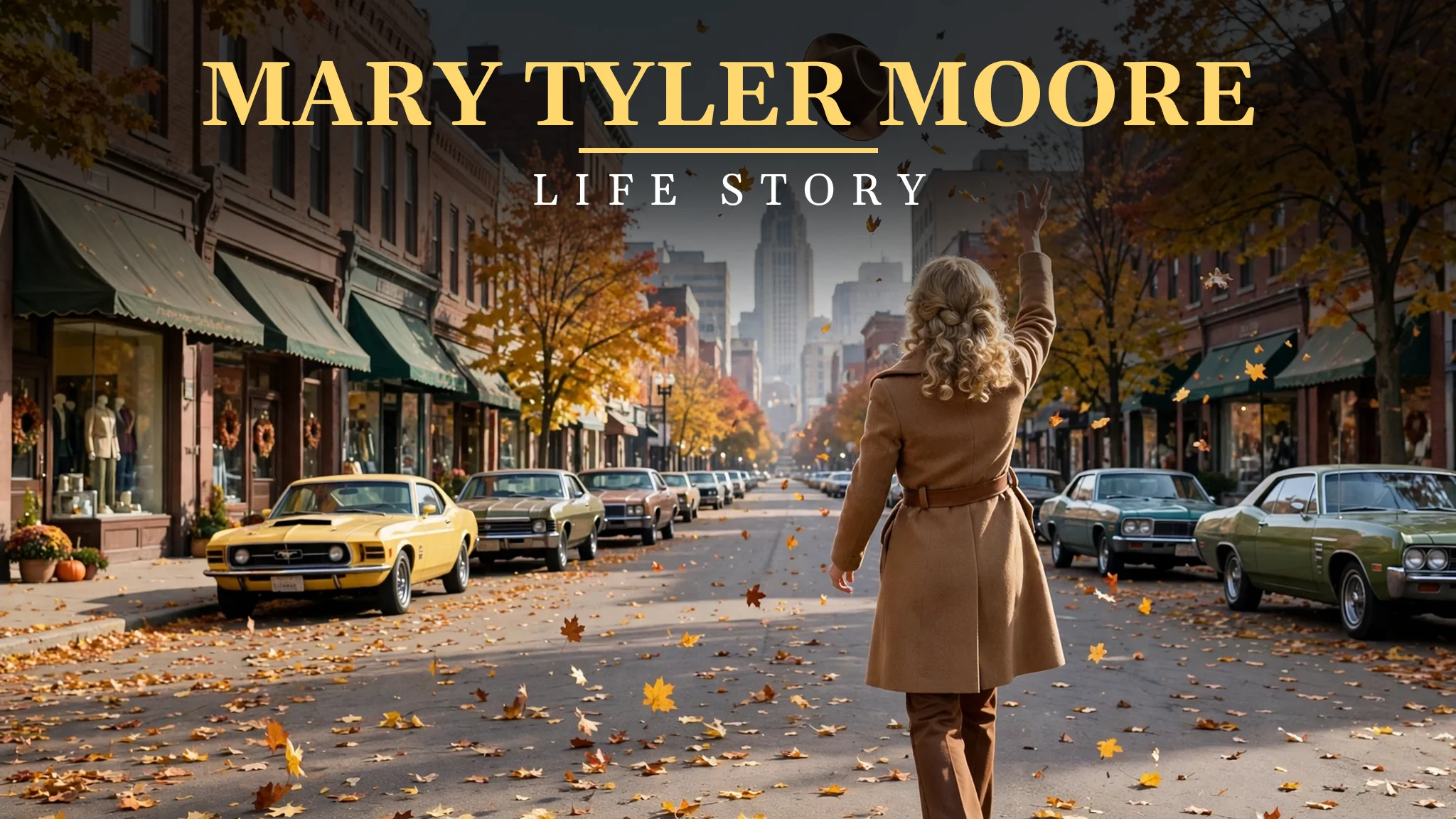
When I think of Mary Tyler Moore now, I think of a blonde woman in a tan coat, tossing her hat into the air on an autumn street covered in fallen leaves, with vintage cars nearby and a city skyline behind her. She is smiling, she is free, and she is starting a new life. That image stays with me, because it captures her joy, her independence, and her hope. She was a woman who threw her hat in the air and meant it, and that is a beautiful thing to remember.
I hope readers who meet her for the first time will watch The Dick Van Dyke Show and The Mary Tyler Moore Show, and I hope they will watch Ordinary People, and I hope they will learn about her diabetes advocacy. I hope they will see that she was more than a television star. She was a pioneer, a producer, an activist, and a woman who changed how America saw women on television. That is why I think her story matters, and that is why I think it will still matter many years from now, when new generations are still throwing their hats in the air and starting new lives.
In the end, I think Mary Tyler Moore teaches us that you can be kind and strong at the same time, that you can be funny and serious at the same time, and that you can change the world by simply being yourself, on screen and off. She did all of those things, and she did them with a smile that became famous around the world. I will remember her hat in the air, her laugh, and her courage, and I will remember that she showed us how to live a life that is independent, generous, and full of joy.
I also think about how Mary Tyler Moore’s story connects to the way women are shown on television today, and to how much has changed since she played Mary Richards. Today, there are many shows about single working women, about women who are independent, funny, and successful, and that is partly because Mary opened the door for them. She showed that a single woman could be the star of a comedy, that she could be happy on her own, and that she did not need a husband to be complete. That was a revolutionary idea in 1970, and it is still an important idea today, when many women are still told that they need someone else to make their lives complete. She proved that a woman can complete herself, and that she can be happy, funny, and successful on her own terms.
Another thought that stays with me is her work as a producer, and how she used her power to help other people. She did not only act. She built a company, she hired talented writers, and she gave opportunities to women and to young people who might not have had them otherwise. That generosity is part of her legacy, and it is one reason I admire her as a person, not only as an actress. She understood that success is not only about yourself. It is about opening doors for others, and about making the industry better for everyone. She did that, and she did it quietly, without making a big speech about it. She simply did the work, and let the quality of the shows speak for itself.
I also wonder what she would think of the way diabetes is treated today, where there are new technologies, new medicines, and new hope for a cure, and where people living with the disease have more support than they did in her time. I think she would be pleased, but I also think she would remind us that there is still work to do, and that millions of people still live with diabetes every day, checking their blood sugar, taking insulin, and worrying about complications. She would want us to keep funding research, to keep supporting families, and to keep hoping for a cure. Her advocacy was not a side project. It was a central part of her life, and it is a legacy that continues today, in the work of the foundation she led.
When I think of Mary now, I do not only think of the hat in the air. I think of a woman in a production office, reading a script, talking to a writer, and making a decision about a show that will change television. That image stays with me, because it captures her intelligence, her leadership, and her belief that television could be both popular and smart. She was an actress, a producer, and an activist, and she did all three with grace and with determination. That is a life I admire, and a life I am glad to have learned about.
I hope that people who read her story will watch her shows, will learn about her diabetes work, and will understand that she was more than a television star. She was a pioneer, a producer, and a woman who changed how America saw women on screen. Her life is proof that you can be kind and strong at the same time, that you can be funny and serious at the same time, and that you can change the world by simply being yourself. That is a legacy worth remembering, and a legacy I will carry with me.
I also think about how Mary Tyler Moore’s smile is remembered today, and how often people who grew up watching her shows still talk about how her smile made them feel happy, even on a bad day. She had a way of making television feel personal, as if she were speaking directly to you, and her smile was a central part of that connection. It was not a fake smile. It was a real smile, one that came from a woman who loved her work, who loved her audience, and who was grateful for the chance to perform. That gratitude showed in her face, and it made audiences love her even more, because they could feel that she was glad to be there, and glad that they were there too.
I also want to remember her as a producer, because that part of her story is often overlooked when we focus on her acting. She built MTM Enterprises with Grant Tinker, she hired talented writers, and she helped create some of the best television shows of the 1970s and 1980s. That work, behind the scenes, changed television as much as her acting did, because it gave opportunities to writers, directors, and actors who might not have had them otherwise. She was not only a star in front of the camera. She was a leader behind it, and she used that leadership to make television better for everyone. That is a legacy worth remembering, and a legacy I admire deeply.
I also think about how Mary Tyler Moore’s work for diabetes is still helping people today, through the foundation she led, through the research she funded, and through the awareness she raised. Millions of people live with type 1 diabetes, and many of them do not know her name, but they benefit from the work she did, from the money she raised, and from the hope she gave to families. That kind of legacy, one that saves lives and gives hope, is more important than any television award, and it is one that should be remembered alongside her Emmy Awards and her famous hat toss.
Frequently Asked Questions
What made Mary Tyler Moore’s role as Mary Richards so important?
Mary Richards, in The Mary Tyler Moore Show from 1970 to 1977, was a single woman in her thirties who worked as a television news producer in Minneapolis. She was the centre of a comedy as a working woman, not as a wife or mother, which was revolutionary at the time. The role changed how women were shown on television and inspired many later shows about single working women.
How did Mary Tyler Moore first become famous on television?
She first became famous as Laura Petrie in The Dick Van Dyke Show from 1961 to 1966, playing the smart and funny wife of television writer Rob Petrie. Her performance, including her dancing and her modern style, made her a star and earned her Emmy Awards. The show is still regarded as one of the best comedies in television history.
Did Mary Tyler Moore win an Oscar nomination?
Yes, she was nominated for the Academy Award for Best Actress for Ordinary People in 1980, playing Beth Jarrett, a cold and distant mother who cannot connect with her surviving son. It was her only Oscar nomination, and it showed her range as a dramatic actress, very different from her comedy work on television.
What did Mary Tyler Moore do for diabetes research?
She lived with type 1 diabetes since her diagnosis in 1969, and she became international chairman of the Juvenile Diabetes Research Foundation, now Breakthrough T1D. She testified before Congress, raised money, and spoke openly about living with diabetes. Her advocacy brought attention and funding to diabetes research and helped many families.
Was Mary Tyler Moore also a television producer?
Yes, she co-founded MTM Enterprises with her husband Grant Tinker, a production company that created successful shows including The Bob Newhart Show, Rhoda, and Hill Street Blues. The company was known for quality writing and for respecting audiences, and it changed American television in a lasting way.
When did Mary Tyler Moore die?
Mary Tyler Moore was born on 29 December 1936 in Brooklyn, New York, and she died on 25 January 2017 in Greenwich, Connecticut, at the age of eighty. She had been a television star for more than fifty years, from The Dick Van Dyke Show to The Mary Tyler Moore Show and beyond, and she is remembered as a pioneer for women on television.


