Metallica: The Life Story Behind Metal's Biggest Band
In this post
Metallica is the biggest metal band in the world, and they have been for more than forty years. They play fast, loud, and heavy, and their songs are about anger, fear, war, and the dark side of life. When they released Master of Puppets in 1986, they made one of the greatest metal albums ever recorded. When they released the Black Album in 1991, with Enter Sandman, they became one of the biggest bands on the planet, metal or not.
The band was formed in Los Angeles in 1981, when Lars Ulrich, a drummer from Denmark, met James Hetfield, a singer and guitarist from California. They were joined by Dave Mustaine, a guitarist who would later form Megadeth, and Ron McGovney, a bass player. They were young, angry, and determined to play faster and heavier than anyone else. They were not interested in pop music. They wanted to make metal that was fast, loud, and real.
Their story is a story of tragedy, of the death of their bass player Cliff Burton in a bus crash in 1986, of fights with their fans over Napster, of a film that showed them almost breaking up, and of a comeback that made them stronger than ever. It is a story of a band that never gave up, and that is why their story matters.
Their early days in San Francisco are worth remembering, because the city shaped their sound in important ways. After moving from Los Angeles to San Francisco in 1983, Metallica found a home in the Bay Area metal scene, a scene that was faster, heavier, and more underground than Los Angeles. They played in clubs, they met other thrash bands like Exodus and Slayer, and they built a following of fans who loved fast, aggressive music. San Francisco gave them a community, and it gave them a place to grow. They still consider the Bay Area their home, and they have played there many times since.
Their relationship with their fans is also special. Metallica has always had a loyal fan base, known as the Metallica family, and they have worked hard to keep that relationship strong. They have a fan club, they release exclusive recordings, they play intimate shows for fans, and they listen to what their fans want. They have also been known to play entire albums live, to celebrate anniversaries, and to do special shows for their most loyal supporters. That loyalty goes both ways, and it is one of the reasons the band has lasted for so long.
They have also been generous with their time and money, supporting charities, helping young musicians, and using their fame to do good. They founded the All Within My Hands Foundation, which works to fight hunger, to support education, and to help communities in need. They have donated millions of dollars, and they have encouraged their fans to do the same. That generosity is a sign of a band that cares about more than just itself.
Los Angeles, 1981, and a Need for Speed
Metallica was formed in Los Angeles, California, in 1981. Lars Ulrich, who was born in Denmark and moved to America as a teenager, was a drummer who loved heavy metal. He placed an advertisement in a local newspaper looking for musicians to form a band, and James Hetfield, a singer and guitarist from Downey, California, answered it. Hetfield had played in bands before, and he had a voice that was both melodic and aggressive. Ulrich and Hetfield became the core of the band, and they have been together ever since.
They were joined by Dave Mustaine, a guitarist from California who was fast, talented, and wild, and Ron McGovney, a bass player who was a friend of Hetfield’s. The band’s name, Metallica, was suggested by a friend, and it was perfect: it sounded like metal, and it sounded like a band that meant business. They began to practise, to write songs, and to play in clubs around Los Angeles. They were not a polished band. They were fast, loud, and angry, and audiences loved them for it.
Los Angeles in the early 1980s was a good place for a metal band, but Metallica was different from the other bands on the Sunset Strip. The other bands wore make-up, they played pop-metal, and they wanted to be stars. Metallica wore jeans and T-shirts, they played thrash metal, and they wanted to be heavy. They were influenced by bands like Black Sabbath, Iron Maiden, and Motörhead, but they played faster than any of them. They were the fastest band in Los Angeles, and they were proud of it.
They recorded a demo tape called No Life ‘til Leather in 1982, and it became famous in the metal underground. Fans traded the tape, and the band built a following without a record deal. They moved to San Francisco, a city with a strong metal scene, and they began to play there. It was the start of a career that would last for more than forty years, and it was the start of a band that would change metal forever.
Kill ‘Em All, Ride the Lightning, and Thrash
Metallica’s first album, Kill ‘Em All, came out in 1983, and it was a landmark in metal history. The album included Seek and Destroy, Whiplash, and Jump in the Fire, songs that were fast, aggressive, and full of energy. By then, Dave Mustaine had been fired from the band because of his drinking and drug use, and he was replaced by Kirk Hammett, a guitarist from San Francisco who had played in a band called Exodus. Cliff Burton, a bass player from San Francisco, had also joined the band, replacing Ron McGovney. Burton was a brilliant bass player, and he brought a classical influence to the band’s sound.
Kill ‘Em All was not a commercial hit, but it was a critical success, and it made Metallica famous in the metal world. They toured with other metal bands, and they built a loyal audience. Their second album, Ride the Lightning, came out in 1984, and it included Fade to Black, a song about suicide, and For Whom the Bell Tolls, a song about war. The album showed that Metallica could write songs that were not just fast, but also thoughtful and emotional. It was a step forward, and it showed that the band was growing.
Their third album, Master of Puppets, came out in 1986, and it is now considered one of the greatest metal albums ever made. The album included Battery, Master of Puppets, and Welcome Home (Sanitarium), songs that are still played today. The album was a critical and commercial success, and it made Metallica one of the biggest metal bands in the world. They were touring with Ozzy Osbourne, playing in large arenas, and their audience was growing fast. They were at the peak of their early career, and they were ready for more.
But tragedy was about to strike. On 27 September 1986, while the band was touring in Sweden, their tour bus crashed, and Cliff Burton was killed. He was only twenty-four years old, and his death devastated the band. They were young, they were successful, and they had lost their friend and their bass player. It was a loss that would stay with them for the rest of their lives.
Cliff Burton’s Death and And Justice for All
Cliff Burton’s death in 1986 was a turning point for Metallica. The band was in shock, and they did not know if they could go on. They decided to continue, and they hired a new bass player, Jason Newsted, who had played in a band called Flotsam and Jetsam. Newsted was a talented bass player, but he had big shoes to fill. Cliff Burton had been a key part of the band’s sound, and his loss was felt by everyone.
The band’s next album, …And Justice for All, came out in 1988, and it was a dark, angry album about injustice, war, and corruption. The album included One, a song about a soldier who is badly wounded in war and who cannot move or speak, and the video for One, which used footage from the film Johnny Got His Gun, became famous on MTV. The album was a commercial success, and it showed that Metallica could still make great music, even after losing Cliff Burton.
The band toured the world to support the album, and they became one of the biggest metal bands in the world. They were playing in stadiums, selling millions of records, and their audience was growing. They were also becoming more famous, and they were starting to attract attention from the mainstream music world. They were no longer just a metal band. They were a major act, and they were ready for the next step.
But the band was also tired. They had been touring and recording for years, and they were exhausted. They decided to take a break, and then they began to work on a new album, one that would change their sound and make them the biggest band in the world. It was a risk, but it was a risk they were willing to take.
The Black Album and Enter Sandman
In 1991, Metallica released their fifth album, called Metallica, but known to fans as the Black Album because of its black cover. The album was produced by Bob Rock, a producer who had worked with Bon Jovi and Mötley Crüe, and it had a slower, heavier sound than their earlier albums. The album included Enter Sandman, a song about nightmares that became a huge hit, Sad but True, a song about addiction, and Nothing Else Matters, a ballad that became one of the band’s most loved songs.
The Black Album was a massive success. It sold more than 30 million copies worldwide, and it made Metallica one of the biggest bands on the planet. Enter Sandman became a stadium anthem, played at sports events, in films, and on the radio every day. Nothing Else Matters showed that Metallica could write a beautiful, emotional song, not just a fast, angry one. The band was now a mainstream act, and they were playing to audiences who had never listened to metal before.
The success brought new fans, but it also brought criticism from old fans, who felt that Metallica had sold out. They said the band had become too slow, too commercial, and too pop. Metallica did not care. They had made the album they wanted to make, and they were proud of it. They toured the world for two years to support the album, playing in stadiums and arenas, and they became one of the most popular live bands in the world.
The Black Album changed metal forever. It showed that a metal band could be huge, that it could sell millions of records, and that it could appeal to a wide audience. It also showed that Metallica was not afraid to change, to grow, and to try new things. They were a band that was always moving forward, even when it was hard.
Load, Reload, Napster, and Some Kind of Monster
In the 1990s, Metallica released two albums, Load in 1996 and Reload in 1997, which had a more bluesy, hard-rock sound. The albums included songs like Until It Sleeps, Hero of the Day, and The Memory Remains, and they were commercial successes, but they were not as popular as the Black Album. The band also cut their hair, changed their image, and experimented with new sounds, which upset some of their old fans. They were trying to grow, but not everyone liked the direction they were going in.
In 2000, Metallica became involved in a famous legal fight with Napster, a file-sharing service that allowed people to download music for free. Metallica sued Napster, saying that it was stealing their music, and the case became a symbol of the music industry’s fight against illegal downloading. Many fans were angry with Metallica, and they felt that the band was being greedy. The band said they were protecting their music, and that artists deserved to be paid for their work. The case was controversial, and it damaged Metallica’s reputation with some fans.
In 2001, Jason Newsted left the band, tired of the arguments and the pressure. The band began to work on a new album, St. Anger, and they hired a film crew to document the process. The film, called Some Kind of Monster, showed the band arguing, going to therapy, and almost breaking up. It was a raw, honest look at a band in crisis, and it showed that even the biggest metal band in the world could fall apart. St. Anger came out in 2003, and it was a commercial success, but it was criticised for its sound and its production.
The band hired a new bass player, Robert Trujillo, who had played with Ozzy Osbourne and Suicidal Tendencies, and they began to rebuild. They toured, they recorded, and they slowly found their way back. They were older, they were wiser, and they were ready to make music again.
Death Magnetic, Hardwired, and Still Heavy
In 2008, Metallica released Death Magnetic, an album that was a return to their thrash metal roots. The album included The Day That Never Comes and All Nightmare Long, and it was a critical and commercial success. Fans were happy to hear the band playing fast and heavy again, and the album showed that Metallica could still make great metal. They were inducted into the Rock and Roll Hall of Fame in 2009, a recognition of a career that had lasted more than twenty-five years.
They followed it with Hardwired… to Self-Destruct in 2016, a double album that included Hardwired, Moth into Flame, and Atlas, Rise! The album was another success, and it showed that the band was still relevant, still heavy, and still able to make great music. They toured the world, playing in stadiums and arenas, and their live shows were as powerful as ever.
In 2023, they released 72 Seasons, an album that dealt with anger, with childhood, and with the passage of time. The album was praised by critics, and it showed that Metallica, even in their sixties, could still make music that mattered. They toured the world to support the album, playing in stadiums, and their audiences included both old fans and young listeners who were discovering metal for the first time.
Today, Metallica is still the biggest metal band in the world. They have sold more than 125 million records, they have won nine Grammy Awards, and they are still touring, still recording, and still playing loud. They are a band that has survived tragedy, fights, and fame, and they are still here, still heavy, and still Metallica.
San Francisco, the Fans, and Giving Back
Metallica’s move from Los Angeles to San Francisco in 1983 was a turning point for the band. Los Angeles was full of glam metal bands, with make-up, hairspray, and pop songs. San Francisco was different. It was home to a thrash metal scene that was faster, heavier, and more underground, with bands like Exodus, Testament, and Death Angel. Metallica fit in there, and they found a community of musicians and fans who loved the same kind of music. They played in clubs, they recorded demos, and they built a following that would stay with them for decades.
Their relationship with their fans has always been special. Metallica calls their fans the Metallica family, and they treat them like family. They have a fan club, they release special recordings for fans, they play fan-only shows, and they listen to what their fans want. They have played entire albums live, they have celebrated anniversaries with special concerts, and they have done acoustic shows for small audiences. That closeness is rare for a band of their size, and it is one of the reasons their fans are so loyal.
The band has also used their fame to help others. They founded the All Within My Hands Foundation in 2017, a charity that works to fight hunger, to support workforce education, and to help communities in need. They have donated millions of dollars, they have held benefit concerts, and they have encouraged their fans to volunteer and to give. James Hetfield, Lars Ulrich, Kirk Hammett, and Robert Trujillo have all spoken about the importance of giving back, and they have put their money where their mouth is. That generosity matters, and it shows that Metallica is a band that cares about the world, not just about itself.
Over the years, Metallica has won nine Grammy Awards, they have been inducted into the Rock and Roll Hall of Fame, and they have sold more than 125 million records. They have also been honoured for their live shows, for their songwriting, and for their contributions to metal. These honours matter, but they are not the whole story. The whole story is a band from Los Angeles that moved to San Francisco, that played fast and heavy, that lost a friend, that fought with its fans, that almost broke up, and that came back stronger than ever.
Their influence on metal is enormous. They showed that a thrash metal band could be huge, that it could sell millions of records, and that it could appeal to a wide audience. Many bands that came after them, from Slipknot to Avenged Sevenfold to many younger metal bands, have said that Metallica inspired them. They changed the sound of metal, and their influence is still felt today. They are the biggest metal band in the world, and they will always be.
Today, their songs are still played on the radio, in films, and at concerts, and new listeners discover them every day. A young person hears Enter Sandman and wants to learn the riff. A fan hears Nothing Else Matters and thinks about love. A soldier hears One and thinks about war. That is the power of Metallica’s music. It speaks to people where they live, and it tells them that their lives matter, even when life is hard and heavy.
Metallica’s song The Unforgiven, from the Black Album, is worth thinking about, because it is a song about a man who is trapped by his family and by society. It is a slow, heavy song, with a beautiful acoustic intro and a powerful chorus, and it became one of the band’s most loved songs. It showed that Metallica could write a song that was both heavy and emotional, and that James Hetfield could write lyrics that were personal and poetic. The Unforgiven is a song that many fans turn to when they feel trapped, and it helps them feel less alone.
They have also recorded a famous album with the San Francisco Symphony Orchestra, called S&M, in 1999. The album combined metal with classical music, and it was a bold experiment that worked. It showed that Metallica was willing to try new things, to work with musicians from a different world, and to make music that was both heavy and beautiful. The S&M concerts were a celebration, and they showed that metal and classical music could work together. It was a brave idea, and it paid off.
Their work with producer Bob Rock on the Black Album changed their sound, and it is worth remembering. Rock helped them to slow down, to focus on the songs, and to make a record that would appeal to a wide audience. It was a controversial decision at the time, because many fans loved their fast thrash sound, but it worked. The Black Album became their biggest success, and it showed that a band can change and still be itself. That is a lesson for any artist.
My Take:
When I think about Metallica, I think about how a band can stay true to itself for more than forty years. They started as a thrash metal band, they became a stadium band, they fought with their fans, they almost broke up, and they came back. Through it all, they never stopped being Metallica. They never stopped playing loud, they never stopped writing honest songs, and they never stopped working hard. I admire that kind of loyalty to your own sound.
I admire James Hetfield’s voice and guitar playing. He is the heart of the band, the man who writes the riffs and sings the songs. When he sings Enter Sandman, I can hear the fear of a child who cannot sleep. When he sings Nothing Else Matters, I can hear the love of a man who is far from home. When he sings One, I can hear the pain of a soldier who cannot move. His voice is rough, honest, and full of feeling, and it never sounds fake.
I admire Lars Ulrich’s drumming, too. He is not the fastest drummer, and he is not the most technical, but he is the engine of the band. He keeps the beat, he drives the songs forward, and he has a sense of rhythm that is perfect for Metallica. He is also the businessman of the band, the man who makes decisions, and he has kept the band going through hard times. I respect that.
I think about Cliff Burton’s death, and I feel sad. He was only twenty-four, and he was a brilliant bass player. His death in a bus crash in Sweden in 1986 was a tragedy, and it changed the band forever. They lost a friend, a bandmate, and a key part of their sound. I think about his family, and I feel sad for them. I also think about how the band kept going, even though they were in shock. That takes courage, and I admire it.
I think about the Napster fight, and I feel mixed. On one hand, I understand why Metallica sued Napster. Artists deserve to be paid for their music, and file-sharing was stealing from them. On the other hand, I understand why fans were angry. They felt that Metallica was being greedy, and that the band had forgotten its roots. I do not know who was right, but I think the fight damaged the band’s reputation, and it took them years to win back some fans. It is a lesson about how hard it is to be both an artist and a businessman.
I think about Some Kind of Monster, the film that showed Metallica almost breaking up. It was brave to let a film crew show their arguments, their therapy sessions, and their pain. Most bands would hide that. Metallica showed it, and it made them more human. I respect that honesty. It showed that even the biggest band in the world can struggle, and that it is okay to ask for help.
If I have a criticism, it is that some of their albums in the 1990s and 2000s were not as strong as their early work. Load, Reload, and St. Anger had good songs, but they were not as consistent as Master of Puppets or the Black Album. I understand why they experimented, but I miss the fast, heavy sound of their early years. I am glad they went back to that sound with Death Magnetic and Hardwired.
I learn from Metallica that a band is a family, and families fight, but they can also heal. They fought over Napster, they fought in therapy, they lost members, and they kept going. That takes forgiveness, patience, and a love of the music. I think their story is a lesson in how to keep a partnership alive, even when it is hard.
I also learn from them that it is okay to change. They changed their sound with the Black Album, they changed their image, they tried new things, and they were criticised for it. But they did not stop changing. They kept growing, and they kept making music that mattered to them. That is a brave thing to do, and I admire it.
When I listen to Master of Puppets now, I hear a perfect metal album. Every song is strong, every riff is memorable, and the album as a whole is a work of art. It is one of the greatest albums ever made, metal or not, and it still sounds fresh today. I listen to it, and I feel the same energy I felt when I first heard it. That is the mark of a great album.
In the end, I think Metallica teaches me to be loud, to be honest, to work hard, and to keep going. They are not a perfect band, and they would be the first to say so. They are a real band, with real problems, real talent, and real songs, and their music has helped millions of people feel less alone. That is a real achievement, and it is why I will keep listening to them.
I will remember Metallica as the biggest metal band in the world, the band that could play a stadium, make a crowd headbang, and come back from the edge. They are survivors, they are metal legends, and they are still here. Their story reminds me that life is loud, heavy, and wonderful, if you are brave enough to live it.
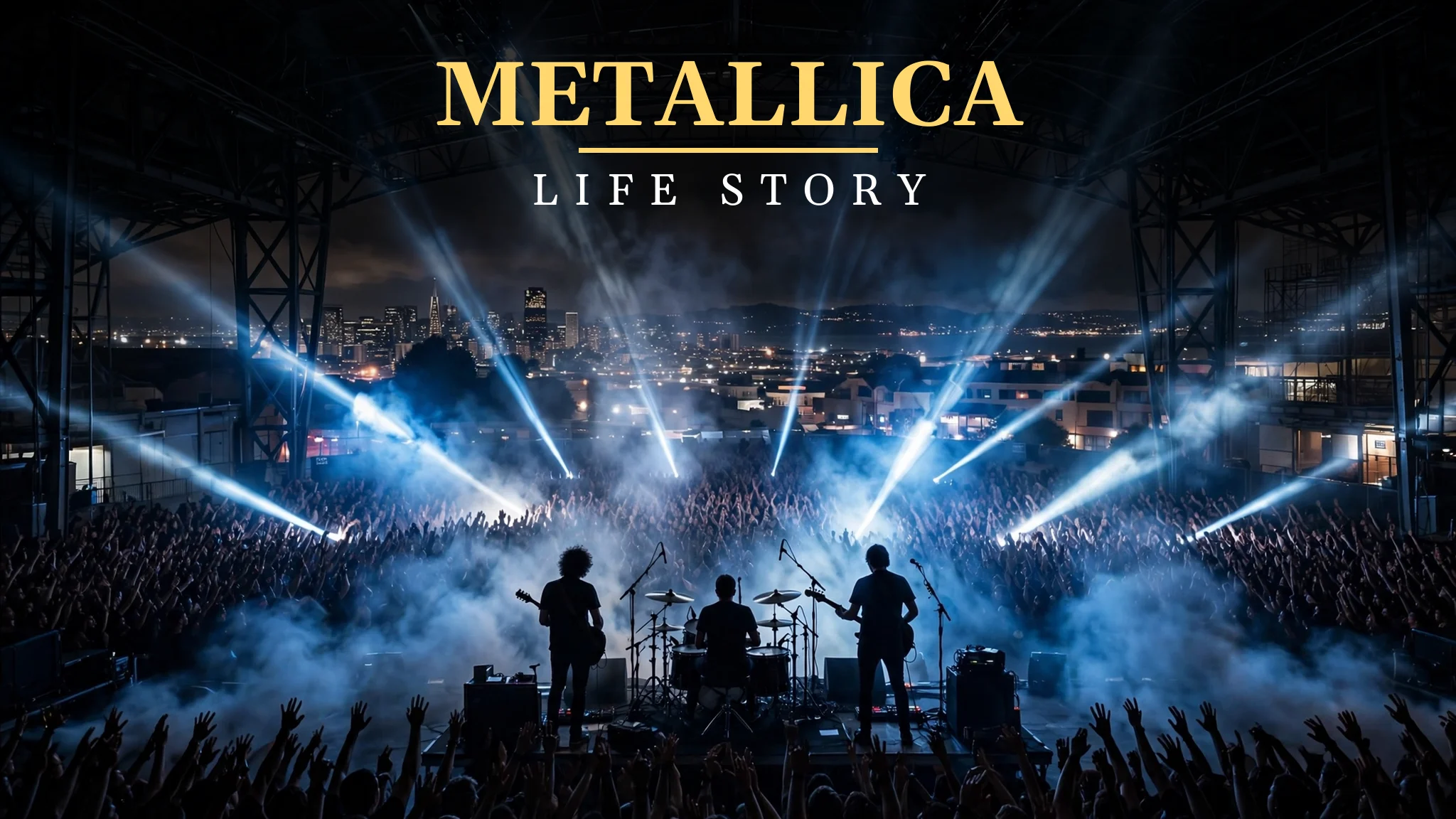
I keep thinking about the image of a band on an open-air stage, under blue lights, with a huge crowd and a city behind them. That feels like Metallica to me. They are a stadium band, a band that was made for big nights, big sounds, and big crowds. I hope their music keeps playing in stadiums for a long time, because it deserves to be heard loud.
I think about Metallica’s move to San Francisco, and I realise how important it was. Los Angeles was full of glam bands, and Metallica did not fit in there. San Francisco was full of thrash bands, and Metallica fit in perfectly. It was a smart move, and it changed their career. I think that is a lesson for anyone: find the place where you belong, find your people, and go there. Do not try to fit in where you do not belong. Find your community, and grow there.
I also think about their fan club, and I respect it. They call their fans the Metallica family, and they treat them like family. They play special shows, they release exclusive music, and they listen to their fans. That is a good way to be famous. Do not treat your fans like customers. Treat them like family, like people who matter. Metallica does that, and their fans are loyal because of it. I wish more bands did the same.
When I listen to Fade to Black, I hear a song about suicide, about a person who feels like giving up. It is a sad song, but it is also a hopeful song, because it talks about the pain, and it lets the listener know they are not alone. I think that is important. Songs about dark feelings can help people, because they show that someone else understands. Metallica has always been honest about dark feelings, and that honesty has helped many people.
I think about the band’s charity, All Within My Hands, and I admire it. They founded it to fight hunger, to support education, and to help communities. They have donated millions, and they have encouraged their fans to give. That is a good use of fame, and I wish more famous bands did the same. They have a platform, and they use it to help others. That matters, and it makes me respect them more.
I also think about James Hetfield’s struggles with addiction, and I respect his honesty about it. He has been to rehab, he has spoken openly about his problems, and he has worked hard to stay sober. That takes courage, especially for a famous man. He could have hidden it, but he did not. He talked about it, and he got help. I think that honesty has helped many fans who are struggling with their own problems. It says, it is okay to ask for help.
If I have a criticism, it is that some of their albums in the 1990s and 2000s were not as strong as their early work. Load, Reload, and St. Anger had good songs, but they were not as consistent as Master of Puppets or the Black Album. I understand why they experimented, but I miss the fast, heavy sound of their early years. I am glad they went back to that sound with Death Magnetic and Hardwired, and I hope they keep it.
I learn from Metallica that a band can last if it stays true to itself and to its fans. They have been together for more than forty years, and they have survived tragedy, fights, and fame. They did it by caring about their music, by caring about their fans, and by staying together through hard times. That is a lesson for any band, and for any partnership. Loyalty matters, honesty matters, and hard work matters.
I also learn from them that it is okay to change, but also okay to go back to your roots. They changed their sound with the Black Album, they tried new things, and then they went back to thrash metal with Death Magnetic. That shows flexibility, and it shows that a band can grow and still remember where it came from. I think that is a good balance, and I admire it.
When I listen to The Unforgiven now, I hear a song about a man who is trapped by his family, by society, and by his own choices. It is a sad song, but it is also a powerful song, because it asks us to think about freedom, about what it means to be yourself. I think that is a message many people need to hear. We are all unforgiven sometimes, and we all need to find a way to forgive ourselves and to move on.
In the end, I think Metallica teaches me to be loud, to be honest, to work hard, and to keep going. They are not a perfect band, and they would be the first to say so. They are a real band, with real problems, real talent, and real songs, and their music has helped millions of people feel less alone. That is a real achievement, and it is why I will keep listening to them.
I will remember Metallica as the biggest metal band in the world, the band that could play a stadium, make a crowd headbang, and come back from the edge. They are survivors, they are metal legends, and they are still here. Their story reminds me that life is loud, heavy, and wonderful, if you are brave enough to live it.
I keep thinking about the image of a band on an open-air stage, under blue lights, with a huge crowd and a city behind them. That feels like Metallica to me. They are a stadium band, a band that was made for big nights, big sounds, and big crowds. I hope their music keeps playing in stadiums for a long time, because it deserves to be heard loud.
I think about The Unforgiven, and I feel moved. It is a song about being trapped, about a man who cannot escape his family or his past. James Hetfield wrote it from personal experience, and it is honest and powerful. I like songs that talk about feeling trapped, because many people feel that way, and it helps to know you are not alone. Metallica has always been honest about dark feelings, and that honesty has helped many fans.
When I listen to S&M, the album with the San Francisco Symphony, I hear a band that is willing to take a risk. Combining metal with an orchestra is a bold idea, and it could have failed. But it worked, and it sounded beautiful. It showed that Metallica is not afraid to try new things, and that they respect other kinds of music. I admire that openness, and I wish more metal bands were as brave.
Finally, I want to remember Metallica as a band that never stopped learning. They learned from San Francisco, they learned from Bob Rock, they learned from the orchestra, and they kept growing. That is a good way to be an artist. Keep learning, keep trying, and keep making music that matters. I am glad I learned about them, and I will keep listening to their songs.
Frequently Asked Questions
When was Metallica formed?
Metallica was formed in Los Angeles, California, in 1981, when Lars Ulrich met James Hetfield. They were joined by Dave Mustaine and Ron McGovney, and later by Kirk Hammett and Cliff Burton, and they became one of the most important metal bands in history.
What are Metallica’s best-known songs?
Their best-known songs include Enter Sandman, Nothing Else Matters, Master of Puppets, One, Sad but True, and The Unforgiven. Enter Sandman, from the Black Album, is their most famous song, and it is played at sports events and on the radio every day.
Who was Cliff Burton and what happened to him?
Cliff Burton was Metallica’s bass player from 1982 to 1986, and he was a brilliant musician who helped shape the band’s sound. He died on 27 September 1986 in a bus crash in Sweden while the band was touring, at the age of twenty-four.
What is the Black Album?
The Black Album is Metallica’s fifth album, released in 1991, called Metallica but known as the Black Album because of its black cover. It included Enter Sandman, Sad but True, and Nothing Else Matters, and it sold more than 30 million copies worldwide.
Why did Metallica sue Napster?
Metallica sued Napster in 2000 because the file-sharing service allowed people to download their music for free. The band said it was stealing their work, and the case became a symbol of the music industry’s fight against illegal downloading.
Is Metallica in the Rock and Roll Hall of Fame?
Yes, Metallica was inducted into the Rock and Roll Hall of Fame in 2009. The honour recognised a career of more than twenty-five years, from their debut album Kill ‘Em All to the Black Album and beyond.
Is Metallica still touring?
Yes, Metallica is still touring and recording. They released 72 Seasons in 2023, and they continue to play stadiums around the world, with James Hetfield, Lars Ulrich, Kirk Hammett, and Robert Trujillo as the band’s members.


