Michelangelo Virus That Scared World
In this post
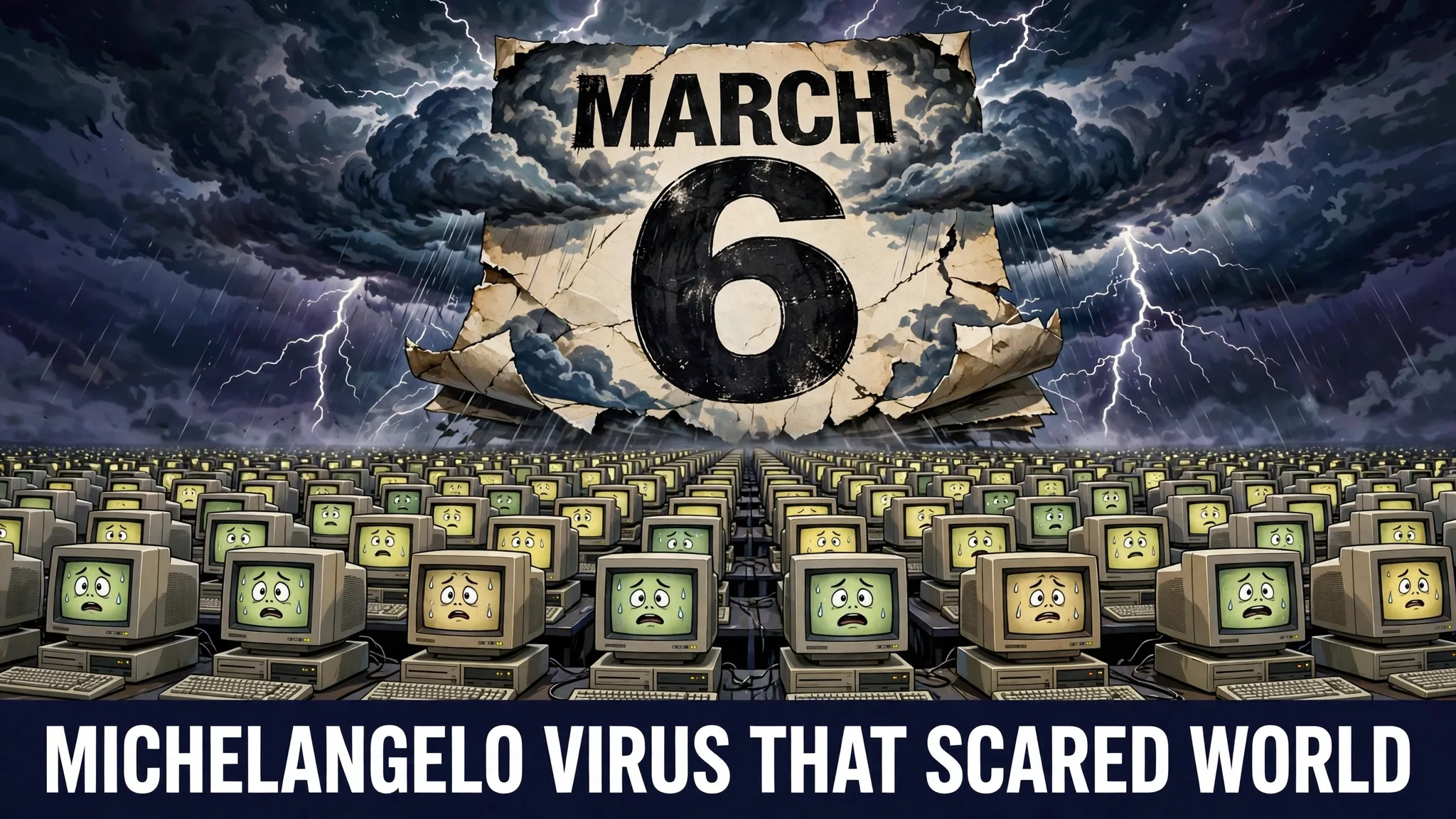
On the evening of 5 March 1992, in offices and homes on almost every continent, people were doing something strange. They were backing up files onto stacks of floppy disks. They were writing down phone numbers they might need. Some unplugged their computers and decided not to switch them on at all the next day. Others sat staring at their machines, wondering if everything inside — the letters, the accounts, the family photos scanned with so much care, the work of months — would still be there when morning came.
No storm was coming. No war had been announced. The fear had a date, and the date had a name borrowed from a painter who had been dead for more than four hundred years. The world was holding its breath for the Michelangelo virus.
A bomb that waited for a birthday
The Michelangelo virus was a type of malware known as a boot-sector virus. To understand why that mattered, picture how a computer wakes up. Before your programs load, before the familiar screen appears, the machine reads a tiny set of starter instructions from a special area of the disk. That little starting zone is called the boot sector. It is the first thing the computer trusts every single time it is switched on.
A boot-sector virus hides in that trusted starting zone. The Michelangelo virus was discovered in 1991, and it earned its name from the cruel detail built into its code. It was programmed to stay quiet all year and to strike on one specific date: 6 March. That date is the birthday of Michelangelo, the Renaissance artist who painted the ceiling of the Sistine Chapel.
On any other day of the year, an infected computer behaved normally. Files opened. Games played. Work got done. But if the machine was switched on when the calendar showed 6 March, the virus woke up and overwrote the beginning of the hard disk with meaningless garbage data.
That sounds technical, but the result was brutally simple. The beginning of a hard disk is where the computer keeps the map that tells it where everything is stored. Destroy the map, and the data might as well be gone, even if fragments of it still sit on the disk. Documents, programs, records — the machine could no longer find or read them in any normal way. For most ordinary users in 1992, that meant total loss.
How the Michelangelo virus travelled from desk to desk
In 1991 and 1992, most home and office computers were not connected to the internet at all. Software, games, and documents moved from person to person on floppy disks — small plastic squares that you pushed into a slot on the front of the machine. Friends copied games for friends. Colleagues shared disks full of spreadsheets. A single disk might pass through a dozen computers in a month.
That sharing culture was the road the Michelangelo virus travelled. When an infected floppy disk was used to start a computer, the virus copied itself into the boot sector of the hard disk. From then on, every blank or innocent floppy disk placed into that machine could pick up the virus too. The owner noticed nothing. There was no strange message, no slowdown, no warning. The disk simply carried a hidden passenger, waiting for one date on the calendar.
This is how the virus could reach an ordinary person without any dramatic hacking. You did not need to be a bank or a government office. You only needed to borrow a disk from a friend, copy a program from a colleague, or buy software that had been prepared on an infected machine. In fact, reports at the time said the virus was even found on some newly shipped machines and software, which poured fuel on the public fear. If the infection could arrive inside a sealed box, people reasoned, then nobody was safe.
The countdown: months of swelling dread
As 1991 turned into 1992, newspapers and television stations around the world began to carry dramatic warnings about the coming date. Some forecasts quoted in the media spoke of millions of computers being wiped on 6 March 1992. Numbers like that were media forecasts of the time, repeated from broadcast to broadcast until they felt like established facts.
The fear grew in stages, like a storm building far out at sea. First came the discovery stories: a strange virus, a famous name, a deadly date. Then came the discovery that infected disks and even some new products carried it, which made the threat feel close and personal. Then came the experts on television, the magazine covers, the office memos warning staff not to use their computers on the day. Antivirus software, which most home users had never heard of before, suddenly became a product people queued to buy. Shops reported rushes. Companies paid for emergency checks. For many families, this was the first time they had ever thought about the safety of the information inside their own computer.
There was also confusion mixed into the fear. Many people did not know whether their machine was infected. Many did not know how to check. Some believed that simply switching the computer off for the whole day would keep them safe — and for a boot-sector virus that only acted when the machine started on that date, staying off was indeed a rough shield, though it did nothing to remove the infection waiting for another year.
Underneath all of it sat a simple, uncomfortable truth. A tiny piece of code, small enough to hide in the starter area of a disk, had taught millions of people at the same moment that the machines on their desks could betray them.
The morning after: the Michelangelo virus in reality
Then 6 March 1992 arrived.
Time zone by time zone, the date swept around the planet. Computers were switched on in New Zealand, in Asia, in Europe, in the Americas. And the catastrophe that had been forecast did not happen.
Machines were genuinely damaged — that part was real. Reports spoke of affected computers in the thousands or low tens of thousands, not the millions that media forecasts had warned about. For the people whose disks were wiped, the loss was serious and painful. Businesses lost records. Individuals lost work they could not replace. Nobody should pretend the day was harmless.
But compared with the dread of the months before, the morning felt strangely quiet. Most computers started normally. Most offices got on with their day. The millions of dead machines never materialised.
Why was the gap so wide? Partly, the warnings themselves had worked. Countless users had scanned their machines, cleaned infections, made backups, or kept computers off on the day — fear had accidentally become a giant public rehearsal for computer safety. Partly, the most dramatic forecasts had simply run far ahead of the evidence, growing larger each time they were retold. The virus was dangerous, but it was never hiding inside every fifth computer on Earth.
What the Michelangelo virus really changed
Ask what the Michelangelo virus destroyed, and the honest answer is: far less than the world expected. Ask what it changed, and the answer is much bigger.
Before 1992, the phrase “computer virus” belonged mostly to specialists and hobbyists. After the long countdown to 6 March, ordinary people everywhere knew the words and roughly what they meant. Grandparents discussed them. Children heard about them on the news. The idea that software could be sick — that a machine could carry an invisible infection with a trigger date — entered everyday conversation and never left.
The panic also turned antivirus software into a normal household purchase. Before Michelangelo, protecting a home computer felt like an concern for big companies. After it, families understood that a machine full of their own work and memories deserved the same care as a locked front door.
I find the whole episode oddly reassuring, because the fear, for all its exaggeration, pushed millions of people to learn one useful habit: make copies of what matters before you need them.
How to protect yourself from a Michelangelo-style threat
The tools have changed since 1992, but the habits that defeat this kind of virus are the same steady ones.
Keep proper backups, all year round. A backup is a separate copy of your important files — on an external drive, or in a trusted cloud account — that does not stay connected to your computer all the time. If a virus wipes or scrambles your disk, a backup turns a disaster into an inconvenience. Do not wait for a famous date in the news. Backups made calmly every week protect you from viruses, theft, spilled tea, and plain mechanical failure, which are all far more common than headline malware.
Use antivirus protection and keep it updated. Modern operating systems include built-in security tools, and reputable antivirus programs add another layer. The important part is that the protection is switched on and allowed to update itself, because new threats appear constantly. An out-of-date shield is only half a shield.
Be careful with anything you plug in or download. The floppy disks of 1992 have become USB sticks, email attachments, and downloads from the internet, but the trick is identical: a friendly-looking carrier with a hidden passenger. Only install software from sources you trust, and treat unexpected attachments and “free” versions of paid programs with suspicion.
Do not panic-buy safety. When a scary date or a frightening headline appears, slow down. Check whether the warning comes from a trustworthy source, confirm whether your type of device is even affected, and follow calm, official advice. Fear is a sales tool. Steady habits are the real protection.
Keep your system updated. Many viruses, then and now, enter through old flaws that have already been fixed. Installing updates promptly closes doors that malware is actively looking for.
Common questions
What exactly was the Michelangelo virus?
It was a boot-sector virus discovered in 1991. It hid in the starter area of disks and stayed silent until 6 March — the birthday of the artist Michelangelo — when it would overwrite the beginning of an infected computer’s hard disk and destroy access to the data stored there.
Did the Michelangelo virus really wipe millions of computers?
No. Some media forecasts at the time spoke of millions of machines being wiped on 6 March 1992, but the reported real damage was far smaller — in the thousands or low tens of thousands of computers. The gap between the forecast and the outcome is a large part of why the story is still remembered.
How did the Michelangelo virus spread without the internet?
It travelled on floppy disks, which people constantly shared for games, programs, and documents. When an infected disk started a computer, the virus copied itself onto the hard disk, and from there onto other disks used in the same machine — silently, with no visible signs.
Could a virus like Michelangelo hurt a computer today?
Boot-sector tricks still exist in modern forms, but today’s systems have stronger built-in defences, secure startup checks, and automatic antivirus protection. The bigger modern risks are ransomware and stolen passwords. The defence is the same as it was in 1992: updated protection, caution with downloads, and regular backups kept separately from your main machine.
Why do people still talk about the Michelangelo virus?
Because its legacy is cultural, not technical. It was the moment the general public learned what a computer virus was, and the moment antivirus software became an ordinary household product. The panic itself became the lesson: real danger, exaggerated fear, and one very useful habit — backing up — learned by millions at once.
Sources
- Wikipedia — Michelangelo (computer virus): https://en.wikipedia.org/wiki/Michelangelo_(computer_virus)