Miles Davis: The Life Story Behind the Jazz Trumpet Legend
In this post
- Alton, East St. Louis, and a Trumpet at Thirteen
- New York, Charlie Parker, and the School of Bebop
- Kind of Blue and the Quietest Revolution in Jazz
- The Second Great Quintet and the Road to Electric Music
- The Trumpet, the Mute, and a Sound Like No Other
- The Silent Years, the Comeback, and the Final Records
- My Take:
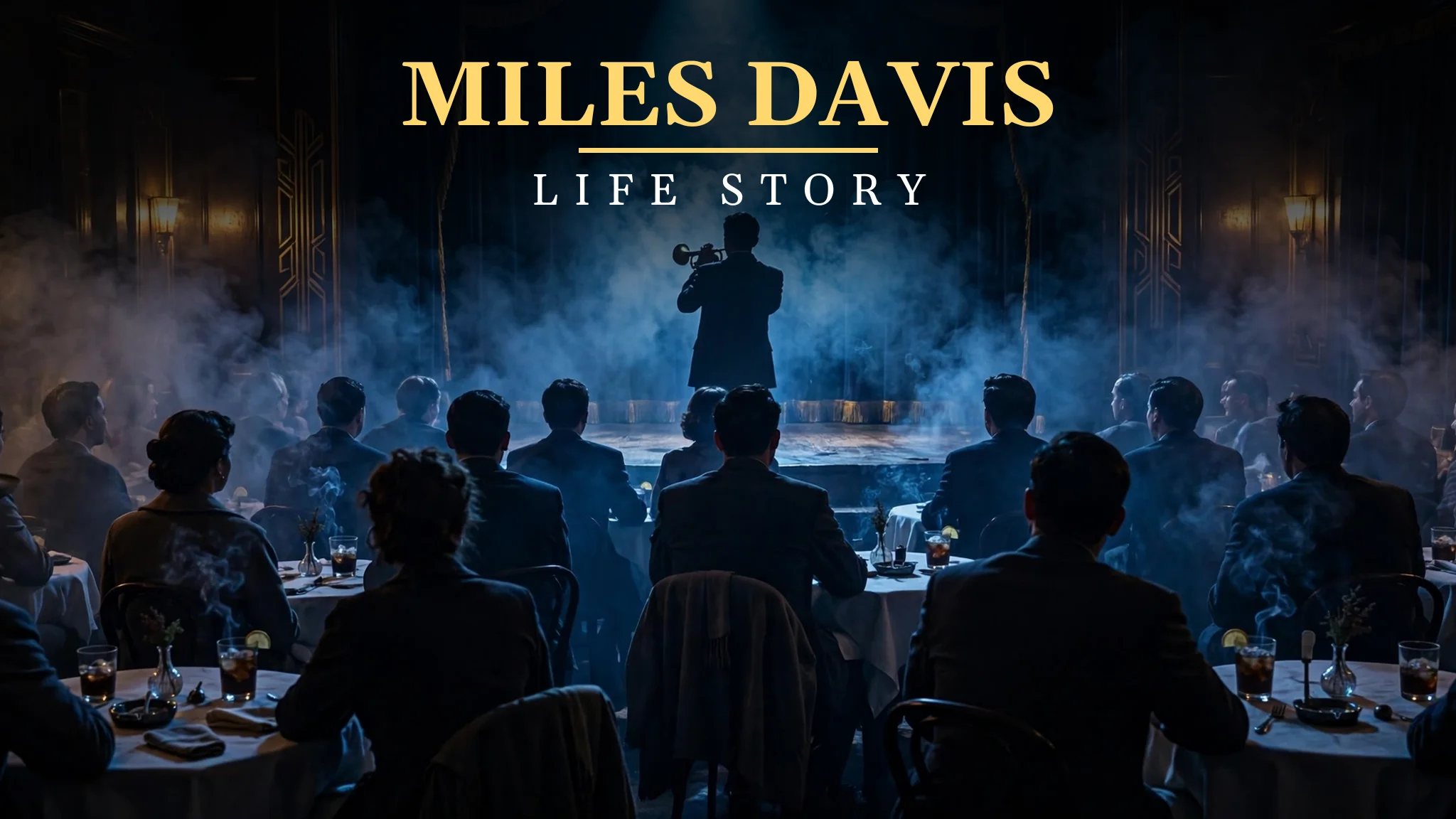
Miles Davis did not just play jazz. He changed it, again and again, and each time he changed it, the whole world of music followed him. He was a trumpeter who played fewer notes than anyone else, and who made each note matter more, a man who could stand on a stage, turn his back to the audience, and play a single, soft note that made a room full of people hold their breath. He made Birth of the Cool, he made Kind of Blue, the best-selling jazz album of all time, and he made Bitches Brew, a record that invented jazz fusion, and he did it all by refusing to stay in one place, by always looking for the next sound.
Miles Dewey Davis III was born on 26 May 1926 in Alton, Illinois, a small city on the Mississippi River, and he grew up in East St. Louis, in a family that was comfortable, educated, and musical. His father, Miles Dewey Davis Jr., was a dentist, a successful businessman, and a man who loved music, and his mother, Cleota, played the violin and the piano, and encouraged her children to learn music. Miles was the middle child, with an older sister, Dorothy, and a younger brother, Vernon, and he grew up in a house where music was a normal part of daily life, not a luxury, but a language that the family spoke together.
What makes Miles’s story so remarkable is that he never stopped changing. Most musicians find a style that works and stay with it for their whole career. Miles found a style, mastered it, and then left it behind, to find a new one, and he did that five or six times, from bebop to cool jazz to hard bop to modal jazz to fusion to funk, and each time he was right, and each time the critics said he was wrong, until they realised, years later, that he had been right all along. He was a restless, difficult, brilliant man, and his restlessness was the engine of his art.
Alton, East St. Louis, and a Trumpet at Thirteen
Miles Davis was born in Alton, Illinois, on 26 May 1926, and he spent his early childhood there, before his family moved to East St. Louis, a city across the river from St. Louis, Missouri, where his father had a successful dental practice. The family lived in a comfortable house, and Miles grew up in a world that was, by the standards of Black America in the 1930s, privileged, with a father who owned land, who ran a business, and who believed in education. But East St. Louis was also a segregated city, where Black people faced racism every day, and Miles learned early that talent and money did not protect a person from prejudice, a lesson that would shape his attitude for the rest of his life.
His father gave him his first trumpet when he was thirteen, a gift that changed his life. Miles had wanted a trumpet, and his father, who loved music, bought him one, and arranged for him to take lessons with a local teacher, Elwood Buchanan, a man who taught him not just how to play the instrument, but how to play it with a clear, clean tone, without vibrato, a style that would become Miles’s trademark. Buchanan told him to play softly, to play with feeling, and to never show off, advice that Miles took to heart, and that he followed for the rest of his career, even when other trumpeters were playing louder and faster than he was.
At school, Miles was a good student, but his real education was in music. He played in the school band, he listened to the jazz records his father brought home, and he began to play in local bands, in clubs and in dance halls, where he learned how to perform in front of an audience. He was a shy teenager, but on stage, with a trumpet in his hands, he was confident, and he knew that music was the thing he wanted to do with his life. He finished high school, and he told his father that he wanted to go to New York to study music, and his father, who had wanted him to become a dentist, agreed, because he saw that his son’s talent was real, and that it could not be ignored.
In 1944, at the age of eighteen, Miles moved to New York City to study at the Juilliard School of Music, one of the most prestigious music schools in America. Juilliard was a place where a young musician could learn theory, composition, and technique, but Miles soon realised that the real education in New York was not in the classroom, but in the clubs of Harlem and on 52nd Street, where the greatest jazz musicians in the world were playing every night, and where a young trumpeter could learn more in a single evening than in a month of classes.
New York, Charlie Parker, and the School of Bebop
When Miles arrived in New York in 1944, the jazz world was in the middle of a revolution, a new style called bebop, played by musicians like Charlie Parker, the saxophonist, and Dizzy Gillespie, the trumpeter, who were playing faster, more complex music than anyone had heard before. Miles was drawn to bebop immediately, and he sought out Charlie Parker, who became his mentor, his friend, and his bandleader, and who taught him more about jazz than any school ever could. Parker was a genius, a man who played the saxophone with a speed and an imagination that seemed impossible, and Miles played in his band, learning to keep up, to listen, and to find his own voice in the midst of Parker’s brilliance.
Playing with Parker was both an education and a trial. Parker was a difficult man, with a chaotic personal life, and the band was often in trouble, with missed gigs, with arguments, and with the pressures of life on the road, but Miles learned from it all, and he began to develop his own style, a style that was cooler, softer, and more spacious than Parker’s, a style that left room for silence, and that made each note count. He recorded his first records with Parker, and he began to be noticed as a trumpeter in his own right, a young man with a unique sound, a sound that was already different from anyone else’s.
In the late 1940s, Miles began to lead his own groups, and he recorded a series of sessions that became known as Birth of the Cool, a set of recordings made in 1949 and 1950 with a nine-piece band, featuring a new, softer sound, with arrangements by Gil Evans and Gerry Mulligan, and with a cool, relaxed feeling that was very different from the heat of bebop. Birth of the Cool was not a commercial success at first, but it became one of the most influential records in jazz history, because it showed that jazz could be quiet, thoughtful, and beautiful, as well as fast and exciting, and it gave Miles a reputation as a leader, not just as a sideman in someone else’s band.
The early 1950s were a difficult time for Miles, because he struggled with drug use, a problem that affected many jazz musicians of his generation, and that cost him work, health, and friendships. He has spoken honestly about those years, and about how he overcame them, by returning to his father’s farm in Illinois, by quitting drugs, and by rebuilding his life and his career. That recovery was a turning point, because it showed a determination that would define the rest of his life, a refusal to give up, even when the odds were against him, and a belief that his music was worth the effort of getting clean.
Kind of Blue and the Quietest Revolution in Jazz
In the late 1950s, Miles formed one of the greatest bands in the history of jazz, a sextet featuring John Coltrane on saxophone, Cannonball Adderley on saxophone, Bill Evans on piano, Paul Chambers on bass, and Jimmy Cobb on drums, and with that band he recorded Kind of Blue, in 1959, an album that became the best-selling jazz record of all time, and one of the most loved records in any genre. Kind of Blue was based on a new idea, modal jazz, in which the musicians improvised not on a series of chords, but on a single scale, or mode, giving them more freedom to play long, lyrical lines, and to create a mood that was calm, spacious, and deeply beautiful.
The album was recorded in two sessions, in the spring of 1959, and it was made quickly, with little rehearsal, because Miles wanted the music to feel fresh, spontaneous, and alive. The musicians were given sketches, not full arrangements, and they were asked to play what they felt, in the moment, and the result was a record of extraordinary beauty, with tracks like So What, Freddie Freeloader, and Blue in Green, that have become standards, played by jazz musicians around the world. Kind of Blue is a record that can be listened to by anyone, even a person who has never heard jazz before, because its beauty is immediate, its melodies are clear, and its feeling is one of calm, of space, and of deep emotion.
Miles followed Kind of Blue with Sketches of Spain in 1960, a collaboration with the arranger Gil Evans, in which he played the trumpet over orchestral arrangements inspired by Spanish music, and with other records that showed his range, from the hard bop of his earlier work to the orchestral beauty of his collaborations with Evans. He was now the most famous jazz musician in the world, a man whose records sold in large numbers, whose concerts were sold out, and whose name was known far beyond the jazz world, by people who had never been to a jazz club, but who had heard Kind of Blue and had been moved by it.
His playing in those years was at its peak, a sound that was soft, clear, and unmistakable, a sound that other trumpeters tried to copy and never quite managed. He played with a Harmon mute, a device that gave his trumpet a soft, distant quality, and he used space, silence, and timing in a way that no other trumpeter did, letting a note hang in the air, and then playing another, and letting the audience feel the gap between them. That use of space was his genius, and it is why his music still sounds modern today, more than sixty years after it was recorded, because it is not about speed or volume, but about feeling, about the choice of a single note, and about the courage to play less, and to mean more.
The Second Great Quintet and the Road to Electric Music
In the mid-1960s, Miles formed another great band, known as his Second Great Quintet, featuring Wayne Shorter on saxophone, Herbie Hancock on piano, Ron Carter on bass, and Tony Williams on drums, a group of young musicians who were among the most talented of their generation, and who pushed Miles to new ideas, to freer improvisation, and to a more open, experimental sound. The quintet recorded a series of albums in the mid-1960s, including E.S.P., Miles Smiles, and Nefertiti, records that are now considered classics, and that show a band that was telepathic, that could change direction in the middle of a song, and that could create music that was both complex and beautiful.
The Second Great Quintet was a band that worked as a collective, with each musician contributing ideas, and with Miles as the leader who gave them freedom and who trusted them to find the music together. That trust was a sign of Miles’s maturity as a bandleader, because he no longer needed to control every note, and he was willing to let his musicians surprise him, and to let the music go where it wanted to go. The quintet was also a band that played live with great intensity, and their concerts from that period, recorded in Europe and in America, are among the most exciting in jazz history, full of energy, of risk, and of a sense of discovery.
By the late 1960s, Miles was listening to rock music, to Jimi Hendrix, to Sly and the Family Stone, and to the new sounds of the time, and he began to think about how jazz could change again, how it could use electric instruments, rock rhythms, and a new kind of energy. He started to play with electric piano, with electric bass, and with a larger band, and he recorded In a Silent Way in 1969, a quiet, beautiful record that hinted at the change to come, and then, in 1970, he recorded Bitches Brew, a double album that invented jazz fusion, a new style that combined jazz improvisation with rock rhythms, electric instruments, and studio effects, and that changed music forever.
Bitches Brew was a shock to many jazz fans, because it was loud, dense, and difficult, with long tracks, with multiple keyboards, with electric guitars, and with a sound that was very different from Kind of Blue. But it was also a huge success, selling in large numbers, and winning a Grammy Award, and it opened the door for a whole generation of musicians, from Herbie Hancock to Chick Corea to John McLaughlin, who followed Miles into the world of fusion, and who created a new kind of music that was both jazz and rock, and neither, at the same time. Miles had done it again. He had changed jazz, and he had done it by listening to the world around him, and by refusing to stay in one place.
The Trumpet, the Mute, and a Sound Like No Other
Miles Davis’s trumpet sound was unlike anyone else’s, and it is worth thinking about how he made it, because the sound was not an accident, it was a choice, made over years of practice and listening. He played with a Harmon mute, a small metal device that fits into the bell of the trumpet and that softens the sound, giving it a distant, intimate quality, as if the music were coming from another room, or from a memory. With the mute, his trumpet did not shout, it whispered, and that whisper could be heard more clearly than a shout, because the audience leaned in to listen, and because the softness made each note feel personal, as if Miles were playing directly to the person listening, alone.
He also played with very little vibrato, the slight wavering of a note that many trumpeters use to make their sound warmer, and that choice gave his playing a clarity, a directness, that was almost like speaking. A note played by Miles was a straight, clean line, with no decoration, and that directness made his music feel honest, as if he were telling the truth, without trying to make it prettier than it was. His teacher, Elwood Buchanan, had told him to play without vibrato, to play softly, and to play with feeling, and Miles followed that advice for his whole life, even when other trumpeters were playing louder, faster, and with more vibrato than he ever did.
His sense of timing was also unique. He played behind the beat, slightly late, as if he were thinking about each note before he played it, and that delay gave his music a relaxed, thoughtful feeling, a sense that the music was not in a hurry, and that the listener did not need to be in a hurry either. He also used silence, letting a note end, and waiting, before playing the next one, and that silence was as important as the notes themselves, because it gave the audience time to feel what they had just heard, and to anticipate what would come next. That use of space and silence is the reason his music still sounds modern, because it is not about filling every moment, but about choosing the right moments, and trusting that less can be more.
The Silent Years, the Comeback, and the Final Records
In the mid-1970s, after years of intense work, of touring, and of health problems, Miles stopped playing. He retired from music in 1975, and he did not perform or record for five years, a period that became known as his silent years. He lived in New York, he struggled with his health, and he stayed away from the stage, while the jazz world wondered whether he would ever return. His silence was a mystery, and it was also a sign of how much the music had cost him, in health, in energy, and in personal terms, because he had given everything to his art, and he needed time to recover.
In 1980, Miles returned to music, with a new band, a new sound, and a new energy, recording The Man with the Horn in 1981, and then a series of albums in the 1980s that mixed jazz with funk, pop, and rock, including Tutu in 1986, a record that won a Grammy and that showed that Miles, even in his sixties, could still make music that was modern, fresh, and relevant. His comeback was not a return to the past. It was a new chapter, with younger musicians, with synthesisers, and with a sound that was brighter, more colourful, and more accessible than his earlier work, and it brought him a new audience, of young people who had not been born when Kind of Blue was recorded, but who loved his new music.
He continued to perform and to record through the 1980s and into the early 1990s, touring the world, playing festivals, and recording with musicians from many different backgrounds, including pop stars, rock musicians, and hip-hop artists, always looking for a new sound, always refusing to repeat himself. His final album, Doo-Bop, was released after his death in 1992, and it featured collaborations with hip-hop producers, a sign that, even at the end of his life, Miles was still looking forward, still listening to the music of young people, and still trying to find a new way to play.
Miles Davis died on 28 September 1991 in Santa Monica, California, at the age of sixty-five, after a long illness, and his death was mourned around the world. He was buried in New York, in Woodlawn Cemetery, and his funeral was attended by thousands of people, including musicians, friends, and fans, who came to pay their respects to a man who had changed music forever. His legacy is not a single record, but a whole history of jazz, from bebop to cool to modal to fusion, a history that he helped to write, again and again, by refusing to stand still.
My Take:
I think Miles Davis is the most important jazz musician who ever lived, and I do not say that lightly, because jazz has had many great musicians, from Louis Armstrong to Duke Ellington to John Coltrane, but none of them changed the music as often, or as completely, as Miles did. He changed it from bebop to cool, from cool to modal, from modal to fusion, and each time he was right, and each time the world followed him, even when it did not understand him at first. That is a rare kind of genius, the genius to see the future before anyone else, and to have the courage to go there, even when the audience wants you to stay where you are. I admire that enormously, because it is easy to repeat a success, and it is very hard to leave it behind.
What I admire most is his sound. Miles played fewer notes than any other trumpeter, and he made each note matter more. He played softly, he played with space, and he let the silence between the notes do as much work as the notes themselves. That is a lesson in restraint, and it is a lesson that applies far beyond music. In a world where everyone is trying to say more, to play faster, to be louder, Miles shows us the power of saying less, of playing a single note and letting it hang in the air, and of trusting that the audience will hear what you mean. I think that restraint is the heart of his art, and it is why his music still sounds modern today, because it is not about showing off, it is about feeling, and feeling does not go out of fashion.
Kind of Blue is the record I return to most, and I want to say why. It is a record that can be listened to by anyone, even a person who has never heard jazz before, because its beauty is immediate, its melodies are clear, and its feeling is one of calm, of space, and of deep emotion. I have listened to it in the morning, in the evening, when I am happy, and when I am sad, and it always fits, because it is not a record about a single mood, it is a record about the whole range of human feeling, expressed in the simplest possible way, with a trumpet, a saxophone, a piano, a bass, and drums, playing together as if they were thinking the same thought. That is a miracle, and it is one that I never get tired of hearing.
I also admire his courage as a bandleader. He hired the best young musicians, he gave them freedom, and he trusted them to surprise him, and that trust produced some of the greatest bands in jazz history. The Second Great Quintet, with Herbie Hancock, Wayne Shorter, Ron Carter, and Tony Williams, was a band that could change direction in the middle of a song, and that could create music that was both complex and beautiful, because Miles let them do it. That is a lesson in leadership, which is to hire people who are better than you in some ways, and to let them do their work, rather than trying to control every note. Miles understood that, and his bands were better because of it.
His restlessness moves me, because it is a story of a person who could never stay still. He was always looking for the next sound, the next band, the next idea, and that restlessness made him difficult to work with, and difficult to live with, but it also made him great. I think about the five years when he stopped playing, from 1975 to 1980, and how the jazz world wondered whether he would ever return, and how he did return, with a new sound, a new band, and a new energy, as if he had never been away. That comeback is a reminder that a career is not over when you stop, and that a person who takes time to recover can return stronger, if they are willing to try again.
If I am honest, there are parts of his life that are hard to admire. He was a difficult man, he could be harsh with the people around him, and his personal life, including his relationships with his wives, was often troubled, and those troubles are part of his story. He struggled with drug use in his early years, and he was open about it, and he overcame it, but the struggle left its mark, on his health, on his relationships, and on his work. I do not think we should ignore those parts of his life, because they are real, and because they show that even a genius can make mistakes, and can hurt the people around him. At the same time, I think his music should be judged on its own, and his music is extraordinary, even if the man who made it was flawed. Both things are true, and an honest account of his life has to hold them together.
I think about Bitches Brew, and how it divided the jazz world. Many jazz fans hated it when it came out, because it was loud, dense, and difficult, and because it did not sound like the Miles they loved. I understand that reaction, because it is hard to love a new sound when you have fallen in love with an old one, but I also think Bitches Brew was a brave record, and a necessary one, because jazz needed to change, and Miles was the person who changed it. He listened to rock, to Jimi Hendrix, to Sly Stone, and he heard a new kind of music, and he had the courage to make it, even when his audience did not want him to. That is a lesson for any artist, which is to listen to the world, not just to your fans, and to follow the sound you hear, even if it is unpopular at first.
His use of space is something I think about a great deal, because it is a skill that is hard to learn. Most musicians fill every moment with notes, because they are afraid of silence, but Miles was not afraid of silence. He let a note hang in the air, he let the audience wait, and he trusted that the wait would make the next note more powerful. That trust is a kind of confidence, and it is one that I wish more musicians had. Silence is not empty. It is full of feeling, and Miles understood that better than anyone, and his music is full of silences that are as beautiful as the notes themselves.
What I learn from Miles is that change is not a sign of weakness, but a sign of life. He changed his style five or six times, and each time he was accused of betraying jazz, and each time he was proved right, because the new style became the old style, and then he changed again. That is a lesson for anyone who feels stuck, which is to keep moving, to keep listening, and to keep looking for the next sound, even when the current sound is comfortable. Comfort is a trap, and Miles refused to fall into it, and his refusal is the reason his music still matters today, more than thirty years after his death.
I also learn from him that a single note can be enough. In a world where we are told to do more, to say more, to be more, Miles shows us that less can be more, that a soft note, played with feeling, can move an audience more than a hundred fast notes played without feeling. That is a lesson that applies to writing, to speaking, and to living, which is to choose your notes carefully, and to play them with meaning, rather than filling the air with noise. I try to remember that lesson when I write, and when I speak, and I think it makes my work better, because it reminds me to be clear, to be simple, and to trust that a single, honest note is enough.
In the end, I think Miles Davis will be remembered as the man who reinvented jazz, again and again, and who did it by playing less, by listening more, and by refusing to stand still. He was not perfect, and his life included struggles and mistakes, but his music is perfect in the way that only great art can be perfect, not because it has no flaws, but because it tells the truth about feeling, about space, and about the beauty of a single note. I will keep listening to Kind of Blue, to Bitches Brew, and to all of his records, because they remind me that music can change, that a person can change, and that the next sound is always waiting, if we are brave enough to listen for it.
I will remember him on stage, turning his back to the audience, playing a soft note on his trumpet, and letting the room hold its breath, and I will remember that he was a man from East St. Louis, the son of a dentist, who became the most important jazz musician in the world, not by playing louder than anyone else, but by playing quieter, by playing less, and by playing with a feeling that no one else could match. That is a story worth telling, and a sound worth hearing, for as long as people care about music.
I also think about his trumpet sound, and how it was made, because it shows that a great sound is not a gift, it is a choice. He chose the Harmon mute, he chose to play without vibrato, and he chose to play behind the beat, and those choices, made over years, became his voice, a voice that no one else could copy, because it was not just a technique, it was a way of thinking about music, about space, and about feeling. I think that is a lesson for any musician, or any artist, which is to find your own sound, and to protect it, even when the world wants you to sound like someone else. Miles found his sound, and he kept it, through bebop, through cool, through modal, and through fusion, and that consistency, in the midst of constant change, is what makes him great.
His relationship with John Coltrane is another part of his story that stays with me. Coltrane was a saxophonist of extraordinary talent, and he played in Miles’s band in the late 1950s, on Kind of Blue and on other records, and the two men pushed each other to new heights, with Coltrane’s dense, searching solos contrasting with Miles’s sparse, quiet playing, and the contrast made both of them better. Coltrane went on to become a legend in his own right, and his departure from Miles’s band was a loss, but it was also a sign of Miles’s generosity as a bandleader, because he hired the best, he let them grow, and he let them leave when they were ready to lead their own bands. That is a rare kind of leadership, and it is one that I admire.
I also think about his father, Miles Dewey Davis Jr., and how important he was to his son’s life. He was a dentist, a businessman, and a man who loved music, and he bought his son a trumpet, he paid for his lessons, and he supported his decision to go to New York, even though he had wanted him to become a dentist. That support mattered, because it gave Miles the confidence to pursue music, and it showed him that a father could love his son enough to let him choose a different path. I think many great musicians owe their careers to a parent who believed in them, and Miles was one of them, and his father’s belief is a part of his story that deserves to be remembered.
Finally, I think Miles teaches me that listening is the most important skill in music, and in life. He listened to Charlie Parker, he listened to his bandmates, he listened to rock, to funk, and to hip-hop, and he let what he heard change his music, again and again. He did not close his ears when he became famous, and he did not decide that he already knew everything. He kept listening, and that listening kept his music alive, for more than forty years. I try to remember that lesson, to keep listening, even when I think I already know, because the next sound, the next idea, and the next change are always waiting, if I am brave enough to hear them.
Frequently Asked Questions
When was Miles Davis born?
Miles Davis was born on 26 May 1926 in Alton, Illinois, and he grew up in East St. Louis. His father was a dentist, and his mother played violin and piano, and he received his first trumpet at thirteen.
What is Kind of Blue?
Kind of Blue, recorded in 1959, is Miles Davis’s most famous album and the best-selling jazz record of all time. It was based on modal jazz, in which musicians improvise on a single scale, and it featured John Coltrane, Cannonball Adderley, Bill Evans, Paul Chambers, and Jimmy Cobb.
What is Bitches Brew?
Bitches Brew, released in 1970, is a double album that invented jazz fusion, combining jazz improvisation with rock rhythms, electric instruments, and studio effects. It was a huge success and opened the door for a generation of fusion musicians.
Who was in Miles Davis’s Second Great Quintet?
The Second Great Quintet, formed in the mid-1960s, featured Wayne Shorter on saxophone, Herbie Hancock on piano, Ron Carter on bass, and Tony Williams on drums. They recorded classic albums including E.S.P., Miles Smiles, and Nefertiti.
Why did Miles Davis stop playing in the 1970s?
Miles retired from music in 1975, after years of intense work and health problems, and he did not perform or record for five years. He returned in 1980 with a new band and a new sound, recording albums including Tutu in 1986.
When did Miles Davis die?
Miles Davis died on 28 September 1991 in Santa Monica, California, at the age of sixty-five. His final album, Doo-Bop, was released after his death in 1992.


