Milly Quezada: The Life Story Behind the Queen of Merengue
In this post
Milly Quezada is the Queen of Merengue, and she has held that crown for more than forty years. Her voice is warm, strong, and full of joy, and her songs have filled dance floors across the Dominican Republic, the United States, and the whole Latin world. When a Milly Quezada song comes on, people do not sit still. They dance, they sing, and they remember the good times, because her music is the sound of celebration.
She was born in Santo Domingo, and she grew up in New York, and she carried both places inside her. She sang with her brothers and sisters in a family band, she learned merengue from the music of her home, and she became a star who could stand on any stage in the world. She is a singer, a mother, and a symbol of Dominican pride, and her story is one of hard work, family, and a voice that never gave up.
What makes her story worth telling is the way she lasted. Many singers have one hit and fade away. Milly has had a career that has lasted for decades, through changes in music, through personal loss, and through the hard work of raising a family while touring the world. This is the story of how a girl from Santo Domingo became the Queen of Merengue, and how she kept her crown for a lifetime.
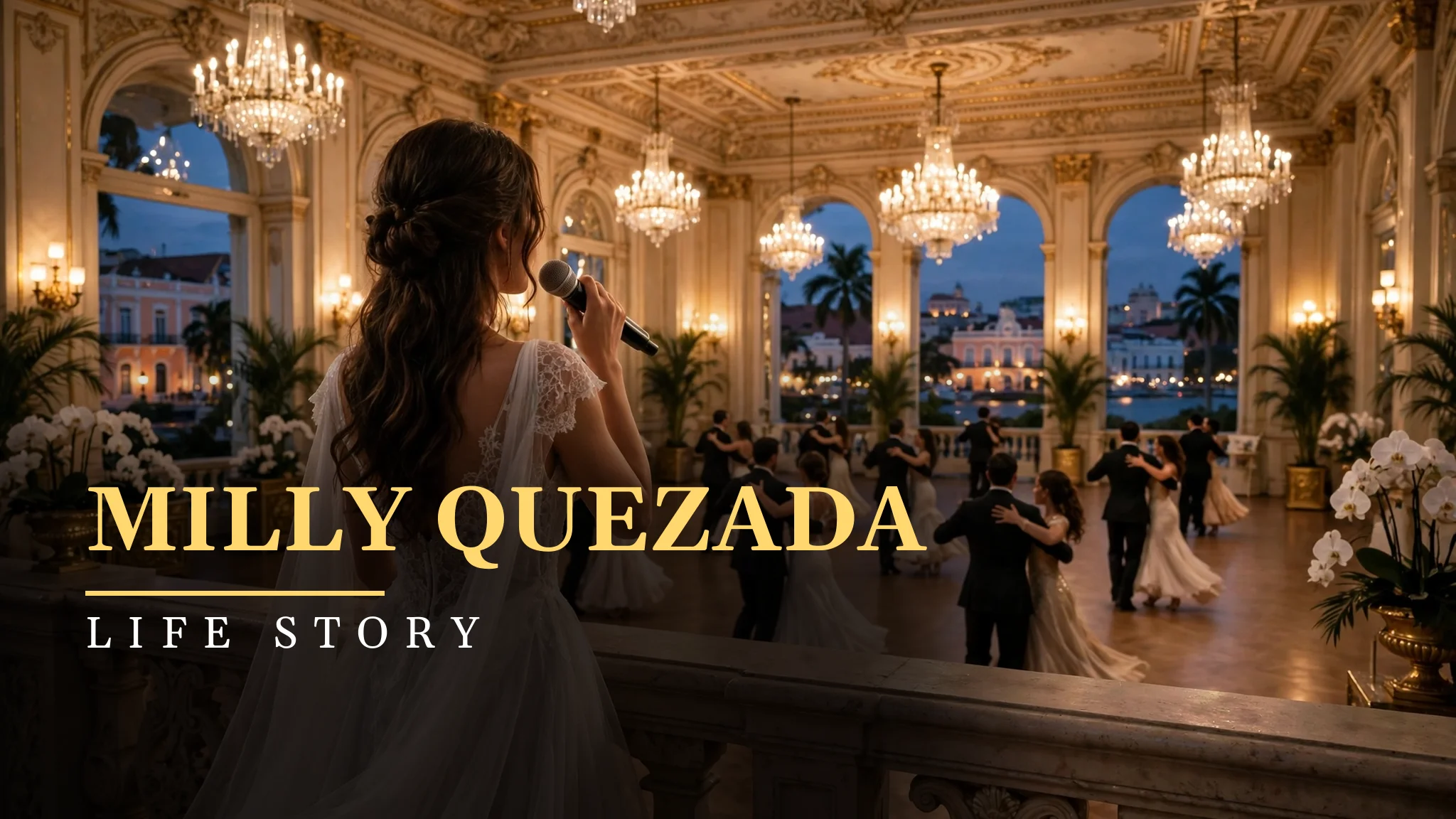
Her concerts today are a world away from the family parties where she began, and yet the heart of the show has not changed. She still sings with joy, she still dances, and she still looks the crowd in the eye. The stages are bigger, the lights are brighter, and the crowds are larger, but the feeling is the same. That is why her fans come back again and again, because they know that a Milly Quezada show is a night of pure happiness, and that the queen will never let them down.
A Girl From Santo Domingo
Milagros Quezada Borbon was born on 21 May 1955 in Santo Domingo, the capital of the Dominican Republic. Santo Domingo is a city of music, of merengue and bachata, and of families who live close together and celebrate loudly. Milly grew up in that world, and music was part of her daily life from the time she was a small child.
As a girl, she sang at home, at family parties, and at church, and her family noticed that she had a strong, beautiful voice. She was not shy about singing, and she loved to perform for the people she loved. Her parents encouraged her, and they saw that music was not only a hobby for their daughter. It was a gift, and it deserved to be nurtured.
The family later moved to New York City, and the move changed Milly’s life. New York was bigger, colder, and harder than Santo Domingo, and she had to learn to live in a new country, in a new language, and in a new world. But she carried the music of home with her, and she sang in Spanish, and she refused to give up her identity.
In New York, she lived in Washington Heights, a neighbourhood where many Dominican families had settled, and she grew up surrounded by Dominican life. There were small shops selling Dominican food, there were parties where merengue played late into the night, and there were families who kept the traditions of home alive. That world gave her a sense of who she was, and it shaped the singer she would become.
School in New York was busy and sometimes hard, and Milly had to find her own path through it. She was a good student, and she loved to learn, but music was always her first love. She sang in the choir, she sang at school events, and she dreamed of becoming a singer while she was still a girl. That dream stayed with her, and it would later become her life.
The move to New York also taught her about two cultures, because she lived as a Dominican at home and as an American at school. That double life gave her a special gift. She understood the old Dominican songs, and she also understood the new American sounds, and in time she would learn to put those two worlds together in her music.
Milly, Jocelyn y Los Vecinos: A Family Band
In the 1970s, Milly began to sing with her brothers and sisters in a family group called Milly, Jocelyn y Los Vecinos, which means Milly, Jocelyn and the Neighbours. The group was formed in New York, and it played merengue at parties, at community events, and at local shows. They were a family, and they were a band, and that closeness was the heart of their sound.
The group practised together, they travelled together, and they learned how to perform as a team. Milly was the lead singer, and her voice was the centre of the sound, but her siblings added harmonies, played instruments, and gave the group a warmth that a band of strangers could not match. When they sang together, you could hear the love between them.
Those early shows were their school. At a small party, a band learns fast, because the audience is close enough to tell you at once whether they like what they hear. If people danced, the song worked. If people talked over the music, the song did not work. Milly learned to read a room, and she learned to make people dance, and those lessons stayed with her for her whole career.
The group also recorded songs, and their records began to sell in the Dominican community in New York and in the Dominican Republic itself. They were still unknown to the wider world, but inside the Dominican community, they were becoming stars. Their songs were played on the radio, at weddings, and at parties, and their name began to spread.
The family band also taught Milly about hard work, because a band that is also a family must work together, argue together, and forgive each other. She learned to lead, to listen, and to keep the group together through the lean years. Those lessons made her a strong leader, and they helped her later when she became a solo star.
The years with Los Vecinos were happy years, and they gave Milly a foundation that lasted her whole life. She learned to sing, to perform, and to love music as a family, and she carried that love with her when she later stepped out on her own. The family band was the beginning of everything.
La Guacherna and the Rise of a Star
As the group grew, Milly began to record songs that became hits, and one of the most famous was La Guacherna, a joyful merengue that became a classic. The song was full of energy, and it made people dance, and it showed Milly’s voice at its best, strong, warm, and full of life. It became one of her signature songs, and it is still played at parties today.
Another famous song was Volvio Juanita, a story song about a woman who returns home, and it became one of the most loved merengues of its time. The song showed a different side of Milly, because it was not only a dance song. It was a story, and Milly told it with feeling, with humour, and with a voice that made the listener care about Juanita.
These songs made Milly a star in the Dominican Republic and in the Dominican community in the United States. She toured, she recorded, and she appeared on television, and her name became known across the Latin world. She was no longer only a singer in a family band. She was a star in her own right, and people called her the Queen of Merengue.
The rise was not easy, and there were many days when the work was hard. She toured for months, she recorded late into the night, and she had to balance her career with her family life. But she kept going, because she loved to sing, and because her fans loved her. That love gave her the strength to keep working, even when the road was long.
She also learned how to handle fame, because a star must learn to live in public, to smile for the cameras, and to keep her private life private. Milly learned that lesson well, and she kept her family close, and her work at the centre of her life. That balance helped her to build a career that lasted for decades.
The songs of those years also showed her range, because she could sing a fast, joyful merengue, and she could also sing a slow, romantic song. That range made her one of the most versatile singers in Latin music, and it is one of the reasons her career has lasted so long.
She also learned to work with new sounds, because music changes, and a singer who does not change is left behind. Milly listened to the new styles, she worked with young producers, and she kept her merengue fresh without losing its heart. That openness is one of the reasons her career has lasted, because she grew with the music instead of standing still.
Tengo, Solo Contigo, and the Peak Years
In the years that followed, Milly released more hits, including Tengo, a song about love and happiness, and Solo Contigo, a romantic song that became a favourite of her fans. These songs were played on the radio, at weddings, and at parties, and they showed that Milly could write and sing songs that spoke to the heart as well as to the feet.
Her albums sold in large numbers, and she toured across Latin America, the United States, and Europe. Her concerts filled halls with fans who danced, who sang along, and who celebrated with her. A Milly Quezada concert is a party, and her fans come to dance, to laugh, and to remember the good times.
She also won awards, and she was recognised as one of the leading voices of merengue. She was nominated for Latin Grammy Awards, and she won a Latin Grammy, which is one of the highest honours in Latin music. Those awards mattered, because they showed that the music world took her seriously, not only as a popular singer, but as a real artist.
During the peak years, she also worked with other major artists, and she recorded duets and collaborations that brought her music to new audiences. She sang with stars from many different styles, and each collaboration showed a new side of her voice. She was not afraid to try new things, and that openness kept her work fresh.
She also became a symbol of Dominican pride, because she had taken merengue, the music of her country, and carried it to the world. In the Dominican Republic, people saw her as a queen, and in New York, young Dominicans saw her as proof that a girl from their community could become a star without giving up her roots.
The peak years also brought her wealth, and she used it to take care of her family and to build a better life. She has spoken about the importance of family, and about the debt she owes to her parents, who came to America and worked hard to give their children a better life. She has never forgotten that, and she has stayed close to her family even as her fame grew.
Loss, Faith, and Standing Strong
Milly’s life has not been without pain, and she has faced personal loss that tested her strength. She lost her husband, Rafael Quezada, who had also been her manager and her partner in life, and the loss was a hard blow. He had believed in her from the start, and he had helped to build her career, and losing him meant losing a part of her life.
She faced that loss with faith, and she has spoken about how her belief in God helped her through the hard days. She is a woman of faith, and she has said that prayer, family, and music gave her the strength to keep going. That faith is part of who she is, and it is one of the reasons her fans love her, because they see a woman who has faced pain and kept her hope.
She also had to raise her family while keeping her career going, and that is a hard balance for any woman. She toured, she recorded, and she came home to her children, and she did it all with grace. She has shown other women in music that a career and a family can go together, if a woman is strong and if she has the support of the people she loves.
The loss also changed her music, because a singer who has known pain sings with a deeper feeling. Her later songs carry a warmth and a wisdom that only comes from a life that has known both joy and sorrow. Her fans can hear that depth in her voice, and they love her for it.
She has also used her fame to help others, and she has spoken about the importance of giving back to her community. She knows what it is like to struggle, and she wants young people in the Dominican Republic to have a chance. That generosity is part of who she is, and it is one of the reasons she is respected as well as loved.
Through it all, she kept singing, and she kept dancing, and she kept bringing joy to her fans. That is the mark of a strong woman, and it is the reason her career has lasted for so long. Pain did not stop her. It made her stronger.
She also found comfort in her children and in her family, who stood beside her in the hard days. A family that sings together can also grieve together, and Milly’s family gave her the love she needed to keep going. That love is part of her story, and it is one of the reasons her fans see her as more than a singer. They see her as a woman who has lived, loved, and lost, and who kept singing anyway.
A Latin Grammy, Honours, and a Lifetime of Music
In 2011, Milly Quezada won a Latin Grammy Award, and the honour was a major moment in her career. It was a recognition of decades of work, of songs that had filled dance floors, and of a voice that had carried merengue to the world. She accepted the award with joy, and she thanked her family, her fans, and her country.
In 2021, she received a Latin Grammy Lifetime Achievement Award, which is given to artists who have made a lasting mark on Latin music. The award was a fitting honour for a singer who had spent more than forty years on stage, and it showed that the music world recognised her as a legend. She was proud, and her fans were proud with her.
She has also been honoured in the Dominican Republic, where she is seen as a national treasure, and in the United States, where she is seen as a pioneer for Dominican artists. She has received awards from many organisations, and she has been celebrated at festivals and concerts across the Latin world.
Her later albums, including Aqui Estoy Yo, showed that she was still growing as an artist, still trying new ideas, and still willing to take risks with her sound. She worked with new producers, she recorded new songs, and she proved that a singer in her sixties could still make music that young people loved.
She has also become a mentor to young singers, and she has encouraged them to work hard, to respect their roots, and to believe in themselves. She knows what it is like to start small, and she wants the next generation to have a better road. That generosity is part of her legacy.
Today, Milly Quezada stands as the Queen of Merengue, and her crown is secure. She has sung for decades, she has won the highest honours, and she has carried her music to the world. Her story is still being written, and her fans are waiting to see what she will do next.
The Queen’s Legacy
Milly Quezada’s legacy is easy to see, because her songs are still played at every Dominican party, at every wedding, and at every celebration. La Guacherna, Volvio Juanita, Tengo, and her other hits are now classics, and young singers still learn them, cover them, and play them. A song that is played at a wedding becomes part of a family’s history, and Milly’s songs have become part of many families’ histories.
Her legacy is also in the way she carried merengue to the world. Before her, merengue was a Dominican music. After her, merengue was a world music, played in New York, in Madrid, and in many other places. She opened the door for many Dominican artists who came after her, and they have said so in interviews.
She has also shown that a woman can lead in Latin music, and that a woman can have a career that lasts for decades. In a music world where men have often been the stars, Milly stood as a queen, and she proved that a woman’s voice could fill a stadium. That is a powerful message for young girls in the Dominican Republic and beyond.
Her voice, her joy, and her strength are the heart of her legacy. She sings with happiness, she dances with energy, and she faces life with faith, and her fans love her for all of it. She is not only a singer. She is a symbol of Dominican pride, of family, and of a life lived with music.
The story of Milly Quezada is, in the end, a story about a queen who never forgot her people. She sang for them, she danced with them, and she carried their music to the world. That is a beautiful story, and it is one that will be told for a long time.
My Take:
When I think about Milly Quezada, the first thing that comes to my mind is joy, because her music is pure joy, and her life is full of joy too. She sings, she dances, and she makes people happy, and I think that is a beautiful gift. In a world full of hard news, a singer who brings joy is a treasure, and Milly has brought joy to millions of people for more than forty years.
I admire her voice, because it is warm, strong, and full of life. She does not sing quietly, and she does not hide her feelings. She sings with her whole heart, and her voice fills a room. When I hear La Guacherna, I hear a woman who loves to sing, who loves to dance, and who loves her people, and that love is in every note.
I also admire her family, because she started in a family band, and she never forgot that. She sang with her brothers and sisters, she learned music as a family, and she carried that love with her for her whole career. I think that is a beautiful thing, because a singer who starts with family carries a warmth that a singer who starts alone does not have.
What I find most interesting about her is the way she lasted. Many singers have one hit and fade away, but Milly has had a career that has lasted for decades. She has sung through changes in music, through personal loss, and through the hard work of raising a family, and she is still singing. That takes strength, and it takes love for the music, and Milly has both.
I think about her loss, because losing a husband is a pain that no success can balance. She faced that pain with faith, and she kept going, and she kept singing. I respect that, because it is easy to give up when life hurts. It is much harder to keep singing, to keep dancing, and to keep bringing joy to others when your own heart is broken. Milly did that, and that is a mark of a strong woman.
I also think about her faith, because it is part of who she is, and it has carried her through the hard days. She has spoken about God, about prayer, and about the hope that faith gives her, and I think that is a beautiful thing. A singer who believes in something bigger than herself can face hard times with courage, and Milly has done that.
There is something I keep returning to, and it is the title Queen of Merengue. A title like that is a gift, but it is also a weight, because a queen must live up to her crown every time she sings. Milly has done that for decades, and she has never let her fans down. That is a rare thing, and it is one of the reasons her fans love her so much.
I think about the young girls in the Dominican Republic who watch Milly and see themselves. A girl from Santo Domingo became a queen, and that tells them that they can dream big too. They do not need to be rich, and they do not need to be famous to start. They need a voice, a family, and a dream, and Milly shows them that those things are enough.
If I have a criticism, it is a small one. I sometimes wish Milly would tell more of her own story in her songs, because her life is full of lessons, about family, about loss, about faith, and about lasting. Her songs are often about joy and dancing, and they are wonderful, but I think her fans would love to hear more of the deeper story too. She has the voice and the life to do it.
I also think about the way she carries merengue to the world, because merengue is the music of the Dominican Republic, and Milly is its queen. She took that music to New York, to Europe, and to Latin America, and she made the world love it. That is a gift to her country, and it is one that will last long after she stops singing.
What can a reader learn from Milly Quezada? I think the lesson is about lasting. She did not become famous in a week, and she did not fade away in a year. She worked for decades, she sang with joy, and she kept going through good times and hard times. That is a lesson for anyone with a dream. You do not need to be famous fast. You need to last, and lasting comes from love for the work.
I also learn from her that family is a strength. She started with her family, she leaned on her family, and she kept her family close. In a music world that often pulls people away from home, Milly stayed close to home, and home stayed close to her. That is a beautiful thing, and it is one of the reasons her career has lasted.
I think about her future, because she is still singing, still dancing, and still bringing joy to her fans. She has won the highest honours, she has sung for decades, and she is still loved. I hope she keeps singing for many more years, because the world needs her joy.
I think about the dancers, because merengue is a dance music, and Milly’s songs fill dance floors in a way that few other songs can. When her music comes on, people do not sit still. They dance, they laugh, and they celebrate, and for a few minutes, the whole room becomes one party. That is a gift, and Milly gives it every time she sings.
I also think about the way her songs are passed down, because a mother who danced to Milly as a girl now plays Milly for her own daughter, and the daughter dances too. That is how a legacy is built, not in a year, but in a generation, and Milly has built a legacy that will last for many generations.
When I listen to Milly Quezada now, I hear a queen who sings with joy, who dances with energy, and who faces life with faith. I hear Santo Domingo, I hear New York, and I hear the sound of a woman who loves her music and her people. That is why her fans love her, and that is why I think her story matters.
I also think about the way her music makes people feel at home, even when they are far from home. A Dominican living in New York or in Madrid can hear a Milly song and feel close to the island, to the family, and to the language of home. That is a powerful thing, because music can carry a person home in a way that nothing else can.
Finally, I think her story is a reminder that joy is not a small thing. In a hard world, a song that makes people dance is a serious gift, and Milly gives that gift with all her heart. She took a music, she made it shine, and she shared it with the world. That is a beautiful story, and it is one that will be told for a long time.
I think about the church, because Milly sang in church as a girl, and the church taught her that a voice is a gift from God. She has carried that belief with her for her whole life, and it is why she sings with such joy. A singer who believes her voice is a gift will use it with care, and Milly has used hers to bring happiness to millions of people.
I also think about Washington Heights, because that neighbourhood in New York is the home of many Dominican families, and Milly grew up there. She knows the streets, the shops, and the people, and she carries that world in her songs. When a Dominican in New York hears Milly, they hear home, and that is a powerful feeling.
I think about the men who have ruled merengue, because merengue has had many great male singers, and Milly stood among them as a queen. She did not ask for permission to lead. She sang, she danced, and she proved that a woman could be the best in a world of men. That is a lesson for every girl who is told that music is a man’s world.
I also think about the way she dresses on stage, because she presents herself with grace and with pride. She wears beautiful dresses, she moves with elegance, and she shows that a queen does not need to shout to be heard. Her style is part of her art, and her fans love her for it.
I think about the awards, because a Latin Grammy is a high honour, and a Lifetime Achievement Award is even higher. Milly earned both, and she earned them with decades of work, not with one hit. I think that is the right way to earn an award, slowly, with many songs, and with a career that lasts.
I also think about the young merengue singers who look up to her, and I hope they learn the right lessons. They should learn to work hard, to respect their roots, to sing with joy, and to keep going when life is hard. Milly teaches all of that, not with speeches, but with her life.
I think about the song Volvio Juanita, because it is a story song, and it shows that Milly can tell a story as well as she can make people dance. A singer who can tell a story is a rare artist, and Milly proved that she was one. The song is about a woman who returns home, and it speaks to everyone who has ever left home and come back.
I also think about the way her music is used at celebrations, because a Milly song is played at weddings, at birthdays, and at holidays, and it becomes part of the memory of those days. A song that is played at a happy moment becomes part of that happiness, and Milly’s songs have become part of many happy memories.
I think about her children, because she raised them while touring the world, and that is a hard life for a mother. She did it with grace, and she showed that a woman can be both a star and a mother. That is a lesson that many working mothers will understand, and they will see themselves in her story.
I also think about the future of merengue, because Milly is one of the singers who will decide where it goes next. She has carried it for decades, and she will keep carrying it, and the young singers who follow her will build on what she did. That is how a music lives, through the singers who love it and who pass it on.
Finally, I think about the queen herself, standing on a stage, singing La Guacherna, with a crowd dancing before her, and I think that is a beautiful picture. A girl from Santo Domingo became a queen, and she did it with a voice, with a family, and with a joy that never faded. That is a story worth telling, and it is a story that will be told for a long time.
When I look at the whole of her career, I see a singer who started with her family, who worked for decades, who faced loss with faith, and who never stopped bringing joy to her fans. She took merengue, she made it shine, and she shared it with the world, and that is a legacy that will last long after the last note of her next song has faded, and it is why her fans will keep singing her songs for many years to come.
Frequently Asked Questions
Where was Milly Quezada born? Milly Quezada was born as Milagros Quezada Borbon on 21 May 1955 in Santo Domingo, in the Dominican Republic. Her family later moved to New York City.
What is Milly Quezada’s most famous song? Her most famous songs include La Guacherna, Volvio Juanita, and Tengo. La Guacherna is one of her signature songs, and it is still played at Dominican parties today.
Why is Milly Quezada called the Queen of Merengue? She is called the Queen of Merengue because she is the most famous and successful woman in merengue, with a career that has lasted more than forty years, many hit songs, and a Latin Grammy Award.
Was Milly Quezada in a family band? Yes, Milly began her career singing with her brothers and sisters in the group Milly, Jocelyn y Los Vecinos, which was formed in New York in the 1970s.
Has Milly Quezada won a Latin Grammy? Yes, Milly Quezada won a Latin Grammy Award in 2011, and in 2021 she received a Latin Grammy Lifetime Achievement Award for her long career in Latin music.
Is Milly Quezada still performing? Yes, Milly Quezada is still performing and recording. She tours across Latin America and the United States, and her concerts are still full of fans who dance and sing along.


