Milo J: The Life Story Behind Argentina's Young Star
In this post
Camilo Joaquín Villarruel was fifteen years old when he started putting his own songs on the internet, and sixteen when one of them changed his life. He did not have a record deal, a manager, or a studio. He had a phone, a bedroom, and a voice that sounded older than he was. That is the whole beginning of the story of Milo J, and it is worth holding onto, because everything that came after, the millions of streams, the Bizarrap session, the Latin Grammy nomination, the albums, the Tiny Desk concert, grew out of that small beginning, and none of it would make sense without it.
He was born on 25 October 2006 in Morón, a city in the west of Greater Buenos Aires, to parents Walter Villarruel and Aldana Celeste Ríos. Morón is an industrial city, a place of factories, trains, and working families, and it is also, by a coincidence that matters to this story, the home town of Bizarrap, the producer who would later change Milo’s life. Two boys from the same city, born years apart, would meet at the top of Argentine music, and both of them would carry Morón with them when they got there.
Milo J is a rapper, a singer, a producer, and a songwriter, and he is known for a voice that is deep for his age and for songs that sound thoughtful in a way that surprises people who expect a teenager to write only about parties. His first album, 111, came out in November 2023, when he was seventeen. His second, 166, followed in July 2024. His third, La vida era más corta, arrived in 2025, and it took him somewhere nobody expected: back to the folk music of Argentina, to zambas and chacareras, to charangos and quenas, to the songs of his grandparents’ generation. That turn, from trap to folk, is the most interesting thing about him, and it is where this story ends, though it is probably not where his story ends.
Morón, a Bedroom, and the BajoWest Collective
Morón sits west of Buenos Aires, far enough from the capital’s centre to have its own character, and close enough for its young people to dream about the centre. It is a city of neighbourhoods, of schools, of football pitches, and of kids who make music on their phones because there is nowhere else to make it. Camilo grew up there in the 2010s, in a Argentina where trap and rap were becoming the sound of the young, and where the internet had made it possible for a teenager to record a song in his room and put it in front of the whole country by nightfall.
He began to take part in freestyle competitions in his early teens, the same plaza battles that had trained Tiago PZK and a whole generation of Argentine rappers. The competitions taught him to think fast, to listen, and to hold a crowd, and they gave him his first audience: other young rappers, who judged him the way only other rappers can, without mercy and without flattery. He was also part of the BajoWest Collective, a group of young artists from the west of Buenos Aires, who made music together, shared what they knew, and gave each other a name to stand behind. A collective is a kind of school, and Milo was a good student. He learned to write, to record, and to produce, and he learned that a song is not finished when you write it. It is finished when you put it out and let strangers hear it.
In 2021, when he was fourteen going on fifteen, he started uploading his own material on social media. There is a particular bravery in that, and it is easy to miss. A teenager who uploads a song is not only sharing music. He is sharing himself, in front of people who can be cruel, and he is doing it without the protection of a label, a manager, or an older brother to speak for him. Milo did it anyway, song after song, and the songs got better as he went. He was learning his trade in public, the way his whole generation learns its trade, and the public was watching, even when it did not know it was watching a future star.
His parents supported him, and that support mattered, because a fourteen-year-old who stays up late recording needs adults who understand what he is doing, even if they do not understand the music itself. Walter Villarruel and Aldana Celeste Ríos gave him room to work, and they gave him the stability that a young artist needs if he is going to survive the attention that comes later. Fame is hard enough for an adult. For a teenager, it is harder, and the difference between the teenagers who survive it and the ones who do not is often the family waiting at home when the show is over. Milo had that family, and it shows in the steadiness of his work.
There is something else about Morón that is worth naming. It is not a rich city, and it is not a fashionable one, and the young people who grow up there know that the world does not owe them attention. They have to earn it, and they have to earn it with work, not with connections. Milo earned it with work, and the work began in a bedroom, with a phone, and with a voice that was deeper and more thoughtful than anyone expected from a boy of fifteen. The bedroom is the first room of his story, and it is worth remembering when the later rooms get bigger.
Milagrosa: A Song That Travelled on TikTok
In August 2022, Milo released a song called Milagrosa, which means Miraculous, and the song did something that no amount of planning can guarantee: it went viral. It became part of a trend on TikTok in Argentina, the short-video app where a song can travel from one phone to a million phones in a week, and suddenly a sixteen-year-old from Morón was being heard by people who had never been to a freestyle battle, who had never heard of the BajoWest Collective, and who did not know his name the day before. That is how fame works now, for better and for worse: a song finds its moment, and the moment finds the singer, and the singer has to be ready for both.
Milagrosa is a fusion of trap beats with the rhythms of Brazilian funk carioca, and it showed what Milo could do when he let his ear wander beyond Argentine rap. The song is not a simple trap track. It has a swing to it, a bounce that comes from Brazil, and a vocal that is both soft and sure. It earned a gold certification in Mexico, a sign that the song had travelled beyond Argentina, and it gave Milo his first real audience: not only freestyle fans, but listeners who had found him through a video, a dance, a joke, a moment on their phone, and who had stayed for the song itself.
A viral hit is a strange gift. It gives a young artist an audience overnight, and it takes away the time he would have had to grow into that audience slowly. Milo was sixteen, and he had to learn, in public, how to be a star, how to follow a hit, and how to keep writing when millions of people were waiting for the next song. Some artists freeze at that moment. They spend years trying to repeat the hit, and they never do. Milo did something smarter. He kept working, and he kept changing, and he let the next songs be different from Milagrosa, trusting that the audience that had found him through one song would follow him to the next.
In early 2023, he released Rara vez, which means Rarely, or Seldom, with the producer Taiu, and the song became even bigger than Milagrosa. It passed hundreds of millions of streams on Spotify, it topped charts in Argentina and Spain, and it showed that Milo was not a one-song artist. The song is slower, more melodic, and more thoughtful than Milagrosa, and it proved that his voice could carry a song that was closer to a ballad than to a trap track. A singer who can do both, who can make a crowd bounce and then make the same crowd listen quietly, has a range that will serve him for a long time, and Milo was showing that range at sixteen and seventeen, before most artists have found their first sound.
In April 2023, he released his first EP, 511, a short record of four trap tracks and an interlude. An EP is a small statement, a way of saying: here is what I sound like now, and here is where I am heading. 511 said that Milo was a trap artist with a melodic ear, a young writer with something to say, and a singer who was not afraid to be quiet as well as loud. It was a promise, and the promise was kept, sooner than anyone expected, when the biggest producer in Argentina came calling.
Bizarrap, En Dormir Sin Madrid, and a Week in a Studio
In October 2023, Milo J became the youngest artist to record one of Bizarrap’s Music Sessions, volume 57, and the session did for him what volume 48 had done for Tiago PZK: it put him in front of the whole Spanish-speaking world, all at once. The session reached number two in Spain and number thirty-one on the Billboard Global 200, and its video passed two hundred million views. For a seventeen-year-old from Morón, those numbers must have felt unreal, and they were. A boy who had started by uploading songs from his bedroom was now being watched by hundreds of millions of people, and the whole world could hear his voice.
The session itself is a remarkable piece of music. Bizarrap’s beat is spare and modern, and Milo’s voice moves over it with a calm that is surprising for his age. He does not rush. He does not show off. He sings and raps as if he has all the time in the world, and the effect is to make the listener slow down and pay attention. That calm is Milo’s signature, and it is what separates him from rappers who try to impress you with speed. Milo impresses you with stillness, with the sense that he has thought about every line before he sings it, and that he means every line he sings.
The session was released alongside a five-track collaborative EP called En Dormir Sin Madrid, which means Sleeping Without Madrid, or On Sleeping Without Madrid, made with Bizarrap in Madrid. The EP’s story, as Milo later told it, is a small window into how the two men worked. They had already made one song together, Toy en el mic, in Argentina, and then Bizarrap asked Milo to come to Madrid and lock himself in a studio for a week. They made one song a day, and four of those songs, together with the one they had already made, became the EP. Fruto, which means Fruit, is among them, and it became one of Milo’s most loved songs, a gentle, melodic track that shows his softer side. A week, five songs, and an EP that the whole world heard: that is the speed of modern music, and Milo kept up with it without losing his calm.
There is a detail in that story that deserves a pause. Bizarrap is also from Morón. The two men share a home town, and they share the knowledge of what it means to come from a place that the music world does not look at first. When Milo says that he and Bizarrap have a lot in common, and a lot of shared connections, he is talking about more than music. He is talking about a shared beginning, and about the strange feeling of two boys from the same city meeting at the top of the world. That shared beginning may be one reason the session worked so well. They did not have to explain themselves to each other. They already knew.
The session and the EP changed Milo’s life in a practical way as well. He was no longer only an Argentine artist. He was an international artist, with listeners in Spain, in Mexico, and across Latin America, and with a name that promoters, producers, and other artists knew. The next step was to make an album, and he made it quickly, before the moment could pass.
111: A Seventeen-Year-Old Makes an Album About Love
On 30 November 2023, barely a month after the Bizarrap session, Milo released his debut studio album, 111, through Dale Play Records. The title is a number, and numbers in Milo’s work have a private meaning: his EP was called 511, his first album 111, his second 166, and the numbers seem to mark chapters in a life that is still being written. 111 is an acoustic, thoughtful record, a collection of love songs from a period of his life, as he later described it, most of which had already been written before he went into the studio. That is an important detail. The album was not assembled in a hurry to catch a wave. It was made of songs he had already been carrying, and the studio gave them a home.
The album features collaborations with Peso Pluma, the Mexican star, with Nicki Nicole, one of Argentina’s biggest voices, with Yami Safdie, and with Yahritza y su Esencia, and it reached number twenty-three in Spain. The collaborations are not decorations. They are conversations, each one bringing a different voice into Milo’s world, and each one showing that his sound could hold a guest without losing itself. The song with Nicki Nicole, Dispara, with three asterisks in its title, earned a Latin Grammy nomination, and Milo was reported as the youngest artist to be nominated for a Latin Grammy. A nomination is not a win, but for a seventeen-year-old it is a mark that the industry is watching, and that the watching is serious.
What strikes me most about 111 is its mood. It is not a loud album. It is not a record that shouts for attention. It is a record of love songs, written by a teenager, sung in a deep voice, with acoustic instruments and space around the words. A teenager writing love songs is not unusual. A teenager writing love songs that sound like they were written by someone who has lived a long life is unusual, and Milo does that. His songs carry a weight that does not match his age, and listeners of all ages hear it. Older listeners hear a young man who understands something about love that they thought only age could teach. Younger listeners hear someone their own age saying what they feel but cannot say. Both are right, and both are listening to the same songs.
In July 2024, he released his second album, 166, which continued the story, and it confirmed that Milo was not going to be a one-album artist. Two albums in eight months, after an EP and a Bizarrap session, is a pace that would tire an older artist, and Milo kept it up while still a teenager. The pace raises a question that runs through his whole story: how does a young artist keep working at that speed without burning out? The answer, in Milo’s case, may be that the work itself is what keeps him steady. He writes, he records, he performs, and the work gives his days a shape, even when the fame around the work has no shape at all.
A Crisis, a Folk Album, and the Tiny Desk
Two years after his breakthrough, Milo was hit by what has been described as an existential crisis, a period when the success, the speed, and the attention left him unsure of who he was and what his music was for. He has spoken about that period openly, and the openness matters, because young stars are rarely allowed to say that they are lost. They are expected to be grateful, to smile, and to keep going, and Milo’s willingness to say that he was struggling is a kind of honesty that his audience recognised. At his lowest, he recorded a track called El Invisible, which sets the words of the folk and tango composer Nicolás Urquiza to music, and the song pointed towards where he would go next.
That next step was a turn towards folk music. Towards the end of 2023, Milo had become obsessed with folk, listening to more of it, and being shown more of it by the people around him. He spent time in a session at the former studio of the late rock legend Gustavo Cerati in Buenos Aires, and then the folk musician Cuti Carabajal, then seventy-nine years old, invited him to Santiago del Estero, in the north-west of Argentina, to experience folk culture first hand. A teenager from Morón, a folk elder from Santiago del Estero, and a journey to the place where the music comes from: it is a story that sounds like a folk song itself, and it changed Milo’s music.
The result was La vida era más corta, which means Life Was Shorter, released in 2025, an album that fuses Argentine folk rhythms, the zamba and the chacarera, with contemporary and electronic sounds, with charango strums and quena flutes sitting beside beats that a trap listener would recognise. The album was nominated for seven Latin Grammys, and it reached a billion streams, and it showed an artist who was willing to risk the audience he had built in order to make the music he needed to make. That is a brave choice for any artist, and it is a braver choice for a teenager, whose audience could easily have decided that folk was not what they wanted from him. The audience, by most accounts, followed him, because the songs were honest, and because the folk turn did not feel like a costume. It felt like a homecoming.
On 30 April 2025, Milo performed on NPR’s Tiny Desk Concert, and he became the youngest Argentine ever to feature in the series. He played flanked by a murga troupe, the carnival drummers and dancers of the Río de la Plata, and with a copy of Martín Fierro, the great Argentine poem by José Hernández, on the desk beside him. The performance was a statement, made without a speech: here is a young rapper, here is the folk tradition, here is the book that tells the story of the gaucho, and here they are, together, in one small room, in Washington. It was a long way from a bedroom in Morón, and it was also, in a way, the same room: a small space, a voice, and people listening closely.
What Comes Next for the Youngest Voice in the Room
Milo J is twenty years old as this is written, and he has already lived several musical lives: a freestyler in the plazas, a viral star on TikTok, a Bizarrap collaborator, a Latin Grammy nominee, a maker of love songs, and now a folk explorer who carries a copy of Martín Fierro onto a stage in Washington. That is a lot of lives for one teenager, and it raises the question that will follow him for the next decade: which of these lives is the real one, and which ones were only passing through?
The honest answer is that all of them are real, and none of them is the whole story. Milo is a young artist who has refused to be one thing, and that refusal is his strength. He can make a trap song, a love song, and a folk song, and each of them sounds like him, because the voice is the same, and the thoughtfulness is the same, and the calm is the same. The genres change. The person does not, or at least not in a way that breaks the thread. That thread, the deep voice, the careful words, the willingness to be quiet, is what his audience follows from one record to the next, and it is what will carry him into his twenties.
His place in Argentine music is already secure, and it is a place that no one else occupies. He is the youngest voice of his generation, and he is also, unexpectedly, one of the voices carrying the oldest music of his country into the future. A teenager who sings zambas with a trap beat is doing something that neither a folk elder nor a trap star could do alone. He is building a bridge, and the bridge goes both ways: it brings young listeners to folk, and it brings folk listeners to the young. That is a useful thing to do with a life, and it is a hopeful thing to watch, because it suggests that Argentine music is not splitting into old and new. It is finding a way to hold both, in one voice, in one song, in one young man from Morón.
My Take:
The first thing I feel when I think about Milo J is a kind of protectiveness, and I want to name it honestly, because it shapes everything else I think about him. He was fourteen when he started uploading songs, sixteen when Milagrosa went viral, and seventeen when he recorded with Bizarrap and released his first album. He is twenty now, and he has already been famous for three years, which is a long time to be famous when you are still a teenager. I look at that and I think: who is looking after this boy? The industry is good at making stars. It is not good at looking after them, and it is worst of all at looking after the young ones, because the young ones do not yet know how to say no, and the industry does not want them to learn. I am glad Milo has his family, and I am glad he has spoken openly about his crisis, because openness is a form of protection. A star who can say he is lost is a star who can be found again, and I hope the people around him keep listening when he says it.
The second thing I feel is admiration for his calm. Milo’s voice is deep, and his songs are slow, and his manner is quiet, and in a music world that rewards noise, that quiet is a kind of rebellion. He does not shout for your attention. He waits for it, and the waiting is the point. When I listen to Fruto, or to Rara vez, I hear a young man who has thought about every line before he sings it, and who trusts the listener to meet him halfway. That trust is rare, and it is brave, because it can fail. A loud song forces you to listen. A quiet song asks you to listen, and the listener can say no. Milo’s listeners say yes, again and again, and I think that says something good about them as well as about him. They are willing to be quiet, and to listen, and to feel something that is not shouted at them. That is a hopeful sign for music, and for the audience itself.
What I admire most, though, is the folk turn, and I want to spend time on it, because it is the most surprising and the most important part of his story. A nineteen-year-old trap star does not have to make a folk album. He could make trap records for the next ten years, and his audience would buy them, and the industry would praise him, and he would be safe. Milo chose not to be safe. He went to Santiago del Estero, he listened to an older folk musician, he learned about zambas and chacareras, and he made La vida era más corta, an album that fuses folk with electronics and that asks his young audience to hear music their grandparents loved. That is a risk, and it is a risk that only makes sense if the artist cares more about the music than about the safety. I think Milo does, and I think that is the mark of a real artist, as opposed to a star. A star protects his brand. An artist follows his ear, even when the ear leads him somewhere strange, and Milo followed his ear to folk, and the ear was right.
I also think about the Tiny Desk concert, because it is a perfect image of what Milo is doing. He is sitting at a small desk, in a small room, with a murga troupe beside him and a copy of Martín Fierro on the desk, singing songs that are both new and old, both trap and folk, both his and his country’s. The room is small, and the world is watching, and the performance works because it is honest. He is not pretending to be a folk elder. He is a nineteen-year-old who has learned something from the elders, and who is showing the world what he learned, in his own voice. That is how tradition works, when it works well: not as a museum, but as a conversation, and Milo is holding up his end of the conversation.
Now the honest worries, because praise without worries would not be honest. My first worry is about speed. Milo released an EP, a Bizarrap session, a collaborative EP, and two albums in the space of about two years, and then a third album in 2025. That is a pace that would exhaust an adult, and he was a teenager when he set it. I worry that the industry will keep asking for that pace, and that he will keep giving it, until the work that once gave him joy becomes a treadmill. He has already had a crisis, and he has spoken about it, and I hope that crisis taught the people around him to slow down. A career is not a race. It is a long walk, and the walkers who last are the ones who rest when they need to rest. I hope Milo rests when he needs to, and I hope his audience lets him.
My second worry is about the weight of being the youngest. To be called the youngest artist to do something, the youngest nominee, the youngest Argentine on Tiny Desk, is a compliment, but it is also a cage. It defines you by your age, and age changes. A nineteen-year-old who is famous for being young will one day be twenty-five, and then thirty, and the compliments will stop, and he will have to be famous for something else. I think Milo knows that, and I think the folk album is his answer: he is building a career that does not depend on being young. It depends on being good, and on being honest, and on knowing his country’s music. That is a career that can last, and I hope he keeps building it, because the youngest label will fade, and the music will have to stand on its own.
What can a reader learn from Milo? I think the first lesson is about starting small. He started in a bedroom, with a phone, and he put his songs on the internet, and he let strangers hear them. That is a lesson for anyone who feels they do not have enough: enough money, enough equipment, enough connections. You do not need enough. You need a start, and you need to keep going, and you need to let the work speak. The bedroom was enough, because the songs were enough, and the songs were enough because he had spent years learning to write them, in plazas and in collectives and in his own room, before anyone was listening.
The second lesson is about listening to older people. Milo could have stayed in his own generation, listening only to trap, only to his peers, only to the music of his own age. Instead, he listened to a seventy-nine-year-old folk musician, he went to Santiago del Estero, and he learned about music that was old before he was born. That is a lesson for all of us, not only for musicians. The young have energy, and the old have memory, and a life that has both is richer than a life that has only one. Milo’s folk turn is proof that listening across generations is not a step backwards. It is a step deeper, and the depth shows in the music.
The third lesson is about honesty in hard times. Milo spoke about his crisis, and he made music out of it, and he let his audience see that success had not made him happy in the simple way people assume success should. That is a brave thing to do, and it is a useful thing, because it tells young listeners that it is normal to feel lost, even when your life looks successful from the outside, and that the answer is not to pretend. The answer is to look for what matters, to go to the place where the music comes from, and to start again, with a clearer idea of who you are. I think many people, young and old, need to hear that, and I am glad a teenager was willing to say it.
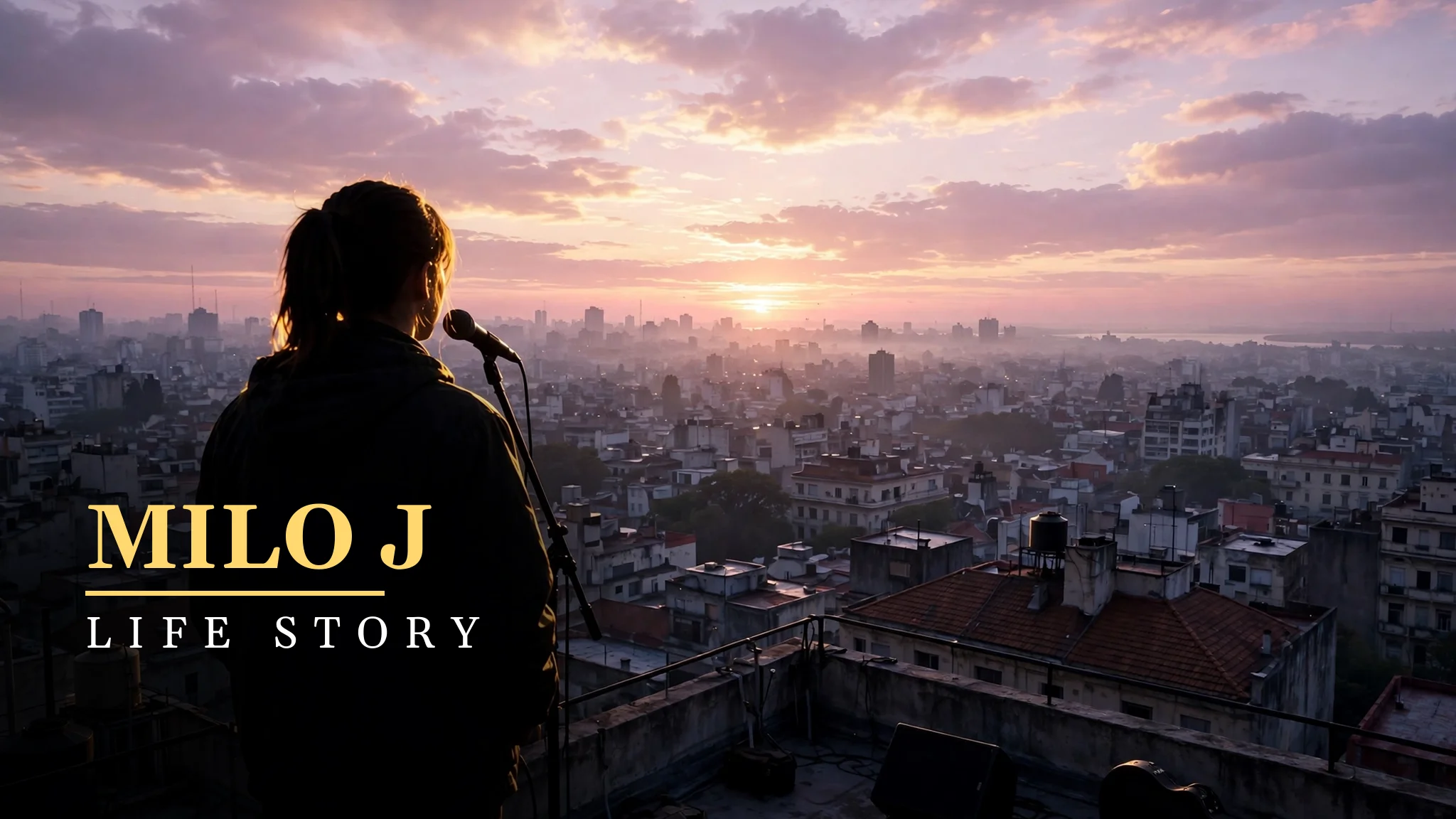
I will finish with the image that stays with me: a boy on a rooftop, or in a bedroom, or at a small desk in Washington, with a microphone, a guitar case nearby, and a city spread out below him. The city is Morón, or Buenos Aires, or the whole world, and the boy is singing, quietly, in a deep voice, about love and about life, and the people listening are quiet too, because the song asks them to be. Milo J is still at the beginning of his story, and the beginning has already been remarkable. If he keeps listening, keeps learning, and keeps following his ear, even when it leads him to unexpected places, the rest of the story may be even better. I hope so, and I will be listening, quietly, along with everyone else. I keep thinking, too, about the week in Madrid, because it is a small story that tells a large truth about how Milo works. One song a day, for a week, in a studio far from home, with a producer who is also from Morón, and at the end of the week there is an EP that the whole world hears. That is not luck. That is a young man who can sit down, do the work, and finish it, day after day, without drama. Many artists talk about discipline. Few of them show it as plainly as that: a song a day, five songs, an EP, done. I think that discipline is the real secret of Milo’s rise, more than the viral moment, more than the Bizarrap session, more than any single song. Virality gives you a chance. Discipline gives you a career, and Milo has shown discipline since he was fourteen, uploading songs from his bedroom, learning his trade in public, and never stopping.
There is something else I want to say about 111, because it is the album I return to most in my own mind. It is a record of love songs, written by a teenager, and it should, by all the usual rules, sound naive. It does not. It sounds like a young man who has paid attention to the people around him, to the way love actually works when you are young and unsure, and who has found words for feelings that most teenagers cannot name. That is a gift, and it is a gift that has nothing to do with age. Some writers are born with it, and some spend a lifetime trying to learn it, and Milo was born with it. The songs on 111 were mostly written before he went into the studio, which means they were written in the ordinary days of his life, not in a rush to fill an album, and that shows. A song written on an ordinary day, because the writer needed to write it, is worth more than a song written on a deadline, because the writer was told to, and 111 is full of the first kind.
I also want to say a word about his parents, because they are the quiet heroes of this story, and quiet heroes are too often left out. Walter Villarruel and Aldana Celeste Ríos gave their son room to work, and they gave him a home to come back to when the work was done, and they did it while the whole world was watching their teenage son. That is not easy. It would have been easy to push him harder, to take every offer, to treat his talent as a family business. It would have been easy, too, to be frightened by it all and to pull him back. They seem to have done neither. They let him work, and they let him be a teenager, and that balance is one reason he is still standing, still writing, still growing. If you are a parent reading this, and your child has a gift that scares you a little, Milo’s parents are a good example: give the gift room, give the child a home, and trust both to find their way.
Finally, I think about the copy of Martín Fierro on the Tiny Desk, and about what it means for a nineteen-year-old rapper to put the great poem of the gaucho beside him while he sings. It means that he knows his country’s story, and that he is not afraid to claim it, and that he wants his young audience to know it too. A rapper who carries a book of poetry onto a stage in Washington is saying something without words: my music comes from somewhere, and that somewhere has a history, and the history is worth knowing. I hope the young listeners who watched that performance went and found the poem, or went and listened to a zamba, or asked their grandparents about the music they grew up with. If even a few of them did, then Milo has done something that no chart position can measure. He has connected a generation to its own past, and that is a gift that will outlast any single song, any single album, or any single year of fame.
Frequently Asked Questions
How old was Milo J when he started uploading his own songs?
He started uploading his own material on social media in 2021, when he was fourteen going on fifteen. He had already taken part in freestyle competitions in his early teens, and he was part of the BajoWest Collective, a group of young artists from the west of Buenos Aires.
What is Milagrosa, and how did it become famous?
Milagrosa, which means Miraculous, is the song Milo released in August 2022, when he was sixteen. It became part of a viral trend on TikTok in Argentina, it mixes trap beats with Brazilian funk carioca rhythms, and it earned a gold certification in Mexico.
What is Rara vez, and who made it with Milo J?
Rara vez, which means Rarely, is the song Milo released in early 2023 with the producer Taiu. It passed hundreds of millions of streams on Spotify, it topped charts in Argentina and Spain, and it showed that he was not a one-song artist.
What is Milo J’s Bizarrap session, and what came with it?
His session is Milo J: Bzrp Music Sessions, Vol. 57, released in October 2023, and he was the youngest artist to record one of Bizarrap’s sessions. It was released alongside a five-track collaborative EP called En Dormir Sin Madrid, made with Bizarrap in Madrid, which includes the song Fruto.
When was Milo J’s first album 111 released, and who appears on it?
His debut studio album, 111, was released on 30 November 2023 through Dale Play Records, barely a month after the Bizarrap session. It features Peso Pluma, Nicki Nicole, Yami Safdie, and Yahritza y su Esencia, and its song Dispara with Nicki Nicole earned a Latin Grammy nomination.
What is 166, and when did it come out?
166 is Milo’s second studio album, released in July 2024. It followed his first album 111 by eight months, and it confirmed that he was not a one-album artist, even though he was still a teenager.
Why did Milo J turn towards folk music, and what album came from it?
Towards the end of 2023, Milo became deeply interested in Argentine folk music, and the folk musician Cuti Carabajal invited him to Santiago del Estero to experience folk culture first hand. The result was La vida era más corta, released in 2025, which fuses zamba and chacarera rhythms with contemporary and electronic sounds.
What happened when Milo J played NPR’s Tiny Desk?
He performed on NPR’s Tiny Desk Concert on 30 April 2025, becoming the youngest Argentine ever to feature in the series. He played flanked by a murga troupe, with a copy of Martín Fierro, the great Argentine poem by José Hernández, on the desk beside him.


