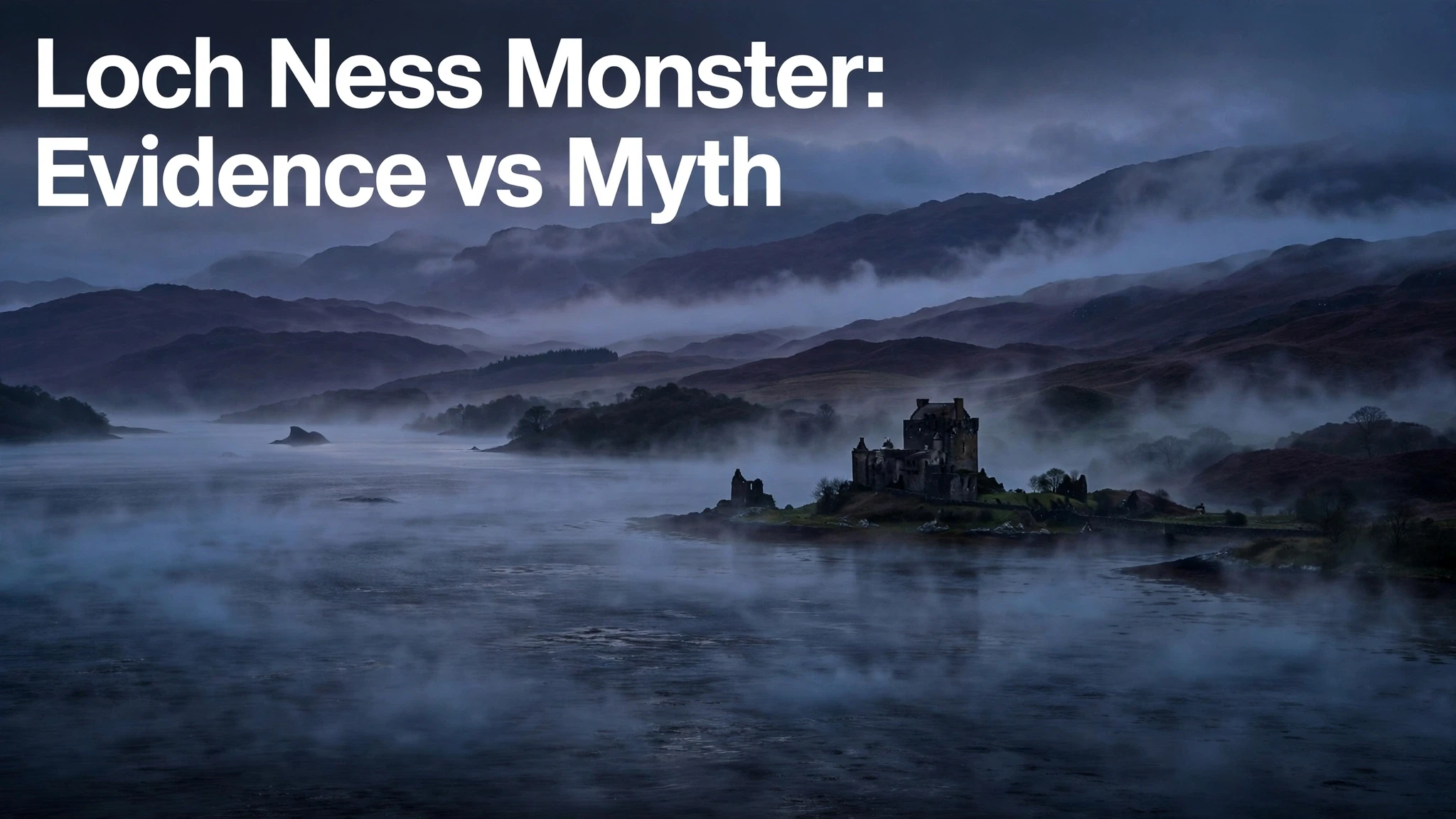
Loch Ness Monster: Evidence vs Myth
In this post
Few legends have lasted as long, or travelled as far, as the Loch Ness Monster. For nearly a century, people have reported seeing something large and unexplained moving in the dark waters of Loch Ness, a deep freshwater loch in the Scottish Highlands. Books, films, documentaries, and tourist shops have turned “Nessie” into a global celebrity. Yet despite decades of searching with cameras, sonar, submarines, and even DNA sampling, no conclusive proof of a monster has ever been found.
That tension is exactly what makes the story interesting. It is not simply a tale of a monster, nor simply a tale of a hoax. It is a story about how a place, a photograph, a road, and human imagination combined to create a legend that science has tested again and again, and that the public has refused to let go. This guide separates what is documented from what is claimed, looks at the strongest evidence on both sides, and explains why the loch itself makes the mystery so hard to settle.
The loch itself: deep, dark, and hard to search
To judge the evidence, you first need to understand the loch. Loch Ness is about 37 kilometres long and, in places, more than 200 metres deep, making it the largest body of freshwater in the United Kingdom by volume. Its water is dark and peaty, stained brown by surrounding soil, so visibility underwater is extremely poor, often only a few metres. That darkness matters: a large animal could, in theory, stay hidden in such water, but it also means that witnesses on the surface see only shapes, wakes, and humps, never a clear animal.
The loch also sits in a geological fault line, the Great Glen, and its steep sides drop quickly into deep water. Sonar searches therefore face tricky reflections, underwater cliffs, and layers of sediment that can be mistaken for moving objects. The loch is connected to the sea by the River Ness and the Caledonian Canal system, but a large breeding population of unknown animals would need food, shelter, and a way to remain unseen for generations, all in a body of water that is now heavily studied and crossed daily by boats, tourists, and researchers.
Local tradition is older than the modern monster. Stories of a water creature in the River Ness date back to a medieval account of Saint Columba, said to have confronted a beast in the sixth century, although historians treat that story as a religious legend rather than a natural history record. For centuries after that, there were occasional folk tales of kelpies, water horses that lured travellers, a common theme in Scottish folklore. The modern Nessie, however, begins in the twentieth century, and its timing is no accident.
1933: the year Nessie went global
The modern legend is usually dated to 1933. In that year, a new road was completed along the northern shore of Loch Ness, giving far more people a clear view of the water for the first time. In April 1933, a local hotel manager and his wife reported seeing a large creature crossing the road and entering the loch. In May, a newspaper, the Inverness Courier, published an account of a couple who said they had seen an enormous animal rolling in the water. The story was picked up by national newspapers, and within months Loch Ness was famous.
The following year brought the most famous image of all: the so-called Surgeon’s Photograph of 1934, showing what looks like a long neck and head rising from the water. For sixty years, that photograph was presented as the best visual evidence for Nessie, reproduced in countless books and documentaries. It was only in 1994 that the truth was publicly confirmed by one of the people involved: the photograph was a hoax, made with a toy submarine fitted with a model neck and head, and photographed at close range to look large. The “surgeon” whose name was attached to it had not taken the photograph himself.
The hoax does not prove that every sighting was faked, but it does show how fragile the visual record is. Many other famous photographs, when examined closely, turn out to show logs, boat wakes, birds, otters, or simply waves photographed at a distance. A dark hump in peaty water, seen for a few seconds from a moving car or boat, is exactly the kind of sighting that is easy to misjudge and hard to verify later.
Sonar, submarines, and organised searches
As technology improved, searchers tried to settle the question with instruments rather than eyewitnesses. In the 1960s and 1970s, the Loch Ness Investigation Bureau kept a constant watch on the loch, with cameras and observers. In 1972, an underwater photograph team led by Robert Rines produced images that some claimed showed a flipper-like shape, but later analysis suggested the images were of sediment, debris, or other ordinary material, and the quality was too poor to identify any animal.
In 1987, Operation Deepscan used a fleet of boats with sonar equipment sweeping the loch in a coordinated line, like a net. The operation did detect some large, moving sonar contacts, but none could be identified as an unknown animal, and similar contacts are known to occur from fish shoals, currents, and equipment effects. In 2003, the BBC funded a full sonar survey of the loch using advanced equipment, and reported finding nothing large and unexplained. The loch, in other words, has been scanned more thoroughly than almost any other lake in the world, and no monster has been found hiding in it.
More recently, in 2018, an international team led by Professor Neil Gemmell of the University of Otago carried out an environmental DNA survey. They collected water samples from many points around the loch and analysed the tiny traces of DNA left by living things, from skin, scales, and waste. The results found DNA from many known species, including fish, birds, and mammals, but no DNA from any large unknown reptile or plesiosaur-like animal. The most notable finding was a large amount of eel DNA, leading the team to suggest, cautiously, that very large eels could explain some sightings, although they stressed this was a hypothesis, not proof that giant eels exist in the loch.
What else could people be seeing?
If there is no monster, why do sightings continue? Researchers point to a combination of ordinary explanations that, together, cover most reports. Logs and debris, especially waterlogged tree trunks that rise and sink with temperature changes, can look like humps or necks. Otters swimming in a line can create a series of humps that appear as one long body. Seals, which occasionally enter the loch, can look surprisingly large and strange at a distance. Birds, boat wakes, and waves reflected in dark water can all be misread, particularly when a witness is already expecting to see something unusual.
Psychology plays a role too. Once a legend is famous, visitors arrive primed to see a monster, and the brain is good at turning ambiguous shapes into familiar patterns. A fleeting glimpse, retold and embellished, can grow in the telling, and media coverage tends to repeat the most dramatic accounts while ignoring the many days when nothing at all is seen. This is not to say witnesses are lying; most are almost certainly sincere. Sincerity, however, is not the same as accuracy, especially for a brief, distant sighting on dark water.
There is also the question of population. For a large animal species to survive in Loch Ness, there would need to be a breeding population, not just one lonely survivor, because a single animal cannot live for centuries. A population would need enough food, and its members would occasionally die, leaving bodies, bones, or DNA traces. None of those have been found. The loch’s fish population, while healthy, is limited, and scientists who have modelled the food web argue it could not support a population of large predators of the size often described. That ecological argument is, for many researchers, as strong as the lack of photographs.
Why the legend refuses to die
Given the weak evidence, why does Nessie remain so popular? Part of the answer is tourism and local identity. Loch Ness attracts hundreds of thousands of visitors a year, and the monster is central to that economy, supporting hotels, boat tours, exhibitions, and shops in the surrounding villages. The legend gives the loch a story that a beautiful but otherwise ordinary lake would not have, and local people understandably value it.
Another part is cultural. Monsters in lakes are a worldwide pattern, from similar creatures reported in Canada, Sweden, and elsewhere, suggesting a deep human tendency to imagine large, hidden animals in deep water. The idea is exciting, a little frightening, and fundamentally hopeful: it suggests the world still holds secrets, that not everything has been mapped, catalogued, and explained. In an age of satellite maps and constant surveillance, a monster that refuses to be found feels like proof that mystery survives.
Science communicators also note that the Loch Ness story is a useful teaching tool. It shows how evidence is weighed, how hoaxes are exposed, how new methods such as environmental DNA can test old claims, and how a legend can persist even when the evidence points the other way. In that sense, Nessie has done real work, even if the monster itself does not exist: it has taught generations of readers to ask what counts as proof, and to be sceptical of a single dramatic photograph.
Visiting Loch Ness today: what to expect
For a modern visitor, Loch Ness offers far more than a monster hunt. The loch is surrounded by dramatic Highland scenery, the ruins of Urquhart Castle on its western shore, the village of Drumnadrochit with its Loch Ness exhibitions, and walking and cycling routes along the Great Glen Way. Boat tours run regularly, offering a chance to see the loch’s depth and scale from the water, and the nearby city of Inverness provides a base for exploring the Highlands.
Visitors hoping for a sighting should know what the evidence suggests: the chance of seeing an unknown animal is extremely low, and most “sightings” turn out to be ordinary wildlife or water effects. That does not spoil the visit. Watching for otters, ospreys, and red deer, learning the geology of the Great Glen, and understanding how the legend grew are rewards in themselves. The loch’s real appeal is its size, darkness, and history, and the monster, real or not, is only one chapter of that story.
If you do see something unusual, the best response is the scientific one: note the time, location, weather, and distance, take photographs or video if you can do so safely, and report it to a local exhibition or research group. A clear, well-documented sighting is far more valuable than a dramatic story told years later. So far, no such report has provided conclusive proof, but the habit of careful observation is what separates a legend from a discovery.
The science of searching a dark loch
Searching Loch Ness is harder than it sounds, and understanding why helps explain both the persistence of the legend and the strength of the negative results. Sonar, which uses sound pulses to detect objects underwater, works well in open water but struggles in a steep-sided loch with sediment layers, temperature changes, and gas bubbles that can scatter sound. A strong sonar return does not automatically mean a large animal; it can mean a dense shoal of fish, a sudden change in water density, or a reflection from the loch bed itself. Skilled operators learn to recognise these effects, but a single unexplained contact, without a photograph or a second independent detection, remains just that: unexplained, not identified.
Cameras face a different problem: darkness. Loch Ness water is stained by peat, so light penetrates only a short distance, and suspended particles scatter what light there is. Underwater cameras therefore see only a small volume at a time, and a large animal could pass metres away without entering the frame. Surface cameras, meanwhile, must cover 37 kilometres of water, day and night, in all weathers, and most of what they record is waves, birds, and boats. The challenge is not a lack of effort; it is that the loch is large, dark, and deep, while any animal in it would be, by definition, rare and elusive.
Environmental DNA changed the calculation because it does not require seeing or hearing the animal at all. Every living thing sheds cells into water, and modern laboratory methods can detect those traces even when the animal itself is long gone from the spot. By sampling at many depths and locations, researchers can build a picture of which species have recently been in the loch, including species that are hard to observe directly. The method has limits: DNA can be carried by currents, it degrades over time, and a negative result cannot prove with absolute certainty that no individual ever entered the water. But when repeated sampling finds no trace of an unknown large animal, while routinely finding eels, trout, salmon, otters, and birds, the result shifts the burden of proof firmly onto anyone claiming a monster exists. The loch has, in effect, been asked to speak for itself, and its answer, so far, is ordinary wildlife.
My Take:
My first judgement is blunt: on the evidence available today, there is no good reason to believe a large unknown animal lives in Loch Ness. That is not a guess, and it is not disrespect to witnesses. It is the conclusion that follows from a century of searching with better and better tools. The most famous photograph was admitted to be a hoax. Full sonar surveys have found nothing identifiable. Environmental DNA sampling, which can detect traces of animals that were recently in the water, found no sign of a large reptile or unknown predator, while finding plenty of ordinary species. A breeding population would also leave bodies, bones, and ecological traces, and none have appeared. At some point, the absence of evidence, when the search has been this thorough, becomes evidence of absence, even if it can never be absolute proof.
My second judgement is about the witnesses, and here I want to be fairer than many sceptics are. Most people who report seeing Nessie are probably not lying. They saw something on dark water, briefly, at a distance, and their brains did what human brains do: they fitted an ambiguous shape to a familiar story. Logs, otters in a line, seals, boat wakes, and waves can all look monstrous for a few seconds, especially if you arrived at the loch hoping to see a monster. Calling every witness a fraud misses the more interesting point, which is how easily sincere perception can go wrong. That lesson applies far beyond Loch Ness, to every field where eyewitness testimony is treated as stronger than it is.
I also think the tourism angle deserves honest discussion, not cynicism. It is easy to say the monster is kept alive purely for money, and tourism certainly benefits from the legend. But the relationship runs both ways: the legend also gives local communities a shared story, a reason for visitors to come to a remote Highland area, and funding for exhibitions that teach real science alongside the myth. The problem is not that a town profits from a story; it is when profit depends on pretending the story is proven. The best Loch Ness exhibitions, in my view, are those that present both sides clearly, celebrate the legend, and still say plainly that the monster has not been found. That balance respects visitors instead of misleading them.
A further point concerns how science handled this mystery, and I think it handled it well. Researchers did not simply dismiss Nessie; they tested it, repeatedly, with sonar, photography, and finally DNA. Each new method was a genuine chance for the monster to show itself, and each time it did not, the scientific picture became clearer. That is how science is supposed to work on extraordinary claims: not by ridicule, but by giving the claim its best possible test and reporting the result honestly. The eel hypothesis from the DNA study is a good example of that honesty, presented as a possibility to explore, not as a final answer dressed up as certainty.
I would also argue that the legend’s survival tells us something about human psychology that is worth taking seriously. We want the world to still contain secrets. A planet fully mapped by satellites can feel smaller, and a hidden monster restores a sense of wonder and frontier. That desire is not foolish; it drives real exploration, from deep oceans to distant planets. The mistake is to let the desire override the evidence in one particular loch, when the real wonders of Loch Ness, its geology, its depth, its wildlife, and its history, are already extraordinary without inventing an animal to live in it.
Finally, my practical advice to readers is to enjoy Nessie as a story and to respect Loch Ness as a place. Visit the loch, take a boat tour, walk the shore, and learn how a road, a newspaper, and a toy submarine created a global legend. Keep an open mind, but keep your standards of evidence open too: a blurry photograph is not proof, a sincere story is not proof, and a sonar blip is not proof. If a monster ever is proven, it will be proven by clear, repeatable evidence that survives scrutiny, not by another fleeting hump in dark water. Until then, the most honest sentence about Loch Ness is also the most interesting one: we have searched hard, we have found no monster, and the search itself has taught us a great deal about water, wildlife, and ourselves.
Another judgement concerns the role of television and documentaries, which I think have done both good and harm here. On the good side, they brought sonar, diving, and DNA science to a mass audience and showed, step by step, how a claim can be tested. On the harmful side, many programmes are edited to keep the mystery alive until the final minutes, presenting a blurry image or a sonar blip as if it were nearly proof, then quietly admitting in the closing seconds that it was inconclusive. Viewers remember the dramatic middle, not the cautious ending. That editing choice is understandable for entertainment, but it distorts public understanding of evidence, and it is one reason the same discredited photographs keep resurfacing as if they were new.
I also think there is a lesson here about how legends adapt to new technology. When photography arrived, Nessie gained a photograph. When sonar arrived, Nessie gained sonar contacts. When DNA arrived, Nessie gained an eel hypothesis. Each new tool was first presented as the one that would finally settle the question, and each time the legend absorbed the tool and survived it, either by disputing the result or by shifting to a smaller, harder-to-detect version of the creature. That adaptability is a sign of a cultural story, not a biological animal. Real animals do not get smaller and shyer every time search technology improves; stories do, because stories can be rewritten while animals cannot.
Finally, I would not want this scepticism to sound like a dismissal of wonder. Loch Ness at dawn, with mist on dark water and hills rising on both sides, is genuinely awe-inspiring, and the feeling that something ancient could be hidden below is part of that awe. The difference is between feeling wonder and claiming knowledge. We can feel the wonder, enjoy the story, buy the postcard, and still say, clearly, that the evidence does not support a monster. In fact, I think that combination is the most respectful attitude of all: it honours the place, the people who live there, and the witnesses who saw something strange, without pretending that a feeling is the same as a fact.
Frequently Asked Questions
Was the famous Surgeon’s Photograph real? No. It was revealed in 1994 to be a hoax made with a toy submarine and a model neck, photographed at close range to appear large. It had been presented for sixty years as the best visual evidence for Nessie.
What did the Loch Ness DNA study find? A 2018 environmental DNA survey found DNA from many known species but no DNA from a large unknown reptile. It found a large amount of eel DNA, leading researchers to suggest very large eels as a possible explanation for some sightings, as a hypothesis rather than proof.
Has sonar ever found the Loch Ness Monster? Sonar surveys, including Operation Deepscan in 1987 and a BBC survey in 2003, detected some unexplained contacts but nothing that could be identified as an unknown animal. Similar contacts can come from fish, currents, and equipment effects.
Why do people still report sightings? Most sightings can be explained by logs, otters swimming in a line, seals, boat wakes, waves, and the tendency to interpret ambiguous shapes as a familiar monster, especially when visitors arrive expecting to see one.
Could a single monster survive in Loch Ness for centuries? Scientists argue this is very unlikely, because a species needs a breeding population, not one individual, and such a population would need enough food and would leave bodies, bones, and DNA traces, none of which have been found.
Is Loch Ness worth visiting even if there is no monster? Yes. The loch offers dramatic Highland scenery, Urquhart Castle, boat tours, wildlife, and walking routes, and its exhibitions explain both the legend and the science behind it.