Najat Aatabou: The Life Story Behind Morocco's Folk Star
In this post
- A Girl From Khemisset in a Large, Poor Family
- The Secret Tape That Made Her Famous
- Hadi Kedba Bayna and the Biggest Hit
- Galvanize and a Voice That Travelled the World
- Songs for Moroccan Women and a Voice for Change
- Marriage, Family, and a Life Between Two Countries
- Hard Years and the Will to Keep Singing
- What Najat Aatabou Means to Morocco Today
- My Take:
There is a voice in Morocco that belongs to the women, to the weddings, and to the mountains. That voice belongs to Najat Aatabou, and for more than forty years it has been one of the most powerful voices in Moroccan music. She sings chaabi, the music of the people, and she sings about the lives of Moroccan women, about love, about betrayal, about strength, and about the right to be heard. She is not a pop star of bright lights. She is a folk star, a singer of the street, of the village, and of the home, and her songs have changed the way Morocco talks about women.
She was born in Khemisset, into a large, poor family, and she began singing while she was still a teenager. Her first fame came from a cassette tape, recorded in secret at a party, that travelled from hand to hand across Morocco until the whole country knew her voice. That tape, with the song J’en ai marre, I’ve had enough, made her a star, and she has been singing ever since, through changes in taste, through the rise of new singers, and through the hard years of her own life. Her story is a story of a woman who sang what other women were afraid to say, and who gave them a voice.
What makes her story worth telling is the courage of it. She sang about a husband who cheats, about a woman who is tired, and about a woman who wants to be free, in a society where those things were hard to say. She sang them, and Morocco listened, and the conversation changed. Her song Hadi Kedba Bayna became a hit, and her song Goul El Hak was sampled by the Chemical Brothers in their world hit Galvanize, carrying her voice to the whole world. This is the story of how a girl from Khemisset became the voice of Moroccan women.
A Girl From Khemisset in a Large, Poor Family
Najat Aatabou was born on 9 May 1960 in Khemisset, Morocco, a town in the Middle Atlas, between Rabat and Meknes, a town of markets, of mountains, and of a life that is close to the land. She was born into a lower-class family, with five brothers and four sisters, a large family, living in a small home, with little money and much love. A child in such a family learns early what it means to share, to work, and to sing, because singing costs nothing, and it brings joy to a home that has little else. Najat learned to sing that way, in a home full of brothers and sisters, where music was a part of daily life.
Khemisset gave her the sound of the Atlas, the Berber music of the mountains, and the chaabi music of the towns, and she learned both, singing in Moroccan Arabic, in Berber, and in French. A singer who can sing in three languages has a wide voice, and Najat’s voice is wide. She sings the songs of her home, in the language of her home, and she sings them with a feeling that is deep and true. That feeling comes from a childhood that was hard, and from a family that was large, and from a town that taught her to be strong.
She was a shy girl, and she did not dream, at first, of becoming a star. She sang for her family, for her friends, and for herself, and she learned the songs of her region, the songs of the Atlas, and the songs of Moroccan women. A singer who grows up singing for her family learns something that a singer who only sings for a stage never learns. She learns to sing for love, not for fame, and that love stays in her voice, even when she sings in a large hall.
As she grew older, she began to sing at parties, at weddings, and at local events, and people who heard her noticed that she had a strong, powerful voice, and a natural sense of rhythm. She did not have money or contacts, but she had a voice, a love of music, and a willingness to work. She practised, she sang, and she learned the songs of her people, and she began to dream of a bigger stage. That dream, held close in a town in the Atlas, would soon take her to the whole of Morocco, and then to the world.
The Secret Tape That Made Her Famous
Najat Aatabou’s fame began in a way that no other singer’s fame has begun, with a secret tape. She was singing at a party, as she often did, and a friend switched on a cassette recorder, without her knowing, and recorded her singing the song J’en ai marre, I’ve had enough. The tape left the party, it was copied, copied again, and it went round Morocco by hand, from one person to another, until the whole country knew her voice, and until everyone was asking who the girl was. That tape, made in secret, made her a star.
The song on the tape was a song about a woman who has had enough, a woman who is tired of a life that is hard, and who says so, plainly and powerfully. That message, sung by a young woman from Khemisset, spoke to Moroccan women who felt the same way, and who had never heard their own feelings sung so plainly. The tape travelled because the song was true, and because the voice was strong, and because women who heard it wanted other women to hear it too. That is how a folk song travels, not through a record company, but through hands, through homes, and through hearts.
She was only seventeen when she began to be recognised, and the tape made her known before she had a record, before she had a concert, and before she had a name on a poster. A singer who becomes famous from a tape, without a company behind her, is a singer whose voice is enough, and Najat’s voice was enough. It carried her from Khemisset to Casablanca, to Rabat, and to the whole of Morocco, and it did so without her even knowing, at first, that it was happening.
The tape also taught her a lesson about the power of a song. A song does not need a studio, a company, or a television show to be heard. It needs only to be true, and to be sung well, and it will find its way. Najat learned that lesson, and she kept it for the rest of her career, singing songs that were true, even when they were hard to sing, and even when they made people uncomfortable. That truth is the heart of her art, and it is why her audience loves her.
Hadi Kedba Bayna and the Biggest Hit
In 1992, Najat Aatabou scored her biggest hit, Hadi Kedba Bayna, This Is an Obvious Lie, a song about a woman whose husband is cheating on her, and who sees the lie clearly, and who says so. The song became a hit across Morocco, and it is still one of her best-known songs today. It is a song about betrayal, about seeing the truth, and about refusing to pretend, and it spoke to Moroccan women who had lived that story, and who had never heard it sung so plainly. A song that tells the truth about a marriage is a brave song, and Najat sang it with courage.
The song’s success changed her life. It gave her a name, a place on the radio, and a chance to record more songs, and it told the whole country that a new voice had arrived, a voice that was strong, honest, and full of feeling. It also told Najat herself that she could sing about the lives of women, and that her audience wanted to hear those lives sung. She did, and she built her career on that truth, and on the songs that followed it.
Her other songs, including Choufi Ghirou, about women who are in a relationship with married men, and many others, became part of the sound of Moroccan life, played at weddings, on the radio, and in the homes of people who loved her honest style. She was not a singer who made one kind of song. She made songs for women, for love, for betrayal, for strength, and for freedom, and each one was sung with the same power and care. A singer who can sing about the lives of women, and make each one feel true, has a rare gift, and Najat has it.
Her first album, The Voice of the Atlas, was released in 1991, and it showed a singer who was ready, who knew her voice, and who knew the kind of songs she wanted to sing. The album was not a rushed debut. It was a careful introduction, and it gave Moroccan listeners a new voice to love, a voice from the Atlas, a voice that was strong, honest, and full of life. That album, and the hit that followed it, made her a star, and she has been a star ever since.
Galvanize and a Voice That Travelled the World
In 2004, Najat Aatabou’s voice travelled further than any Moroccan folk singer’s voice had ever travelled, when the British electronic duo the Chemical Brothers sampled her song Goul El Hak El Mout Kaina in their world hit Galvanize. The song became a hit around the world, played in clubs, on the radio, and on television, and millions of people heard Najat’s voice, without knowing, at first, whose voice it was. That sampling was a remarkable thing, and it showed that her voice belonged to the world, not only to Morocco.
Galvanize won a Grammy Award, and it brought Najat’s name to a new audience, young people in Europe and America who had never heard chaabi, and who learned to love the sound of her voice through a dance track. A folk singer whose voice is sampled in a world hit has done something that few singers ever do. She has crossed a border, not by changing her sound, but by letting the world hear her sound as it is. Najat did that, and her voice, first recorded on a party tape in Khemisset, went round the world a second time.
The sampling also showed the power of her music. A song that is true, that is sung well, and that carries the feeling of a people, can travel anywhere, in any form, and it will still be heard. Najat’s songs are true, and they carry the feeling of Moroccan women, and that feeling is universal, because women everywhere know what it is to be tired, to be betrayed, and to want to be free. That is why her voice, in Galvanize, spoke to millions, even in a language they did not understand.
She also became a subject of the film Morocco Swings, a documentary about two generations of Moroccan singers, and that film brought her story to audiences who wanted to know more about Moroccan music. A singer who is the subject of a film is a singer whose story matters, and Najat’s story matters, because it is a story of a woman, of a voice, and of a country. Her voice, in that film and in Galvanize, continues to travel, and it will keep travelling, as long as people love music that is true.
Songs for Moroccan Women and a Voice for Change
Najat Aatabou is not only a singer. She is a songwriter, and she writes songs about the lives of Moroccan women, about their struggles, their hopes, and their strength. Her songs have evoked social and political discussion in Morocco, and they have brought improvements on women’s issues, because a song that tells the truth can change the way people think. She has sung about a woman whose husband cheats, about a woman who is tired, about a woman who wants to be free, and about the family code, the Moudawana, that governs Moroccan family life. Those songs are brave, and they have made a difference.
Her song Moudawana, about Morocco’s family code, turned her music toward women’s rights and justice, in a way that was both daring and deeply rooted in chaabi tradition. A folk singer who sings about the law is a singer who believes that music can change the world, and Najat believes it. She has used her voice to speak for women who cannot speak for themselves, and she has done so with a courage that few singers have shown. That courage is part of her legacy, and it is part of why she is loved, not only as a singer, but as a voice for change.
She sings in Moroccan Arabic, in Berber, and in French, and that wide voice allows her to reach many audiences, in Morocco, in the Atlas, and abroad. A singer who can sing in three languages has a wide heart, and Najat’s heart is wide. She sings for Berber women, for Arab women, and for French-speaking Moroccans, and each one hears her own life in her songs. That is a rare gift, and it is why her audience is so wide, and so loyal.
Her songs have also been a source of comfort for Moroccan women, who hear their own lives sung, and who feel less alone. A woman who is tired, who is betrayed, or who is afraid, hearing Najat sing, feels that someone understands her, and that understanding is a powerful thing. It gives her strength, and it gives her hope, and it tells her that she is not alone. That is the work of a great folk singer, and Najat has done that work for more than forty years.
Marriage, Family, and a Life Between Two Countries
Najat Aatabou is married to the Moroccan music producer Hassan Dikouk, and she has three children, and she has built a life that balances her career with her family. She has kept much of her private life out of the press, and that privacy is a choice that deserves respect. What the public sees is the singer on stage, full of power and joy. What it does not see is the work behind that power, the travel, the rehearsals, and the long nights, and the life of a mother who must balance a career with a home. That work is real, and it is the price of a long career.
She now lives, for much of the time, in a chalet in the south of France, and she still records songs, and she still performs, carrying the sound of Morocco with her, wherever she goes. A singer who lives abroad, and who still sings for home, is a singer who has not forgotten where she came from, and Najat has not forgotten. Her songs are still about Morocco, about its women, and about its life, and they are still sung in Darija, in Berber, and in French, and they are still loved by Moroccans at home and abroad.
Her family life has also shaped her songs. A singer who is a mother hears songs differently. A song about love is no longer only about a lover. It is also about a child, about a home, and about the future. Najat’s later work carries that wider feeling. Her voice did not lose its power. It gained a depth that comes from a life fully lived, with all its joy and all its difficulty. That depth is what makes her later songs feel so true to listeners who have lived through similar years.
She has also faced the challenge of staying fresh, of keeping her concerts alive, and of singing with the same power she had when she was young. Power is not a thing that fades with age if the singer still loves the music. Najat still loves it, and her audience can feel that love. Her concerts, at weddings, at festivals, and in halls across Morocco and abroad, are still full, and her fans, many of them women, still sing along, and the night feels like a shared celebration.
Hard Years and the Will to Keep Singing
A career as long as Najat’s is never free of hard times. The music business in Morocco has gone through difficult years, with piracy, falling sales, and the rise of new sounds that do not always leave room for a folk singer. Najat faced those years, and she faced them by doing what she had always done. She sang, she performed, and she trusted her audience. She did not chase every new trend, and she did not try to become a different singer. She stayed herself, and her audience stayed with her.
There were also personal hard times, as there are in every long life. A singer who comes from a poor family, who becomes famous from a secret tape, and who sings about hard truths, faces criticism, and faces pressure, and Najat faced both. She was judged for singing about women’s lives, for singing plainly, and for refusing to be quiet. She did not become quiet. She kept singing, and she kept telling the truth, and that courage is part of why she is loved. A singer who tells the truth, even when it is hard, is a singer who can be trusted, and Najat can be trusted.
She has also faced the challenge of being a woman in a conservative society, where a woman who sings in public is judged in a way a man is not. She faced that judgment from a young age, and she kept singing, and she kept writing songs for women, and she kept giving them a voice. That is a brave way to live, and it deserves to be remembered with respect. She did not let the judgment stop her, and she did not let it change her songs. She sang, and Morocco listened, and the conversation changed.
The passing of time has also brought change to the world she sings about. The Khemisset of her childhood is not the Khemisset of today, and the Morocco of the 1980s is not the Morocco of today. Najat has moved with those changes, without losing the sound that made her famous. That is a hard balance to hold, and she has held it for more than forty years. A singer who can hold it deserves to be called a star, and Najat is called a star for that reason.
What Najat Aatabou Means to Morocco Today
Today, Najat Aatabou stands as one of the great folk stars of Morocco, a singer whose name is trusted, whose songs are loved, and whose concerts are waited for. She is not the loudest singer, and she is not the newest, but she is one of the most honest, and honesty is the hardest thing to achieve in music. Her legacy is not only her songs. It is also the example she sets for young singers, especially young women, that a singer can come from a poor family, can sing what she believes, can speak for women, and can build a career that lasts for more than forty years.
She is still singing, still recording, and still reaching new listeners. Her story is not finished, and her voice, strong and powerful, continues to carry the sound of Moroccan women across the country and the world. The girl from Khemisset whose voice was recorded on a secret tape became the voice that Morocco turns to when it wants to hear the truth, and that voice is still singing, evening after evening, song after song.
My Take:
When I listen to Najat Aatabou, I feel strength. Her voice is powerful, it is honest, and it speaks plainly about the lives of Moroccan women, and it makes me want to stand up straighter. I have listened to many singers, and many of them sing beautifully, but few of them sing with the courage that Najat has. She sings about a husband who cheats, about a woman who is tired, and about a woman who wants to be free, and she sings those things in a society where they were hard to say. That courage is rare, and it is beautiful, and it is the heart of her greatness.
What I admire most about her is her honesty. She did not become famous through a record company, through a television show, or through a famous family. She became famous through a secret tape, recorded at a party, that travelled from hand to hand because her song was true. That is the purest kind of fame, a fame that comes from the people, not from a company, and it is a fame that cannot be bought. A singer who is loved because her song is true will be loved for a long time, and Najat has been loved for more than forty years, because her songs are true.
Her song Hadi Kedba Bayna moves me deeply, because it is a song about seeing a lie clearly, and refusing to pretend. A woman whose husband cheats, who sees the lie, and who says so, is a woman of great strength, and Najat sings her with that strength. When I hear that song, I think of all the women who have lived that story, and who have never heard it sung so plainly, and I feel that Najat gave them a voice. That is what a great folk singer does. She gives a voice to people who have no voice, and she does it with a song that they can sing themselves.
I also think about Galvanize, and about how her voice travelled the world in a dance track by the Chemical Brothers. Millions of people heard her voice, in clubs, on the radio, and on television, without knowing whose voice it was, and they danced to it. That is a remarkable thing, and it shows that her voice belongs to the world, not only to Morocco. A folk song that is true can travel anywhere, in any form, and it will still be heard, because truth is universal. Najat’s truth travelled, and it is still travelling, in every club where Galvanize plays, and in every home where her songs are sung.
Her work for Moroccan women moves me, because it is work that matters. She has sung about the family code, about women’s rights, and about the lives of women who are tired, who are betrayed, and who want to be free, and her songs have brought discussion, and they have brought change. A singer who can change a conversation, and who can help to change a law, has done something that few singers ever do. She has used her voice for more than entertainment. She has used it for justice, and that is a legacy to be proud of.
I think about her childhood, in a large, poor family in Khemisset, with five brothers and four sisters, and about how that childhood shaped her. A child in a large family learns to share, to work, and to sing, because singing costs nothing, and it brings joy to a home that has little else. Najat learned to sing that way, and that love of singing, for its own sake, stays in her voice. She does not sing for money alone. She sings because she loves to sing, and because she has something to say, and that is why her audience trusts her.
If I am honest, I do not love every song she has made. Some of her songs are hard to listen to, because they are about pain, about betrayal, and about a life that is difficult, and they do not offer an easy comfort. But I also understand why she sings them. A folk singer who only sings happy songs is not telling the truth, and Najat tells the truth, even when it is hard. That honesty is more valuable than comfort, because it tells listeners that they are not alone, and that their pain is real, and that it deserves to be sung.
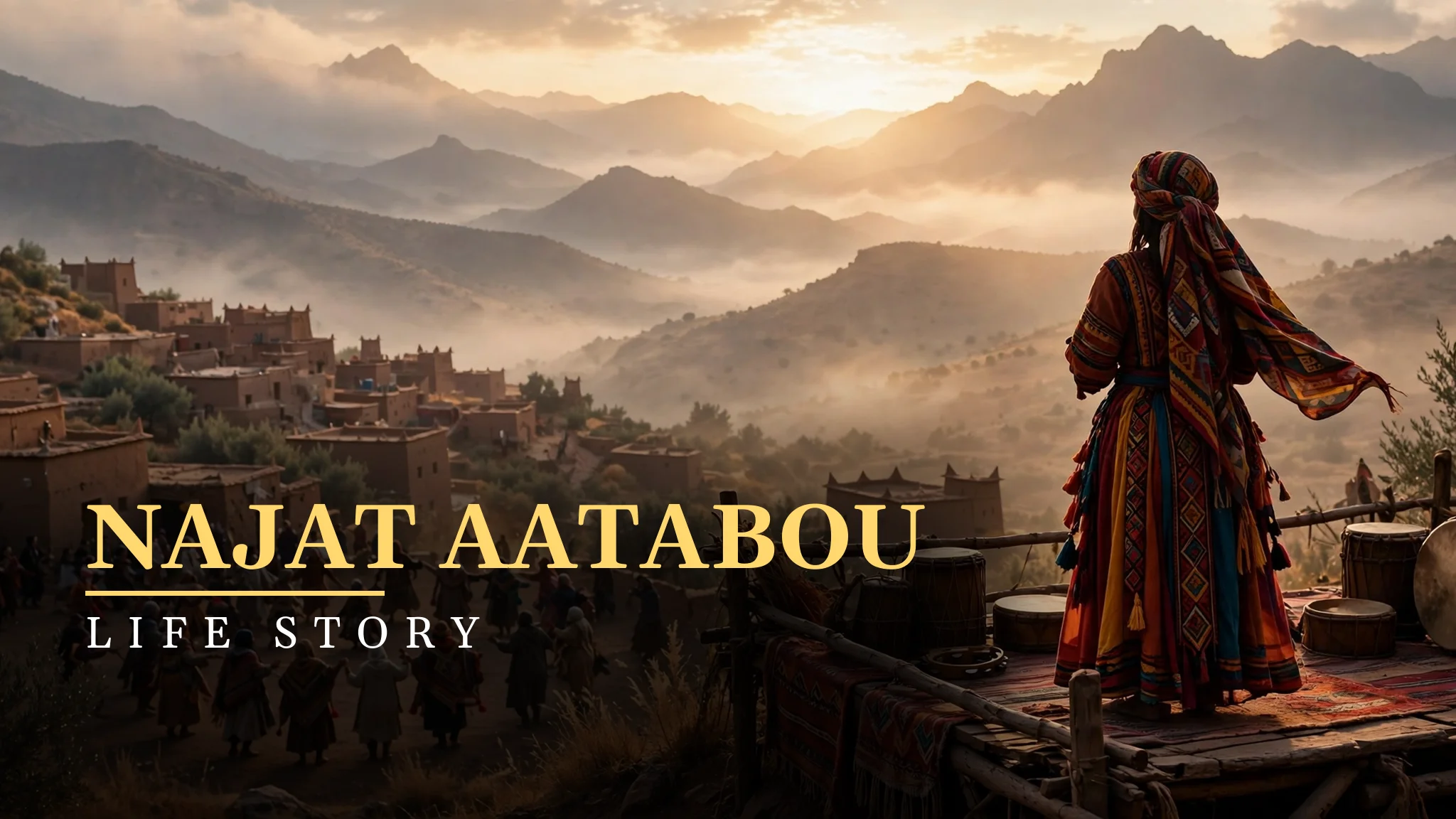
What stays with me is the image of a mountain village at sunrise, with a woman in a colourful dress standing above it, singing, with drums beside her, and villagers dancing below. That image, from her cover, is the image of her music, a music that belongs to the mountains, to the villages, and to the people, and that is sung with pride. When I think of Najat, I think of that image, and I think of the Atlas, of Khemisset, and of a voice that carries the sound of Morocco to the world.
I also think about what her music means to Moroccan women living abroad. A woman in France, in Belgium, or in Spain, hearing Najat’s voice, hears home. She hears Darija, she hears Berber, and she hears the songs of her childhood, and she feels less far from home. That is a beautiful thing, and it is a thing that only a singer who sings in her own languages can do. Najat does it, and she has done it for Moroccans abroad for more than forty years, and her voice is a bridge between Morocco and the world.
Her story also teaches me something about the power of a tape, of a song that travels from hand to hand. In a world where music is now streamed, where a song can travel in a second, it is easy to forget that a song once travelled slowly, on a cassette, copied by hand, and that slow travel made it more precious. Najat’s tape travelled slowly, and it was loved more because of it, because each copy was a gift, from one person to another. That is a beautiful way for a song to travel, and it is a way that I hope we do not forget, even in the age of streaming.
I will remember Najat Aatabou as a singer who gave Moroccan women a voice, and who sang with a voice that was strong, honest, and true. She started with a secret tape, she sang Hadi Kedba Bayna, she was sampled in Galvanize, she sang for women’s rights, and she kept singing, year after year, even when the work was hard and the attention moved to younger singers. That is a career to be proud of, and it is a story that will help any reader who wants to build something that lasts.
Finally, I think about the future of Moroccan folk music, and about where Najat fits in it. New singers will arrive, new sounds will come, and the radio will play new songs, but Najat’s songs will still be there, because truth does not go out of fashion, and a voice that sings the truth will always find listeners. I imagine a young girl in Khemisset, fifty years from now, hearing her song for the first time, and I think that is a beautiful future. A singer who can give a future girl the words for her strength has done something that no chart can measure, and Najat has done it, for a whole generation, and for the generations that will follow.
I also think about the way she sings in three languages, in Moroccan Arabic, in Berber, and in French, and about what that means. A singer who can sing in three languages has a wide heart, and Najat’s heart is wide. She sings for Berber women, for Arab women, and for French-speaking Moroccans, and each one hears her own life in her songs. That is a rare gift, and it is why her audience is so wide, and so loyal. I hope she keeps singing in all three, because Morocco needs a voice that speaks to all of its people, and hers is one of the few that does.
There is one more thing I want to say, and it is about courage itself. Courage is not a word we use often, but it is the word that best describes Najat. She sang what other women were afraid to say, she sang about betrayal, about tiredness, and about freedom, and she did so in a society where those things were hard to say. That courage changed the conversation in Morocco, and it gave women a voice. I think that is a great achievement, and it is one that deserves to be remembered, not only as music, but as a change in a country’s life. Najat Aatabou did that, with a voice, with a song, and with a courage that has never faded.
I also think about the cassette tape, and about how a tape can change a life. A tape is a small thing, a plastic box with a brown ribbon inside, and it can carry a voice across a country, from hand to hand, from home to home, until a whole nation knows it. Najat’s tape did that, and it did so without a company, without a studio, and without a plan. That is a beautiful thing, and it is a thing that I hope we remember, even in a world of streaming and of instant music. A song that travels by hand, from one person to another, is a song that is loved, and Najat’s songs were loved, because they travelled that way, and because they were true.
There is a lesson in her life about singing for your own people that I want to remember. She did not try to become an American singer, or a French singer, or a singer of the world. She sang for Moroccans, in Moroccan Arabic, in Berber, and in French, and she sang about Moroccan women, about Moroccan lives, and about Moroccan homes, and the world came to her, because truth is universal, and because a song that is true about one place is true about every place. That is a lesson for any artist who wants to be loved everywhere. Sing truly about your home, and the world will listen.
I also think about her children, and about what it means to be the child of a folk star. They grew up with a mother whose voice was known across Morocco, and they learned, from her, how to live with courage, how to work hard, and how to love their country. I do not know the details of their private lives, and I do not need to. What I see is a family that was built on love, on music, and on a shared belief in truth, and that is a beautiful thing. Najat gave her children a mother who was a star, and a mother who was present, and that is a gift that matters more than any award.
Finally, I want to say that her story is not finished, and that her voice is still singing, and that I hope it keeps singing for many years to come. Morocco still needs a voice that tells the truth, and Najat’s voice is that voice, strong, honest, and true, and it will be needed for as long as women have something to say, and as long as they need someone to say it for them. She has given them that voice, and she has given it with courage, with love, and with a song, and I am grateful for it, and I hope Morocco is grateful too.
I also think about the film Morocco Swings, and about how it brought her story to audiences who wanted to know more about Moroccan music. A film about two generations of singers is a film about a country, about its music, and about its women, and Najat’s part in it shows that her story matters, not only as music, but as history. I hope more films are made about singers like her, because their stories deserve to be seen, not only heard, and because a young girl who sees her story on screen will believe that her own story can matter too.
There is a lesson in her life about the Atlas that I want to remember. She was born in Khemisset, in the Middle Atlas, and she carries the sound of the mountains in her voice, a sound that is strong, clear, and full of air. The Atlas is not a place that is easy to live in, and it makes people strong, and Najat is strong, because she grew up there, and because she learned to sing there, in a home that was poor, in a family that was large, and in a town that taught her to be proud. That pride is in her voice, and it will be there, as long as she sings.
Frequently Asked Questions
When and where was Najat Aatabou born?
Najat Aatabou was born on 9 May 1960 in Khemisset, Morocco, into a lower-class family with five brothers and four sisters. She grew up in a town in the Middle Atlas, where she learned Berber and chaabi music.
How did Najat Aatabou become famous?
She became famous from a secret cassette tape, recorded at a party without her knowing, of her singing J’en ai marre, I’ve had enough. The tape was copied from hand to hand across Morocco, until the whole country knew her voice.
What is Najat Aatabou’s biggest hit?
Her biggest hit was Hadi Kedba Bayna, This Is an Obvious Lie, released in 1992, a song about a woman whose husband is cheating on her. It is still one of her best-known songs today.
Was Najat Aatabou’s voice used in Galvanize by the Chemical Brothers?
Yes, her song Goul El Hak El Mout Kaina was sampled by the Chemical Brothers in their 2004 world hit Galvanize, which won a Grammy Award and carried her voice to audiences around the world.
What languages does Najat Aatabou sing in?
She sings in Moroccan Arabic, in Berber, and in French, and that wide voice allows her to reach many audiences in Morocco and abroad, including Berber women and French-speaking Moroccans.
Is Najat Aatabou married and does she have children?
Yes, she is married to the Moroccan music producer Hassan Dikouk, and she has three children. She now lives for much of the time in the south of France, and she still records songs.


