The Chemical Brothers: The Life Story Behind the Dance Legends
In this post
- Two Students in Manchester
- Exit Planet Dust and Dig Your Own Hole
- Surrender, Hey Boy Hey Girl and the Festival Years
- We Are the Night, Further and Born in the Echoes
- No Geography, For That Beautiful Feeling and Still Going
- The Visuals, the Lights and the Big Beat
- Still Together, Still Big, Still Themselves
- The Visual Artists Behind the Big Screens
- My Take:
The Chemical Brothers make dance music that sounds like a machine dreaming: big beats, deep bass, strange sounds and melodies that lift a whole crowd at once. Their songs have filled clubs, arenas and festival fields for more than thirty years, and their live shows are famous for their huge visuals, their lights and their power. When their song Block Rockin Beats became a hit in 1997, it showed that two young men from Manchester could make electronic music that was as big as rock music, and that a dance duo could become one of the biggest acts in the world.
The duo is made up of Tom Rowlands and Ed Simons, two friends who met while studying at the University of Manchester in 1989. Rowlands had grown up in England and loved hip hop, techno and house music. Simons had grown up in London and loved the same sounds. They began to DJ together in Manchester clubs, playing records for small crowds, and they began to make their own tracks in a bedroom studio. Their sound mixed hip hop beats, rock guitars and electronic sounds, and it stood out in a time when much dance music sounded simple and repetitive.
Their journey has brought them number one albums, Grammy Awards, and songs that are still played around the world. Their albums are Exit Planet Dust from 1995, Dig Your Own Hole from 1997, Surrender from 1999, Come with Us from 2002, Push the Button from 2005, We Are the Night from 2007, Further from 2010, Born in the Echoes from 2015, No Geography from 2019, and For That Beautiful Feeling from 2023. Through all of it, they have stayed together as the same two friends, and they have kept the same belief: that dance music should be big, bold and full of feeling.
Two Students in Manchester
Tom Rowlands and Ed Simons met at the University of Manchester in 1989, in a city that was famous for its music. Manchester had given the world bands like Joy Division, New Order and The Stone Roses, and it had a lively club scene where young people danced to house, techno and hip hop. Rowlands and Simons were students, but they spent their free time in clubs, listening to DJs, buying records, and talking about the music they loved.
Rowlands had been a DJ before he came to Manchester, and he had a collection of records that mixed hip hop, funk and electronic music. Simons had a similar love of music, and the two of them found that they shared the same taste. They began to DJ together at small clubs in Manchester, playing under the name The Dust Brothers, a name they later had to change because another group in America used the same name. They played records for crowds who wanted to dance, and they learned how a good DJ can lift a room with the right song at the right time.
As DJs, they also began to make their own music. They had a small studio in a bedroom, with a computer, a sampler and a few keyboards, and they began to build tracks from samples, beats and bass lines. Their early tracks were rough and exciting, with a feeling of energy that came from their love of hip hop and techno. They released them on small labels, and DJs in London and Manchester began to play them. People who heard them noticed the difference. Here were two young men making dance music that sounded big, bold and full of ideas.
By the early 1990s, Rowlands and Simons had a name and a clear idea of what they wanted to be. They changed their name to The Chemical Brothers, a name that pointed to the chemistry between the two of them and to the way their music mixed different sounds like chemicals in a lab. They began to release singles, and they began to play DJ sets in London clubs. The audiences were small at first, but the people who heard them remembered them. Here were two friends making electronic music that sounded like rock music, and that was a rare thing.
Exit Planet Dust and Dig Your Own Hole
The Chemical Brothers released their debut album, Exit Planet Dust, in 1995, and it became one of the most loved dance albums of its time. The album included Leave Home, a track that became a favourite in clubs, and Life Is Sweet, a song with a vocal by Tim Burgess of The Charlatans. The album was praised by critics, and it showed the duo’s range: fast beats, deep bass, rock guitars, and melodies that stayed in the mind. It was a record that worked in clubs and at home, and it won the duo a loyal following.
Dig Your Own Hole, their second album, was released in 1997, and it became the record that made them world famous. The album included Block Rockin Beats, a track that became a number one hit in Britain and won a Grammy Award, and Setting Sun, a song with a vocal by Noel Gallagher of Oasis. The album also included Elektrobank and The Private Psychedelic Reel, tracks that showed the duo’s love of long, building songs that grew from a quiet start into a huge finish. The album reached number one in Britain, and it was praised as one of the best dance albums of the decade.
Block Rockin Beats is the song many people think of first when they hear the name The Chemical Brothers, and it is easy to understand why. The track has a heavy beat, a deep bass line, and a feeling of power that makes people dance. It was used in films, in adverts and at sports events, and it became an anthem for a generation of dance fans. The song showed that electronic music could be as exciting as rock music, and that a duo with a sampler and a keyboard could make a sound as big as a band with guitars and drums.
Touring for Dig Your Own Hole took the duo around the world, and their live shows became famous for their power. They played as DJs, with decks and mixers, and they also played live instruments on stage. The shows were full of lights, visuals and sound, and the audiences danced along. The Chemical Brothers had become one of the biggest dance acts in the world, and they were enjoying the success they had worked for.
Surrender, Hey Boy Hey Girl and the Festival Years
Surrender, the duo’s third album, was released in 1999, and it included Hey Boy Hey Girl, one of their most famous songs. Hey Boy Hey Girl is a bright and joyful track, with a vocal that repeats the title and a beat that makes people dance. The song became a hit around the world, and it is still played at festivals today. The album also included Let Forever Be, a song with a vocal by Noel Gallagher, and Out of Control, a track with a vocal by Bernard Sumner of New Order. The album reached number one in Britain, and it showed the duo working with singers from the rock world, a sign of how far dance music had come.
Come with Us, their fourth album, was released in 2002, and it included Star Guitar, a track with a beautiful melody and a feeling of movement, and It Began in Afrika, a track with a fast and joyful beat. The album was praised by critics, and it kept the duo at the top of the dance world. Their live shows during this period became even bigger, with huge screens, lasers and visuals that turned a concert into a work of art. The duo worked with visual artists to create shows that were as much about light as about sound, and their festivals became famous for their beauty.
The years after Come with Us were busy. The duo toured the world, they played at big festivals like Glastonbury, and they became known as one of the best live acts in the world. Their shows were not just concerts. They were experiences, with the crowd dancing under huge lights, the music shaking the ground, and the visuals filling the sky. The Chemical Brothers had become more than a dance duo. They had become a spectacle, and their audience loved them for it.
Push the Button, their fifth album, was released in 2005, and it included Galvanize, a song with a vocal by Q-Tip, a rapper from America. Galvanize became a huge hit, and it won a Grammy Award for Best Dance Recording. The song had a Middle Eastern feeling, with a melody that sounded like a call to prayer, and a beat that made people dance. It was a brave and original track, and it showed that the duo were still willing to try new sounds after ten years.
We Are the Night, Further and Born in the Echoes
We Are the Night, their sixth album, was released in 2007, and it included Do It Again, a track with a vocal by Ali Love, and The Salmon Dance, a playful track with a vocal by Fatlip. The album was praised for its variety, and it showed the duo still making music with joy and with humour. It won a Grammy Award for Best Electronic Dance Album, a sign that the duo were still at the top of their field after many years.
Further, their seventh album, was released in 2010, and it was a record made without any guest singers, with the duo’s own voices and sounds at the centre. The album was accompanied by a film, made by visual artists, that turned the music into a visual journey. It was a bold and artistic record, and it showed the duo’s love of combining music with visuals. The album was praised by critics, and it kept the duo’s reputation as artists, not just as hit makers.
Born in the Echoes, their eighth album, was released in 2015, and it included Go, a track with a vocal by Q-Tip, and Sometimes I Feel So Deserted, a track with a vocal by the duo themselves. The album was a return to the big and bold sound of their early years, with heavy beats, deep bass and melodies that lifted the crowd. It was praised by critics, and it showed that after twenty years, the Chemical Brothers could still make a record that sounded fresh and exciting.
The years after Born in the Echoes were busy with touring, and the duo played at festivals around the world. Their live shows during this period were some of the biggest of their career, with huge screens, lasers and a sound that shook the ground. They had become elder statesmen of dance music, respected by the new generation and loved by the old. They were proof that a duo could last, if it was made with honesty and with care.
No Geography, For That Beautiful Feeling and Still Going
No Geography was released in 2019, and it was one of the duo’s most loved albums in years. The album included Got to Keep On, a joyful track about dancing, and We’ve Got to Try, a track with a feeling of hope. The album was praised by critics as one of the best dance albums of the year, and it won a Grammy Award for Best Electronic Dance Album. It showed that after thirty years, the Chemical Brothers could still make a record that felt new, and that their audience had stayed with them.
For That Beautiful Feeling, their tenth album, was released in 2023, and it included songs like No Reason, Live Again, featuring Halo Maud, and Skipping Like a Stone, featuring Beck. The album was a warm and joyful record, with a feeling of celebration, and it showed the duo still making music with the same energy as before. It was praised by critics, and it kept the duo at the top of the dance world, even after more than thirty years.
The duo’s live shows in recent years have been as big as ever, with huge visuals, lasers and a sound that fills festival fields. They have played at Glastonbury, at Coachella, and at festivals around the world, and their shows are still talked about as some of the best in dance music. Rowlands and Simons are now in their fifties, but they play with the same energy as when they were students in Manchester, and their audience, young and old, dances along.
Their story is also a story about friendship. Rowlands and Simons have been working together for more than thirty years, and they have stayed close through success, through changes in music, and through the pressures of fame. That friendship is the quiet centre of their story, and it is the reason their music still sounds warm and human after so many years.
The Visuals, the Lights and the Big Beat
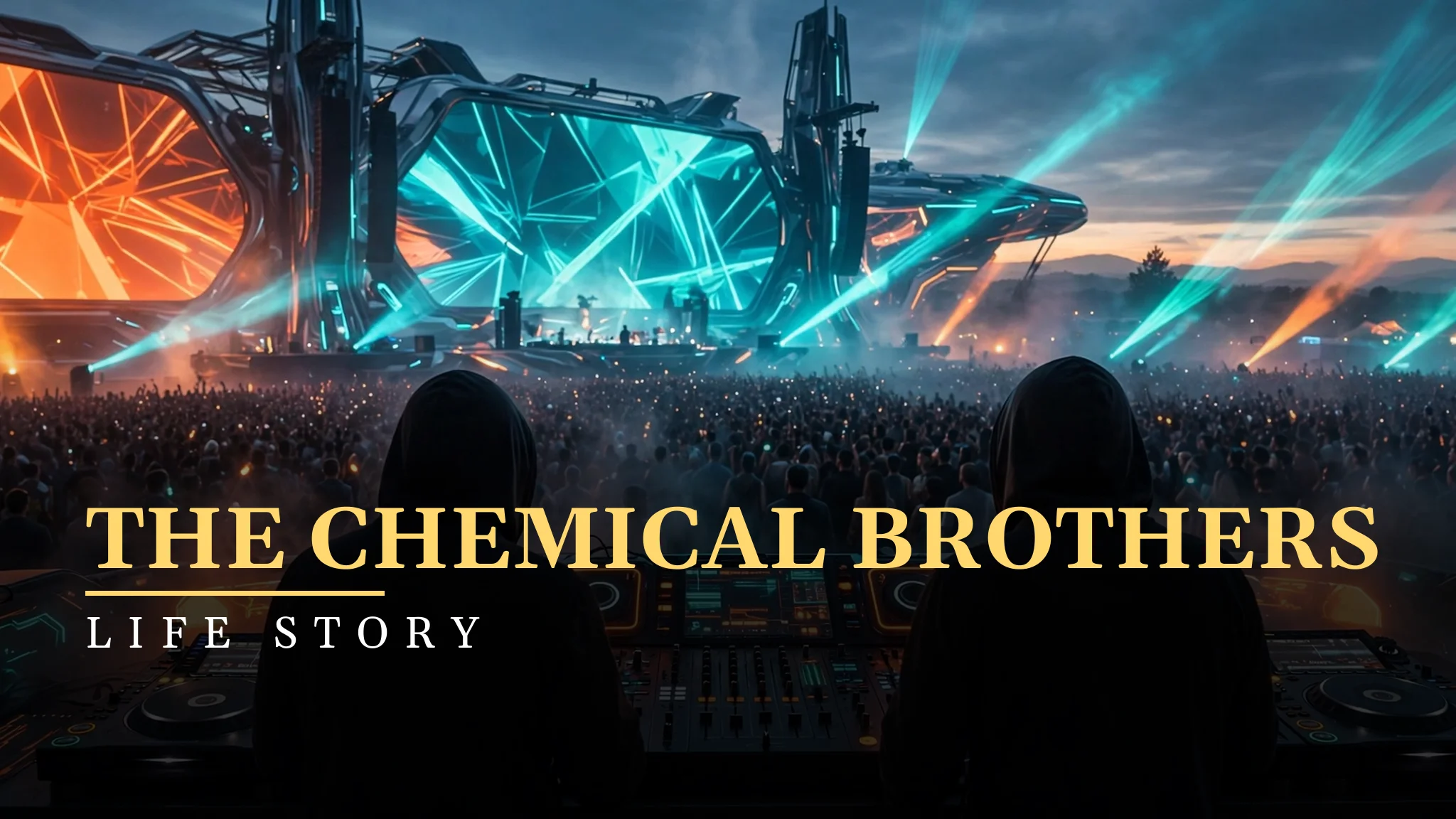
One of the most famous things about The Chemical Brothers is their live show. Unlike many dance acts, who play with a few decks and a laptop, the Chemical Brothers play with huge screens, lasers, lights and visuals that turn a concert into a work of art. They work with visual artists to create shows where the music and the light move together, and the crowd dances under a sky of colour. That visual style has become their signature, and it is part of why their festivals are so loved.
Their sound is also famous for its size. A Chemical Brothers track is not a small song. It is a big sound, with heavy beats, deep bass, and melodies that build slowly into a huge finish. That size comes from their love of rock music, hip hop and techno, and from their skill as producers. Rowlands and Simons know how to make a track that starts quietly and ends loudly, and that journey is what makes their music so exciting to hear live.
Their influence can be heard in many younger dance artists who learned from them that electronic music could be big, bold and visual, and that a dance duo could headline a rock festival. The Chemical Brothers showed that dance music could be as spectacular as rock music, and that a DJ could be a star. That lesson has helped a new generation of producers to be braver about their live shows, and to trust that their audience wants a spectacle as well as a beat.
Their music videos are also part of their story. The video for Star Guitar, made by the director Michel Gondry, showed a train journey where the landscape moved in time with the music, and it became famous for its cleverness. The video for Let Forever Be, also made by Gondry, showed a young woman dancing in a dream, and it became a favourite with fans. Those videos showed the duo’s love of art, and their belief that music and visuals belong together.
Still Together, Still Big, Still Themselves
After more than thirty years, The Chemical Brothers are still a duo, still two friends from Manchester, still making music in their own big and bold way. They have won Grammy Awards, they have had number one albums, and they have played to huge crowds, but they still work like a band that is hungry to learn. They take their time between albums, they try new sounds, and they do not let success decide what the next record should sound like. That independence is part of their story.
Looking back, the story of The Chemical Brothers is a story of friendship and big beats. They started as students in Manchester, they made Exit Planet Dust and Dig Your Own Hole, they became world famous with Block Rockin Beats and Hey Boy Hey Girl, they won Grammys with Galvanize, and they are still making music with For That Beautiful Feeling. Their songs are still played in clubs, at festivals and on the radio, and they still make people dance. That is a good legacy for a duo that began with a simple idea: that dance music should be big, bold and full of feeling.
The Visual Artists Behind the Big Screens
A Chemical Brothers concert is not just a concert. It is a work of art, with huge screens, lasers, lights and visuals that move with the music. Those visuals are made by artists who work with the duo, and they are part of why the shows are so loved. The duo have worked with visual artists for many years, and they have built a style where the music and the light move together, where a beat is matched by a flash, where a melody is matched by a colour. That partnership between sound and light is the heart of their live show.
The visuals began as simple lights and projections, and they grew into something much bigger. Today, a Chemical Brothers show has giant screens that show abstract shapes, robots, faces, and landscapes, all moving in time with the music. The screens are not a background. They are part of the performance, and the crowd watches them as much as they listen to the music. That is a rare achievement, and it is the result of years of collaboration between the duo and the artists who make the visuals.
Working with visual artists also taught the duo how to think about their music in a new way. A track that sounds big on a record must look big on a stage, and the duo learned how to build tracks that have visual moments: a drop, a flash, a change in colour. That way of thinking made their albums better, because they were thinking about the live show as well as the studio. A song that works on a record and on a stage is a song that has been made with care, and the Chemical Brothers make such songs.
Their music videos are also part of that visual story. The video for Star Guitar, made by Michel Gondry, showed a train journey where the landscape moved in time with the music, and it became famous for its cleverness. The video for Let Forever Be, also made by Gondry, showed a young woman dancing in a dream, and it became a favourite with fans. Those videos showed the duo’s love of art, and their belief that music and visuals belong together. A good video does not just show the band playing. It tells a story, and the Chemical Brothers’ videos tell stories that are clever, beautiful and strange.
The duo’s visual style has also influenced other dance acts, who learned from them that a live show could be a spectacle, and that a DJ could be a visual artist as well as a musician. Many younger producers now work with visual artists, and many festivals now have huge screens and lights, because the Chemical Brothers showed that it could be done. That influence is part of their legacy, and it is a sign of how far their ideas have travelled.
What I find most interesting about their visuals is that they never hide the music. The screens are big, the lights are bright, and yet the beats are still at the centre. The visuals serve the music, not the other way around. That is a hard balance to keep, because a big visual can easily swallow a song. The Chemical Brothers keep the balance, because they remember that the music came first, and that the visuals are there to make the music feel bigger, not to replace it. That is a lesson for any artist who works with visuals: the art should lift the song, not hide it.
My Take:
When I listen to The Chemical Brothers, the first thing I feel is size. Their music is big, with heavy beats, deep bass and melodies that build slowly into a huge finish. It makes me want to move, and it makes me feel like I am part of something larger than myself. That feeling is rare in dance music, where so many tracks sound small and thin. The Chemical Brothers make music that fills a room, a field, a whole festival, and that size is part of why people love them. I admire music that is not afraid to be big.
I think the most admirable part of their story is the friendship between Tom Rowlands and Ed Simons. They met as students in Manchester in 1989, and they have been working together for more than thirty years. That is a very long time for any duo, and it is the reason their music sounds so tight. They know each other’s strengths, they know each other’s taste, and they trust each other. When I hear their tracks, I hear that trust, and it makes the music feel like a partnership, not just a business. A duo that likes each other plays differently from a duo that is only working together for money, and the audience can hear the difference.
I also admire their live shows, and the way they mix music with visuals. A Chemical Brothers concert is not just a DJ set. It is a work of art, with huge screens, lasers and lights that move with the music. That takes a special kind of imagination, because the duo must think about what the audience sees as well as what they hear. I think that is an important lesson. Music is not only sound. It is also light, colour and feeling, and a great live show brings all of those things together. The Chemical Brothers understand that, and their shows are better for it.
There is a sadness in their story, too, and it is the sadness of a duo that is sometimes seen as only a festival act. The Chemical Brothers make big and joyful music, and big music is sometimes treated as less serious than quiet music. I think that is unfair, because it takes great skill to make a track that lifts a whole crowd, and it takes great skill to make a melody that stays in the mind after the night ends. The Chemical Brothers have that skill, and they use it with generosity. They do not make music to show off. They make music to bring people together, and that is a kind of seriousness that deserves more respect.
Another thing I notice is how much their music depends on building slowly. A Chemical Brothers track often starts quietly, with a single beat or a single melody, and then it grows, layer by layer, until it becomes huge. That slow build is a risk, because a listener can lose interest, but it is also the duo’s greatest strength. When the music finally opens up, the feeling is bigger because the duo waited for it. I respect a duo that is willing to wait, in a world where so much music rushes to the chorus in the first ten seconds. Their patience is part of what makes their music special.
I find their album Dig Your Own Hole especially important, because it showed that electronic music could be as big as rock music. Before that album, dance acts rarely topped the album charts or headlined rock festivals. After it, they did. The Chemical Brothers broke down the wall between dance and rock, and they did it with a sound that was unmistakably their own. I think that is a lasting legacy, and it is why they are still remembered as one of the most important British dance acts. They did not just make hits. They changed what a dance duo could be.
If I have a criticism, it is only that their albums can sometimes feel long and uneven. Because their tracks are often built slowly, an album can have a song I love next to a song that takes too long to get going. That is the price of their way of working, and I would not want them to lose it. But I do think a listener who is new to the duo can feel lost, because there is no single song that tells you everything about them. You need to listen to a whole album, and then another, before the picture becomes clear. That is not a real fault, though. It is a sign that the duo is richer than a single hit, and that richness is worth the effort.
I also think about their influence, and how many younger artists learned from them. The Chemical Brothers showed that a dance duo could headline a rock festival, could win Grammy Awards, and could make music that was both popular and artistic. That lesson has helped a new generation of producers to be braver about their live shows, and to trust that their audience wants a spectacle as well as a beat. I think that is a valuable gift, and it is one that the duo gave without ever setting out to be teachers. They just made the music they loved, and the world learned from it.
When I compare The Chemical Brothers with other dance acts of their time, what stands out is their longevity. They have been making music for more than thirty years, and they are still making records that feel fresh. Many dance acts fade after a few years, because the fashion changes and they cannot change with it. The Chemical Brothers kept changing, slowly, album by album, and that slow change kept them fresh. They did not chase fashion, but they were never out of fashion either, because they were always a little ahead of it. That is a clever way to survive in music, and it is also an honest way, because it comes from curiosity rather than calculation.
For a young reader, I think the clearest lesson is about friendship. Rowlands and Simons met at university, and they are still working together more than thirty years later. That friendship is the reason their music sounds warm, and it is the reason they have lasted for so long. Many duos split when the members grow apart, but The Chemical Brothers have grown together, because they started as friends first and musicians second. That tells me that the best work is often done with people you trust, people you have known for a long time, people who know you when you are not famous. That is a hopeful thought, and it is one I will carry with me.
I also take a personal lesson from their patience. They started as DJs in Manchester, they made tracks in a bedroom studio, they built their sound slowly, and they did not become famous overnight. They became famous after years of work, and the fame lasted because the work was good. That tells me that slow work, done with care, can still win. I do not need to rush. I can build something piece by piece, and if it is honest, people will find it.
In the end, I think The Chemical Brothers matter because they prove that dance music can be big, bold and beautiful. Their songs make people dance, and they also make people feel. When I hear Block Rockin Beats today, I still feel the beat, I still feel the power, and I still feel the joy that the duo put into the track. That is a good dance song, and it is a good legacy for a duo that started as two students in Manchester.
One more thought stays with me, and it is about the future. I do not know what their next album will sound like, and I do not need to know. I trust that when it comes, it will sound like them: big, bold, and full of beats and melodies. That trust is something a duo earns over many years, and The Chemical Brothers have earned it. I will keep listening, not because they are the loudest duo in the world, but because they are one of the most generous, and generosity in music is rarer than it should be.
I also think about what I would say to a friend who had never heard The Chemical Brothers. I would start with Block Rockin Beats, because it is their most famous track, and then I would play Hey Boy Hey Girl, and then Galvanize, and I would let the friend hear how the duo can be big and clever at the same time. That is the best way to meet this duo: through the power first, and then through the melodies that hold that power together.
There is another lesson in their story that I keep coming back to, and it is about the value of a visual idea. The Chemical Brothers showed that a live show can be a work of art, with lights, screens and music moving together. That tells me that a person does not need to choose between sound and sight. They can put them together, and the result can be better than either one alone. That is a hopeful thought, and it is one I will carry with me into my own work.
I also wonder what their next album will sound like, and I find that I do not mind not knowing. Some duos make me want to guess, to predict, to follow every rumour. The Chemical Brothers make me want to wait. I trust that when the record comes, it will be big, it will be bold, and it will sound like them. That trust is a rare thing to feel about a duo, and it is the result of more than thirty years of good work. A duo that has never let me down earns the right to be waited for.
When I think about their beats, I think about how they have changed over the years. On the first album they sounded raw and exciting, as if the duo were testing the strength of their own sound. On No Geography they sound sure and joyful, as if they know exactly what their beats can do. That change is not about technique. It is about confidence, and confidence grows slowly, through years of making music, through years of playing live, through years of learning that your sound is worth hearing. I find that growth hopeful, because it shows that a duo, like a person, can become stronger with time.
I also think about the listeners who found this duo during hard times. Many people discovered The Chemical Brothers at a festival, in a crowd, dancing under huge lights, and the songs became part of their happiest memories. Those listeners did not find the duo in a quiet room. They found them in a field, with thousands of strangers, and the songs stayed with them when they went home. That is a special kind of success: not a hit that everyone hears at once, but a song that becomes part of a person’s life, and stays.
If I could ask the duo one question, I would ask them how they build a track, how they know when a beat is right, when a melody is strong enough, when a song is finished. I suspect the answer would be simple: they listen, they feel it in their bodies, and they trust each other. That simplicity is the heart of their story, and it is the reason their music still sounds fresh. A duo that listens to itself will always sound honest, and honesty is the rarest sound in popular music.
In the end, what I carry from The Chemical Brothers is a feeling of size. Their music does not shout, it does not beg, and it does not try to be everything at once. It is a big, generous sound, made by two friends who listen to each other, and it reaches people all over the world. That is enough, and it is more than enough. It is a reminder that generous work, done with care, can still be heard, even in the noisiest of times.
Frequently Asked Questions
Who are The Chemical Brothers?
The Chemical Brothers are Tom Rowlands and Ed Simons, two friends who met while studying at the University of Manchester in 1989. They began as DJs, then became one of the world’s biggest electronic dance duos.
What is The Chemical Brothers’ most famous song?
Block Rockin Beats is one of their most famous songs, a number one hit from Dig Your Own Hole that won a Grammy Award. Hey Boy Hey Girl and Galvanize are also well known songs from later albums.
What albums has The Chemical Brothers released?
Their studio albums are Exit Planet Dust from 1995, Dig Your Own Hole from 1997, Surrender from 1999, Come with Us from 2002, Push the Button from 2005, We Are the Night from 2007, Further from 2010, Born in the Echoes from 2015, No Geography from 2019, and For That Beautiful Feeling from 2023.
What kind of music do The Chemical Brothers make?
They make big beat and electronic dance music with heavy beats, deep bass, rock guitars and strong melodies. Their sound mixes hip hop, techno, house and rock, and their live shows are famous for huge visuals, lasers and lights.
Why did The Chemical Brothers change their name?
They first performed as The Dust Brothers, but changed their name to The Chemical Brothers because another group in America used the same name. The new name pointed to the chemistry between the two friends and to the way their music mixed different sounds.
Where are The Chemical Brothers from?
Rowlands and Simons met at university in Manchester, and their music grew out of the city’s club scene. They have stayed together as a duo for more than thirty years, with their base in England.
Is The Chemical Brothers still together and touring?
Yes, the duo have continued to release albums and play festivals in the years since No Geography, including For That Beautiful Feeling in 2023. Their live shows remain known as some of the biggest and most visual in dance music.


