Nickelback: The Life Story Behind the Rock Stars
In this post
- Hanna: A Prairie Town With One Loud Garage
- The Nickel Story and the First Two Records
- Silver Side Up and the Chorus That Crossed the World
- The Long Road and a Band Learning to Carry Weight
- All the Right Reasons: Photograph, Rockstar, and the Biggest Room
- Dark Horse, Mutt Lange, and the Stadium Years
- The Joke, the Meme, and the Crowd That Never Left
- Get Rollin’, the Hall of Fame, and Why the Songs Still Fill Arenas
- My Take:
Hanna, Alberta, sits on flat prairie land where grain elevators rise above low houses and the sky seems to go on forever. It is the kind of place where everybody knows whose truck is parked outside the diner, where winter arrives early and stays late, and where a teenager with a guitar has to invent his own excitement. Chad Kroeger grew up there with his younger brother Mike, and the two boys filled their spare hours with the loud records their friends passed around: heavy metal, grunge, the kind of music that sounded like a door being kicked open. Chad was born Chad Robert Turton on 15 November 1974, and he took the Kroeger name later, but the voice that would one day be heard on radios from Toronto to Tokyo was already forming in that quiet prairie town, in bedrooms and basements where the volume was always turned up too high.
What makes Nickelback hard to dismiss, even for people who claim to dislike them, is the sheer scale of what they built from that starting point. They have sold more than fifty million albums around the world. Their choruses have been sung in football stadiums, played at weddings, quoted in films, and turned into internet jokes. They were voted into the Canadian Music Hall of Fame in 2023, and a documentary about their strange position in pop culture, Hate to Love: Nickelback, played at the Toronto International Film Festival that same year. A band from a town of about two and a half thousand people does not reach that height by accident, and it does not stay there for thirty years by accident either. The story is about stubbornness, about a sound that refused to change for fashion, and about four musicians who learned their trade by playing night after night until the songs were stronger than the doubts.
Chad was the driving force from the start. He sang, he played guitar, and he wrote most of the material, shaping melodies that were simple enough to remember after one hearing and heavy enough to work in a packed arena. Mike held down the bass with a steady, unshowy hand, and Ryan Peake, a friend from the Hanna area, played guitar and added the harmony vocals that gave the choruses their lift. The early drummer was their cousin Brandon Kroeger, and the four of them began rehearsing together in 1995, calling themselves Nickelback. They were not students at a music school and they were not children of famous musicians. They were working-class kids from the prairies who believed a loud guitar and a plain, honest lyric could carry them further than Hanna, and they were willing to drive the long, cold highways of western Canada to prove it.
Hanna: A Prairie Town With One Loud Garage
Hanna in the nineteen nineties was a town built on farming, oilfield work, and the railway, and it offered a young musician very little in the way of stages. There was no thriving club circuit waiting to discover a local band, no record company office down the street, and no shortcut to an audience. What Hanna did offer was space and time: long evenings, cheap rehearsal rooms, and friends who would turn up to hear a band play in a hall or a bar because there was not much else to do on a Friday night. Chad, Mike, and Ryan used that time the way hungry musicians always do, by playing covers of the bands they admired and then slowly daring to write their own songs. They argued about riffs, they rewrote choruses, and they learned how to keep a crowd standing when the room was half empty and the heating barely worked.
The Kroeger brothers had grown up in a household where music was always present, and Chad in particular had spent his teenage years teaching himself guitar, picking apart songs by ear and trying to understand why one melody stuck in the head while another slipped away. He was not a polished technical player in the beginning, but he had a natural ear for a hook, and he understood something that many cleverer musicians never learn: a song that a stranger can hum after hearing it once is worth more than a song that only impresses other guitarists. Ryan Peake brought a different strength, a cleaner guitar style and a voice that blended well with Chad’s rougher delivery, and Mike’s bass playing gave the songs a solid floor to stand on. Together they sounded heavier than most radio rock of the moment, yet their melodies stayed close to pop, and that combination would later become their trademark.
Money was short, as it always is for a band starting out in a prairie town. The group borrowed equipment, shared vehicles, and played any gig that would have them, from small-town bars to community halls where the audience might be a few dozen people nursing cheap beer. They sold homemade recordings at the merchandise table and counted every dollar, because every dollar went back into petrol, strings, and studio time. There was nothing glamorous about those years, and that is exactly why they matter. By the time Nickelback reached a bigger stage, they had already learned how to play through a bad sound system, how to win over a room that did not know their name, and how to keep going when the drive home took six hours through snow. That education cannot be bought, and it explains why the band sounded so sure of itself when the world finally started listening.
The Nickel Story and the First Two Records
Every famous band needs a story about its name, and Nickelback’s is one of the most repeated in rock, because it is so ordinary that it fits them perfectly. Mike Kroeger worked in a coffee shop, and when a customer paid with a larger coin, he would hand back the change and say, here is your nickel back. The phrase stuck in his head, and when the band needed a name, Nickelback was the one that felt right. It was not mysterious, it was not grand, and it did not pretend the band came from anywhere other than the world of till receipts and shift work. In later years, when interviewers asked about the name, the band told the story with a shrug, as if to say that a name is only a label and the music is the real thing. That attitude, plain and unbothered, would carry them through far worse than a joke about a coin.
Their first album, Curb, arrived in 1996, recorded on a small budget and released by the band themselves. It sold modestly, mostly at shows and in local shops, but it proved they could finish a record and put it in people’s hands. The songs were rougher than the polished hits that would come later, leaning harder on grunge and metal, yet the shape of the band was already there: Chad’s gravelly voice, big guitar riffs, and choruses built to be shouted back. Curb did not make them famous, but it gave them something to sell on the road, and on the road is where a band from Hanna had to live. They toured western Canada in a van, playing bars in towns most people have never heard of, and slowly the crowds grew from a handful to a roomful.
The turning point came with their second album, The State, first released independently in 1998 and then reissued in 2000 after the American label Roadrunner Records signed them. The State carried the song Leader of Men, which began to get radio play in Canada and then in the United States, and suddenly programmers who had never heard of Hanna were calling the band. Roadrunner, a label known for heavy music, gave them a wider release and a bigger touring schedule, and The State went on to sell well over a million copies. The band’s lineup had shifted by then, with drummer Ryan Vikedal taking over from Brandon Kroeger, and the group was now a tight, road-tested unit. They had gone from selling home-burned discs at the back of a bar to hearing their own song on American rock radio, and the distance between those two moments was only a few years of relentless driving, rehearsing, and refusing to stop.
Silver Side Up and the Chorus That Crossed the World
If there is one song that changed everything for Nickelback, it is How You Remind Me, the opening track of their third album, Silver Side Up, released in September 2001. Chad wrote the song about a relationship that had gone wrong, and the lyric is blunt in the way his best writing always is: a man admitting he got it wrong, a woman who has heard it all before, and a chorus that lands like a punch. The music matches the words, with a quiet verse that builds into a huge, ringing refrain, and radio stations in Canada picked it up immediately. Within months it had reached number one on the Billboard Hot 100 in the United States, a rare feat for a rock band in an era when pop and hip hop ruled the charts, and it went on to top charts in countries across Europe, Australia, and beyond.
Silver Side Up sold millions of copies and turned Nickelback from a touring rock act into a household name. The album also carried Too Bad, a driving track about a father who walked out on his family, and Never Again, a darker song about domestic violence that showed Chad was willing to write about subjects other rock bands avoided. The record was produced by Rick Parashar, who had worked with Pearl Jam and Alice in Chains, and his touch gave the album a warm, live feel, as if the band were playing in the room with the listener. Suddenly the group was playing large venues, appearing on television, and seeing their faces in magazines, and the four men from Hanna had to learn how to live with fame, with long tours far from home, and with the pressure of following a song that had become one of the biggest rock singles of the decade.
The success also brought the first taste of the criticism that would follow them for years. Some reviewers called the songs too simple, too polished, or too calculated, and some rock fans decided that a band this popular could not possibly be authentic. The band’s answer was to keep working. They toured Silver Side Up for the better part of two years, playing in North America, Europe, and Australia, and they discovered that the audiences did not care about the reviews. In arena after arena, thousands of people sang every word of How You Remind Me back at them, and that sound, a crowd singing a chorus in unison, became the band’s real measure of success. Critics could write what they liked; the crowd had already voted with its voice.
The Long Road and a Band Learning to Carry Weight
The Long Road, released in September 2003, was the album where Nickelback had to prove that How You Remind Me was not a lucky accident. The pressure on a band after a number one hit is enormous, because the record company, the radio stations, and the fans all want the same magic again, and the band itself knows that a weak follow-up can end a career. Nickelback answered with an album that was heavier, darker, and more confident, opening with Flat on the Floor and moving through songs that mixed anger, regret, and desire. Someday, the lead single, became another huge hit, a song about a couple trying to hold on to each other, and its chorus was soon being sung in cars and bars across the world. Figured You Out and Feelin’ Way Too Damn Good followed as singles, and the album sold millions, confirming that the band was not a one-song wonder.
Behind the scenes, the band was learning how to survive success. Touring had become a permanent way of life, with months away from home, hotel rooms that all looked the same, and the strange loneliness of being cheered by twenty thousand people and then sitting alone in a dressing room. Chad, who wrote most of the songs, was also becoming a sought-after collaborator, and in 2002 he had recorded Hero with Josey Scott of Saliva for the Spider-Man film, a song that reached the top of the rock charts on its own. He also sang on Santana’s single version of Why Don’t You and I, a reminder that his voice worked far beyond the hard rock world. These outside projects brought Nickelback to listeners who might never have bought a rock album, and they showed that Chad’s gift for melody travelled well.
The Long Road tour took the band to bigger stages than ever before, including festival headline slots and arena tours with other major rock acts. Ryan Peake’s guitar work grew sharper, Mike’s bass lines grew more melodic, and the band’s live show became a well-oiled machine, with lights, video screens, and a setlist built around the choruses the crowd knew by heart. Yet the group also kept a habit from their bar days: they played every show as if the audience had paid to be entertained, not to be impressed, and they rarely missed a note or a cue. That professionalism would matter enormously in the years to come, when the band’s reputation among critics sank while their ticket sales stayed high. The people who actually paid for tickets kept coming back, and that loyalty was built one honest performance at a time.
All the Right Reasons: Photograph, Rockstar, and the Biggest Room
All the Right Reasons, released in October 2005, is the album that made Nickelback one of the biggest-selling rock bands on the planet, and it remains the high-water mark of their career. The record was shaped with help from the legendary producer Mutt Lange, the man behind AC/DC’s Back in Black and Def Leppard’s biggest albums, and his ear for a perfect chorus pushed the band to sharpen every song until it gleamed. The results were extraordinary. Photograph, a nostalgic look back at small-town youth, became one of the band’s most loved songs, with a lyric about looking at old pictures and remembering friends, first loves, and the feeling of being young in a place you have left behind. Rockstar, with its winking list of fame’s rewards, became an anthem in its own right, and Far Away, Savin’ Me, and Animals all became radio staples. The album sold more than ten million copies in the United States alone, earning diamond status, and it stayed on the charts for years.
Daniel Adair had joined as drummer in early 2005, replacing Ryan Vikedal, and his powerful, precise playing gave the new album a harder backbone. Adair, a Canadian drummer with a background in jazz and rock, fitted the band immediately, and he has remained with them ever since, completing the lineup that most fans think of when they picture Nickelback: Chad on vocals and guitar, Ryan Peake on guitar, Mike Kroeger on bass, and Daniel Adair on drums. The band toured the album for nearly three years, playing to millions of people, and the shows grew into full arena spectacles, with giant screens showing images of the prairies, of old photographs, and of the band’s journey from Hanna to the world. When Rockstar played, the crowd sang the words back so loudly that Chad could step away from the microphone and let the audience carry the chorus.
The scale of All the Right Reasons changed the band’s life. They were no longer a rock band with a few hits; they were a global brand, with their songs in films, in television shows, in sports arenas, and in advertising. Photograph in particular took on a second life years later as an internet meme, with people posting the lyric look at this photograph alongside funny pictures, and the band took the joke in good humour, even joining in themselves. But beneath the jokes and the huge sales figures, the album’s real achievement was simpler: it contained five or six songs that millions of people knew by heart, and that is a rare thing for any band in any decade. Most groups are lucky to write one such song. Nickelback, on this one record, wrote a whole handful.
Dark Horse, Mutt Lange, and the Stadium Years
Dark Horse arrived in November 2008, with Mutt Lange now producing the whole album, and it showed a band comfortable with its power. The record was louder and more direct than its predecessor, opening with Something in Your Mouth and moving through Gotta Be Somebody, a huge ballad that became another chart hit, and Burn It to the Ground, a riff-driven track that was adopted as the theme for WWE’s Monday Night Raw and became a fixture at sporting events. If Today Was Your Last Day asked listeners what they would do with one final day, and This Afternoon offered a relaxed, beer-on-the-porch counterpoint to the album’s heavier moments. Dark Horse sold millions more copies and kept the band at the top of rock radio, even as the music industry around them was changing, with streaming beginning to replace compact discs and rock’s share of the charts shrinking.
The years that followed were the band’s stadium years, when they played some of the largest venues of their career, including shows in Europe where their following had grown enormous. In Germany, in particular, Nickelback became a fixture of the summer festival circuit, and their concerts there drew crowds that rivalled anything they played at home. The band also began to experiment with its sound in small ways, adding country touches here and electronic textures there, but the core never changed: big guitars, a big chorus, and a lyric that a listener could understand on first hearing. Chad’s voice, gravelly and warm at once, remained the band’s calling card, and Ryan Peake’s backing vocals gave the harmonies a brightness that kept the choruses from sounding too heavy.
Here and Now, released in November 2011, continued the run, with When We Stand Together, Bottoms Up, and Lullaby all finding radio success, and the band’s tours remained among the highest-grossing in rock. By now Nickelback had been together for more than fifteen years, and they had outlasted many of the bands that had been fashionable when they started. They had done it without reinventing themselves every album, without chasing trends, and without apologising for the sound that had made them famous. That stubbornness was both their greatest strength and, in the eyes of their detractors, their greatest weakness, and the next chapter of their story would test it more than any album ever had.
The Joke, the Meme, and the Crowd That Never Left
Somewhere in the early twenty tens, Nickelback became something no band wants to be and very few bands survive: a punchline. The joke spread through the internet, through comedy shows, and through casual conversation, until saying you liked Nickelback became a way of admitting you had bad taste. The reasons were never entirely clear, and the band themselves have wondered about it in interviews. Partly it was their ubiquity: when a band is played everywhere, some people grow tired of hearing them. Partly it was their directness: critics who valued complexity and irony found Nickelback’s plain, emotional songs too easy. And partly it was simple momentum: once a joke starts, each retelling makes the next one easier, until the joke becomes a habit that nobody questions.
What made the situation remarkable was the gap between the joke and the numbers. While comedians mocked them, Nickelback continued to sell out arenas, to sell millions of records, and to top rock charts. Their fans, who had grown up with the songs, did not abandon them, and new, younger listeners kept discovering Photograph and Rockstar through films, games, and streaming playlists. The band handled the mockery with a patience that won them grudging respect even from some of their critics. They joked about it themselves, they appeared in a humourous advertisement for a food delivery company that played on their reputation, and Chad spoke openly about how strange it felt to be famous and ridiculed at the same time. They never lashed out at their critics, and they never changed their sound to win favour, and that refusal to flinch became part of their identity.
The documentary Hate to Love: Nickelback, which premiered at the Toronto International Film Festival in 2023, finally gave the band a chance to tell their side of the story, with interviews, archive footage, and appearances from musicians who defended them. It showed a group of men from a prairie town who had never set out to be cool, who had simply made the music they loved, and who had been baffled to find themselves turned into a symbol of everything uncool. The film also showed the loyalty of their audience, with fans speaking about what the songs had meant to them through hard times, breakups, long drives, and lonely nights. A joke can last a season, but a song that helps a person through a hard year lasts far longer, and the documentary made that point better than any defence the band could have written themselves.
Get Rollin’, the Hall of Fame, and Why the Songs Still Fill Arenas
No Fixed Address in 2014 and Feed the Machine in 2017 kept the band recording and touring, with songs like Edge of a Revolution, What Are You Waiting For, Feed the Machine, and Song on Fire showing that the group could still write a strong chorus and still fill a venue. The albums did not match the sales of All the Right Reasons, because the whole music business had changed and almost nobody sold records the way they had in 2005, but the band’s touring audience stayed loyal, and their older songs continued to stream in huge numbers. In 2022 they released Get Rollin’, an album that looked back to their heavier roots, with San Quentin, a hard-driving track about a prison riot, and Those Days, a nostalgic look at youth that recalled Photograph without copying it. The record was welcomed by fans who had missed the band’s harder edge, and the tour that followed showed that Nickelback could still draw a crowd after nearly three decades.
The Canadian Music Hall of Fame induction in 2023 was a formal recognition of what the sales figures had said for years: Nickelback belong among the most successful Canadian musicians of all time, alongside artists like Neil Young, Joni Mitchell, and Rush. The ceremony in Toronto brought the band together with friends, family, and fellow musicians, and it was a moment of pride for Hanna, the town that had watched four local boys drive away in a van and return as international stars. For the Kroeger brothers, the honour had a personal meaning too, because it confirmed that the music they had made in basements and bars had earned a permanent place in their country’s story, whatever the jokes said.
Today Nickelback continue to tour, to record, and to play the songs that made them famous, and the crowds still sing along. The band’s story is not a tale of overnight fame or of a single lucky break. It is a tale of a prairie town, a coffee shop phrase, a van full of equipment, and four musicians who learned their trade the slow way, by playing for anyone who would listen. They wrote choruses that ordinary people could remember, they stood by those choruses when the world laughed at them, and they are still standing. In the end, that may be the most honest measure of a rock band: not what the critics wrote, but how many voices join in when the first notes of How You Remind Me ring out across a darkened arena, and how many of those voices still know every word.
My Take:
I think Nickelback is a band that proves that a direct song can also be a great song. When I hear How You Remind Me, I do not hear a simple rock song. I hear a strong riff, a catchy chorus, and words about a relationship that is ending, sung with a voice that sounds both angry and sad. That blend does not come along often, and it explains why the track still gets played after two decades. A song that is direct and true can last longer than a song that is only complex, and Nickelback made many songs like that.
I admire the way they started. They were four friends in Hanna, they recorded their own albums, and they built a career without a big label at first. That road is a tough one, and plenty of groups would have walked away from it. Nickelback did not give up. They kept playing, they kept writing, and they kept believing that their direct rock songs would find an audience. That belief paid off, and it is a lesson for any young band: trust your own music, even when the world tells you to make it more artistic or more commercial.
What I like most about their music is the melody. Their songs have choruses that stay in the mind, and they are easy to sing along to, even if you have only heard them once. Photograph is a good example. The song is about looking back at old photos, about remembering a childhood, and about the feeling of time passing. That is a simple idea, but Nickelback makes it feel deep, because they sing it with a voice that is honest and warm. That is an uncommon gift, and it explains why their tracks still turn up everywhere.
I also think about the criticism they have faced, and how hard it must be to be joked about by millions of people. Many bands would stop, or they would change their sound to please the critics. Nickelback did not stop. They kept making music, they kept touring, and they kept trusting their fans. That is a kind of courage, and I respect it, because it shows that they know who they are. A band that can survive jokes and keep going is a band that is strong, and Nickelback is strong.
There is a part of their story that makes me think about small towns, and how a small town can hold a big dream. Nickelback came from Hanna, a town that is not known for rock stars, and they became one of the biggest rock bands in the world. That does not happen by luck alone. It happens by work, by talent, and by a voice that refuses to go quiet. They worked, they believed, and they kept playing, and that is why their songs still matter today.
For a young listener, I think the lesson is to be direct. Do not be afraid to write a simple chorus, to sing about love, or to make a song that people can sing along to. Nickelback wrote about love, about life, and about the feeling of being young, and they did it with a direct and melodic sound. That is a strong lesson, because it proves a tune about an ordinary life can still be a great tune when it is written with honesty. Trust the songs you believe in, make them properly, and let listeners make up their own minds. Nickelback did that, and the world decided that they were stars.
I do wonder sometimes if their direct style made it harder for critics to take them seriously, because many critics think that direct music is not serious music. But I think that is a mistake. Direct music can be serious, and serious music can be direct, and Nickelback proved that again and again. Their lyrics touch on love, on loss, and on feeling out of place, and they do it so plainly that the songs feel lived-in. Being plain-spoken never made those songs any less weighty. It makes them more human, and that is a gift.
When I think about their album All the Right Reasons, I feel a quiet respect for how many hits it had. Photograph, Rockstar, and Far Away are all songs that people still play today, and they are all on the same album. That is an uncommon feat, and it proves the band was working at the very height of its powers. An album with three classic songs is an album that will last, and All the Right Reasons has lasted because it is full of songs that feel true.
I also think about their live shows, and how they feel like a big party. They play with power, they use lights and smoke, and they give fans a show that feels like a celebration. Anyone who stood in one of their crowds tends to hold on to that night, because the room felt like neighbours gathered together rather than strangers at a gig. That warmth is a gift, and it has helped them hold on to devoted listeners across many years. I hope the band stays on the road, because a Nickelback night has a charge of its own.
In the end, I see Nickelback as a band that turned four friends in Hanna into a global success, and that kept that success alive through fame, through criticism, and through many years of music. They turned a small town into a stage, a direct song into a world hit, and a joke into a reason to keep going. They did all of it with craft, with candour, and with a love of playing that never wore thin. I do not need them to be more artistic or more complex. I need them to be remembered as they were: a band that made direct, melodic, and beautiful music, and that proved that a band can be both popular and true.
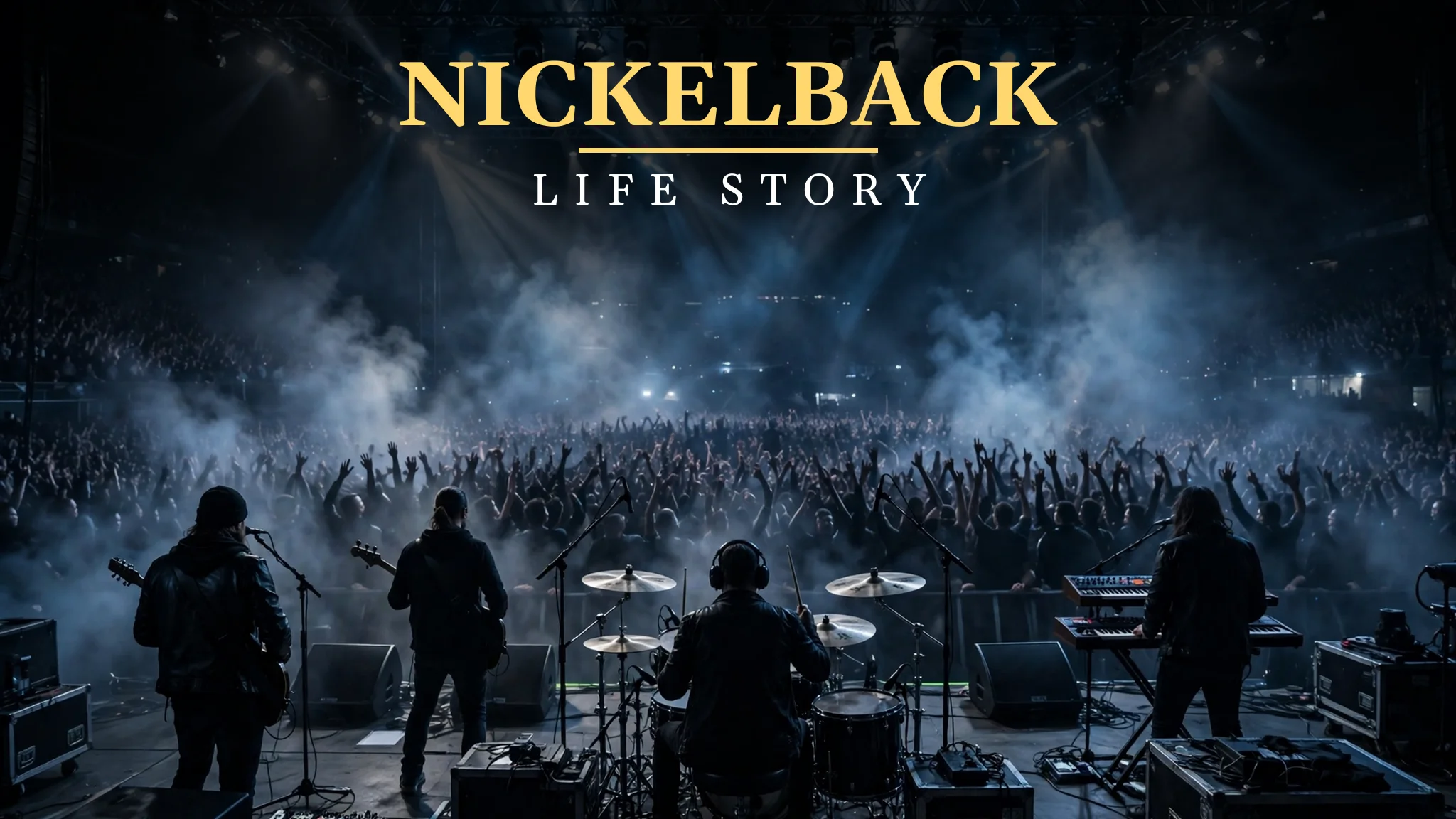
One more thought stays with me. When I hear their music, I think of a dark arena, with blue and white spotlights, smoke in the air, and a huge crowd singing along. The picture is plain, yet it sits right at the centre of what they do. They made music for those moments, for the times when we need a song that is both loud and honest. I think we need more music like that, and I am glad Nickelback is still making it.
I also keep thinking about Chad Kroeger, and how his voice gave the band its sound. Chad’s singing carries both grit and warmth, and his writing stays plain-spoken and sincere. His work is a big part of why Nickelback sounds like Nickelback, and I will keep listening to his songs, because they remind me that music can be both a skill and a story, and that a band can be both a group of friends and a work of art.
Finally, I want to say that their story gives hope to young bands who feel that their music is too simple, too direct, or too different. Nickelback felt that too, and they kept going anyway. They stuck to the songs they believed in, and in time the rest of the world came round to them as well. It is a hopeful tale, and it is one I will not forget. If four friends from Hanna can do that, then many other bands can do it too, and Nickelback has shown them the way with their skill, their honesty, and their music.
I will hold on to their albums, not because every track is flawless, but because the feeling behind them is real. They remind me to join in, to listen with care, and to treasure songs built with craft and feeling. In a busy world, that reminder is precious, and I am thankful that four friends from Hanna, with guitars and drums, decided to share their direct and beautiful songs with the rest of us. Their music is a light in a dark arena, and I hope it keeps shining for many years.
I also keep returning to how their choruses lift people who are going through a low patch. A direct rock song can make a sad day a little brighter, and Nickelback makes many such songs. Their music never tries to be clever, but it stays truthful, and it helps listeners feel brave, understood, and less on their own. That kind of comfort is a gift, and plenty of people are glad of it. A band that can make you feel strong when you are sad is a band that will be loved for a long time.
Another thing I admire is their work ethic. They cut album after album, spent years on the road, and kept their guitar sound big and their words straight. That is a lot of work, and it takes discipline. They did not seem to complain about that work. They plainly enjoyed it, and you can hear that enjoyment running through the records. A band that loves its work makes better songs, and Nickelback is a good example of that truth.
When I play their newer records, I hear a group that sounds settled and sure of where it stands. They are not chasing youth, and they are not chasing whatever sound is fashionable this year. These days they write songs that match the life they live now, songs about love, family, hope, and what lies ahead. That steadiness is a real gift, and it gives their newer records a warm, settled glow. Plenty of listeners who grew up with these records seem to find a steady comfort in that steadiness.
Looking ahead, I keep hoping those choruses stay on the radio and on stage for a long while yet. The world changes fast, and rock music changes even faster, but a clear voice and an honest song will always have a place. Nickelback has both, and they have the skill to keep being heard in new ways. Whether it is a young listener finding How You Remind Me for the first time, or an older fan playing Photograph on a quiet night, their songs will keep finding people who need them.
In the end, I see Nickelback as a band that turned four friends in Hanna into a global success, and that kept that success alive through fame, through criticism, and through many years of music. They turned a small town into a stage, a direct song into a world hit, and a joke into a reason to keep going. It is a strong story, and it is one I will hold on to. A direct song can do a big thing, if it is true, and Nickelback has proved that again and again.
I will keep listening to their music, because it is direct, melodic, and full of heart, and because a band that sings about everyday life will always have a place in my life. Their songs remind me that a small town, a photograph, and a rock star dream can all be part of a great song, and that a voice that loves to sing can teach the whole world how to sing along.
When I think about Nickelback one last time, I think about four friends who loved rock music so much that they spent twenty-five years making it, and I think about how that love never faded, even when life was hard, even when the world changed, and even when jokes tried to stop them. That love is the heart of their story, and it is why their music still matters today, and why it will keep mattering for a long time, in Hanna and around the world.
I am thankful for their music, because it reminds me that a direct song, a strong chorus, and an honest word are all worth singing about, and that four friends from Hanna can teach the whole world how to sing along, with many voices, many guitars, and one big heart.
Their songs will keep playing in my home, in my car, and in my heart, for many years to come, because true music does not fade, and because a direct song can help a person through a hard day, a long night, and a new beginning in a new place.
When I hear Nickelback on a loud night, I think about how their music carries a feeling of strength in a way that few bands can match, and I think about how much the world needs that strength. Their songs do not hide from criticism, they face it with a direct chorus, and that is why they still help listeners who need a song to sing along to.
I will keep Nickelback’s records close, because they remind me that a direct song can be a great song, and that four friends from a small town can make music that the whole world sings along to.
Frequently Asked Questions
Where was Nickelback formed and who were the members?
Nickelback was formed in Hanna, Alberta, in 1995. The classic members are Chad Kroeger on vocals and guitar, Ryan Peake on guitar, Mike Kroeger on bass, and Daniel Adair on drums, who joined in 2005.
What is Nickelback’s most famous song?
How You Remind Me, from Silver Side Up in 2001, is their most famous song. Other well-known songs include Photograph, Rockstar, Far Away, Someday, and Gotta Be Somebody.
What album made Nickelback famous around the world?
Silver Side Up, released in 2001, made them famous around the world. It includes How You Remind Me, which became a number one hit in many countries and is still one of their most played songs.
What is All the Right Reasons?
All the Right Reasons, released in 2005, is their biggest album. It includes Photograph, Rockstar, Far Away, Animals, and Savin’ Me, and it sold millions of copies around the world.
Why do people joke about Nickelback?
Nickelback became a joke in popular culture, even while they sold millions of albums, because many critics and internet users made fun of their direct rock sound. The band has talked about the criticism with humour and has kept making music for their loyal fans.
Is Nickelback still making music today?
Yes, they are still making music and touring. After Get Rollin in 2022, they continue to write, record, and perform, and they remain known for their direct, melodic, and energetic rock sound.


