Nicolas Winding Refn: The Life Story Behind the Drive Director
In this post
Nicolas Winding Refn is a director who makes films that look like dreams and feel like nightmares. His films are full of colour, of neon light, of silence, and of violence that comes suddenly and without warning. He made Pusher, a film about a drug dealer in Copenhagen, Bronson, about a violent prisoner in Britain, and Drive, about a stunt driver in Los Angeles who becomes a hero, which won him the award for Best Director at Cannes. His films are not like other films. They are strange, beautiful, and unforgettable, and they have made him one of the most talked-about directors in the world.
He was born in Copenhagen, Denmark, and he grew up in a family where film mattered. His father was a film director, his mother was a cinematographer, and his stepfather was also in film. He spent his childhood on film sets, watching his parents work, and learning about cameras, light, and stories. He moved to New York as a teenager, he went to film school, he was expelled, and he came back to Denmark to make his first film. That journey shaped him, and it is why his films feel so personal and so different.
What makes his story worth telling is the boldness in it. He does not make safe films. He makes films that divide people, that some love and some hate, and he does it with a confidence that is rare. This is the story of a Danish director who became famous for making films that are beautiful, violent, and unlike anything else, by following his own vision and refusing to compromise.
A Childhood on Film Sets in Copenhagen
Nicolas Winding Refn was born on 29 September 1970 in Copenhagen, Denmark. His father, Anders Refn, was a film director and editor, and his mother, Vibeke Winding, was a cinematographer. His parents worked in Danish film, and Nicolas grew up on film sets, watching them work, listening to them talk about cameras and light, and learning about the world of cinema from the inside. He was the eldest of two children, and he grew up with a sense of creativity and a love of stories.
As a child, Nicolas was restless and curious. He liked to watch films, he liked to make up stories, and he liked to think about how a film could make you feel. He was colour blind, and he was dyslexic, which meant that he saw the world differently from other children, and he learned differently too. He did not read well, but he saw well, and he learned to tell stories with images, with colour, and with sound, rather than with words. That way of seeing the world stayed with him, and it later became the heart of his films, which are famous for their colour and their visual style.
When he was eight years old, his family moved to New York, in the United States, where his father worked. Nicolas grew up in New York, and he went to school there, but he did not fit in easily. He was a Danish boy in an American school, he had trouble reading, and he felt different from the other children. He found comfort in films, in the cinema, and in the world of images. He watched films by directors like John Cassavetes and others, and he began to dream of becoming a director himself.
He returned to Denmark as a teenager, and he applied to the Danish National Film School, but he was not accepted. He went back to New York, and he studied at the American Academy of Dramatic Arts, a school for actors, not for directors, but he learned about acting, about performance, and about the way actors work. He was expelled from the school for throwing a table at a wall during a class, an incident he has talked about with humour, saying that it showed he was not meant to be an actor, but a director. He returned to Denmark, and he began to work on his first film.
Pusher and a Debut That Shook Denmark
Nicolas’s first film was Pusher, released in 1996, when he was twenty-five years old. The film was about Frank, a drug dealer in Copenhagen, played by Kim Bodnia, who owes money to a dangerous man, and who has one week to pay it back. The film was shot with a handheld camera, with natural light, and with no music, in a style that felt like real life. It was a raw and powerful film, about the drug world in Copenhagen, about violence, about fear, and about a man who is trapped by his own choices.
Pusher was a huge success in Denmark. It was praised by critics, it was loved by audiences, and it made Nicolas famous overnight. He had made a film that was unlike anything in Danish cinema, a film that was tough, honest, and unflinching, and he had done it with a small budget and a young cast. He was twenty-five, and he was already one of the most talked-about directors in Denmark. He had arrived, and he had arrived with a film that would become a classic.
He went on to make two sequels, Pusher II in 2004 and Pusher III in 2005, which followed different characters in the same world, and which were also praised. The trilogy became one of the most important works in Danish cinema, and it showed that Nicolas could tell stories about the dark side of life with honesty and with power. He was not afraid to show violence, to show drugs, to show people at their worst, and he did it in a way that felt real, not glamorous, not romantic, but true.
His early success also brought pressure. He made Bleeder in 1999, a film about a man in Copenhagen, and Fear X in 2003, a film in English, which was a failure at the box office and which left him in debt. He has talked about that time with honesty, saying that he was in trouble, that he owed money, and that he had to make the Pusher sequels to pay off his debts. That honesty is a big part of who he is, and it is why his story is so interesting. He did not hide his failures. He faced them, and he worked his way out of them.
Bronson, Valhalla Rising and a New Direction
In 2008, Nicolas directed Bronson, a film about Charles Bronson, a British prisoner who became famous for his violence, played by Tom Hardy. The film was a bold and strange work, with bright colours, with music, with long speeches, and with a performance by Tom Hardy that was praised by critics. It was not a normal prison film. It was a film about a man who wanted to be famous, who used violence to get attention, and who became a kind of artist of violence. Bronson was a success, and it brought Nicolas to the attention of a wider audience in Britain and in America.
In 2009, he directed Valhalla Rising, a film about a Viking warrior named One-Eye, played by Mads Mikkelsen, who travels with a group of Christians to a new land. The film was slow, quiet, and brutal, with little dialogue, and with beautiful images of the Scottish landscape. It was a very different film from Bronson, and it showed that Nicolas could work in many styles, in many genres, and with many kinds of stories. He was becoming a director who could not be put in a box, and that was a strength.
He also began to work more in English, and he began to be noticed by directors and producers in Hollywood. He was invited to direct films in America, and he was offered scripts that other directors had turned down. He chose his projects carefully, and he waited for the right one. That patience paid off, when he was offered a film about a stunt driver in Los Angeles, a film that would become his most famous work, and that would win him the award for Best Director at Cannes.
During this time, he also married Liv Corfixen, a Danish actress and filmmaker, and they had children together. He became a father, and he has talked about how fatherhood changed him, how it made him think about his films differently, and how it made him want to make films that his children could one day understand. He lives in Copenhagen, and he works in Denmark and in other countries, moving between the two with ease. He is a Danish director who works in the world, not a director who has left Denmark behind.
Drive and the Best Director Award at Cannes
In 2011, Nicolas directed Drive, a film about a stunt driver in Los Angeles, played by Ryan Gosling, who also works as a getaway driver for criminals at night. The driver falls in love with his neighbour, Irene, played by Carey Mulligan, and he tries to protect her and her son from dangerous men. The film was a stylish and beautiful work, with neon light, with a soundtrack of electronic music, with long silences, and with sudden violence. It was unlike any other film of its time, and it became a huge success.
Drive was shown at the Cannes Film Festival in 2011, where Nicolas won the award for Best Director. It was a huge honour, and it made him one of the most talked-about directors in the world. The film was praised by critics, it was loved by audiences, and it became a cult classic. People talked about the jacket Ryan Gosling wore, about the music, about the colours, and about the way Nicolas had made a simple story feel like a dream. He had made a film that was both popular and artistic, and that is a rare achievement.
The film also showed how much Nicolas had grown as a director. He was no longer the young man who had made Pusher with a handheld camera and no budget. He was a mature filmmaker, working with Hollywood stars, with a bigger budget, and with a clear vision. He directed Drive with confidence, with patience, and with a deep understanding of how images and sound can tell a story. He did not use many words. He used light, colour, music, and silence, and that was why the film was so powerful.
After Drive, Nicolas became a star director, and he was offered many projects in Hollywood. He directed Only God Forgives in 2013, with Ryan Gosling again, a film set in Bangkok, about a man who seeks revenge for his brother’s death. The film was controversial, and it divided critics, but it also showed that Nicolas was not afraid to take risks, even after the success of Drive. He did not want to repeat himself. He wanted to make new films, in new ways, and to keep pushing himself.
The Neon Demon, Too Old to Die Young and Later Work
In 2016, Nicolas directed The Neon Demon, a film about a young model named Jesse, played by Elle Fanning, who comes to Los Angeles to become a fashion model, and who discovers a dark and dangerous world of beauty, jealousy, and violence. The film was a bold and strange work, with bright colours, with beautiful images, and with a story that shocked many viewers. It was shown at Cannes, where it divided critics, but it also became a cult film, loved by fans who appreciated its beauty and its daring.
He also directed the television series Too Old to Die Young in 2019, for Amazon, a series about a police officer in Los Angeles, played by Miles Teller, who becomes involved in a world of crime and violence. The series was long, slow, and visually stunning, with episodes that felt like films. It was praised by some critics and criticised by others, but it showed that Nicolas could work in television, with a long story, and with the same visual style that had made his films famous. He was not afraid to take his time, to let a scene breathe, and to trust the audience to stay with him.
In recent years, he has continued to work in film and television, in Denmark and abroad. He has directed commercials, he has worked on new projects, and he has continued to explore new ideas. He is now in his fifties, and he is still working, still learning, and still choosing projects that interest him. His career is a model of boldness, of vision, and of a director who refuses to compromise. He makes the films he wants to make, in the way he wants to make them, and he does not care if everyone likes them.
He lives in Copenhagen with his family, and he is a father, a husband, and a director who values his privacy. He gives interviews when he has a new project, he talks about his work with passion and with humour, and then he goes home to his family and his life. That balance is important to him, and it is one of the reasons his films feel so personal. He is not making films for fame. He is making films because he loves cinema, and because he has something to say.
A Director Who Sees the World in Colour
Nicolas Winding Refn’s story is, in the end, a story about seeing. He is colour blind, and he sees the world differently from other people. He sees colour in a way that is unique, and he uses that in his films, which are famous for their bright, saturated colours, their neon light, and their visual beauty. He has turned a difference into a strength, and he has made films that look like no one else’s films. That is a remarkable achievement, and it is why his work is so recognisable.
He has also turned his dyslexia into a strength. He does not read well, so he tells stories with images, with sound, and with silence, rather than with words. His films have little dialogue, and they rely on the audience to watch, to listen, and to feel. That is a different kind of cinema, and it is one that many people love, because it speaks to them in a way that words cannot. He has shown that a director does not need to be good at reading to be great at filmmaking. He needs to be good at seeing, and Nicolas is very good at seeing.
As he moves into his fifties, Nicolas is still a working director, still choosing projects, still learning. His story is not finished, and his fans wait with hope for whatever he does next. He is a director, a father, and a man who sees the world in his own way, and his story is one of the most inspiring in European film. He shows that being different is not a weakness. It is a strength, and it can lead to a life and a career that is unlike anyone else’s.
Fear X, Debt and Learning From Failure
Nicolas Winding Refn’s career has not been a straight line of success. After Pusher made him famous, he directed Fear X in 2003, an English-language thriller with John Turturro, about a man whose wife is murdered and who tries to find her killer. The film was a failure at the box office, and it left Nicolas in serious debt. He has talked about that time with honesty, saying that he owed a lot of money, that he was in trouble, and that he did not know how he would pay it back. It was a difficult time, and it could have ended his career. Instead, it taught him a great deal about himself, about money, and about the risks of making films.
He paid off his debts by making Pusher II and Pusher III, returning to the world that had made him famous, and telling new stories about different characters in that world. It was a practical decision, but it was also a creative one, because the sequels were good films, praised by critics, and they showed that Nicolas could return to a story and find new things in it. He did not see the sequels as a step back. He saw them as a way forward, a way to pay his debts and to keep making films. That pragmatism is a big part of who he is, and it is why his career has lasted. He is not just an artist. He is a worker, and he knows how to keep working, even when things are hard.
The failure of Fear X also taught him to be more careful about the films he chose, to think about the audience, and to balance his artistic vision with the practical realities of making a film. He did not stop taking risks. He made Bronson, Valhalla Rising, Only God Forgives, and The Neon Demon, all risky films, but he made them with a clearer understanding of what he was doing, and with a team he trusted. He learned from failure, and he became a better director because of it. That is a lesson for anyone who fails at something. Failure is not the end. It is a teacher, if you are willing to listen to it.
He has also talked about his dyslexia and his colour blindness as part of his story, saying that they shaped the way he sees the world, and that they made him a visual director, a director who tells stories with images rather than with words. That honesty about his differences is a big part of his appeal, and it is why many people who feel different themselves look up to him. He did not hide his differences. He used them, and he made them into strengths. That is a powerful message, and it is one that resonates with many people.
He has also become known for the way he works with cinematographers, for the care he takes with light and colour, and for the patience he brings to every shot. His films are famous for their look, for the neon, for the darkness, for the way a face is lit in a room, and that look does not happen by accident. It happens because Nicolas thinks about every frame, because he talks to his cinematographer, and because he knows what he wants the audience to see and feel. That attention to the image is a big part of his art, and it is why his films are so recognisable. You can tell a Refn film from a single frame, and that is a rare achievement for a director.
My Take:
When I think about Nicolas Winding Refn, the first thing I feel is curiosity. His films are strange, they are beautiful, and they are unlike anything else I have seen. When I watch Drive, I feel like I am in a dream, with neon lights, with electronic music, with long silences, and with a driver who says very little but who feels a great deal. That is a special feeling, and it is why I admire him. He does not make films like everyone else. He makes films that look and feel like his own dreams, and he invites me into those dreams. That takes courage, because it is easier to make a normal film. It is harder to make a strange one, and to trust that the audience will follow you.
I admire him most for turning his differences into strengths. He is colour blind, and he is dyslexic, and many people would see those as weaknesses. Nicolas sees them as gifts. He sees colour differently, and he uses that in his films, which are famous for their bright, saturated colours. He does not read well, so he tells stories with images, with sound, and with silence. That is a lesson for all of us. What makes you different is not a problem. It is a gift, and if you learn to use it, it can make you great. I think about that when I feel different, and I ask myself, how can I turn this difference into a strength? Nicolas did it, and I want to learn from him.
What moves me about Drive is the silence in it. The driver, played by Ryan Gosling, says very little. He drives, he looks, he listens, and he acts. There are long scenes with no dialogue, just music and images, and they are more powerful than any speech could be. That is a brave choice for a director, to trust silence, to trust the audience to understand without words. Many films are full of talk, full of explanations, full of noise. Drive is quiet, and that quietness makes it more powerful. I respect Nicolas for trusting his audience, for believing that we can watch and feel without being told what to feel. That is a kind of respect, and it is rare in Hollywood.
I also think about Pusher, and how raw and honest it was. It was his first film, made with a small budget, with a handheld camera, and with actors who were not famous. It was about a drug dealer in Copenhagen, about a man who is trapped, about violence and fear, and it felt like real life. That is a remarkable debut, and it showed that Nicolas had a clear vision from the start. He did not wait for a big budget. He made a film with what he had, and he made it well. That is a lesson for any young filmmaker. You do not need a lot of money. You need a true story, and the courage to tell it simply. Nicolas did that, and I admire him for it.
I love the way he works with colour. His films are full of pink and blue neon, of red and gold, of light that feels like a dream. When I watch The Neon Demon, I feel like I am inside a painting, with colours that are too bright to be real, but that feel true. That is his gift. He sees the world in colour, and he shows me a world I have never seen before. I do not always understand his films, and I do not always like them, but I always remember them. That is a sign of a great director. His films stay with you, they haunt you, and they make you think. I think that is more important than making a film that everyone likes. It is better to make a film that some people love and some people hate, than to make a film that everyone forgets.
If I have a sadness in his story, it is that his films after Drive did not always get the love they deserved. Only God Forgives and The Neon Demon divided critics, and some people said they were too violent, too strange, too slow. I understand that feeling, because his films are not easy to watch. But I also think that is the point. He is not making easy films. He is making films that challenge you, that make you uncomfortable, and that make you think. That is a brave thing to do, especially after the success of Drive, when he could have made a safe film and made a lot of money. He chose to take risks, and I respect him for that, even when the risks do not always work.
I also learn from him that failure is not the end. He made Fear X, and it failed, and he was in debt. He did not give up. He made the Pusher sequels, he paid off his debts, and he kept going. That is a lesson for all of us. Failure is painful, but it is not final. You can learn from it, you can work your way out of it, and you can come back stronger. Nicolas did that, and his story gives me hope when I fail at something. I think, if he can come back from debt and failure, I can come back too.
For a young reader, I think the lesson from Nicolas is simple: see the world in your own way, and trust your vision. Do not try to see like everyone else. See like yourself, and make art from what you see. Nicolas sees in colour, he sees in images, and he makes films from that seeing. That is what makes him special. If you want to be an artist, do not copy others. Find your own way of seeing, and trust it. That is what Nicolas teaches me, and it is a lesson I want to carry with me.
In the end, I think Nicolas Winding Refn is a reminder that cinema can be a dream. It can be beautiful, it can be strange, it can be violent, and it can be unforgettable. His films are not for everyone, and that is all right. They are for people who love colour, who love silence, who love images, and who are willing to follow a director into a strange and beautiful world. I am grateful for his films, and I hope he keeps making them for many years to come. The world needs more directors like him, directors who are bold, honest, and true to their own vision.
I also think about his family, and how it has changed him. He is married to Liv Corfixen, and they have children together, and he has talked about how fatherhood made him think differently about his films. He used to make films about violence, about men who hurt each other, and now he thinks about what his children will see, and what they will learn from his work. That does not mean he has stopped making bold films. It means he thinks more carefully about why he is making them, and what they mean. That is a mature way to think about art, and I respect it. He is not just a director. He is a father, and he carries that responsibility with him into his work.
There is another side to him that I want to mention, and that is his love of cinema itself. He loves films, he watches them, he talks about them, and he lives for them. He is not making films to get rich, or to be famous. He is making them because he loves cinema, because he believes in it, and because he has something to say through it. That love is infectious, and it is why his fans love him. They can feel that he cares, that he is passionate, and that he is not just doing a job. He is living his dream, and he is sharing it with the audience. That is a beautiful thing, and it is why his films, even the strange ones, feel so alive.
I also think about the way he uses music. Drive has a soundtrack of electronic music that is now famous, with songs that feel like the night, like neon, like Los Angeles. The Neon Demon has music that is beautiful and unsettling, just like the film. He chooses music carefully, and he uses it to create a mood, to tell a story without words, and to make the audience feel something. That is a skill, and it is one that many directors do not have. He understands that music is not just background. It is part of the story, and it can say things that images and words cannot. I respect him for that, because it shows that he thinks about every part of his films, not just the acting and the camera.
I think about the young filmmakers who look at Nicolas and see a role model. They see a man who was expelled from school, who was in debt, who made a film with a small budget, and who became one of the most talked-about directors in the world. That story tells them that they do not have to follow the normal path, that they can be different, that they can fail, and that they can still succeed. I hope those young filmmakers remember that, and I hope they keep going when they face hard times. Nicolas did, and his story proves that it is possible.
I also want to say something about his courage in making films that divide people. It would be easy to make a safe film, a film that everyone likes, and to make a lot of money. Nicolas does not do that. He makes films that some people love and some people hate, and he does it because he believes in his vision. That is a brave thing to do, especially in Hollywood, where safe films are rewarded. I respect him for it, even when I do not love every film he makes. He is true to himself, and that is the most important thing an artist can be.
I also think about the way he talks about his films in interviews. He does not explain them, and he does not tell the audience what to think. He talks about his love of cinema, about the directors who inspired him, and about the images that stayed with him, and he lets the audience find their own meaning in his work. That is a generous way to be a director, and it is one that I respect. He trusts me to watch, to think, and to feel, and he does not try to control my reaction. That trust is rare, and it is why his fans are so loyal. They feel that he respects them, and they respect him back.
I also think about the way he has stayed in Copenhagen, even as he became famous in Hollywood. He lives in Denmark, he works in Denmark, and he carries his Danish roots with him wherever he goes. That loyalty to home is a beautiful thing, and it is one that I admire. He did not forget where he came from, even when he was directing films in Los Angeles and Bangkok. He kept his home, his family, and his culture close to him, and that grounding is part of why his films feel so personal. He is a Danish director who works in the world, and he is proud of that.
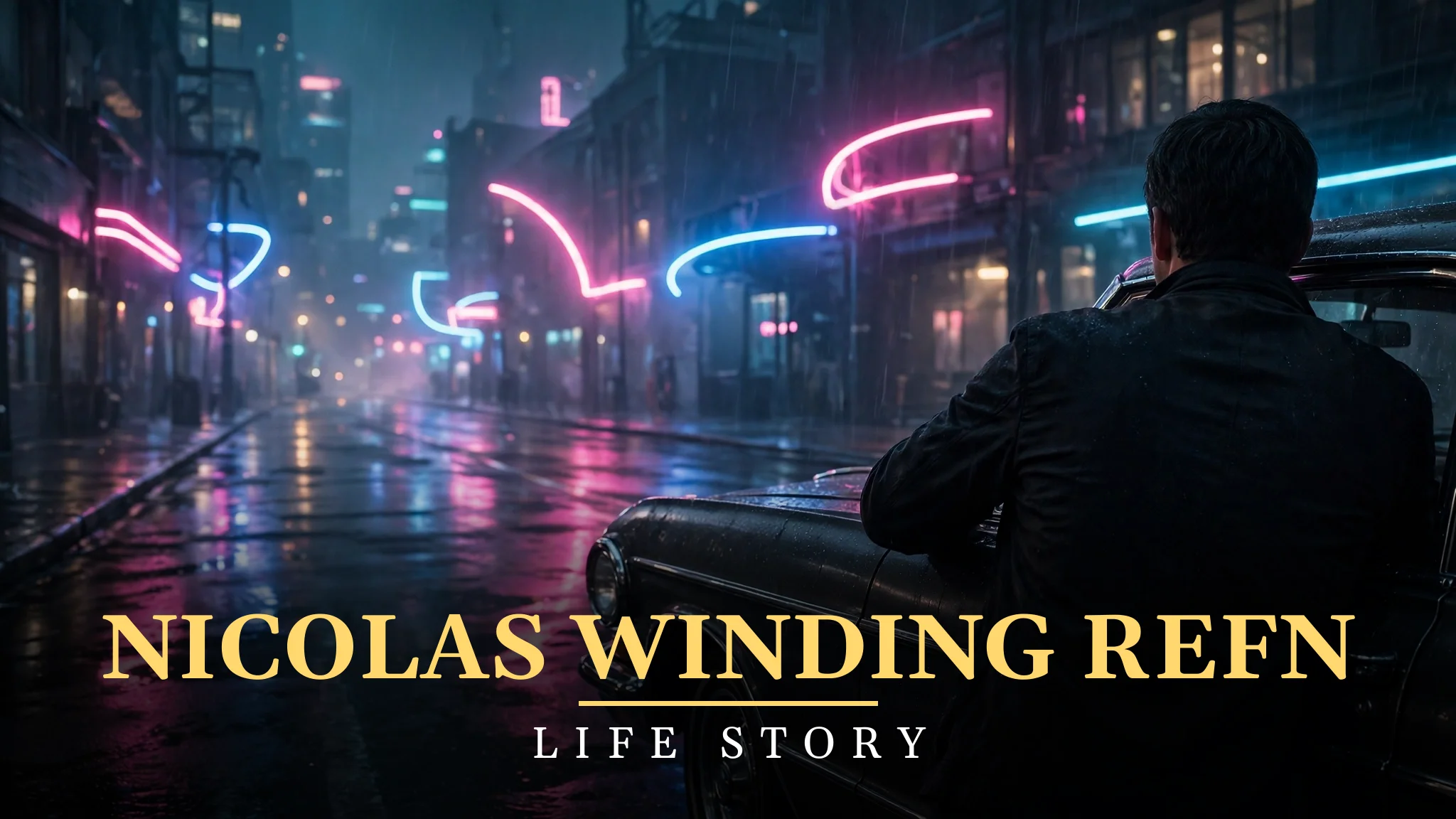
One more thought stays with me. I think about the neon street in the image, with its pink and blue lights reflecting on wet pavement, and how it fits Nicolas. His films are like that street: dark, wet, full of colour, and a little bit dangerous. But they are also beautiful, and they make you want to walk down that street and see what is there. I hope he keeps lighting up those streets, keeps making his strange and beautiful films, and keeps showing the world what cinema can be. He is a director, but he is also a dreamer, and that is the best kind of director.
Frequently Asked Questions
Where was Nicolas Winding Refn born and how old is he?
Nicolas Winding Refn was born on 29 September 1970 in Copenhagen, Denmark, which makes him 56 years old in 2026. He grew up on film sets, lived in New York as a child, and returned to Denmark to make his first film.
What is Nicolas Winding Refn most famous for?
He is most famous for directing Pusher in 1996, Bronson in 2008, and Drive in 2011. Drive won him the award for Best Director at the Cannes Film Festival and became a cult classic around the world.
What is Drive about?
Drive is about a stunt driver in Los Angeles, played by Ryan Gosling, who also works as a getaway driver at night. He falls in love with his neighbour Irene, played by Carey Mulligan, and tries to protect her and her son from dangerous men.
Is Nicolas Winding Refn colour blind?
Yes, he is colour blind, and he is also dyslexic. He has said that these differences shaped the way he sees the world, and that his films, famous for their bright colours and visual style, come from that different way of seeing.
What is the Pusher trilogy?
The Pusher trilogy is three films, Pusher in 1996, Pusher II in 2004, and Pusher III in 2005, about drug dealers and criminals in Copenhagen. The first film was Nicolas’s debut and became a classic of Danish cinema.
What is The Neon Demon about?
The Neon Demon, released in 2016, is about Jesse, a young model played by Elle Fanning, who comes to Los Angeles to become a fashion model and discovers a dark world of beauty, jealousy, and violence. It was shown at Cannes and became a cult film.
Where does Nicolas Winding Refn live now?
He lives in Copenhagen, Denmark, with his wife Liv Corfixen and their children. He works in Denmark and in other countries, directing films and television, and he continues to choose bold and unusual projects.


