Nimda Spread Five Ways Fast
In this post
Picture a burglar who does not waste time picking the lock on your front door. He does not even check if the door is locked. In one single second, he pulls the door handle, climbs through the bathroom window, drops down the chimney, lifts the cellar hatch, and pushes the back gate. If even one of those five entrances is open, he is inside your house, making tea in your kitchen. That is exactly how a computer worm called Nimda behaved in September 2001, and it is why security experts still talk about it more than twenty years later.
Nimda appeared on 18 September 2001, just one week after the 9/11 attacks in the United States. The world was nervous, and when a fast, aggressive computer worm suddenly exploded across the internet, some people feared it was the start of a second attack, launched through computers this time. Investigators later found no such connection. Nimda was a crime of code, not part of any larger attack, but the fear it caused in those first hours shows how frightening its speed really was. Its name gives a small clue about its maker. Nimda is simply the word “admin” spelled backwards, a little joke aimed at the administrators who would have to clean up the mess.
What Nimda is and what it does
Nimda is a computer worm. A worm is a piece of harmful software that copies itself from machine to machine without waiting for a human to pass it along. A normal virus needs someone to open a file or run a program. A worm travels on its own, and Nimda traveled better than almost any worm before it.
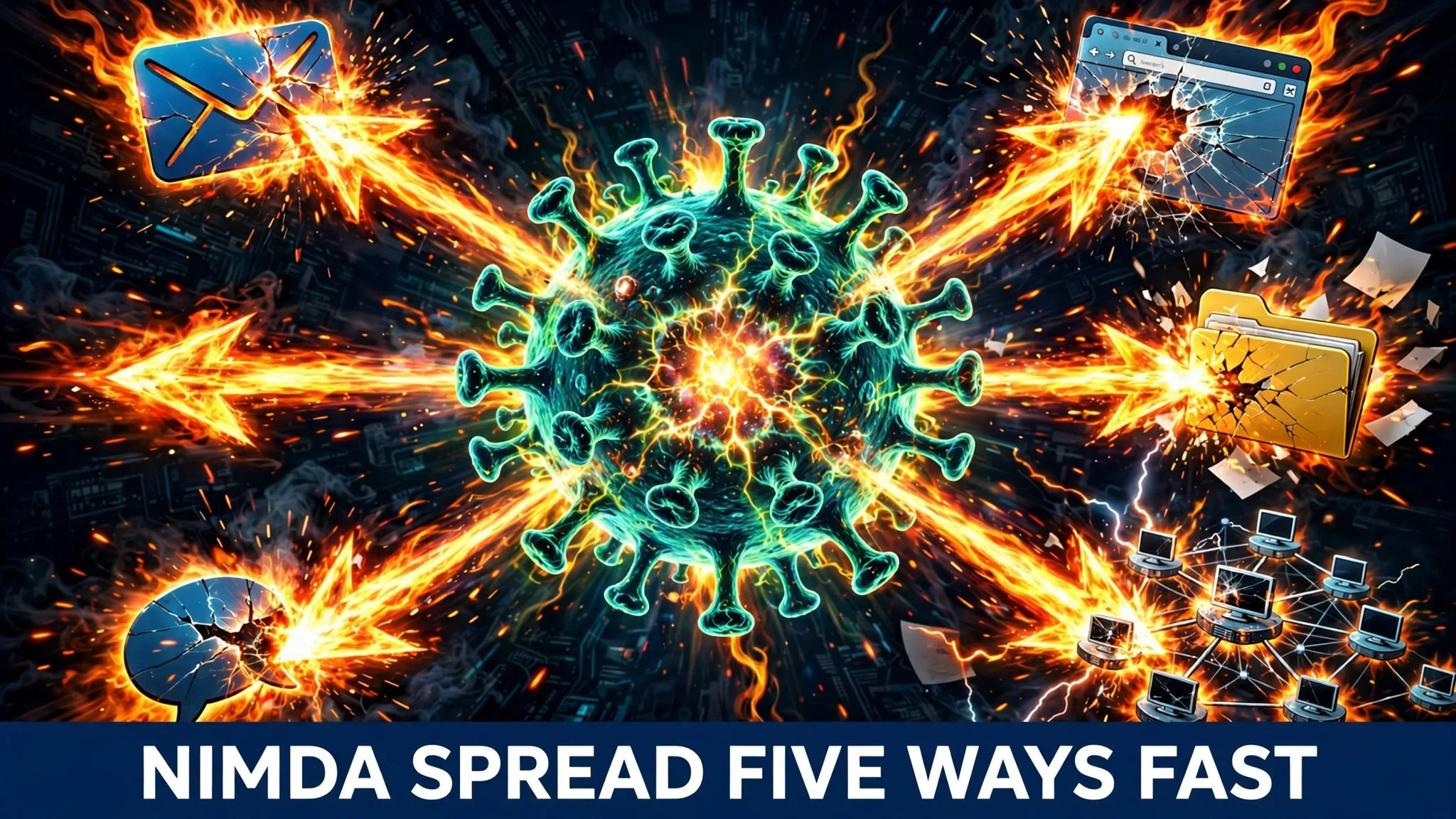
Once Nimda landed on a computer, it got busy. It searched the machine for email addresses and mailed copies of itself to the people it found. It hunted for shared folders on the local network and copied itself into them, so the next person who opened that folder could be infected too. On web servers, it slipped into websites and changed their pages. Most importantly, Nimda did not rely on one single trick. It attacked through five different doors at the same time, and that is the whole secret of its fame.
The five doors Nimda used
Door one: email that could bite
Nimda sent itself as an email attachment, usually a file called readme.exe. The name was chosen to look harmless, like a small note you were meant to read. The nasty part was a flaw in Internet Explorer. Because of that flaw, the attachment could sometimes start running just because the email was previewed in the inbox. A careful person who never opened strange attachments could still be caught simply by clicking once on the message to see what it was. That single trick turned every inbox into a loaded trap.
Door two: websites that infected their own visitors
Nimda attacked Microsoft IIS web servers, the software that powered a huge share of the world’s websites at the time. After breaking into a server, it altered the site’s web pages. The changed pages offered visitors a file to download, and that file carried the worm. So a person could do everything right, avoid strange emails, visit a well-known website they trusted, and still walk away infected. The website itself had become the burglar’s open window, and it was handing the burglar’s tools to every guest.
Door three: shared folders on the network
Offices run on shared folders. They are the digital equivalent of a tray on a desk where everyone drops their papers. Nimda copied itself across these shared folders on local networks. If one computer in an office was infected, the worm quietly placed copies of itself in the shared spaces that every other computer could reach. When a colleague opened the wrong file from the shared tray, the worm had a new home, and from there it reached for the next tray, and the next.
Door four: old backdoors left by earlier worms
This door is the strangest one. Earlier worms, including one called Code Red II, had left secret entrances behind in the servers they infected, like a burglar who glues a spare key under your flowerpot for later. Nimda went looking for those left-behind backdoors. Where it found one still open, it simply walked in. A server could survive one worm attack, be cleaned carelessly, and then be robbed again through the hole the first worm had made.
Door five: wandering the network on its own
Finally, Nimda spread by network browsing. It scanned from machine to machine, hunting for open, unprotected network shares, the digital equivalent of walking down a street and trying every gate. No email was needed, no website visit, no human mistake. If a computer on the network had left its shares open and unguarded, Nimda found them and copied itself across.
How something like Nimda reaches an ordinary person
Most of us do not run web servers or office networks, so it is fair to ask what any of this has to do with a normal home computer or phone. The answer is that the five doors still exist today, just with newer paint. Strange attachments still arrive in inboxes. Trusted websites still get hacked and turned into traps. Shared folders and shared drives still connect whole families and offices. Old software still carries old holes that were never fixed. And devices on the same Wi-Fi still reach out to each other all day long. Nimda’s lesson is not really about the year 2001. It is about the simple fact that a modern attack rarely knocks on one door. It tries all of them, quietly, at machine speed, and it only needs one to be open.
I find it humbling that the strongest lock in the world means nothing if the cellar window is standing wide open, and I think Nimda understood our houses better than we did.
The damage Nimda caused
The speed is what stunned everyone. Nimda was reported around the world within about 22 minutes of its first sighting. By the standards of 2001, when many people still connected to the internet with a modem that sang while it dialed, that was almost unbelievable. Reports said hundreds of thousands of computers and servers were infected in the first days. Email systems slowed under the weight of the worm’s messages. Websites that had been altered had to be taken down, cleaned, and rebuilt. Offices lost working days while every machine on the network was checked, because cleaning one computer meant nothing if the shared folder next door was still carrying the worm.
The money damage was counted in cleanup bills and lost business. Estimates put the total cost in the hundreds of millions of dollars. Those figures are estimates rather than exact accounts, since no company can measure every lost hour, but even the lowest estimates describe a very expensive week for the world’s IT departments. The hidden damage was trust. After Nimda, a website could no longer be assumed safe just because it was famous, and an email could no longer be assumed safe just because it arrived in a tidy inbox.
How to protect yourself from a five-door attack
The good news is that Nimda’s five doors each have a simple lock, and most of them are habits rather than expensive tools.
Keep every layer updated. Nimda walked through flaws in Windows, in Internet Explorer, and in server software. Three different layers, three different patches. Updates are not just new features; they are repaired locks. Turn automatic updates on for your system, your browser, and your apps, and let them install.
Treat attachments like strangers at the door. Never open an attachment you were not expecting, even if it comes from someone you know, because that person’s machine may be the infected one. If an email says a file is a harmless note but its name ends in .exe or another program ending, delete it. When in doubt, ask the sender through a different channel before opening anything.
Be careful with shared folders and drives. Only share what you truly need to share, and switch sharing off when you do not need it. On a home network, check which folders your computer is offering to everyone else. A shared folder with no password is an open window, and worms are patient window-checkers.
Do not leave old damage behind. If a computer or website is ever infected, cleaning the visible problem is not enough. Change passwords, check for backdoors and leftover accounts, and reinstall software from clean sources where possible. Nimda’s fourth door existed only because earlier attacks were cleaned too quickly.
Remember that trusted places can be turned. A famous website can be hacked, and a friend’s account can be stolen. Caution is not rudeness. Pausing for five seconds before downloading a file a website suddenly offers you is one of the cheapest forms of protection ever invented.
Common questions
What does the name Nimda mean?
Nimda is the word “admin” spelled backwards. “Admin” is short for administrator, the person in charge of a computer system, so the name was a small mocking joke aimed at the people who would have to fight the worm.
Did Nimda have anything to do with the 9/11 attacks?
No. Nimda appeared on 18 September 2001, one week after the attacks, and the timing made some people fear a connection at first. Investigators looked into it and found no such link.
How fast did Nimda really spread?
It was reported around the world within about 22 minutes of being first spotted, which was astonishing speed for 2001. Reports said hundreds of thousands of computers and servers were infected during its first days.
Could Nimda infect you without opening an email?
Yes. Because of a flaw in Internet Explorer, its email attachment could sometimes run merely when the message was previewed. It could also reach machines through infected websites, shared folders, old backdoors on servers, and open network shares, none of which required opening an email at all.
Is Nimda still a danger today?
The original Nimda is an old worm, and modern systems with updates applied are protected against the specific flaws it used. Its real legacy is the method: attacking through many doors at once. That method is still used today, which is why updates and caution still matter.
Sources
- Wikipedia — Nimda: https://en.wikipedia.org/wiki/Nimda