Nobel Medals Melted Into Liquid
In this post
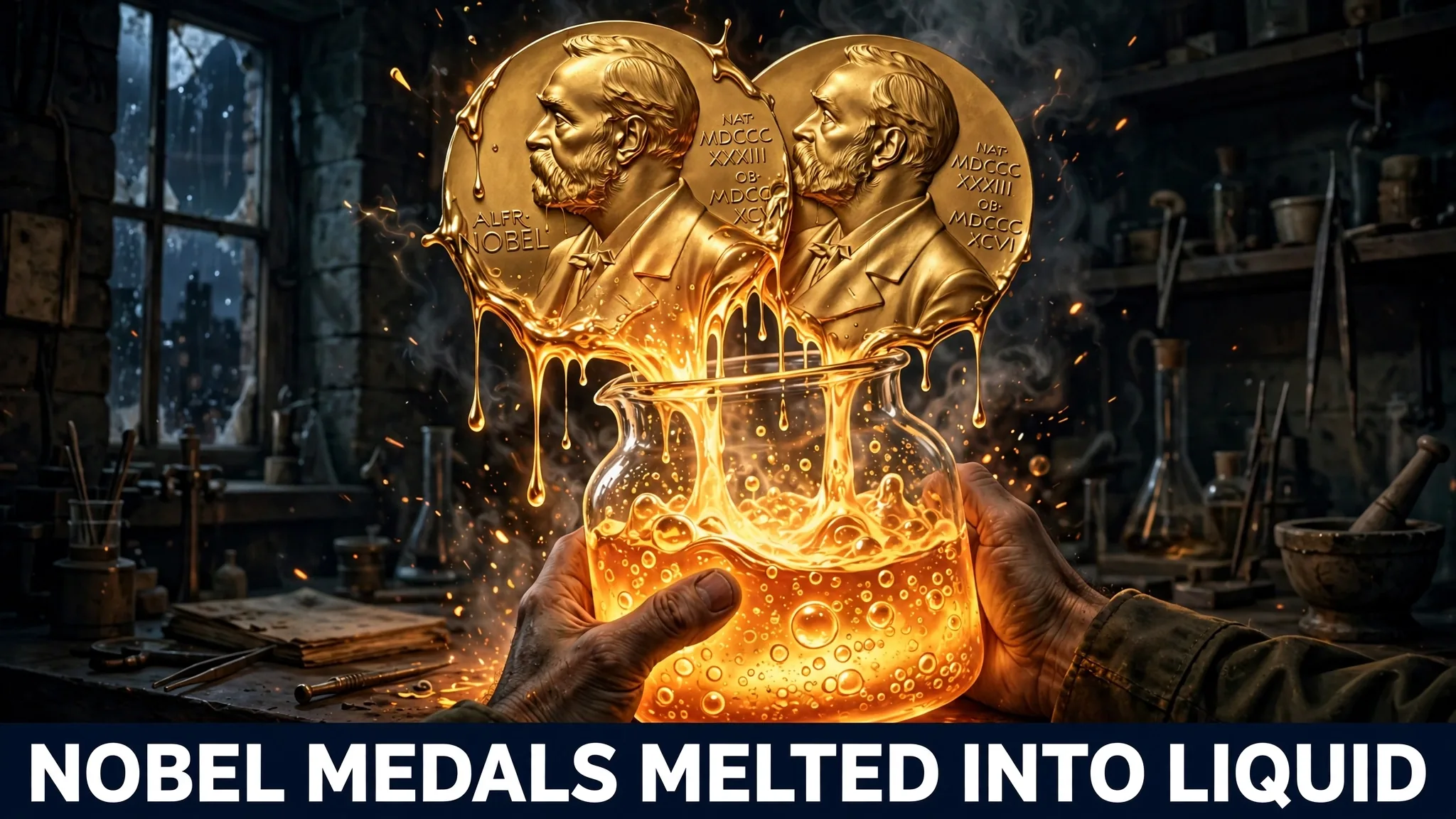
First, an honest note, because this story deserves the truth told clearly: nobody lit a fire under these medals, and no furnace was involved. When people say two Nobel Prize medals were “turned into liquid”, they mean something far cleverer. The medals were dissolved — eaten away by a special acid — until two solid discs of gold became nothing but a jar of orange liquid, sitting in plain sight on a laboratory shelf.
It sounds like a trick from a spy film. It really happened, in Copenhagen, during the Second World War, and it may be the smartest hiding place in the whole history of science. Here is the full story.
Two Gold Medals In A Dangerous Place
The medals belonged to two German physicists. Max von Laue had won the Nobel Prize in Physics in 1914, and James Franck had won it in 1925. Both men were respected scientists — and both were in trouble with the Nazi government that ruled Germany in the 1930s.
In 1935, the Nobel Peace Prize was given to Carl von Ossietzky, a German peace campaigner who was sitting in a Nazi prison camp. Hitler was furious. After that, the German government forbade its citizens from accepting or keeping Nobel Prizes at all.
There was another danger, too. Sending gold out of Germany was strictly banned — in the words of one of the men who lived through it, it was almost a crime punishable by death. And a Nobel medal is not anonymous: the winner’s name is engraved on it. If the medals of von Laue and Franck were ever found, the engraved names would point straight at them.
So, for safekeeping, the two physicists sent their medals out of Germany anyway — quietly — to the Institute of Theoretical Physics in Copenhagen, Denmark, run by the famous Danish physicist Niels Bohr. There, in Bohr’s institute, the two gold discs rested safely. Until the war came to Denmark.
April 1940: The Soldiers Arrive
On 9 April 1940, German forces invaded Denmark. Now the medals were in danger again — worse danger than before. If Nazi officers searched Bohr’s institute and found two German Nobel medals hidden there, the consequences for von Laue, whose name was carved into one of them, could be deadly.
Bohr and the people at his institute had to act fast. How do you hide two heavy discs of solid gold, made of 23-carat gold, from an army that could search every room, every drawer and every cupboard?
The first idea was the oldest hiding trick in the world: bury them. But the idea was dropped. Buried treasure can be dug up. A freshly turned patch of earth can be noticed, a search team with time and shovels can find what hands have hidden. The medals needed to disappear in a way no search could ever undo.
That is when a Hungarian chemist working at the institute, George de Hevesy, suggested something that must have sounded like madness: make the medals stop being medals.
The Acid That Can Eat Gold
To understand Hevesy’s idea, you need one small piece of chemistry, explained simply.
Gold is famous for being lazy. Most chemicals cannot touch it. Drop gold into almost any single strong acid, and the gold simply sits there, shiny and unbothered. That is one reason humans have treasured it for thousands of years — it does not rust, rot or fade.
But there is one famous exception. Mix two powerful acids together — nitric acid and hydrochloric acid — and you get a fearsome liquid with a grand old name: aqua regia, Latin for “royal water”, because it can do what no single acid can. It can dissolve gold.
Neither acid can manage the job alone. Together, they team up: one attacks the gold’s surface and loosens tiny particles of it, while the other grabs those particles and holds them in the liquid. Bit by bit, bite by bite, solid gold disappears into the mixture, turning it a clear orange colour.
So that is what Hevesy did. While German troops were in the streets of Copenhagen, he took the two Nobel medals — the life’s honour of two men — and lowered them into aqua regia. Slowly, the proud gold discs with their engraved names dissolved away, until nothing remained but orange liquid in a glass flask.
Then came the most daring part of the plan. Hevesy did not hide the flask in a cellar or behind a wall. He put it on a shelf in the laboratory, among the ordinary bottles of an ordinary chemistry lab — high up on the shelf, says one account — where it looked like nothing more than one more uninteresting chemical mixture.
The medals were not locked away. They were invisible, in full view.
A Jar That Sat Through A War
The flask stayed on that shelf through the years of occupation. To any soldier or official who might have glanced at it, it was just a jar of orange liquid in a room full of jars of liquids. Nobody was looking for medals in a bottle. Nobody could have guessed that the most famous prizes in science were swimming, invisibly, in acid.
Hevesy himself could not stay to guard it. In 1943, as the danger for Jewish scientists in Denmark grew worse, he escaped to Sweden, leaving the flask behind on its shelf. There is a lovely twist in his own story: while he was living in exile in Stockholm, Hevesy was awarded the Nobel Prize in Chemistry himself, for 1943 — honoured for his work using isotopes as tracers, tiny marked atoms that let scientists follow what happens inside living things. The man who had dissolved two Nobel medals now received one of his own.
But through all those years, the question hung in the air: would the flask survive? Would someone throw it away, knock it over, pour it out? Wars are not kind to laboratory shelves.
After The War: Gold Out Of Liquid
When the war ended, de Hevesy returned to Copenhagen and went back to the institute. And there it was: the flask, still on its shelf, undisturbed. The orange liquid had waited out the entire war, patient as paint.
Now the trick had to be run backwards. Using chemistry, Hevesy drew the gold back out of the acid — a process called precipitation, in which the dissolved gold is coaxed out of the liquid and settles again as solid metal. By 1950, he had recovered the gold: the very same gold atoms that had once been the medals of von Laue and Franck.
He sent the recovered gold to Stockholm, to the Nobel Foundation. There, new medals were struck from that same gold — freshly made, shining, with the names engraved once more. And in 1952, twelve years after the originals had vanished into a jar, Max von Laue and James Franck were presented with their Nobel medals all over again.
Think about what that means. The medals they held in 1952 were not copies made from different gold. They were their own medals, reborn — the same gold, which had spent a war disguised as orange liquid, standing quietly on a shelf while an empire searched in vain.
Why This Story Still Shines
Every part of this tale is a lesson in clear thinking. Burying the medals would have hidden them in space; dissolving them hid them in nature — it changed what they were. The best lock was not a wall or a safe, but an idea no searcher could think of.
And it happened because one chemist understood his science deeply and stayed calm while soldiers marched outside. George de Hevesy did not save the medals with strength or weapons. He saved them with knowledge — the same quiet knowledge that the Nobel Prizes exist to celebrate.
Two discs of gold became a jar of orange liquid, and a jar of orange liquid became two medals again. Of all the hiding places in all the wars in history, it is hard to beat a shelf.
Frequently Asked Questions
Were the Nobel medals really melted? Not by fire. The medals were dissolved in aqua regia, a mixture of acids that can eat gold. “Turned into liquid” is the honest description: solid gold discs became an orange liquid, and later the gold was taken back out of that liquid.
What is aqua regia? It is a mixture of two strong acids, nitric acid and hydrochloric acid. Separately, neither can dissolve gold, but together they can — which is why it was nicknamed “royal water”. It is one of the very few liquids that can dissolve gold at all.
Why were the medals in Denmark? The German winners, Max von Laue and James Franck, sent them to Niels Bohr’s institute in Copenhagen for safekeeping, because Nazi Germany had banned its citizens from keeping Nobel Prizes, and sending gold out of the country was treated as a near-capital crime.
Did the Nazis ever find the liquid? No. The flask sat on a laboratory shelf in the institute through the occupation, looking like an ordinary chemical mixture, and it was still there, untouched, when de Hevesy returned after the war.
Are the medals von Laue and Franck received in 1952 the same medals? They are the same gold. The original medals were dissolved, the gold was recovered from the liquid in 1950, sent to the Nobel Foundation in Stockholm, and struck into new medals, which were presented to the two men in 1952.
Who was George de Hevesy? A Hungarian chemist working at Bohr’s institute in Copenhagen. He suggested and carried out the dissolving of the medals. He later won the 1943 Nobel Prize in Chemistry himself, for his work on using isotopes as tracers in chemical processes.
Sources
- American Institute of Physics (AIP), “The Invisible Prize”: https://www.aip.org/library/the-invisible-prize
- NobelPrize.org, “George de Hevesy – Facts”: https://www.nobelprize.org/prizes/chemistry/1943/hevesy/facts
- Agence France-Presse (AFP), “1,001 Ways to Lose a Nobel Prize”, via Phys.org: https://phys.org/news/2018-09-ways-nobel-prize.html
- The picture on this page is an original illustration made for Talha M Blog.