Pakistan Signs Four Nation Accord
In this post
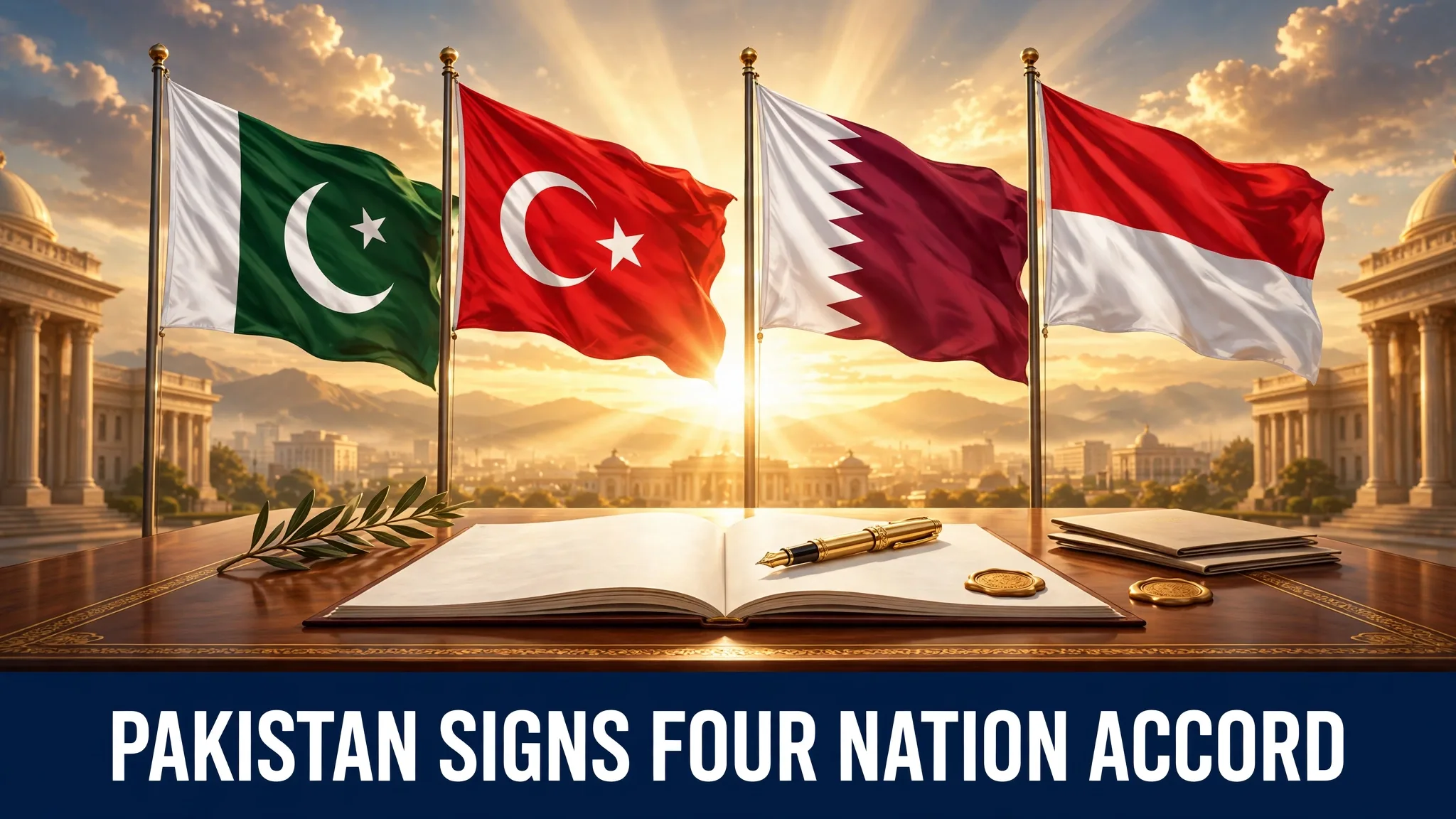
Picture four flagpoles standing in a row on a bright morning. On the first, green and white with a crescent and star. On the second, bold red with the same crescent shining in white. On the third, deep maroon and white, split like the edge of a desert banner. On the fourth, red over white, simple and proud. One by one, the flags climb into the sky together.
That picture now matches something real. Pakistan has signed a joint defence cooperation accord with Turkiye, Qatar and Indonesia. The news was reported on 21 October 2026, with the accord announced from Ankara, according to Reuters reporting carried by Arab News. Four countries, spread across three corners of the map, have decided to work more closely on defence — and the stated aim is a phrase worth remembering: strengthening self-reliance.
What does that actually mean? Why these four? And what does each flag bring to the table? Let us walk past each pole, one at a time.
What Was Signed, In Simple Words
A defence cooperation accord is a formal promise between countries to help each other in military matters. It is not an alliance that drags anyone into a war. It is closer to a written agreement between workshops: we will share knowledge, train together, learn from each other, and help one another become less dependent on outsiders.
The heart of this particular accord is self-reliance. Every country in the world faces the same quiet worry. If your equipment, your spare parts and your training all come from faraway suppliers, then your safety sits in someone else’s hands. Prices can rise. Deliveries can stop. Conditions can be attached. The four signatories have said, in effect, that they want to build more of their own strength at home — and that they can reach that goal faster together than alone.
The announcement came from Ankara, the capital of Turkiye, which tells its own small story. This was not a deal pushed on reluctant partners. It was presented from the heart of one of the four capitals, as a shared step.
The First Flag: Pakistan
Start with the flag on the first pole. Pakistan is a large country with a large, experienced military, shaped by decades of guarding difficult borders. Experience like that is a kind of wealth. Soldiers who have trained in mountains, deserts and plains, and engineers who have kept equipment running under hard conditions, carry lessons that cannot be bought in a shop.
Pakistan also knows the self-reliance lesson from the inside. Over the years, it has built its own defence production base, learning step by step how to make and maintain more of what it needs at home. That journey — from depending on others to producing at home — is exactly the journey this accord is about. Pakistan brings hard-earned experience, a big pool of trained personnel, and a strong reason to make the partnership work.
The Second Flag: Turkiye
Now the red flag of Turkiye. Few countries tell the self-reliance story better. Turkiye decided years ago that it would not remain only a buyer of other nations’ equipment. It invested in its own defence industry, patiently, factory by factory, engineer by engineer. Today it is widely seen as one of the rising defence producers of the world, building at home much of what it once had to import.
That makes Turkiye a natural anchor for an accord like this. It has walked the full road: from customer, to partner, to producer. For the other three flags, that experience is a map. For Turkiye itself, the accord offers trusted partners, shared training, and a wider circle of friends who think the same way about standing on their own feet.
The Third Flag: Qatar
The maroon and white of Qatar flies next. Qatar is small on the map, but it thinks big. It has used its energy wealth to modernise quickly, and it has become an important meeting point in its region — a country that talks to many sides and hosts many tables.
In a four-nation accord, a country like Qatar brings resources, connections and balance. Defence cooperation is not only about workshops and training grounds. It is also about planning, funding and steady relationships. Qatar’s presence says this partnership is not a small arrangement between neighbours. It stretches across regions, linking South Asia, the Gulf and beyond.
The Fourth Flag: Indonesia
Finally, the red and white of Indonesia — the giant of Southeast Asia, an archipelago of thousands of islands and one of the largest Muslim-majority nations on earth. Guarding a country made of islands spread across a vast ocean is a defence challenge unlike any other, and Indonesia has long worked to grow its own defence industry to meet it.
Indonesia brings scale, geography and ambition. Its shipyards, its growing technical base and its huge population give this accord real weight at the eastern end of the partnership. With Indonesia at the table, the four flags together span an enormous arc of the world, from the Mediterranean’s edge all the way to the Pacific.
Why These Four Fit Together
Step back from the four poles and a pattern appears. All four are Muslim-majority countries. All four have growing defence industries. All four share a history of military cooperation and training exchanges — officers visiting each other’s academies, forces learning side by side, friendships between institutions that go back years.
That shared background matters more than it may seem. Cooperation works best where trust already exists. A signature on paper is easy; working together month after month is the hard part. These four are not strangers starting from zero. They are partners formalising something that has been quietly growing for a long time.
There is also a shared mindset. Each of the four has felt, in its own way, the discomfort of depending too heavily on distant suppliers. Each has decided that the answer is to build at home and to lean on trusted friends rather than on strangers. The accord simply writes that mindset down and gives it a name.
What Self-Reliance Really Means
Self-reliance is a gentle phrase with a tough meaning. It does not mean a country makes everything itself — no country on earth does that, not even the biggest. It means a country is not helpless. It can maintain what it owns. It can repair, adapt and improve. It can train its own people to a high standard. And when it does buy from outside, it buys from a position of choice, not desperation.
For ordinary citizens, this can sound distant, but it touches daily life more than we think. A country that spends wisely on defence, builds skills at home and creates technical jobs for its young people is spending on its own future. Workshops need engineers. Engineers need education. Education lifts whole families. The road from a defence accord to a young person’s job is long, but it is real.
What Happens Next
An accord is a beginning, not a finish line. The paper has been signed and announced; the work now moves to committees, training calendars and factory floors. Progress in such partnerships is usually quiet. There will be visits, exercises and meetings that never make headlines. That is normal. The real test of these four flags will not be a ceremony, but whether, five years from now, each country can honestly say it depends on outsiders a little less than it did before.
My own view is simple: friendships between countries work the same way as friendships between people — they are strongest when each side brings something, learns something, and leaves the table more capable than before. On paper, at least, this accord has exactly that shape.
Four flags rose together this October. The sky they fly in is wide. What they build under it is now up to them.
Frequently Asked Questions
Which countries signed the accord with Pakistan?
Pakistan signed the joint defence cooperation accord with three partners: Turkiye, Qatar and Indonesia. The four countries together form the partnership.
When and where was the accord announced?
The accord was reported on 21 October 2026, and it was announced from Ankara, the capital of Turkiye, according to Reuters reporting carried by Arab News.
What is the main aim of the accord?
The stated aim is to strengthen self-reliance in defence. In simple words, the four countries want to depend less on outside suppliers by cooperating with each other, sharing knowledge and building more of their own capability at home.
Does this accord mean the four countries are now military allies?
No. A defence cooperation accord is a promise to cooperate — on things like training, knowledge and industry — not a war alliance. It does not commit any of the four to fight for the others.
Why do these four countries fit well together?
All four are Muslim-majority countries with growing defence industries, and they already share a history of military cooperation and training exchanges. That existing trust makes deeper cooperation easier to build.
Sources
- Arab News Pakistan (Reuters report, four-nation defence accord): https://www.arabnews.pk/tag/pakistan