Papa Wemba: The Life Story Behind Congo's King of Rumba
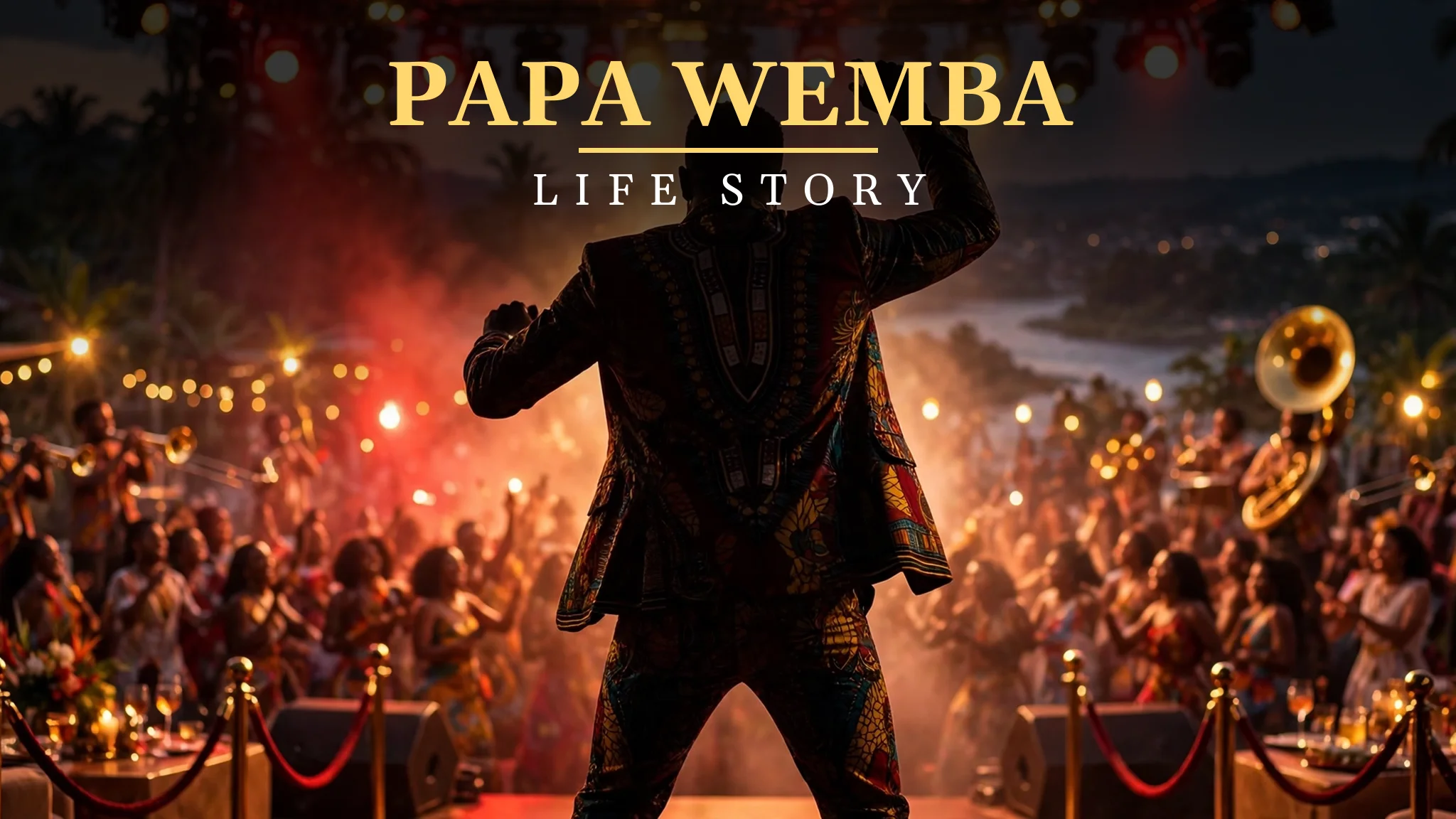
In this post
- Growing Up in Lubumbashi With Music All Around
- Kinshasa, Zaiko Langa Langa, and a New Sound
- Viva La Musica and the King of Rumba Rock
- Sape, Style, and the Fashion of Kinshasa
- Paris, World Music, and Taking Rumba to the World
- Songs, Albums, and a Catalogue That Lasted
- Hard Times, Prison, and a Return to Music
- Death in 2016 and a Legacy That Lives On
- My Take:
Papa Wemba is one of the most loved and most important singers in the history of Congolese music, a man whose voice, whose style, and whose songs shaped rumba for more than forty years. His real name was Jules Shungu Wembadio Pene Kikumba, and he was born in Lubumbashi, in the Democratic Republic of Congo. He was known as the King of Rumba Rock, a title that fits the way he mixed traditional rumba with modern rock, with dance, and with a fashion sense that made him a star far beyond Congo. His music played in Kinshasa, in Paris, in Brussels, and in cities across Africa, and his name is still spoken with love by fans who grew up with his songs.
What makes his story stand out is the length and the depth of his influence. He did not only make hit songs. He founded Zaiko Langa Langa, one of the most famous bands in Congo, and later Viva La Musica, another band that launched many stars. He helped to create the sape movement, the Congolese culture of elegant dress, and he turned fashion into a part of music. He also took Congolese music to the world, performing in Europe and working with international artists, and he showed that a singer from Lubumbashi could be loved on a world stage. He died in 2016, but his music is still played, still danced to, and still loved.
This is the story of a boy from Lubumbashi who loved to sing, who moved to Kinshasa, who founded Zaiko Langa Langa, and who became the King of Rumba Rock.
Growing Up in Lubumbashi With Music All Around
Jules Shungu Wembadio Pene Kikumba was born on 14 June 1949 in Lubumbashi, in the south-east of the Democratic Republic of Congo, near the Zambian border. The city lived off its mines, and its days were set by shifts, wages and the long walk home after work. Yet the same streets that carried miners home at dusk also carried music: Zambian records crossing the border, Kinshasa songs on the radio, and local bands playing at weekend gatherings. A boy in Lubumbashi therefore heard rumba mixed with sounds from outside Congo, and he learned early that music did not belong to one city. For Jules, singing began as part of that evening noise, something ordinary that slowly became the thing he loved most.
Lubumbashi ran on work. Copper mines set the rhythm of the day, and after work the city loosened up with music, dancing and sharp clothes. Jules grew up hearing two kinds of sound at once: the heavy beat of an industrial town and the lighter, faster music drifting in from Zambia and from Kinshasa. School gave his days a shape, but the streets gave them colour. He noticed how a well-dressed man could change the mood of a room simply by walking in, and he noticed how a singer who danced while he sang held eyes longer than one who stood still. Singing and looking the part were not separate things to him. They were one performance, and he practised both whenever a gathering, a party or a street corner gave him an audience.
His break came not from a single lesson but from watching the young bands that were remaking Congolese music. The older rumba was smooth and slow; the new sound was quicker, louder and made for dancing, and Jules felt at home in that energy. He learned by joining in, by singing with others, and by feeling how a crowd answered a fast guitar line or a sudden change in rhythm. Where other young singers copied the old masters note for note, he began to mix what he heard: rumba’s romance, rock’s drive, and the showmanship he had picked up on the streets of Lubumbashi. That mix, part music and part theatre, later became the sound of Zaiko Langa Langa and then of Viva La Musica, and it also became the root of the sape style he made famous.
School and music pulled in different directions, and Papa Wemba chose music. That choice was not easy, because music in Congo at the time did not offer a safe income. A singer had to find a band, pay for recording time, and hope that radio would play the song. Many young people tried and gave up. Papa Wemba did not give up, but he also knew that Lubumbashi alone might not be enough. He needed Kinshasa, the centre of Congolese music, and he needed people who knew how to make records. That search took him to the capital, and it changed his life.
Kinshasa, Zaiko Langa Langa, and a New Sound
Kinshasa in the late 1960s was a different world from Lubumbashi, louder, faster, and full of young people who wanted a sound of their own. The older bands still ruled the dance halls, but their slow rumba felt old to the new generation. Jules arrived as an outsider from the mining south, with no band behind him and no name on a poster, and he had to prove himself in rehearsal rooms and at small shows where nobody owed him a hearing. What he brought was a young voice, a sharp sense of dress, and an instinct for what a dancing crowd wanted. Instead of waiting to be invited into an old band, he began to look for other young musicians who shared his impatience, and that search led him to the group that would change his life.
In 1969 he helped to found Zaiko Langa Langa, one of the most famous and most influential bands in the history of Congolese music. Zaiko was different from the older bands, because it was younger, faster, and more modern, with a sound that mixed rumba with rock and with dance. Papa Wemba was one of its leaders, and he gave the band a voice, a style, and a sense of youth that appealed to a new generation. The band’s songs became hits in Congo, and its concerts drew large crowds of young people who wanted to dance to a new sound.
Zaiko Langa Langa was not only a band. It was a school, a team, and a brand that would shape a whole generation of Congolese singers. Papa Wemba taught young musicians how to sing, how to perform, and how to handle the business of music. Many of those musicians went on to become stars in their own right, and their success is a part of Papa Wemba’s legacy. The band also changed the sound of Congolese music, because it showed that rumba could be young, fast, and modern, and that it could speak to a new generation without losing its roots.
His time in Zaiko gave him a name that people in Congo and in the wider African world began to recognise. He was no longer a young man from Lubumbashi who liked to sing. He was a leader of the most exciting young band in the country, and he was on his way to becoming a star. That experience gave him the confidence and the skills he needed to take the next step, which was to build his own band and to try his luck as a leader in his own right.
Viva La Musica and the King of Rumba Rock
In 1977 Papa Wemba founded his own band, Viva La Musica, and that founding was one of the most important moments in his career. Viva La Musica was built around his own songs, his own style, and his own vision of rumba, and it gave him a home for his music that did not depend on another band. The band’s sound was smooth, romantic, and danceable, with beautiful guitar work and with vocals that told stories of love. Papa Wemba was the leader, the main singer, and the main songwriter, but he also gave space to other singers in the band, and he taught them how to sing, how to perform, and how to handle the business of music.
Viva La Musica travelled further than most Congolese bands of its time, playing to Congolese audiences at home and to mixed crowds in Paris, Brussels and other European cities. On stage, Papa Wemba treated a concert as a long conversation with the room: he would slow a song down so the crowd could sing the chorus back to him, then lift the tempo and let the guitars and dancers take over. Night after night he learned the small skills of a bandleader, when to speak, when to step back and let a guitarist shine, and how to end a set so that people left humming. Those nights built the band’s name far more than any single record did, and they kept Viva La Musica working for years.
The records Viva La Musica made in those years added up to a catalogue that fans still return to. Papa Wemba wrote slowly, keeping a song until its words and its melody both felt right, and he preferred a record that would still sound good in ten years to one that chased the fashion of a single season. Some of those albums mixed rumba with pop and world music, yet the voice at the centre stayed recognisably his. Young singers in Kinshasa still study those records, not to copy them, but to learn how a love song can be both simple and lasting.
The title King of Rumba Rock fits Papa Wemba well, because he mixed rumba with rock in a way that felt natural and modern. He did not abandon rumba. He added to it, with faster beats, with electric guitars, and with a stage presence that was more like a rock star than a traditional rumba singer. That mix helped his music to reach young listeners, and it helped Congolese music to stay fresh in a world that was changing fast.
Sape, Style, and the Fashion of Kinshasa
Papa Wemba is known not only for his voice but also for his style, and that style is a central part of his image. He was one of the leaders of sape, the Congolese culture of elegant dress, which has been a part of Kinshasa life for decades. Sape is about wearing beautiful clothes, about presenting yourself with pride, and about turning fashion into a form of art. Papa Wemba carried that tradition with pride, and he showed it in his videos, in his concerts, and in his public appearances. He dressed in elegant suits, in bright colours, and with a confident look that matched his title as a king of music.
The name Papa said as much about his manner as about his clothes. On stage he rarely rushed. He walked in slowly, greeted the crowd as if they were guests in his house, and sang the first lines in a low, easy voice that made the room go quiet. That ease was deliberate: it told the audience that he did not need to prove anything, and it made younger singers in the band look up to him as an elder rather than only as a boss. Fans took up the name because it fitted, a singer who led like a father leads a family, with pride, with warmth, and with the expectation that everyone around him would dress and perform to the same high standard.
He also took sape to Paris, where he lived for many years and where he became a well known figure in the Congolese community and in the wider French music world. In Paris he dressed well, he performed in elegant venues, and he showed French audiences that Congolese music was not only about sound. It was also about style, about dance, and about a culture that deserved to be seen and respected. That work helped Congolese music to travel, and it helped Papa Wemba to become a star in Europe as well as in Africa.
In Paris, where he lived for many years, that same style opened doors that music alone might not have opened. French audiences who had never heard a rumba song could still read the message of a beautifully cut suit, and Congolese fans in Paris saw in his dress a piece of home carried with pride. He never treated elegance as a costume for the stage. It was the same off stage as on it, and that consistency is why sape became attached to his name rather than only to his concerts. Through clothes, as through song, he showed that a man from Lubumbashi could stand in Paris without giving up who he was.
Paris, World Music, and Taking Rumba to the World
In the 1980s and 1990s Papa Wemba spent much of his time in Paris, where he became a central figure in the world music scene. Paris was home to a large Congolese community, and it was also a city where African music was heard by French audiences, by record companies, and by festival organisers. Papa Wemba performed in Paris, he recorded albums there, and he worked with international artists who wanted to learn from Congolese rumba. That work helped his music to travel beyond Africa, and it gave him a profile that few Congolese singers had achieved.
He worked with the British musician Peter Gabriel, among others, and his music was featured in films and in festivals that introduced African music to new audiences. Those collaborations were important, because they showed that Congolese rumba could live alongside other world music styles, and that a singer from Lubumbashi could be loved by listeners who had never been to Congo. Papa Wemba did not treat those collaborations as a favour. He treated them as a partnership, and he brought his own sound, his own language, and his own fans to the table.
His albums in Paris, including work that mixed rumba with pop and with world music, were widely discussed, and they gave his fans a collection of songs that they could play again and again. He did not abandon rumba when he moved to Paris. He added to it, with new instruments, with new producers, and with a wider view of the world. That openness helped his music to stay fresh, and it helped Congolese music to grow in a new direction.
He also performed at large festivals in Europe, where his shows drew crowds of African and European fans who loved his voice and his style. A Papa Wemba concert in Paris was not only a show for Congolese people living abroad. It was also a show for French fans who had discovered his music, and for anyone who loved rumba and dance. That travel was important, because it showed that Congolese music could fill venues far from Kinshasa, and that Papa Wemba was a star who could lead that travel.
Songs, Albums, and a Catalogue That Lasted
What kept Papa Wemba’s catalogue alive was its variety. A single year could bring a tender love song, a fast track made for the dance floor, and a proud song about Kinshasa life, and listeners recognised the same voice in all three. He never let one mood define him. If a song needed softness he sang it softly; if it needed energy he pushed his voice harder and let the band drive the rhythm. That freedom to move between moods is why his records never sound dated in one narrow way, and why radio in Congo still reaches for them decades later.
His song Analengo became one of his signature works, a track that fans still ask for at concerts and that is still played on radio in Congo. The song was catchy, romantic, and easy to sing along to, and it helped to define the smooth rumba style that Papa Wemba became known for. When people talk about his best work, Analengo is almost always one of the first songs they mention. It showed his ability to make a song that was both traditional and modern, both romantic and danceable.
He also released many other popular songs, and he worked with other artists, both inside Congo and outside it. Those collaborations helped his music to travel to new audiences, and they showed that he could adapt his voice to different beats without losing his own style. He learned how to write a chorus that worked in different styles, and how to make a song that sounded fresh even when the formula was familiar. That learning was important, because African pop was changing fast, and a singer who could not adapt would quickly be left behind.
His albums gave fans a chance to hear him in different moods, and they gave radio stations more songs to play. They also showed that he was thinking about his career in the long term, not only about the next hit. An album is a bigger test than a single song, because it asks a singer to hold a listener’s attention for many tracks, and Papa Wemba passed that test again and again. His catalogue is a treasure for Congolese music, and it is still studied by young singers who want to learn how to write a good song.
Hard Times, Prison, and a Return to Music
Papa Wemba’s life was not only about success. He also faced hard times, including a period in prison in France in the early 2000s, in a case that was widely reported in the press. That period was a difficult time for him and for his fans, because it took him away from music and from the stage, and it raised questions about his future. He served his time, and he returned to music with a determination to sing again. That return showed a resilience that his fans admired, because it is not easy to come back after a public fall.
He also faced other hard moments, including health problems and the pressure of a long career in the public eye. A singer who performs for decades will face many challenges, from money problems to family problems to the simple tiredness that comes with travel and with late nights. Papa Wemba faced those challenges, and he kept working, which showed a professionalism that his fans noticed. He did not let hard times stop his career, and he did not use them as a reason to seek sympathy in public.
His return to music after prison was an important moment, because it showed that his fans had not forgotten him, and that his songs still meant something to them. He performed again in Congo and in Europe, and his concerts drew large crowds who wanted to hear the King of Rumba Rock sing again. That loyalty is a valuable thing for a singer, because it means his audience will follow him through hard times, and that is a sign of a real star.
Through all of this, his family and his band remained an important part of his life, and he continued to work with young musicians in Viva La Musica. He taught them, he performed with them, and he tried to pass on what he had learned. That teaching role became even more important in his later years, because he knew that his time on stage would not last forever, and he wanted to leave something behind for the next generation.
Death in 2016 and a Legacy That Lives On
Papa Wemba died on 24 April 2016 in Abidjan, in Ivory Coast, at the age of 66. His death was a shock to fans across Africa and Europe, because he had been performing for decades and because his music was still loved by millions. He died while he was still active, still singing, and still leading his band, and that fact made his death feel even more sudden. I will not describe the details of his final moments, because they do not need to be repeated here, and because his life deserves to be remembered for his music, not for the manner of his death.
His funeral and the tributes that followed showed how much he meant to Congolese music and to African music as a whole. Fans in Kinshasa, in Paris, and in many other cities mourned him, and singers from across Africa spoke about his influence on their own work. He was remembered as a king, as a father figure, and as a teacher, and those titles tell the story of his life better than any single song. He was not only a singer. He was a leader, a founder, and a man who changed the sound of a whole country.
His legacy is not only in his songs. It is in the bands he founded, in the singers he taught, in the sape movement he helped to lead, and in the way he took Congolese rumba to the world. Zaiko Langa Langa and Viva La Musica both shaped Congolese music, and both are still remembered as schools for young singers. His songs are still played at weddings, in clubs, and on radio, and his style is still copied by young artists who want to dress well and sing well.
Today Papa Wemba stands as one of the greatest singers in African music history, a man who rose from Lubumbashi to become a king of rumba. His story is about talent, about learning, about building bands, and about taking music to the world. He died in 2016, but his music lives on, and his place in Congolese music history is secure. His songs will be played for many years, and his name will be spoken with love by fans who grew up with his voice.
My Take:
I think Papa Wemba is one of the greatest singers Africa has ever produced, and I mean greatest in the sense that he changed the music itself, not only in the sense that he made hit songs. When I listen to his songs, I hear a voice that is smooth, warm, and confident, and I hear a melody that feels both old and new at the same time. That mix is rare, and it is the heart of his success.
What I admire most is his work as a founder. He did not only make his own songs. He founded Zaiko Langa Langa, and he founded Viva La Musica, and both bands became schools for a whole generation of Congolese singers. That founding is a bigger achievement than any single hit, because it created many stars. I think that is the part of his legacy that will last longest.
I also admire his song Analengo, because it is a song that people will remember for a long time. It is romantic, it is beautiful, and it speaks to listeners in a direct and honest way. It played on radio, at weddings, and in homes across Africa, and it became part of people’s lives. That is a real achievement, and it is one that I value more than any award.
I think his work in Paris deserves special praise, because it showed that Congolese music could travel to the world. He performed in France, he worked with international artists, and he showed French audiences that rumba from Kinshasa was world-class music. That work helped African music to be heard in new places, and I think that is an important part of his story.
I also think about his roots in Lubumbashi, and about what it means for a boy from a mining city to become a star in Kinshasa and in Paris. That journey is long, and it is hard, and it gives hope to young people in small towns across Congo. Papa Wemba shows them that talent can come from anywhere.
At the same time, I am honest about the parts of his story that trouble me. His time in prison was a difficult period, and it divided his fans. I think it is important to be honest about that period, because a reader who only hears praise will not understand the full story. He was a talented singer, and he was also a man who made mistakes, like many stars who have lived a long and public life.
I also think about the pressure that comes with being a king of rumba. When you are Papa Wemba, every song has to be a hit, every show has to be full, and every choice is watched by millions of people. That pressure must be exhausting, and I think it explains some of the mistakes and the public arguments. I do not think fame makes a person perfect.
There is a lesson in his Zaiko years that I think young people should hear. He did not wait for success to come to him. He built his own band, he wrote his own songs, and he worked hard to earn his place. That is a brave choice for a young man with little money. It is also a smart choice, because if you want to be good at something, you should build your own team.
I also respect the way he built Viva La Musica, because building a band is much harder than singing a song. He had to find musicians, he had to teach them, and he had to keep them together for decades. He did that, and he built a brand that people recognised. That work was not always smooth, but the fact that he tried is important.
I have mixed feelings about his public image as a king of style, because I understand that a pop star needs a strong image, and I understand that young fans love to see success. But I also think that image can make success look too easy, as if it comes from wearing the right clothes rather than from working for years in a studio. I wish he talked more often about the hard years.
What I take from his story, in the end, is that a long career in music is built on talent, on hard work, and on a willingness to teach others. Papa Wemba had a voice that people loved, he had the patience to build bands, and he had the courage to lead them for decades. Those three things together made him a legend.
I also think about the way his music travels across Africa and Europe, and about how a song from Kinshasa can play in Paris, in Brussels, and in other cities on the same day. That travel is a sign of a song that has crossed borders, and it shows that Papa Wemba’s music is not only for one city. It is for the whole world.
Another thought that stays with me is about the young singers who copy his style today, and about what they learn when they try to sing like Papa Wemba. They soon discover that a smooth voice is not only about hitting the right notes, but also about feeling, about timing, and about making a love song sound honest.
I also think about his live shows, and about the energy he brought to a stage, because a singer who can make a large crowd dance and sing along has a gift that goes beyond a good voice. He had that gift, and he used it to make his concerts feel like a celebration. I wish I could have seen one of those shows.
I think about his family, and about the balance he tried to keep between a loud public life and a private home life. That balance is hard for any famous person, and it is harder when the public life includes controversy and criticism. I hope his children see the hard work behind the fame.
I also think about the future of Congolese rumba, and about the place Papa Wemba will hold in it when the next generation looks back. I believe they will see him as a singer who kept rumba alive, who built schools for many stars, and who took it to new audiences across the world.
Finally, I think his story is a reminder that a career is not a straight line. It goes up and down, it takes unexpected turns, and it asks a person to keep learning and keep changing. Papa Wemba went from Lubumbashi to Kinshasa, from Zaiko to Viva La Musica, and he kept changing. I respect that change.
I will keep listening to his music with respect, because I believe that a singer who can mix rumba and rock, who can sing in Lingala and be loved across the world, and who can inspire young singers in Congo, is a singer worth remembering. His story is finished, but his music is not, and I think that is the best legacy a singer can leave.
I also think about the way his songs sound at a wedding in Kinshasa, with friends and family dancing and singing along. A song that plays at a wedding becomes part of a family’s memory, and that is a real achievement for any singer. Papa Wemba made many songs like that.
I think about the young boy in Lubumbashi who is listening to Papa Wemba today, and about what that boy sees when he looks at the star. He sees a man who came from a place like his own, who spoke his language, and who became famous across Africa and Europe. That picture can change a life.
I also think about the business side of his career, and about how important it is for a young star to own his work and to understand his contracts. Papa Wemba learned that side of music through Zaiko and through Viva La Musica, and I hope young singers learn it from his example.
Finally, I think Papa Wemba’s story shows that talent, hard work, and teaching can take a person very far. He had a voice that people loved, he had the patience to build bands, and he had the courage to lead them for decades. Those things together made him a king, and I think they will keep him a king.
I also think about the way his songs sound in a car on a long road in Congo, with the windows down and the chorus playing loud, because that is where many of his songs are truly heard. A song that sounds good on a long road, with friends singing along, has a quality that a studio alone cannot create.
I think about the way he learned to write a chorus, because a good chorus is not easy to write. It has to be simple enough to remember after one listen, and it has to be strong enough to carry a whole song. Papa Wemba wrote many choruses like that, and I think that skill is the heart of his success.
I also think about the young artists who look up to Papa Wemba, and about what they learn from working with his music. They learn how to record, how to perform, and how to handle fame, and they learn it from a man who lived through all of those things himself.
I think about his fashion and his image, and about how a pop star’s clothes can tell a story about success and pride. Papa Wemba dressed in an elegant and modern way, and his fans saw that as a sign of a man who had come from Lubumbashi to the top. I understand that image, but I also hope young fans see the work behind it.
I also think about the way his songs have been used at celebrations across Congo, at weddings, at birthdays, and at festivals where people dance for hours. A song that plays at a celebration becomes part of a family’s memory, and that is a real achievement for any singer.
Finally, I think Papa Wemba’s story shows that a boy from Lubumbashi can become a king of music, not by waiting for permission, but by singing with elegance, by working hard, and by teaching others. That is a lesson I want young people in Congo to remember.
I also think about the way his music has been passed down in families, from parents to children, because a song that a father played at home becomes a song that his son plays for his own children. Papa Wemba’s songs have that kind of life, and I think that is the truest test of a singer. A hit can fade in a year, but a family song can last for generations.
I think about the way he handled the departure of his students from his bands, because a teacher who loses his best students must feel both pride and pain. He taught them well, and they left to become stars, and that is both a success and a loss. I think Papa Wemba felt both, and I respect the way he kept building after they left.
I also think about the future of Viva La Musica, and about whether the band will continue to teach young singers after Papa Wemba. A band that has lasted for decades is a rare thing in African music, and I hope it keeps going, because Congo needs a school like that for its next generation.
I think about his time in Paris, and about what it meant for Congolese music at a time when African music was not always recognised in the wider world. When Papa Wemba performed in Paris, it told the world that rumba from Kinshasa was world-class music, and that it deserved to be heard alongside any other style.
I also think about the way his songs sound in Paris, where many Congolese people live far from home. A song from Kinshasa can make a person in Paris feel close to home again, because the melody carries the sound of the city, and the words carry the warmth of family. Papa Wemba’s music does that for many people, and I think that is a valuable gift.
Finally, I think Papa Wemba’s story shows that a singer can be both a star and a teacher, both a king and a student, and both a legend and a flawed man. Those contradictions do not make his story weaker. They make it more honest, and more human, and that is why I will keep listening to his music with both respect and honesty.
Frequently Asked Questions
Where was Papa Wemba born and what is his real name?
Papa Wemba was born Jules Shungu Wembadio Pene Kikumba on 14 June 1949 in Lubumbashi, in the Democratic Republic of Congo. He later moved to Kinshasa, where he built his career in Congolese rumba.
How did Papa Wemba become famous in Congo?
He became famous by helping to found Zaiko Langa Langa in 1969, one of the most influential bands in Congolese music. He later founded Viva La Musica in 1977, and both bands made him a star across Africa.
What is Analengo in Papa Wemba’s career?
Analengo is one of Papa Wemba’s signature songs, with a catchy and romantic melody that fans still ask for at concerts. It shows the smooth rumba style that he became known for in Congo and beyond.
What is sape and how is Papa Wemba linked to it?
Sape is the Congolese culture of elegant dress, and Papa Wemba was one of its leaders. He dressed in elegant suits and showed that fashion was a central part of Congolese music and identity.
When did Papa Wemba die?
Papa Wemba died on 24 April 2016 in Abidjan, Ivory Coast, at the age of 66. His death was widely mourned in Congo and across Africa, and his music is still played and loved today.
What is Viva La Musica?
Viva La Musica is the band Papa Wemba founded in 1977, and it became one of the most famous bands in African music. It launched many singers and helped to shape Congolese rumba for decades.


