Park Hae-il: The Life Story Behind Korea's Quiet Star
In this post
- A Seoul Childhood and the Theatre
- Waikiki Brothers and the First Film Steps
- The Host, Memories, and Working with Bong Joon-ho
- Eungyo, Moss, and the Difficult Roles
- The Fortress, The King’s Case Note, and the Historical Films
- Decision to Leave and the Cannes Triumph
- The Quiet Master and His Place in Korean Cinema
- The Actor Directors Trust and the Craft of Stillness
- My Take:
Park Hae-il is one of the quietest stars in Korean cinema, and that quietness is his power. He does not shout, he does not show off, and he does not try to be the most handsome man in the room. He simply becomes the character, so completely that you forget you are watching an actor, and you start to believe that the tired detective, the lonely poet, or the gentle husband on the screen is a real person. For more than twenty years he has been the actor directors call when a film needs truth, and audiences have learned to trust him in a way they trust very few stars.
He began in theatre, like many of Korea’s best actors, and he made his film debut in the early 2000s. Within a few years he was working with Bong Joon-ho, one of the greatest directors in the world, in Memories of Murder and The Host, two films that changed Korean cinema forever. He went on to play a schoolgirl’s lover in Eungyo, a king’s servant in The Fortress, and a detective falling in love with a murder suspect in Decision to Leave, a film that won the Best Director prize at Cannes. In each role he was different, and in each role he was completely believable.
This is the story of a patient, serious actor who built his career on listening, on watching, and on telling the truth. It is a story about theatre, about working with great directors, about choosing difficult roles, and about the quiet strength of a man who lets his work speak for him.
A Seoul Childhood and the Theatre
Park Hae-il was born on 26 January 1977 in Seoul, South Korea. He grew up in the capital, in an ordinary family, and there was nothing in his childhood that pointed clearly toward fame. He was a thoughtful boy, and he liked to watch people, to listen, and to imagine their lives. That habit of watching would become the foundation of his acting, because an actor who watches well can play anyone.
As a young man, he fell in love with theatre. He joined a theatre company, and he spent his early adult years on stage, learning the hardest lessons an actor can learn. In theatre, you must be heard by the back row, you must remember your lines, and you must keep going when something goes wrong. There is no second take, and there is no editing to save you. Park learned those lessons, and they gave him a discipline and a presence that screen actors who never do theatre often lack.
He was not a young man in a hurry. He knew that acting was a craft, and that a craft takes time. He worked in small productions, he played many kinds of characters, and he learned how to work as part of a team. Theatre taught him that the play matters more than the actor, and that an actor’s job is to serve the story, not to show off. That lesson stayed with him for his whole career, and it is one reason directors love working with him.
He also learned patience. Theatre in Korea does not pay well, and it does not make a person famous, but it makes a person good. Park became good in those years, and when film finally came to him, he was ready. He had the voice, the body, and the understanding of character that only years on stage can give.
Waikiki Brothers and the First Film Steps
Park Hae-il made his film debut in 2001, in Waikiki Brothers, a film about a struggling band that returns to its hometown. He played a young man in the band, and the film was praised for its warmth and its realism. It was not a big commercial hit, but it was a respected film, and it showed that Park could play a real, ordinary person with honesty. He was not trying to be a star. He was trying to be true, and that truth was noticed.
He took other small film roles in the early 2000s, and he learned how different film acting is from theatre. On film, the camera is close, and a small movement can say more than a loud speech. Park learned to be still, to trust the camera, and to let his face do the work. He was building a screen presence that was quiet but strong, and directors began to notice it.
In 2003, he appeared in Memories of Murder, directed by Bong Joon-ho, a film about the hunt for a serial killer in a small Korean town in the 1980s. Park played a young detective, a man who is earnest and out of his depth, and his performance was praised. The film became a classic of Korean cinema, and it is still regarded as one of the finest crime films ever made in Korea. For Park, it was a turning point, because it put him in a great film with a great director, and it showed the world what he could do.
He had not become a star overnight, but he had become a trusted actor, and trusted actors get called back. Bong Joon-ho called him back, and other directors began to call him too. He was on his way, slowly and steadily, the way he does everything.
The Host, Memories, and Working with Bong Joon-ho
In 2006, Park Hae-il appeared in The Host, another film by Bong Joon-ho, about a monster that comes out of the Han River in Seoul and takes a young girl. Park played a member of the girl’s family, a man who is unemployed, funny, and deeply loyal, and his performance gave the film its heart. The Host became the biggest Korean film of its time, breaking box-office records, and it introduced Korean cinema to audiences around the world. Park was part of that success, not as a hero, but as a real person in a fantastic story.
Working with Bong Joon-ho taught Park a great deal. Bong is a director who cares about detail, about class, about family, and about the way ordinary people behave in extraordinary situations. Park learned to play those ordinary people with care, to find the humour in a sad scene, and to find the sadness in a funny one. That balance, between humour and pain, became a hallmark of his acting, and it is one reason his performances feel so human.
He continued to work in films in the late 2000s, taking on roles that were different from each other. He played a man who believes he is Superman in A Man Who Was Superman in 2008, a gentle and strange character who brings hope to the people around him. The role was unusual, and it showed that Park could be whimsical as well as serious. He did not want to be typecast as a detective or a tired husband. He wanted to play many kinds of men, and he did.
By the end of the decade, he was one of Korea’s most respected film actors, known for his quiet intensity and his reliability. He was not a celebrity in the loud sense, but he was a name that film lovers trusted, and that trust was worth more than fame.
Eungyo, Moss, and the Difficult Roles
In 2010, Park Hae-il starred in Moss, a thriller about a man who returns to a village to find out how his father died, and his performance was praised for its darkness and its control. The film was based on a popular web comic, and it showed that Park could carry a mystery, holding the audience’s attention through a slow and tense story. He played a man who is searching for the truth, and who finds that the truth is more painful than he expected.
In 2012, he starred in Eungyo, a film about an old poet who falls in love with a seventeen-year-old girl, and about a young man who is caught between them. Park played the young man, a writer who admires the poet and is jealous of him, and his performance was complex and brave. The film dealt with love, art, and jealousy in a way that was uncomfortable and honest, and it won Park wide praise. It was a role that many actors would have avoided, because it was morally difficult, but Park took it, and he played it without judgement.
Those films showed his willingness to take on difficult, adult stories, and to play men who are not heroes. He played men who are jealous, who are lost, who make bad choices, and who must live with those choices. That honesty made his work stand out, because it refused to make life simple. He understood that real people are complicated, and he played them that way.
He also continued to work in theatre when he could, because theatre was his home and because it kept his skills sharp. A screen actor who stops doing theatre can lose the habit of listening, and Park never lost it. He listened, he watched, and he waited for the right moment to speak, and that waiting made his performances feel real.
The Fortress, The King’s Case Note, and the Historical Films
In 2017, Park Hae-il starred in The Fortress, a historical film about a Korean king who must decide whether to surrender to an invading army. Park played a minister who argues for resistance, a man of principle in a time of fear, and his performance was praised for its dignity and its passion. The film was a major production, and it showed that Park could hold his own in a large historical story, alongside some of Korea’s finest actors.
He also appeared in lighter films, showing his comic side, and he continued to move between genres with ease. He did not care whether a film was big or small, historical or modern, funny or sad. He cared whether the character was true, and whether the story was worth telling. That attitude kept his career fresh, and it meant that audiences never knew what he would do next, only that he would do it well.
In those years, he also became a mentor figure for younger actors, a man who had built a long career on craft rather than on fame, and who could show others how to do the same. He spoke rarely in interviews, and when he did, he spoke about acting, not about himself. He was a private man, and his privacy gave his work a kind of mystery. When you watched him, you saw the character, not the celebrity, and that is as it should be.
By the end of the 2010s, he was firmly one of Korea’s most respected actors, a man whose name on a poster promised quality. He had worked with the best directors, he had played the hardest roles, and he had done it all without noise. He was ready for the role that would bring him to the widest audience of his life.
Decision to Leave and the Cannes Triumph
In 2022, Park Hae-il starred in Decision to Leave, directed by Park Chan-wook, one of Korea’s greatest directors. He played Hae-joon, a detective investigating the death of a man who fell from a mountain, and who falls in love with the dead man’s wife, a woman who may or may not be a murderer. The film is a romantic thriller, slow, beautiful, and deeply sad, and Park’s performance is at its centre.
He played Hae-joon as a man who is tired, honest, and lonely, a man who suffers from insomnia and who cannot stop thinking about his cases. When he meets the widow, played by Tang Wei, he finds a person who understands his loneliness, and the two of them begin a relationship that is tender and dangerous. Park played that relationship with great restraint, letting a look, a pause, or a small gesture carry the emotion. The film was shown at the Cannes Film Festival, where Park Chan-wook won the Best Director prize, and it was praised around the world.
Decision to Leave introduced Park Hae-il to a new global audience, and it showed that his quiet style could carry a large, international film. He was not the loudest actor in the film. He was the stillest, and that stillness made the film work. Critics praised his performance, and many called it one of the finest of his career. He was forty-five, and he was doing the best work of his life.
The film also showed his gift for playing love in a mature way. Hae-joon is not a young man falling in love for the first time. He is a married man, a tired man, who finds a connection he did not expect, and who must decide what to do with it. Park played that dilemma with honesty, without making his character into a hero or a villain. He played him as a person, and that is why the film stays with you.
The Quiet Master and His Place in Korean Cinema
Park Hae-il has never been a loud celebrity. He does not give many interviews, he does not share his private life, and he does not chase attention. He lets his films speak for him, and his films speak quietly but clearly. That quietness is his signature, and it is also his strength. In a film world full of noise, a quiet actor stands out, because the audience must lean in to hear him, and leaning in makes them pay attention.
His career tells a larger story about Korean cinema. When he started, Korean films were growing, but they were still mostly watched at home. Today they are watched around the world, and Park has been part of that rise, from Memories of Murder to The Host to Decision to Leave. He has worked with the directors who made that rise possible, and he has helped them tell stories that the world wanted to hear. He did not do it by being loud. He did it by being true.
He is also a reminder that a career can be built slowly, and that slow building can lead to a stronger result. He did not become a star in one night. He became an actor over twenty years, role by role, film by film, and the result is a body of work that few actors can match. Young actors who want a quick career should look at Park Hae-il and learn patience. Patience is not a weakness. It is a strategy, and it works.
Today, Park Hae-il remains one of Korea’s most respected actors. He continues to choose films carefully, and he continues to work with the best directors. He is still growing, and his best work may still be ahead of him. What is certain is that his story so far is a story of quiet strength, of careful choices, and of a man who learned that the most powerful thing an actor can do is to listen, and to tell the truth.
The Actor Directors Trust and the Craft of Stillness
One of the most interesting things about Park Hae-il is how often the greatest directors in Korea have chosen him, and that story deserves to be told in full, because it explains his place in Korean cinema better than any award list can. He has worked with Bong Joon-ho in Memories of Murder and The Host, with Park Chan-wook in Decision to Leave, and with many other directors who are known for being demanding, precise, and unwilling to accept anything less than the truth. Those directors do not choose an actor by accident. They choose him because they trust him, and trust, in film, is earned over years of good work. Park earned it by being prepared, by being honest, and by being willing to do the hard, quiet work that makes a film good.
His craft is built on stillness, and stillness is one of the hardest things to do well on screen. Most actors, when they are nervous, move too much, speak too loudly, or try too hard to show emotion. Park does the opposite. He is still, he waits, and he lets the emotion come to him, rather than chasing it. When you watch him in Decision to Leave, you can see that stillness at work. He sits in a room, he looks at a photograph, he listens to a woman speak, and he does almost nothing, and yet the scene is full of feeling, because the audience can see him thinking. That thinking is visible in his eyes, in the small movements of his face, and in the way his breathing changes, and it is more powerful than any loud performance could be.
He has also learned to work with the camera as a partner, not as an enemy. On film, the camera is close, and it sees everything, including the things an actor would rather hide. A nervous actor tries to hide from the camera, to turn away, or to overact. Park does not hide. He lets the camera come close, he lets it see his tiredness, his sadness, and his doubt, and that openness makes his performances feel intimate, as if the audience is sitting in the room with him. That intimacy is rare, and it is one reason his films feel so personal, even when they are about large subjects like murder, monsters, or history.
His preparation for a role is also worth describing, because it shows how seriously he takes his work. He reads the script many times, he thinks about the character’s past, about what the character wants and what he fears, and he talks with the director about the smallest details. He does not arrive on set with a fixed idea and refuse to change it. He arrives with an understanding, and he is willing to let that understanding grow as he works with other actors, with the camera, and with the location. That flexibility is a mark of a mature actor, and it is one reason directors want to work with him again, because they know that he will make the film better, not only his own part.
Finally, it is worth saying that his stillness is not emptiness. It is fullness, held quietly. A still actor is not an actor who is doing nothing. He is an actor who is doing everything inside, and who trusts the audience to see it. That trust is a form of respect, and it is one reason Park Hae-il’s performances stay with viewers long after the film ends. He does not tell you what to feel. He lets you feel it for yourself, and that is the highest compliment an actor can pay to an audience.
My Take:
I think Park Hae-il is the kind of actor who teaches you that quietness is a form of strength, and I have thought about that a lot while writing his story. When I watch him, I do not see a man trying to impress me. I see a man trying to understand the person he is playing, and that understanding makes me trust him. In Decision to Leave, he plays a detective who cannot sleep, who is tired and lonely, and who falls in love with a woman he should not love. He does not play that love loudly. He plays it in small moments, in the way he looks at her, in the way he pauses before he speaks, and in the way he keeps coming back even when he knows he should stop. I found that deeply moving, because that is how real love often works. It is not a shout. It is a quiet return, again and again, to a person who matters.
I also admire his theatre roots, because I believe they are the reason his acting feels so solid. In theatre, you cannot hide behind a camera or an edit. You must be present, you must listen, and you must earn the audience’s attention. Park learned that, and he carried it into film, where many actors forget to listen. When I watch him in Memories of Murder, I see a young detective who is listening to a suspect, to a colleague, to the silence of a small town, and that listening makes the scene work. I wish more people in life learned to listen like that. Listening is a small thing, but it changes everything, and Park Hae-il is a master of it.
What moves me most about his career is the patience of it. He did not become a star young. He worked in theatre, he took small roles, he played supporting parts in great films, and he waited for the roles that would let him show what he could do. That patience is a lesson for anyone who feels that they are behind, or that their time has passed. Park’s time did not pass. It came slowly, and it came in the form of better and better work, until, at forty-five, he gave one of the finest performances of his career in Decision to Leave. I think that is a beautiful thing. It says that your best work may not be behind you. It may still be ahead of you, if you keep working and keep learning.
I think about Eungyo a great deal, because it is a difficult film, and Park’s performance in it is difficult too. He plays a young writer who is jealous of an old poet, who loves a young girl, and who makes choices that hurt everyone. It would be easy to play such a man as a villain, or as a fool, but Park plays him as a person, a person who is talented and afraid, and who does not know how to handle his own feelings. I respect that honesty. It is easy to judge a character from the outside. It is harder to play him from the inside, to show why he does what he does, without excusing him. Park does that, and the film is stronger because of it.
I also want to say something about his work with Bong Joon-ho, because I think those films changed Korean cinema, and Park was part of that change. Memories of Murder is not only a crime film. It is a film about a country that was changing, about police who did not know how to solve a crime, and about the sadness of a small town. The Host is not only a monster film. It is a film about a family that is poor and funny and loyal, and about a government that fails them. Park played real people in both films, and those real people made the fantastic stories feel true. That is a gift, and it is one reason Bong called him back. A director needs actors he can trust to be real, even when the story is strange, and Park is that actor.
There is a lesson here about fame, too. Park Hae-il is famous, but he is not a celebrity in the loud sense. He does not share his private life, he does not chase headlines, and he does not use his fame to sell himself. I respect that deeply. In a world where everyone is expected to be visible all the time, his privacy feels like a form of dignity. It says that the work is enough, and that a person does not need to turn his life into content to matter. I think that dignity has helped his acting, because when you do not know too much about the actor, you can believe him more easily as a character.
If I could ask him one question, I would ask him what he learned in theatre that film never taught him. I suspect he would talk about listening, about presence, and about the feeling of a live audience breathing with you. I think that answer would tell us a lot about why his screen work feels so alive. He is not acting for a camera. He is acting for people, and the camera happens to be there. That is a small difference, but I think it is the difference between a star and an actor, and Park Hae-il is an actor.
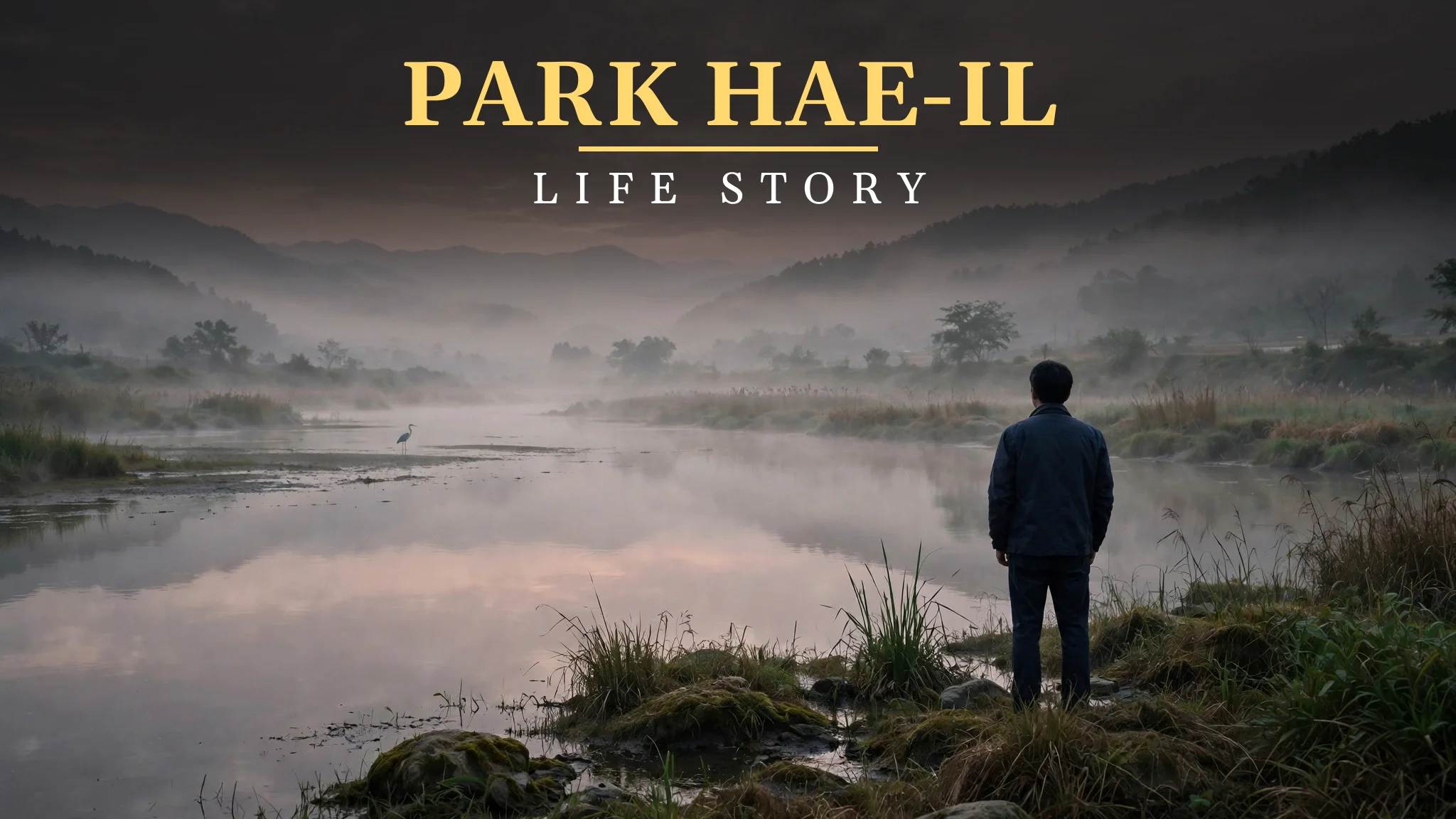
In the end, I come back to the image of him standing by a misty river at dawn, a man alone, looking at the water and the hills. That image fits him, because his career has been a quiet walk by the water: slow, steady, and beautiful in a way that does not shout. He has not chased the loudest roles or the biggest headlines. He has walked quietly, and he has arrived at a place of great respect. I hope he keeps walking, and I hope his next films are as honest as the ones that came before. I think Korean cinema is better because he is in it, and I think anyone who values quiet, honest work will find a friend in his films.
One last thought stays with me. Park Hae-il’s story shows that you do not need to be loud to be heard. You need to be true, and you need to be patient, and you need to listen. If you do those three things, people will lean in to hear you, and what you say will matter more than if you had shouted it. That is a lesson for actors, and it is a lesson for all of us. Be quiet, be true, and be patient, and the work will speak for you.
I also keep thinking about his stillness, because it is such a rare and beautiful quality, and because it is one that I wish more people had. When Park Hae-il is still on screen, he is not empty. He is full, and he is thinking, and the audience can see that thinking in his eyes. I think that is a lesson for all of us. We live in a world that tells us to move, to speak, and to perform all the time, and we forget that stillness can be powerful. Sometimes the most important thing you can do is to be still, to listen, and to think, and Park shows us how to do that, film after film, with grace and with honesty.
There is another thought that stays with me, about the directors who trust him. Bong Joon-ho, Park Chan-wook, and many others have chosen him again and again, and that trust is not given lightly. It is earned, over years of good work, and it is the truest measure of an actor’s worth. An award can be won in a single year. Trust is built over a lifetime, and Park has built it. I think that should give hope to anyone who feels that their work is not being recognised. Keep working, keep being honest, and the people who matter will notice, even if it takes time. Park Hae-il proves it.
I also think about the way he plays love, because it is so different from the love we usually see on screen. In Decision to Leave, he plays a man who falls in love slowly, quietly, and dangerously, and he does it without a single grand gesture. He looks, he listens, he returns, and that returning is the love. I find that deeply moving, because that is how real love often works. It is not a shout. It is a quiet return, again and again, to a person who matters. I believe that performance has helped many viewers understand their own loves a little better, and that is a real thing that art can do.
If I could watch only one of his performances again, it would be Decision to Leave, because it is the film in which his stillness is clearest, and in which his honesty is deepest. I would watch it and be reminded that the most powerful thing an actor can do is to listen, and to tell the truth. That is a simple lesson, and it is one that I will not forget.
I also keep thinking about his work with Bong Joon-ho, because those films changed Korean cinema, and Park was part of that change. Memories of Murder is not only a crime film. It is a film about a country that was changing, about police who did not know how to solve a crime, and about the sadness of a small town. The Host is not only a monster film. It is a film about a family that is poor and funny and loyal, and about a government that fails them. Park played real people in both films, and those real people made the fantastic stories feel true. That is a gift, and it is one reason Bong called him back. A director needs actors he can trust to be real, even when the story is strange, and Park is that actor.
I also think about the audience that watches his films late at night, alone, after a long day, and about what his quiet acting gives them. In a loud world, a quiet film can feel like a rest, like a room where you are allowed to breathe, and Park’s films are those rooms. He does not demand your attention with noise. He invites it with calm, and that invitation is a kindness. I believe many viewers return to his films for that calm, not only for the stories, and that returning is itself a form of trust, a trust that he has earned, film after film, by never shouting when a whisper would do.
I also think about his privacy, and about the dignity it gives his work. He does not share his private life, he does not chase headlines, and he does not use his fame to sell himself. In a world where everyone is expected to be visible all the time, his privacy feels like a form of dignity. It says that the work is enough, and that a person does not need to turn his life into content to matter. I think that dignity has helped his acting, because when you do not know too much about the actor, you can believe him more easily as a character, and that belief is the beginning of real attention.
If I could watch only one of his performances again, it would be Decision to Leave, because it is the film in which his stillness is clearest, and in which his honesty is deepest. I would watch it and be reminded that the most powerful thing an actor can do is to listen, and to tell the truth, and that listening and truth are enough, even in a world full of noise. That is a simple lesson, and it is one that I will not forget.
Frequently Asked Questions
What is Park Hae-il best known for?
He is best known for Decision to Leave from 2022, where he played a detective who falls in love with a murder suspect, and for his early work in Memories of Murder and The Host, both directed by Bong Joon-ho. He is also known for Eungyo and The Fortress. His quiet, honest acting style has made him one of Korea’s most respected film actors.
Did Park Hae-il start in theatre?
Yes, he began his career in theatre, where he learned voice, presence, and the discipline of live performance. His theatre training shaped the calm, listening style he is known for on screen. He still values theatre as the foundation of his acting.
What was Park Hae-il’s role in The Host?
In The Host from 2006, he played a member of the family whose young daughter is taken by a monster from the Han River. His character is unemployed, funny, and deeply loyal, and his performance gave the large monster film a warm human heart. The film became one of the biggest Korean films of its time.
Has Park Hae-il won major awards?
Yes, he has won many honours for his film work over the years, including awards for his performances in Eungyo, The Fortress, and Decision to Leave. Critics have praised his work for more than twenty years, and he is regarded as one of Korea’s finest film actors.
What kind of roles does Park Hae-il usually play?
He often plays quiet, thoughtful men, including detectives, husbands, writers, and ordinary people caught in difficult situations. He is known for playing characters who listen, who think, and who feel deeply without showing it loudly. His range covers crime, romance, history, and fantasy, always with the same honesty.
Which Park Hae-il film would you recommend to someone watching him for the first time?
A new fan should start with Decision to Leave for his most recent great performance, then watch Memories of Murder and The Host to see his early work with Bong Joon-ho. Eungyo shows his brave, complex side, and The Fortress shows him in a large historical drama. Together, they give a full picture of his range.


