Radiohead: The Life Story Behind the Alt Rock Legends
In this post
Radiohead are one of the most respected, most creative, and most unusual rock bands in the world, and they are also one of the most successful. They started as school friends in Oxford, they had a huge hit with Creep, they made OK Computer, an album that is often called the greatest of the 1990s, they reinvented themselves with Kid A, an electronic album that confused many fans and then became a classic, and they changed the music business by releasing In Rainbows online and letting fans pay what they wanted.
Their story is about Thom Yorke, the singer with a high, haunting voice and a gift for writing about anxiety, technology, and the modern world, about Jonny Greenwood, the guitarist who plays like no one else, about Colin Greenwood, Ed O’Brien, and Philip Selway, the other members who have been together since they were teenagers. It is about a band that has never followed trends, that has always followed its own ideas, and that has made music that is both popular and artistic.
What makes their story worth telling is the music and the courage behind it. They could have made Creep again and again, and they would have sold millions of records, but they chose to change, to experiment, and to take risks, and that choice made them legends. This is the story of how five friends from Oxford became Radiohead, and how Radiohead became one of the greatest bands in the world.
Five School Friends in Abingdon, Oxford
Thom Yorke was born on 7 October 1968 in Wellingborough, in Northamptonshire, and he grew up in Oxfordshire, where his family moved when he was young. He was born with a paralysed left eye, which was operated on several times as a child, and he was a shy, thoughtful boy who loved music, art, and reading. He learned to play the guitar and the piano, he wrote songs, and he dreamed of being in a band, even though he was not a natural performer and did not like being the centre of attention.
Jonny Greenwood was born on 5 November 1971 in Oxford, and he grew up loving music, learning to play the guitar, the piano, and many other instruments, and becoming a talented, inventive musician who would later become known for his work in film scores as well as in Radiohead. His older brother Colin Greenwood was born on 26 June 1969 in Oxford, and he played the bass, while Ed O’Brien was born on 15 April 1968 in Oxford, and he played guitar, and Philip Selway was born on 23 May 1967 in Abingdon, and he played drums.
The five met at Abingdon School, a boys’ school in Oxfordshire, in the mid-1980s, and they formed a band first called On a Friday, because that was the day they rehearsed, and later called Radiohead, after a song by the Talking Heads called Radio Head. They played in school halls, in local clubs, and in small venues, and they were influenced by bands like the Smiths, R.E.M., and the Pixies, as well as by the music they heard on the radio. They were not a typical school band. They were serious, they were talented, and they wanted to make music that mattered.
After school, the members went to university, with Yorke studying art at Exeter University, and the band took a break, but they stayed in touch, and they reformed in 1991, when they signed to Parlophone Records. They recorded their first single, Creep, in 1992, and their first album, Pablo Honey, in 1993, and they began a career that would last for more than thirty years. They were young, they were from Oxford, and they were ready to work hard to make their band a success.
Creep, Pablo Honey, and an Unwanted Hit
Creep was released in 1992, and it became a huge hit around the world, reaching the top ten in the UK and the United States, and making Radiohead famous almost overnight. The song was about feeling like a creep, about not fitting in, and about wanting to be special, with a loud guitar riff and a vocal that was raw, emotional, and full of pain. It spoke to millions of young people who felt the same way, and it became an anthem for outsiders, for people who felt different, and for people who did not fit in.
The success of Creep was both a blessing and a curse for the band. It made them famous, it gave them money, and it gave them a platform, but it also typecast them as a one-hit band, and they hated playing the song, because they felt that it did not represent who they were as musicians. Yorke, in particular, grew tired of Creep, and the band stopped playing it live for many years, only bringing it back occasionally, when they felt like it. They wanted to be known for more than one song, and they were determined to prove it.
Their first album, Pablo Honey, released in 1993, was a solid guitar rock album, with songs like Anyone Can Play Guitar and Stop Whispering, but it was not yet the Radiohead that would become famous, and it was seen by critics as a promising debut, but not a masterpiece. The band toured the album in Britain and America, they built a following, and they learned how to be a touring band, how to play live, and how to handle fame. They were still young, they were still learning, and they were already thinking about their next album.
The Creep period also taught the band about the music business, about the pressure to make a hit, and about the danger of being labelled. They learned that a hit song can be a trap, and that they needed to make music that was true to themselves, even if it did not sell as well as Creep. That lesson stayed with them, and it shaped every album they made afterwards, because they refused to repeat themselves, and they refused to make Creep again, even when their record label wanted them to.
The band also learned how to work in the studio during The Bends, spending long hours trying different guitar sounds, different vocal takes, and different arrangements, and that patience and attention to detail became a hallmark of their work, with every album taking as long as it needed to be right.
The Bends and Finding Their Own Voice
In 1995, Radiohead released their second album, The Bends, and it was a major step forward, with songs like High and Dry, Fake Plastic Trees, Just, and Street Spirit (Fade Out), and with a sound that was more mature, more emotional, and more ambitious than Pablo Honey. The album was praised by critics, it reached the top ten in the UK, and it showed a band that was growing, writing better songs, and finding its own voice. It was the album where Radiohead became Radiohead, a band that could write beautiful, sad, and powerful songs.
The Bends was recorded with the producer John Leckie, and it took a long time to make, because the band were perfectionists, and they wanted every song to be right. They toured the album, they played festivals, and they built a reputation as a serious, talented band, with a singer who could convey deep emotion, and with a guitarist in Jonny Greenwood who could play with noise, with melody, and with invention. They were no longer a one-hit band. They were a band with a future.
The album also showed Yorke’s gift for writing about modern life, about fake plastic trees, about high and dry, about street spirit, and about the feeling of being lost in a world that is changing too fast. His lyrics were poetic, they were personal, and they were universal, and they spoke to listeners who felt the same anxieties. The Bends is still regarded as one of the great albums of the 1990s, and it is still loved by fans today, because it captures a band at a moment of growth and discovery.
After The Bends, the band took their time with their next album, working in the studio, experimenting with new sounds, and thinking about what they wanted to say next. They were no longer under pressure to make a hit, because they had proven themselves with The Bends, and they had the freedom to try something new. That freedom would lead to their next album, OK Computer, which would become one of the most famous records ever made.
The recording of OK Computer in a country house also gave the band a sense of space and freedom, away from the city and away from the pressure of the music business, and that calm environment helped them to make a record that was both ambitious and intimate, with songs that felt personal even when they were about big ideas.
OK Computer and the Greatest Album of the 1990s
In 1997, Radiohead released OK Computer, an album that is often called the greatest album of the 1990s, and one of the greatest albums of all time. The album was about technology, about modern life, about alienation, and about the feeling of being a human being in a world run by machines, and it included the songs Paranoid Android, Karma Police, No Surprises, and Let Down. It was recorded in a country house in Oxfordshire, with the band working together, experimenting with sounds, and creating a record that was both beautiful and disturbing.
OK Computer was a huge success, reaching number one in the UK, winning a Grammy Award, and selling millions of copies around the world. It made Radiohead one of the biggest bands in the world, and it gave them a new level of respect, as artists who could make music that was both popular and intelligent. The album’s cover, with its strange, computer-like images, became iconic, and its songs became anthems for a generation that was worried about technology, about the future, and about what it means to be human.
The band toured OK Computer around the world, playing in stadiums and arenas, and they became known as one of the best live bands in the world, with a stage show that was powerful, emotional, and visually striking. They were at the peak of their fame, but they were also exhausted, and Yorke, in particular, was struggling with the pressure of being a rock star, with the expectations of fans and critics, and with the feeling that he had said everything he wanted to say with guitars. He needed a change, and the band needed a change, and that change would come with their next album.
OK Computer also showed the band’s range, from the loud, complex Paranoid Android to the gentle, sad No Surprises to the anthemic Karma Police. They could write songs that were strange and songs that were beautiful, and they could do it on the same album. They were not a simple rock band. They were artists, and they were using rock music to talk about big ideas, about the modern world, and about what it means to be alive. That ambition is why OK Computer is still loved today.
The band’s decision to release Kid A without singles or videos was also a brave one, because it meant that fans had to listen to the whole album to understand it, and it showed that Radiohead trusted their audience to be patient, to listen carefully, and to give the music time to grow on them.
Kid A, Amnesiac, and Reinventing Rock
In 2000, Radiohead released Kid A, an album that was a complete reinvention, with almost no guitars, with electronic beats, with synthesisers, and with Yorke’s voice treated as another instrument. The album was confusing for many fans at first, because it did not sound like OK Computer, and it did not have hit singles, but over time, it became regarded as a masterpiece, and as one of the most important albums of the 2000s. It included the songs Everything in Its Right Place, Idioteque, and Motion Picture Soundtrack, and it showed a band that was brave enough to change completely.
Kid A was followed by Amnesiac in 2001, an album recorded during the same sessions, with songs like Pyramid Song and I Might Be Wrong, and with a similar electronic, experimental sound. The two albums together showed a band that had left guitar rock behind, at least for a while, and that was exploring new territory, with jazz, with electronica, and with ambient music. They were not trying to please their fans. They were trying to make music that was true to themselves, even if it was difficult to listen to at first.
The Kid A period was also a time of personal change for the band. Yorke was becoming a father, he was thinking about the future, and he was worried about climate change, about politics, and about the world his children would grow up in. Those worries came through in his lyrics, which became more political, more urgent, and more concerned with the planet. The band were no longer just writing about personal feelings. They were writing about the world, and about what needed to change.
They toured Kid A and Amnesiac, playing in tents and in smaller venues, with a stage show that was more intimate and more experimental, and they proved that they could still connect with an audience, even without guitars and hit singles. They were a band that had reinvented itself, and they had done it successfully, which is a rare achievement in rock music. Most bands that try to change so radically fail, but Radiohead succeeded, because their fans trusted them, and because their music was still beautiful, even when it was strange.
Jonny Greenwood’s film scores also brought Radiohead’s music to a new audience, with his work on There Will Be Blood and Phantom Thread winning praise from film critics and showing that a rock guitarist could also be a serious composer for the cinema.
In Rainbows, Pay What You Want, and Later Albums
In 2007, Radiohead released In Rainbows, an album that changed the music business, because they released it online first, and they let fans pay what they wanted for it, with no fixed price. It was a radical experiment, and it was a success, with millions of people downloading the album, and with the band proving that a major band could release music without a record label, and without a traditional marketing campaign. The album itself was also a success, with songs like 15 Step, Bodysnatchers, Nude, and Reckoner, and it was praised by critics as a return to a warmer, more melodic sound.
In Rainbows was followed by The King of Limbs in 2011, an album with a more rhythmic, electronic sound, and by A Moon Shaped Pool in 2016, an album with strings, with piano, and with songs like Burn the Witch and Daydreaming, which was praised as one of their best works. The band continued to tour, to play festivals, and to make music, but they took their time, releasing albums when they were ready, and not rushing to meet a deadline. They were now a band that could do what they wanted, when they wanted, and their fans trusted them to deliver.
The later years also saw the members working on solo projects. Thom Yorke released solo albums and worked on film scores, Jonny Greenwood became a acclaimed composer for films like There Will Be Blood and Phantom Thread, Philip Selway released solo albums, and Ed O’Brien and Colin Greenwood worked on their own music. They were still Radiohead, but they were also individual artists, with their own interests and their own careers, and that balance helped them to stay together as a band for more than thirty years.
Radiohead have also become known for their activism, speaking out about climate change, about politics, and about the music business, and using their platform to support causes they believe in. Yorke, in particular, has been vocal about the environment, and the band have tried to make their tours more sustainable, and to reduce their carbon footprint. They are a band that cares about the world, and they use their fame to try to make it better, which is a part of their story that their fans respect.
Their songs have also been used in films and television, introducing their music to people who may never have bought a Radiohead album, and songs like Creep and Karma Police have become part of popular culture in a way that few rock songs ever do.
What Radiohead Leave Behind
Radiohead left behind a body of music that is still loved today, with albums like OK Computer, Kid A, and In Rainbows regarded as classics, and with songs like Creep, Karma Police, No Surprises, and Paranoid Android still played on the radio, still sung by fans, and still loved by new generations. They sold tens of millions of records, they won Grammy Awards, they headlined festivals like Glastonbury, and they became one of the most respected bands in the world, without ever compromising their artistic vision.
Their legacy is also about courage and about change. They showed that a band could have a huge hit, and then refuse to repeat it, that it could make a masterpiece, and then reinvent itself completely, and that it could release music in a new way, and change the business. They also showed that a band could be both popular and artistic, that it could write songs about technology, about anxiety, and about the modern world, and that it could do it with beauty, with intelligence, and with feeling.
For young musicians, Radiohead are an example of what is possible if you are creative, if you work hard, and if you believe in your own ideas. They started as school friends in Oxford, they made music in a rehearsal room, they got a record deal, and they became legends. They did it with talent, with hard work, and with a love of music. They also did it with courage, with imagination, and with a willingness to take risks. They were not perfect, and their story has sad parts, but their music remains, and it will remain for as long as people listen to rock music.
They also showed that a band can be successful without chasing fame, that it can make music in its own time, in its own way, and that it can trust its fans to follow, even when the music changes in unexpected directions.
My Take:
When I think about Radiohead, the first thing I think about is OK Computer. It is an album that still amazes me, with its songs about technology, about modern life, and about feeling like a human being in a world run by machines. When I hear Paranoid Android, I hear a song that is strange, complex, and beautiful. When I hear Karma Police, I hear a song that is gentle and menacing at the same time. When I hear No Surprises, I hear a song that is sad, quiet, and perfect. I think OK Computer is one of the greatest albums ever made, and it is one of the reasons Radiohead are legends.
I admire Thom Yorke most of all, because he is a singer and a songwriter who is not afraid to be honest about anxiety, about fear, and about the modern world. He sings in a high, haunting voice, and he writes lyrics that are poetic, personal, and universal. He does not try to be a rock star in the usual sense. He is shy, he is thoughtful, and he is a musician who cares about his art. I respect that kind of honesty, because it takes courage to sing about your fears in public, and Yorke does it again and again.
I also think about Jonny Greenwood, because his guitar playing is unlike anyone else’s. He plays with noise, with melody, and with invention, and he can make a guitar sound like a machine, like a voice, or like a storm. He is also a talented composer for films, and his work on There Will Be Blood and Phantom Thread shows that he is a musician of great range. I think he is one of the most interesting guitarists in rock, and I think his playing is a major reason why Radiohead’s music sounds so distinctive.
I think about Creep, too, because it is a song that means a lot to many people, including me. It is about feeling like an outsider, about not fitting in, and about wanting to be special, and those are feelings that almost everyone has had at some point. I understand why the band grew tired of it, because they did not want to be known for only one song, but I also think it is a great song, and I am glad that they still play it sometimes. It is a song that helped a lot of people feel less alone, and that is a gift.
There is a part of their story that I find inspiring, and that is their reinvention with Kid A. They could have made OK Computer again, and they would have sold millions of records, but they chose to change, to make an electronic album with almost no guitars, and to take a risk that confused many fans. That risk paid off, because Kid A became a classic, and it showed that Radiohead were not afraid to fail. I admire that kind of bravery, because it is easy to stay safe, and it is hard to change when you are already successful.
I also think about In Rainbows, because it changed the music business. They released it online, they let fans pay what they wanted, and they proved that a band could release music without a record label. That was a radical idea at the time, and it is now a normal part of how music is released. I think that shows their intelligence, their independence, and their willingness to try new things. They were not only making music. They were changing how music is shared, and that is a legacy that goes beyond their songs.
If I have a criticism, it is that Radiohead’s music can sometimes feel cold or distant, especially on their more experimental albums, where the electronics and the strange sounds can make it hard to connect with the songs. I understand why they do it. They want to try new things, and they want to make music that is challenging. But as a listener, I sometimes want a song that is warm, simple, and direct, like Fake Plastic Trees or No Surprises, and I miss that warmth on some of their later records. I think their best work is when the experiment and the emotion work together.
Another thing I think about is how their music has lasted. OK Computer was released in 1997, almost thirty years ago, and it is still regarded as one of the greatest albums ever made. It is still played, still discussed, and still loved by people who were not born when it was made. That is a rare thing. Most music fades after a few years. Radiohead’s music does not fade. It stays, because the songs are well written, because the playing is superb, and because the feelings in them are true.
I think about their influence, too. They changed the way rock bands sounded, the way albums were made, and the way music was released. They showed that a band could be experimental and popular, that it could write about technology and anxiety, and that it could still sell millions of records. Many bands that came after them learned from them, and many still do. They opened a door, and many other artists walked through it. That is a legacy that goes beyond their own songs.
For a young reader, I think the lesson from Radiohead is about being yourself and about not being afraid to change. They were school friends who made music, they had a hit with Creep, they made OK Computer, they reinvented themselves with Kid A, and they are still making music today. They did not stay in one place, they did not follow trends, and they did not try to be like anyone else. They were themselves, they made music that sounded like them, and they trusted that people would find it. That is a hopeful message for anyone who feels different.
I also think their story teaches something about friendship. Thom, Jonny, Colin, Ed, and Philip have been friends since they were teenagers, they have argued, they have grown up together, and they have stayed together as a band for more than thirty years. That is a rare achievement, and it shows that friendship, trust, and respect can keep a band together, even when the pressure is great. I admire that kind of loyalty, and I think it is a major reason why their music has lasted.
In the end, I think Radiohead will be remembered as one of the greatest bands ever, not only because they sold the most records, but because they made the most thoughtful music, because they changed rock, and because their songs still make people think and feel. They were five friends from Oxford who became legends, and they became legends because they were talented, because they worked hard, and because they made music that spoke to people. I love their music, I respect their story, and I will keep listening to them for as long as I can.
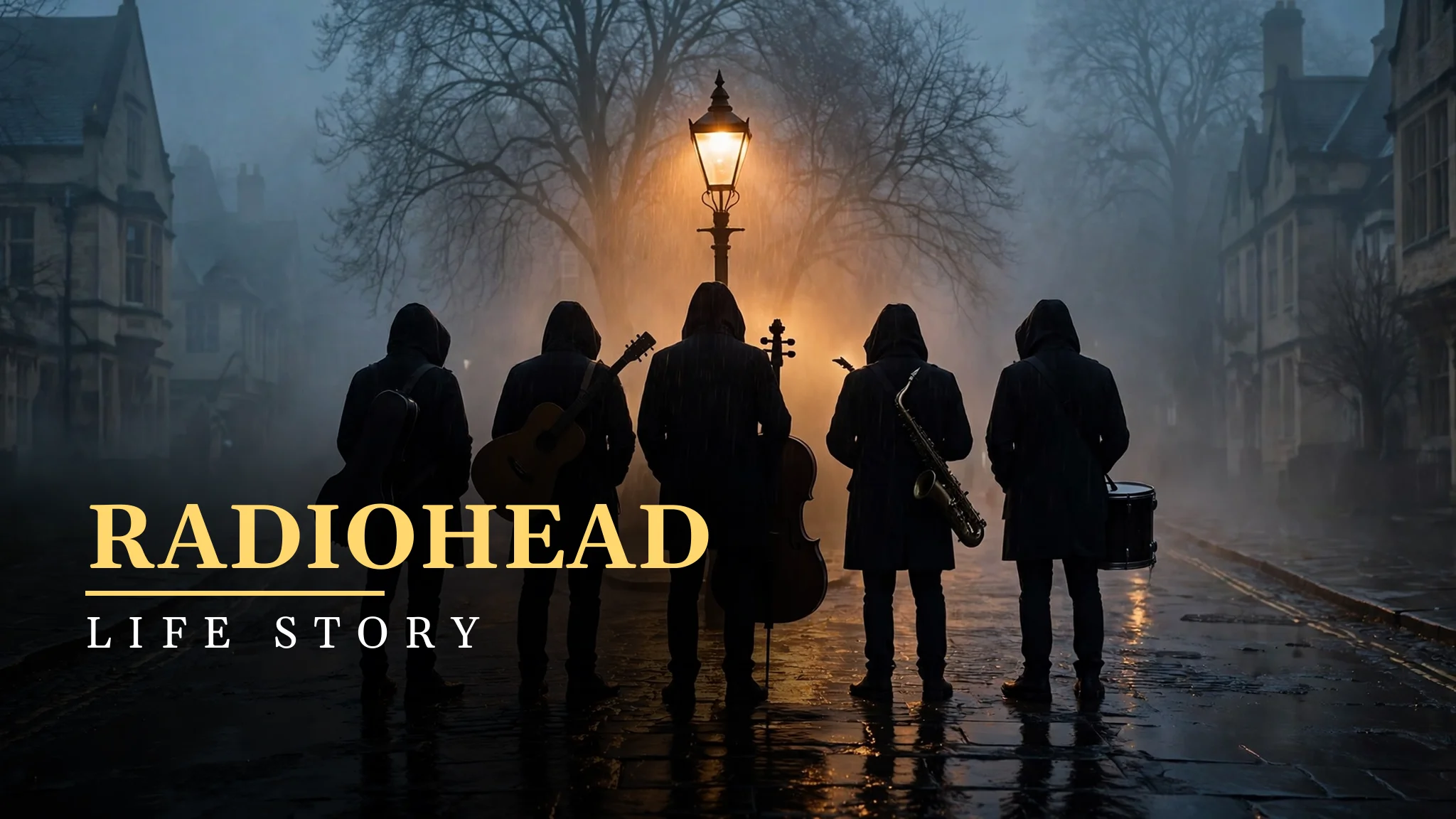
One more thought stays with me. When I think about Radiohead, I think about the image of five hooded figures in a foggy, rainy street in Oxford, carrying their instruments, walking towards a lamppost, and I think about how that image captures their music: mysterious, thoughtful, and a little bit lonely, but also beautiful and full of hope. Their music is like that street, foggy and dark, but with a light at the end. I think that is a beautiful image, and it is one I will always remember.
I also think about their activism, because Thom Yorke and the band have spoken out about climate change, about politics, and about the future of the planet, and they have tried to make their tours more sustainable. I admire that, because it shows that they care about more than just music, and that they want to use their fame to make the world better. That is a responsibility that comes with being a famous band, and Radiohead have taken it seriously.
I think about the future, too. Radiohead have not released a new album since 2016, and fans are waiting to see what they will do next. They may make another album, they may tour again, or they may work on solo projects, but whatever they do, their music will remain, and it will continue to inspire new generations. I am grateful that I have been able to hear their music, and I am grateful that they made it.
Finally, I want to say that Radiohead teach me something about anxiety. Their songs are about feeling anxious, about feeling lost, and about feeling like a creep, and they make those feelings sound beautiful, which is a kind of magic. They show that anxiety is not something to be ashamed of, and that it can be turned into art. That is a hopeful message for anyone who feels anxious, and it is one that I will always remember.
I also think about the way Radiohead’s music sounds best with headphones, late at night, when you can hear every layer, every sound, and every word, and that intimacy is part of what makes their albums so special, because they reward careful listening in a way that few bands do.
I think about their Glastonbury performances, too, because they have headlined the festival several times, playing to huge crowds in the rain and the mud, and those shows are remembered as some of the greatest in the festival’s history, with the band playing with power, with emotion, and with a connection to the audience that is rare for a band of their size.
I think about the way their fans discuss their albums, arguing about which is best, about what the lyrics mean, and about what the band will do next, and how that discussion is a sign of how much their music matters to people, and how it continues to inspire thought and conversation long after it was made.
I also think about the way Radiohead write about the future, about a world run by computers, about people who feel like numbers, and about the loss of what makes us human, and how those songs feel more relevant today than they did when they were written, because the world they warned about is now the world we live in.
I think about Thom Yorke’s solo work, too, because it shows another side of him, more electronic, more danceable, and more personal, and it proves that he is not only a Radiohead singer, but a musician who can explore many different sounds and still make music that is unmistakably his own.
I think about the band’s decision to stop playing Creep for many years, because it shows how a band can feel trapped by its own success, and how it can take courage to walk away from a hit song, even when fans want to hear it, in order to be true to yourself and to your art.
I think about their later album A Moon Shaped Pool, because it is a beautiful, sad, and mature record, with strings and piano, and with songs about love, loss, and the passage of time, and it shows that Radiohead can still make great music after more than thirty years together, which is a rare achievement.
Finally, I want to say that Radiohead remind me that music can be a warning, a comfort, and a work of art all at once, and that a band that is brave enough to change, to experiment, and to speak honestly will always find listeners who need to hear what they have to say.
I also think about how their music helps me when I feel anxious, because it does not pretend that anxiety does not exist, but instead turns it into something beautiful, and that is a kind of healing that only great music can provide.
That healing power, quiet and steady, is why I will keep listening to Radiohead for many years to come.
Frequently Asked Questions
How did Radiohead meet at school in Oxford?
Radiohead formed at Abingdon School in Oxfordshire in the mid-1980s, when Thom Yorke, Jonny Greenwood, Colin Greenwood, Ed O’Brien, and Philip Selway met as teenagers, first calling themselves On a Friday, then Radiohead after a Talking Heads song.
What is Creep about and why did the band dislike it?
Creep, released in 1992, is about feeling like an outsider who does not fit in, it became a huge hit, but the band grew tired of being known for only one song and stopped playing it live for many years.
What makes OK Computer so important?
OK Computer, released in 1997, is about technology, modern life, and alienation, with Paranoid Android, Karma Police, and No Surprises, and it is often called the greatest album of the 1990s and one of the greatest ever made.
Why was Kid A such a radical change for Radiohead?
Kid A, released in 2000, had almost no guitars, using electronics, synthesisers, and treated vocals instead, confusing many fans at first, but later becoming regarded as a masterpiece and one of the most important albums of the 2000s.
How did Radiohead change the music business with In Rainbows?
In Rainbows, released in 2007, was first released online with fans paying what they wanted, proving a major band could release music without a record label and changing how albums are shared and sold.
Who are the five members of Radiohead?
The band is Thom Yorke on vocals, Jonny Greenwood on guitar, Colin Greenwood on bass, Ed O’Brien on guitar, and Philip Selway on drums, five school friends who have been together since the 1980s.
Are Radiohead still making music today?
Yes, they released A Moon Shaped Pool in 2016, members work on solo projects and film scores, and fans are waiting for their next album, while their classic records continue to be loved around the world.


