Ray Liotta: The Life Story Behind the Goodfellas Star
In this post
- Adopted in Newark and Raised in Union
- Soap Operas, New York, and the First Steps
- Field of Dreams and the Man in the Cornfield
- Goodfellas and Henry Hill
- The 1990s, Cop Land, and a Working Actor
- A Late Comeback and a Sudden Goodbye
- Narc, the Voice of Vice City, and the Working Years
- Shades of Blue, Marriage Story, and a Late Revival
- The Many Saints of Newark, Black Bird, and the Final Roles
- My Take:
Ray Liotta had a face that could change in an instant. One moment he looked like a friendly young man with a bright smile, and the next moment he looked like a man who had seen too much and who could not be trusted. That change was his gift. He could play a hero and a criminal in the same film, and the audience would believe both. He was one of the most watchable actors of his generation, and his best role, as Henry Hill in Goodfellas, is one of the great performances in American film.
He was adopted as a baby, and he grew up in New Jersey, in a loving family that gave him a good home. He found acting at university, almost by accident, and he built a career that took him from soap operas to the biggest films in Hollywood. He worked steadily for more than forty years, and he was still working, still finding new roles, when he died suddenly in 2022.
His story runs from Newark to Hollywood, from a young man who did not know where he came from to a star who played one of the most famous criminals in film history. It is a story of talent, of hard work, and of a life that ended too soon, with much more still to give.
Adopted in Newark and Raised in Union
Raymond Allen Liotta was born on 18 December 1954 in Newark, New Jersey. He was adopted as a baby by Mary and Alfred Liotta, who raised him in Union, New Jersey, a town not far from Newark. His adoptive father worked in an auto parts business, and his mother was a township clerk. He grew up in a warm, ordinary family, and he had a happy childhood, playing sports and going to school like any other boy in town.
As a young man, he did not know much about his birth parents. He was told that he was adopted, and he grew up knowing that fact, but he did not search for his birth family until he was much older. That search, when it finally came, taught him that he had siblings he had never met, and it gave him a deeper sense of where he came from. It was a personal journey, and he spoke about it rarely, but it mattered to him.
He went to Union High School, where he played football, and he later went to the University of Miami, where he studied acting. He had not planned to become an actor. He took an acting class almost by chance, and he discovered that he had a talent for it. He performed in university plays, and he began to think about acting as a career. It was a slow discovery, but it was a real one, and it changed the direction of his life.
The New Jersey years gave him his voice and his manner. He spoke with a direct, honest style, and he carried himself like a man from the streets. That quality stayed with him, and it made his characters feel real. When he played a man from New York or New Jersey, you believed him, because he was one.
Soap Operas, New York, and the First Steps
After university, Liotta moved to New York to try to make a living as an actor. He took a role in the soap opera Another World, playing Joey Perrini from 1978 to 1981, and he learned how to work fast, how to learn lines quickly, and how to perform in front of a camera every day. Soap operas are hard work, and they teach an actor discipline, because there is no time to waste. He learned that discipline, and it stayed with him for the rest of his career.
He also worked in the theatre and in small films, building his name one job at a time. He was a handsome young man, and he was offered many parts, but he was not yet a star. He was a working actor, and he took the work that came to him, learning as he went. He appeared in films such as The Lonely Guy in 1984, a comedy, and he kept working, waiting for the role that would show what he could really do.
In the mid-1980s, he began to get noticed. He played in Something Wild in 1986, a film by Jonathan Demme, where he played Ray Sinclair, a dangerous and unpredictable ex-husband. The role was frightening and funny at the same time, and it brought him a Golden Globe nomination. He played Ray as a man who could charm you one moment and scare you the next, and audiences remembered him. It was the first sign that he could play a villain with a smile, and that he could be both attractive and dangerous.
The early years were slow, but they were important. He learned how to act on camera, how to work with directors, and how to make a character feel real. By the end of the 1980s, he was ready for the role that would define his career, and he had the skill to carry it.
Field of Dreams and the Man in the Cornfield
In 1989, Liotta appeared in Field of Dreams, a film about a farmer in Iowa who builds a baseball field in his cornfield after hearing a mysterious voice. Liotta played Shoeless Joe Jackson, the legendary baseball player who was banned from the game after a scandal in 1919. He appears out of the cornfield, young and smiling, and he plays baseball again, as if time had never passed. It is a small role, but it is a beautiful one, and Liotta played it with a warmth and a sadness that moved audiences.
The film became a beloved classic, and Liotta’s scenes in it are among the most remembered. He played Shoeless Joe as a man who loved the game, who missed it, and who was grateful for one more chance to play. It was a gentle performance, very different from the dangerous men he had played before, and it showed that he could be tender as well as frightening. Audiences who had seen him as a villain now saw him as a hero, and that range made him more valuable as an actor.
In the same period, he appeared in other films, building his reputation as a reliable and talented performer. He was not yet a major star, but directors trusted him, and audiences began to recognise his face. He was the kind of actor who made every film he was in a little better, and who could play almost any kind of man.
Field of Dreams mattered because it showed his heart. He was not only a tough guy. He was an actor who could play a ghost, a legend, and a man who loved baseball, and who could make the audience believe in magic. That belief is hard to create, and Liotta created it with a smile and a quiet voice.
Goodfellas and Henry Hill
In 1990, Liotta played Henry Hill in Goodfellas, Martin Scorsese’s film about the rise and fall of a mobster. The film follows Henry from a young boy who admires the gangsters in his neighbourhood to a man who becomes a criminal himself, and then to a man who loses everything to drugs and fear. Liotta is in almost every scene, and he carries the film on his shoulders. He narrates the story, he shows Henry’s charm, his greed, his paranoia, and his collapse, and he does it with a performance that is now seen as one of the great lead performances in American film.
The role was the biggest of his life, and it asked him to do everything. He had to be young and eager, then rich and confident, then frightened and broken. He did it all, and he made Henry feel like a real man, not like a movie gangster. Audiences understood why Henry wanted the life he chose, and they understood why it destroyed him. That understanding is the heart of the film, and Liotta created it.
Goodfellas became one of the most famous films ever made, and it won the Academy Award for Best Supporting Actor for Joe Pesci. Liotta was not nominated for an Oscar, which many people still think was unfair, but his performance has only grown in reputation over the years. Today, Goodfellas is seen as a masterpiece, and Liotta’s Henry Hill is at its centre. He is the man who takes us into the world of the mob, and who shows us how seductive and how destructive it can be.
The film changed his career. He was now a star, and he was offered bigger parts. But it also set a pattern. People began to offer him many roles as criminals and tough men, and he took many of them, because they suited him. He was Henry Hill, and Henry Hill was hard to escape.
The 1990s, Cop Land, and a Working Actor
Through the 1990s, Liotta worked steadily in films of many kinds. He appeared in Unlawful Entry in 1992, playing a dangerous policeman, and in No Escape in 1994, a science fiction film. He played in Cop Land in 1997, a film about corrupt police officers in New Jersey, where he played a detective opposite Sylvester Stallone and Robert De Niro. The role was serious and complex, and it showed that he could hold his own against the biggest stars in Hollywood.
He also appeared in Hannibal in 2001, playing a justice official who becomes a victim of the killer Hannibal Lecter, and in Blow in 2001, playing the father of a drug dealer. He took many parts, some good and some forgettable, and he kept working. He was a working actor, and he did not turn down work lightly. He believed in working, and he believed that a good actor should keep acting, even when the films were not perfect.
He also worked in television, appearing in the medical drama ER in 2004, where he played a dying man in a guest role that won him an Emmy Award. The performance was moving and powerful, and it showed that he could still surprise audiences, even after many years in the business. He played the part with a quiet dignity that stayed with viewers long after the episode ended.
The 1990s and 2000s were busy years, but they were not always easy. He was often cast as a criminal or a tough man, and he sometimes wished for different kinds of roles. But he kept working, and he kept his craft sharp, because he loved acting and because he knew that work was the best way to stay alive as an actor.
A Late Comeback and a Sudden Goodbye
In his later years, Liotta found a new energy in his work. He appeared in Marriage Story in 2019, playing a sharp divorce lawyer, and his performance was praised for its wit and its bite. He appeared in The Many Saints of Newark in 2021, a prequel to The Sopranos, playing two roles, twin brothers, and he showed that he could still command the screen. He also appeared in the television series Shades of Blue, playing a corrupt police lieutenant opposite Jennifer Lopez, and he brought his usual intensity to the part.
He was working in the Dominican Republic in May 2022, filming a new movie called Dangerous Waters, when he died suddenly in his sleep on 26 May 2022, at the age of sixty-seven. The news shocked the film world, because he had seemed healthy and active, and he was still taking on new roles. Tributes came from actors, directors, and fans around the world, all of whom remembered him as a talented, generous, and hard-working man.
He left behind a daughter, Karsen, from his marriage to Michelle Grace, which lasted from 1997 to 2004. He was engaged to Jacy Nittolo at the time of his death, and he had spoken about his happiness in his later years. He had found a new love, he was working on new films, and he seemed to be enjoying life. His death was sudden, and it left a sense of loss that is still felt today.
Today, Ray Liotta is remembered as one of the great actors of his generation, and as the man who played Henry Hill in one of the greatest films ever made. He was not a star who chased fame. He was a working actor who loved his craft, and who gave everything to each role he played. His story is a reminder that a life in film can be long, varied, and full, and that it can end too soon, with much more still to give.
Narc, the Voice of Vice City, and the Working Years
In 2002, Liotta gave one of the finest performances of his career in Narc, a gritty crime film about two Detroit detectives investigating the murder of a colleague. He played Henry Oak, a tough, troubled detective who will do anything to find the truth, and he played the part with a raw, painful honesty that critics praised. The film was small and dark, but Liotta’s performance was powerful, and it reminded audiences that he was far more than Henry Hill. He could carry a serious drama on his own, and he could make a flawed man feel human.
In the same year, he gave his voice to one of the most famous video games ever made. He played Tommy Vercetti in Grand Theft Auto: Vice City, a game set in a neon-lit Miami in the 1980s, where the player controls a criminal building an empire. His voice became famous to millions of young players who had never seen Goodfellas, and the game became a cultural landmark. It was a new kind of acting, and Liotta did it with the same intensity he brought to film. He understood that a voice could carry a character, and he gave Tommy a life that players still remember today.
He continued to work in films through the 2000s and 2010s, appearing in Killing Them Softly in 2012, playing a man who robs a card game, and in The Place Beyond the Pines in 2012, playing a corrupt policeman. He took many parts, some good and some forgettable, and he kept working. He was a working actor, and he believed that work was the best way to stay alive as an actor. He did not wait for the perfect script. He worked, and he kept his craft sharp.
He also appeared in Observe and Report in 2009, a dark comedy, and in many other films that showed his range. He could be funny, he could be frightening, and he could be sad, and he moved between those qualities with ease. He was not a star who needed to be in every scene. He was an actor who made every scene he was in better, and directors valued him for that.
Shades of Blue, Marriage Story, and a Late Revival
In 2016, Liotta took on a leading role in the television series Shades of Blue, playing Lieutenant Matt Wozniak, a corrupt police officer who leads a crew of officers in Brooklyn, opposite Jennifer Lopez. The role was dark and complex, and Liotta played Wozniak with a mix of charm, menace, and loyalty that made the character fascinating to watch. The series ran for three seasons, and it gave him a chance to build a character over a long time, something he had rarely done on television. It was a late-career triumph, and it showed that he was still at the top of his game.
In 2019, he appeared in Marriage Story, playing Jay Marotta, a sharp, funny divorce lawyer, in a film about a couple going through a painful divorce. His scenes are brief, but they are memorable, because he plays Jay with a wit and a bite that makes the audience laugh even as the story breaks their hearts. It was a small role, but it showed that he could still surprise audiences, and that he had lost none of his timing.
In 2021, he appeared in The Many Saints of Newark, a prequel to The Sopranos, playing two roles, twin brothers Aldo and Salvatore Moltisanti, and he showed that he could still command the screen in his sixties. He also appeared in No Sudden Move in 2021, a crime film by Steven Soderbergh, and in Black Bird in 2022, a television series about a prisoner, playing Big Jim Keene, the father of the main character. Black Bird was his final role, and it was a powerful one, a fitting end to a long career.
He was working, and he was happy, and he seemed to have many more years ahead of him. His death in 2022, while filming in the Dominican Republic, shocked everyone who knew him, because he had found a new energy in his later work, and he was showing that he could still do great things. His late revival was a reminder that a good actor never really fades. He just keeps working, and the work keeps getting better.
The Many Saints of Newark, Black Bird, and the Final Roles
In 2021, Liotta played two roles in The Many Saints of Newark, a prequel to The Sopranos, playing twin brothers Aldo and Salvatore Moltisanti. The two brothers are very different men: one is a charming, reckless criminal, and the other is a quiet, thoughtful man in prison. Liotta played both with a skill that made the audience believe they were two different people, even though they were played by the same actor. It was a remarkable achievement, and it showed that he could still surprise audiences in his sixties. He was not just Henry Hill anymore. He was an actor who could play two men at once, and make both feel real.
In 2022, he played Big Jim Keene in Black Bird, a television series about a prisoner who is offered his freedom if he can get a confession from a suspected serial killer. Big Jim is the father of the main character, a former policeman who loves his son and who is trying to help him survive. Liotta played the part with a warmth and a strength that made the character one of the most loved in the series. It was his final role, and it was a powerful one, a fitting end to a long career. He did not know it would be his last, and neither did we, but it stands as a reminder of everything he was.
After his death, he appeared in Cocaine Bear in 2023, a wild comedy thriller about a bear that eats cocaine, playing Syd, a drug dealer who is chasing his missing shipment. The film was released after he died, and his performance was praised for its humour and its energy. It was a strange final film, but it showed that he could still make audiences laugh, even in a film about a bear. He had a sense of humour about his work, and he was not afraid to take on a film that was fun, even if it was not serious.
He left behind a body of work that spans more than forty years, from soap operas to Goodfellas, from Field of Dreams to Black Bird, and from the voice of Tommy Vercetti to the father in Marriage Story. He was a working actor, and he worked until the very end, because he loved the work and because the work loved him. His death was sudden, and it left a sense of loss that is still felt today, but his films remain, and they will keep speaking to us for many years to come.
My Take:
When I think about Ray Liotta, the first thing I see is his smile. It is a bright, friendly smile, and it makes you trust him. Then, in the next moment, that smile changes, and you realise that the man smiling at you might not be a friend at all. That change is his gift. He could be warm and dangerous in the same scene, and the audience never knew which one was real. That uncertainty is what made him so watchable, and it is why Goodfellas is still one of the most powerful films I have ever seen.
I admire how he found acting. He did not plan it. He took a class at the University of Miami almost by chance, and he discovered that he had a talent for it. That is a brave way to find a career, because it means you are following something you did not expect. He could have done something else. He could have stayed in New Jersey, or he could have chosen a safe job. Instead, he followed the acting, and he built a life from it. I think that is a lesson for anyone who does not know what they want to do. Sometimes you find your path by accident, and you have to be brave enough to follow it.
What I find most interesting is his performance in Goodfellas. He is in almost every scene, and he carries the whole film. He shows Henry Hill as a young boy who admires gangsters, as a young man who becomes one, as a rich man who enjoys the life, and as a broken man who loses everything. That is a long journey, and Liotta plays every step of it with honesty. He does not make Henry a hero, and he does not make him a monster. He makes him a man, a man who makes bad choices and who pays for them. I think that is the hardest kind of acting, because it asks the audience to understand a criminal without forgiving him. Liotta does it, and he does it beautifully.
I also think about Field of Dreams, because it shows a completely different side of him. He plays Shoeless Joe Jackson, a baseball player who comes back from the past to play one more game, and he plays the role with a warmth and a sadness that is deeply moving. He is not a criminal in that film. He is a ghost, a legend, and a man who loves the game. I love that he could do both. He could play Henry Hill, a man who destroys himself, and Shoeless Joe, a man who gets a second chance, and he could make both feel real. That range is rare, and it is why I think he was underrated.
There is something sad in his story, and it is the sadness of Henry Hill himself. Henry wants a life of glamour and easy money, and he gets it, but the life destroys him. He ends the film as a frightened man, looking over his shoulder, living a life he never wanted. I think Liotta understood that sadness, because he played it so well. He knew that the glamour was a lie, and he showed us the truth behind it. That is a powerful thing to do in a film that many people watch for fun. He made us see the cost of the life, not just the thrill of it.
I admire his work in ER, where he won an Emmy for playing a dying man. It is a small role, only one episode, but it is one of the most moving performances of his career. He plays a man who is facing death, and he does it with a quiet dignity that stays with you. I think that role shows his depth. He did not need a big film to show what he could do. He could do it in a single episode of television, with a few scenes, and he could make it unforgettable. That is the mark of a great actor.
Another thing I notice is how hard he worked. He was in films and television for more than forty years, and he never stopped. He took many parts, some good and some not so good, and he kept going. He did not wait for the perfect script. He worked, because he loved working, and because he believed that an actor should act. I respect that. Many actors become picky, and they wait for years between films. Liotta worked, and his work kept him alive as an actor. That steady work is the reason he was still finding new roles in his sixties.
I also think about his adoption, and how he searched for his birth family later in life. He grew up knowing he was adopted, and he loved the family who raised him, but he also wanted to know where he came from. That search taught him that he had siblings he had never met, and it gave him a deeper sense of himself. I think that is a brave thing to do, because it means facing questions about who you are and where you belong. He did it quietly, and he spoke about it rarely, but it mattered to him. I think that sense of not quite knowing where you come from is part of his acting too. His characters often seem like men who are searching for something, and who do not quite know where they belong.
His death in 2022 was a shock, and it still feels too soon. He was sixty-seven, he was working on a new film, and he seemed to have many more years of work ahead of him. He had found a new energy in his later roles, in Marriage Story and in The Many Saints of Newark, and he was showing that he could still surprise audiences. To lose him so suddenly, in his sleep, far from home, is a sad ending to a full life. I think about his daughter, and about his fiancée, and about the people who loved him, and I feel the loss even though I never met him. That is the power of his work. He made us feel like we knew him.
If I have a criticism, it is that Hollywood did not always give him the roles he deserved. After Goodfellas, he was often cast as a criminal or a tough man, and he was rarely given the chance to play a romantic lead or a comic hero. He could do those things, as Field of Dreams proves, but the industry saw him as Henry Hill, and it kept offering him the same kind of part. I think that is a waste of his talent, and I wish he had been given more chances to show his full range. But he made the most of what he was given, and he turned even small parts into memorable performances.
For a young reader, I think the lesson of his life is about following an unexpected path. He found acting by accident, and he built a career from it. He did not plan to be a star. He just followed the work, one role at a time, and the work led him to Goodfellas, to Field of Dreams, and to a long and respected career. That is a useful lesson: you do not always need a plan. Sometimes you need to try something new, and to see where it takes you.
I also think his story teaches something about hard work. He worked in soap operas, in small films, in television, and in big movies, and he never stopped. He did not become famous overnight, and he did not give up when the work was slow. He kept going, and he kept learning, and that steady work is what made him great. A person who works every day, even when the work is hard, will go further than a person who waits for the perfect chance.
When I look at his whole life, I see a man who was adopted, who found a loving family, who found acting by accident, and who became one of the most loved actors of his time. He played a gangster, a ghost, a detective, and a dying man, and he made each one feel real. He died too soon, with much more to give, and that is the saddest part of his story. But the work he left behind will last, and people will keep watching Goodfellas and Field of Dreams for many years to come, and they will keep remembering the man with the bright smile and the dangerous eyes.
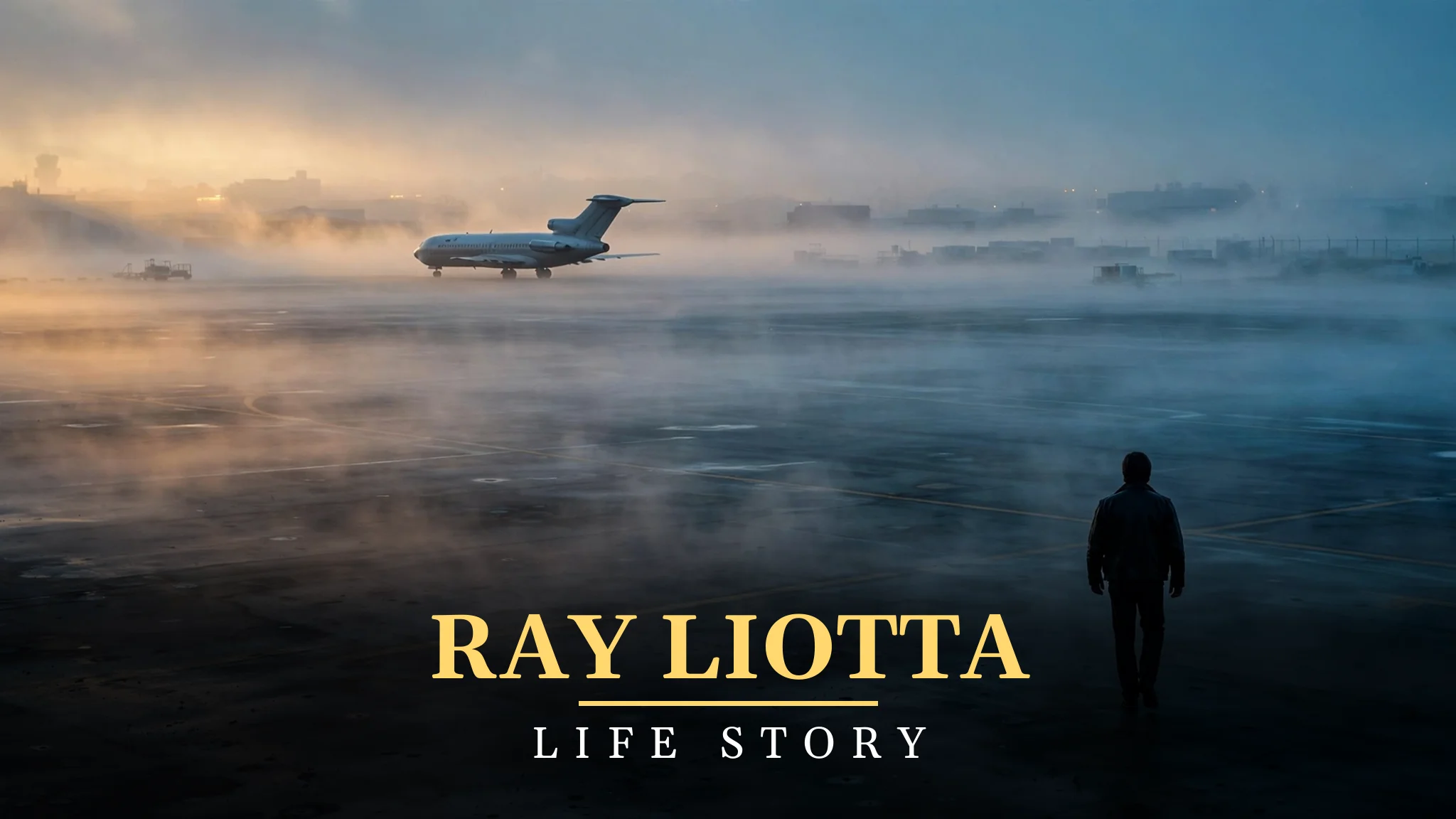
One more thought stays with me. When I picture him, I picture the airport in the image for this story: one man walking across a misty tarmac at dawn, toward a plane that is waiting in the fog. That is a good picture of his life, because he was always moving, always travelling to the next job, the next film, the next chance. And he kept walking, right up to the end, with the sun rising behind him, even when the fog was thick.
I also think about Narc, because it is one of his finest performances, and many people have never seen it. He plays Henry Oak, a Detroit detective who is tough, troubled, and willing to do anything to find the truth. It is a small, dark film, but Liotta’s performance is powerful, and it shows that he was far more than Henry Hill. He could carry a serious drama on his own, and he could make a flawed man feel human. I wish more people knew that film, because it proves that his talent went far beyond Goodfellas.
Another thing I notice is his voice work in Grand Theft Auto: Vice City. He played Tommy Vercetti, and his voice became famous to millions of young players who had never seen his films. That is a remarkable thing. He reached a whole new generation, not through a film, but through a game, and he did it with the same intensity he brought to the screen. It tells me that he was not afraid of new kinds of work, and that he understood that acting could take many forms. A good actor can act anywhere, even in a recording booth, and Liotta proved it.
I think about Shades of Blue as well, because it gave him a leading role on television in his sixties. He plays Matt Wozniak, a corrupt police lieutenant, and he plays the part with a mix of charm, menace, and loyalty that makes the character fascinating. It is a dark role, and it shows that he had not lost any of his power. He was still the same actor who had played Henry Hill, still intense, still watchable, and still able to surprise an audience. That late-career triumph makes his sudden death even sadder, because he was clearly still at his best.
When I think about Black Bird, his final role, I feel a deep sadness. He plays Big Jim Keene, the father of a prisoner, and he plays the part with a warmth and a strength that is deeply moving. It was his last work, and it was a good one, a fitting end to a long career. He did not know it would be his last, and neither did we. That is the hardest part of his story. He was working, he was happy, and he had more to give, and then he was gone. But the work remains, and it will keep speaking to us, in Goodfellas, in Field of Dreams, in Narc, and in every film he touched.
I also think about his twin roles in The Many Saints of Newark, because they show how much he could still do in his sixties. He plays Aldo and Salvatore Moltisanti, two brothers who are very different men, and he makes the audience believe they are two different people, even though they are played by the same actor. That is a remarkable achievement, and it proves that he had not lost any of his skill. He was not just Henry Hill anymore. He was an actor who could play two men at once, and make both feel real. I wish he had been given more chances like that, because he was capable of so much more than the industry often asked of him.
Another thing I notice is Cocaine Bear, the film that was released after his death, where he plays Syd, a drug dealer chasing a missing shipment. It is a wild, funny film about a bear, and Liotta plays his part with a humour and an energy that makes the audience laugh. It is a strange final film, but it shows that he was not afraid to have fun, and that he could still surprise people. He did not take himself too seriously, and he was willing to play in a film that was silly, because he loved to work. That joy is part of who he was, and it is why people loved him.
Frequently Asked Questions
Was Ray Liotta adopted?
Yes, Ray Liotta was adopted as a baby by Mary and Alfred Liotta, who raised him in Union, New Jersey. He grew up knowing he was adopted, and he searched for his birth family later in life, learning that he had siblings he had never met.
How did Ray Liotta become an actor?
He discovered acting almost by chance at the University of Miami, where he took an acting class and found he had a talent for it. After university, he moved to New York, worked in the soap opera Another World, and built his film career one role at a time.
What is Ray Liotta’s most famous role?
His most famous role is Henry Hill in Goodfellas from 1990, where he carries the film as a mobster who rises from a young admirer of gangsters to a man destroyed by drugs and fear. The performance is now seen as one of the great lead performances in American film.
Who did Ray Liotta play in Field of Dreams?
In Field of Dreams from 1989, he played Shoeless Joe Jackson, the legendary baseball player who appears out of the cornfield to play one more game. The small, warm role showed a gentle side of him very different from his later gangster parts.
Did Ray Liotta win an Emmy Award?
Yes, he won an Emmy Award for a guest role in the medical drama ER in 2004, playing a dying man in a single episode. The quiet, moving performance showed his depth and surprised many viewers.
What was Ray Liotta working on when he died?
He was filming a movie called Dangerous Waters in the Dominican Republic when he died suddenly in his sleep on 26 May 2022, at the age of sixty-seven. He had recently found new energy in roles such as Marriage Story and The Many Saints of Newark.
Why was Ray Liotta not nominated for an Oscar for Goodfellas?
He was not nominated for an Oscar for Goodfellas, which many film lovers still see as unfair, while Joe Pesci won for the same film. His performance as Henry Hill has only grown in reputation over the years, and it is now regarded as one of the finest of his generation.


