Robbie Williams: The Life Story Behind the Take That Star
In this post
Robbie Williams is one of the biggest pop stars Britain has ever produced, and he is also one of the most honest about how hard fame can be. He was the youngest member of Take That, the boy band that ruled British pop in the early 1990s, and he left the band in a blaze of headlines, drink, and arguments. Most people thought his career was over. Instead, he became an even bigger star on his own, with songs such as “Angels”, “Rock DJ”, and “Feel”, and with stadium concerts that drew tens of thousands of people. He has sold more than seventy million records, he has won more Brit Awards than any other artist, and he has done it all while talking openly about anxiety, addiction, and the pressure of being famous.
He was born in Stoke-on-Trent, in the Midlands, and he grew up in a working-class family, with a mother who ran a pub and a father who was a comedian. He was a cheeky, funny boy who liked to perform, and he was spotted by Take That when he was only sixteen. The band made him famous, but it also made him unhappy, because he felt controlled, because he wanted to write his own songs, and because he did not like the clean, wholesome image the band was given. He left, he struggled, and then he rebuilt his career, one song at a time, until he was bigger than the band he had left behind.
His story is about talent, about rebellion, and about recovery. He has been open about his problems with drink and drugs, about his time in rehab, and about his mental health, and that openness has helped many people who have faced similar problems. He has also been a showman, a joker, and a singer who can hold a stadium with a single song and a smile. He is still performing, still recording, and still talking, and his story is far from over.
A Cheeky Boy From Stoke-on-Trent
Robert Peter Williams was born on 13 February 1974 in Stoke-on-Trent, Staffordshire, to Peter Williams, a comedian, and Janet Williams, who ran a pub called the Red Lion in Burslem. He grew up in the pub, surrounded by customers, by music, and by the sound of people laughing and talking. His father performed as a comedian, and Robbie watched him work, learning how to hold a room, how to tell a joke, and how to make people feel at ease. That early training in front of an audience would later make him one of the best live performers in British pop.
He went to school in Stoke, and he was a lively, funny pupil, but he was not a great student. He liked to perform, he liked to make people laugh, and he liked to sing, but he did not like sitting still in a classroom. His teachers noticed his talent for performance, and his family supported him, even though they knew that a career in show business was uncertain. He was the kind of boy who would sing in the pub, who would do impressions of famous people, and who would always be the centre of attention when he walked into a room.
Stoke-on-Trent in the 1970s and 1980s was a city known for its pottery, for its factories, and for its working-class pride. It was not a centre of pop music, and a boy from Stoke who wanted to be a pop star had to leave to find his chance. Robbie knew that, and he was willing to leave, but he also carried Stoke with him, in his accent, in his humour, and in his direct way of speaking. He has never pretended to be from somewhere else, and that honesty about where he comes from is part of why people like him.
When he was sixteen, his mother saw an advertisement for a new boy band, and she encouraged him to audition. The band was Take That, put together by the manager Nigel Martin-Smith, and Robbie was chosen as the youngest member. He was a teenager, he was suddenly in a pop group, and his life changed overnight. He moved to Manchester, he began to rehearse, and he began to learn what it meant to be a pop star, with all the excitement and all the pressure that came with it.
Take That and the Youngest Star
Take That became one of the biggest boy bands in British history, with hits such as “Pray”, “Back for Good”, and “Never Forget”, and Robbie was the cheeky one, the joker, the member who made the fans laugh. He was also the member who felt most trapped by the band’s image. Take That were presented as clean, wholesome, and safe, and Robbie wanted to be wilder, funnier, and more honest. He began to drink, he began to argue with the other members, and he began to feel that the band was holding him back.
The band toured the world, they sold millions of records, and they were loved by millions of teenage fans, but behind the scenes, the pressure was intense. Robbie was still a teenager, he was away from home, and he was living a life that was very different from the life he had known in Stoke. He has spoken in later years about how lonely he felt, even when he was surrounded by fans, and about how the drink became a way of coping with that loneliness. It was a difficult time, and it was a time that would shape the rest of his career.
In 1995, Robbie left Take That, and the news was huge. Fans were devastated, the press reported it for days, and many people thought his career was over. He was twenty-one, he had no solo record deal, and he had a reputation as a troublemaker. He went to Los Angeles, he drank, he partied, and he seemed to be throwing his career away. The other members of Take That continued without him for a short time, and then they split up in 1996, but Robbie’s future was far from certain.
The years after he left Take That were a low point, and he has been honest about that. He was drinking heavily, he was taking drugs, and he was not working. He was also being watched by the press, who reported every mistake he made. It would have been easy for him to disappear, as many former boy band members do, but he had a talent for songwriting and a voice that people remembered, and he was determined to prove that he could succeed on his own.
Angels and the Solo Breakthrough
Robbie’s solo career began slowly, with a cover of George Michael’s “Freedom” in 1996, which reached number two in Britain. It was a good start, but it was not enough to prove that he was a solo star. He then worked with the songwriter Guy Chambers, and together they wrote songs that would become some of the biggest hits of the late 1990s. The first album, “Life Thru a Lens”, was released in 1997, and it was a slow starter, but it eventually became a huge success, thanks to the song “Angels”.
“Angels” was released as a single in December 1997, and it became one of the most loved songs in British pop history. It is a song about love, about loss, and about the feeling that someone is watching over you, and Robbie sings it with a warmth and a sincerity that surprised people who had only known him as the cheeky boy from Take That. The song reached number four in Britain, but it stayed in the charts for a long time, and it became a song that people played at weddings, at funerals, and at moments when they needed comfort. It is still one of the most played songs on British radio.
The album also included the songs “Let Me Entertain You” and “Old Before I Die”, and it sold millions of copies. Robbie was now a solo star, and he was a star with a voice and a personality that were all his own. He toured, he appeared on television, and he became known as a showman who could hold a large audience with a mix of humour, honesty, and great songs. He had proved the doubters wrong, and he had done it with a song that was completely different from anything Take That had ever recorded.
The success continued with his second album, “I’ve Been Expecting You”, released in 1998, which included the hits “Millennium” and “No Regrets”, and with his third album, “Sing When You’re Winning”, released in 2000, which included “Rock DJ” and “Kids”, a duet with Kylie Minogue. He was now one of the biggest stars in Europe, and he was selling out stadiums, including three nights at Knebworth in 2003, where he played to more than 375,000 people over three days, one of the biggest live events in British music history.
Rock DJ, Knebworth, and the Height of Fame
By the early 2000s, Robbie Williams was at the height of his fame. He had won Brit Awards, he had sold millions of records, and he was a household name in Britain and in many other countries. His concerts were huge, his videos were famous, and his personality was everywhere, in newspapers, on television, and on the radio. He was a star who seemed to enjoy being a star, and who was willing to be funny, to be rude, and to be honest in a way that other pop stars were not.
“Rock DJ”, released in 2000, became one of his most famous videos, in which he strips off his skin in a nightclub, a shocking and memorable image that was widely talked about. The song was a hit, and the video won awards, but it also showed that Robbie was willing to take risks and to shock people. He was not a safe pop star. He was a pop star who liked to push boundaries, and who liked to make people laugh and to make people think.
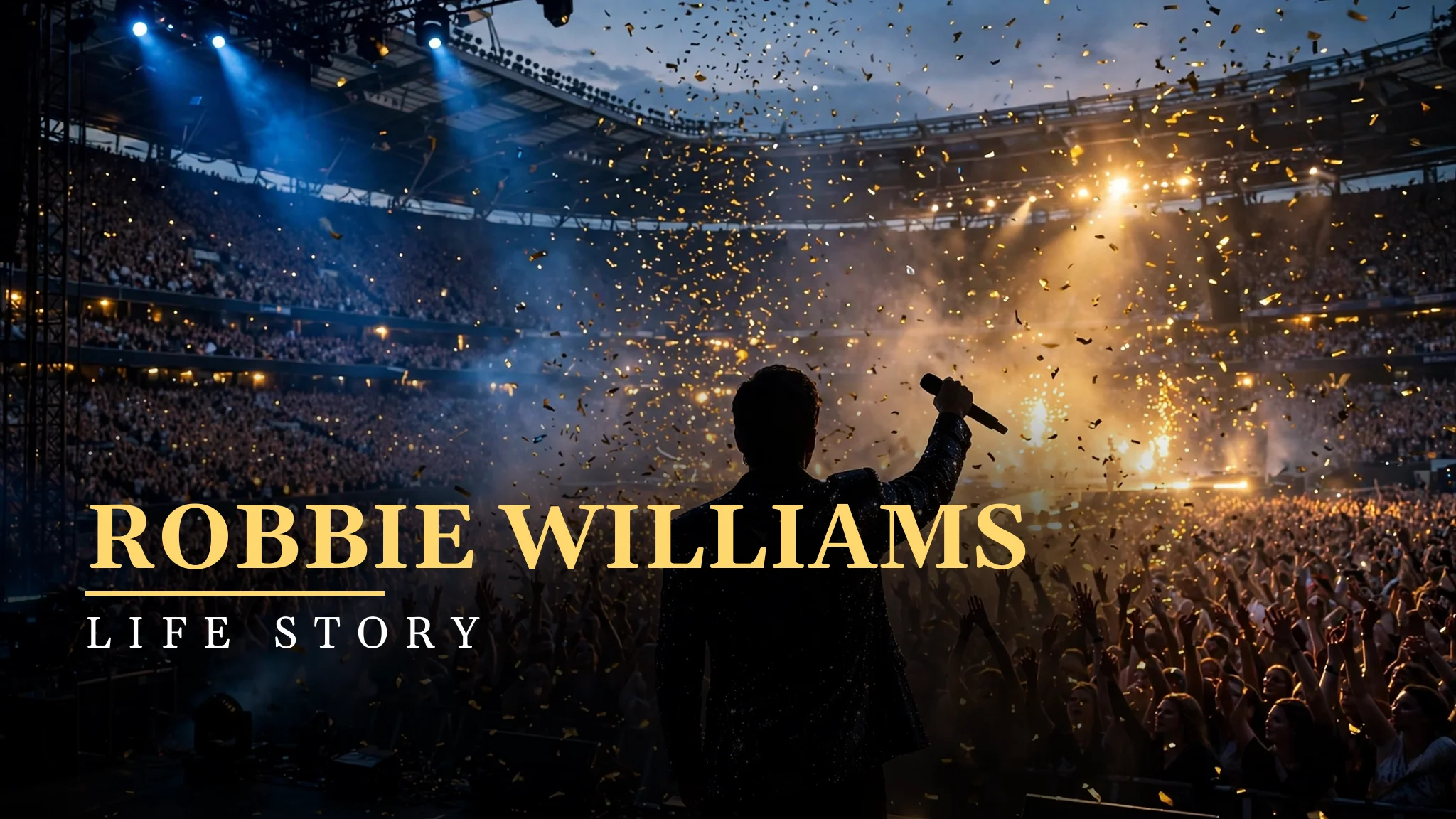
The Knebworth concerts in 2003 were the peak of his live career. He played three nights, to more than 375,000 people, and the shows were recorded and released as a live album and a DVD. The concerts were a triumph, and they showed that he could hold a stadium audience with a mix of songs, jokes, and sheer personality. He was at the top of his game, and he seemed unstoppable, but behind the scenes, the pressure was building again, and the drink and the drugs were becoming a problem once more.
He released more albums, including “Escapology” in 2002, which included the hit “Feel”, and “Intensive Care” in 2005, which included “Tripping” and “Advertising Space”. The albums were successful, but Robbie was becoming tired, and he was struggling with his mental health. He has spoken about feeling anxious, about feeling depressed, and about using drink and drugs to cope with the pressure of fame. In 2007, he went into rehab, and he took a break from music, a break that lasted for several years.
Rehab, Recovery, and a New Life
In February 2007, Robbie Williams checked into a rehab clinic in the United States to deal with his problems with drink and drugs, and with his mental health. It was a brave decision, and it was one that he made public, because he wanted to be honest about what he was going through. He spent time in rehab, he worked on his recovery, and he began to think about what kind of life he wanted to live. He was thirty-three, he had been famous for more than fifteen years, and he needed to stop and to look after himself.
After rehab, he took a break from recording and from touring, and he lived in Los Angeles, where he tried to live a quieter life. He met the American actress Ayda Field, and they married in 2010. They have four children together, Teddy, Charlie, Coco, and Beau, and Robbie has spoken about how becoming a father changed him. He has said that his children gave him a reason to stay well, and that they made him want to be a better person. He has also spoken about his anxiety and his depression, and about the need to talk about mental health openly.
He returned to music in 2009 with the album “Reality Killed the Video Star”, and in 2010 he rejoined Take That for a tour and for the album “Progress”, which was a huge success. The reunion was a happy moment for fans, and it showed that the old arguments had been put aside. Robbie toured with Take That, he sang with them, and he enjoyed being part of the band again, even though he also kept his solo career. He later left the band again to focus on his solo work, but the reunion had healed old wounds.
He released more solo albums, including “Take the Crown” in 2012, which included the hit “Candy”, and “The Heavy Entertainment Show” in 2016, and he continued to tour, including a residency in Las Vegas. He also released a Christmas album, “The Christmas Present”, in 2019, and he has continued to record and to perform, even as the music business has changed around him. He has also been open about his health, including a scare in 2017 when he was taken ill during a tour, and he has spoken about the need to look after yourself as you get older.
The Later Years, Las Vegas, and Still Entertaining
In the late 2010s and 2020s, Robbie Williams continued to perform and to record, even as the music business changed around him. He released the album “The Christmas Present” in 2019, a double album of Christmas songs, and he performed a residency in Las Vegas, where he played to audiences who had followed him for more than twenty years. The Las Vegas shows were a new kind of performance for him, intimate and theatrical, with stories, jokes, and songs from across his career. He enjoyed the residency, because it allowed him to stay in one place, to sleep in the same bed, and to perform without the exhaustion of touring.
He also released the album “XXV” in 2022, a collection of his greatest hits re-recorded with an orchestra, to mark twenty-five years as a solo artist. The album reached number one in Britain, and it showed that his songs still mattered, even when they were performed in a new way. He toured to support the album, playing to stadiums and to arenas, and he was welcomed by audiences who had grown up with his music, and who now brought their own children to the concerts. That is a sign of a singer whose music has crossed generations, and who is still loved by people of all ages.
He has also been open about his health in recent years, including a scare in 2017 when he was taken ill during a tour, and he has spoken about the need to look after yourself as you get older. He has said that he exercises, that he eats well, and that he tries to get enough sleep, even when he is on tour. Those are simple things, but they are important, and they show that he has learned from his earlier mistakes. He is no longer the young man who drank and partied every night. He is a father, a husband, and a man in his fifties who wants to stay well.
He has also become a figure on television, appearing as a judge on The X Factor in 2018, alongside his wife Ayda, and he was a popular judge, known for his humour, his honesty, and his knowledge of music. He has also appeared in documentaries about his life, including a Netflix series in 2023, in which he talked openly about his career, his mental health, and his family. The series was praised for its honesty, and it showed a different side of Robbie, a thoughtful, reflective man, who is not afraid to talk about his mistakes.
His legacy is not just “Angels”, although that song will always be part of his story. It is the example of a singer who left a boy band, who struggled, who recovered, and who became one of the biggest stars in British music, by being himself, by being funny, and by being honest. He showed that a pop star can be open about mental health, can talk about addiction, and can still be loved by millions of people. That is a rare achievement, and it is one that will last.
He has also spoken about the importance of family, and about how his children have taught him to slow down and to enjoy the small moments in life. He has said that being a father is the hardest job he has ever had, and also the most rewarding, and that it has made him think differently about fame, about money, and about what really matters. That is a mature view, and it is one that many fans respect, because it shows that Robbie has grown up, and that he is no longer the wild young man who left Take That in 1995.
He has also kept his love of Stoke-on-Trent, and he has spoken about how proud he is of where he comes from, and about how the city shaped him. He has supported local charities, he has talked about the city in interviews, and he has never pretended to be from somewhere else. That loyalty to his home town is part of why people like him, because he seems real, and because he has not forgotten his roots, even after becoming one of the biggest stars in Britain.
He has also used his voice to support charities, performing at benefit concerts and raising money for children’s hospitals and for mental health organisations. He does not make a big fuss about that work, and he does not use it to promote himself, but he gives his time and his talent, and that generosity matters, because it shows that fame can be used for good, not just for selling records.
My Take:
I think Robbie Williams is a singer I have mixed feelings about, and I say that honestly, because his story is not a simple one. On one hand, I admire his talent, his humour, and his ability to hold a stadium with a single song. On the other hand, I think about the pain he has caused himself and others, and about the years he lost to drink and drugs. That mix of admiration and sadness is what makes his story interesting, because he is not a perfect hero. He is a real person, with real flaws, and he has been honest about those flaws in a way that few pop stars are.
I admire “Angels” more than any other song he has made, because it is a song that has helped millions of people. I have heard it at weddings, at funerals, and on the radio late at night, and every time I hear it, I feel something. It is a song about love and about loss, and it is sung with a sincerity that is hard to fake. Robbie was twenty-three when he recorded it, and he sang it like a man who had already lived a long life. That is a rare gift, and it is the reason the song is still loved today. I think “Angels” will be remembered long after most of his other songs are forgotten.
I also admire his humour, because it is a big part of who he is. He is funny on stage, he is funny in interviews, and he is funny in a way that makes people feel at ease. That humour is not just a performance. It is a way of coping with the pressure of fame, and it is a way of making the audience feel like they are part of the show, not just watching it. I think that humour is one of the reasons he has been able to keep a large audience for so long, because people like to be entertained, and Robbie entertains them.
What I find sad in his story is the way fame hurt him when he was so young. He was sixteen when he joined Take That, and he was still a child in many ways. He was taken away from home, he was put under intense pressure, and he was expected to behave like a perfect pop star, even though he was still growing up. That is a lot to ask of a teenager, and I think it is unfair. He drank, he argued, and he made mistakes, but those mistakes were the mistakes of a young person who was not given the support he needed. I think the music business should have looked after him better.
I think his decision to go into rehab in 2007 was one of the bravest things he has done, because it meant admitting that he had a problem, and that he needed help. Many famous people hide their problems, and they pretend that everything is fine, until it is too late. Robbie did not hide. He went public, he got help, and he talked about it afterwards, so that other people might feel able to do the same. That honesty has helped many people, and I respect him for it. It takes courage to say, in public, that you are not okay.
I also think about his relationship with Take That, and about how hard it must have been to leave the band and then to return to it years later. He left because he felt trapped, and he returned because he had grown up and because the old wounds had healed. That is a mature thing to do, and it shows that he has learned to forgive, both himself and others. I like the idea that a band that split up in anger could come back together and make great music again. It is a hopeful story, and it is one that many people can relate to, because most of us have had arguments with friends that we later wish we could undo.
His marriage to Ayda Field and his life as a father is another part of his story that I think about with hope. He has four children, and he has spoken about how they changed him, and about how they gave him a reason to stay well. I think that is a good thing, because it shows that fame is not the most important thing in life. Family is more important, and a singer who puts his family first is a singer who has learned something valuable. I hope he continues to put his family first, and I hope his children grow up knowing that their father loves them more than he loves fame.
If I have a criticism, it is that some of his later music does not match the quality of his best work. Albums such as “Take the Crown” and “The Heavy Entertainment Show” have good songs on them, but they do not have the same power as “Life Thru a Lens” or “I’ve Been Expecting You”. I think that is partly because he has been famous for so long, and it is hard to keep making great records after thirty years. I also think it is partly because he has been through so much, and it is hard to write a great pop song when you are tired. I do not blame him for that, but I do think his best work is behind him, and that is sad, because he is still a talented singer.
I also think about his mental health, and about the way he has talked about anxiety and depression. He has said that he feels anxious before every show, and that he sometimes feels depressed even when he is successful. I think that honesty is important, because it tells other people who feel the same way that they are not alone. It also tells us that fame does not make you happy, and that money does not cure anxiety. Those are important lessons, and Robbie has taught them by being honest about his own life.
For a young reader, I think the lesson from Robbie Williams is to be honest about your problems, and to ask for help when you need it. He was famous, he was rich, and he was still unhappy, and he was brave enough to say so. That is a lesson for anyone, whether they are famous or not. You do not have to pretend to be okay when you are not, and asking for help is not a sign of weakness. It is a sign of strength, and it is the first step to getting better.
I keep thinking about his Knebworth concerts in 2003, and about what it must have felt like to play to 375,000 people over three nights. That is an extraordinary achievement, and it is one that very few singers ever reach. I wonder if he enjoyed it, or if he was already tired and anxious by then. I hope he enjoyed it, because it was a moment that proved how far he had come, from a boy in Stoke to a star who could fill a field with more people than live in his home town. That is a remarkable journey, and it deserves to be celebrated.
In the end, I think Robbie Williams teaches us that fame is a double-edged sword. It can give you everything, and it can take everything away, and the same voice that makes you famous can also make you lonely. He has lived that truth, and he has talked about it openly, and that openness is his greatest gift to his fans. I will remember him not just for “Angels”, but for the honesty with which he has lived his life, and for the way he has kept singing, even when it was hard. That is a story worth respecting.
I also think about his work with Guy Chambers, and about how important that partnership was. Guy Chambers wrote the music, Robbie wrote the words, and together they made songs that were better than either of them could have made alone. That partnership is a reminder that even a solo star needs help, and that a good collaborator can make a singer better. I hope Robbie finds another collaborator like that, because his best work has always come when he was working with someone who understood him.
One more thought stays with me, and it is about his humour on stage. He can make a stadium laugh, and he can make a stadium sing, and he can do both in the same song. That is a rare talent, and it is one that I think he was born with. He learned it in the pub in Stoke, watching his father, and he has used it ever since. I hope he never loses that humour, because it is the thing that makes him different from other pop stars, and it is the thing that makes his concerts so special.
Finally, I think about his future, and about what he will do next. He is in his fifties now, he has children, and he has a long career behind him. He could retire, he could stop touring, and no one would blame him. I think he will keep going, because he loves to perform, and because he still has something to say. I hope he looks after himself, I hope he stays well, and I hope he keeps singing, because his voice still matters, and his story still matters, to the people who have followed him since he was sixteen.
I also think about his Netflix documentary in 2023, and about how honest it was. He talked about his anxiety, about his depression, and about the pressure of fame, in a way that was raw and unflinching. I think that documentary helped many people, because it showed that even a famous, successful person can struggle, and that it is okay to talk about it. He did not hide behind a polished image. He showed the real Robbie, with all his flaws, and that honesty is brave.
Another thing I admire is the way he has kept his sense of humour, even through hard times. He can make a stadium laugh, he can make a television audience laugh, and he can make himself laugh, even when life is difficult. That humour is a coping mechanism, and it is also a gift. It tells the audience that it is okay to laugh, even when things are hard, and that laughter can be a way through pain. I think that is a valuable lesson, and it is one that Robbie has taught through his whole career.
I also think about his children, and about how they have changed him. He has four children, and he has spoken about how they gave him a reason to stay well, and a reason to be a better person. I think that is a good thing, because it shows that fame is not the most important thing in life. Family is more important, and a singer who puts his family first is a singer who has learned something valuable. I hope he continues to put his family first, and I hope his children grow up knowing that their father loves them more than he loves fame.
When I listen to his later albums, I hear a singer who is still trying, still learning, and still willing to take risks, even after thirty years in the business. The Christmas album, the orchestral album, and the Las Vegas residency all show a singer who is not afraid to try new things, and who is not content to repeat himself. That willingness to keep learning is rare, and it is one of the reasons I respect him, even when the new work is not as good as his best work.
Finally, I think about his place in British pop history, and about how he will be remembered. He will be remembered as the cheeky boy from Take That, as the singer of “Angels”, as the star who played Knebworth to 375,000 people, and as the man who talked openly about mental health and addiction. That is a full, complicated, and honest legacy, and it is one that deserves respect. I hope he keeps singing, keeps laughing, and keeps being honest, because his voice still matters, and his story still matters.
Frequently Asked Questions
Where was Robbie Williams born and when?
Robbie Williams was born Robert Peter Williams on 13 February 1974 in Stoke-on-Trent, Staffordshire, where his mother ran a pub and his father worked as a comedian.
How old was Robbie Williams when he joined Take That?
He was sixteen when he joined Take That, after his mother saw an advertisement for the new boy band and encouraged him to audition in Manchester.
Why did Robbie Williams leave Take That in 1995?
He left because he felt trapped by the band’s clean image, because he wanted to write his own songs, and because he was struggling with drink and with arguments inside the group.
What is Robbie Williams’s most famous solo song?
“Angels”, released in December 1997, is his most famous solo song, and it is still one of the most played and most loved songs in British pop history.
How many people did Robbie Williams play to at Knebworth in 2003?
He played three nights at Knebworth in 2003 to more than 375,000 people in total, one of the biggest live events in British music history.
When did Robbie Williams go into rehab?
He checked into a rehab clinic in February 2007 to deal with drink, drugs, and mental health problems, and he has spoken openly about his recovery since then.
Who is Robbie Williams married to?
He is married to the American actress Ayda Field, whom he married in 2010, and they have four children together called Teddy, Charlie, Coco, and Beau.


