Roberto Carlos: The Life Story Behind Brazil's Romantic Voice
In this post
- Cachoeiro de Itapemirim and the Train Accident
- The Radio, Rio and the First Songs
- Jovem Guarda and the Youth Movement
- Detalhes, Emoções and the Romantic King
- Jesus Cristo, Lady Laura and the Faith
- The Christmas Special and the National Ritual
- Erasmo Carlos and the Lifelong Friendship
- Loss, Wives and the Private Man
- The Grammy, the Sales and the King
- The Voice, the Style and the Later Years
- The Legacy of O Rei
- My Take:
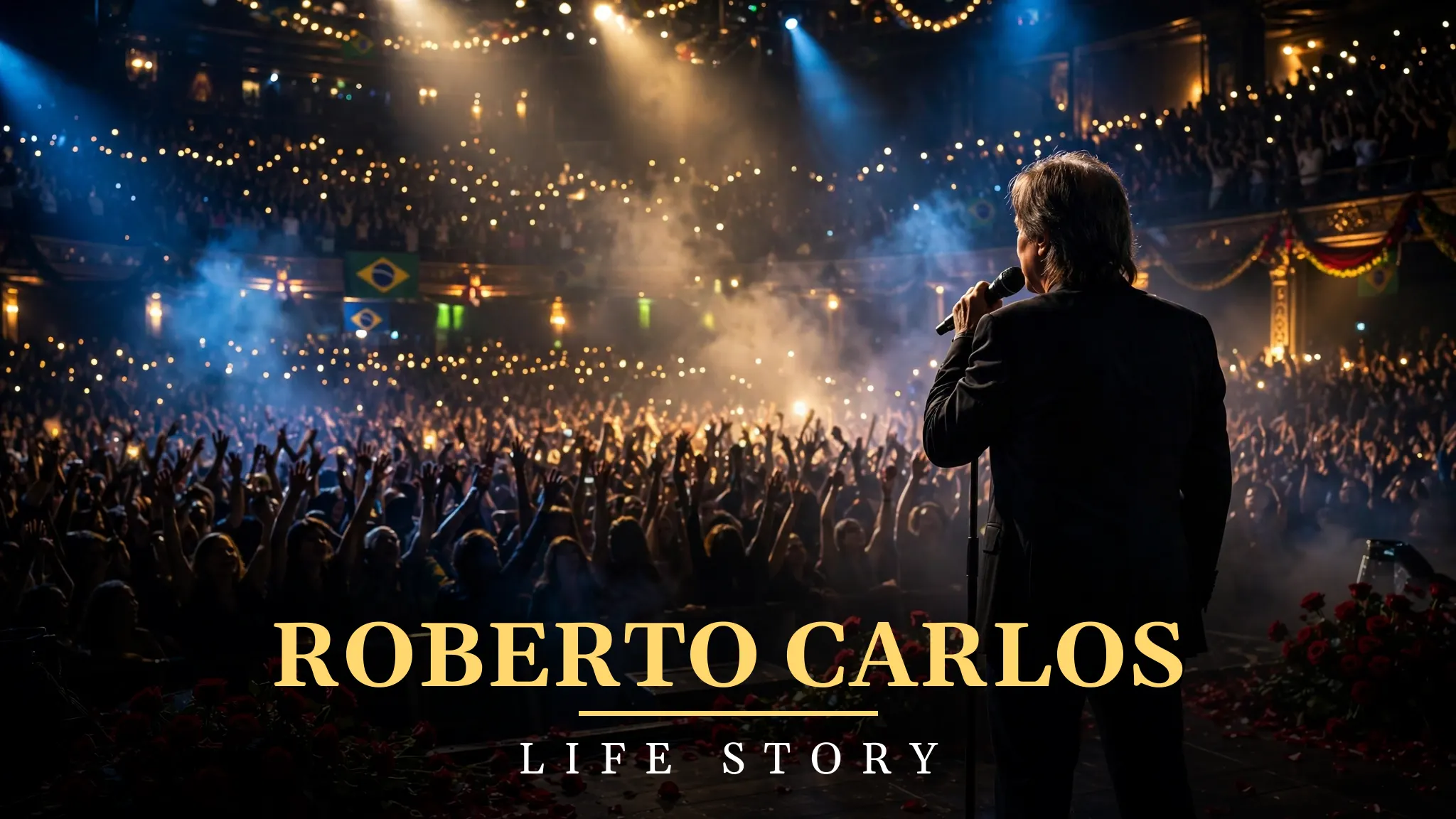
Roberto Carlos Braga was born on 19 April 1941 in Cachoeiro de Itapemirim, a town in the state of Espírito Santo, Brazil, and his life began with a tragedy that would shape everything that followed. When he was six years old, he was run over by a train, and his right leg had to be amputated below the knee. He has worn a prosthesis ever since, and he has lived his entire public life with a disability that most of his audience never thinks about, because he has never made it the subject of his music. He is known in Brazil simply as O Rei, the King, the most popular and most enduring singer in the history of Brazilian music, a man whose songs have been the soundtrack of Brazilian life for more than sixty years, whose annual Christmas television special has been a national ritual since the 1970s, and whose voice is known to every generation in the country.
His career began in the rock and roll of the 1960s, when he led the Jovem Guarda movement with Erasmo Carlos and Wanderléa, and it evolved into the romantic ballads that made him famous: Detalhes, Emoções, Amigo, Lady Laura, and dozens of others that Brazilians know by heart. He has reportedly sold more than one hundred million records, he has won a Grammy Award, and he has performed for audiences across Latin America, in the United States, and in Europe. He is also a man of deep Catholic faith, known for wearing blue and white, the colours of his devotion, and for a private life marked by loss, including the deaths of two wives. This is the story of a boy who lost a leg to a train and who became the king of Brazilian music, and of the songs that carried him there.
Cachoeiro de Itapemirim and the Train Accident
Cachoeiro de Itapemirim is a town in the interior of Espírito Santo, built around the Itapemirim river and known for its marble quarries, and it was a quiet, provincial place in the 1940s. Roberto Carlos grew up there in a modest family, the youngest of four children, and his childhood was, by his own account, happy until the day of the accident. He was six years old, playing near the railway line, when he was struck by a train, and the injuries to his right leg were so severe that it had to be amputated below the knee. The accident was a defining event, not only because of the physical loss but because of the way it shaped his character. He learned, as a child, that life could change in an instant, and that a person had to adapt, to endure, and to find a way forward.
He has spoken about the accident rarely, and he has never used it to seek sympathy. He wears a prosthesis, he walks with a slight limp that most audiences never notice, and he has performed on stage for more than sixty years without making his disability part of the show. That discretion is characteristic of him, and it is part of why he is respected. He did not want to be known as a singer who overcame a disability. He wanted to be known as a singer, and the disability was a private fact, not a public story. The accident also gave him a seriousness, a sense that life is fragile and that time is precious, and that seriousness is audible in his ballads, which are often about love, loss, and the passage of time.
The Radio, Rio and the First Songs
Roberto Carlos discovered music as a child, singing in church and on local radio in Cachoeiro de Itapemirim, and his talent was evident early. He had a clear, warm voice, and he loved the rock and roll that was arriving in Brazil from the United States in the 1950s, the music of Elvis Presley, of Little Richard, and of the young rockers who were changing popular music around the world. As a teenager, he moved to Rio de Janeiro, the centre of Brazilian music, and he began to perform in clubs, on radio, and on television, singing rock and roll in Portuguese and building a following among young Brazilians who wanted their own version of the music they heard from abroad. It was a difficult time, because the Brazilian music industry was dominated by samba and bossa nova, and rock was seen as a foreign import.
He persisted, and he found allies, most importantly Erasmo Carlos, a singer and songwriter who became his closest collaborator and his lifelong friend. Together, Roberto and Erasmo wrote songs, performed together, and built a sound that was Brazilian rock, with Portuguese lyrics, local references, and a rhythm that owed as much to samba as to American rock. The partnership was one of the most productive in Brazilian music, and it lasted for decades, producing dozens of hits. Roberto Carlos’s early recordings were energetic, youthful, and full of the excitement of rock and roll, and they made him a star among Brazilian teenagers, who saw in him a singer who spoke their language, literally and figuratively, and who understood their lives.
Jovem Guarda and the Youth Movement
In the mid-1960s, Roberto Carlos became the leader of the Jovem Guarda, the Young Guard, a movement that transformed Brazilian popular music. The Jovem Guarda was a television programme, broadcast by TV Record from 1965 to 1968, in which Roberto Carlos, Erasmo Carlos and Wanderléa performed rock and pop songs for a young audience, and it became a phenomenon, watched by millions of Brazilians every week. The movement was more than a television show. It was a youth culture, with its own fashion, its own slang, and its own music, and Roberto Carlos was its king, the figure that young Brazilians looked to for style, for sound, and for identity. The Jovem Guarda was, in effect, Brazil’s version of the British Invasion, and Roberto Carlos was its Elvis.
The songs of the Jovem Guarda period were fast, catchy, and full of youthful energy. É Proibido Fumar, Quero Que Vá Tudo pro Inferno, and O Calhambeque were among the hits, and they were sung by teenagers across Brazil. The movement also provoked a reaction from the older generation of Brazilian musicians, who saw rock as a threat to samba and bossa nova, and who criticised the Jovem Guarda for being commercial and foreign. Roberto Carlos did not engage in the argument. He kept making music, and the audience kept listening, and the Jovem Guarda became a permanent part of Brazilian music history. It was the first phase of his career, and it was the phase that made him a star, but it was not the phase that would define him. That would come later, when he slowed down and began to sing about love.
Detalhes, Emoções and the Romantic King
In the 1970s, Roberto Carlos changed direction, moving from the fast rock of the Jovem Guarda to the slow, romantic ballads that would become his signature. The turning point was Detalhes, released in 1971, a song about the small details of a love affair, written by Roberto Carlos and Erasmo Carlos, and it became one of the most famous songs in Brazilian music. Detalhes was followed by a string of ballads that defined the decade: Amigo in 1977, a tribute to friendship, Lady Laura, dedicated to his mother, and Emoções in 1981, a song that became one of his most beloved recordings. These songs were slow, emotional, and beautifully sung, and they showed a different side of Roberto Carlos: not the young rocker, but a mature singer who could express the deepest feelings of love, loss and longing.
The romantic songs made him the king of Brazilian music in a new sense. He was no longer only the idol of teenagers. He was the singer of adults, of couples, of families, and his songs were played at weddings, at anniversaries, and at moments of celebration and of grief. Emoções, in particular, became a song that Brazilians associate with the most important moments of their lives, and it is still one of his most requested songs at concerts. The ballads also showed his growth as a songwriter, because they were more sophisticated, more personal, and more honest than the rock songs of the 1960s. He was no longer singing about youth. He was singing about life, and the audience, which had grown up with him, was ready to listen.
Jesus Cristo, Lady Laura and the Faith
Roberto Carlos’s music has always had a spiritual dimension, and two of his most important songs show it clearly. Jesus Cristo, released in 1970, was a song about faith, about the search for meaning, and about the figure of Christ, and it was a bold choice for a pop singer at the time. The song became a major hit, and it showed that Roberto Carlos was willing to sing about subjects that other pop stars avoided. Lady Laura, dedicated to his mother, Laura Braga, was a tribute to the woman who had raised him, and it became one of his most personal songs, a ballad about a mother’s love that resonated with audiences across Brazil. Both songs show a singer who is not afraid to be sincere, and who believes that music can express the deepest things in life.
His faith is also visible in his public life. Roberto Carlos is a devout Catholic, and he is known for wearing blue and white, the colours associated with the Virgin Mary, to whom he is devoted. He has spoken about his faith in interviews, and he has made it a part of his image, not as a marketing choice but as a genuine expression of belief. That faith has sustained him through the losses in his life, including the deaths of his wives, and it has given his music a spiritual quality that many listeners feel, even if they do not share his beliefs. He is, in that sense, a singer who is also a believer, and his music is the sound of that belief, expressed in songs that are both popular and profound.
The Christmas Special and the National Ritual
Since 1974, Roberto Carlos has presented an annual Christmas television special on TV Globo, and it has become one of the most enduring rituals in Brazilian television. The special, known as the Especial Roberto Carlos, is broadcast in December, and it features the singer performing his greatest hits, duetting with guest artists, and singing Christmas songs, in a show that is watched by millions of Brazilians every year. For many families, the special is as much a part of Christmas as the dinner or the tree, and it is a sign of how deeply Roberto Carlos has entered Brazilian life. He is not only a singer. He is a part of the calendar, a voice that marks the end of the year, and a presence that Brazilians expect to see at Christmas.
The special has also been a showcase for his longevity. He has presented it for fifty years, through changes in Brazilian television, in Brazilian music, and in his own life, and it has remained popular throughout. The format has changed over the years, with different guests, different songs, and different settings, but the core has remained the same: Roberto Carlos, singing, in front of an audience that loves him. The special is a reminder that his career is not only about records. It is about a relationship with the Brazilian people, built over decades, and renewed every December. That relationship is unique in Brazilian music, and it is one reason he is called the King.
Erasmo Carlos and the Lifelong Friendship
The partnership between Roberto Carlos and Erasmo Carlos was one of the most important in Brazilian music, and it lasted for more than fifty years, until Erasmo’s death in 2022. Erasmo was a singer and songwriter in his own right, and he co-wrote many of Roberto’s greatest songs, including Detalhes, and he was a constant presence in Roberto’s life, as a collaborator, as a friend, and as a fellow traveller through the changes in Brazilian music. The two men were known as Roberto and Erasmo, a pair, and their friendship was as famous as their music. They performed together, they recorded together, and they supported each other through the difficulties of a long career in show business.
Erasmo’s death in 2022 was a profound loss for Roberto Carlos, and he spoke about it with a sadness that was visible to the public. The friendship had been a central part of his life, and its end marked the end of an era in Brazilian music. But the songs remain, and they are a testament to what the two men created together. Detalhes, Amigo, and dozens of others are not only Roberto Carlos songs. They are Roberto and Erasmo songs, and they will be remembered as the work of a partnership that was one of the great creative relationships in Latin American music. The friendship is a reminder that behind the King, there was a friend, and that the music was, in the end, a shared achievement.
Loss, Wives and the Private Man
Roberto Carlos’s private life has been marked by loss, and he has borne it with a dignity that is characteristic of him. His first wife, Nice, died in 1990, and his second wife, Maria Rita, died in 1999, after a battle with cancer. Both deaths were public events in Brazil, and both were met with an outpouring of sympathy for the singer, who had lost two partners in less than a decade. He has spoken about those losses rarely, and he has never used them for publicity. He has borne them privately, with the support of his family and his faith, and he has continued to perform, to record, and to live, even as he grieved. That resilience is part of why he is admired, not only as a singer but as a man.
His mother, Laura, to whom he dedicated Lady Laura, died in 2010, at the age of ninety-six, and her death was another significant loss. Roberto Carlos has always been close to his family, and he has kept his private life largely out of the press, even as his public life has been lived in front of millions. He is known as a shy, private man, who does not seek publicity, who does not give many interviews, and who prefers to let his music speak for him. That privacy is a choice, and it is a respectable one, in an age when many celebrities share every detail of their lives. Roberto Carlos shares his songs, and that is enough.
The Grammy, the Sales and the King
Roberto Carlos’s commercial success is extraordinary by any measure. He has reportedly sold more than one hundred million records, making him one of the best-selling Latin American artists in history, and his albums have topped the charts in Brazil for six decades. He won a Grammy Award in 1989, for Best Latin Pop Performance, a rare honour for a Brazilian singer, and he has received numerous other awards in Brazil and abroad. His concerts draw large audiences, his Christmas special is watched by millions, and his songs are known to Brazilians of every age, from teenagers who hear them at home to grandparents who danced to them in the 1960s. That breadth of appeal, across generations, is unique in Brazilian music, and it is the reason he is called the King.
The title, O Rei, is not an exaggeration. In Brazil, there is no other singer who has had a career as long, as successful, and as deeply rooted in the national life as Roberto Carlos. He is the singer of the Jovem Guarda, the singer of the romantic ballads, the singer of Christmas, and the singer of Brazil itself, and his music is part of the country’s identity. He has performed in the United States, in Europe, and across Latin America, and he has been honoured in many countries, but his home is Brazil, and his audience is Brazilian, and that is where his kingdom is. The King does not need to conquer the world. He has already conquered his own country, and that is enough.
The Voice, the Style and the Later Years
Roberto Carlos’s voice is one of the most recognisable in Brazilian music, and it has aged gracefully. It is warm, clear, and expressive, with a quality that is both intimate and powerful, and it has retained its character for more than sixty years. He sings with a restraint that is the opposite of showmanship, letting the melody and the lyrics do the work, and that restraint is what makes his ballads so effective. He does not oversing. He sings the song, and he trusts the song to reach the listener. That trust is the mark of a great singer, and it is why his performances, even now, in his eighties, are still moving. He is not a young man, but his voice is still the voice that Brazilians know and love.
In his later years, he has continued to perform, to record, and to present his Christmas special, and he shows no sign of stopping. He performs in large venues, he tours Brazil, and he remains a central figure in the country’s cultural life. His later work is not a footnote to a great career. It is a continuation of it, and it shows a singer who is still committed to his art, still capable of moving an audience, and still the King. At eighty-four, he is one of the oldest active performers in Brazilian music, and he is also one of the most beloved, a living link to the history of the country’s popular music, and a reminder of what a long, honest career can look like.
The Legacy of O Rei
Roberto Carlos’s legacy is already clear, and it will only grow with time. He is the most successful singer in the history of Brazilian popular music, the leader of the Jovem Guarda, the author of some of the most beloved ballads in the Portuguese language, and the voice of Christmas in Brazil. His songs are part of the national soundtrack, his concerts are events, and his name is synonymous with Brazilian music itself. He has influenced generations of singers, from the rockers of the 1960s to the romantic singers of today, and his music is studied, covered, and loved by artists across Latin America. That influence is the true measure of a king, not the sales, not the awards, but the fact that the music lives on in other people.
In the history of Latin American music, he will be remembered as a singer who began in rock and roll, who became a romantic balladeer, and who stayed at the top for six decades, without ever losing the trust of his audience. He is a reminder that a career can be long, that it can change, and that it can remain honest, if the artist is willing to grow with it. He grew, from a teenager in Cachoeiro de Itapemirim to the King of Brazilian music, and he did it with a voice, a guitar, and a determination that began the day he survived a train accident as a six-year-old boy. That is a legacy worth having, and it is one that will last.
My Take:
When I think about Roberto Carlos, the first thing that comes to mind is the length of the career. He has been a star for more than sixty years, from the Jovem Guarda in the 1960s to the Christmas special in the 2020s, and that kind of longevity is almost unheard of in popular music. Most singers have a decade, if they are lucky. Roberto Carlos has had six, and he is still performing in his eighties. That longevity is not an accident. It is the result of talent, of hard work, of a willingness to change, and of a connection with his audience that has never been broken. He grew up with his audience, and they grew up with him, and that shared history is the foundation of his career.
The second thing is the voice, because it is a remarkable instrument that has aged with unusual grace. It is warm, clear, and expressive, and it has retained its character for six decades. He sings with restraint, letting the song do the work, and that restraint is what makes his ballads so moving. Detalhes and Emoções are not showy songs. They are simple, honest, and beautifully sung, and they work because Roberto Carlos trusts the material. A singer who oversings ruins a ballad. A singer who sings it plainly lets the listener feel it, and Roberto Carlos sings plainly, and the listener feels it. That is the mark of a great singer, and it is why his voice is still loved after sixty years.
Detalhes is the song I would point to if someone asked me to explain his appeal in a single track. It is a song about the small details of a love affair, the way a person laughs, the way they move, the little things that make love real, and it is sung with a tenderness that is impossible to fake. The song was written by Roberto Carlos and Erasmo Carlos, and it is a perfect example of their partnership: a simple idea, expressed beautifully, and performed with complete sincerity. Detalhes is not a complicated song, and it does not need to be. It is a song about attention, about noticing the person you love, and that attention is what makes it last. It is still one of his most requested songs, more than fifty years after its release, and it will still be requested in fifty more.
Emoções is the other essential song, and it is, if anything, even more beloved in Brazil. It is a song about feelings, about the emotions that define a life, and it is sung with a warmth and a sincerity that make it feel like a personal message to every listener. Brazilians play Emoções at weddings, at anniversaries, and at moments of celebration and of grief, and the song has become part of the national life in a way that few songs ever do. That is the highest achievement for a popular song: to become part of people’s lives, to be there when they need it, and to say what they cannot say themselves. Emoções does that, and it is why Roberto Carlos is more than a singer. He is a companion, a voice that has been present at the most important moments of millions of lives.
The Jovem Guarda period is worth remembering, because it shows a different Roberto Carlos, a young rocker with energy, with style, and with a following of teenagers who saw him as their own. The television programme, the fashion, the slang, and the music were a youth culture, and Roberto Carlos was its leader. That period is often overlooked in favour of the ballads, but it is important, because it shows that he was not always a romantic singer. He was once a rock star, and the energy of that period is still audible in his performances, in the way he moves on stage, and in the way he connects with a young audience. He did not become the King by singing ballads alone. He became the King by starting as a rocker and growing into a balladeer, and the journey is part of the story.
The Christmas special is the ritual that best captures his place in Brazil. Since 1974, he has presented an annual special on TV Globo, and it has become a part of Christmas for millions of families. The special is not only a concert. It is a moment in the year, a voice that marks the season, and a presence that Brazilians expect to see. That kind of ritual is rare in popular music, and it is a sign of how deeply Roberto Carlos has entered the national life. He is not only a singer. He is a part of the calendar, and his voice is the sound of December in Brazil. That is a legacy that no award can match, because it is measured not in sales but in memories.
His faith is another part of his story that deserves respect, because it is genuine and it is central to who he is. He is a devout Catholic, he wears blue and white, and he has spoken about his devotion to the Virgin Mary. That faith has sustained him through the deaths of his wives, through the difficulties of a long career, and through the ordinary challenges of life, and it has given his music a spiritual quality that many listeners feel. He does not preach, and he does not use his faith as a marketing tool. He lives it, quietly and consistently, and the music reflects it. That quiet faith is a refreshing contrast to the noise of modern celebrity, and it is one reason he is admired.
The train accident is the fact that most people know about him, and it is worth thinking about carefully, because it is a story of resilience that he has never exploited. He lost his leg at six years old, he has worn a prosthesis ever since, and he has performed for sixty years without making it part of his public image. That discretion is admirable, because it shows a man who refused to be defined by a tragedy, and who insisted on being judged by his work. It is also a reminder that the most important facts about a person are not always the ones they talk about. Roberto Carlos does not talk about the accident. He sings, and the singing is the answer. That is a powerful statement, and it is one that deserves to be heard.
His friendship with Erasmo Carlos is the other great relationship of his life, and it deserves to be remembered. The two men wrote songs together, performed together, and supported each other for more than fifty years, until Erasmo’s death in 2022. That kind of creative partnership is rare, and it produced some of the greatest songs in Brazilian music. Detalhes, Amigo, and dozens of others are the work of both men, and they are a testament to what friendship can create. Erasmo’s death was a profound loss, and Roberto Carlos’s grief was visible, but the songs remain, and they are a permanent record of a friendship that was also a collaboration. That is a beautiful legacy, and it is one that will last.
For a new listener, I would suggest a simple path. Start with Detalhes and Emoções, then listen to Amigo and Lady Laura, then watch the Christmas special, and then listen to the Jovem Guarda songs, including É Proibido Fumar. That order takes you from the ballads to the personal songs to the ritual to the rock, and it shows the full range of a career that has lasted for sixty years. If you only have time for one song, make it Detalhes, because it is the essential one, and if you only have time for one performance, make it the Christmas special, because it is the most Brazilian.
One more thought: Roberto Carlos’s career is a useful answer to anyone who thinks that popular music is only for the young. He became famous as a teenager, and he is still performing in his eighties, and his audience has grown up with him, from teenagers to grandparents. That is a rare achievement, and it is the result of a willingness to change, to grow, and to sing about the things that matter at every stage of life. He sang about youth when he was young, and he sings about love, loss, and faith now that he is old, and the audience has followed him, because the songs are honest at every age. That honesty is the secret of his longevity.
Finally, I would say this: Roberto Carlos matters not only for what he has sung but for what he represents. He represents Brazil, its music, its faith, and its resilience, and he does so with a voice that has been present in Brazilian homes for six decades. He is a reminder that a singer can be both popular and profound, both a star and a neighbour, and both a rocker and a balladeer. That is a rare combination, and it is why, after more than sixty years, he is still the King, and why he will remain the King for as long as Brazilians sing his songs.
There is a last detail that stays with me, which is the way he dresses. He is known for wearing blue and white, the colours of his devotion, and he has done so for decades, in a business where fashion changes every year. That consistency is a small thing, but it is a sign of a man who knows who he is, and who does not need to change his appearance to stay relevant. He is himself, in blue and white, singing the songs that Brazil loves, and that is enough. It has been enough for sixty years, and it will be enough for as long as he sings.
His sales figures are worth a final word, because they are extraordinary. More than one hundred million records, by most accounts, is a number that places him among the best-selling artists in the history of Latin American music, and it is a number that reflects not a single hit but a lifetime of work. Each of those records represents a person who bought a song, who played it at home, and who made it part of their life. That is the real measure of his success, not the number itself but the lives behind it, and those lives are the reason he is called the King.
The Grammy Award he won in 1989 is another milestone worth noting, because it was a recognition from the American music industry, which rarely honours Brazilian singers. The award was for Best Latin Pop Performance, and it was a sign that his music had travelled beyond Brazil, and that it was respected by the wider world. He did not need the Grammy to be the King in Brazil, but the Grammy confirmed what Brazilians already knew: that his voice, his songs, and his career were of world class. That confirmation matters, and it is a fitting honour for a singer who has given so much to his country.
One more practical note: if you want to understand Brazilian music, start with Roberto Carlos. His career contains the whole history of Brazilian popular music, from rock to ballad to Christmas, and his songs are the best introduction to the sound, the feeling, and the soul of the country. He is not only a singer. He is a history, and listening to him is like listening to Brazil itself, in all its joy, its sorrow, and its faith.
Looking ahead, the question is not what Roberto Carlos will do next, because at eighty-four he has already done more than any singer could hope to do. The question is how long his music will last, and the answer is: as long as Brazilians sing. His songs are sung at weddings, at Christmas, at parties, and at funerals, and they will continue to be sung, because they are part of the country. The King may one day stop performing, but the songs will not stop, and that is the truest kind of immortality for a singer.
Frequently Asked Questions
When was Roberto Carlos born?
Roberto Carlos was born on 19 April 1941 in Cachoeiro de Itapemirim, in the state of Espírito Santo, Brazil.
What happened to Roberto Carlos as a child?
When he was six years old, he was run over by a train and his right leg had to be amputated below the knee. He has worn a prosthesis ever since.
What is the Jovem Guarda?
The Jovem Guarda was a youth music movement and television programme in Brazil from 1965 to 1968, led by Roberto Carlos, Erasmo Carlos and Wanderléa. It brought rock and pop to a young Brazilian audience.
What are Roberto Carlos’s most famous songs?
His best-known songs include Detalhes, Emoções, Amigo, Lady Laura, Jesus Cristo, É Proibido Fumar and Quero Que Vá Tudo pro Inferno.
What is the Roberto Carlos Christmas special?
Since 1974, Roberto Carlos has presented an annual Christmas television special on TV Globo in Brazil. It has become a national ritual, watched by millions of families every December.
Why is Roberto Carlos called O Rei?
O Rei means The King in Portuguese. He is called the King because he is the most successful and most enduring singer in the history of Brazilian popular music, with a career of more than sixty years.


