Robin Williams: The Life Story Behind Comedy's Genius
In this post
- A Lonely Childhood in Chicago and Michigan
- Stand-Up Comedy and the San Francisco Clubs
- Mork & Mindy and Overnight Stardom
- Good Morning, Vietnam and Dead Poets Society
- Mrs. Doubtfire, Aladdin, and the Family Films
- Good Will Hunting and the Oscar
- Addiction, Recovery, and the Later Years
- The Man Behind the Laughter
- A Legacy of Laughter and Love
- My Take:
Robin Williams could make a room full of strangers laugh until they cried, and he could make the same room cry with a single quiet line. He was one of the greatest comic minds who ever lived, a man whose brain seemed to run faster than anyone else’s, and whose performances in films like Good Morning, Vietnam, Dead Poets Society, Mrs. Doubtfire, and Good Will Hunting made him one of the most loved actors in the world. He won an Academy Award, he won Golden Globes, and he won the hearts of millions of people, and he did it with a talent that was both dazzling and deeply human.
He was born on 21 July 1951 in Chicago, Illinois, the only child of a senior executive at the Ford Motor Company and a former model, and he grew up in a wealthy but lonely household in Michigan. He was a shy, overweight boy who was bullied at school, and he discovered that making people laugh was a way to make friends and to survive. He studied at Juilliard in New York, one of the finest drama schools in America, where his classmates included Christopher Reeve, and he began his career as a stand-up comedian in San Francisco, where his manic, improvisational style made him a legend of the comedy clubs.
His breakthrough came in 1978, when he played the alien Mork in the television series Mork & Mindy, a role that made him a star overnight and that showed the world his extraordinary gift for improvisation. He went on to a film career that mixed comedy and drama in a way that few actors have ever managed, playing a radio DJ in Vietnam, a teacher who inspired his students, a father who dressed as a nanny to see his children, and a therapist who helped a troubled young man. He was a genius, and he was also a man who struggled with depression, addiction, and, in his final years, a terrible brain disease.
He died on 11 August 2014, at the age of 63, and his death shocked the world, because he had seemed so full of life, so funny, and so beloved. It was later revealed that he had been suffering from Lewy body dementia, a degenerative brain disease that had affected his mind and his body in ways that he and his family did not fully understand. This is the full life story of Robin Williams, the comic genius who gave the world so much laughter and who left it far too soon.
A Lonely Childhood in Chicago and Michigan
Robin McLaurin Williams was born on 21 July 1951 in Chicago, Illinois, and he was the only child of Robert Williams, a senior executive at the Ford Motor Company, and Laurie Williams, a former model. The family was wealthy, but Robin’s childhood was lonely, because his parents were often busy, and he spent much of his time alone, playing with toy soldiers and entertaining himself. He was a shy, overweight boy, and he was bullied at school, experiences that stayed with him for the rest of his life and that shaped his comedy, which was often about the outsider, the misfit, and the person who does not quite belong.
When he was 12, the family moved to Marin County, California, and Robin attended Redwood High School, where he was elected class clown and where he discovered that making people laugh was a way to be liked. He was still shy, and he was still overweight, but on stage, or in front of a group, he could be someone else: funny, fast, and fearless. He joined the drama club, he took part in school plays, and he began to realise that performance was where he belonged. It was the first time he had felt at home anywhere, and it was the start of everything.
After high school, he studied political science at Claremont Men’s College, but he left to pursue acting, enrolling at the College of Marin and then at the Juilliard School in New York, one of the most prestigious drama schools in the world. At Juilliard, he was in a class with Christopher Reeve, who became his lifelong friend, and his teachers recognised his extraordinary talent for improvisation, a gift that could not be taught. He left Juilliard in 1976, before graduating, to pursue a career in stand-up comedy, and he moved to San Francisco, where the comedy scene was thriving and where his manic, brilliant style would make him a star.
Stand-Up Comedy and the San Francisco Clubs
Williams began his career as a stand-up comedian in San Francisco in the mid-1970s, performing in clubs like the Holy City Zoo and the Intersection, where his act was unlike anything anyone had seen before. He did not tell jokes in the traditional sense. He improvised, he did voices, he became characters in an instant, and he moved so fast that audiences could barely keep up. He was a force of nature on stage, and he quickly became one of the most talked-about comedians in America, a man whose mind seemed to work at a speed that no one else could match.
His stand-up was not only funny. It was intelligent, and it was rooted in his love of language, of history, and of the absurd. He could do Shakespeare, he could do a Russian accent, he could be a Scotsman, a priest, or a Martian, and he could switch between them in a single sentence. He was a verbal acrobat, and his audiences loved him for it, because they had never seen a comedian who could do so much, so fast, and so brilliantly. He recorded comedy albums, he appeared on television, and he built a reputation as the most exciting young comedian in the country.
But stand-up was also hard, and it was lonely, and Williams struggled with the pressure of performing night after night. He drank, he used cocaine, and he lived the chaotic life of a comedian on the road, a life that would lead to addiction and to problems that he would battle for the rest of his life. He was funny, and he was famous, but he was also fragile, and that fragility was part of what made his comedy so powerful. He knew what it was to be sad, and he turned that sadness into laughter, and that is why people loved him.
Mork & Mindy and Overnight Stardom
In 1978, Williams was cast as Mork, an alien from the planet Ork, in an episode of the television series Happy Days, and his performance was so extraordinary that it led to his own spin-off series, Mork & Mindy, which ran from 1978 to 1982. He played an alien who had come to Earth to study human behaviour, and the role was perfect for him, because it allowed him to improvise, to be strange, to be funny, and to be himself. He ad-libbed much of his dialogue, he invented words, and he made the show his own, and it made him a star overnight.
Mork & Mindy was a huge success, and it made Williams one of the most famous people in America. He was on magazine covers, he was interviewed on every talk show, and he was offered film roles. But the fame was also overwhelming, and he struggled with it, because he was a shy man who had become a public figure, and the attention was hard to handle. He continued to do stand-up, he continued to work, and he began to build a film career, but the television fame was the foundation, and it was a foundation that he never quite left behind.
The show also showed the world what Williams could do, and it opened doors that would lead to a film career that lasted for more than three decades. He was not just a comedian. He was an actor, and he was a brilliant one, and Mork was the role that proved it. He would go on to play many characters, in many films, but Mork was the first, and he was the one that made the world fall in love with Robin Williams.
Good Morning, Vietnam and Dead Poets Society
Williams’s film career began in earnest in the 1980s, and his breakthrough came with Good Morning, Vietnam in 1987, in which he played Adrian Cronauer, a radio DJ in Saigon during the Vietnam War. It was a role that allowed him to use his improvisational genius, because much of his radio patter was improvised, and it earned him his first Academy Award nomination, for Best Actor. It was a serious film with a comic heart, and it showed that Williams could do drama as well as comedy, and that he was more than just a funny man.
Two years later, in 1989, he starred in Dead Poets Society, playing John Keating, an English teacher at a conservative boys’ school who inspires his students to seize the day, to think for themselves, and to live fully. It was a performance of great warmth and depth, and it earned him another Academy Award nomination, and it became one of the most loved films of his career. The line carpe diem, seize the day, became famous around the world, and the film’s message about the importance of living fully resonated with millions of people.
Those two films established Williams as a serious actor, and they showed that his talent was not limited to comedy. He could make people laugh, and he could make them cry, and he could do both in the same film. He went on to star in Awakenings in 1990, playing a doctor who treats patients in a coma, and in The Fisher King in 1991, playing a homeless man who has lost everything, earning another Academy Award nomination. He was not just a comedian. He was one of the finest actors of his generation.
Mrs. Doubtfire, Aladdin, and the Family Films
In the 1990s, Williams became one of the biggest movie stars in the world, with a string of hits that made him a household name. In 1992, he voiced the Genie in Disney’s Aladdin, a performance that was largely improvised and that changed the way animated films were made, because it showed that a comedian could bring a cartoon character to life in a way that no one had done before. The Genie was funny, warm, and unforgettable, and it became one of the most loved characters in Disney history, and it earned Williams a special Golden Globe award.
In 1993, he starred in Mrs. Doubtfire, playing a divorced father who dresses as a Scottish nanny in order to spend time with his children. It was a comedy, but it was also a film about love, about family, and about the lengths a parent will go to for their children, and it was a huge success, earning more than 440 million dollars at the box office. It became one of the most beloved films of the decade, and it showed Williams’s gift for physical comedy, for voices, and for playing a character who was both funny and deeply human.
He also starred in Jumanji in 1995, Hook in 1991, and Patch Adams in 1998, films that made him a star with children and families around the world. He was a versatile actor, and he could do anything, from a children’s adventure to a dark drama, and he did it all with a warmth and a humanity that made audiences love him. He was the most popular actor in the world, and he was also one of the most respected, because his performances were always honest, always committed, and always real.
Good Will Hunting and the Oscar
In 1997, Williams starred in Good Will Hunting, playing Sean Maguire, a therapist who helps a troubled young genius, played by Matt Damon, to confront his past and to find his future. It was a quiet, powerful performance, and it earned him the Academy Award for Best Supporting Actor, the only Oscar of his career. The film’s most famous scene, in which Maguire tells Will that it is not his fault, is one of the most moving scenes in cinema, and it showed Williams at his best: not as a comedian, but as an actor who could convey deep emotion with a single look, a single pause, a single line.
The Oscar was a validation of his talent, and it was a moment of great pride for him, because it showed that the industry recognised him as a serious actor, not just a funny man. He had been nominated three times before, and he had lost, and the win was a long time coming. He accepted the award with humour and with grace, and he thanked his family, his friends, and his fellow actors, and he dedicated the award to his father, who had died a few years earlier. It was a beautiful moment, and it was one that his fans will never forget.
After Good Will Hunting, Williams continued to work in both comedy and drama, starring in films like Bicentennial Man, One Hour Photo, and Insomnia, in which he played a villain, a departure from his usual roles that showed his range. He was not afraid to take risks, and he was not afraid to play dark, difficult characters, and those risks made him a better actor. He was a man who was always growing, always learning, and always pushing himself, and that is why his career lasted for more than three decades.
Addiction, Recovery, and the Later Years
Williams struggled with addiction for much of his life, and he was open about it. He used cocaine in the 1970s and 1980s, he drank heavily, and he went to rehab more than once. He got sober in the 1980s, after the death of his friend John Belushi, and he stayed sober for many years, but he relapsed in the 2000s, and he went back to rehab in 2006. He was honest about his struggles, and he spoke about them in interviews and in his comedy, using humour to talk about pain in a way that helped other people who were struggling too.
In his later years, he worked steadily, starring in the television series The Crazy Ones in 2013, and in films like The Angriest Man in Brooklyn and Night at the Museum: Secret of the Tomb, which was released after his death. He was still funny, still brilliant, and still loved, but he was also struggling, in ways that were not visible to the public. He had been diagnosed with Parkinson’s disease, and he was experiencing anxiety, depression, and paranoia, symptoms that were later understood to be caused by Lewy body dementia, a degenerative brain disease that affects thinking, movement, and mood.
His death, on 11 August 2014, shocked the world, because he had seemed so full of life, and because his comedy had brought so much joy to so many people. It was later revealed that he had been suffering from Lewy body dementia, a disease that had caused him great distress in his final months, and that had affected his ability to think, to sleep, and to perform. His wife, Susan Schneider Williams, has spoken about his final months, and about how the disease took away the man she loved, and how his death was a result of the disease, not a choice. It is a tragic ending to a brilliant life, and it is one that has raised awareness about a disease that few people had heard of before.
The Man Behind the Laughter
Behind the laughter, Robin Williams was a shy, sensitive, and deeply kind man, who was known for his generosity to other comedians, to his friends, and to strangers. He performed for American troops overseas, he supported charities, and he was a loyal friend to many people in the entertainment industry, including Christopher Reeve, whom he supported after Reeve’s accident, and Billy Crystal, who was one of his closest friends. He was a man who gave a great deal, and who asked for very little in return.
He was also a family man, married three times, and the father of three children: Zachary, Zelda, and Cody. He loved his children, and he spoke about them often, and they have spoken about him since his death with love and with pride. His daughter Zelda, named after the character in the Legend of Zelda video games, has become an actress and a director, and she has spoken about her father’s legacy and about the importance of mental health. His family is the centre of his story, and they are the people who knew him best.
Williams was also a man of great intelligence, who read widely, who loved history, and who could talk about almost any subject. He was a fan of science fiction, of video games, and of cycling, and he was known for his curiosity and his enthusiasm for learning. He was not just a comedian. He was a thinker, a reader, and a man who was interested in the world, and that curiosity is part of what made his comedy so rich and so intelligent.
A Legacy of Laughter and Love
Robin Williams’s legacy is secure, because he is one of the greatest comedians and actors who ever lived, and his films are still watched and loved by millions of people around the world. Mrs. Doubtfire, Aladdin, Dead Poets Society, Good Will Hunting, and Good Morning, Vietnam are classics, and they will be watched for generations to come. He won an Oscar, he won Golden Globes, and he won the love of audiences everywhere, and that is a legacy that few performers ever achieve.
His death also raised awareness about mental health and about Lewy body dementia, and his family has worked to educate the public about the disease and about the importance of seeking help. His wife has spoken about his final months, and about the need for more research into Lewy body dementia, and her work has helped other families who are facing the same disease. His legacy is not only about laughter. It is about compassion, about honesty, and about the importance of taking care of your mind as well as your body.
Today, Robin Williams is remembered as a genius, a kind man, and a legend, and his story is one of great joy and great sadness. He gave the world so much laughter, and he suffered so much in silence, and that contrast is part of what makes his story so powerful. He is gone, but his films remain, and his laughter remains, and every time someone watches Mrs. Doubtfire or hears the Genie sing, Robin Williams is alive again, if only for a moment. That is the gift he left us, and it is a gift that will never fade.
My Take:
What I admire most about Robin Williams is that he could do everything. He could be the funniest man in the room, and he could be the most moving, and he could switch between the two in a single scene. That is a rare gift, and it is one that very few actors possess. Most comedians cannot do drama, and most dramatic actors cannot do comedy, but Williams could do both, and he could do both brilliantly. That versatility is what makes him a genius, and it is why his films are still watched and loved today.
His improvisational genius is the thing I find most astonishing, because he did not work from a script in the way other actors do. He invented, he riffed, and he created characters in the moment, and his mind worked so fast that directors often had to ask him to slow down. I think about the Genie in Aladdin, a performance that was largely improvised, and I am amazed, because it changed animation forever. He showed that a voice actor could be as creative as a live actor, and that improvisation could make a cartoon character feel real. That is a gift that cannot be taught.
Dead Poets Society is the film I think about most, because it is a film about teaching, about inspiration, and about the importance of living fully. His performance as John Keating is one of the great performances in cinema, and the line carpe diem has become a part of our language. I think about the students in that film, and the way Keating changed their lives, and I think about the teachers in my own life who did the same. Williams played a teacher who mattered, and that is a powerful thing, because teachers matter, and his performance reminded the world of that.
Mrs. Doubtfire is a film I love, because it is funny and sad at the same time, and it is about a father who will do anything to see his children. Williams played a man who dressed as a woman to be with his kids, and he did it with such warmth and such humour that the film became a classic. It is a film about love, about family, and about the lengths we go to for the people we love, and it is a film that makes me laugh and cry every time I watch it. That is the mark of a great film, and a great performance.
The Oscar for Good Will Hunting is a moment I will never forget, because it was the moment when the world recognised what his fans already knew: that he was a great actor, not just a great comedian. His performance as Sean Maguire is quiet, powerful, and deeply moving, and the scene where he tells Will that it is not his fault is one of the most powerful scenes in cinema. I think about that scene often, because it is about healing, about forgiveness, and about the power of kindness. Williams played a therapist who healed, and in doing so, he healed something in all of us.
His death is the hardest part of his story to write about, because it was so sudden, and so shocking, and so sad. He was 63 years old, and he seemed so full of life, and then he was gone. It was later revealed that he had Lewy body dementia, a disease that had affected his mind and his body in ways that he did not understand, and that knowledge makes his death even sadder, because he was suffering in silence, and he did not know why. I think about his final months, and I wish he had known what was wrong, and I wish he had been able to get help.
His openness about addiction is something I respect, because he spoke about his struggles honestly, and he did not hide them. He went to rehab, he got sober, and he talked about it, and that honesty helped other people who were struggling. Addiction is a disease, and it is a disease that affects millions of people, and Williams’s willingness to talk about it was a form of leadership. He showed that it is okay to ask for help, and that asking for help is a sign of strength, not weakness.
I think about his friendship with Christopher Reeve a lot, because it is a beautiful story. They met at Juilliard, they became lifelong friends, and when Reeve was paralysed in a horse-riding accident, Williams was one of the first people to visit him, and he made Reeve laugh when Reeve thought he would never laugh again. That is what friends do, and Williams was a great friend. He was there when it mattered, and he used his gift for laughter to heal, and that is a gift that goes beyond comedy. It is a gift of love.
His generosity is another part of his story that I admire, because he performed for troops, he supported charities, and he gave his time and his money to causes he believed in. He did not do it for publicity. He did it because he believed it was the right thing to do, and because he knew that laughter could heal. He was a man who gave a great deal, and who asked for very little, and that generosity is part of why he is so loved. He was not just a funny man. He was a kind man, and kindness matters more than fame.
The lesson I take from Robin Williams is that laughter and sadness are not opposites. They are partners, and the people who make us laugh the most are often the people who understand sadness the best. Williams understood sadness, and he turned it into laughter, and that laughter helped millions of people. If you are sad, remember that laughter is not a denial of sadness. It is a way through it, and Williams showed us how to find that way, with humour, with warmth, and with love.
I also think about his childhood, and the loneliness he felt as an only child in a wealthy family, because that loneliness shaped his comedy. He learned to entertain himself, and then he learned to entertain others, and that skill became his career. It is a reminder that the things that hurt us as children can become our greatest strengths as adults, if we learn to use them. Williams used his loneliness to become a comedian, and his comedy brought joy to millions. That is a transformation that is both sad and beautiful.
His work as the Genie in Aladdin is a performance I will always love, because it is joyful, brilliant, and unforgettable. He improvised most of his lines, he sang, he did voices, and he made a cartoon character feel like a real person. That performance changed animation, and it showed that a comedian could bring a new kind of energy to a Disney film. Children who have never seen his stand-up know him as the Genie, and that is a wonderful thing, because it means his laughter will live on in a new generation, in a film that will be watched forever.
Finally, I believe Robin Williams was a genius, and I do not use that word lightly. He was a comic genius, an acting genius, and a human genius, a man who could make people laugh and cry, and who could do it with a speed and a brilliance that no one else could match. He is gone, but his films remain, and his laughter remains, and every time I watch one of his films, I feel as if he is still here, still making me laugh, still making me think. That is the mark of a genius, and it is why I will always remember him.
One more thing I want to say is that his story is a reminder to be kind to the funny people in your life, because they are often the ones who are struggling the most. Williams made the world laugh, and he was suffering in silence, and that is a tragedy. If you know someone who is always funny, check on them, ask them how they are, and listen to their answer. Laughter is not always a sign of happiness, and the funniest person in the room is sometimes the saddest. Remember that, and be kind.
When I think about his legacy, I think about the joy he brought to the world, and I think about the sadness he carried, and I hold both of those things together, because they are both true. He was a man of great joy and great pain, and his life was a testament to the power of laughter to heal, and to the importance of asking for help when you need it. His legacy is not just his films. It is his honesty, his kindness, and his courage, and those are the things I will remember most.
I will end by saying that Robin Williams’s life was a gift, and his death was a loss, and the world is a sadder place without him. But his films are still here, and his laughter is still here, and every time someone watches Mrs. Doubtfire or hears the Genie, he is alive again. That is the power of art, and it is the power of a great performer: to live on, long after you are gone, in the hearts of the people you made laugh. Thank you, Robin Williams, for the laughter, and for the love.
There is a final thought I want to leave with, and it is about carpe diem, seize the day, the line from Dead Poets Society that became famous around the world. Williams played a teacher who told his students to seize the day, and that is a message that we should all hear. Life is short, and it is precious, and we should live it fully, with joy, with courage, and with love. Williams seized the day, every day, and he taught us to do the same. That is his greatest lesson, and it is one I will never forget.
And if you are reading this and you are struggling, remember Robin Williams, and remember that it is okay to ask for help. He was a genius, and he struggled, and his struggle does not diminish his genius. It makes him human, and it makes his story more important, because it shows that even the greatest among us need help sometimes. Ask for help, talk to someone, and know that you are not alone. That is the message I take from his life, and it is a message worth sharing.
His films will be watched for generations, and his comedy will be quoted for generations, and his name will be remembered as one of the greats. But I hope he is also remembered as a kind man, a generous man, and a man who gave the world more laughter than it deserved. That is the real Robin Williams, and that is the man I will remember: not just the comedian, but the human being, who laughed, who loved, and who left us far too soon.
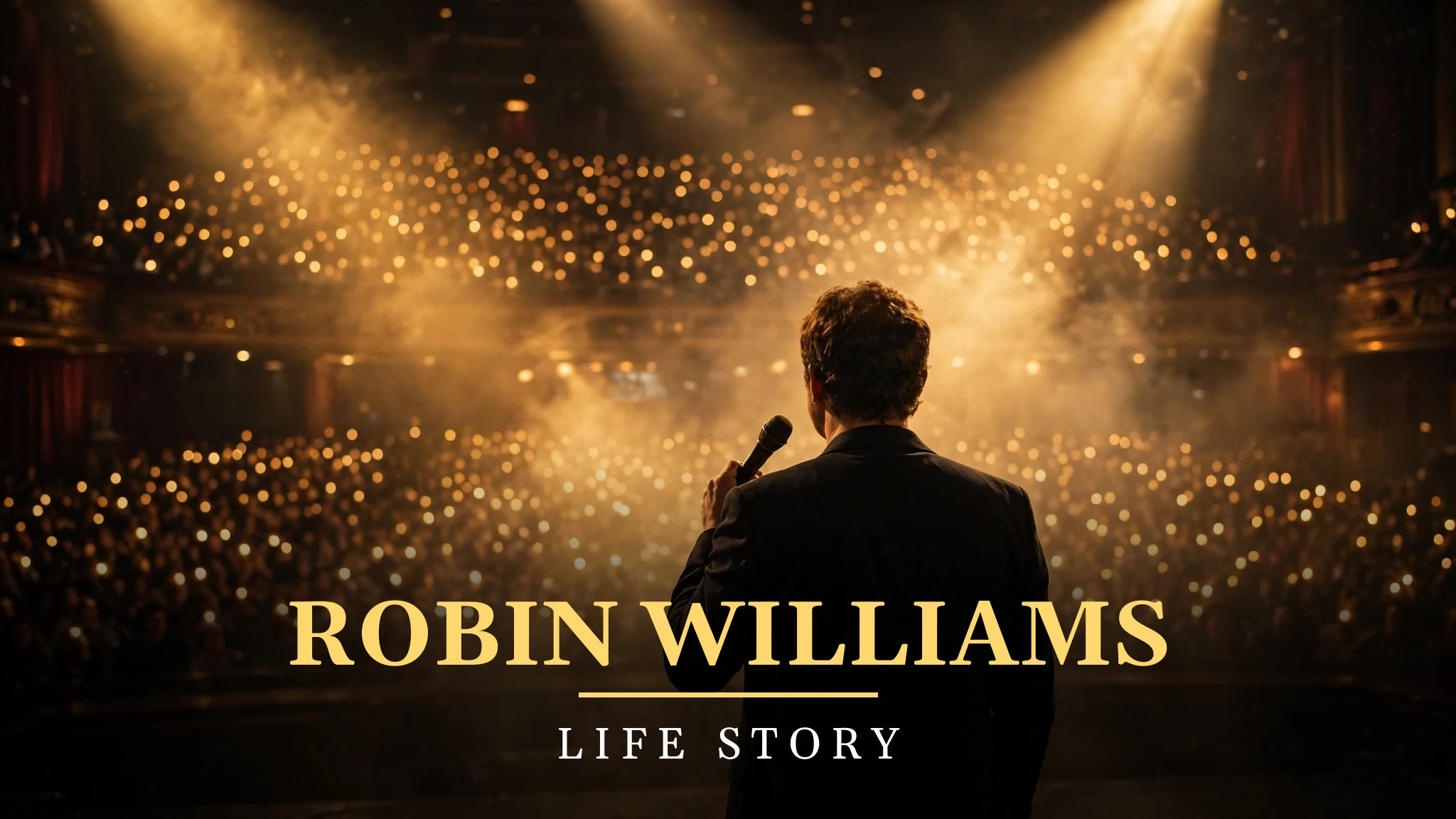
One last memory: the image of him on stage, with a microphone in his hand, moving so fast that the audience could barely keep up, and laughing as hard as they were. That is how I want to remember him: not sad, not struggling, but joyful, brilliant, and alive, doing the thing he loved most, making people laugh. That is Robin Williams, and that is the image I will carry with me, always.
And finally, I want to say thank you, because his films got me through hard times, and his comedy made me laugh when I needed to laugh, and his story reminded me that it is okay to be sad and funny at the same time. He was a gift to the world, and the world is better because he was in it. Thank you, Robin Williams. You will never be forgotten, and your laughter will never fade.
There is one more lesson in his life that I carry with me, and it is this: be generous with your talent, because talent is a gift, and gifts are meant to be shared. Williams shared his talent with the world, freely and joyfully, and the world is richer for it. If you have a talent, share it, the way he did, and do not be afraid to be brilliant. The world needs brilliance, and it needs laughter, and Williams gave us both, in abundance, and for that I am grateful.
Frequently Asked Questions
When was Robin Williams born?
Robin Williams was born on 21 July 1951 in Chicago, Illinois, USA. He grew up in Michigan and California, and he studied drama at the Juilliard School in New York.
What was Robin Williams’s most famous role?
He is famous for many roles, including Mork in Mork & Mindy, the Genie in Aladdin, Mrs. Doubtfire, and Sean Maguire in Good Will Hunting, for which he won an Academy Award.
Did Robin Williams win an Oscar?
Yes. He won the Academy Award for Best Supporting Actor for Good Will Hunting in 1997. He had been nominated three times before, for Good Morning, Vietnam, Dead Poets Society, and The Fisher King.
What caused Robin Williams’s death?
He died on 11 August 2014 at the age of 63. It was later revealed that he had been suffering from Lewy body dementia, a degenerative brain disease that had affected his thinking, movement, and mood.
What is Robin Williams’s most famous film?
Mrs. Doubtfire (1993) is one of his most loved films, along with Aladdin (1992), Dead Poets Society (1989), and Good Will Hunting (1997). Each is a classic in its own way.
Who was Robin Williams’s best friend?
His closest friend was Christopher Reeve, whom he met at Juilliard. He supported Reeve after his paralysing accident, and the two remained close friends for life.


