Ronaldo: Road to 1000 Goals Countdown After 982
In this post
- What 982 Means, and Why Another Source Says 981
- From 982 to 1000: The Simple Maths
- Where the Goals Have Come From
- The Headed-Goals Record Inside the Countdown
- Why 1000 Is So Hard, Even for Ronaldo
- What Could Speed Up or Slow Down the Chase
- Comparing Ronaldo’s Chase With Other Great Scorers
- How to Track the Countdown Without Being Misled
- My Take:
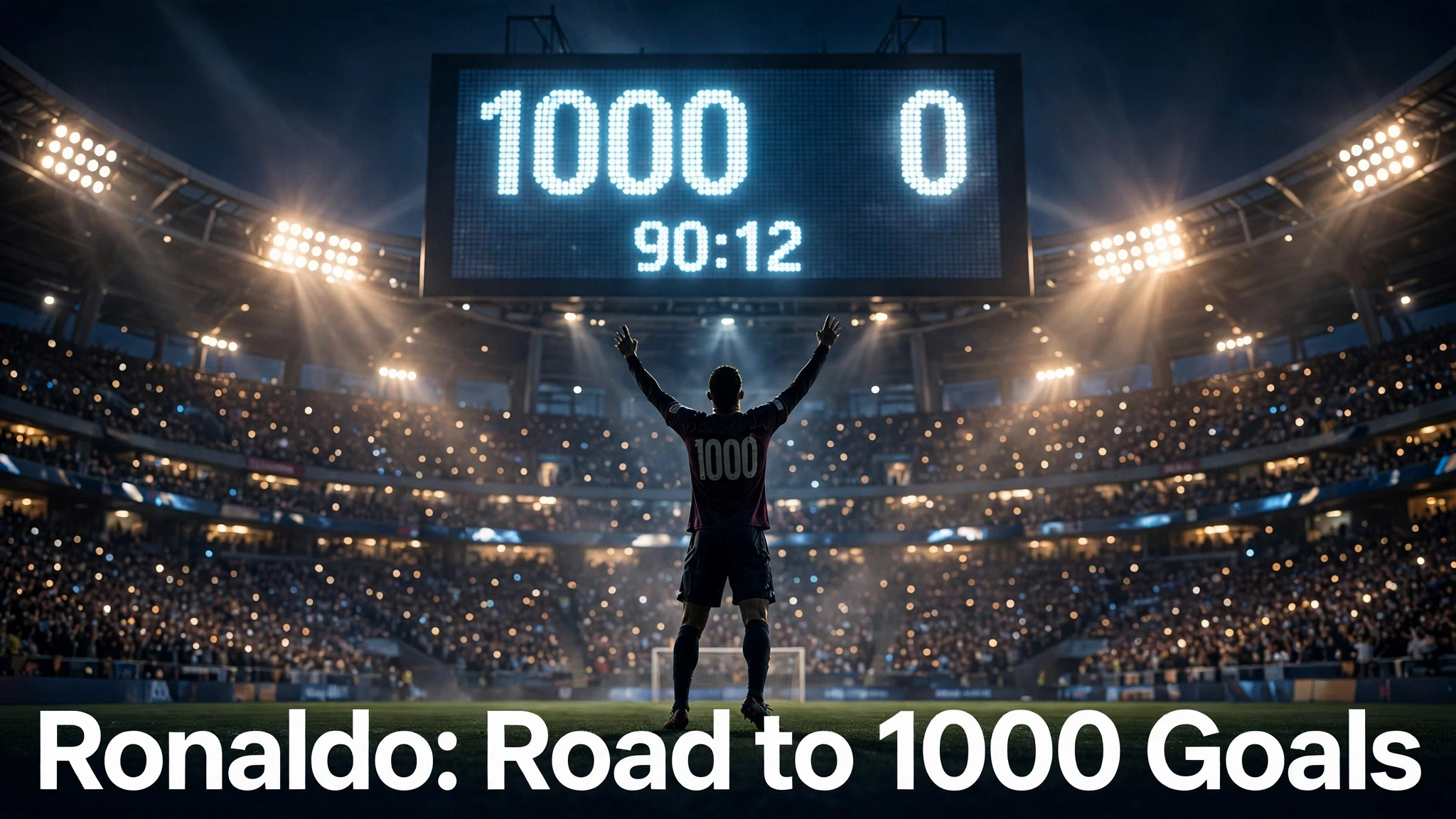
Cristiano Ronaldo’s chase for 1,000 career goals is the rarest kind of sports story: a number that no player has officially reached in competitive football, pursued by a 41-year-old still scoring regularly. After his 982nd career goal, recognised by the Saudi Pro League in Al Nassr’s 3-1 win over Al Faisaly on 23 October 2026, Ronaldo needed 18 more goals to reach 1,000 on that count. That simple subtraction — 1,000 minus 982 equals 18 — hides a more interesting truth. Goal counts differ by source, one disputed goal can move the total by one, and the date he reaches 1,000, if he does, depends on fitness, fixtures, form and competition, not on a fixed calendar. This post explains the countdown honestly, without promising a date.
What 982 Means, and Why Another Source Says 981
The 982 figure comes from the Saudi Pro League’s official record. In the Al Faisaly match, Ronaldo scored in the 49th minute after a free-kick delivery from João Félix. The match referee, Abdullah Al Owaidan, credited Ronaldo with the goal in his official report, and the league’s records reflected that decision. Saudi media confirmed that the final decision on attribution rests with the Referees Committee of the Saudi Arabian Football Federation, which relies on the referee’s report rather than automatically adopting independent statistics providers’ figures.
Other providers disagreed. Opta, ESPN’s statistics provider, recorded the goal as an own goal by Al Faisaly defender Andrei Girotto, on the grounds that it was unclear whether Ronaldo got a significant touch with his head before the ball deflected into the net off Girotto. ESPN therefore listed Ronaldo’s tally at 981 after that match, and 985 by 30 October 2026 after a hat-trick against Al Kholood, while the Saudi count would be one higher for the same period. That one-goal difference matters for headlines, but it does not change the scale of the chase: on either count, Ronaldo needs fewer than 20 goals, not 50 or 100.
The lesson for readers is to always check which count a report uses. A headline that says “18 away” and a headline that says “19 away” can both be correct under different counting rules. The Saudi league count is official for Saudi competition, while Opta’s count is widely used by international broadcasters. Neither is dishonest; they apply different rules to a deflected goal. For this post, the headline count is the Saudi league’s 982, with the Opta difference stated openly wherever it affects the countdown.
From 982 to 1000: The Simple Maths
On the Saudi count, Ronaldo needs 18 goals. On the Opta count, he needs 19. If he scores at roughly his recent Al Nassr rate — about 0.84 goals per game before the Al Faisaly match, or one goal every 103 minutes — then 18 goals would take roughly 21 to 22 matches at that rate, before accounting for injuries, suspensions, rest, international breaks or matches where he does not score. That is a projection, not a prediction. Football does not follow a straight line. A striker can score a hat-trick one week and go three matches without a goal the next.
A more useful way to think about the countdown is in stages. The first stage is 990: eight goals after 982. That would put him within ten of the milestone and make the final chase a regular news story. The second stage is 995: five more goals, leaving only five. The third stage is 999: one goal away, when every match becomes a potential history match. The final stage is 1,000 itself, which will be covered live worldwide if it happens in a major competition. Breaking the chase into stages helps readers follow it without expecting a single date.
It is also important to count only competitive club and international goals in the usual way. Friendly matches, youth goals and unofficial exhibition goals are not part of the standard 1,000-goal conversation, which is why claims by Pelé and Romário about reaching 1,000 including friendlies are treated separately by ESPN and other trackers. Ronaldo’s chase is for 1,000 officially recognised competitive goals, which is why it would be unprecedented if completed.
Where the Goals Have Come From
Ronaldo’s total is built across five clubs and Portugal. He began at Sporting CP, then played for Manchester United in two spells, Real Madrid, Juventus, and now Al Nassr. At Manchester United, he scored 145 goals in 346 appearances across both spells: 118 in the first spell and 27 in the second, at about 0.42 goals per game. At Al Nassr, before the Al Faisaly match, he had 134 goals in 159 appearances, at about 0.84 goals per game, roughly double his United rate. After the Al Faisaly goal, his Al Nassr total reached 135 in all competitions, leaving him ten short of matching his United total of 145.
That contrast does not mean one league is simply easier than another. Age, role, team quality, opposition, fitness and tactical system all affect scoring rate. At Al Nassr, Ronaldo is the central attacking focus, takes penalties and free kicks, and plays in a team built around his movement. At United, especially in his first spell, he was a winger who developed into a scorer over time. At Real Madrid, where he scored most prolifically in Europe, he played in a team designed to create chances for him at the highest level. The Al Nassr rate therefore reflects a late-career role as much as league strength, and readers should avoid using it alone to compare leagues.
Internationally, Ronaldo is already the leading men’s international scorer, with 143 goals from 225 games for Portugal, according to ESPN’s tracker in late October 2026. That international total is part of the 982, not additional to it. It includes goals in World Cups, European Championships, Nations League matches and qualifiers. His international longevity — scoring for Portugal over more than two decades — is itself a record, and it adds goals to the countdown even when club fixtures pause.
The Headed-Goals Record Inside the Countdown
Inside the 1,000-goal chase sits a second record. According to a historical compilation cited by World Soccer Talk, drawing on International Football Association Board metrics, Celtic legend Jimmy McGrory leads the all-time headed-goals list with 162. After his header against Al Faisaly, Ronaldo reached 159 headed goals, leaving him three short of equalling McGrory and four short of passing him. That record may fall before the 1,000-goal milestone, and it deserves attention because heading is a specific skill: timing, jumping, neck strength, courage in crowded boxes, and delivery from wide players.
Ronaldo’s headed goals also explain part of his longevity. As pace declines with age, aerial ability, positioning and penalty-box instinct can remain. A striker who can score with his head from crosses and set pieces stays dangerous even when he cannot beat defenders for pace as often. That adaptation is a useful lesson for young players: develop more than one scoring method, because the method that works at 21 may not be the method that works at 35 or 41.
Why 1000 Is So Hard, Even for Ronaldo
Reaching 1,000 competitive goals requires three things that rarely align: talent, durability and opportunity. Talent alone is not enough, because many great scorers retire in their mid-30s with 600 or 700 goals. Durability matters because injuries, especially muscle injuries in later years, can remove months of scoring. Opportunity matters because a player needs a team that creates chances, a manager who selects him regularly, and competitions that provide enough matches. Ronaldo has combined all three for over 20 years, which is why he is close while other greats are not.
Age is the main risk now. At 41, recovery takes longer, minor injuries become more disruptive, and managers may rest him for important matches or against weaker opponents to preserve him for bigger games. International duty adds travel and fatigue. A single injury of six to eight weeks could delay the milestone by months, and a longer injury could end the chase entirely. That uncertainty is why no responsible post should give a fixed date for goal 1,000. The countdown is real, but the calendar is not.
Form is the second risk. Scoring 18 goals requires sustained form, not one hot month. If Ronaldo scores in clusters, as strikers often do, he could reach 990 quickly and then stall. If he scores steadily, the chase will feel slower but more predictable. Either pattern is normal. Readers should follow goals per match over five or ten matches, not over one match, to judge whether the chase is on track.
What Could Speed Up or Slow Down the Chase
Several factors could change the pace. A deep cup run by Al Nassr would add matches and scoring chances. A strong Portugal campaign, with extra qualifiers or tournament matches, would also add goals. Conversely, early cup exits, international retirement, or a decision to reduce minutes would slow the chase. The Saudi Pro League calendar, with its breaks and fixture congestion, also matters. A congested week with three matches in eight days can produce goals quickly, but it also increases injury risk for an older player.
Set pieces help. Ronaldo takes penalties and free kicks, which provide regular scoring chances independent of open-play form. Penalties are the most reliable route to a milestone, because they do not depend on beating a defender. That is also why some critics discount penalty goals, but standard goal counts include them, and every great scorer in history has benefited from penalties. The fair comparison is total competitive goals, with the breakdown by penalty, header, free kick and open play available for readers who want detail.
Finally, the disputed-goal issue could reappear. If another deflected goal is credited differently by the league and by Opta, headlines will again differ by one. Readers should check the source before celebrating or disputing a milestone. The official league record will decide Saudi matches, while international trackers may keep a different total. That difference will matter most at 999 and 1,000, when one goal decides whether history has been made.
Comparing Ronaldo’s Chase With Other Great Scorers
No other player gives a direct comparison for 1,000 competitive goals, which is why the chase feels unprecedented. Pelé and Romário both claimed 1,000 goals when friendly and exhibition matches were included, but standard competitive counts place them below that figure, and their claims are treated separately by modern trackers. Josef Bican, from an earlier era, is sometimes credited with more than 800 goals, but records from his period are incomplete and competitions differed. Lionel Messi, Ronaldo’s contemporary rival, sits around 936 in the comparison cited in late October 2026, which is extraordinary but still more than 60 short of 1,000. That gap shows how much longevity matters: Messi and Ronaldo are close in peak scoring, but Ronaldo’s longer run as a central scorer, plus his international total, puts him uniquely close. Gerd Müller, Ferenc Puskás and other historic scorers also fall short of 1,000 in competitive counts, despite legendary rates, because their careers were shorter or their teams played fewer matches. The lesson is that 1,000 is not simply a talent threshold. It is a durability threshold, requiring more than 20 seasons of regular scoring, freedom from career-ending injury, and a team that keeps creating chances. That is why even if Ronaldo falls a few goals short, his total will remain a benchmark that future players are unlikely to approach without a similarly long, healthy and central career.
How to Track the Countdown Without Being Misled
Track the countdown by recording three things after each match: the source of the count, the competition, and the type of goal. The source matters because Saudi league and Opta counts can differ by one after a disputed deflection. The competition matters because club league goals, cup goals and international goals all count toward the career total, but they are reported in different places and on different schedules. The type of goal matters because penalties, headers, free kicks and open-play goals tell different stories about form: a run of penalties suggests opportunity, a run of headers suggests aerial dominance, and a run of open-play goals suggests broader attacking form. A simple table — date, opponent, competition, goal number on each count, goal type — prevents the common error of celebrating 1,000 a match early or disputing a legitimate goal because of a different counting rule. It also helps readers see whether Ronaldo is scoring steadily or in clusters, which is the best predictor of how long the final stage will take.
My Take:
I think the most honest way to follow Ronaldo’s countdown is to treat 982 as a starting point, not as a promise. The maths is simple: 18 goals on the Saudi count, 19 on the Opta count. The football is not simple. A 41-year-old body, a congested calendar, international travel, and the normal ups and downs of striking form all stand between Ronaldo and 1,000. I have seen too many milestone chases ruined by premature predictions. A journalist who names a month, a match or an opponent for goal 1,000 is guessing, not reporting. The responsible approach is to track the stages — 990, 995, 999, 1,000 — and to update the count after each match, with the source stated.
I also think the disputed Al Faisaly goal is more interesting than embarrassing. It shows how football statistics work in the real world. A referee’s report, a league record, a data provider’s video review and a fan’s memory can all differ on the same incident. That does not mean anyone is lying. It means attribution rules differ. The Saudi league follows the referee. Opta follows its own deflection rules. Both are defensible, but they produce different totals. For a milestone as large as 1,000, that one-goal gap will become a story in itself. When Ronaldo is on 999 by one count and 1,000 by another, broadcasters will have to explain the difference live. That explanation will be confusing, but it will also be educational. It will teach viewers that statistics are not pure facts; they are facts produced by rules.
My judgement on Ronaldo’s longevity is that it deserves respect without exaggeration. Scoring at 0.84 goals per game at Al Nassr is remarkable for any age, and doing it at 41 is extraordinary. But it does not prove that the Saudi league is weak, nor does it prove that Ronaldo at 41 is better than Ronaldo at 28. It proves that he has adapted: central role, penalty and set-piece responsibility, aerial threat, penalty-box positioning, and a team built around him. Adaptation is the real story of late-career greatness. Players who refuse to adapt fade. Players who adapt extend their careers. Ronaldo’s adaptation is not only physical; it is tactical and psychological. He accepts a different role and still delivers goals.
I am also struck by the headed-goals record, because it is a quieter achievement inside a louder chase. Jimmy McGrory’s 162 headed goals stood for decades, from a different era of football, with different balls, pitches and defensive rules. Ronaldo reaching 159 is therefore a bridge between eras. It shows that some skills — timing, bravery, heading technique — transfer across generations. If Ronaldo passes McGrory before reaching 1,000, that moment deserves its own coverage, not only as a footnote to the bigger chase. It would be a record in its own right, earned over 20 years of aerial goals.
Finally, I think readers should enjoy the countdown without turning it into a weapon in the Ronaldo versus Messi debate. Messi’s total, around 936 in the same comparison, is also extraordinary, and the two players have different roles, teams and careers. The 1,000-goal chase is not a verdict on who is “better.” It is a specific milestone that only Ronaldo is close to, because only he has combined this scoring rate with this longevity in competitive football. If he reaches it, it will be a first. If he falls short by a few goals, the chase will still have been historic. Either way, the next 18 goals — or 19, depending on your count — are worth watching match by match, without a promised date.
One more angle deserves attention: what goal 1,000 would mean for Al Nassr and the Saudi Pro League, beyond Ronaldo himself. A milestone of this size would bring global television, social media and sponsorship attention to a league match that might otherwise receive limited international coverage. That attention benefits the league, the club, teammates who assist the goal, and young Saudi players who gain visibility by playing alongside Ronaldo. It also creates pressure: teammates may try too hard to set Ronaldo up, opponents may defend more aggressively to prevent history, and referees may face scrutiny over every decision near the milestone. Managing that pressure is a team task, not only an individual one. A manager must balance the milestone chase with winning matches, rotating an older player, and developing younger scorers. If the chase distorts team play, it could harm results even as it creates headlines. The healthiest way to reach 1,000 is as a by-product of winning football, not as a separate project that overrides tactics.
There is a final, personal angle to the countdown that statistics miss. For Ronaldo, 1,000 is not only a number; it is a reason to keep training, recovering and playing at 41, when most players have retired. That motivation can extend a career, but it can also prolong it past the point where retirement would be healthier or happier. Fans should therefore enjoy the chase without demanding it. If Ronaldo reaches 1,000, celebrate it as a historic first. If he stops at 990 or 995, celebrate that total as well, because it still represents more than two decades of scoring at the highest level. A milestone should be a celebration, not a test that turns a great career into a failure if one number is missed. That perspective keeps the countdown enjoyable, rather than turning every goalless match into a crisis.
A final caution concerns social media during the countdown. Clips, graphics and “goal 1,000” posts will circulate before official confirmation, especially after deflected goals or in matches with disputed attribution. A clip alone does not prove a goal count, because the same clip can be captioned with the Saudi total, the Opta total, or a fan total that includes different competitions. Before sharing a milestone post, check the source, the competition and the date, and compare at least two reputable trackers. That habit takes thirty seconds and prevents the spread of a false milestone, which is difficult to correct once it has gone viral. The countdown is exciting precisely because it is close, and that closeness makes accuracy more important, not less.
Frequently Asked Questions
How many goals does Ronaldo need after 982 to reach 1000? On the Saudi Pro League count of 982, Ronaldo needs 18 more goals to reach 1,000. On Opta’s count, which recorded the Al Faisaly goal as an own goal by Girotto, he needs 19. Always check which count a report uses before comparing headlines.
When did Ronaldo score his 982nd goal recognised by the Saudi Pro League? Ronaldo’s 982nd goal on the Saudi count came on 23 October 2026 in Al Nassr’s 3-1 win over Al Faisaly, when he scored in the 49th minute after a free-kick delivery from João Félix. The referee credited Ronaldo in his official report, while Opta recorded it as an own goal.
What is Ronaldo’s scoring rate at Al Nassr compared with Manchester United? Before the Al Faisaly match, Ronaldo had 134 goals in 159 Al Nassr appearances, about 0.84 goals per game, compared with 145 goals in 346 Manchester United appearances across two spells, about 0.42 goals per game. The Al Faisaly goal took his Al Nassr total to 135, ten short of his United total.
How many headed goals does Ronaldo need to break Jimmy McGrory’s record? After his header against Al Faisaly, Ronaldo had 159 headed goals, according to the historical compilation cited by World Soccer Talk, leaving him three short of equalling Jimmy McGrory’s 162 and four short of passing him. That record could fall before the 1,000-goal milestone.
How many international goals has Ronaldo scored for Portugal in the 1000-goal count? Ronaldo is the leading men’s international scorer, with 143 goals from 225 games for Portugal according to ESPN’s tracker in late October 2026. Those international goals are included in his career total, not added on top of it.
Will Ronaldo definitely reach 1000 goals, and on what date? No date can be guaranteed. Reaching 1,000 depends on fitness, form, fixtures, cup runs, international matches and injury, especially at age 41. Projections based on his Al Nassr rate suggest roughly 21 to 22 matches for 18 goals, but that is a projection only, not a promised date.
Why do Ronaldo goal totals differ between the Saudi league and Opta? The Saudi league follows the referee’s official report, which credited Ronaldo with the Al Faisaly goal, while Opta applies its own deflection rules and recorded it as an own goal by Andrei Girotto. Different attribution rules produce a one-goal difference, which is why the countdown can be 18 or 19 depending on the source.
Sources
- https://worldsoccertalk.com/amp/news/cristiano-ronaldo-on-verge-of-breaking-all-time-heading-record-as-saudi-pro-league-recognizes-his-982nd-career-goal-how-many-more-does-he-need/
- https://www.beinsports.com/en-us/soccer/articles/cristiano-ronaldo-s-ghost-goals-spark-huge-al-nassr-controversy-2026-10-27
- https://www.espn.ph/football/story/_/id/46751020/cristiano-ronaldo-goal-tracker-road-1000-career-goals
- https://worldsoccertalk.com/news/cristiano-ronaldo-is-on-the-verge-of-matching-his-manchester-united-goal-total-at-al-nassr/