Roxy Music: The Life Story Behind the Art Rock Legends
In this post
- Bryan Ferry, Brian Eno and Art School in London
- Virginia Plain, For Your Pleasure and the First Albums
- Country Life, Siren and Love Is the Drug
- Flesh and Blood, Avalon and More Than This
- Reunions, the Hall of Fame and a Lasting Legacy
- The Singer, the Saxophone and the Art of Rock
- Still Legends, Still Together in Spirit
- The Cover Art and the Image of Roxy Music
- My Take:
Roxy Music make rock music that sounds like art: glamorous, clever, strange and beautiful, with a singer in a suit, a saxophone, a synthesiser, and songs that feel like they come from another world. When their song Virginia Plain became a hit in 1972, it sounded like nothing else on the radio: a fast, witty track with a driving beat, a saxophone, and a singer who sounded like he had stepped out of a film. It was a new kind of rock music, and it came from a group of art school friends in London who believed that a band could be as stylish as a painting and as exciting as a party.
The band formed in London in 1970, and its founder was Bryan Ferry, a singer and songwriter who had studied art and who loved music, film and fashion. He was joined by Brian Eno, a musician who played synthesisers and who loved strange sounds, Andy Mackay, who played saxophone and oboe, Phil Manzanera, who played guitar, Paul Thompson, who played drums, and Graham Simpson, who played bass. Together, they made a sound that mixed rock, pop, jazz and electronic music, and they became one of the most influential British bands of the 1970s and 1980s.
Their journey has brought them hit albums, songs that are still played around the world, and a place in the Rock and Roll Hall of Fame. Their albums are Roxy Music from 1972, For Your Pleasure from 1973, Stranded from 1973, Country Life from 1974, Siren from 1975, Manifesto from 1979, Flesh and Blood from 1980, and Avalon from 1982. Through all of it, they changed members, they changed sounds, and they kept the same belief: that rock music could be art, and that art could be fun.
Bryan Ferry, Brian Eno and Art School in London
Bryan Ferry grew up in the north of England, in Washington, County Durham, and he studied art at university in Newcastle. He loved music, film and fashion, and he began to sing in bands while he was still a student. He moved to London in the late 1960s, and he worked as a teacher while he tried to form a band. He wanted a group that would be different from the rock bands of the time: a band that would be stylish, clever and artistic, with a singer who dressed like a film star and songs that sounded like they came from a gallery.
Brian Eno was a young musician and artist who had studied art as well, and he loved electronic sounds, strange noises, and the idea of making music that was not like anything else. He played synthesisers, he made tapes of sounds, and he had a gift for thinking about music in a new way. Andy Mackay was a saxophone player who loved jazz and classical music, and Phil Manzanera was a guitarist who loved rock and who had a gift for melody. Paul Thompson was a drummer with power and precision, and Graham Simpson was a bass player who gave the band its bottom end.
The six of them met in London in 1970, through friends in the art world, and they began to rehearse together. They practised in small rooms, they tried songs, they argued about clothes, about sounds, about the look of the band. Ferry wanted the band to look glamorous, like a film, and the others agreed. They wore suits, they styled their hair, and they made their stage shows look like art. That visual style became part of their identity, and it made them stand out in a time when many rock bands dressed in jeans and T-shirts.
By 1971, the band had a name and a clear idea of what they wanted to be. They called themselves Roxy Music, a name that pointed to the Roxy, a cinema, and to the glamour of old films. They began to play small shows in London, and they began to record their first songs. The audiences were small at first, but the people who heard them noticed the difference. Here was a band that sounded like rock, like jazz, like electronic music, and like a film, all at the same time. It was a new sound, and it was about to travel far beyond London.
Virginia Plain, For Your Pleasure and the First Albums
Roxy Music released their debut album, Roxy Music, in 1972, and it included Virginia Plain, a song that became a hit in Britain. Virginia Plain is a fast and witty track, with a driving beat, a saxophone, and Ferry singing about a girl, a car, and a night out. The song was written in a hurry, after the album was finished, and it became the band’s first hit. It showed their gift for writing a pop song that was also clever and strange, and it won them a loyal following.
For Your Pleasure, their second album, was released in 1973, and it was a darker and more experimental record. The album included Do the Strand, a song about dancing, and In Every Dream Home a Heartache, a long and strange song about love and loneliness. The album was praised by critics, and it showed the band growing bolder, with Eno’s synthesisers making sounds that no one had heard before. It was the last album with Eno, who left the band in 1973 to make solo music. His departure changed the band, but it did not stop them. They carried on, with a new member, Eddie Jobson, on keyboards and violin, and they found a new sound.
Stranded, their third album, was released in 1973, and it included Street Life, a song that became a hit, and Mother of Pearl, a track that showed Ferry’s gift for writing about love and glamour. The album reached number one in Britain, and it showed that Roxy Music could survive without Eno. The band had become Ferry’s band, with Mackay’s saxophone, Manzanera’s guitar and Thompson’s drums giving the songs their shape. It was a remarkable achievement, and it set the stage for the band’s next albums.
Touring for these early albums took them around the world, and their live shows became famous for their style. Ferry sang in a suit, Mackay played saxophone, Manzanera played guitar, and the stage was lit like a film set. The shows were glamorous, clever and exciting, and the audiences loved them. Roxy Music had become one of the most stylish bands in Britain, and their influence was growing, not just in music, but in fashion and art as well.
Country Life, Siren and Love Is the Drug
Country Life, their fourth album, was released in 1974, and it included The Thrill of It All, a song about the excitement of love, and All I Want Is You, a track with a feeling of longing. The album was praised by critics, and it showed the band still making music with the same glamour and cleverness as before. The album’s cover, with two models in the countryside, became famous, and it showed the band’s love of art and fashion. It was a record that worked as music and as an image, and that combination became their signature.
Siren, their fifth album, was released in 1975, and it included Love Is the Drug, one of their most famous songs. Love Is the Drug is a smooth and seductive track, with a bass line that moves like a dance, and Ferry singing about love as if it were a drug. The song became a hit in Britain and in America, and it is still played on the radio today. The album also included Sentimental Fool, a song about heartbreak, and Just Another High, a track about the feeling of being lost. Siren was praised by critics, and it showed the band at the height of their early powers.
The years after Siren were a time of change. The band took a break, Ferry made solo albums, and the members worked on other projects. They had been working without a break for five years, and they needed time to rest, to think, and to find new ideas. That break was important. It gave them space to grow, and it gave them the freedom to make their next albums in their own way, without the pressure of following a hit. When they returned, their music had changed, and the change showed a band that was still curious and still willing to try new things.
Manifesto, their sixth album, was released in 1979, and it included Dance Away, a song that became a hit, and Angel Eyes, a track with a feeling of romance. The album was a return to the charts, and it showed the band still making music with the same style as before, but with a softer and more polished sound. The album was praised by critics, and it kept the band at the top of the British music world, even after a break of four years.
Flesh and Blood, Avalon and More Than This
Flesh and Blood, their seventh album, was released in 1980, and it included Over You, a song about a relationship ending, and Oh Yeah, a track with a feeling of nostalgia. The album was a smooth and polished record, with a sound that was more pop than rock, and it showed the band moving towards a softer and more romantic style. It was praised by critics, and it became a hit in Britain, with the band’s audience growing older with them.
Avalon, their eighth and final studio album, was released in 1982, and it became their most successful record. The album included More Than This, one of their most famous songs, a soft and beautiful track about love, and Avalon, the title song, a dreamy and romantic track that became a favourite at weddings. The album also included The Space Between, a song about distance, and Take a Chance with Me, a track about taking a risk in love. Avalon reached number one in Britain, and it became a classic, a record that is still loved today.
Avalon was a very different album from the band’s early records. It was soft, smooth and romantic, with a sound that was more like a late night than a rock concert. Ferry sang with a warmth that made the songs feel personal, Mackay’s saxophone gave the tracks their lift, and Manzanera’s guitar gave them their shape. The album was made slowly, with great care, and it showed a band that had grown up, from wild art school students to mature musicians making music about love and life.
After Avalon, the band split up in 1983. Ferry continued as a solo artist, Manzanera worked on other projects, and Mackay and Thompson worked on their own music. The split was not bitter. It was a decision made by friends who had shared a long journey and who wanted different things from the next part of their lives. The band’s story could have ended there, but it did not. They would return, many years later, to play together again.
Reunions, the Hall of Fame and a Lasting Legacy
Roxy Music reunited in 2001, almost twenty years after they had split, and they played a tour that brought their old songs to a new generation. The reunion shows were joyful, with Ferry singing, Mackay playing saxophone, Manzanera playing guitar, and Thompson playing drums. The crowds sang along to Virginia Plain, Love Is the Drug and More Than This, and the band played with the same energy as before. It was a reminder that their music had lasted, and that their audience had stayed with them.
The band reunited again in 2011, and again in 2022, for a tour to mark fifty years since their first album. The 2022 tour took them to Britain, Europe and America, and it was a celebration of their history. Ferry, Mackay, Manzanera and Thompson played together, with guest musicians, and the shows were praised by critics and loved by fans. It was a fitting way to mark fifty years of a band that had changed British music.
In 2019, Roxy Music were inducted into the Rock and Roll Hall of Fame, one of the biggest honours in music. The induction was a recognition of their influence, not just on rock music, but on pop, on electronic music, on fashion and on art. Many younger bands, from Duran Duran to The Smiths to modern electronic acts, have pointed to Roxy Music as an influence, and the Hall of Fame induction said that their work mattered, and that it would be remembered.
The band’s legacy is also a story about style. Roxy Music showed that a rock band could be glamorous, that a singer could wear a suit, that an album cover could be a work of art, and that a song could be both clever and catchy. That lesson has helped a new generation of musicians to be braver about their image, about their sound, and about the feeling of their music. Roxy Music never set out to be teachers, but their example has taught a lesson anyway: a band should be as stylish as its music, and its music should be as stylish as its image.
The Singer, the Saxophone and the Art of Rock
One of the most famous things about Roxy Music is Bryan Ferry’s voice. He sings in a smooth and romantic way, with a feeling of longing that makes the songs feel personal. His voice is the centre of the band’s sound, and it gives their rock music a warmth that many rock bands do not have. When he sings More Than This, it feels like he is singing to one person alone, and that intimacy is the reason the song is still loved today.
Andy Mackay’s saxophone is the other half of the band’s sound. The saxophone is not a normal rock instrument, and Mackay plays it with a feeling that makes the songs soar. His playing gives the band’s tracks their lift, their romance, and their glamour. Phil Manzanera’s guitar gives the songs their shape, with melodies that stay in the mind, and Paul Thompson’s drums give them their power. Together, the four of them make a sound that is bigger than any one instrument, and that is the reason their music has lasted for so long.
Brian Eno’s early work with the band is also part of their story. Eno played synthesisers, he made strange sounds, and he gave the band’s early albums a feeling of mystery. His departure in 1973 changed the band, but his influence stayed. The band’s later albums still had a feeling of art and experiment, and that feeling came from Eno’s time with them. Eno went on to become one of the most famous producers in the world, working with U2, David Bowie and many others, and his time in Roxy Music was the start of that journey.
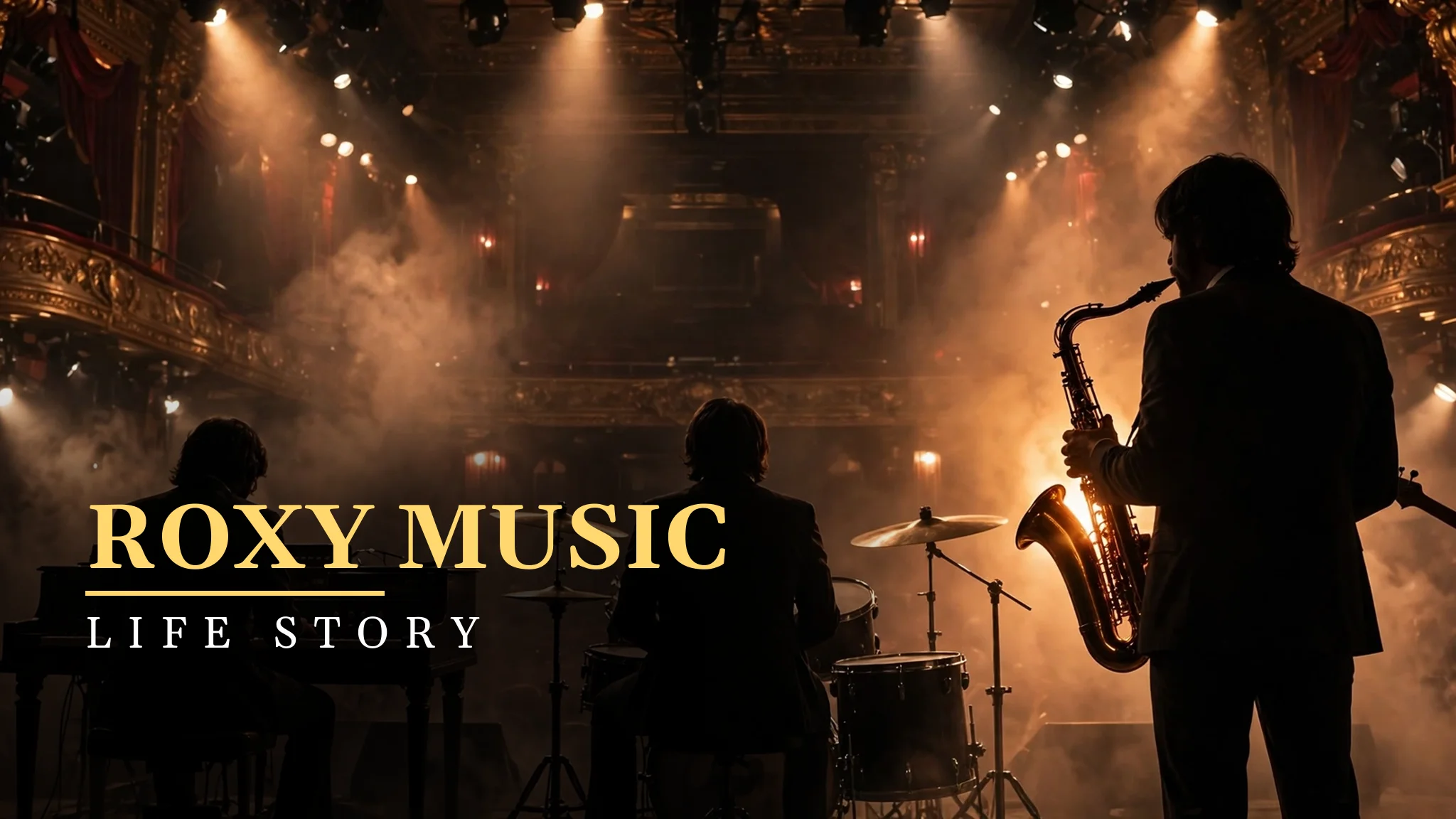
Their live shows are famous for their style. Ferry sings in a suit, Mackay plays saxophone, Manzanera plays guitar, and the stage is lit like a film set. The shows are glamorous, clever and exciting, and the audiences love them. A Roxy Music concert is not just a rock show. It is a work of art, a night where music, fashion and film come together. That style is part of why people love them, and it is part of why their influence has lasted for fifty years.
Still Legends, Still Together in Spirit
In the years since their last tour, Roxy Music have remained legends, with their albums still loved and their songs still played. Bryan Ferry continues to make solo music, Phil Manzanera continues to work on other projects, and Andy Mackay continues to play. The band may not make a new album, but their story is complete: eight studio albums, hit songs, a place in the Hall of Fame, and a legacy that has shaped British music for fifty years.
Looking back, the story of Roxy Music is a story of art and rock. They started as art school friends in London in 1970, they made Virginia Plain, they became famous with Love Is the Drug, they made their masterpiece with Avalon, they split up, they reunited, and they were inducted into the Hall of Fame. Their songs are still played on the radio, at weddings, and in films, and they still make people feel. That is a good legacy for a band that began with a simple idea: that rock music could be art, and that art could be fun.
The Cover Art and the Image of Roxy Music
Roxy Music cared about their album covers as much as their songs, and their covers became famous in their own right. Each album had a different image, a different model, a different colour, and each one told the listener something about the music inside. The debut album had a glamorous cover, For Your Pleasure had a dark and mysterious cover, Country Life had a cover with two models in the countryside that became famous, and Avalon had a soft and romantic cover with a falcon. Those covers are not just packaging. They are works of art, and they helped the band’s music travel.
Bryan Ferry understood that an album cover is the first thing a person sees, and that it can make them want to listen. He worked with artists, photographers and designers to create covers that looked like paintings, like films, like fashion magazines. That attention to detail made Roxy Music stand out in a record shop, where many album covers were plain and simple. A person who saw a Roxy Music cover wanted to know what the music sounded like, and that curiosity brought new listeners to the band.
Their stage image was just as careful. Ferry wore suits, Mackay played saxophone in a stylish way, Manzanera played guitar with elegance, and the whole band looked like they had stepped out of a film. That style was not a trick. It was part of who they were: art school friends who loved fashion, film and art, and who believed that a concert should be a visual experience as well as a musical one. When Roxy Music stepped on stage, the audience saw a band that looked as good as it sounded, and that image made the music feel larger.
Their influence on fashion was real. Young people copied Ferry’s suits, his hair, his style, and designers took ideas from the band’s covers and shows. That influence went beyond music, into the world of fashion, art and film, and it is part of why Roxy Music are remembered as more than just a rock band. They were a cultural force, a group that changed how a band could look, as well as how it could sound. That is a rare achievement, and it is a sign of how far their ideas travelled.
The band’s videos and television appearances also carried that image. When they appeared on television, they looked glamorous, they played with style, and they made the audience want to listen. That visual confidence helped their songs in other countries, where a viewer who did not speak English could still understand the glamour, the style, and the feeling of the music. A good image can travel across borders even when the words cannot, and Roxy Music’s image did that.
What I find most interesting about their covers is that they never hide the music. The covers are beautiful, the stage is beautiful, and yet the songs are still at the centre. The style serves the music, not the other way around. That is a hard balance to keep, because a big visual can easily swallow a song. Roxy Music keep the balance, because they remember that the music came first, and that the image is there to make the music feel larger, not to replace it. That is a lesson for any artist who works with visuals: the art should lift the song, not hide it.
My Take:
When I listen to Roxy Music, the first thing I feel is style. Their music sounds glamorous, with a singer in a suit, a saxophone, and songs that feel like they come from a film. More Than This is a soft and beautiful song, but it is also a song about love that is honest and direct. Love Is the Drug is a smooth and seductive song, but it is also a song about the power of love to control us. That mix of glamour and feeling feels honest to me, because real life is often like that: beautiful on the outside, complicated on the inside. I admire music that can be both, and Roxy Music do that better than most rock bands I know.
I think the most admirable part of their story is Bryan Ferry’s vision. He studied art, he loved film and fashion, and he wanted a band that would be as stylish as a painting and as exciting as a party. That takes courage, because a rock band that dresses in suits and sings about glamour can easily be laughed at. Ferry did not let that fear stop him. He built a band around his vision, he found musicians who shared it, and he made records that proved his idea was right. I think young musicians should remember that. A clear vision, held with confidence, can become a new sound, if you have the patience to make it work.
I also admire Brian Eno, and the way he made strange sounds with synthesisers. Eno was a young artist who loved electronic music, and he gave Roxy Music’s early albums a feeling of mystery that no other rock band had. His departure in 1973 could have ended the band, but it did not. It made them find a new sound, and that new sound became their own. I think that is an important lesson. A band can lose a member, and it can still grow. The loss can be a chance to find something new, if the remaining members are willing to try.
There is a sadness in their story, too, and it is the sadness of a band that split up at the height of its powers. After Avalon in 1982, one of the most successful albums of their career, Roxy Music split up. It was not a bitter split, but it was still a loss. Fans who loved Avalon wanted more, and they had to wait almost twenty years for a reunion. I think that is a shame, because the band were making their best music when they stopped. But I also understand why they stopped. They had been working for twelve years, they needed time to rest, and they wanted to do other things. That is a human decision, and I respect it, even though I wish they had made more albums together.
Another thing I notice is how much their music depends on style. Ferry’s suits, Mackay’s saxophone, the album covers, the stage design: all of it is part of the band’s identity. That style is sometimes treated as less serious than the music, but I think that is unfair. Style is part of the music, and a band that cares about how it looks cares about its audience. Roxy Music showed that a rock band could be glamorous without losing its honesty, and that lesson has helped many younger bands to be braver about their image.
I find their album Avalon especially moving, because it is a record about love made by a band that had grown up. The early albums were wild and strange, with songs about dancing and nightlife. Avalon is soft, smooth and romantic, with songs about love that lasts, about distance, about taking a chance. It is a record made by adults, for adults, and it is beautiful because of that maturity. I think it is one of the best albums of the 1980s, and it is a fitting final studio album for a band that had grown so much since Virginia Plain.
If I have a criticism, it is only that their early albums can sometimes feel strange to a new listener. The synthesisers, the saxophone, the witty lyrics: all of it can feel like a puzzle that takes time to solve. That is not a real fault, though. It is a sign that the band was ahead of its time, and that its music needs a patient listener. I would not want them to lose the strangeness that made them special. I only wish that more people took the time to listen closely, because the reward is a band that is richer than a single hit.
I also think about their reunions, and how joyful they must have been. A Roxy Music reunion concert is a celebration, with old friends playing together, and the crowd singing along to songs they have loved for fifty years. I would love to have been in that crowd, to hear More Than This played live, and to feel the warmth that the band clearly feel when they play together. That is a rare feeling in music, where so many reunions feel forced. Roxy Music feel genuine, and that genuineness is part of why people love them.
When I compare Roxy Music with other bands of their time, what stands out is their influence. They influenced Duran Duran, The Smiths, modern electronic acts, fashion designers, film makers, and many others. That influence is not just about sound. It is about the idea that a band can be art, that a song can be clever, and that a concert can be beautiful. I think that is the clearest lesson in their story: a band does not need to choose between art and pop. It can be both, and when it is both, it lasts longer than a band that is only one of those things.
For a young reader, I think the lesson is about vision. Bryan Ferry had a vision of a glamorous, artistic rock band, and he built it, even when people might have laughed. That takes courage, because a vision can easily fail. But Ferry’s vision succeeded, and it changed British music. That tells me that if you have a clear idea of what you want to make, and you work at it with care, then the world will listen. That is a hopeful thought, and it is one I will carry with me.
I also take a personal lesson from their patience. They started as art school friends, they made albums one by one, they took a break, they reunited, and they are still loved fifty years later. That tells me that slow work, done with care, can still win. I do not need to rush. I can build something piece by piece, and if it is honest, people will find it, even if it takes fifty years for the world to fully understand it.
In the end, I think Roxy Music matter because they prove that rock music can be art. Their songs make people dance, and they also make people think. When I hear More Than This today, I still feel the beauty, I still feel the love, and I still feel the glamour that the band put into the song. That is a good rock song, and it is a good legacy for a band that started in London in 1970 with a simple idea: that a band could be as stylish as a painting and as exciting as a party.
One more thought stays with me, and it is about the future. I do not know if Roxy Music will tour again, and I do not need to know. Their music is already complete, with eight studio albums that tell a story from Virginia Plain to Avalon. That trust is something a band earns over many years, and Roxy Music have earned it. I will keep listening, not because they are the loudest band in the world, but because they are one of the most stylish, and style in music is rarer than it should be.
I also think about what I would say to a friend who had never heard Roxy Music. I would start with More Than This, because it is their most beautiful song, and then I would play Love Is the Drug, and then Virginia Plain, and I would let the friend hear how the band can be soft and wild at the same time. That is the best way to meet this band: through the romance first, and then through the stranger songs that show what they really wanted to say.
There is another lesson in their story that I keep coming back to, and it is about the value of a clear vision. Bryan Ferry had a vision of a glamorous, artistic rock band, and he built it. That tells me that a person does not need to follow the crowd. They can follow their own idea, work at it with care, and the world will listen. That is a hopeful thought, and it is one I will carry with me into my own work.
I also wonder if Roxy Music will tour again, and I find that I do not mind not knowing. Some bands make me want to guess, to predict, to follow every rumour. Roxy Music make me want to wait, or simply to listen to the albums they have already made. I trust that their music is complete, with eight studio albums that tell a story from Virginia Plain to Avalon. That trust is a rare thing to feel about a band, and it is the result of more than fifty years of good work. A band that has never let me down earns the right to be remembered, even if they never play again.
When I think about Bryan Ferry’s voice, I think about how it has stayed with me, even after many years. His voice is smooth and romantic, and it makes the songs feel personal. That voice is now part of my memory, and every time I hear More Than This, I hear him again. That is the power of a recording: a voice can live on, even when the years pass, and it can still speak to people who were not alive when the song was made. I find that both sad and hopeful, because it shows that a person’s work can outlive them, and that is a kind of immortality.
I also think about the listeners who found this band during hard times. Many people discovered Roxy Music when they were young, when they needed a band that sounded glamorous and clever, and the songs became part of their happiest memories. Those listeners did not find the band in a quiet room. They found them on the radio, on television, in a record shop, and the songs stayed with them when they grew up. That is a special kind of success: not a hit that everyone hears at once, but a song that finds the right person at the right time, and stays.
If I could ask Ferry one question, I would ask him how he keeps his vision clear after fifty years, how he knows when a song is glamorous enough, when it is clever enough, when it is ready. I suspect the answer would be simple: he listens, he looks, and he trusts his taste. That simplicity is the heart of their story, and it is the reason their music still sounds fresh. An artist who trusts himself will always sound honest, and honesty is the rarest sound in popular music.
In the end, what I carry from Roxy Music is a feeling of style. Their music does not shout, it does not beg, and it does not try to be everything at once. It is a glamorous, clever sound, made by friends who listened to each other, and it reaches people all over the world. That is enough, and it is more than enough. It is a reminder that stylish work, done with care, can still be heard, even in the noisiest of times.
Frequently Asked Questions
Who were the members of Roxy Music?
Roxy Music were founded by Bryan Ferry, with Brian Eno on synthesisers, Andy Mackay on saxophone, Phil Manzanera on guitar, Paul Thompson on drums, and Graham Simpson on bass. Eno left in 1973, and Eddie Jobson later joined on keyboards and violin.
What is Roxy Music’s most famous song?
More Than This is one of their most famous songs, a soft and beautiful track from Avalon about love. Love Is the Drug from Siren and Virginia Plain from their debut album are also well known songs.
What albums has Roxy Music released?
Their studio albums are Roxy Music from 1972, For Your Pleasure from 1973, Stranded from 1973, Country Life from 1974, Siren from 1975, Manifesto from 1979, Flesh and Blood from 1980, and Avalon from 1982. Avalon was their most successful album.
Why did Brian Eno leave Roxy Music?
Brian Eno left the band in 1973, after their second album For Your Pleasure, to make solo music and to work as a producer. He went on to become one of the most famous producers in the world, working with U2, David Bowie and many others.
What is Avalon about?
Avalon, released in 1982, is a soft, smooth and romantic album about love, distance and taking a chance. It included More Than This and the title song Avalon, and it reached number one in Britain, becoming the band’s most successful record.
Where is Roxy Music from?
The band formed in London in 1970, after Bryan Ferry moved there from the north of England. Their music grew out of the city’s art schools, its clubs, and its love of film, fashion and glamour.
Is Roxy Music in the Rock and Roll Hall of Fame?
Yes, Roxy Music were inducted into the Rock and Roll Hall of Fame in 2019, in recognition of their influence on rock, pop, electronic music, fashion and art. They have also reunited for tours in 2001, 2011 and 2022.


