Sabaton: The Life Story Behind Sweden's Metal Band
In this post
Sabaton is a Swedish metal band that sings about history. Their songs are about battles, about soldiers, about kings and empires, and about the people who lived through the great wars of the past. They do not sing about history in a dry or boring way. They sing about it with loud guitars, strong drums, and a singer whose voice can fill a stadium. Their shows are famous for their fire, their energy, and their crowds, and their fans come from all over the world. They are one of the biggest metal bands on the planet, and they built that success by doing something no other band had done: they made history into heavy metal.
The band was formed in Falun, Sweden, in 1999, by a group of young musicians who loved metal and loved history. The singer, Joakim Brodén, and the bass player, Pär Sundström, became the heart of the band, and they stayed at its centre for more than twenty-five years. They started small, playing in clubs and recording their first songs in a home studio, and they grew slowly, album by album, until they were playing in front of tens of thousands of people. Their story is a story of patience, of hard work, and of a clear idea that never changed: every song would tell a true story from history.
Their music is not only loud. It is also educational, in the best sense of the word. Many of their fans have said that they first learned about a battle, a soldier, or a war from a Sabaton song, and then they went to read more about it. The band has even started a history channel, where they explain the stories behind their songs, and they have worked with historians to make sure their songs are accurate. That respect for history is what makes them different from other metal bands, and it is why their fans are so loyal.
A Band Is Born in Falun
Sabaton was formed in Falun, a small city in central Sweden, in 1999. Falun is known for its copper mine, its red wooden houses, and its quiet life, and it is not the kind of place where you would expect a world-famous metal band to start. Yet that is where it happened, because a group of young musicians in Falun loved heavy metal and wanted to make their own music. The singer Joakim Brodén and the bass player Pär Sundström were at the centre of the group from the start, and they shared a love of history as well as music. They talked about battles, about kings, and about the great events of the past, and they began to think about writing songs about those events.
In the early years the band played in small clubs and recorded demos in a home studio. They were not famous, and they did not have a big record deal. They had a clear idea, and they had the energy to work hard. They wrote songs about history, they practised together, and they played wherever they could. It was slow work, and it was often frustrating, but it was necessary. A band that starts in a small city has to earn every fan, one show at a time, and Sabaton did that. They played in Sweden, then in other parts of Europe, and they built a small but loyal audience.
The band’s name, Sabaton, comes from a piece of armour, the metal shoe worn by a knight. It is a fitting name for a band that sings about war, because it sounds strong and old, and it fits the band’s love of history. The name was not chosen by accident. It was chosen because it said something about who they were: a band that looked to the past, that respected the warriors of history, and that wanted to make music as strong as steel. That name has now become known around the world, and it is a symbol of history metal.
The early line-up changed over time, as band members came and went, but Brodén and Sundström stayed. They were the heart of Sabaton, and they kept the band going through the hard years. They believed in the idea, even when it was not popular, and they kept writing songs about history when other metal bands were singing about other things. That belief is the reason the band survived, and it is the reason it later became famous.
Primo Victoria and the First Albums
Sabaton’s first album, Primo Victoria, was released in 2005. The title means first victory in Latin, and the album was about the great battles of history, from the Second World War to the wars of the past. The title song, Primo Victoria, is about the D-Day landings in Normandy in 1944, and it became one of the band’s most loved songs. The album had a strong power metal sound, with fast guitars, strong drums, and Brodén’s deep voice leading the way. It was praised by metal fans, and it gave the band its first real success.
The album was recorded in Sweden, and it was released by a small label. It did not become a huge commercial hit, but it did something more important. It proved that the idea worked. People liked songs about history, and they liked the way Sabaton sang about it. The band toured the album in Europe, and they began to build a bigger audience. They played at metal festivals, they supported other bands, and they learned how to perform on larger stages. They were still a small band, but they were growing.
Their next album, Attero Dominatus, was released in 2006, and it continued the same idea. The songs were about the Second World War, about the Eastern Front, and about the soldiers who fought there. The album was well received, and it showed that the band was not a one-album act. They had more songs, more stories, and more energy. They were building a catalogue, album by album, and each album was better than the one before.
In 2008 they released The Art of War, an album inspired by the ancient Chinese book of the same name by Sun Tzu. The album had songs about famous battles and about the art of war itself, and it was one of their most ambitious records. It showed that they were thinking deeply about history, not only about battles, but about the ideas behind war. The album was praised by critics, and it helped them to reach a wider audience. They were now known as a band that took history seriously, and that respect made their fans even more loyal.
Coat of Arms and Carolus Rex
In 2010 Sabaton released Coat of Arms, an album about the Second World War, with songs about the Winter War between Finland and the Soviet Union, about the Battle of Midway, and about other famous battles. The album was a success, and it included the song Uprising, about the Warsaw Uprising of 1944, which became one of their most loved songs. The album showed that they could write songs about difficult and painful parts of history, and that they could do so with respect and with power. They did not glorify war. They sang about the people who lived through it, and about the cost of war.
Their next album, Carolus Rex, was released in 2012, and it was a turning point. The album was about the Swedish king Charles XII, known in Swedish as Karl XII, and about the Swedish Empire of the seventeenth and eighteenth centuries. It was recorded in both Swedish and English, and the Swedish version became a huge hit in Sweden. The album reached number one in Sweden, and it became one of the best-selling albums in Swedish history. It was a moment of national pride, and it showed that a metal band could sing about Swedish history and be loved by the whole country.
Carolus Rex was also a time of big change inside the band. In 2012, four members of the band left, and Brodén and Sundström had to rebuild Sabaton with new musicians. It was a hard time, and many people thought the band might end. Instead, the two founders found new members, including the guitarists Chris Rörland and Thobbe Englund, and the drummer Hannes Van Dahl, and they kept going. The new line-up was strong, and it proved that the band was more than its members. It was an idea, and the idea could survive a change of people. That resilience is one of the most important parts of their story.
The success of Carolus Rex gave them a new level of fame. They were now playing in large arenas, they were headlining festivals, and they were known in many countries. They had become one of the biggest metal bands in Europe, and they had done it by singing about history. It was a remarkable achievement, and it was the result of years of hard work, from Falun to the top of the charts.
Heroes, The Last Stand, and Bigger Stages
In 2014 Sabaton released Heroes, an album about the heroes of war, not only generals and kings, but ordinary soldiers who did extraordinary things. The album included songs about the Night Witches, the Soviet women pilots of the Second World War, and about other heroes who are often forgotten by history. The album was a success, and it showed that the band was still growing as writers. They were not only singing about battles. They were singing about people, and about the courage that ordinary people can show in hard times.
Their next album, The Last Stand, was released in 2016, and it was about famous last stands in history, from the Battle of Thermopylae in ancient Greece to the Battle of Shiroyama in Japan. The album was ambitious, and it was well received. It included songs such as The Last Stand, about the Swiss Guard defending the Pope in 1527, and Winged Hussars, about the Polish cavalry at the Battle of Vienna in 1683. Winged Hussars became one of their most popular songs, and it is still played at their shows today, with the crowd singing along to the chorus.
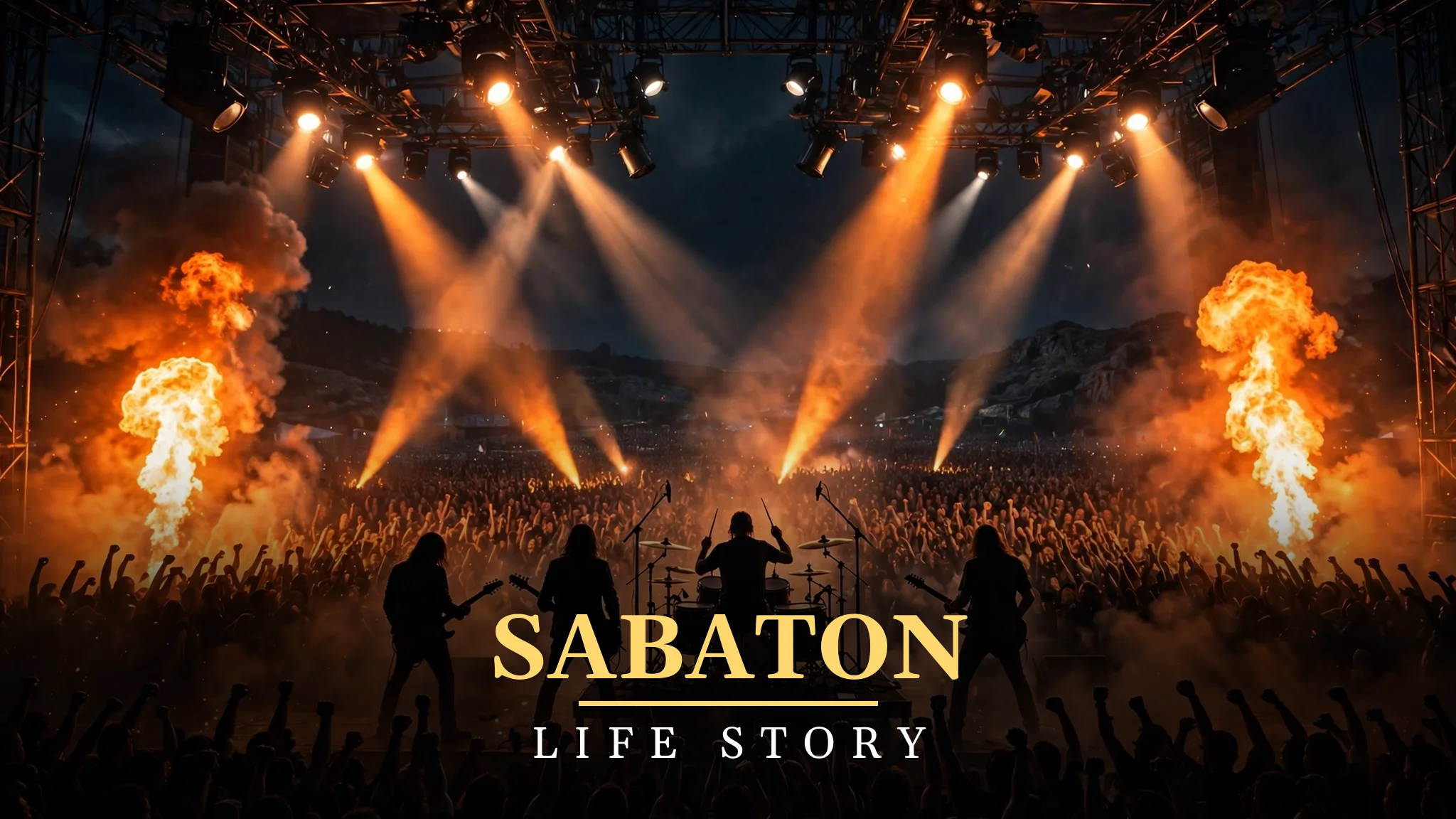
During these years Sabaton became a festival band, playing at major metal festivals in Europe and around the world. Their shows were famous for their energy, their fire, and their crowds. They built a tank on stage, they used pyrotechnics, and they created a show that was as much a theatre as a concert. Their fans, known as Sabaton fans around the world, came to their shows in large numbers, and they sang every word. The band had become a live act that people travelled to see, and that live reputation helped them to grow even more.
They also began to tour outside Europe, playing in North America, in Asia, and in other parts of the world. They learned that their songs about history were understood everywhere, because history is a universal language. A fan in Japan could love a song about a Polish battle, and a fan in Brazil could love a song about the Second World War. That is the power of their idea. History belongs to everyone, and their music belongs to everyone too.
The Great War and the History Channel
In 2019 Sabaton released The Great War, an album about the First World War, released one hundred years after the war ended. The album included songs about the Christmas Truce of 1914, about the Battle of Verdun, and about the soldiers who fought in the trenches. The album was a success, and it was praised for its respect for the soldiers of the First World War. It was not a celebration of war. It was a remembrance, and it showed that the band understood the cost of war as well as its drama.
The Great War was also the start of a new project: the Sabaton History Channel on YouTube. The band began to make videos explaining the stories behind their songs, working with historians to tell the true history of each battle. The channel became very popular, and it showed that the band cared about accuracy. They did not want their fans to learn the wrong history from their songs. They wanted their fans to learn the true history, and then to enjoy the songs even more. The channel has now become a big part of their work, and it has brought them new fans who love history as well as metal.
Their next album, The War to End All Wars, was released in 2022, and it was also about the First World War. It included songs about the Christmas Truce, about the Battle of Passchendaele, and about other events of the war. The album was well received, and it showed that the band could return to the same war and find new stories to tell. They were not repeating themselves. They were digging deeper, and they were finding new angles on a war that is still remembered a century later.
In recent years they have also released an album called Legends, in 2025, about legendary figures from history, and they have continued to tour and to make new music. They have also started their own festival, Sabaton Open Air, in Falun, where they play for their fans in their home town. The festival is a celebration of metal and history, and it brings fans from all over the world to the small city where the band began. It is a fitting homecoming for a band that started in Falun and now belongs to the world.
The Sound, the Shows, and the Fans
Sabaton’s sound is power metal: fast guitars, strong drums, and a singer with a deep and powerful voice. Joakim Brodén’s voice is one of the most recognisable in metal, and it is the heart of the band’s sound. He does not sing with a high voice, like many power metal singers. He sings with a low, strong voice, and he delivers the words with clarity, so that the listener can hear the story. That clarity matters, because the story is the point of the song. If you cannot hear the words, you cannot understand the history, and Sabaton wants you to understand.
Their live shows are famous for their scale. They use fire, they use a tank on stage, they use large screens showing images from history, and they create a show that feels like a battle. Their fans love it, and they come to the shows in large numbers, often wearing Sabaton shirts and singing along to every song. The band has a strong relationship with their fans, and they take time to meet them, to talk to them, and to thank them. That loyalty is mutual, and it is one of the reasons the band has lasted so long.
They have also won many awards in Sweden and in other countries, and they have been named one of the most important metal bands of their generation. They have sold millions of albums, they have played in front of millions of people, and they have built a business around their music, including their festival, their history channel, and their merchandise. They are not only a band. They are a small company, run by Brodén and Sundström, and they have built it carefully, year by year.
Their fans come from all ages and from all countries. Some fans are young, and they discovered Sabaton through YouTube. Some fans are older, and they have followed the band since Primo Victoria. What they share is a love of history and a love of metal, and Sabaton gives them both. The band has created a community, and that community is one of the strongest in metal music. It is a community built on respect for history, on a love of music, and on the joy of singing together in a large crowd.
What Sabaton Leaves Behind
Sabaton is still working, and their story is not finished. They continue to tour, to record, and to make history videos, and they continue to find new listeners. Their early songs are still played, and their later albums have found their own audience. They have become a name that people trust when they want metal music that is both loud and smart, and that trust is the most valuable thing a band can earn. They earned it by telling true stories, by respecting history, and by working hard for more than twenty-five years.
Their influence can be seen in the many younger metal bands who now write songs about history. Sabaton did not invent history metal, but they made it popular, and they showed that it could be a big success. They opened a door for other bands, and many of them have walked through it. They also showed that a band from a small city in Sweden can become a world-famous act, if it has a clear idea and the patience to build it slowly.
They also leave a lesson about education. Many of their fans have said that they first learned about a battle from a Sabaton song, and then they went to read a book about it. That is a powerful thing, because it means that music can teach, and that a song can open a door to learning. Sabaton has used that power well, and they have worked with historians to make sure their songs are accurate. They have turned metal into a classroom, and their fans are grateful for it.
For young musicians, their story teaches a clear lesson. Start with an idea you believe in, work hard, and do not give up when the first album does not make you famous. Sabaton started in Falun, they played in small clubs, and they built their career album by album, year by year. They did not become famous overnight, and they did not try to copy other bands. They made their own music, about their own passion, and the world came to them. That is a lesson that will last long after their last show.
Their work with historians also deserves praise. Many bands write songs about history without checking the facts, and they get the story wrong. Sabaton works with people who know the history, and they try to get the details right, from the names of the soldiers to the dates of the battles. That care shows respect for the people who lived through those events, and it shows respect for the listeners who trust the band. A song that gets the history wrong can mislead thousands of people, and Sabaton knows that. They take that responsibility seriously, and that is one more reason their fans trust them.
My Take:
I think Sabaton is one of the most original bands in metal, and I do not say that only because they are loud. I say it because they had an idea that no other band had, and they stuck to it for more than twenty-five years. They sing about history, and they do it with respect, with energy, and with a sound that fills a stadium. Many metal bands sing about fantasy, about darkness, or about themselves. Sabaton sings about real people, real battles, and real history, and that makes their music different. When I listen to Primo Victoria, I hear a song about D-Day, and I feel the weight of that day. When I listen to Carolus Rex, I hear a song about a Swedish king, and I feel the pride and the tragedy of his story. That is not just entertainment. It is history, turned into music, and it is powerful.
What I admire most about them is their patience. They started in Falun in 1999, and they did not become famous quickly. They made album after album, they toured in small clubs, and they built their audience one fan at a time. That is slow work, and it is hard work, and many bands give up when it does not happen fast. Sabaton did not give up. They kept writing, they kept touring, and they kept believing in their idea. When Carolus Rex became a hit in Sweden, it was not luck. It was the result of thirteen years of hard work, and that is why it means so much. I think young bands should learn from that. If you have a good idea, do not drop it because it is not popular yet. Keep working, and the world may come to you.
I also admire the way they rebuilt the band in 2012. Four members left at the same time, and that is a crisis for any band. Many bands would have ended there, and no one would have blamed them. Brodén and Sundström did not end the band. They found new members, they kept going, and they made the band stronger. That takes courage, and it takes leadership. It also shows that Sabaton is more than its members. It is an idea, and the idea can survive a change of people. I respect that, because it is easy to quit when things get hard, and it is hard to rebuild. They rebuilt, and they proved that the band was built on something solid.
When I listen to The Great War, I hear a band that understands the cost of war. The album is about the First World War, and it does not celebrate war. It remembers the soldiers, it talks about the trenches, and it sings about the Christmas Truce, when soldiers stopped fighting for a day and shared a moment of peace. That is a beautiful and sad story, and Sabaton tells it with respect. I think that matters, because it is easy to make war sound exciting, and it is hard to make war sound human. Sabaton does the hard thing. They sing about the people, not only about the battles, and they remind us that every battle has a human cost. That is a lesson that the world still needs to hear.
I think about their history channel a lot, because it shows how much they care about getting the story right. They could have made songs about history and left it at that, but they did not. They started a channel, they worked with historians, and they explained the true stories behind their songs. That is a generous act, because it gives their fans more than music. It gives them knowledge, and it shows that the band respects its audience. They do not think their fans are stupid. They think their fans are curious, and they want to learn. I admire that, and I think it is one reason their fans are so loyal. When a band respects you, you respect the band back.
There is a part of their story that makes me sad, and I want to be honest about it. Metal music is often seen as loud and aggressive, and it does not always get the respect it deserves from the wider world. Sabaton makes metal music that is also educational, and yet they are still seen by some people as just a loud band. That is unfair, because their work is smart, careful, and well researched. I wish more people outside metal listened to their songs, and I wish more people understood that metal can be a serious art form. Sabaton proves that, and I hope more people will listen with an open mind.
I also think about the scale of their shows, and what it means. They use fire, they use a tank, and they create a huge spectacle, and some people might think that is too much. I do not think so. I think the spectacle fits the music, because the music is about big events, about battles that changed the world, and a small show would not do those events justice. The fire, the lights, and the crowd singing along are part of the experience, and they make the history feel alive. When I watch a Sabaton show, I do not feel that I am watching a band. I feel that I am part of a community, singing about history with thousands of other people, and that feeling is powerful.
I have a small criticism, and it is not about their music. It is about the way history is sometimes simplified in a song. A song is only a few minutes long, and it cannot tell the whole story of a battle or a war. Sabaton knows that, and they try to be accurate, but a listener who only hears the song might get a simple version of a complex event. That is not the band’s fault, and they have tried to fix it with their history channel, but it is a risk. I think listeners should use Sabaton songs as a starting point, not as the whole story, and they should read more about the history after they hear the song. The band would agree with that, and they have said so themselves.
Another thing I notice is how Swedish their story is, in the best way. They started in Falun, a small city, they sang about Swedish history in Carolus Rex, and they built their festival in their home town. They did not need to move to a big city to become famous. They stayed close to home, and they made music that travelled around the world. That is a lesson for small towns everywhere. You do not need to be from a big city to be great. You need a good idea, good friends, and the courage to work hard for many years. Sabaton did that, and their music is now loved in many countries.
For a young person who loves history, I think their story teaches a clear lesson. You can love history and you can love metal, and you do not need to choose between them. You can turn your passion into music, and you can share it with the world. Sabaton did that, and they built a career from it. If you love a subject, whether it is history, science, or art, you can make something beautiful from it, and you can find other people who love it too. That is a hopeful message, and it is one that many young people need to hear.
I also think their story teaches something about loyalty and friendship. Brodén and Sundström have worked together for more than twenty-five years, and they have stayed at the centre of the band through good times and hard times. That is a long partnership, and it is rare in the music business, where bands often split up after a few years. They stayed together because they shared an idea, and because they trusted each other. That trust is the foundation of Sabaton, and it is part of why the band has lasted so long. When you work with someone you trust, you can survive hard times, and you can rebuild when things fall apart.
When I think about their future, I feel hopeful. They are still making music, they are still touring, and they are still finding new stories to tell. History is a big subject, and there are always new battles, new heroes, and new legends to sing about. I hope they keep going for many years, because their music helps people to learn, and it helps people to feel connected to the past. I hope they keep their history channel going, and I hope they keep their festival in Falun, because those things bring people together in a way that a single song cannot.
In the end, I think Sabaton matters because they made history loud, and they made it live. They took stories from books, they turned them into songs, and they sang them in stadiums full of people who might never have read those books. That is a gift, and it is a kind of teaching that the world needs. They did not make history boring. They made it exciting, and they made it human, and they did it with respect. I am glad they are still here, still singing, and still teaching, and I look forward to hearing what history they sing about next.
One last thought stays with me, and it is about the fans. Sabaton fans are not just listeners. They are a community, and they share a love of history and a love of metal. When they go to a show, they sing every word, they raise their fists, and they feel part of something bigger than themselves. That feeling is the real power of Sabaton. They did not only make songs. They made a community, and that community will last long after the last note of their last show has faded. That is a legacy to be proud of, and it is why I will keep listening to Sabaton for many years to come.
I also keep thinking about the young fans who discover history through Sabaton. A teenager who has never liked a history lesson at school might hear a song about the Night Witches, and suddenly want to know who those women were. That spark is precious, because it can lead to a lifelong love of learning. Schools try to create that spark with books and lessons, and sometimes they fail. Sabaton creates it with a guitar, a drum, and a strong voice, and it works. That is not a small achievement. It is a big one, and it deserves to be celebrated by teachers as well as by metal fans.
Another thing I admire is the way they treat the soldiers in their songs. They do not make war sound like a game, and they do not make soldiers sound like heroes without fear. They sing about fear, about loss, and about the price that soldiers pay, and they do it with respect. That respect matters, because the people in their songs were real, and their families are still alive in some cases. A band that sings about war has a duty to be honest, and Sabaton tries to be honest. They do not always get everything right, but they try, and that trying is what makes their music different from a simple war film or a video game.
Finally, I want to say something about joy. A Sabaton show is joyful, even when the songs are about sad events, because the joy comes from the music, from the crowd, and from the feeling of being together. That joy does not disrespect the history. It celebrates the people who lived it, and it celebrates the fact that we are still here to remember them. I think that is the right way to remember history: not with silence, but with music, with singing, and with a community that refuses to forget.
Frequently Asked Questions
Where was Sabaton formed and when?
Sabaton was formed in Falun, Sweden, in 1999 by a group of young musicians who loved metal and history. The singer Joakim Brodén and bass player Pär Sundström have been at the centre of the band since the start.
What is Sabaton best known for?
They are best known for power metal songs about real events from history, including Primo Victoria about D-Day, Carolus Rex about the Swedish king Charles XII, and Winged Hussars about the Battle of Vienna.
What is Carolus Rex about?
Carolus Rex is an album about the Swedish king Charles XII and the Swedish Empire of the seventeenth and eighteenth centuries. It was released in 2012 in both Swedish and English, and the Swedish version reached number one in Sweden.
Did Sabaton change members in 2012?
Yes, four members left the band in 2012, and Brodén and Sundström rebuilt Sabaton with new musicians. The new line-up proved strong, and the band continued to grow and to release successful albums.
What is the Sabaton History Channel?
The Sabaton History Channel is a YouTube channel where the band explains the true stories behind their songs, working with historians. It helps fans learn the real history of the battles and people in their music.
Is Sabaton still touring and making music?
Yes, they continue to tour around the world, to release new albums such as Legends, and to run their own festival, Sabaton Open Air, in Falun, their home town in Sweden.


