Sal Mineo: The Life Story Behind the Rebel Without a Cause Star
In this post
Some actors arrive in Hollywood slowly, and some arrive all at once, as if a door has opened and the whole world is suddenly looking at them. Sal Mineo was the second kind. He was still a teenager when he played Plato in Rebel Without a Cause, and the part made him famous in a way that few young actors ever know. He was small, dark-eyed, and full of feeling, and audiences could see at once that he was not pretending. He seemed to carry a sadness that was real, and that sadness became the heart of his best work.
He was born in the Bronx, in New York City, to a family that had come from Sicily. His father worked with his hands, and his mother kept the home, and the boy grew up in a crowded, noisy part of the city where children learned to be tough early. He was not a quiet child who sat still. He was restless, bright, and drawn to music and movement, and his parents saw that he needed something to do with all that energy. They sent him to dancing school, and that small choice changed the whole direction of his life.
The path from a Bronx dancing school to a Hollywood film set was not a straight one, but Mineo walked it with a speed that surprised everyone around him. He was on Broadway while he was still a boy, and he was in films while he was still in his teens. He worked with James Dean, with Elizabeth Taylor, and with some of the best directors of his time. He was nominated for an Academy Award before he was twenty, and he was nominated again before he was twenty-two. Then the work began to thin out, the parts grew smaller, and the young star who had once seemed unstoppable had to learn how to keep going when the world stopped calling. His life ended in violence, in a dark alley in West Hollywood, when he was only thirty-seven years old, and the shock of that ending has shaped the way people remember him ever since.
A Bronx Boy With Music in His Feet
Salvatore Mineo Jr. was born on 10 January 1939 in the Bronx, New York City. His parents, Salvatore and Josephine, had come from Sicily, and the family lived in a working-class neighbourhood where Italian was spoken at home and English was spoken on the street. The boy grew up with the sounds of the city around him, with traffic and music and the voices of neighbours, and he learned early how to watch people and copy the way they moved. His family was not rich, and money was often tight, but there was warmth in the home, and his parents cared deeply about their children.
As a small boy, Sal was full of energy, and he was often in trouble at school for not sitting still. His mother saw that he loved to move, and she enrolled him in dancing school, hoping that the lessons would give him a place to put his energy. The dancing school became his first stage. He learned tap and ballet, and he discovered that he liked being watched, that he liked the feeling of a room turning its attention toward him. He was good at it, and the teachers noticed him, and soon he was taking part in small shows and local performances.
The family moved for a time, and the boy’s schooling was broken up by the moves and by his growing work in the theatre. He did not have a calm, steady childhood, and he later spoke of feeling different from other children, of feeling that he did not quite fit in. Dancing gave him a way to belong somewhere, and the stage gave him a place where being different was an advantage rather than a problem. He learned his lines, he learned his steps, and he learned how to stand in front of strangers and hold their attention.
By the time he was ten years old, he had already begun to work as a child performer. He was not a child who dreamed of fame from far away. He was a working child, earning money, learning a trade, and spending his days in rehearsal rooms and on stages. That early start gave him a skill that many older actors never learn, the skill of being natural in front of a crowd, but it also meant that he grew up fast, and that the ordinary life of a schoolboy was never really his.
The Rose Tattoo and the Road to Broadway
Mineo’s first real break came on Broadway, when he was cast in The Rose Tattoo, a play by Tennessee Williams. He was only twelve years old, and he played the son of the leading character, a boy who watches the adults around him with a clear and honest eye. The play opened in 1951, and it was a success, and the young actor was suddenly working with grown professionals, learning how a serious play is built, and finding out that he could hold his own on a real stage. The experience taught him that acting was not only about charm, and that a small part, played with truth, could matter as much as a large one.
The Rose Tattoo ran for a long time, and Mineo stayed with it, growing a little older and a little more sure of himself with each performance. He worked with actors who had spent their whole lives on the stage, and he watched how they prepared, how they listened, and how they saved their energy for the moments that counted. He was still a child, but he was learning the discipline of a professional, and he carried that discipline with him into every job that followed. The theatre was his school, and it was a hard school, but it gave him a foundation that many film actors never have.
After the play, he went back to New York and kept looking for work, taking parts where he could find them and learning how to handle rejection. He appeared in other stage productions, and he began to think about films, where the money was better and the audience was larger. He was still very young, and he looked younger than his age, which was both a gift and a problem, because directors saw him as a boy even as he was growing into a young man. He knew that he would have to prove that he could play more than a child.
The years on Broadway had given him something else, too, a sense of how a story is told through small choices rather than big gestures. He learned to listen on stage, to react to the other actors, and to let a scene grow out of what was happening between people rather than out of a single speech. Those lessons would matter a great deal when he reached Hollywood, because the director who gave him his most famous part was looking for exactly that kind of honest, listening actor.
Plato, James Dean, and Rebel Without a Cause
In 1955, Mineo was cast as John Crawford, known as Plato, in Rebel Without a Cause, a film directed by Nicholas Ray and starring James Dean. Plato was a lonely boy from a broken home, a boy who attached himself to Dean’s character because he was looking for a family, and Mineo played him with a tenderness that audiences had never seen before. He was sixteen years old, and he brought to the part a feeling of real need, a sense that the boy on the screen was not acting but remembering something true about his own life. The film became one of the most famous of the decade, and Mineo’s performance was at its centre.
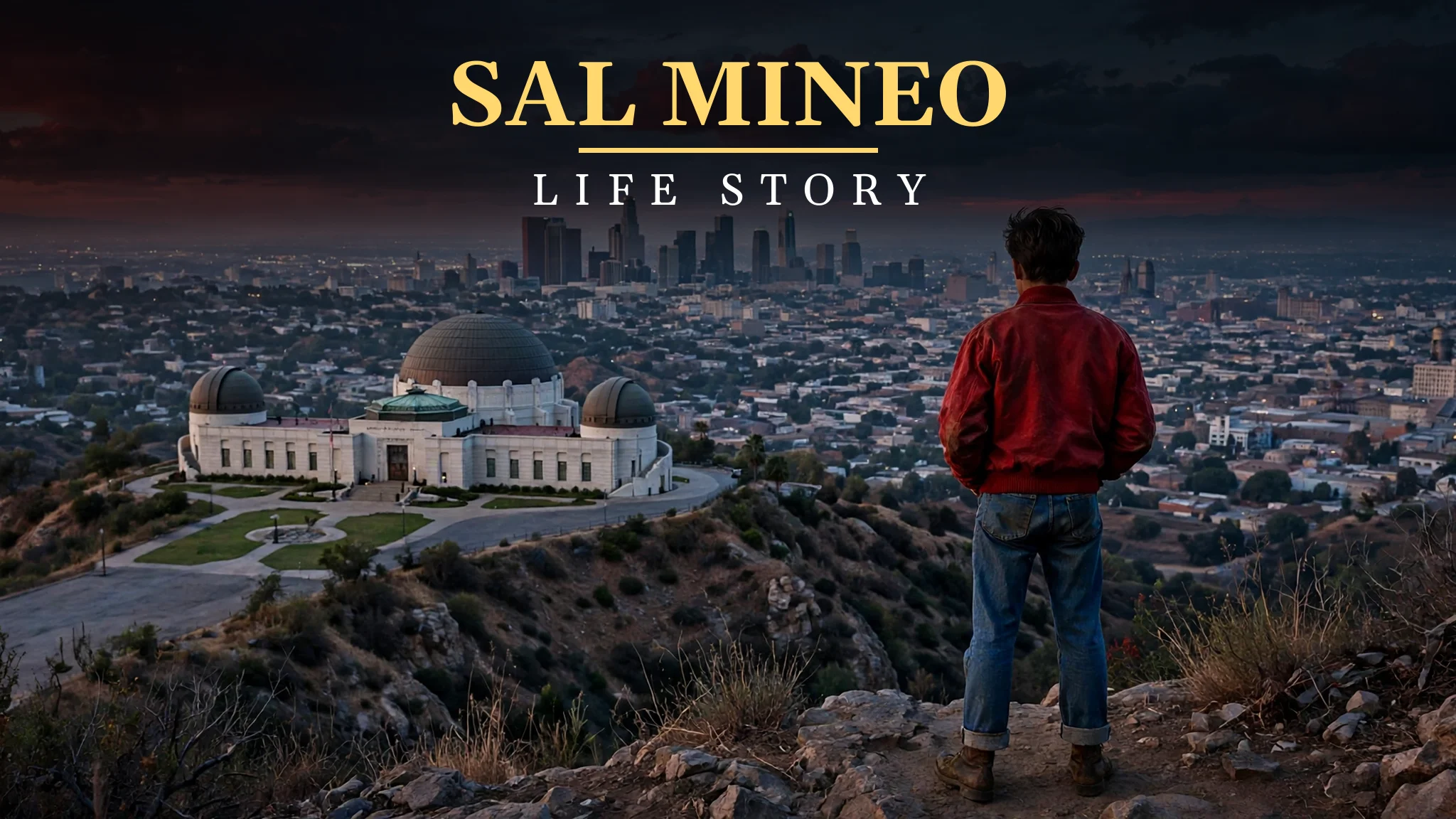
The film told the story of three troubled teenagers in Los Angeles, and it spoke to a generation of young people who felt that the adults around them did not understand them. Dean was the star, and Natalie Wood was the girl, but Mineo was the heart of the film, the boy who loved too much and who paid the highest price. His death scene, in the grounds of the Griffith Observatory, is still one of the most moving moments in American film, and it made audiences feel that they had lost a real person rather than a character. The film was a hit, and Mineo was nominated for the Academy Award for Best Supporting Actor, the youngest actor of his time to be so honoured in that way.
Working with James Dean changed Mineo. Dean was only a few years older, but he was already a legend in the making, and Mineo watched him closely, learning how Dean used stillness, how he listened, and how he made a scene feel real by doing less rather than more. The two young actors got on well, and Dean treated Mineo with a kindness that the younger boy never forgot. When Dean died in a car crash in September 1955, only weeks before the film was released, Mineo was deeply shaken, and he carried the loss with him for the rest of his life.
The success of the film brought Mineo fame, money, and attention, but it also brought a problem that would follow him for years. He was now known as Plato, the lonely boy, and directors and producers found it hard to see him as anything else. He was offered parts that repeated the same idea, the sensitive young outsider, and he took many of them because he needed the work, but he wanted to grow, to play men rather than boys, and the industry was slow to let him do that.
Giant, Exodus, and a Second Oscar Nomination
In 1956, Mineo appeared in Giant, a long and famous film directed by George Stevens and starring Elizabeth Taylor, Rock Hudson, and James Dean in his last role. Mineo played Angel Obregon Jr., a young Mexican-American man who goes to war and comes home changed, and the part gave him a chance to play a character with a different background from his own. The film was a major success, and it showed that Mineo could work with the biggest stars in Hollywood and hold his own. It also showed that he could play a young man rather than a child, and that mattered to him.
Four years later, he was cast in Exodus, a long film about the founding of Israel, directed by Otto Preminger and based on a famous novel. Mineo played Dov Landau, a young Jewish man who had survived a concentration camp and who was trying to find a place in the world. The part was hard and serious, and Mineo threw himself into it, learning about the history behind the story and working to make the character feel real rather than like a symbol. The film was a success, and Mineo was nominated for the Academy Award for Best Supporting Actor for a second time, at the age of twenty-one.
The nomination was a sign that the film industry still respected him, but it did not bring the flood of leading roles that he had hoped for. Hollywood in the early 1960s was changing, and the kind of sensitive young man that Mineo played so well was no longer the fashion. The studios were looking for different faces, different styles, and Mineo found that the phone rang less often. He worked in television, he appeared in smaller films, and he tried to find parts that would let him show what he could do, but the big roles were hard to find.
He also began to think about directing, and about working behind the camera, because he understood that an actor who waits for the phone to ring can wait for a long time. He directed plays in Los Angeles, and he worked with young actors, trying to pass on what he had learned from his own early start. He was still young, but he had already been working for more than fifteen years, and he knew the business from the inside in a way that few people of his age did.
The Lean Years and the Fight to Keep Working
The 1960s were hard years for Mineo. The fame of Rebel Without a Cause had faded, and the parts that came his way were often small, or in films that few people saw. He appeared in films such as The Gene Krupa Story, where he played the famous jazz drummer, and he worked in television, appearing in many popular shows of the time. He was a good actor, and directors who worked with him knew it, but the industry had put him in a box, and it was hard to climb out of it. He was no longer a boy, but he was not yet seen as a leading man, and that in-between place is a hard place for any actor to live.
He also faced a problem that was common for actors of his generation, the problem of being known for one famous role. Audiences remembered Plato, and they wanted to see Plato again, but Mineo wanted to show them other people, other lives, other kinds of feeling. He took parts that were different, even when the films were small, because he believed that the work itself mattered more than the size of the audience. He played villains, he played soldiers, he played men with troubled pasts, and he brought the same honesty to each of them that he had brought to Plato.
Money was a worry, too. He had earned a great deal as a young star, but the lean years were expensive, and he had to keep working to pay his bills. He did not complain in public, and he did not blame other people for the way his career had gone. He kept going to auditions, he kept taking the work that was offered, and he kept looking for a way back to the kind of parts that had made him famous. He was a professional, and he behaved like one, even when the work was not what he had hoped for.
In the early 1970s, he found a new kind of work in the theatre, directing a play called P.S. Your Cat Is Dead, a comedy about a young actor in New York. The play was a success in Los Angeles, and it gave Mineo a new sense of purpose. He was no longer only waiting for someone to cast him. He was making work for himself, and he was helping other young actors to find their way. The play was still running when his life came to an end, and it was a sign that he had found a second act in his career.
A Violent End in West Hollywood
On the night of 12 February 1976, Sal Mineo came home to his apartment in West Hollywood, California, after a rehearsal for his play. He parked his car and walked toward his home, and in the alley behind the building he was attacked by a man with a knife. He was stabbed once, and the wound was fatal. He was thirty-seven years old. The news shocked Hollywood, and it shocked the many people who had grown up watching him on screen. A young man who had once been one of the most famous teenagers in the world had died alone in a dark alley, and no one could understand why.
The police investigated, but for a long time there was no arrest, and the case seemed as if it might never be solved. Rumours spread, and people said many things that were not true, because a famous death without an answer leaves room for stories to grow. Mineo’s family and friends waited for the truth, and they grieved in public and in private, trying to make sense of a loss that had come without warning. He was buried in New York, near his family, and the funeral was attended by people from every part of his life, from the theatre, from film, and from his childhood in the Bronx.
Three years later, in 1979, a man named Lionel Williams was convicted of the murder. Williams had a criminal record, and the evidence showed that the killing had been part of a robbery, a random and senseless act rather than something aimed at Mineo because he was famous. The conviction brought some comfort to his family, because it gave them an answer, but it could not bring him back. The man who had played Plato, who had been nominated for two Academy Awards, who had worked since he was a child, was gone, and the world was left with the films and the memories.
His death was a reminder of how fragile a life can be, and how quickly a person can be taken from the people who love them. He had been working, he had been planning, he had been looking forward to the next stage of his career, and then, in a single moment, it was over. The shock of his death has never quite left the story of his life, and it is the reason that many people who hear his name for the first time hear about the ending before they hear about the work.
What Remains: The Films and the Memory of Plato
Mineo left behind a body of work that is small in number but large in feeling. Rebel Without a Cause is still watched today, and it is still shown in schools and film classes, because it speaks to young people in a way that few films from the 1950s still do. His performance as Plato is the reason that the film still moves people, and it is the reason that his name is still remembered. The film is a classic, and classics do not fade, and Mineo’s work in it is a part of that lasting power.
Exodus is still watched, too, and Giant is still one of the most famous films ever made in Hollywood. Those films show a young actor who could work with the best, who could hold his own with Elizabeth Taylor and Rock Hudson and James Dean, and who could bring a real feeling to a part that might have been flat in other hands. His work in those films is a record of what he could do, and it is a record that no one can take away from him.
In the years since his death, his life has been the subject of books and documentaries, and people have tried to understand the man behind the famous roles. Some have written about his private life, and some have written about the way Hollywood treated him, but the most honest thing that can be said about him is simple. He was a talented boy from the Bronx who became a famous actor before he was twenty, who worked hard for the rest of his short life, and who died far too young. His story is a sad one, but it is also a story of real talent, and that talent is still there, on the screen, for anyone who wants to see it.
My Take:
When I think about Sal Mineo, I do not start with his death. I start with a boy in the Bronx who learned to dance because he could not sit still, and who found, on a stage, a place where his restlessness made sense. That is the part of his story that stays with me, because it is the most human part. He was not born into fame. He was born into a working family, in a crowded part of New York, and he had to earn every step he took. The dancing school, the Broadway stage, the film set, each one was a step that he took himself, and I admire that kind of hard work in a child who had every reason to give up.
I think his performance as Plato is one of the most honest performances I have ever seen from a young actor. He does not act like a boy who is trying to be sad. He acts like a boy who is sad, and who does not know what to do with that sadness, and that is a very different thing. When Plato follows Jim around, when he looks for a home in a family that is not his own, when he holds a gun because he does not know how else to be strong, I feel that I am watching a real person, not a character in a script. That is a rare gift, and it is a gift that cannot be taught. You either have it or you do not, and Mineo had it.
What makes me sad about his story is the way the world used him up so fast. He was famous at sixteen, and by the time he was twenty-five, the world had already decided that it knew who he was, and it did not want to see him as anyone else. That is a cruel thing to do to a young person. He was growing, he was changing, he was learning new things, but the industry kept offering him the same part, the same lonely boy, and when he said no, or when he tried something else, the work dried up. I think about how hard that must have been, to be told, in so many quiet ways, that the best thing you ever did is already behind you, when you are still only in your twenties.
I also think about James Dean, and about how their lives were tied together by one film. Dean died before the film was even released, and Mineo had to carry the memory of that friendship for the rest of his life. He was only sixteen when he lost a friend who had treated him with kindness, and that kind of loss stays with a person. I wonder if part of the sadness in his acting came from that loss, and from the knowledge that fame can be taken away in a moment. He saw it happen to Dean, and then, in a different way, it happened to him, when the roles stopped coming and the phone stopped ringing.
The second Oscar nomination, for Exodus, is the part of his career that I respect the most. It would have been easy for him to give up after Rebel Without a Cause, to take the money and live on the fame, but he did not do that. He worked, he learned, he took a hard part in a serious film, and he earned a second nomination on his own merit. That tells me that he was not a one-film wonder. He was a real actor, with real skill, and he could have had a long career if the world had given him the chance. I wish it had.
When I think about the lean years, I feel a kind of anger on his behalf. Not anger at any one person, but anger at a system that takes a young actor, makes him famous, and then throws him away when he grows up. Mineo did not stop being talented. He did not stop working hard. He kept taking small parts, he kept appearing on television, he kept directing plays, and he kept trying to make something good out of the work that was offered to him. That is a brave way to live, and it is a way of living that does not get enough credit. It is easy to be brave when everyone is cheering for you. It is much harder to be brave when no one is watching.
The play he directed, P.S. Your Cat Is Dead, matters to me because it shows that he was finding a new path. He was not only an actor waiting for a part. He was a director, a maker of theatre, a person who could build something for himself and for other young actors. I think he was on the edge of a second career, a career that might have lasted for many years, and I think that makes his death even sadder. He was not finished. He was starting again, and that new start was taken from him.
I do not want to spend too much time on the details of his death, because the details do not tell us who he was. What matters is that a man of thirty-seven, who was working, who was loved by his family and his friends, who was planning his next play, was killed in a robbery, in a dark alley, for no reason that makes sense. It was random, it was senseless, and it was final. That is the hardest part of his story to accept, because there is no lesson in it, no meaning to take from it, only the fact that a life can end in a moment, and that the people who loved him had to go on without him.
If there is a lesson in his life, I think it is about how we treat young talent. We should not use a young person up and then forget them. We should give them room to grow, room to fail, room to try new things, and room to become the adult they are meant to be. Mineo was a child star who became a good actor, and then a director, and the world did not give him the room he needed. I hope that we have learned something from that, and that young actors today are given more care, more time, and more respect than he was given.
I also think about his family, and about the Bronx, and about the way a boy from a small, crowded home can become known all over the world. That is the American dream, in a way, but it is a dream with a sharp edge, because fame does not protect you, and it does not make you safe. Mineo was famous, and he was still killed in an alley. That is a hard truth, and it reminds me that fame is not a shield. It is only a light, and a light can go out.
When I watch Rebel Without a Cause now, I see two young men who are both gone, Dean and Mineo, and I feel the weight of that. The film is about young people who feel alone, and the two actors who made it feel so real were both alone in their own ways, and both died young. That is a sad thing to carry, but it is also the reason the film still matters. It is not a film about the 1950s. It is a film about being young and feeling lost, and that feeling does not belong to one decade. It belongs to every young person who has ever felt that the world does not understand them.
In the end, I think Sal Mineo deserves to be remembered for his work, not only for his death. He was a dancer, a stage actor, a film actor, a director, and a man who kept working when the work was hard to find. He was nominated for two Academy Awards, he worked with some of the greatest names in Hollywood, and he gave a performance as Plato that still moves people seventy years later. That is a life worth remembering, and it is a life that was cut short far too soon. I wish he had lived longer, I wish he had directed more plays, I wish he had been given the leading roles he deserved, but I am grateful for what he left behind, and I think that is the best way to honour him, to watch his films, to remember his work, and to say his name with respect.
One more thought stays with me, and it is about the boy who could not sit still. That boy found a way to turn his energy into art, and that art is still here, long after he is gone. If a young person reads this story and feels restless, and feels different, and feels that they do not fit in, I hope they see in Mineo a sign that being different can be a gift, and that a restless child can grow into an artist. That is the part of his story that gives me hope, even in the sadness, and it is the part I want to hold on to.
I also keep thinking about the way fame came to him before he had time to understand it. At sixteen, most boys are worried about school and friends and the small troubles of growing up. Mineo was worried about those things too, but he was also carrying the weight of a whole film, the hopes of a studio, and the eyes of millions of strangers. That is too much weight for a boy of sixteen, and I think we forget that when we look back at old films and see a young face on a poster. Behind the poster there was a real boy who needed rest, who needed friends his own age, and who needed someone to tell him that it was all right to be tired and unsure.
There is another part of his story that I find quietly moving, and it is the way he kept his family close. He was born into a Sicilian family in the Bronx, and that family stayed with him through the fame and through the lean years. His mother had sent him to dancing school, his parents had supported his early work, and when the work grew thin, he did not run away from where he came from. He went back to the theatre, he worked with his hands as a director, and he built something real in Los Angeles. That loyalty to his roots tells me more about his character than any award could, because it shows that he knew who he was, even when the world around him was confused about who he was.
I think about the audience, too, and about what audiences owe to the actors they love. We watch a film, we love a performance, and then we move on to the next film, the next star, the next year. We forget that the actor is still there, still working, still trying to pay the rent, still hoping for a good part. Mineo gave audiences a performance that they still remember seventy years later, and in return, the industry gave him smaller and smaller parts. That does not feel fair to me, and I think it is worth saying so plainly. If we love an actor’s work, we should remember that the actor is a person, not a poster on a wall.
Finally, I want to remember him as a worker, not only as a star. He worked as a child, he worked as a teenager, he worked as a young man, and he was working on the night he died, coming home from a rehearsal. That is the thread that runs through his whole life, from the dancing school in the Bronx to the theatre in Los Angeles. He did not stop. He did not give up. He kept showing up, kept learning, kept trying, and that is a kind of courage that I admire more than any single performance. A life cut short is still a life, and his life was full of work, full of feeling, and full of talent, and that is how I choose to remember him.
Frequently Asked Questions
How old was Sal Mineo when he starred in Rebel Without a Cause?
Sal Mineo was sixteen years old when he played Plato in Rebel Without a Cause, which was released in 1955. He was nominated for the Academy Award for Best Supporting Actor for the role, which made him one of the youngest actors to earn such a nomination at that time.
What other major films did Sal Mineo appear in?
His other major films include Giant from 1956, in which he played Angel Obregon Jr., and Exodus from 1960, in which he played Dov Landau. He earned a second Academy Award nomination for Best Supporting Actor for Exodus, and he also appeared in The Gene Krupa Story and many television shows.
Did Sal Mineo work on Broadway as a child?
Yes, he appeared on Broadway as a boy in The Rose Tattoo, a play by Tennessee Williams that opened in 1951. He was twelve years old at the time, and the experience gave him a strong foundation in stage acting that shaped his later film work.
How did Sal Mineo die?
Sal Mineo was stabbed to death in an alley behind his apartment building in West Hollywood on 12 February 1976, when he was thirty-seven years old. The killing was later shown to have been part of a robbery, and a man named Lionel Williams was convicted of the murder in 1979.
Was Sal Mineo nominated for an Oscar more than once?
Yes, he was nominated twice for the Academy Award for Best Supporting Actor, first for Rebel Without a Cause in 1955 and then for Exodus in 1960. He did not win either time, but the two nominations showed that the film industry respected his talent.
What was Sal Mineo doing in the years before his death?
In the early 1970s he worked in television and smaller films, and he also turned to directing theatre in Los Angeles. His production of the play P.S. Your Cat Is Dead was a success, and it was still running when he died, which suggests he was building a new stage in his career.


