Sciatica Explained: Symptoms, Causes and Relief
In this post
- What Sciatica Is and How the Sciatic Nerve Works
- The Most Common Causes of Sciatica
- Symptoms: How Sciatica Feels and How It Differs From Back Pain
- Red Flags: When Sciatica Needs Emergency Care
- What Actually Helps: Movement, Heat and Pain Relief
- Exercises for Sciatica: What to Do and What to Avoid
- When to Consider Physio, Injections or Surgery
- My Take:
Sciatica is a word that many people use, and few people understand. It is often used to describe any pain in the lower back or leg, but it is actually a specific condition: pain that travels along the sciatic nerve, the longest nerve in the body, from the lower back, through the buttock, and down the leg. The pain can be sharp, burning, tingling or aching, and it can make walking, sitting and sleeping difficult. For some people it lasts a few days and then goes away. For others it lasts for weeks or months, and it becomes a major disruption to daily life.
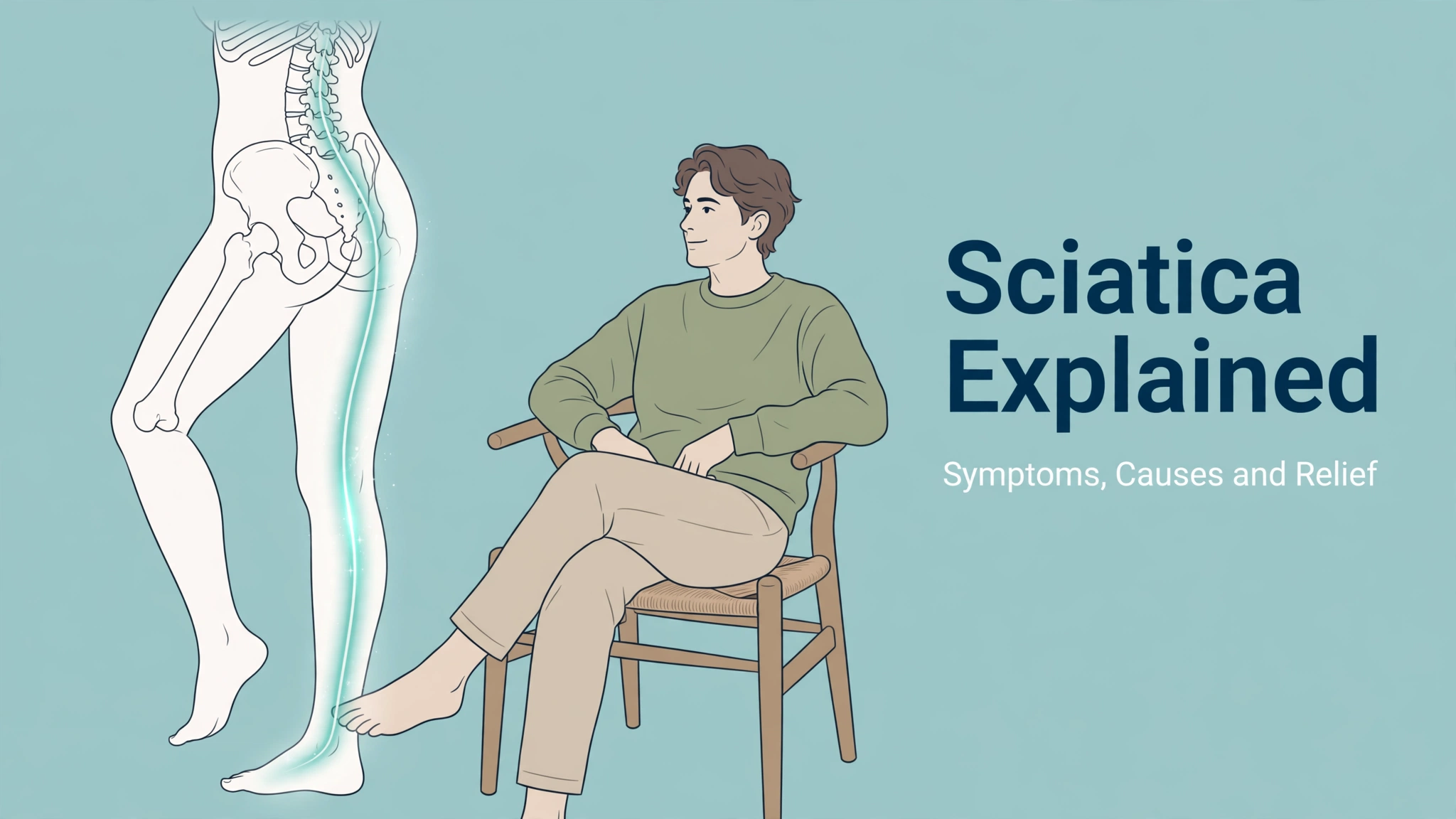
The sciatic nerve is formed from nerve roots in the lower spine, and it runs through the pelvis and down the back of each leg to the foot. When something presses on or irritates that nerve, the result is sciatica, and the symptoms follow the path of the nerve. That is why sciatica is felt in the leg as well as the back, and why the pattern of the pain can tell a doctor where the problem is. Understanding that pattern is the key to understanding sciatica, because it is not a disease in itself. It is a symptom of an underlying problem, and treating it means treating the cause.
This article explains what sciatica is, what causes it, what the symptoms look like, how it differs from ordinary back pain, what helps and what does not, which exercises are useful, and when it needs medical care or surgery. It is general information, not medical advice, and it is written to help you understand a condition that affects millions of people and that is often treated with the wrong advice.
This article is general information only. It is not individual medical advice. See a doctor promptly for any red-flag symptom listed in this article, and before starting a new exercise programme if you have a health condition.
What Sciatica Is and How the Sciatic Nerve Works
The sciatic nerve is the longest and widest nerve in the human body, and it is actually made up of five nerve roots that come together in the lower spine and form a single nerve about as thick as a thumb. It runs from the lower back, through the buttock, down the back of the thigh and calf, and into the foot, and it controls the muscles of the back of the thigh and the leg, and provides sensation to much of the leg and foot. When it is healthy, you do not notice it. When it is irritated or compressed, you notice it immediately, because the pain follows the nerve’s path.
Sciatica is the term for the symptoms that occur when the sciatic nerve is irritated, and those symptoms are distinctive. The pain is usually on one side only, it starts in the lower back or buttock and travels down the leg, and it is often described as sharp, shooting, burning or electric. It can be accompanied by tingling, numbness or weakness in the leg or foot, and it is often worse when sitting, coughing or sneezing, which increase pressure on the nerve. The pain can range from mild to severe, and it can make it difficult to walk, to sit, or to find a comfortable position.
It is important to understand that sciatica is not a diagnosis in itself. It is a symptom, like a cough or a fever, and it can be caused by several different problems. The most common is a herniated disc, where the soft centre of a disc in the spine pushes out and presses on a nerve root. Other causes include spinal stenosis, where the space around the nerves narrows, spondylolisthesis, where a vertebra slips forward, and piriformis syndrome, where a muscle in the buttock irritates the nerve. The treatment depends on the cause, which is why a proper assessment matters.
The Most Common Causes of Sciatica
The most common cause of sciatica is a herniated or slipped disc, which accounts for the large majority of cases. The discs are the cushions between the vertebrae, and they have a tough outer layer and a soft, jelly-like centre. With age, wear or injury, the outer layer can tear, and the centre can push out and press on a nearby nerve root. The pressure causes pain, inflammation and sometimes numbness or weakness, and the symptoms follow the nerve that is affected. A herniated disc in the lower back typically causes sciatica in one leg, and the specific pattern depends on which disc and which nerve root are involved.
Spinal stenosis is another common cause, especially in older adults. It is a narrowing of the spaces in the spine, which can put pressure on the nerves. The narrowing is often caused by arthritis, by thickened ligaments, or by bone spurs, and it tends to develop slowly over years. People with spinal stenosis often find that walking makes the pain worse, and that sitting or leaning forward helps, because leaning forward opens up the spaces in the spine. This is different from a herniated disc, where sitting often makes the pain worse, and the difference can help a doctor work out the cause.
Other causes are less common but worth knowing. Spondylolisthesis, where one vertebra slips forward over another, can narrow the space for the nerves and cause sciatica. Piriformis syndrome, where the piriformis muscle in the buttock irritates the sciatic nerve, can cause similar symptoms, though it is less common than is often claimed. Tumours, infections and fractures can also cause sciatica, though they are rare, and they are usually associated with other symptoms such as fever, weight loss or pain at night. The cause matters, because the treatment is different for each one, and a person who is treated for the wrong cause will not improve.
Symptoms: How Sciatica Feels and How It Differs From Back Pain
The defining symptom of sciatica is pain that travels down the leg, and that is what distinguishes it from ordinary back pain, which stays in the back. The pain usually starts in the buttock and goes down the back of the thigh, sometimes as far as the calf or foot, and it is often worse in the leg than in the back. It can be constant or it can come and go, and it can be aggravated by sitting, by coughing or sneezing, or by bending forward. Some people find that lying down helps, while others find that no position is comfortable.
Numbness and tingling are also common, and they follow the same pattern as the pain, down the leg and into the foot. The tingling is often described as pins and needles, and the numbness can make the leg feel heavy or clumsy. Weakness is a more serious symptom, and it can affect the ability to lift the foot, to stand on tiptoes, or to walk normally. A person who notices weakness should see a doctor, because it can be a sign that the nerve is significantly compressed and needs assessment.
It is also worth knowing what sciatica is not. Pain in both legs, pain that does not follow the nerve’s path, or pain that is only in the back without leg symptoms is not typical sciatica, and it may have a different cause. Pain in the buttock that does not travel down the leg is often caused by a muscle or a joint, not by the nerve, and it is treated differently. The pattern matters, and a doctor or physiotherapist can help work out whether the symptoms are sciatica or something else. Getting the diagnosis right is the first step to getting the right treatment.
Red Flags: When Sciatica Needs Emergency Care
Most sciatica improves on its own, but there are warning signs that need emergency care, and they are the same as for back pain, with a few additions. The most serious is cauda equina syndrome, a rare condition where the nerves at the bottom of the spine are severely compressed. The symptoms include numbness in the saddle area, the inner thighs and buttocks, loss of bladder or bowel control, and weakness in both legs. This is a medical emergency that needs surgery within hours, and anyone with these symptoms should go to an emergency department immediately.
Other red flags include severe weakness in the leg or foot, especially if it is getting worse, sciatica after a serious injury or fall, sciatica with fever, unexplained weight loss or a history of cancer, and sciatica that does not improve after several weeks of treatment. A person who has had sciatica before and notices a change in the pattern, such as pain in both legs or new numbness, should also seek medical advice. These are uncommon, but they are important, and knowing them can prevent serious harm.
The practical point is that most sciatica is not an emergency, and it can be managed at home with rest, movement and pain relief, but the exceptions matter. A person who is unsure should seek medical advice rather than waiting, because the conditions that cause red flags are rare but serious, and early treatment matters. When in doubt, it is better to get checked than to ignore a symptom that could be significant.
What Actually Helps: Movement, Heat and Pain Relief
The treatment for sciatica is similar to the treatment for back pain, and the most important principle is the same: keep moving. Bed rest makes sciatica worse, because it weakens the muscles, stiffens the joints, and increases the fear of movement. Gentle activity, especially walking, is one of the best things for sciatica, and it should be started as soon as the pain allows. Walking helps keep the muscles strong, the joints mobile, and the blood flowing to the tissues that need to heal, and it can be done by almost everyone.
Heat can help relax the muscles and reduce pain, and it is generally preferred for sciatica, especially in the first few days. A hot water bottle or a heat pack applied to the lower back or buttock for 15 to 20 minutes can provide relief, and a warm bath can also help. Ice can be useful for a new injury or for pain after activity, but heat is usually the better choice for the muscle tension that accompanies sciatica. Both should be used with a barrier between the pack and the skin, and neither should be used for too long at a time.
Painkillers can also help, and the same advice applies as for back pain. NSAIDs such as ibuprofen can reduce inflammation and pain, and paracetamol can help with pain, though it is less effective. A doctor may prescribe stronger medicine for severe pain, including muscle relaxants or, in some cases, a short course of steroids, but these are not a long-term solution. The goal is to use the simplest treatment that works, for the shortest time necessary, and to focus on movement and exercise as the long-term solution. Pills can help in the short term, but they do not fix the underlying problem.
Exercises for Sciatica: What to Do and What to Avoid
Exercise is an important part of treating sciatica, but it needs to be done carefully, because the wrong exercise can make it worse. The most useful exercises are those that gently stretch the muscles around the nerve and strengthen the core, and they should be started slowly, with attention to how the body responds. The piriformis stretch, where you lie on your back, cross one ankle over the opposite knee, and gently pull the knee towards the chest, can help if the piriformis muscle is involved. The knee-to-chest stretch, the cat-cow stretch, and the cobra stretch, where you lie face down and gently push up with your arms, can also help, though the cobra should be avoided if it causes sharp leg pain.
The McGill Big Three, the curl-up, the side plank and the bird dog, are also useful, because they strengthen the core without putting a lot of load on the spine. Walking is the simplest and most effective exercise, and it should be done every day, even if it is only for a short time at first. The key is to start gently, to increase gradually, and to stop if an exercise causes sharp pain down the leg. Some discomfort is normal, but pain that shoots down the leg is a sign that the nerve is being irritated, and the exercise should be modified or stopped.
A physiotherapist can help design a programme that is safe and effective, and they can check that the exercises are being done correctly. They can also provide hands-on treatment, such as mobilisation or massage, which can help in the short term, though the long-term benefit comes from exercise. The goal is not to become flexible overnight. It is to build a back and a core that are strong and mobile, and to reduce the pressure on the nerve over time. That takes weeks, and patience is part of the treatment.
When to Consider Physio, Injections or Surgery
Physiotherapy is often the first step for sciatica that does not improve with self-care, and the evidence for it is good. A physiotherapist can assess the cause, design an exercise programme, and provide education about how to manage the condition. They can also advise on posture, lifting and everyday activities, and they can help a person return to work and to normal life. The key is to find a physiotherapist who focuses on exercise and education, rather than on passive treatments that do not last.
Injections are sometimes used for sciatica that does not improve with physiotherapy and painkillers. An epidural steroid injection, where a steroid is injected near the affected nerve, can reduce inflammation and provide relief for a few weeks or months, though the effect is often temporary. Injections are not a cure, and they do not fix the underlying problem, but they can provide a window of relief that allows a person to exercise and to recover. They are usually considered when other treatments have not helped, and they should be discussed with a specialist.
Surgery is reserved for specific situations, and it is not needed for most people with sciatica. The most common operation is a microdiscectomy, where the part of the disc that is pressing on the nerve is removed, and it is usually considered when there is severe leg pain that has not improved after six to twelve weeks, or when there is significant weakness or a red flag such as cauda equina syndrome. Surgery can be very effective for the right person, but it carries risks, and it is not a guarantee of a cure. The decision should be made with a specialist, after trying conservative treatments, and with a clear understanding of the risks and benefits.
My Take:
I think sciatica is a condition that people misunderstand in a way that makes it harder to treat, because they think of it as a back problem when it is actually a nerve problem, and they treat the back when they should be treating the nerve. The pain is in the leg, and that is the clue. A person who has back pain that stays in the back has a different problem from a person whose pain shoots down the leg, and the treatment is different too. I think understanding that distinction is the most useful thing a person with sciatica can do, because it stops them from following advice that was meant for a different condition.
What I find most important is the same message as for back pain: keep moving. Bed rest makes sciatica worse, and walking is one of the best treatments there is. I know that sounds too simple, and I know that walking when your leg is in pain feels wrong, but the evidence is clear, and the people who keep moving recover faster than the people who lie down. I think that message should be given on the first day, because the instinct to rest is strong, and it is the instinct that does the most harm. Movement is not just exercise. It is treatment, and it is the treatment that works best.
I am also frustrated by how often sciatica is blamed on the piriformis muscle, because that diagnosis is popular online and it is often wrong. Piriformis syndrome exists, but it is uncommon, and most sciatica is caused by a disc pressing on a nerve, not by a muscle in the buttock. A person who spends months stretching their piriformis when the problem is a disc is wasting time, and they may be delaying the treatment that would actually help. I think a proper assessment matters, and I think a physiotherapist or a doctor should be the one to make it, rather than a video on the internet.
The red flags are the part I think everyone should know, because they are rare but serious, and knowing them can save a person from permanent harm. Cauda equina syndrome is a medical emergency, and the symptoms, numbness in the saddle area, loss of bladder control, weakness in both legs, should be known by everyone with back or leg pain. I do not say that to frighten people, because the condition is rare, but I say it because the people who do not know the signs are the ones who delay, and delay is the thing that causes harm. Knowing the signs is a form of protection, and it costs nothing to learn them.
My honest opinion is that most sciatica will improve on its own, with time, movement and simple pain relief, and that is a reassuring message for people who are in pain and afraid. The body is good at healing, and a herniated disc often shrinks over time, relieving the pressure on the nerve. That does not mean a person should do nothing. It means they should do the right things: keep walking, do gentle exercises, use heat, take painkillers if needed, and be patient. The people who recover best are usually the ones who stay active and who do not panic, and that is a lesson worth remembering.
I also think surgery is overused in the public imagination, and underused in the right cases. Many people think surgery is the only cure for sciatica, and they demand it, while others are afraid of it and refuse it even when it would help. The truth is in the middle: surgery is very effective for the right person, usually someone with severe leg pain that has not improved after weeks of conservative treatment, or someone with significant weakness, but it is not needed for most people, and it is not a guarantee. The decision should be made with a specialist, with a clear understanding of the risks and benefits, and after trying the simpler treatments first.
Walk, be patient, and know the red flags: that is the whole approach, and it is enough for most people. Walk every day, even if it is only a short distance. Do gentle exercises, and stop if they cause sharp leg pain. Use heat and painkillers if they help, but do not lean on them. And if you notice weakness, numbness in the saddle area, or loss of bladder control, get emergency care immediately, because those signs are different from ordinary sciatica pain and need urgent attention. Sciatica is painful and frightening, but it is also a condition most people recover from, and understanding it is the first step to getting better, because understanding replaces fear with a plan.
I also think the waiting is the hardest part, because sciatica can take weeks to improve, and during those weeks the pain can be frightening and the progress can feel slow. I think it helps to know that most cases do improve, and that the body is healing even when the pain has not yet gone. Keeping a simple note of what you can do each week, how far you can walk, how long you can sit, can show progress that is easy to miss day by day. That record is encouraging, and it is a reminder that recovery is happening, even when it feels slow.
The people around someone with sciatica matter more than they usually realise, because pain is not a solo experience. A person in pain needs patience, not pressure, and help with the practical things that become difficult, lifting, driving, and household tasks. A little kindness goes a long way here, and the expectation that a person should push through severe leg pain is unfair, because pushing through does not speed healing, it delays it. Sciatica is a real, painful condition, and the people who live with it deserve understanding, not judgement, and the understanding is itself a treatment, because a person who feels supported recovers better than a person who feels judged for being in pain.
Understand the nerve, keep moving, be patient, and know the red flags. Sciatica is painful, but it is also a condition that most people recover from, and understanding it is the first step to getting better. Most people recover, and recovery starts with knowing what is happening and what to do next.
Frequently Asked Questions
What is sciatica?
Sciatica is pain that travels along the sciatic nerve, from the lower back through the buttock and down the leg, usually on one side, caused by irritation or compression of the nerve.
What causes sciatica?
The most common cause is a herniated disc pressing on a nerve root. Other causes include spinal stenosis, spondylolisthesis and, less commonly, piriformis syndrome.
How long does sciatica last?
Most cases improve within a few weeks, often without specific treatment. Some cases last longer, and pain that does not improve after several weeks should be assessed by a doctor.
What exercises help sciatica?
Gentle stretching, core exercises such as the bird dog and side plank, and walking are among the most useful. Stop any exercise that causes sharp pain down the leg.
When is sciatica an emergency?
Numbness in the saddle area, loss of bladder or bowel control, weakness in both legs, or sciatica after a serious injury need emergency care immediately.
Does sciatica need surgery?
Rarely. Surgery is usually considered only when there is severe leg pain that has not improved after weeks of conservative treatment, or significant weakness. Most cases improve without surgery.