Sofie Gråbøl: The Life Story Behind the Killing Star
In this post
Sofie Gråbøl is the actress who made a knitted jumper famous around the world. She played Sarah Lund, a detective in Copenhagen, in the Danish television series The Killing, and she wore a thick, patterned jumper that became as famous as the character herself. But Sofie is much more than a jumper. She is an actress who has been working since she was a teenager, who has played in theatre, in film, and in television, and who has built a career on quiet, honest, and powerful performances.
She was born in Frederiksberg, a part of Copenhagen, and she grew up in a home where books and ideas mattered. Her father was an architect, her mother was a teacher, and the family lived a life full of culture and conversation. Sofie did not plan to be an actress at first. She wanted to study, she wanted to learn, and she found acting almost by accident, when she was cast in a film as a teenager. That accident changed her life, and it shaped the actress she became.
What makes her story worth telling is the quiet in it. She does not shout, she does not seek attention, and she does not live her life in public. She works, she goes home, and she lets her performances speak for themselves. This is the story of a Danish actress who became a star in Britain and around the world by playing a detective in a jumper, and by doing it with an honesty that made audiences feel they knew Sarah Lund as a real person.
A Childhood in Frederiksberg
Sofie Gråbøl was born on 30 July 1968 in Frederiksberg, Denmark. Frederiksberg is a district of Copenhagen, known for its parks, its old streets, and its long tradition of culture. Sofie grew up there with her family, and her childhood was full of books, school, and the theatre. Her father was an architect, her mother was a teacher, and the family lived a life where ideas were taken seriously and where culture was part of everyday life. She was the eldest of three children, and she grew up with a sense of curiosity about the world.
As a child, Sofie was thoughtful and observant. She liked to read, she liked to watch people, and she liked to notice the small details of their behaviour. She was not the loudest child in the room, but she was one of the most attentive. She loved stories, and she loved the theatre, and she often went to see plays with her family. She did not yet know that she wanted to be an actress, but she knew that she loved the world of stories, and that she wanted to be part of it in some way.
When she was a teenager, she was cast in a film almost by accident. She was seventeen years old when she appeared in Barndommens gade, a film about a young girl growing up in Copenhagen in the 1930s, based on the novel by Tove Ditlevsen. She played a girl named Ester, and her performance was praised for its warmth and its honesty. The film was a success in Denmark, and it brought her to the attention of directors and audiences. She had not planned to be an actress, but she had found something she loved, and she decided to pursue it.
Her family supported her, but they also kept her grounded. They wanted her to finish school, to think about her future, and to make her own choices. That support gave her confidence, and it also gave her a sense of balance that would help her later, when fame came and the work became more serious. She studied at the Danish National School of Performing Arts, and she graduated in 1993, at the age of twenty-five. She was ready to build a career as a serious actress, and she did so with patience and with determination.
Theatre School and Early Film Work
Sofie studied at the Danish National School of Performing Arts in Copenhagen, one of the most respected theatre schools in Denmark. She learned about acting, about voice, about movement, and about the craft of telling a story on a stage. She was a serious student, and she worked hard. She was not the most polished student, but she was one of the most determined. She wanted to learn, and she wanted to be good. Her teachers noticed her talent, her intelligence, and her ability to play characters who were strong and complex.
After she graduated in 1993, she began to work in Danish theatre and film. She appeared in theatre productions in Copenhagen, and she was praised for her ability to hold a stage with quiet power. She did not need big gestures. She could stand still and let the audience come to her, and that was a rare gift. She also appeared in films, and she began to build a reputation as a serious and talented actress who could play difficult roles with honesty and with depth.
One of her early film roles came in the 1990s, and she also appeared in other Danish films in the 1990s and 2000s. She worked with directors like Lars von Trier, appearing in his films, and she learned a great deal from working with some of the most demanding directors in Denmark. She was not yet a star, but she was a working actress, and she was respected by the people she worked with. She did not choose easy parts. She chose parts that challenged her, and that made her grow.
She also worked in television, appearing in Danish series, and she began to build a reputation as an actress who could play complex women, women who were strong and vulnerable at the same time. She was in her thirties, and she was building a career that would last for decades. She did not rush, and she did not chase fame. She simply worked, and she worked well. That quiet dedication would soon be rewarded in a way she could not have imagined, when a television series about a murder in Copenhagen changed her life.
The Killing and Sarah Lund
In 2007, Sofie Gråbøl was cast as Sarah Lund in the Danish television series The Killing, known in Danish as Forbrydelsen. Sarah Lund was a detective in Copenhagen, a woman who was brilliant at her job, but who was also lonely, awkward, and unable to connect with the people around her. She wore a thick, patterned jumper, she drove an old car, and she worked long hours, often at the expense of her family and her personal life. Sofie played her with a mix of intelligence and sadness, and audiences loved her for it.
The Killing was a huge success in Denmark, and it soon became a success in other countries too. It was shown in Britain, where it was praised by critics and loved by audiences, and it was shown in many other countries around the world. People who had never watched Danish television before fell in love with The Killing, and they fell in love with Sarah Lund. Sofie’s performance was at the heart of that success. She made Sarah feel real, not like a detective on a poster, but like a woman who was trying her best in a difficult job, and who was paying a price for it.
The series ran for three seasons, from 2007 to 2012, and each season followed a single murder investigation over twenty episodes, with Sarah Lund at its centre. Sofie won awards for her performance, and she became a household name in Britain and in other countries. Her jumper became famous, and fans in Britain bought similar jumpers, and talked about them as if they were part of the character. Sofie herself was surprised by the attention, and she has said in interviews that she did not expect the jumper to become so famous. But it did, and it became a symbol of Sarah Lund, and of Danish television.
The Killing changed the way the world saw Danish drama, and it opened doors for other Danish series, like Borgen and The Bridge, which also became famous around the world. Sofie was at the centre of that change, and she helped to show that a small country could make television that was as good as anything in the world. She had spent years building her career, and now, in her late thirties, she was famous around the world.
After The Killing: Fortitude and New Roles
After The Killing ended in 2012, Sofie began to work more in international film and television. In 2015, she was cast in Fortitude, a British television series set in a small town in the Arctic, about a murder, about secrets, and about the strange world of the far north. She played a character named Hildur Odegard, the governor of the town, a woman who was strong, intelligent, and caught up in a mystery she did not understand. The role was different from Sarah Lund, and it showed that Sofie could play a different kind of character, in a different language, in a different kind of story.
She also appeared in other international productions, including films in English and in Danish. She worked with directors in Britain and in America, and she became known as an actress who could work in different countries and different languages. She was no longer just a Danish actress. She was an international actress, and she was respected in many countries. She continued to work in Denmark too, appearing in Danish films and television series, and she did not leave her home behind.
She also returned to theatre, appearing in productions in Copenhagen, and she continued to take on stage roles that challenged her. Theatre was important to her, because it was where she had learned her craft, and it was where she could test herself in front of a live audience. She played in productions that were praised by critics, and she was recognised as one of the best stage actresses in Denmark. She was a working actress, and she was building a career that was both deep and wide.
In recent years, she has continued to take on interesting roles, in film and in television, in Denmark and abroad. She has appeared in The Killing’s legacy, in new Danish series, and in other productions that have brought her to new audiences. She is now in her late fifties, and she is still working, still learning, and still choosing roles that interest her. Her career is a model of patience, of craft, and of quiet excellence.
A Quiet Life in Copenhagen
Sofie Gråbøl lives a quiet life in Copenhagen. She is a mother, she is a partner, and she is an actress who values her privacy. She does not seek attention, and she does not live her life in public. She gives interviews when she has a new project, she talks about her work with intelligence and warmth, and then she goes home to her family and her life. That privacy is important to her, and it is one of the reasons her performances feel so honest. She does not use her private life to sell her work. She lets the work speak for itself.
She has won many awards in Denmark, including the Bodil Award and the Robert Award, which are Denmark’s most important film prizes. She has also won awards in other countries, and she has been recognised as one of the best actresses of her generation. But she does not talk much about awards. She talks about the work, about the characters, about the directors, and about the joy of telling a story well. That focus on the work, rather than on the prizes, is a big part of who she is.
She has also spoken about her health, and about a difficult time in her life when she was ill. She has talked about it with honesty, and she has said that it taught her to value her life, her family, and her work even more. That honesty has made her a role model for many people, and it is one of the reasons her fans love her. She is not just an actress. She is a person who has faced hard times and who has kept going, and that is an inspiring story.
Her influence on Danish television is large. The Killing changed the way the world saw Danish drama, and it opened doors for other Danish series. Sofie was at the centre of that change, and she helped to show that a small country could make television that was as good as anything in the world. She is proud of Denmark, and she often talks about it, about its culture, and about the way it shaped her.
The Jumper, the Detective and a Lasting Legacy
Sofie Gråbøl’s legacy is tied to Sarah Lund, and to the jumper she wore. The jumper became a symbol, not just of a character, but of a kind of television, a kind of acting, and a kind of Denmark. It was a thick, warm, practical jumper, worn by a woman who worked long hours in the cold, who did not care about fashion, and who cared about solving a murder. That image stayed with audiences, and it became famous around the world. Sofie did not plan for it to become famous. She simply wore what Sarah Lund would wear, and the audience loved it.
But her legacy is also about more than a jumper. It is about a career built on quiet, honest, and powerful performances, about a woman who has worked for more than thirty years, who has won awards, who has played in theatre, in film, and in television, and who is still working. She has shown that you do not need to shout to be heard, and you do not need to chase fame to be respected. You just need to work well, and to keep working well, for a long time.
As she moves into her late fifties, Sofie is still a working actress, still choosing roles, still learning. Her story is not finished, and her fans wait with hope for whatever she does next. She is an actress, a mother, and a quiet star, and her story is one of the most inspiring in European acting. She shows that a small role, played well, can change a life, and that a jumper, worn with honesty, can become famous around the world.
A Detective Who Changed Television
Sofie Gråbøl’s work as Sarah Lund changed television in a way that few actors can claim. Before The Killing, most crime dramas followed a familiar pattern: a murder, a clever detective, a quick solution, and a happy ending. The Killing was different. It followed one murder over twenty episodes, it showed the pain of the victim’s family, it showed the politics behind the investigation, and it showed a detective who was brilliant at her job but lonely in her life. That slow, careful storytelling was new, and it inspired television makers in many countries to try the same thing. Sofie was at the centre of that change, and her performance made it work. Without her, The Killing would have been just another crime show. With her, it became a landmark.
She also changed the way people thought about a female detective. Sarah Lund was not glamorous, she was not charming in the usual way, and she did not try to be liked. She wore a jumper, she drove an old car, she worked long hours, and she was awkward with people. But she was brilliant, she was honest, and she cared about the truth more than anything else. That was a new kind of heroine, and it showed that a woman on television did not have to be beautiful or sweet to be loved by an audience. She could be difficult, she could be lonely, and she could still be the hero. Sofie played that heroine with an honesty that made audiences love her, even when Sarah was at her most difficult.
The Killing also changed the way the world saw Denmark. Before it, few people outside Denmark watched Danish television. After it, Danish drama became famous around the world, and series like Borgen and The Bridge followed in its path. Sofie was part of that wave, and she helped to open the door for other Danish actors and writers. She is proud of that, and she often talks about Denmark, about its culture, and about the way it shaped her. She did not just play a detective. She helped to put Danish television on the map, and that is a remarkable achievement for an actress who never sought fame for herself.
Her work in Fortitude showed another side of her, a woman in a position of power, a governor in the Arctic, trying to hold a community together in a strange and dangerous place. It was a different role, in a different language, in a different kind of story, and she played it with the same quiet power she brought to Sarah Lund. She showed that she was not just one character. She was an actress who could play many kinds of women, in many kinds of stories, and do it with the same honesty. That range is rare, and it is why directors keep casting her in important roles, in Denmark and abroad.
She has also become known for the way she works with young actors, for the patience she shows them, and for the advice she gives them on set. Actors who have worked with Sofie say that she is generous, that she listens, and that she makes the people around her feel safe, and that safety allows them to take risks and to be honest in their performances. That generosity is not something you can learn from a book. It comes from years of working, from knowing how hard acting is, and from wanting to help others through it. Sofie does that, quietly, without seeking credit, and that is a big part of why she is loved by the people she works with, in Denmark and abroad.
My Take:
When I think about Sofie Gråbøl, the first thing I feel is calm. She is not a loud actress. She does not shout, she does not overact, and she does not try to impress me with big gestures. She acts quietly, and that quiet acting is more powerful than shouting. When I watch her as Sarah Lund in The Killing, I see a woman who is thinking, who is listening, who is trying to solve a puzzle, and I believe her. I believe her because she does not pretend. She simply is the character, and that is a rare gift. I admire that kind of acting, because it is honest, and honesty is the hardest thing to fake.
I admire her patience most of all. She did not become famous when she was young. She spent years in theatre school, years in small roles, years in Danish film and television, learning her craft one step at a time. She was in her late thirties when The Killing made her famous around the world. That is a long time to wait, and many people would have given up. She did not give up. She kept working, she kept learning, and she kept believing that good work would be noticed in the end. That patience is a lesson for all of us. Sometimes the best things take time, and sometimes you have to work quietly for many years before the world sees you. Sofie did that, and I respect her for it.
What moves me about Sarah Lund is the loneliness in her. She is brilliant at her job, but she is lonely in her life. She cannot connect with her son, she cannot keep a relationship, and she works long hours because work is the only place where she feels she belongs. Sofie plays that loneliness with such honesty that I feel it. I have felt lonely, even when I was with other people, and watching Sarah, I felt understood. That is what great acting does. It takes a character who is very different from me and makes me feel that her pain is my pain too. I respect Sofie for playing that loneliness so openly, without hiding it.
I also think about the jumper, and how funny and wonderful it is that a piece of clothing became famous around the world. Sofie did not plan for it. She just wore what Sarah Lund would wear, a thick, warm, practical jumper, because Sarah worked long hours in the cold, and she did not care about fashion. The audience loved it, because it was real. It was not a costume designed to be famous. It was a costume designed to be true. That is a lesson for all of us. When you are true, people notice, even in the smallest details. A jumper can become famous, if it is worn with honesty. I love that story, because it shows that fame does not come from trying to be famous. It comes from being true.
I love the way she lives her life now. She is famous, but she is not obsessed with fame. She lives in Copenhagen, she is a mother, she values her privacy, and she lets her work speak for itself. She does not use her private life to get attention, and she does not chase the cameras. That is a quiet kind of dignity, and I admire it. In a world where many famous people live their lives in public, Sofie keeps hers private, and that privacy makes her performances feel more honest. She is not selling herself. She is selling a story, and that is as it should be.
I also think about the way she plays women who are strong and flawed at the same time. Sarah Lund is strong, but she is also flawed. She makes mistakes, she hurts people she loves, and she has to live with those mistakes. Sofie does not hide those flaws. She shows them, and she lets the audience see them. That is brave, because many actresses want to play perfect women. Sofie plays real women, with real faults, and that makes them more interesting and more human. I think that is why audiences love her. They see themselves in her characters, not a perfect image, but a real person trying her best.
If I have a sadness in her story, it is that she was not famous sooner. She was a wonderful actress for many years before The Killing, but the world did not see her. That is not her fault. It is the fault of a world that often overlooks quiet talent, and that only notices people when they are in a big hit. But I am glad that The Killing came, and I am glad that the world finally saw her. It is never too late to be recognised, and Sofie’s story proves that. She was in her late thirties, and she became a star. That gives hope to anyone who feels that they have been overlooked for too long.
I also learn from her that acting is not about being seen. It is about seeing. Sofie watches people, she listens to them, and she understands them. That is why her characters feel so real. She is not performing for the camera. She is listening to the other actors, she is thinking as the character, and she is letting the truth come out slowly. I think that is a lesson for life, not just for acting. If we listen more, and talk less, we will understand people better, and we will be better people ourselves. Sofie teaches me that by the way she acts.
For a young reader, I think the lesson from Sofie is simple: take your time, learn your craft, and do not rush. She spent years learning, years working in small roles, and years waiting. She did not become famous overnight, and she did not need to. She became good first, and then she became famous. That is the right order. If you want to be an actor, or a writer, or anything else, learn first, work hard, and be patient. The world will notice you when you are ready, and when it does, you will be ready for it. That is what Sofie teaches me.
In the end, I think Sofie Gråbøl is a reminder that quiet power is real power. She does not shout, she does not demand attention, and she does not need to. She simply does her work well, and the work speaks for itself. I am grateful for her, and I hope she keeps acting for many years to come. The world needs more actresses like her, actresses who are honest, patient, and true. When I watch The Killing, I do not just see a detective. I see a woman who is trying her best, and I see an actress who is doing her best too. That is a beautiful thing, and it is why I will keep watching her work.
I also think about the way she handles the fame of the jumper. It would be easy to be annoyed by it, to feel that people only care about a piece of clothing and not about the acting. Sofie has never been annoyed by it. She has talked about the jumper with humour, saying that she did not expect it to become famous, and that she is glad people loved it. That humour tells me a lot about her. She does not take herself too seriously, and she does not resent the thing that made her famous. She accepts it, she laughs about it, and she keeps working. That is a healthy way to handle fame, and I admire it. Many actors would be bitter. Sofie is not bitter. She is grateful, and she is still working.
There is another side to her that I want to mention, and that is her work in theatre. She has always returned to the stage, even after The Killing made her famous on television. Theatre is hard work, it pays less, and it is seen by fewer people, but Sofie keeps doing it, because it is where she learned her craft, and because it keeps her honest as an actress. On a stage, there is no editing, no second take, and no camera to hide behind. You have to be present, you have to listen, and you have to be true. Sofie values that, and she keeps going back to it. That tells me that she cares about acting itself, not just about fame. She is an actress first, and a star second, and that is the right order.
I also think about her health, and about the difficult time she went through when she was ill. She has talked about it with honesty, and she has said that it taught her to value her life, her family, and her work even more. That is a hard lesson to learn, and it is one that many people learn only when they face illness themselves. Sofie learned it, and she shared it, and that sharing helped other people. I respect her for being open about something so personal, because it is easy to hide illness, and it is hard to talk about it. She talked about it, and she kept going, and that is brave.
I think about the young actresses who look at Sofie and see a role model. They see a woman who started as a teenager, who studied, who worked in small roles, who waited, and who became a star in her late thirties. That story tells them that they do not have to be famous at twenty to have a great career. They can learn, they can grow, and they can become better with time. That is a hopeful message in a world that often tells young women that they must be famous young or not at all. Sofie proves that wrong, and I am glad she does. Her career is a long one, and it is still going, and that is the best kind of career.
I also want to say something about the way she plays silence. Sarah Lund is often silent, and Sofie plays that silence with great skill. She does not fill every moment with words. She lets the silence sit there, and she lets the audience feel it. That is a hard thing to do, because silence can feel awkward, and many actors are afraid of it. Sofie is not afraid of it. She trusts the silence, and she trusts the audience to understand it. That trust is a sign of a great actress, and it is one of the reasons her performances feel so real. She does not need to explain everything. She lets me watch, and lets me feel, and that is enough.
I also think about the way she carries herself in public. She does not dress to be noticed, she does not speak to be quoted, and she does not live to be photographed. She goes to work, she does her job well, and she goes home. That simplicity is refreshing in a world where many famous people seem to live for attention. Sofie lives for her work and for her family, and the attention is something that happens to her, not something she chases. I respect that, because it shows that she knows what matters, and that she has kept her priorities straight through more than thirty years of fame.
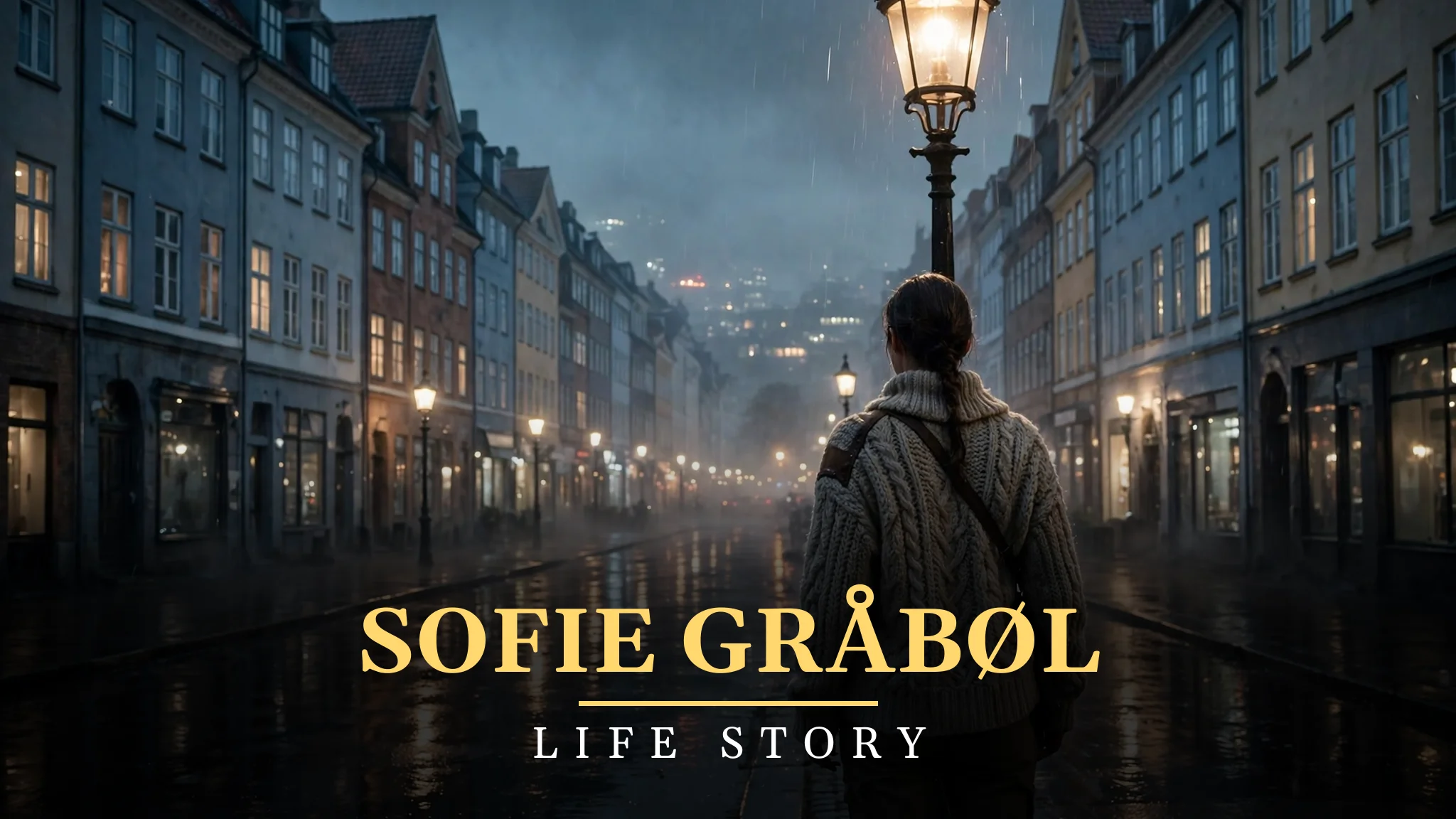
One more thought stays with me. I think about the rainy street in the image, with its wet stones and its glowing lamp, and how it fits Sofie. She is like that street: quiet, a little bit cold, a little bit lonely, but full of light that comes from a lamp in the dark. I hope she keeps standing in that light, keeps working, and keeps showing the world what quiet acting can do. She is a star, but she is a quiet star, and that is the best kind of star.
Frequently Asked Questions
Where was Sofie Grabol born and how old is she?
Sofie Grabol was born on 30 July 1968 in Frederiksberg, Denmark, which makes her 58 years old in 2026. She grew up in Frederiksberg, was cast in a film at seventeen, and graduated from the Danish National School of Performing Arts in 1993.
What is Sofie Grabol most famous for?
She is most famous for playing Sarah Lund, a detective in Copenhagen, in the Danish television series The Killing, which ran from 2007 to 2012. Her thick patterned jumper became as famous as the character, and the series made Danish drama known around the world.
Why did Sarah Lund’s jumper become famous?
Sarah Lund wore a thick, patterned jumper because she worked long hours in the cold and did not care about fashion. Viewers in Britain loved it, bought similar jumpers, and talked about it as a symbol of the character and of Danish television.
Did Sofie Grabol appear in Fortitude?
Yes, she appeared in Fortitude in 2015, playing Hildur Odegard, the governor of a small town in the Arctic. The role was different from Sarah Lund and showed her working in a British series in a new kind of story.
What was Sofie Grabol’s first film?
Her first film was Barndommens gade, released when she was seventeen, in which she played Ester, a young girl growing up in Copenhagen in the 1930s. The film was based on the novel by Tove Ditlevsen and was a success in Denmark.
Has Sofie Grabol won awards?
Yes, she has won many awards in Denmark, including the Bodil Award and the Robert Award, and she has been recognised in other countries for her performance as Sarah Lund. She is regarded as one of the best actresses of her generation in Denmark.
Where does Sofie Grabol live now?
She lives a quiet life in Copenhagen, Denmark, where she is a mother and a working actress. She values her privacy, gives interviews when she has a new project, and continues to work in Danish and international theatre, film, and television.


