Soprano: The Life Story Behind France's Rapper with a Big Heart
In this post
There are rappers who build their fame on anger, and there are rappers who build it on hope. Soprano belongs to the second kind. For more than twenty years, he has been one of the most loved voices in French music, and he has done it by singing about love, about family, about his city, and about the belief that life can get better. He does not hide the hard parts of life, but he refuses to let them win. His music is full of energy, full of warmth, and full of a simple message: keep going, keep believing, and keep loving the people around you.
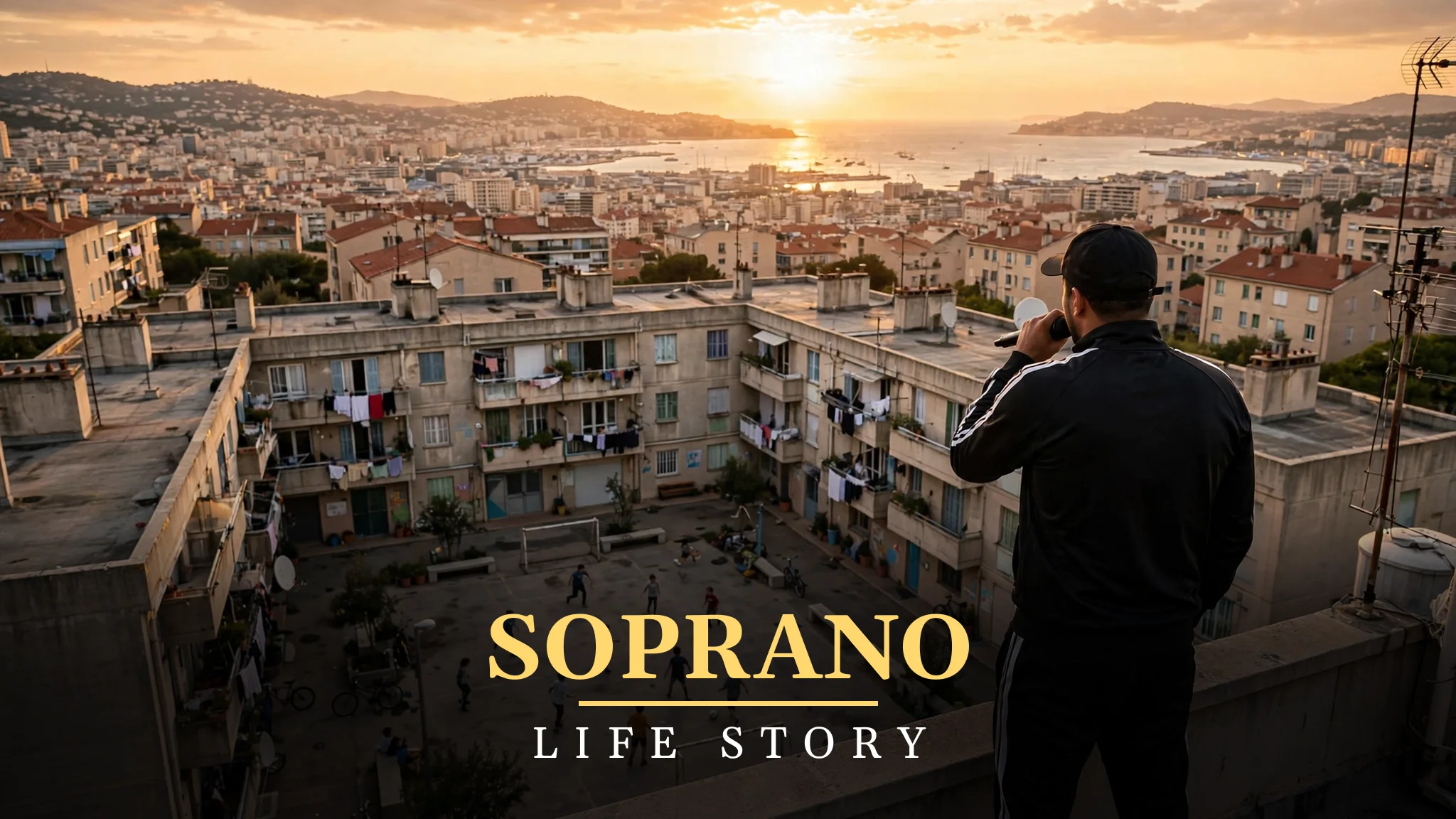
His real name is Saïd M’Roumbaba, and he was born in Marseille, in the south of France, into a family from the Comoros Islands. He grew up in the northern districts of Marseille, in the tower blocks and the housing estates where many immigrant families live, and he learned to rap on the streets and in the courtyards of his neighbourhood. He started with the group Psy 4 de la Rime, and he became a solo star with albums that sold in huge numbers. He is a singer, a rapper, a father, and a man who has never forgotten where he came from.
This is the story of a boy from Marseille who became one of the biggest stars in France, and who did it without losing his kindness. It is a story about friendship, about the power of a group, about a solo career built on positive energy, and about a man who uses his fame to help young people. It is also a story about a city, Marseille, and about the way a place can shape an artist for his whole life.
A Childhood in the North of Marseille
Saïd M’Roumbaba was born on 14 January 1979 in Marseille, France, into a family from the Comoros, a group of islands in the Indian Ocean off the coast of Africa. He grew up in the northern districts of Marseille, in the housing estates where many families from the Comoros, from North Africa, and from other parts of the world live side by side. It was a world of tower blocks, of courtyards, of football games, and of music coming from open windows. It was not a rich world, but it was a world full of life, and Saïd loved it.
As a child, he was full of energy, and he loved to play, to laugh, and to make his friends laugh. He was not the quietest boy in the class, and he was not the most serious, but he had a gift for words, and he loved to rhyme. He discovered rap music as a teenager, and it changed his life. Rap was the music of his neighbourhood, the music that told the truth about life in the estates, and he felt that it was made for him. He began to write his own rhymes, first for fun, then more seriously, and he discovered that he had a talent for it.
His family was large, and it was close, and it gave him a strong sense of who he was. His parents had come from the Comoros to build a better life in France, and they worked hard to give their children an education and a future. They taught him the value of respect, of family, and of faith, and those values stayed with him through all the years of his career. He has spoken often about his mother, and about the love and the strength she gave him, and that love is at the heart of many of his songs.
School was a part of his life, but the streets were where he really learned. He learned to rap in the courtyards, to perform for his friends, and to tell stories about the life he saw around him. He learned that words have power, that a good rhyme can make people laugh, can make them think, and can make them feel less alone. That lesson became the foundation of his whole career, and it is why his music still speaks to young people in the same neighbourhoods where he grew up.
Psy 4 de la Rime and the Power of Friendship
In the late 1990s, Saïd joined forces with three friends from Marseille, Alonzo, Vincenzo, and DJ Sya Styles, to form the rap group Psy 4 de la Rime. The name was a play on words, and the group became one of the most important in French rap. They were four young men from the same neighbourhood, with the same dreams, and they made music together that was honest, energetic, and full of the life of Marseille. They were not just a group. They were a family, and that friendship was the secret of their success.
Their first album, “Block Party”, came in 2002, and it was a success in France, with songs that spoke about life in the estates, about friendship, and about the dreams of young people. The album showed a group with a clear voice, a strong sense of identity, and a talent for making music that people wanted to hear again and again. They followed it with “Enfants de la lune” in 2005, an album that included the song “Le monde est stone”, and then with “Les cités d’or” in 2008, which became one of the most loved French rap albums of its time.
The group toured France, they performed at festivals, and they became stars, but they never forgot where they came from. They sang about Marseille, about their neighbourhoods, and about the people they loved, and their fans saw themselves in their songs. They were not distant celebrities. They were boys from the estates who had made it, and their success gave hope to many young people in the same situation. That hope is one of the most important parts of their story.
The group also taught Saïd the value of working with others. He learned to write with his friends, to share ideas, to listen, and to build something together that was bigger than any one of them could make alone. Those lessons stayed with him when he later became a solo artist, and they are part of the reason his solo career has been so successful. He is a rapper who knows how to work with others, and that generosity has made him a respected figure in French music.
Going Solo and Finding His Own Voice
In 2007, Soprano released his first solo album, “Puisqu’il faut vivre”, and it was a success. The album showed a rapper with a clear voice, a warm heart, and a gift for writing songs that spoke to a wide audience. It included songs about life, about love, and about the need to keep going, and it proved that he could stand on his own, without the group behind him. He was no longer only a member of Psy 4 de la Rime. He was a solo star in his own right.
His second solo album, “La Colombe”, came in 2010, and it included the song “Hiro”, a tribute to the Japanese hero of the television series Heroes, which became a hit. The album showed a rapper who was growing, with songs that were more personal and more varied, and it was a success in France and abroad. He toured with the album, singing in big halls and at festivals, and he discovered the joy of performing for large audiences who knew his songs by heart.
In 2014, he released “Cosmopolitan”, an album that included the song “Cosmo”, a joyful and energetic track that became one of his most loved songs. The album showed a rapper who was comfortable in his own skin, who could make people dance, and who could also make them think. It was a success, and it confirmed that his solo career was not a short experiment. It was a real and lasting career, built on talent, hard work, and a positive message.
He continued to release albums, including “L’Everest” in 2016, which included the song “En feu”, and “Phœnix” in 2018, and each one showed a different side of his art. He was no longer a young rapper from the estates. He was a mature artist, a father, and a star who had learned to balance fame with family, and success with kindness. His music had grown with him, and his audience had grown with him too.
The Big Heart of French Rap
What sets Soprano apart from many other rappers is his positive message. French rap is often associated with anger, with protest, and with stories of hardship, and Soprano does not hide those things. He sings about the hard parts of life, about the estates, about the struggles of immigrant families, and about the pain of losing people you love. But he always adds something else: hope. His songs say that life can get better, that love matters, that family matters, and that a person can rise above their circumstances. That hope is why his music is loved by people of all ages, from teenagers to grandparents.
His song “À nos héros du quotidien” is a perfect example. It is a tribute to the ordinary heroes of daily life: the nurses, the teachers, the parents, the workers who keep the world going without ever being thanked. The song became an anthem, played on the radio, in schools, and at public events, and it showed that rap could be a music of gratitude as well as a music of anger. It is one of the songs most associated with his name, and it is a song that many French people know by heart.
He has also written songs about his mother, about his children, and about his city, and each one is full of love. He does not write about fame or money. He writes about the things that matter most: family, friendship, and the simple joys of life. That is why his concerts feel like family gatherings, with audiences that include parents and children, singing together, dancing together, and sharing a moment of joy. He has built a career on love, and that love has been returned to him many times over.
His positive message has also made him a role model for young people. He visits schools, he talks to teenagers, and he tells them that they can achieve their dreams if they work hard and stay true to themselves. He does not pretend that life is easy, but he shows them that it is possible to rise, and that their background does not have to define their future. That message has given hope to many young people in Marseille and across France.
Chasseur d’étoiles and the Later Years
In 2021, Soprano released the album “Chasseur d’étoiles”, which included the hit song “Forrest”, a song about running through life, about dreams, and about the journey of a young man from the estates to the stars. The album was a success, and it showed a singer who was still growing, still writing, and still finding new things to say. He toured with the album, singing in big stadiums and arenas, and he proved that he was still one of the biggest stars in France, more than twenty years after he started.
He also became a coach on The Voice in France, helping young singers who were starting where he had started. He understood their fear, because he had felt it himself, and he tried to give them the advice he wished someone had given him: to be themselves, to trust their voices, and to sing with their hearts. That advice, coming from a man who had lived it, carried more weight than any lesson from a book, and the young singers listened.
He continued to work with other artists, to write songs, and to perform at festivals and events across France. He became a familiar and loved figure in French culture, known not only for his music but also for his kindness, his humour, and his generosity. He was no longer a young rapper from the estates. He was a star, a father, and a man who had built a life that he was proud of, and who used his fame to help others.
His later work also showed a more reflective side, with songs about getting older, about the passing of time, and about the importance of family. He sang about his children, about his parents, and about the city that made him, and he did it with a tenderness that touched many listeners. He had grown from a young rapper into a mature artist, and his music had grown with him, becoming deeper, warmer, and more honest with each album.
He also performed at some of the biggest events in France, including concerts for charity, for the victims of disasters, and for the celebration of French culture. He sang for people who had lost their homes, for families who were grieving, and for communities that needed hope. Those performances were not about fame or money. They were about using his voice to help, and they showed a man who understood that a singer has a responsibility to the people who listen to him. That responsibility is something he has taken seriously throughout his career.
His concerts also became famous for their energy, with audiences that sang along to every word, danced in the aisles, and left the hall feeling happier than when they arrived. He learned to talk to the crowd between songs, to joke with them, and to make a big stadium feel like a family gathering. That closeness is rare in modern music, and it is one of the reasons his fans keep coming back, year after year, to hear him sing.
Marseille, Family, and Never Forgetting
Marseille is at the heart of everything Soprano does. He was born there, he grew up there, and he still lives there, and he sings about the city in almost every album. He sings about the sea, about the sun, about the streets of the northern districts, and about the people who live there. For him, Marseille is not just a city. It is a home, a family, and a source of inspiration that never runs dry. He has said that he could never live anywhere else, because Marseille is part of who he is.
His family is also at the heart of his music. He is a father, and he has spoken often about his children, about the joy they bring him, and about the responsibility of being a good example for them. He has kept his family life private, protecting his children from the spotlight, but he has also spoken with tenderness about the love he feels for them. His songs about family are some of his most loved, because they speak to a universal feeling: the love of a parent for a child, and the wish to give them a better life.
He has also never forgotten the people who helped him when he was starting out: his friends in Psy 4 de la Rime, his family, and the people of his neighbourhood who believed in him before anyone else did. He has worked to give back to Marseille, supporting young artists, visiting schools, and helping charities that work with children in the estates. He does not see his fame as something that belongs only to him. He sees it as something he shares with his city, and he tries to use it to help others.
Today, he continues to record and to perform, and his concerts still have the warmth of a family gathering. He talks to the audience, he sings with his whole heart, and he makes people feel that they are part of something special. That is a rare gift, and it is why his fans stay loyal. He is not just a rapper. He is a man who loves his city, his family, and his music, and who has built a career on that love.
He also became known for his work with young people in Marseille, visiting schools and youth centres, talking to teenagers about their dreams, and telling them that their background does not have to define their future. He did not just sing about hope. He went to the places where hope was needed most, and he shared it in person. That work, done quietly and without much publicity, is one of the most important parts of his story.
His story is also a reminder that a rapper can be a force for good, using his voice to lift people up rather than to tear them down, and that is a legacy worth celebrating.
What Soprano Means Today
Today, Soprano is one of the most loved artists in France, with millions of records sold, with hit songs that are still played on the radio, and with a fan base that spans generations. He has won major French music awards, he has filled stadiums, and he has become a familiar and respected figure in French culture. He is known for his voice, his energy, his positivity, and his big heart, and he is loved by people of all ages and all backgrounds.
His influence can be seen in the young rappers who followed him, especially young artists from the estates who saw that it was possible to rap about hope as well as about anger, and to build a career on love rather than on hate. He showed that a rapper from Marseille could become a star, and that his background was not a barrier but a strength. That message has travelled far beyond music, and it has given hope to many young people who feel different from the world around them.
He continues to record and to perform, and his story is far from over. For anyone who dreams of a life in music, his story is a reminder that the best music comes from who you are, from your family, and from the place you come from, and that no one can take that away from you. It is also a reminder that kindness is not a weakness. It is a strength, and it is the strength that has carried Soprano further than anger ever could.
My Take:
When I think about Soprano, the first thing I feel is warmth. Not the loud and showy kind of warmth, but the quiet kind, the kind you feel when someone is genuinely kind and means it. His music has that quality, and his public image has it too. He is a rapper, but he is not an angry rapper. He is a rapper who sings about love, about family, about his city, and about the belief that life can get better. I love that, because so much of rap music is about anger, and anger has its place, but hope also has its place, and Soprano has made hope his home.
I admire his loyalty to his friends, because Psy 4 de la Rime was not just a group. It was a family, and the friendship between those four young men from Marseille is one of the most beautiful parts of his story. They grew up together, they made music together, they became stars together, and they stayed friends. That is rare in the music industry, where groups often break up over money, over fame, or over ego. They stayed together because they loved each other, and because they understood that the music was better when they made it together. I think that is a lesson for anyone who works with others: friendship is not a weakness. It is a strength, and it makes the work better.
What I love most about his solo career is that he did not change who he was when he became a star. He could have become a different person, a colder person, a person who only cares about fame and money. He did not. He stayed the same warm and generous man, and his music stayed the same: full of love, full of hope, full of Marseille. That is a hard thing to do, because fame changes people. It gives them money, it gives them power, and it gives them the chance to forget where they came from. He did not forget. He carried Marseille with him wherever he went, and he made sure that his city was part of his success.
I also think about his mother, and about the songs he has written for her, because they are some of the most moving in French rap. He sings about her with a tenderness that is rare in any kind of music, and he does it without embarrassment. He is a big and strong man, a rapper who fills stadiums, and he sings about his mother with the love of a child. That is a beautiful thing, and it tells me a lot about who he is. He is not afraid to be soft, and he is not afraid to show his feelings. That courage is part of what makes him a great artist.
There is something I find sad in his story, and it is the thought of the young people in the estates who look up to him and who still face the same hardships he faced. He has become a star, but the estates are still there, the tower blocks are still there, and the young people there still need hope. He has done a lot to help them, visiting schools, talking to teenagers, and supporting charities, but one man cannot change a whole system. I think he knows that, and I think it weighs on him. He has used his fame to do what he can, and that is admirable, but the work is not finished, and it will not be finished by one artist alone.
I admire his song “À nos héros du quotidien”, because it is a song about the people who are usually forgotten: the nurses, the teachers, the parents, the workers. Most pop songs are about stars, about love, about fame. This song is about ordinary people, and it says thank you to them. That is a generous thing to sing about, and it shows a man who sees the world clearly. He knows that the world is not kept going by celebrities. It is kept going by ordinary people, doing ordinary jobs, with love and with care. I think that song is one of the most important in French music, and I hope it is remembered for a long time.
I think about his role as a coach on The Voice, and I feel happy for the young singers who get to work with him. He understands their fear, because he has felt it himself, and he gives them advice that comes from real experience. He tells them to be themselves, to trust their voices, and to sing with their hearts. That is simple advice, but it is the best advice a young singer can get, because the music industry is full of people who will tell you to be someone else. He tells them to be themselves, and that is a gift. I hope the young singers listen to him, because he knows what he is talking about.
If I have a criticism, it is a small one, and it is really a wish. I wish more people outside France knew his music, because his songs deserve a wider audience. He sings in French, and that limits his reach, but his energy, his warmth, and his message cross borders even when the words do not. I hope that his music travels further in the coming years, and that new listeners discover the joy and the hope in his songs. There is a lot to discover there, and the discovery is worth the effort.
I also think about his city, Marseille, and about what it means to him. He could have moved to Paris, as many stars do, and lived a life of luxury in the capital. He stayed in Marseille, because Marseille is his home, and because he loves it. That loyalty is rare, and it is admirable. He has shown that you do not need to leave your city to become a star. You can stay, you can build your career there, and you can use your success to help the place that made you. That is a lesson for young artists everywhere: your home is not a barrier. It is your strength.
I sometimes think about the young Saïd, rapping in the courtyards of his neighbourhood, with his friends, dreaming of a better life. I wonder if he imagined that one day he would fill stadiums, win awards, and become one of the most loved artists in France. I think he dreamed of it, but I do not think he knew how far it would go. He just kept rapping, kept writing, kept believing, and the dream came true, one step at a time. That is a beautiful story, and it is a reminder that dreams do not come true all at once. They come true slowly, through hard work, through friendship, and through never giving up.
Another thing that stays with me is his humour. He is a funny man, and his music is full of joy and laughter, even when it is about serious things. That humour is part of his charm, and it is part of why his concerts feel like parties. He makes people laugh, he makes them dance, and he makes them feel good about themselves. In a world that often feels heavy, a singer who can make people laugh is doing something important. He does it without pretending that life is easy, and without hiding the hard parts. He does it by being himself, warmly and honestly, and I think that is the best kind of music there is.
In the end, what I take from the story of Soprano is a simple idea: be kind, be hopeful, and never forget where you come from. He has built a career on those three things, and they have carried him further than anger or fame ever could. He is a rapper with a big heart, and that heart is the reason his music has lasted for more than twenty years. I hope he keeps singing, I hope he keeps helping young people, and I hope he keeps reminding us that hope is not a naive dream. It is a choice, and it is a choice worth making every day.
One last thought stays with me. When I hear his songs, I hear a man who loves his family, his city, and his music, and who wants to share that love with the world. That is a simple thing, and it is a beautiful thing, and it is the reason his fans love him. He is not just a star. He is a friend, and I think that is the best thing a singer can be.
I also think about the song “Forrest”, because it is a song about running, about moving forward, and about the journey of a life. It is a song that many people have adopted as their own anthem, because they are also running, also moving, also trying to reach their dreams. The song is full of energy, and it makes people want to move, to act, to keep going. That is a powerful thing for a song to do, and it is why “Forrest” became one of his most loved songs.
There is another thing I admire, and it is the way he has stayed humble despite his success. He fills stadiums, he wins awards, he is one of the biggest stars in France, and yet he still talks about his neighbourhood, his family, and his friends as if they were the most important things in his life. That humility is rare, and it is admirable. Fame often makes people arrogant, and it makes them forget the people who helped them. He has not forgotten, and he has not become arrogant. He is still the boy from Marseille, and he is proud of it.
I sometimes think about the Comoros, the islands where his family comes from, and about what they mean to him. He has spoken about his roots, about the music of the islands, and about the pride he feels in his heritage. He carries the Comoros with him, just as he carries Marseille, and that mix of cultures is in his music. He is French, he is Comorian, he is from Marseille, and he is all of those things at once. That is a beautiful thing, and it is a lesson for anyone who feels that they must choose one identity. You do not have to choose. You can carry them all.
I also think about the future, and I feel hopeful for him. He is still writing, still singing, and still growing as an artist. His music has matured, his songs have deepened, and he has a life now that includes his children, his work, and his fans. I want to hear the songs he will write in the next ten years, when he has lived more and learned more. I think they will be even better than the songs we know now, because he is an artist who grows with his life, and his life is still unfolding.
Finally, I want to say that his story gives me hope about the future of rap music. In a world where rap is often associated with anger and violence, Soprano shows that rap can also be about love, about hope, and about kindness. That is a hopeful thought, and it is one that I will carry with me. If he can do it, then other rappers can do it too, and the world will be better for it.
I also think about the children who sing his songs in school, and about what they learn from them. They learn that it is good to be kind, to love your family, and to believe in yourself. That is a beautiful thing for a child to learn from a song, and it is a gift that Soprano gives to a whole generation.
Frequently Asked Questions
Where was Soprano born and what is his real name?
Soprano was born Saïd M’Roumbaba on 14 January 1979 in Marseille, France, into a family from the Comoros Islands. He grew up in the northern districts of Marseille, in the housing estates where many immigrant families live.
What group did Soprano start with?
He started with the rap group Psy 4 de la Rime, formed in Marseille with his friends Alonzo, Vincenzo, and DJ Sya Styles. The group released successful albums including “Block Party”, “Enfants de la lune”, and “Les cités d’or”.
What is Soprano’s most famous song?
His most famous songs include “Cosmo”, “En feu”, “À nos héros du quotidien”, and “Forrest”. His solo albums include “Puisqu’il faut vivre”, “La Colombe”, “Cosmopolitan”, “L’Everest”, “Phœnix”, and “Chasseur d’étoiles”.
What is Soprano known for in French rap?
He is known for his positive message, singing about love, family, hope, and his city of Marseille, rather than only about anger and hardship. His music is loved by people of all ages, from teenagers to grandparents.
Did Soprano coach on The Voice in France?
Yes, he became a coach on The Voice in France, helping young singers who were starting where he had started. He gave them advice from his own experience as a rapper from Marseille.
Does Soprano still live in Marseille?
Yes, he still lives in Marseille, the city where he was born and grew up. He sings about the city in almost every album, and he works to help young people and charities in his home city.


