Sting: The Life Story Behind the Police Frontman
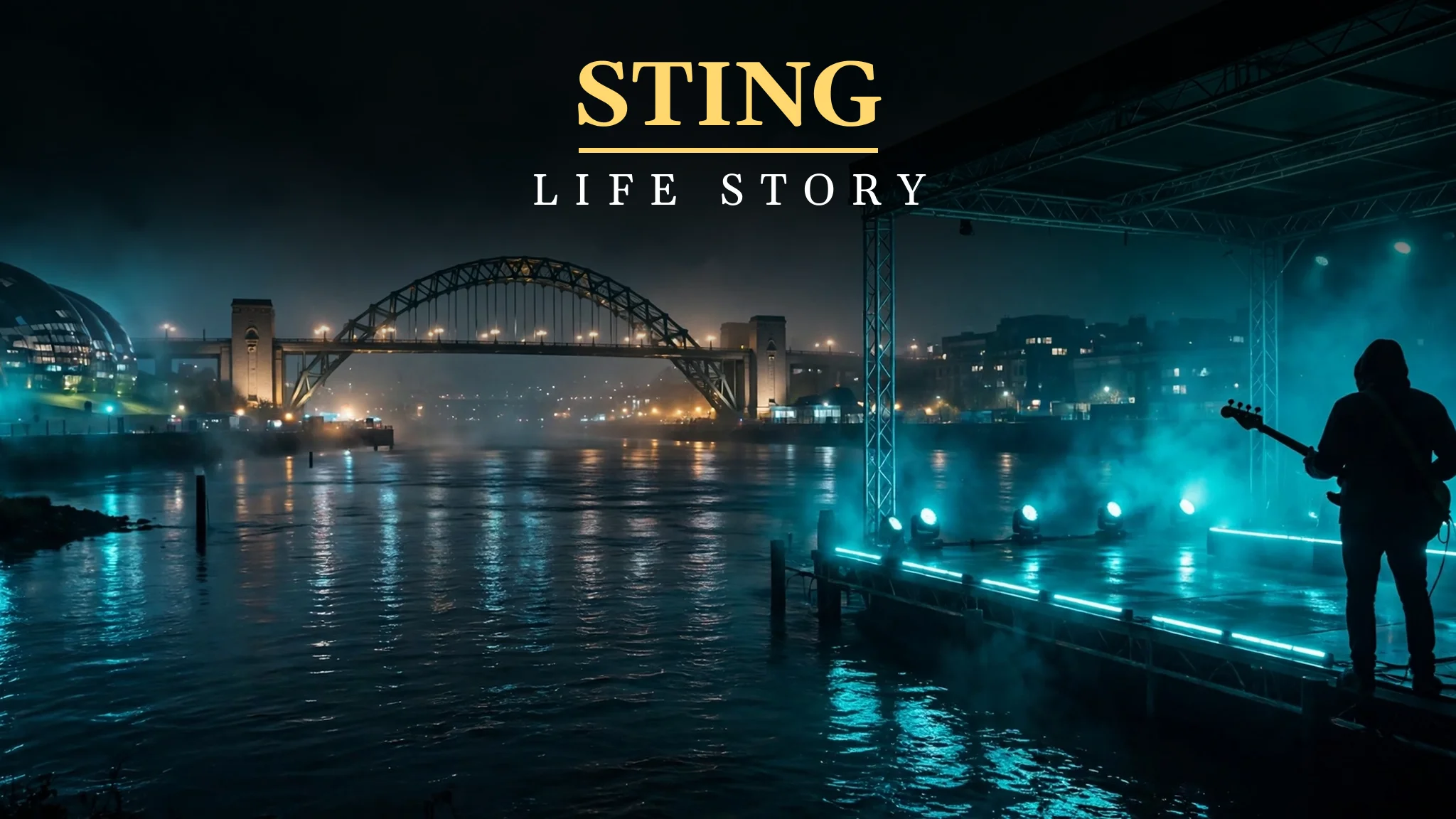
In this post
- Wallsend, the River Tyne and a Boy Called Sting
- The Police, Roxanne and Three Men in a Van
- Every Breath You Take and the End of the Police
- Solo Songs, Jazz and a Different Kind of Pop
- Fields of Gold, the Rainforest and a Life of Work
- The Police Reunion, The Last Ship and the Teacher Who Came Home
- My Take:
Sting is the singer who went from a classroom in the north-east of England to the biggest stages in the world, and then kept changing. He started as a teacher, became the bass player and singer of the Police, wrote Roxanne, Message in a Bottle and Every Breath You Take, and then left the band to make solo records that mixed pop, jazz and world music. He has acted in films, he has written songs for the stage, and he has worked to protect the rainforest. He is not a man who stays in one place, musically or personally. He moves, he learns, and he tries new things.
He was born Gordon Sumner in Wallsend, near Newcastle, a shipbuilding town where life was shaped by work, by the river and by the weather. He grew up in a house where music was loved, he learned to play the bass guitar, and he took a job as a teacher because it was safe. Then music took him away from the classroom, and he never went back. His story is about a man who had a gift for words, a gift for melody, and a restless mind that wanted to try everything. It is also a story about a band that became too big to hold together, and about a solo career that lasted longer than the band itself.
What makes Sting worth writing about is the range of his work. He wrote punk-influenced songs, reggae-influenced songs, jazz songs and pop songs, and he made them all sound like Sting. He has a voice that is clear, high and instantly recognisable, and he has a way with words that few pop singers can match. His life shows that a teacher from Wallsend can become a world star, and that a world star can still be curious, still be learning, and still be trying to do good in the world.
Wallsend, the River Tyne and a Boy Called Sting
Gordon Matthew Thomas Sumner was born on 2 October 1951 in Wallsend, a town near Newcastle upon Tyne in the north-east of England. His father, Ernest Sumner, was a milkman and later an engineer, and his mother, Audrey, was a hairdresser. The family lived in a modest house, and Gordon grew up with younger siblings. Wallsend was a shipbuilding town, and the River Tyne was the centre of life. Ships were built on the river, men worked in the yards, and the sound of industry was everywhere. Gordon grew up watching the ships, listening to the men, and dreaming of a different life.
He went to school in Wallsend, and he was a bright, curious boy. He liked books, he liked music, and he liked to be outside. His mother played the piano, and his father loved jazz, and the house was full of music. Gordon learned to play the guitar, and then the bass guitar, and he began to play in local bands. He got the nickname Sting because he once wore a black and yellow striped sweater that made him look like a bee, or a wasp. The name stuck, and he has used it ever since. It is a short, sharp name, and it fits the sharp, clear sound of his voice.
After school, Gordon went to teacher training college, and he became a teacher. He taught at a school in Newcastle, and he was good at it. He liked working with children, and he liked the steady life of a teacher. But music kept pulling at him. He played bass in jazz bands at night, after teaching during the day, and he began to write songs. He was not a typical teacher. He had long hair, he played in bands, and he dreamed of a life in music. The classroom was safe, but the stage was where he felt alive.
He married Frances Tomelty, an actress, in 1976, and they had two children, Joseph and Kate. The marriage gave him a family, but the pull of music was strong. He played in a local jazz band called Last Exit, and he began to think about moving to London. London was where the music business was, and where a band could become famous. He knew that leaving Wallsend meant leaving a safe life, but he also knew that he would regret it if he never tried. In 1977, he moved to London with two other musicians, Stewart Copeland and Andy Summers, and formed a band called the Police. It was a brave move, and it changed his life for ever.
The Police, Roxanne and Three Men in a Van
The Police began as a small band playing in pubs and clubs in London. Stewart Copeland played drums, Andy Summers played guitar, and Sting played bass and sang. They had very little money, and they toured in a small van, sleeping in cheap hotels and playing to small crowds. Their music was a mix of punk, reggae and pop, a sound that was new and exciting. Sting’s voice was high and clear, and his bass playing was melodic and strong. The band’s early songs, including Roxanne, were about unusual subjects. Roxanne was a song about a prostitute, written from the point of view of a man who loves her and wants her to stop. It was a strange subject for a pop song, but it worked, and it became a hit.
The band made their first album, Outlandos d’Amour, in 1978, and it featured Roxanne, Can’t Stand Losing You and So Lonely. The album was a success, and the band began to tour Britain and America. They made more albums, Reggatta de Blanc in 1979, Zenyatta Mondatta in 1980, Ghost in the Machine in 1981 and Synchronicity in 1983. Each album was more successful than the last, and the band became one of the biggest in the world. Songs such as Message in a Bottle, Walking on the Moon, Don’t Stand So Close to Me and Every Little Thing She Does Is Magic became hits around the world. Sting was writing most of the songs, and his words were clever, literate and full of images from books, films and life.
The Police were a band of three strong personalities, and they did not always agree. Stewart Copeland was a loud, energetic drummer, Andy Summers was a quiet, thoughtful guitarist, and Sting was the singer and songwriter who wanted control. They argued about music, about money and about direction. Yet they made great records together, because the tension made the music better. Sting’s bass playing gave the band a strong foundation, and his singing gave them a clear, emotional voice. The band’s sound was tight, clean and powerful, and it stood out from other bands of the time.
By 1983, the Police were at the peak of their fame. Their album Synchronicity featured the song Every Breath You Take, a song that became one of the biggest hits of the decade. The song sounds like a love song, but Sting has said that it is about obsession, about a man who watches a woman and cannot let her go. The song won Grammy Awards, and it is still played on the radio every day. It was the band’s greatest success, and it was also the beginning of the end. After a huge world tour, the band stopped working together. They had become too big, too tired and too divided to continue. Sting was ready to make music on his own.
Every Breath You Take and the End of the Police
Every Breath You Take is the song that defines Sting for many people, and it is a song that is often misunderstood. It was written during the break-up of Sting’s first marriage, and it is about a man who cannot let go. The words are simple, the melody is beautiful, and the song sounds gentle. But the meaning is darker. The man in the song watches every move, every breath, every step. It is not love. It is control. Sting has said that he is surprised that people play the song at weddings, because it is not a happy love song. It is a song about jealousy, and about the pain of losing someone.
The success of the song made the Police even more famous, but it also made the band’s problems worse. The three men were tired of touring, tired of arguing, and tired of living in each other’s pockets. They took a break after the Synchronicity tour in 1984, and they never really came back. They tried to record a new album in 1986, but the sessions did not work. Sting wanted to make solo music, and the other two wanted to do other things. The band broke up quietly, without a big announcement. It was a sad end to a great band, but it was also a natural one. Three men who had made five great albums in five years needed time apart.
Sting’s personal life was also changing. His marriage to Frances Tomelty ended in divorce in 1984, and he began a relationship with Trudie Styler, an actress and film producer. They married in 1992, and they have four children together, Mickey, Jake, Eliot and Giacomo. Trudie became his partner in life and in work, and she has been a strong presence in his career. He has spoken about the importance of his family, and about the difficulty of balancing a life in music with a life at home. He lives in England and in other places, and he keeps his family life private, away from the press.
The end of the Police was not the end of Sting. It was the start of a solo career that would last for decades. He had learned how to write songs, how to lead a band, and how to perform on a big stage. He was ready to try new kinds of music, to work with jazz musicians, and to write songs that were more personal and more complex than the Police songs had been. He was thirty-three years old, and he had already been in one of the biggest bands in the world. Now he had to prove that he could do it on his own.
Solo Songs, Jazz and a Different Kind of Pop
In 1985, Sting released his first solo album, The Dream of the Blue Turtles. The album featured jazz musicians, including Branford Marsalis on saxophone, and it had a warmer, more relaxed sound than the Police. Songs such as If You Love Somebody Set Them Free, Fortress Around Your Heart and Russians became hits, and the album was a success. It showed that Sting could make music that was thoughtful, musical and popular at the same time. He toured with a band of jazz musicians, and he enjoyed the freedom of playing with people who could improvise and explore.
He followed it with Nothing Like the Sun in 1987, which featured the song Fragile, a gentle song about the fragility of life, and Englishman in New York, a song about a gay man living in New York, inspired by the writer Quentin Crisp. The album was more personal, more literary, and more ambitious. Sting was writing about politics, about love, about identity, and about the world. He was not afraid to be serious, and he was not afraid to be different. His solo work was not as loud as the Police, but it was deeper, and it showed a man who was growing as an artist.
In the 1990s, he released albums such as The Soul Cages in 1991, a sad album about the death of his father, Ten Summoner’s Tales in 1993, which featured the hit Fields of Gold, and Mercury Falling in 1996. Fields of Gold became one of his most loved songs, a gentle, beautiful song about love and memory. He also wrote the song Shape of My Heart, which later became famous again when it was used in the film Leon. His solo career was steady, successful and respected. He was no longer a pop star chasing hits. He was a mature artist making the music he wanted to make.
He also acted in films, including Quadrophenia in 1979, in which he played a mod leader, Dune in 1984, in which he played a villain, and Lock, Stock and Two Smoking Barrels in 1998. He was not a trained actor, but he had a strong presence on screen, and directors liked his face and his voice. Acting gave him a different kind of creative life, and it let him work with people outside music. He enjoyed it, even when the films were not great successes. He was a man who liked to try new things, and acting was one of them.
Fields of Gold, the Rainforest and a Life of Work
In the late 1980s, Sting became involved in work to protect the rainforest. He met Raoni, a chief of the Kayapo people in Brazil, and he learned about the destruction of the Amazon rainforest and the threat to the people who lived there. He helped to start the Rainforest Foundation, an organisation that works to protect the rainforest and the rights of the people who live in it. He has raised money for the foundation through concerts, and he has spoken about the issue in public. The work has been a central part of his life for more than thirty years, and it shows that he uses his fame for something larger than himself.
He has also worked for human rights, for Amnesty International, and for other causes. He believes that musicians have a responsibility to speak up, and he has done so, even when it was not popular. He has written songs about politics, about war, and about the environment, and he has used his concerts to raise awareness. Some people criticise him for being a wealthy rock star who talks about the environment, and he has faced questions about his own lifestyle. He has answered them with honesty, saying that he tries to live responsibly, and that he knows he is not perfect. The work matters to him, and he has kept doing it.
In the 2000s, he released albums such as Brand New Day in 1999, which won Grammy Awards, Sacred Love in 2003, and Songs from the Labyrinth in 2006, an album of songs by the Elizabethan composer John Dowland. The last of these surprised many people, because it was not pop music at all. It was early music, played on a lute, and it showed Sting’s love of old songs. He also wrote a musical, The Last Ship, in 2014, inspired by his childhood in Wallsend and the shipbuilding industry. The musical was about the men who built ships on the River Tyne, and about the town that lost its industry. It was a personal work, and it showed how much Wallsend still meant to him.
In 2007, the Police reunited for a world tour, playing to huge crowds around the world. The tour was a success, and it showed that the band could still play together after more than twenty years apart. Sting, Stewart Copeland and Andy Summers played their greatest hits, and fans who had never seen them live finally got their chance. The reunion was a happy moment, but it was also a farewell. After the tour, the band went their separate ways again. Sting returned to his solo career, and he has kept touring and recording ever since. He has released new albums, including 57th and 9th in 2016 and The Bridge in 2021, and he still plays to audiences around the world.
The Police Reunion, The Last Ship and the Teacher Who Came Home
In 2007, after more than twenty years apart, the Police reunited for a world tour. Sting, Stewart Copeland and Andy Summers played together again, touring America, Europe, Asia and Australia, and playing to huge crowds. The tour began with a concert at the Grammy Awards in Los Angeles, where the band played Roxanne, and it ended in New York in 2008. The shows were a success, and they showed that the band could still play together, even after a long break. Sting sang with energy, Stewart drummed with power, and Andy played guitar with skill. The fans cheered, and the band enjoyed it. It was a happy reunion, but it was also a farewell. After the tour, the band went their separate ways again, and Sting returned to his solo career.
He also wrote a musical, The Last Ship, which opened on Broadway in 2014. The musical was inspired by his childhood in Wallsend, and by the shipbuilding industry on the River Tyne. It told the story of a man who returns to Wallsend after many years away, and who finds that the shipyard is closing, and that the town is changing. The musical featured songs by Sting, sung by actors, and Sting himself appeared in the show for a time, playing a role. The musical was personal, and it showed how much Wallsend still meant to him. He had left Wallsend as a young man, he had become a world star, and he had come back, in a musical, to tell the story of the town that made him.
The Last Ship was not a huge commercial success on Broadway, but it was loved by audiences in Newcastle, where it was performed to great acclaim. Sting has said that the musical was one of the most important things he ever did, because it was about his home, his family, and the men who built ships. It was a tribute to the working men of Wallsend, to his father, and to the community that raised him. He wrote the songs with care, and he performed them with feeling. The musical showed a different side of Sting, a man who could write for the stage, who could tell a story, and who could honour his roots.
In recent years, Sting has continued to tour and record. He released the album 57th and 9th in 2016, a rock album that returned to a more direct sound, and The Bridge in 2021, an album recorded during the pandemic, when he was at home and thinking about life. He has toured with a show called My Songs, playing his greatest hits from the Police and from his solo career, and he has performed in Las Vegas, in London, and around the world. He is in his seventies, and he still sings with a clear, strong voice. He still plays bass, he still writes songs, and he still tries new things. He is a teacher from Wallsend who became a world star, and who never stopped learning.
My Take:
When I think about Sting, I think first about his voice. It is high, clear and instantly recognisable. When he sings Roxanne, I can hear a young man in London, singing about a woman he loves and wants to save. When he sings Fields of Gold, I can hear an older man, singing about love and memory with a gentle, sad voice. His voice has changed over the years, but it has always been honest. He does not hide behind noise. He sings clearly, and he lets the words do the work. I admire that clarity, and I think it is a lesson for anyone who writes or sings. Say what you mean, say it clearly, and let the listener feel it.
I also think about his journey from teacher to rock star, because it is a rare journey. He taught children in Newcastle, and then he became a world-famous singer. That change must have been strange, and it must have taken courage. He left a safe job, he moved to London, and he lived in a van with two other musicians. He risked everything, and it worked. I find that inspiring, because it shows that a safe life is not always the right life. Sometimes you have to leave safety behind to find what you really want to do. Sting did that, and I respect him for it.
What saddens me in his story is the break-up of the Police. The band made five great albums in five years, and then they fell apart. They were three strong men who could not live together any more. I feel sad when I think about what they might have made if they had stayed together, and about the friendship that was lost. I also feel sad about the break-up of his first marriage, and about the pain that inspired Every Breath You Take. That song is beautiful, but it is also a song of jealousy and control. It shows that love can turn into something dark when a person cannot let go. I think that is a sad truth, and Sting sang it honestly.
I respect his work for the rainforest, because it shows that he cares about more than music. He met a chief in Brazil, he learned about the destruction of the forest, and he started a foundation to help. That is not a small thing. It takes time, money and effort, and he has kept doing it for more than thirty years. Some people might say that a rock star should not talk about the environment, but I think the opposite. A rock star has a voice that people listen to, and he should use it. Sting has used his voice well, and I admire him for that.
I also admire his curiosity about music. He started with punk and reggae, he moved to jazz, he sang songs by John Dowland, he wrote a musical about shipbuilding, and he worked with musicians from many countries. He did not stay in one place. He kept learning, kept listening, and kept trying new things. That curiosity has kept his music fresh, even after fifty years. I want to remember that. I do not want to stop learning when I get older. I want to keep listening, keep trying, and keep meeting new people. Sting shows that it is possible.
If I have a criticism, it is that Sting sometimes seems too serious, too careful, too aware of his own importance. He writes about literature, about politics, about history, and sometimes the songs feel like lessons, not like music. I prefer his simpler songs, like Fields of Gold, where the feeling is clear and the words are simple. I think he is at his best when he sings from the heart, not from the head. That is not a harsh criticism, because his serious songs are also good. But I think his best work is the work that makes me feel something, not the work that makes me think about a book.
I also think about his acting, and about the way he has tried many things. He was good in Quadrophenia, he was striking in Dune, and he was funny in Lock, Stock and Two Smoking Barrels. He was not a great actor, but he was a brave one. He tried, and he learned. I respect that bravery, and I think it is a good example. A person should try new things, even if they might fail. Sting tried acting, he tried writing a musical, he tried singing old songs, and he learned from each attempt. That is a good way to live.
For a young reader, I think the lesson of Sting’s life is about words and music together. He writes songs that are like poems, with images, stories and ideas. He shows that a pop song can be clever, that it can talk about books, about history, about love and about loss. You do not need to write simple words to be popular. You can write good words, and people will listen. That is a hopeful lesson for anyone who loves to write. Sting proves that a song can be both popular and intelligent, and that is a rare achievement.
I also think about his home town, Wallsend, and about how much it still means to him. He wrote a musical about the shipyards, he talks about the River Tyne, and he remembers the men who built ships. That is a sign of a person who has not forgotten where he came from. Fame can make a person forget their roots, but Sting has not forgotten his. He carries Wallsend with him, in his songs and in his stories. I find that moving, and I think it is a good example. No matter how far you go, you should remember where you started, and you should honour the people who helped you.
There is also something about his discipline that I admire. He practises yoga, he eats carefully, he looks after his voice, and he trains his body. He has kept himself fit for fifty years, and he still performs with energy. That takes work, and it takes a willingness to look after yourself. Many rock stars burn out young because they do not look after themselves. Sting has looked after himself, and he is still here. I think that is a lesson worth learning. Talent is not enough. You need to look after your body, your mind and your voice, if you want a long career.
In the end, I think Sting teaches us that a musician can be many things at once. He can be a teacher, a bass player, a singer, a songwriter, an actor, a campaigner and a father. He can write a punk song, a jazz song, a pop song and a song about a shipyard. He can be serious and funny, popular and intelligent, famous and private. That range is rare, and it is why his career has lasted so long. When I hear Every Breath You Take now, I do not just hear a hit from 1983. I hear a man who has lived a long, varied life, and who is still singing, still learning, and still trying to do good. That is a life worth learning from.
One more thought stays with me, and it is about the name Sting. It came from a striped sweater, a joke, a small moment in a jazz band. That small moment gave him a name that the whole world knows. It reminds me that big things often start in small, ordinary moments. A sweater, a train platform, a chance meeting. Sting’s life is full of those moments, and he turned them into a career. I find that hopeful. It tells me that I do not need a grand plan to start something good. I need to notice the small moments, and to follow them.
I also think about what will happen when Sting finally stops. The records will remain, the songs will remain, and young singers will keep learning from him. That is a legacy that few people achieve. Sting has already achieved it, and he is still adding to it. I am glad that he is still here, still singing, still working, and I hope he keeps going for as long as he wants to. Music is his home, and I think he knows it.
I also think about The Last Ship, because it is a musical about home, and home is a powerful idea. Sting left Wallsend as a young man, he became a world star, and he came back, in a musical, to tell the story of the shipyard, the men who built ships, and the town that lost its industry. That is a brave thing to do. He could have written a musical about anything, but he wrote about his home, about his father, about the river. I find that moving, because it shows that he has not forgotten where he came from. Fame can make a person forget their roots, but Sting has not forgotten his. He carries Wallsend with him, and he honours it in his work.
I also think about the Police reunion in 2007, and about what it must have felt like to play with Stewart and Andy again after twenty years apart. They were older, they were wiser, and they had lived different lives, but they could still play together. That is a remarkable thing. A band is like a family, and families can come back together, even after a long time apart. The reunion tour was a success, and it gave fans a chance to see a band they thought they would never see again. I am glad it happened, and I am glad that Sting, Stewart and Andy could share that moment. It was a happy ending to a story that could have ended in anger.
There is also something about his bass playing that I want to mention, because it is often forgotten. Sting is known as a singer, but he is also a very good bass player. His bass lines are melodic, clear and strong, and they give his songs a foundation that is easy to miss. On Message in a Bottle, his bass drives the song forward. On Walking on the Moon, his bass is light and dancing. On Every Breath You Take, his bass is simple and steady. He plays bass like a singer, with melody and with feeling, and that is a rare skill. I admire him for it, and I think his bass playing deserves more praise than it usually gets.
I also think about his work with jazz musicians, because it shows his respect for other kinds of music. On his first solo album, he worked with Branford Marsalis, a jazz saxophonist, and he let the jazz musicians play freely. That takes confidence, and it takes a willingness to learn. Many pop singers would not work with jazz musicians, because jazz is hard, and it requires listening. Sting listened, he learned, and he made a better record because of it. That openness is a good example. If you want to grow as a musician, work with people who are better than you, and learn from them. Sting did that, and I respect him for it.
I also think about his children, and about how he has tried to be a good father while being a famous singer. He has six children, from two marriages, and he has spoken about the difficulty of balancing work and family. He loves his children, and he has tried to be present for them, even while touring the world. That is hard, and I do not pretend to know the full story. But I think it is fair to say that he has tried, and that his children are a central part of his life. He is not only a singer. He is a father, and he takes that role seriously. I respect him for that.
I also think about his yoga practice, and about how it shows his discipline. He practises yoga, he eats carefully, he looks after his body, and he has done so for many years. That discipline has helped him to keep singing, to keep performing, and to stay healthy into his seventies. Many rock stars do not look after themselves, and they pay the price. Sting has looked after himself, and it shows. I want to remember that. Talent is not enough. You need to look after your body, your mind, and your voice, if you want a long career. Sting has done that, and I admire him for it.
Frequently Asked Questions
Where was Sting born, and how did he get his stage name?
Sting, born Gordon Sumner, was born on 2 October 1951 in Wallsend, near Newcastle upon Tyne, and he got the nickname Sting because he once wore a black and yellow striped sweater that made him look like a bee. The name stuck, and he has used it ever since.
How did the Police form, and who was in the band?
The Police formed in London in 1977, with Sting on bass and vocals, Stewart Copeland on drums and Andy Summers on guitar. They began playing in pubs and clubs, touring in a small van, and their mix of punk, reggae and pop soon made them famous.
What is Every Breath You Take really about?
Every Breath You Take, released in 1983, sounds like a love song, but Sting has said it is about obsession and control, written during the break-up of his first marriage. The man in the song watches every move and every breath, and it is a song about jealousy, not happy love.
What solo songs is Sting best known for?
Sting’s best-known solo songs include If You Love Somebody Set Them Free, Englishman in New York, Fragile and Fields of Gold. Fields of Gold, from the album Ten Summoner’s Tales in 1993, became one of his most loved songs.
What is the Rainforest Foundation that Sting helped to start?
The Rainforest Foundation, started after Sting met Raoni, a chief of the Kayapo people in Brazil, works to protect the Amazon rainforest and the rights of the people who live there. Sting has raised money for it through concerts for more than thirty years.
What was The Last Ship, the musical Sting wrote?
The Last Ship, first staged in 2014, is a musical inspired by Sting’s childhood in Wallsend and the shipbuilding industry on the River Tyne. It tells the story of the men who built ships and the town that lost its industry.


