Stonebwoy: The Life Story Behind Ghana's Dancehall King
In this post
- A Boy From Ashaiman With Music in His Blood
- The Accident That Changed His Life
- Early Music, Samini and the First Breakthrough
- BET Award and Becoming Ghana’s Dancehall King
- 5th Dimension, Up and Running and a Global Sound
- Bhim Nation, Family and Giving Back
- What Stonebwoy Means for Ghanaian Music
- The Stage, the Crowd and the Energy of a Show
- The Collaborations That Carried Him Further
- My Take:
There is a voice in Ghana that can move from a whisper to a roar in a single song, a voice that can sing about love, about struggle, and about pride, and make a whole stadium feel it. That voice belongs to Stonebwoy, born Livingstone Etse Satekla, a singer from Ashaiman who became one of the biggest dancehall and Afrobeats stars in Africa. He has won a BET Award, he has filled stadiums, and he has carried Ghanaian music to the world, with a sound that is both rooted in his home and open to the globe.
His story is a story of Ashaiman, a busy, tough town near Accra, and of a boy who found music early, who learned to sing and to write, and who refused to let his background limit him. It is also a story of hard work, of a near-fatal accident that changed his life, and of a career built on talent, on discipline, and on a deep love for his people. This is how a boy from Ashaiman became a king.
A Boy From Ashaiman With Music in His Blood
Stonebwoy was born on 5 March 1988 in Ashaiman, in the Greater Accra Region of Ghana. Ashaiman is a lively, crowded town, known for its energy, its markets, and its music. Growing up there gave him a sense of real life, of struggle and of joy, and that sense is in his songs. He heard music everywhere: in the streets, in the churches, in the homes of his neighbours, and on the radio. Music was not a luxury. It was part of daily life.
He was a bright, musical child, drawn to singing and to writing. He sang in school, he sang in church, and he began to write his own songs as a teenager. He was not only a singer. He was a thinker, a young man who watched the world around him and turned what he saw into words. That habit, watching and writing, became the base of his career. His songs are not only about love. They are about life in Ghana, about the hopes of young people, and about the pride of being African.
His family supported his interest, and that support mattered. Many parents in Ashaiman worry when a child says he wants to be a musician, because the path is uncertain. Stonebwoy’s family gave him room to try, and that room allowed him to learn, to practise, and to dream. He finished his schooling, and he began to look toward Accra, toward the music world, and toward the chance to turn his gift into a life.
Ashaiman stayed with him. He has spoken with pride about his home town, and he has returned there for events and for causes. He did not have to leave Ashaiman behind to become a star. He carried it with him, in his music, in his language, and in his name, Bhim Nation, the name of his fan base and his movement. The boy from Ashaiman became a star, and he did it by staying true to where he came from.
The Accident That Changed His Life
When Stonebwoy was young, he was involved in a serious road accident that injured his leg and changed his life. The accident left him with a lasting injury to his right leg, and he has lived with that injury ever since. He has spoken about it openly, not as a sad story, but as a part of his life that taught him strength. He walks with a limp, and he performs with it, and he does not hide it. That openness is part of why his fans love him. They see a man who has faced a hard thing and kept going.
The accident could have ended his dreams. A young man with an injured leg, in a world that values physical perfection, could have given up. Stonebwoy did not give up. He turned the pain into music, and he turned the injury into a symbol of resilience. When he performs, his energy is not despite his leg. It is with it, a proof that a body can be hurt and still dance, still sing, still lead a crowd. That is a powerful message for anyone who has faced a hard time.
He has also used his story to speak to young people about road safety, about care, and about the need to keep going when life is hard. He does not present himself as a victim. He presents himself as a survivor, a man who has learned to live with a challenge and to make it part of his strength. That attitude, calm and determined, is the same attitude he brings to his music.
The accident also gave his songs a deeper feeling. When Stonebwoy sings about struggle, about pain, about hope, the audience believes him, because they know he has known struggle. That belief is not something a singer can fake. It comes from life, and it gives his music a weight that younger singers cannot yet have. The boy who was hurt became a man who heals others with his songs.
Early Music, Samini and the First Breakthrough
Stonebwoy began his music career in the late 2000s, in the Ghanaian dancehall and reggae scene. He was discovered and mentored in part by Samini, one of Ghana’s leading dancehall stars, who saw his talent and helped him find his way. That mentorship mattered. A young artist needs a guide, someone who knows the industry, who can open doors, and who can teach the craft. Samini was that guide for Stonebwoy, and their relationship, though it later had its tensions, was an important part of his early career.
He released his early songs, and he began to build a following in Ghana. His voice was distinctive, a mix of dancehall energy and melodic singing, and his songs were catchy and meaningful. He sang in English, in Twi, and in Ewe, the language of his people, and that mix gave his music a wide reach. Ghanaians from different regions could hear themselves in his songs, and that is a rare gift.
His debut album, Grade 1, released in 2012, introduced him to a wider audience, and his second album, Necessary Evil, released in 2014, made him a star. Necessary Evil included hits that were played across Ghana and beyond, and it showed that Stonebwoy was not a one-song artist. He could make an album, with many songs, each one different, each one strong. That album was a turning point, and it set him on the path to the top.
By the mid-2010s, he was one of the leading voices in Ghanaian music. He had a fan base, Bhim Nation, that was loyal and loud, and he had a sound that was his own. He was ready for the world stage, and the world was ready for him.
BET Award and Becoming Ghana’s Dancehall King
In 2015, Stonebwoy won the BET Award for Best International Act: Africa, one of the most important awards for African music. The award, given in Los Angeles, put him on a global stage, and it confirmed what Ghanaians already knew: he was one of the finest dancehall artists in the world. He accepted the award with pride, and he spoke about Ghana, about Ashaiman, and about the music that had brought him there.
The BET win changed his career. It brought him new audiences in Europe, in the United States, and in the Caribbean, where dancehall was born. He toured, he collaborated, and he showed the world that Ghanaian dancehall was a force to be reckoned with. He was not copying Jamaican dancehall. He was making Ghanaian dancehall, with his own language, his own rhythms, and his own message, and the world loved it.
He continued to release hit songs and albums, including Epistles of Mama in 2017, an album dedicated to his mother, and Anloga Junction in 2020, an album named after a place in his home region that showed his range, from dancehall to Afrobeats to highlife. Anloga Junction was a success, with songs that were played across Africa and beyond, and it proved that Stonebwoy could grow, could try new sounds, and could still stay true to himself.
He also became known for his live shows, which are energetic, powerful, and full of connection with the crowd. A Stonebwoy show is a celebration, with a large band, with dancers, and with Stonebwoy at the centre, singing, dancing, and leading the crowd. Audiences who have seen him live remember it, because he gives everything he has, every time.
5th Dimension, Up and Running and a Global Sound
Stonebwoy’s later albums have shown his growth as a global artist. 5th Dimension, released in 2023, was a large, ambitious album, with collaborations with artists from many countries, and with songs that mixed dancehall, Afrobeats, reggae, and pop. The album was a success, and it showed that Stonebwoy could work with the world and still sound like himself. He did not lose his Ghanaian voice. He used it to speak to the world.
Up and Running, released in 2024, continued that global journey, with new songs, new collaborations, and a sound that was both modern and rooted. The album’s title was a message: he is up, he is running, he is not stopping. That message spoke to his fans, who have watched him rise from Ashaiman to the world, and who see in him a proof that a boy from a small town can go far.
He has collaborated with artists from Jamaica, from Nigeria, from the United States, and from across Africa, and those collaborations have brought his music to new audiences. He has also been a mentor to younger Ghanaian artists, showing them how to build a career, how to stay true to their sound, and how to reach the world without losing themselves.
His music today is a mix of many things: dancehall energy, Afrobeats rhythm, reggae soul, and Ghanaian highlife warmth. That mix is his signature, and it is why his songs are played in Accra, in Lagos, in Kingston, in London, and in New York. He is a Ghanaian artist, and he is a world artist, and he is both at the same time.
Bhim Nation, Family and Giving Back
Stonebwoy’s fan base, Bhim Nation, is more than a group of fans. It is a movement, a community of people who follow his music, who wear his colours, and who support his work. Bhim, a word from his Ewe language, means something like strength and resilience, and the Nation is a family that Stonebwoy has built around his music. He speaks to them directly, he thanks them, and he treats them as partners, not only as listeners.
He is a family man, married to Dr. Louisa Ansong, a dentist, and they have children together. He speaks about his wife and children with love, and he shares moments of his family life with fans, while also protecting their privacy. That balance, a public career and a private home, is one he has kept for years, and it has given him a steady base from which to work.
He has also given back to his community, through his foundation and through events in Ashaiman and across Ghana. He has supported education, health, and youth causes, and he has used his fame to open doors for young people. He believes that a star has a duty to help, and he lives that belief. His foundation work, done quietly, matters as much as his music, because it shows a man who remembers where he came from and who wants to give back.
He has also spoken about the need for Ghanaian music to be respected, for artists to be paid fairly, and for the industry to grow. He is not only a singer. He is a voice for Ghanaian music, and his voice carries weight because it comes from decades of work and from a deep love for his country.
What Stonebwoy Means for Ghanaian Music
Stonebwoy’s place in Ghanaian music is secure. He is one of the leading dancehall artists in Africa, a BET winner, and a global ambassador for Ghanaian sound. He has shown that a boy from Ashaiman can win on the world stage, that a leg injury does not have to end a dream, and that a musician can be both local and global at the same time.
For younger artists, his example is clear. Learn your craft. Know your language. Work hard. Be honest about your struggles. And when you have a chance, give back. Stonebwoy has done all of that, and he has done it in public, for more than fifteen years.
For audiences, his legacy is the music. He gave them songs they could dance to, songs they could cry to, and songs that made them proud to be Ghanaian. That is a gift that does not fade when the music stops. It stays in the memory, in the body, and in the way people sing along to it.
Today Stonebwoy continues to record, to tour, and to perform, with Bhim Nation behind him and with the world listening. His career is still going, and each new album adds another chapter. The boy from Ashaiman who found music early became a king, not by birth, but by voice, by work, and by a refusal to stop when life got hard.
The Stage, the Crowd and the Energy of a Show
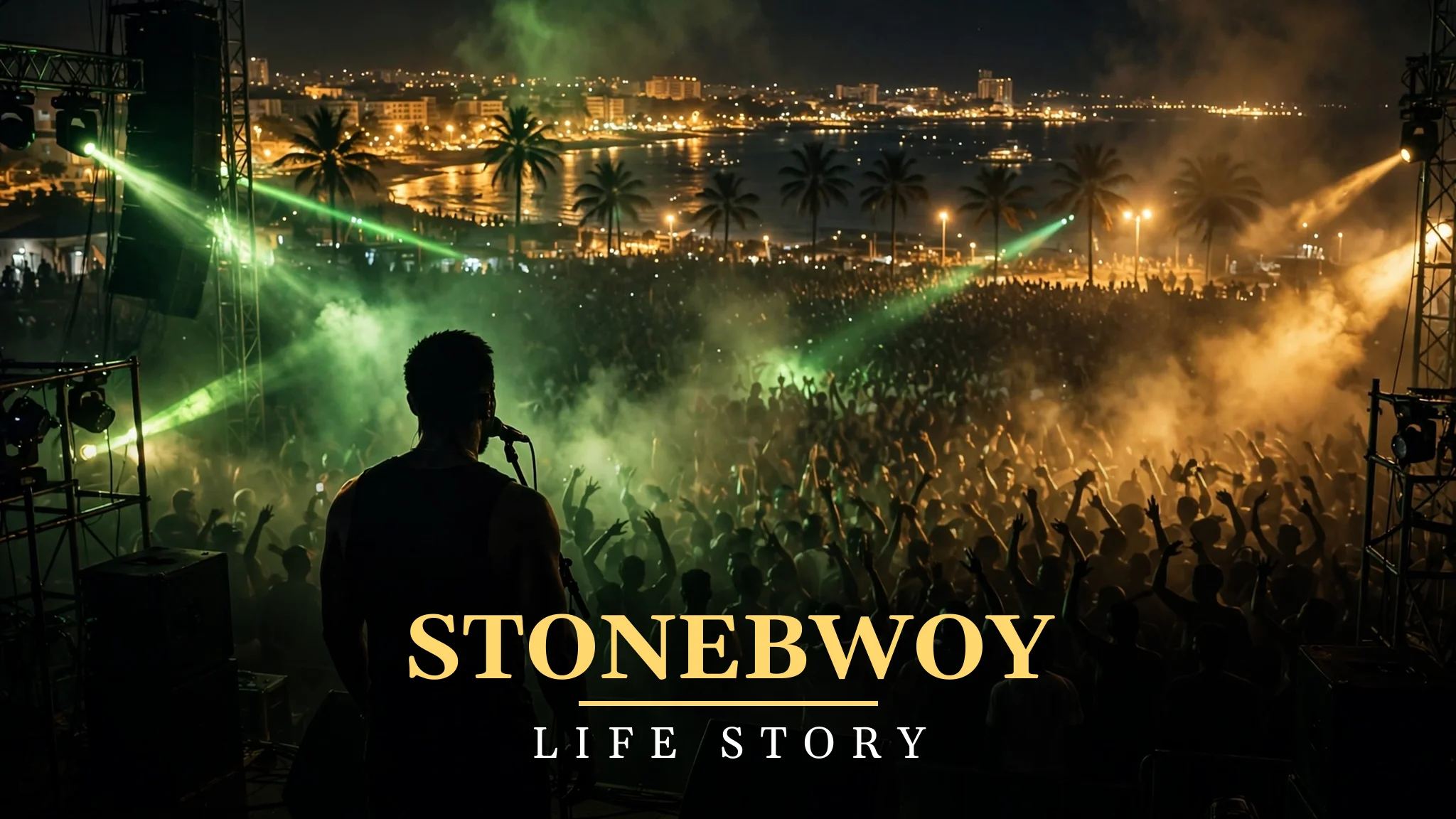
A Stonebwoy show is not a quiet concert. It is a celebration, with a large band, with dancers, with lights, and with a crowd that sings along to every word. Stonebwoy gives everything he has on stage, singing, dancing, and leading the crowd, and the crowd gives it back, with energy that fills the venue. That exchange, between a star and his fans, is the heart of his live work, and it is why his shows are remembered long after they end.
He performs with his leg injury, and he does not hide it. He walks with a limp, he dances with it, and he shows the crowd that a body can be hurt and still move, still sing, still lead. That is a powerful message, and it is one that audiences feel, even when he does not speak about it directly. They see a man who has faced a hard thing and kept going, and they feel stronger for seeing it. That is a gift that goes beyond music.
His stagecraft comes from years of performing, from small clubs in Ghana to large festivals around the world. He has learned how to read a crowd, how to build a set, how to move from a slow song to a fast one, and how to keep the energy high for hours. That reading of a room is a skill that only comes from experience, and Stonebwoy has it in abundance. He does not only sing at a crowd. He sings with them, and that togetherness is what makes his shows special.
He has played at major festivals, in Ghana, in Europe, in the United States, and in the Caribbean, and each time he brings Ghana with him. He brings the language, the rhythms, and the pride of Ashaiman, and he shows audiences that Ghanaian dancehall is a force to be reckoned with. That is a form of ambassadorship, and Stonebwoy carries it with pride, not as a burden, but as a joy.
The Collaborations That Carried Him Further
Stonebwoy did not build his global career alone. He built it with collaborations, with artists from Jamaica, from Nigeria, from the United States, and from across Africa, and each collaboration brought his music to a new audience. A collaboration is a conversation, a chance to hear another voice, another style, another way of writing a song. Stonebwoy listens in those conversations, and he learns. He takes what is good from another artist, and he adds it to his own sound, without losing himself. That is why his music has grown over the years, from dancehall to Afrobeats to reggae, without ever sounding like someone else.
His albums show that growth. Anloga Junction in 2020 mixed dancehall, Afrobeats, and highlife, and it proved he could try new sounds and still stay true to himself. 5th Dimension in 2023 was even larger, with collaborations from many countries, and with songs that mixed genres in a way that felt natural. Up and Running in 2024 continued that journey, with new songs, new partners, and a sound that was both modern and rooted. Each album was a step further, and each one kept his Ghanaian voice at the centre.
He has also been a mentor to younger Ghanaian artists, showing them how to build a career, how to stay true to their sound, and how to reach the world without losing themselves. That mentoring, done quietly, matters as much as his own music, because it helps the next generation of Ghanaian stars find their way. Stonebwoy did not only build a career for himself. He helped build a path for others to follow.
His foundation work shows another side of him. Through his foundation, Stonebwoy has supported education, health, and youth causes in Ashaiman and across Ghana, and he has used his fame to open doors for young people. He believes that a star has a duty to help, and he lives that belief, quietly, without making a show of it. That work matters as much as his music, because it shows a man who remembers where he came from and who wants to give back. A star who gives back is a star who lasts, because his fans know he cares about more than himself.
He has also spoken about the need for Ghanaian artists to be paid fairly, for the industry to grow, and for music to be respected as a real profession. Those are not glamorous topics, but they matter to every young artist trying to build a life from music. Stonebwoy speaks about them because he has lived them, and because he wants the next generation to have a better path than he did. That is a form of leadership, and it is one that his fans respect.
His music has also become a bridge between Ghana and the Caribbean, where dancehall was born. Jamaican audiences hear Stonebwoy’s songs and recognise the dancehall energy, while Ghanaian audiences hear the Twi, the Ewe, and the highlife warmth that make it theirs. That bridge, between Accra and Kingston, is one of the most interesting things about his career. He did not copy Jamaican dancehall. He answered it, in his own language, with his own rhythms, and the conversation between the two sounds has made both richer.
He has also performed at major festivals in the Caribbean and in Europe, where crowds who had never been to Ghana danced to his songs. Those crowds did not need to understand every word. They felt the beat, they felt the energy, and they felt the joy in his voice. That is the power of dancehall done well: it crosses language, it crosses borders, and it brings people together on a dance floor.
His songs have also become anthems for young Ghanaians living abroad, in London, in Toronto, in New York, who hear his voice and feel closer to home. A song in Twi or in Ewe, played far from Ghana, can make a person feel less alone, can remind them of Ashaiman, of Accra, of the streets they grew up on. Stonebwoy’s music does that for the diaspora, and that is a powerful kind of service. He does not only sing for Ghana. He sings for Ghanaians everywhere, and they hear him, and they feel at home.
My Take:
I think Stonebwoy is one of the most complete artists in African music, because he is not only a singer. He is a voice, a leader, and a symbol of resilience. He was born in Ashaiman, a town that many people outside Ghana have never heard of, and he became a BET winner, a stadium filler, and a global star. That journey, from a small town to the world, is the kind of story that gives hope to young people everywhere. I find it moving, because it shows that where you start does not have to decide where you finish.
What I admire first is his voice. He can sing softly, he can sing loudly, he can chant in dancehall style, and he can carry a melody that stays in your head for days. That range is rare. Many dancehall artists can shout. Few can sing. Stonebwoy can do both, and he does both in the same song, moving from a whisper to a roar without losing the feeling. I think that is why his music reaches so many people. It has energy, but it also has heart, and heart is what makes a song last.
His accident is the part of his story that I think about most. He was injured in a road accident as a young man, and he has lived with a lasting injury to his leg ever since. He does not hide it. He walks with it, he performs with it, and he speaks about it openly. I think that honesty is brave, and it is powerful. In a world that values physical perfection, especially for performers, to stand on stage with a limp and to dance anyway is a statement. It says, my body is hurt, but my spirit is not. It says, you can be broken and still be strong. I think many people who have faced a hard time, an injury, an illness, a loss, hear that message in his music, even when he is not singing about it directly. They hear it in the way he performs, in the energy he gives, in the refusal to stop.
I also admire his BET win in 2015. To win Best International Act: Africa is a big thing, and it put Ghanaian dancehall on a global stage. I think about what that must have felt like, a boy from Ashaiman standing in Los Angeles, accepting an award, speaking about Ghana. That is not only a personal victory. It is a victory for Ashaiman, for Ghana, and for every young artist who dreams of being heard beyond their town. Stonebwoy carried that victory with pride, and he used it to open doors, not only for himself, but for Ghanaian music as a whole. That generosity, that sense of carrying others with you, is part of what makes him a leader, not only a star.
His albums, from Necessary Evil to Anloga Junction to 5th Dimension to Up and Running, show a musician who keeps growing. He does not repeat himself. He tries new sounds, he collaborates with artists from Jamaica, from Nigeria, from America, and he brings those sounds back to Ghana and makes them his own. I think that curiosity is important. A musician who stops learning stops growing, and Stonebwoy has not stopped learning. He is still curious, still trying, still reaching, and that is why his music still feels fresh after more than fifteen years.
If I am honest, I think the Ghanaian music industry does not always support its stars well enough. Artists have to fight for fair pay, for good promotion, for respect. Stonebwoy has fought those fights in public, and he has done it with dignity. He speaks about the need for Ghanaian music to be valued, for artists to be treated fairly, and for the industry to grow. I respect that, because it is easy to take your fame and go quiet. It is harder to use your fame to speak for others, and Stonebwoy does the harder thing.
Bhim Nation is another part of his story that I love. It is more than a fan base. It is a community, a family, a movement built around his music and his message of strength. The word Bhim, from his Ewe language, means resilience, and that is what his fans feel when they listen to him. They feel strong. They feel proud. They feel like they belong. I think that is the best thing a musician can give an audience, not only songs, but belonging. Stonebwoy gives belonging, and his fans give it back to him, in loyalty, in love, and in support that has lasted for years.
I think about his family too, and how it grounds him. He is married to Dr. Louisa Ansong, and they have children, and he speaks about them with love. In an industry where fame can pull people away from home, that grounding matters. A quiet home, a partner who understands, a family that loves you for who you are, not for your fame, gives an artist a place to rest. I think that is part of why Stonebwoy has lasted so long. He did not let fame become his whole life. He kept a life outside it, and that life feeds his work.
There is a lesson in his story for young people in Ashaiman and beyond, and it is simple: your town does not limit you. Your injury does not limit you. Your background does not limit you. What limits you is giving up, and Stonebwoy did not give up. He worked, he sang, he wrote, he performed, and he kept going, even when the road was hard. That is a useful lesson for anyone, in any place, who feels small. You are not small. You are a voice, and your voice can travel, if you are willing to work for it.
I also think about Bhim Nation, and what it means to have fans who follow you like a family. Bhim Nation is more than a fan base. It is a community, a movement built around his music and his message of strength. The word Bhim, from his Ewe language, means resilience, and that is what his fans feel when they listen to him. They feel strong. They feel proud. They feel like they belong. I think that is the best thing a musician can give an audience, not only songs, but belonging. Stonebwoy gives belonging, and his fans give it back to him, in loyalty, in love, and in support that has lasted for years.
There is a thought I keep returning to, about his BET win in 2015. To win Best International Act: Africa is a big thing, and it put Ghanaian dancehall on a global stage. I think about what that must have felt like, a boy from Ashaiman standing in Los Angeles, accepting an award, speaking about Ghana. That is not only a personal victory. It is a victory for Ashaiman, for Ghana, and for every young artist who dreams of being heard beyond their town. Stonebwoy carried that victory with pride, and he used it to open doors, not only for himself, but for Ghanaian music as a whole.
I also think about the Ghanaian music industry, and how hard artists have to fight for fair pay, for good promotion, for respect. Stonebwoy has fought those fights in public, and he has done it with dignity. He speaks about the need for Ghanaian music to be valued, for artists to be treated fairly, and for the industry to grow. I respect that, because it is easy to take your fame and go quiet. It is harder to use your fame to speak for others, and Stonebwoy does the harder thing.
One more lesson stays with me, about resilience. He was hurt in an accident, he kept going. He was from a small town, he went to the world. He was a dancehall singer, he became a global artist. That is a story of a man who did not let a hard thing define him. He let it strengthen him, and he turned it into music that helps others. I think many people who have faced a hard time, an injury, an illness, a loss, hear that message in his songs, even when he is not singing about it directly. They hear it in the way he performs, in the energy he gives, in the refusal to stop.
I also think about his early mentor, Samini, and what mentorship means. A young artist needs a guide, someone who knows the industry, who can open doors, and who can teach the craft. Samini was that guide for Stonebwoy, and their relationship, though it later had its tensions, was an important part of his early career. I think about how hard it is to be mentored, to listen to someone older, to accept advice, and to grow from it. Stonebwoy did that, and then he became a mentor himself, for younger artists who look to him now. That chain, from Samini to Stonebwoy to the next generation, is how a music culture survives, and I am glad Stonebwoy is part of it.
There is a thought I keep returning to, about Ashaiman. He was born there, in a busy, tough town near Accra, and he carries it with him. He has spoken with pride about his home town, and he has returned there for events and for causes. He did not have to leave Ashaiman behind to become a star. He carried it with him, in his music, in his language, and in his name, Bhim Nation. Young people in Ashaiman can look at him and see that a star can come from their town too, and that their home is not a limit. It is a base, and it can be the very thing that makes them special.
One more lesson stays with me, about his voice. He can sing softly, he can sing loudly, he can chant in dancehall style, and he can carry a melody that stays in your head for days. That range is rare. Many dancehall artists can shout. Few can sing. Stonebwoy can do both, and he does both in the same song, moving from a whisper to a roar without losing the feeling. I think that is why his music reaches so many people. It has energy, but it also has heart, and heart is what makes a song last beyond a trend.
I also think about his marriage, and how it grounds him. He is married to Dr. Louisa Ansong, and they have children, and he speaks about them with love. In an industry where fame can pull people away from home, that grounding matters. A quiet home, a partner who understands, a family that loves you for who you are, not for your fame, gives an artist a place to rest. I think that is part of why Stonebwoy has lasted so long. He did not let fame become his whole life. He kept a life outside it, and that life feeds his work, in his songs, in his energy, and in his calm.
One more lesson stays with me, about his sound. His music is a mix of dancehall energy, Afrobeats rhythm, reggae soul, and Ghanaian highlife warmth, and that mix is his signature. He did not copy one style. He built his own, from the sounds he heard growing up in Ashaiman, and he took that sound to the world. That is a powerful lesson for any young artist. You do not have to choose one genre. You can build your own, from the music you love, and if it is honest, people will hear it.
I also think about the way he sings in more than one language, and how that widens his reach. He sings in English, in Twi, and in Ewe, and each language brings a different audience closer. A fan in Accra hears Twi and feels at home. A fan in the Volta Region hears Ewe and feels seen. A fan in London hears English and feels included. That is a generous way to make music, to speak to many people at once, without leaving anyone out, and it is part of why his fan base, Bhim Nation, is so wide and so loyal.
In the end, I think Stonebwoy’s story is about resilience as music. He was hurt, he kept going. He was from a small town, he went to the world. He was a dancehall singer, he became a global artist. The boy from Ashaiman became a king, not by birth, but by voice, by work, and by a refusal to stop. I hope he keeps recording and performing for many more years, because Ghanaian music still needs his voice, and because the world still needs artists who sing about struggle and hope with the same breath.
Frequently Asked Questions
Where was Stonebwoy born?
He was born on 5 March 1988 in Ashaiman, Greater Accra Region, Ghana. His full name is Livingstone Etse Satekla, and Ashaiman remains central to his identity and his music.
What happened to Stonebwoy’s leg?
He was involved in a serious road accident as a young man that injured his right leg, leaving a lasting injury. He speaks about it openly and performs with it, turning it into a symbol of resilience.
What award did Stonebwoy win at the BET Awards?
He won the BET Award for Best International Act: Africa in 2015, a major global recognition for Ghanaian dancehall. The win put him on a world stage and opened doors for his music internationally.
What are Stonebwoy’s best-known albums?
His best-known albums include Necessary Evil in 2014, Epistles of Mama in 2017, Anloga Junction in 2020, 5th Dimension in 2023, and Up and Running in 2024. Each shows a different side of his dancehall and Afrobeats sound.
What is Bhim Nation?
Bhim Nation is Stonebwoy’s fan base and movement, built around his music and his message of strength. The word Bhim, from his Ewe language, speaks of resilience, and the Nation is a loyal community of fans.
Who is Stonebwoy married to?
He is married to Dr. Louisa Ansong, a dentist, and they have children together. He speaks about his family with love while keeping much of their private life out of public view.


