Stoned Virus Flashed Funny Message
In this post
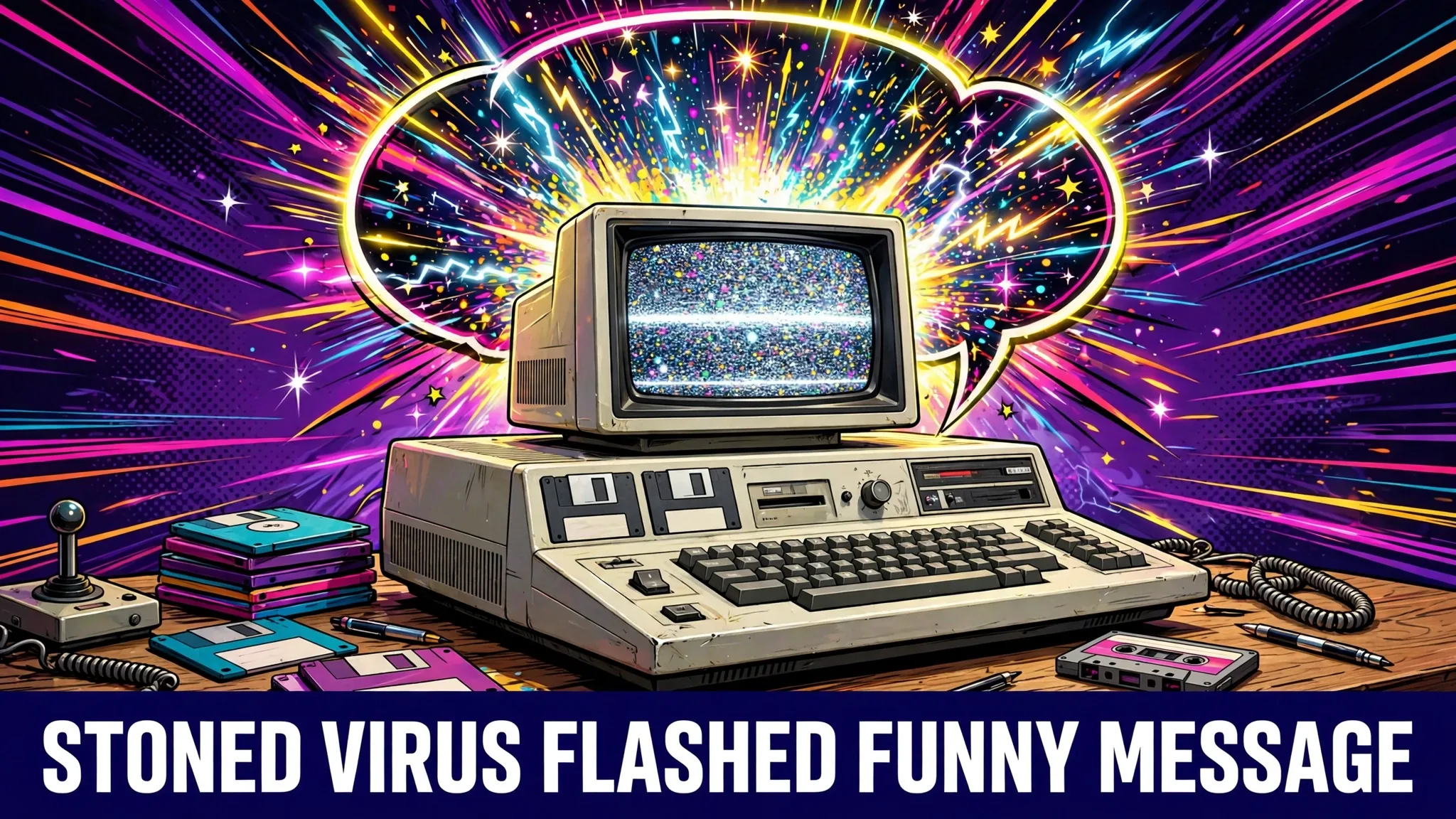
Imagine switching on your computer one ordinary morning in the late 1980s. The machine wakes up, the screen flickers — and instead of your work, a cheeky line of text grins back at you: “Your PC is now stoned!”
You have done nothing wrong. Nobody has broken into your house. All that happened is that, somewhere along the way, your computer started up from a floppy disk that somebody else had used before you. Hidden in that disk was one of the most successful jokes in computer history — a tiny program that travelled the whole world, showed its silly message on millions of screens, and left everyone asking the same question for years.
Who wrote it?
Nobody ever found out.
What the Stoned virus actually is
The Stoned virus appeared in 1987 and was first reported in New Zealand. It belongs to a family called boot sector viruses, and understanding that one phrase explains the whole story.
Every floppy disk has a tiny area called the boot sector. Think of it as the disk’s front doorstep — the very first patch of ground the computer steps on when it wakes up. When a computer starts from a floppy disk, the instructions on that doorstep are the first ones it reads and obeys, before anything else loads.
Stoned simply moved in and sat on that doorstep.
When an infected disk was used to start a machine, the virus quietly copied itself into the computer’s memory. From there, it did the one thing it was built to do: wait. Every new floppy disk placed into that machine picked up its own hidden copy of the virus in its boot sector. The disk looked normal. It worked normally. But it now carried a passenger, and wherever that disk travelled and started another computer, the passenger moved in there too.
The virus was not awake all the time in an obvious way. It made no noise, deleted nothing, and asked for nothing. Its favourite moment was the startup itself — roughly one time in eight, when an infected machine was switched on, the boot process paused and the famous line appeared on the screen: “Your PC is now stoned!”
Some versions of the virus carried a longer message as well — a slogan demanding that marijuana be legalised. That slogan is part of why the short message used the word “stoned” at all. The joke, the slogan, and the mystery of the author all arrived together, packed into a space smaller than a single photograph on a modern phone.
How the Stoned virus spread around the world
To understand Stoned’s journey, you have to remember how people shared things in 1987. There was no home internet. No email attachments, no downloads, no cloud. Software, games, and documents moved from person to person the physical way — on floppy disks, by hand.
A disk was borrowed to copy a game. A disk was lent to a colleague who needed a document. A disk came home from the office, went into the family computer, and went back the next day. Every one of those friendly exchanges was a possible ride for anything hiding in the disk’s boot sector — and the owner usually had no idea a ride was being given.
The trap was the startup. Starting a computer from a floppy disk was completely normal at the time; many machines did it automatically whenever a disk happened to be sitting in the drive at switch-on. So a person did not even need to run a suspicious program. Simply turning the machine on with the wrong disk inside was enough to bring the virus home, and from that moment the machine faithfully passed copies onward to fresh disks.
Riding this river of borrowed plastic, Stoned quietly circled the planet. By the early 1990s, it was commonly described as one of the most common computer viruses anywhere in the world — a remarkable achievement for a program whose entire visible trick was one joke on a screen. And I have to admit, the part of this story that stays with me is that a prank with no money, no theft, and no damage plan behind it out-travelled almost every serious virus of its time.
The damage story: a joke that was not harmless
It is tempting to call Stoned a harmless prank, and in intention it nearly was. The virus was not built to delete files, and it removed nothing on purpose. Nobody’s documents were wiped by design, and no money was ever demanded. Compared with the destructive viruses that came later, Stoned looks almost gentle.
But “not built to harm” is not the same as “harmed no one,” and the reported effects tell the fuller story.
The virus had to store itself somewhere, and on some systems the hiding place it chose overlapped with space the machine was using for real information. Where that happened, the stored copy could overwrite and damage the data underneath — the digital equivalent of a guest sleeping in a bed that was already taken. The harm was accidental, which made it no smaller for the person who lost their work.
An infected machine was also a problem simply because it was infected. It spread the virus to every disk it touched, so one careless computer in an office or a school quietly seeded dozens of disks, each of which went on to seed more machines. Cleaning up meant checking and disinfecting disk after disk, in an age when antivirus tools were young and many owners had never heard the word “virus” applied to a computer at all.
And then there is the strangest chapter of all — Stoned’s family legacy. The virus did not stay a lone joke. Other programmers studied it, copied its methods, and built on it. Its most famous descendant was the Michelangelo virus, which grew out of the Stoned family and became a global scare in its own right. The joker’s code, in other words, became the seed from which a far more frightening generation of viruses grew.
The original author’s name never surfaced. No arrest, no confession, no proud interview. The most widely travelled joke of the early computer age remains unsigned to this day.
How to protect yourself
Stoned itself belongs to history — modern computers do not start from floppy disks, because floppy disks no longer exist in daily life. But the shape of its trick never died. It only changed its costume. The lessons below are the same ones security experts still give today, translated from the floppy-disk age into ours.
Never start a computer from media you do not trust
Stoned’s whole career rested on one habit: machines starting up from whatever disk happened to be inside. The modern version of that habit is plugging in an unknown USB stick “just to check what is on it.” A found USB drive, a free drive handed out at an event, or a borrowed drive from an unknown source should never be your computer’s first greeting of the day. If you must look at strange media, let your security software scan it first — and never restart your machine with unknown media attached.
Treat borrowed storage like borrowed anything
Disks travelled hand to hand in 1987 because sharing was normal and checking was not. Today the same sharing happens with USB sticks, portable drives, and memory cards. Before opening files from borrowed storage, scan the whole device with updated antivirus software. It takes a minute, and that minute is exactly the barrier Stoned never had to face.
Keep your protection switched on and updated
Early computer owners often had no antivirus at all, which is why a joke could conquer the world undisturbed. Your operating system and security tools now carry decades of accumulated lessons, including everything learned from the boot sector era. Leave real-time protection on, let updates install, and do not silence warnings just because they are inconvenient.
Make backups a calm habit, not a panic reaction
Stoned’s accidental overwrites taught an early generation of users that data can be damaged by something that was never even aiming at it. A simple backup — copies of your important files on a separate drive or in a trusted cloud account — turns almost any virus story, old or new, from a disaster into an annoyance.
Common questions
Who created the Stoned virus?
Nobody knows. The virus appeared in 1987 and was first reported in New Zealand, but its author was never publicly identified. The longer slogan found in some versions suggests the message was the point of the joke, yet the person behind it never stepped forward to claim their famous prank.
Did the Stoned virus delete people’s files?
Not on purpose. Stoned was not built to destroy anything, and its only planned visible act was displaying its message. However, on some systems the place where it stored itself could overwrite stored data, so real damage was reported even though destruction was never the design.
Why did the message only appear sometimes?
The message was part of the startup routine and showed on roughly one occasion in eight when an infected machine was switched on. That randomness helped the virus stay unnoticed for long stretches, because a machine could seem perfectly clean through many normal starts.
Can the Stoned virus infect a computer today?
Practically speaking, no. It lives in the boot sector of floppy disks and depends on machines starting from them, a world that has disappeared. Its importance today is as a lesson: its exact method survives in modern form whenever a computer trusts unknown USB media at startup.
What is the connection between Stoned and the Michelangelo virus?
Michelangelo grew out of the Stoned family — later virus writers built on Stoned’s boot sector methods to create it. The playful original and the feared descendant share the same roots, which is why the two names so often appear together in virus history.
Sources
- Wikipedia — Stoned (computer virus): https://en.wikipedia.org/wiki/Stoned_(computer_virus)