Stuxnet Worm That Broke Machines
In this post
Some time before the world heard its name, machines inside a guarded plant in the Iranian desert began to die for no clear reason. The plant was Natanz, where Iran enriched uranium, and its halls were filled with tall metal tubes called centrifuges. Each one had to spin at an exact, steady speed, thousands of times a minute, hour after hour. Then, one by one, they started breaking. Engineers opened the machines, replaced the ruined parts, and started again. Weeks later, the new machines failed too. Strangest of all, the control room screens insisted everything was normal. Speeds looked healthy. Nothing flashed red. It was as if the plant was haunted. Nobody inside Natanz knew that the real problem was not inside the machines at all. It was inside the computers telling the machines what to do, and it had been hiding there, patiently, doing its work in silence.
The case only began to open in June 2010, far from Iran. A small computer security company in Belarus, called VirusBlokAda, was asked to look at computers in Iran that kept restarting on their own. Its experts pulled the strange software apart, piece by piece, the way detectives empty a suspect’s pockets onto a table. What they found did not look like ordinary criminal malware. It looked like a weapon.
What Stuxnet was, and exactly what it did
Malware is software built to harm, and most of it wants something simple: your password, your money, your files. Stuxnet wanted none of that. Experts call it the first true cyber weapon, because it was built to physically destroy equipment, not just steal or damage information on a screen.
Its target was very narrow. Inside Natanz, the centrifuges were run by industrial control systems made by the German company Siemens. To understand the attack, you only need two simple ideas. The first is the PLC, a small, tough computer fixed to the machinery that gives the machines their orders — spin faster, spin slower, stop, start. The second is SCADA, the wider system that watches over those controllers and shows the human operators what is happening. Stuxnet slipped into this control layer and quietly took over the orders.
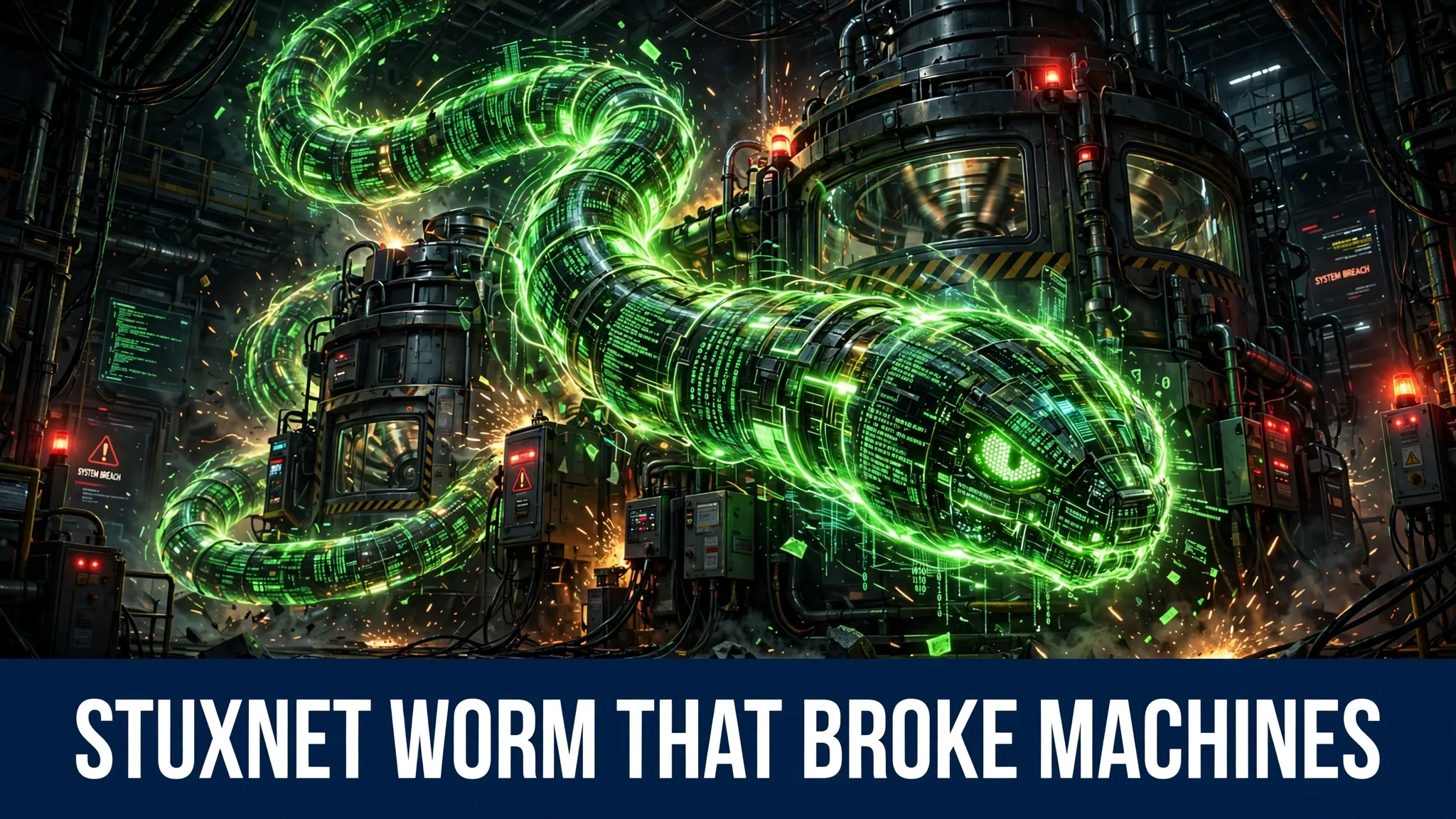
Then it attacked in the cruellest way possible: politely, and in secret. It ordered the centrifuges to spin far faster than they were built to spin, then slowed them down, then sped them up again, over and over, until the metal tore itself apart. While it was doing this, it played back calm, healthy readings to the operators’ screens, like a recorded video of a peaceful room shown to a guard while a robbery happens behind him. The machines were dying, and every instrument in the building said they were fine.
How Stuxnet spread, and how malware like it can reach you
The first mystery in the file was a locked door. The Natanz computers that ran the centrifuges were not connected to the internet. In security language, they were “air-gapped” — separated from the outside world by a gap of air. A worm cannot jump through air. So how did it get in?
The answer is embarrassingly small: a USB stick. Stuxnet travelled mainly on infected USB sticks that people carried in and plugged into computers, and from there it could move through Windows networks from machine to machine. Somewhere along the line, somebody — most likely without knowing — carried the enemy through the front gate in a pocket.
Once inside a computer, it was extraordinarily well equipped. It used four separate zero-day flaws in Windows at the same time. A zero-day is a hole in software that nobody knows about yet, not even the company that made it, so there is no patch and no warning. Using one is rare. Using four at once was, in the words experts kept repeating, almost unheard of. Whoever built Stuxnet had burned four precious secrets on a single mission.
The worm did not stay inside Natanz. It escaped beyond the plant and turned up on ordinary computers around the world — which is exactly how the Belarus firm found it. On a normal home or office computer it was not the main target; it was hunting for one very specific Siemens setup. But its journey carries the lesson for all of us: the same doors it used are open in every home. An unknown USB stick, an unpatched computer, a shared network — that is how malware like this reaches ordinary people too.
The damage Stuxnet left behind
By the time the full picture was assembled, the numbers were stark. About 1,000 centrifuges at Natanz had been destroyed — roughly a fifth of the ones Iran had running at the time. That is not a few broken machines. That is a production line quietly bleeding for months while its owners replaced part after part, never understanding why the new parts kept dying.
And that is the part of the story that stayed with the investigators. The real weapon was not only the spinning and slowing. It was the lying screens. Because the operators trusted their instruments, the sabotage ran far longer than any open attack could have. Stuxnet did not just break machines; it broke the plant’s ability to know it was under attack.
The question at the end of the file
Every detective file has one page that stays blank: who did it? The New York Times and many experts reported that Stuxnet was widely believed to be built jointly by the United States and Israel. Neither government has officially confirmed this. That is all that can honestly be said, and it is worth noticing how much work the phrase “widely believed” is doing. The worm carried no flag, no signature, no return address. Its makers built the most precise computer weapon of its age, and the last mystery of the case remains officially unsolved.
I find it frightening that a weapon powerful enough to wreck a guarded nuclear plant began its journey on something as small and ordinary as a USB stick.
How to protect yourself from malware like Stuxnet
You will probably never be the target of a state-built cyber weapon. But the tricks Stuxnet used — hidden flaws, infected USB sticks, quiet spreading — are the same tricks everyday malware uses on people like us. These steps genuinely help:
Keep your software updated. Updates are not just new colours and buttons. They are patches that close holes in Windows and other programs. Once a zero-day flaw becomes known, the update is the lock that fixes the door. Turning on automatic updates is one of the strongest protections you own, and it costs nothing.
Treat unknown USB sticks as strangers. Never plug in a USB stick you found, were handed at an event, or do not fully trust. A stick can carry malware that starts working the moment it connects — that is precisely how the world’s most guarded plant was entered. If you must open a doubtful stick, do it on a spare computer with nothing important on it, or ask a professional.
Use security software and leave it on. A good antivirus program quietly checks files, sticks and downloads as they arrive. It cannot stop a secret government weapon, but it stops the thousands of ordinary infections that arrive the same way, every single day.
Keep backups of what you cannot lose. Copy your photos, documents and important files to a second place — an external drive that you unplug afterwards, or a cloud account. Destructive malware can only truly hurt you if the only copy of your life is on one machine. A backup turns a disaster into an inconvenience.
Be slow with files from people you do not know. Strange attachments, free download sites and “cracked” programs are the everyday cousins of the infected USB stick. If a file arrives with pressure to open it quickly, that pressure itself is the warning sign.
Common questions
What is Stuxnet in simple words?
Stuxnet was a computer worm — a program that copies itself from machine to machine — built as a weapon. Instead of stealing money or passwords, it secretly ordered Iran’s nuclear centrifuges to spin wrongly until about 1,000 of them destroyed themselves, while showing the operators fake, healthy readings.
When was Stuxnet discovered?
It was discovered in June 2010 by VirusBlokAda, a small security firm in Belarus, after computers in Iran kept restarting strangely. The worm had already been at work inside the Natanz plant before anyone in the world knew it existed.
How did Stuxnet enter a plant with no internet?
Mainly through infected USB sticks. The plant’s key computers were cut off from the internet, but people still carried files in and out on USB sticks, and the worm rode in on one of them. From a single plugged-in stick, it could spread through the local Windows network.
Did Stuxnet attack ordinary home computers?
It did spread onto ordinary computers all over the world, which is how it was found. But its destructive instructions were written for one specific Siemens control setup at Natanz, so normal computers were carriers on its journey rather than the machines it was built to break.
Who created Stuxnet?
Nobody has officially admitted it. The New York Times and many experts reported that it was widely believed to be built jointly by the United States and Israel, but neither government has officially confirmed this, so the honest answer is that the case is still unclosed.
Sources
- Wikipedia — Stuxnet: https://en.wikipedia.org/wiki/Stuxnet
- Kaspersky — What is Stuxnet?: https://www.kaspersky.com/resource-center/definitions/what-is-stuxnet