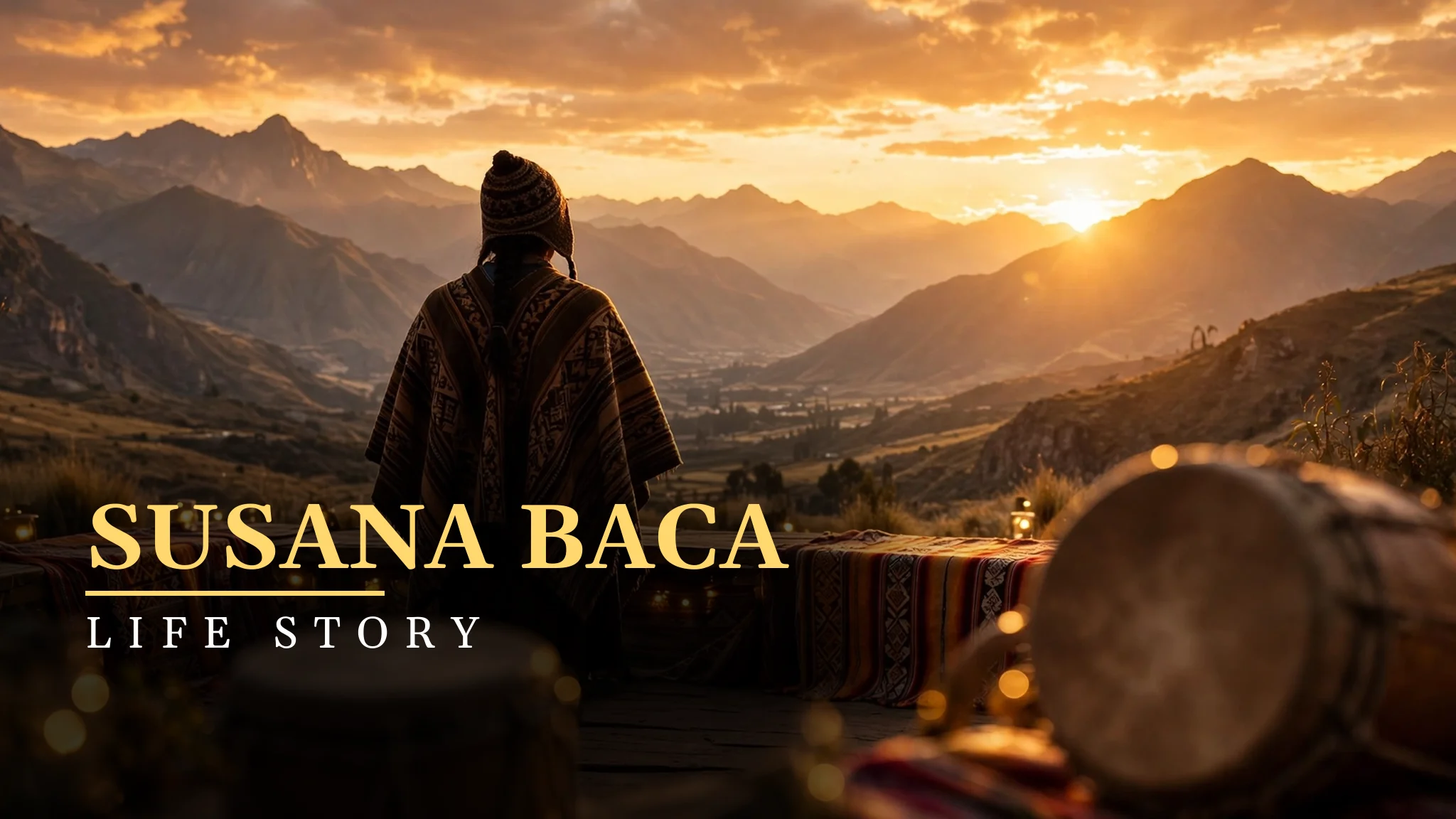
Susana Baca: The Life Story Behind the Peruvian Folk Star
In this post
- A Childhood in Chorrillos by the Sea
- Researching a Music That Was Being Forgotten
- The World Discovers Susana Baca
- Minister of Culture and a Voice for Afro-Peru
- The Later Years and a Life of Singing
- What Susana Baca Leaves Behind
- The Cajón, the Landó, and the Instruments of Memory
- Ecos de Sombras, Espíritu Vivo, and the Albums That Travelled
- Afrodiaspora and the Music of a Continent
- A Teacher First and a Singer Always
- My Take:
Susana Baca is one of the most important singers in the history of Peru. She did not only sing beautiful songs. She saved a music that was being forgotten, the Afro-Peruvian music of the descendants of enslaved Africans who were brought to Peru centuries ago. She researched it, she recorded it, she sang it on stages around the world, and she made the world listen to a sound that had been ignored for too long. Her voice is deep, warm, and full of history, and when she sings, you can hear the whole story of Afro-Peru in a single note.
She was born in Chorrillos, a fishing district of Lima, in 1944, and she grew up in a family where music was part of daily life. She became a teacher, she studied the music of her people, and she spent years travelling through Peru, collecting songs, rhythms, and stories from old musicians who remembered what others had forgotten. Then, in her fifties, the world discovered her, and she became a star of world music, a Latin Grammy winner, and, for a time, the Minister of Culture of Peru.
What makes her story remarkable is that she is not only a singer. She is a researcher, a teacher, a keeper of memory, and a woman who used her voice to give dignity to a people who had been treated as invisible. Her life is a lesson in the power of remembering, and in the power of a single voice to change how a country sees itself.
A Childhood in Chorrillos by the Sea
Susana Baca was born on 24 May 1944 in Chorrillos, a district of Lima on the Pacific coast. Chorrillos was a fishing town, a place of boats, of nets, of salt air, and of music. It was also a place where Afro-Peruvian families had lived for generations, keeping alive the rhythms and songs that their ancestors had brought from Africa and shaped in Peru. Baca grew up in that world, hearing music in her home, in the streets, and in the celebrations of her community.
Her family was poor, but it was rich in music. She learned to sing as a child, and she learned that music was not only entertainment. It was a way of remembering, a way of telling the story of a people, a way of holding on to who you are when the world tries to make you forget. The songs she heard as a child were not written in books. They were passed from person to person, from parent to child, from old musicians to young ones, and they carried the history of Afro-Peru in their rhythms.
As a young woman, Baca studied education, and she became a teacher. Teaching was a natural choice for her, because she loved to share what she knew, and because she believed that education could change lives. She taught in schools, and she saw how children learned, how they listened, and how they remembered. That experience as a teacher shaped her whole life. She would become a teacher in a larger sense, teaching the world about Afro-Peruvian music, teaching Peruvians about their own history, and teaching young musicians to respect the traditions they had inherited.
In those early years, she also began to sing in public, in small venues, in cultural events, and in gatherings of people who loved Peruvian music. She was not a star. She was a singer who loved her music and who wanted to share it. She sang the songs she had learned as a child, and she began to understand that those songs were more than beautiful. They were important. They were the voice of a people who had been silenced for too long.
Researching a Music That Was Being Forgotten
In the 1960s and 1970s, Baca began a project that would define her life. With her husband, Ricardo Pereira, she began to research Afro-Peruvian music, travelling through Peru, talking to old musicians, recording their songs, and collecting the rhythms, instruments, and stories that made up this tradition. It was painstaking work, and it was urgent work, because the old musicians were dying, and with them, the songs were dying too.
Afro-Peruvian music has a long and painful history. Enslaved Africans were brought to Peru during the colonial period, and they were forbidden to play their drums, because their owners feared that the drums could be used to send messages and to organise resistance. So they made drums from boxes, from tables, from anything they could find, and they created a new music, a music of resistance and of survival. The cajón, the wooden box drum that is now famous around the world, was born from that history. It is a box that became a drum, and a drum that became a voice.
Baca understood that history deeply, and she dedicated herself to preserving it. She and Pereira founded an institute, the Instituto Negrocontinuo, to study and promote Afro-Peruvian culture. They recorded old musicians, they transcribed songs, they organised concerts, and they taught young people to play the cajón, to sing the old songs, and to understand where their music came from. It was not glamorous work. It was slow, patient, and often unrewarded. But it was necessary, and Baca did it with love and with determination.
During these years, she also began to record her own albums, singing the songs she had collected, and writing new songs in the Afro-Peruvian tradition. Her voice was deep and warm, and her singing was full of feeling. She did not sing to show off. She sang to tell a story, to remember, to honour the people who had made the music. Her albums were heard by a small audience in Peru, and by an even smaller audience outside it. She was not famous. She was a researcher and a singer, working quietly, doing the work that mattered.
The World Discovers Susana Baca
In the 1990s, everything changed. The American musician David Byrne, the former leader of the Talking Heads, heard Baca’s music and was amazed by it. He signed her to his record label, Luaka Bop, and released her album Susana Baca in 1997. The album was heard around the world, and critics wrote about it with wonder. They said that Baca’s voice was extraordinary, that her music was beautiful and important, and that the world had been missing something precious.
The album’s success was a turning point. Baca began to tour the world, singing in Europe, in the United States, in Asia, and in Latin America. Audiences who had never heard Afro-Peruvian music fell in love with it. They heard the cajón, they heard the deep rhythms, they heard Baca’s voice, and they understood that they were listening to something ancient and alive. She was in her fifties, and she was becoming a star of world music, a singer whose concerts were praised in newspapers around the world.
Her most famous song became María Landó, a song written by the great Peruvian songwriter Chabuca Granda. It tells the story of a woman, María Landó, and it is a song of love, of longing, and of the Peruvian coast. Baca’s version of the song is now the best-known one, and it has become a classic of Peruvian music. When she sings it, audiences are silent, and then they applaud for a long time. It is a song that carries the whole soul of Peru in it.
She released more albums, including Ecos de Sombras and Espíritu Vivo, and she won Latin Grammy Awards, including honours for Best Folk Album. Those awards were important, because they recognised Afro-Peruvian music on the world stage, and they recognised Baca as one of the great singers of Latin America. But for Baca, the awards were less important than the music itself, and less important than the fact that young Peruvians were now learning the songs she had spent her life collecting.
Minister of Culture and a Voice for Afro-Peru
In 2011, Baca’s life took an extraordinary turn. The new president of Peru, Ollanta Humala, appointed her as Minister of Culture. She became the first Afro-Peruvian to hold a ministerial post in Peru, and her appointment was a moment of great pride for Afro-Peruvians, who had been excluded from power for centuries. It was also a recognition of her life’s work. She had spent decades preserving Peruvian culture, and now she was being asked to lead the ministry that protected it.
Her time as minister was short, lasting only a few months, but it was significant. She used her position to draw attention to Afro-Peruvian culture, to the music, the dance, the food, and the history of a people who had been ignored. She spoke about the need to respect all of Peru’s cultures, not only the cultures of the coast, of the Andes, and of the Amazon, but of every community that made Peru what it is. She did not stay in the job long, and she returned to her music, but her appointment had sent a message that could not be taken back: Afro-Peruvians belong in the highest places in their country.
After her time as minister, Baca continued to sing, to record, and to tour. She released new albums, she performed in concerts around the world, and she continued to teach and to research. She also continued to speak about the importance of Afro-Peruvian culture, about the need to remember, and about the power of music to bring people together. She became a symbol, not only of Peruvian music, but of dignity, of perseverance, and of the idea that a culture that is remembered cannot be destroyed.
Her work has also inspired a new generation of Afro-Peruvian musicians. Young singers, drummers, and dancers in Peru now learn the cajón, sing the old songs, and perform the music that Baca spent her life preserving. They do it with pride, because Baca showed them that their music is not a curiosity. It is a treasure, and it deserves to be heard around the world. That is perhaps her greatest achievement: not her own fame, but the pride she gave to others.
The Later Years and a Life of Singing
In recent years, Baca has continued to sing and to record, even as she has grown older. Her voice has deepened, and her performances have become even more moving, because they carry the weight of a long life, of a long history, and of a deep love for her people. She performs in Peru and around the world, and audiences still listen to her in silence, and still applaud her for a long time when she finishes.
She has also continued her work as a researcher and a teacher, through her institute and through her recordings. She has written about Afro-Peruvian music, she has collected songs, and she has helped to keep the tradition alive. Her life’s work is not finished, because the work of remembering is never finished. Each generation must learn the songs again, must play the cajón again, must sing again, or the music will be lost. Baca has made sure that will not happen, at least not in her lifetime.
Her place in Peruvian culture is now secure. She is one of the most respected artists in the country, a person whose name is known in every home, a singer whose voice is the voice of Peru itself. She is also known around the world as one of the great voices of Latin America, a woman who took a forgotten music and made the world listen to it. That is a rare achievement, and it is one that will last.
What Susana Baca Leaves Behind
Susana Baca’s legacy is a music that was saved. Without her, Afro-Peruvian music might have been forgotten, its songs lost, its rhythms silenced, its history erased. Because of her, the cajón is played around the world, the songs are sung by young people in Peru, and the world knows that Peru is not only the land of the Incas and the Andes. It is also the land of Afro-Peruvian music, of deep rhythms, of powerful voices, and of a people who survived slavery and created beauty from pain.
She also leaves behind an example: a woman who became a teacher, a researcher, a singer, and a minister, who worked for decades without fame, and who was rewarded late, with awards, with tours, and with the love of audiences around the world. Her life says that the work you do in the quiet years matters, that remembering is an act of courage, and that a single voice, singing honestly, can change how a country sees itself.
The Cajón, the Landó, and the Instruments of Memory
To understand Susana Baca’s work, it is important to understand the instruments she sang with, especially the cajón. The cajón is a wooden box, and it is the most famous instrument of Afro-Peruvian music. It was born from a terrible history: enslaved Africans in Peru were forbidden to play drums, because their owners feared that drums could be used to send messages and to organise resistance. So they made music on boxes, on tables, on drawers, on anything that could make a sound, and over time the box became a drum, a real instrument, with a deep, warm sound that could carry a whole rhythm.
Baca understood that history, and she sang with the cajón as if it were a voice, a voice that remembered. When she performed, the cajón was not only an accompaniment. It was a partner, a memory, a reminder of the people who had made music from nothing, who had turned a box into a drum, and a drum into freedom. Her songs also used the landó, the slow, deep rhythm of Afro-Peru, and the festejo, the joyful dance rhythm, and she moved between them with ease, showing the full range of Afro-Peruvian music.
She also understood that these rhythms were not only music. They were history, they were resistance, they were survival. Every time she sang a landó, she was remembering the people who had created it, the people who had been enslaved, who had been forbidden to drum, and who had found a way to make music anyway. That is why her performances are so moving. They are not only concerts. They are acts of memory, and the audience can feel it.
Ecos de Sombras, Espíritu Vivo, and the Albums That Travelled
After the success of her first album on Luaka Bop, Baca released more albums that deepened her reputation. Ecos de Sombras, released in 2000, was a collection of songs that showed the full range of her voice and her repertoire, from slow, meditative landós to joyful festejos. Espíritu Vivo, released in 2002, was a live album that captured the power of her concerts, the warmth of her voice, and the connection she had with her audience. These albums were heard around the world, and they won her Latin Grammy recognition, including honours for Best Folk Album.
Her albums were not made to follow fashion. They were made to preserve, to remember, and to share. Each one was a collection of songs that she had collected, that she had learned from old musicians, that she had carried with her for years. She recorded them with care, with respect, and with the knowledge that a recording is a kind of memory, a way of keeping a song alive after the singer is gone. Her albums are now part of the permanent record of Afro-Peruvian music, and they will be listened to for generations.
She also recorded later albums, including Afrodiaspora, which won further Latin Grammy recognition, and which showed her continuing creativity, her willingness to explore new sounds while staying true to her roots. Her discography is a journey through Afro-Peruvian music, from the old songs she collected to the new songs she wrote, and it is a journey that any listener can take, and that will teach them about Peru, about Africa, and about the power of music to survive.
Afrodiaspora and the Music of a Continent
In her later career, Susana Baca released Afrodiaspora, an album that won further Latin Grammy recognition and that showed her continuing creativity. The album’s title speaks to its idea: the African diaspora, the spread of African people and African music across the Americas, from Peru to Brazil, from Cuba to the United States, and the shared rhythms, shared histories, and shared feelings that connect them. Baca sang songs from many traditions, showing that Afro-Peruvian music is not isolated. It is part of a larger story, the story of African people in the Americas, and of the music they created from pain, from resistance, and from joy.
The album was a statement about identity, about belonging, and about the connections between peoples who share a history. Baca sang it with the same depth and feeling she brought to all her work, and audiences around the world recognised it as an important album, a work that was both personal and universal. It showed that she was not only a singer of Peruvian music. She was a singer of the diaspora, of a history that spans continents, and of a music that belongs to many peoples at once.
Afrodiaspora also showed that Baca was still growing, still exploring, still learning, even in her later years. She did not repeat herself. She did not rest on her earlier success. She kept working, kept researching, kept singing new songs, and kept finding new ways to tell the story of her people. That willingness to grow, even after decades of work, is one of the reasons her career has lasted so long and has been so respected.
A Teacher First and a Singer Always
Susana Baca was a teacher before she was a famous singer, and that fact shapes everything about her. She studied education, she taught in schools, and she learned how children listen, how they learn, and how they remember. That experience made her a better singer, because she understood that a song is a kind of teaching, a way of passing on what matters, and that an audience, like a classroom, needs patience, clarity, and love. She carried that understanding into her research, into her institute, and into her concerts, where she taught the world about Afro-Peruvian music, not by lecturing, but by singing, by sharing, and by inviting people to listen. She was a teacher in the widest sense, a person who believed that knowledge is meant to be shared, and that sharing it is an act of love.
My Take:
I want to begin with something that moves me deeply about Susana Baca: she spent her life saving a music that the world had forgotten, and she did it without expecting fame or reward. For decades, she travelled through Peru, talking to old musicians, recording their songs, learning rhythms that were dying with the people who played them. That is not glamorous work. It is slow, patient, and often lonely work. But it is the most important work there is, because when a song is forgotten, a whole history is forgotten with it. Baca understood that, and she refused to let it happen. I admire her for that more than I can say.
What strikes me most is the history of Afro-Peruvian music itself. Enslaved Africans were brought to Peru, and they were forbidden to play their drums, because their owners were afraid of what the drums could do. So they made drums from boxes, from tables, from anything they could find, and they created the cajón, a wooden box that became one of the most famous drums in the world. Think about that. People who had everything taken from them, who were treated as property, who were forbidden to make music, found a way to make music anyway. They turned a box into a drum, and a drum into a voice. That is one of the most beautiful stories I know, and Baca spent her life telling it, singing it, and making sure the world heard it.
I love her voice. It is deep, warm, and full of feeling. When she sings María Landó, I feel as if I am listening to the whole history of Peru in a single song: the sea, the coast, the love, the longing, the pain, and the beauty. She does not sing to show off. She does not sing to impress. She sings to tell a story, to remember, to honour the people who made the music. That honesty is what makes her performances so powerful. I have heard many singers who are technically perfect, who hit every note, who have beautiful voices, and I have forgotten them. I have never forgotten Baca, because her singing is not about technique. It is about truth.
I am also moved by the fact that she became famous late. She was in her fifties when David Byrne heard her music and released her album on his label. She had been working for decades, researching, teaching, singing in small venues, and the world had not noticed her. And then, suddenly, the world did notice, and she became a star of world music, touring the globe, winning Latin Grammys, performing in concert halls around the world. That tells me something I need to hear: it is never too late. The work you do in the quiet years is not wasted. It is the foundation. Baca’s fame did not come from luck. It came from decades of preparation, of research, of singing, of loving her music. When her moment came, she was ready.
Her appointment as Minister of Culture in 2011 moves me in a different way. She became the first Afro-Peruvian to hold a ministerial post in Peru, and that was a moment of great pride for Afro-Peruvians, who had been excluded from power for centuries. I think about what that must have felt like for her, to walk into a government building as a minister, knowing that her ancestors had been enslaved, knowing that her people had been treated as invisible, and knowing that she was now in a position to speak for them. She did not stay in the job long, but she did not need to. Her appointment sent a message that could not be taken back: Afro-Peruvians belong in the highest places in their country. That message matters, and I am grateful to her for it.
I also think about her as a teacher, because teaching is at the heart of everything she did. She taught in schools, she taught young musicians, she taught the world about Afro-Peruvian music. She founded an institute to study and promote that music, and she spent her life passing on what she had learned. That generosity is rare, and it is beautiful. She could have kept her knowledge to herself. She could have used it only for her own career. Instead, she shared it, she taught it, she made sure that young people would learn the songs, play the cajón, and carry the tradition forward. That is a legacy that will outlast any album, any award, any concert. It lives in people.
What I take from her story, for my own life, is this: remember. Remember where you come from, remember the songs of your people, remember the stories that others have forgotten, and do the work of keeping them alive. It is easy to forget. It is easy to let the past disappear, to let old songs die, to let old people die without listening to them. Baca teaches me to listen, to record, to learn, and to sing. She teaches me that remembering is not a passive act. It is an active one. It requires work, patience, and love. And it is worth doing, because a people who remember who they are cannot be destroyed.
I also learn from her that a single voice can change how a country sees itself. Before Baca, many Peruvians did not think of Afro-Peruvian music as important. They thought of Peru as the land of the Incas, of the Andes, of Spanish colonial churches. Baca showed them that Peru is also the land of Afro-Peruvian music, of deep rhythms, of powerful voices, of a people who survived slavery and created beauty from pain. She changed how Peruvians see themselves, and she changed how the world sees Peru. That is an extraordinary achievement, and it came from one woman, singing honestly, for a long time.
In the end, I think Susana Baca is one of the most important artists of Latin America, not because she was famous, but because she was faithful. She was faithful to her music, to her people, to her history, and to the truth. She worked for decades without fame, and when fame came, she used it to serve her music, not herself. She sang, she taught, she researched, she led, and she never stopped. I will keep listening to her voice, and I will keep learning from her life, because it teaches me that remembering is an act of love, and that love, expressed in a song, can change the world.
I want to add something about the cajón, because it is the heart of Susana Baca’s music, and it is one of the most beautiful stories I know. Enslaved people in Peru were forbidden to play drums, because their owners were afraid. So they made drums from boxes, from tables, from anything they could find, and they created the cajón, a wooden box that became one of the most famous drums in the world. Think about that. People who had everything taken from them, who were treated as property, who were forbidden to make music, found a way to make music anyway. They turned a box into a drum, and a drum into a voice. That is not only a story about music. It is a story about the human spirit, about the refusal to be silenced, about the power of creativity in the face of cruelty. Baca spent her life telling that story, singing it, and making sure the world heard it. I will never forget it.
I also think about her work as a researcher, because it is easy to overlook, and it is one of the most important parts of her life. She travelled through Peru, talking to old musicians, recording their songs, learning rhythms that were dying with the people who played them. That is slow, patient, lonely work, and it is work that does not bring fame or money. But it is the work that saves a culture. Without it, the songs would have been lost, the rhythms forgotten, the history erased. Baca did that work, for decades, because she believed it mattered, because she loved her people, and because she understood that remembering is an act of love. I want to be like that in my own life: willing to do the slow, patient work, the work that nobody sees, the work that saves something precious, even if it takes years.
Finally, I think about what her life teaches me about dignity. She was a Black woman in Peru, a country where Afro-Peruvians had been excluded, ignored, and treated as invisible for centuries. She became a singer, a researcher, a teacher, and a minister. She walked into government buildings as a minister, she sang on stages around the world, she won Latin Grammys, and she did it all with dignity, with grace, and with a deep love for her people. She did not ask for pity. She did not ask for special treatment. She worked, she sang, she remembered, and she earned her place. That dignity is a lesson for all of us: that who you are matters, that your culture matters, that your history matters, and that no one can take that away from you if you remember it, if you sing it, if you carry it with pride. Susana Baca carried it, and I am grateful to her for it.
I want to add something about Afrodiaspora, because it shows me something important about Baca’s vision. She did not only sing Peruvian music. She sang the music of a diaspora, of African people across the Americas, of shared rhythms and shared histories that connect Peru to Brazil, to Cuba, to the United States. That is a large vision, and it is a generous one. It says that my music is not only mine. It belongs to many peoples, it carries many histories, and it connects us. I admire that generosity, and I want to be generous in the same way: to see the connections between people, to recognise that my story is part of a larger story, and to sing, or to work, in a way that honours those connections. Baca did that, and her album is a reminder that music is not a border. It is a bridge, and it can carry us across continents, across histories, and across the pain that divides us.
I want to end with something about Baca as a teacher, because it is the thread that runs through her whole life. She taught in schools, she taught young musicians, she taught the world about Afro-Peruvian music, and she did it with patience, with love, and with a belief that knowledge is meant to be shared. Teaching is a generous act. It takes time away from your own work, and it gives that time to other people. Baca did it anyway, for decades, because she believed that a culture that is not taught will be forgotten, and that a song that is not sung will die. She taught, she sang, she remembered, and she made sure that others would remember too. I want to be like that: a person who shares what they know, who teaches, who remembers, and who helps others to remember, because that is how a culture lives, and how a people survives.
One more thing stays with me about Baca, and it is her voice itself. It is deep, warm, and full of feeling, and when she sings María Landó, I feel as if I am listening to the whole history of Peru in a single song: the sea, the coast, the love, the longing, the pain, and the beauty. She does not sing to show off. She sings to tell a story, to remember, to honour the people who made the music. That honesty is what makes her performances so powerful. I have heard many singers who are technically perfect, who hit every note, who have beautiful voices, and I have forgotten them. I have never forgotten Baca, because her singing is not about technique. It is about truth, and truth, sung honestly, stays with you long after the song has ended.
Frequently Asked Questions
What is Susana Baca best known for? Susana Baca is best known as the great voice of Afro-Peruvian music. She researched, preserved, and performed the music of Afro-Peruvians, and her song María Landó, written by Chabuca Granda, became a classic of Peruvian music.
Where was Susana Baca born? Susana Baca was born on 24 May 1944 in Chorrillos, a fishing district of Lima, Peru. She grew up in an Afro-Peruvian family where music was part of daily life.
Did Susana Baca win a Latin Grammy? Yes, Susana Baca won Latin Grammy Awards, including honours for Best Folk Album, for her recordings of Afro-Peruvian music. Her albums brought the music to audiences around the world.
What is the cajón and why is it important? The cajón is a wooden box drum central to Afro-Peruvian music. Enslaved Africans in Peru, forbidden to play drums, created music on boxes and tables, and the cajón was born from that history. It is now played around the world.
Was Susana Baca a minister in Peru? Yes, Susana Baca was appointed Minister of Culture of Peru in 2011, becoming the first Afro-Peruvian to hold a ministerial post in the country. She used the role to draw attention to Afro-Peruvian culture.
What is the Instituto Negrocontinuo? The Instituto Negrocontinuo is the institute Susana Baca founded with her husband Ricardo Pereira to study and promote Afro-Peruvian culture. It records old musicians, collects songs, and teaches young people the traditions of Afro-Peruvian music.


