Susanne Bier: The Life Story Behind Denmark's Oscar-Winning Director
In this post
- A Childhood in Copenhagen
- Design, Israel and the Road to Film School
- Brothers, After the Wedding and Danish Success
- In a Better World and an Academy Award
- Bird Box, The Night Manager and the World Stage
- A Director Who Tells Stories About People
- Love Is All You Need, Serena and Working in Many Genres
- My Take:
Susanne Bier is a director who makes films about people who are trying to do the right thing, and who often fail. Her films are about families, about brothers, about mothers, about love, and about the choices that change a life. She made Brothers, about two brothers and a war, After the Wedding, about a man who returns to Denmark, and In a Better World, which won her an Academy Award. She went on to direct Bird Box, a thriller watched by millions on Netflix, and The Night Manager, a television series that won her an Emmy. Her work is known around the world, and she is one of the most successful directors Denmark has ever produced.
She was born in Copenhagen, Denmark, and she grew up in a Jewish family where books, ideas, and culture mattered. She studied in Israel and in Denmark, she worked as a designer, and she came to film later than many directors, after she had already lived a full life. That late start shaped her, and it is why her films feel so mature, so wise, and so full of understanding about how people really behave.
What makes her story worth telling is the way she built a career across many countries and many languages. She made films in Danish, in English, and in other languages, she worked with actors in Denmark, in Britain, and in America, and she won awards in all of those places. This is the story of a Danish woman who became one of the most respected directors in the world, by telling stories about real people, with honesty and with heart.
A Childhood in Copenhagen
Susanne Bier was born on 15 April 1960 in Copenhagen, Denmark. She grew up in a Jewish family, and her childhood was full of books, school, and the culture of the Danish capital. Her father was a businessman, her mother was a teacher, and the family lived a life where ideas were taken seriously and where education mattered. Susanne was a curious child, and she loved stories. She liked to read, she liked to watch films, and she liked to think about how people behaved when no one was watching.
As a child, she was thoughtful and observant. She liked to listen to adults talk, to notice the way they hid their feelings, and to understand the small details of their behaviour. She was not the loudest child in the room, but she was one of the most attentive. She loved the theatre, and she loved film, and she often went to see plays and films with her family. She did not yet know that she wanted to be a director, but she knew that she loved the world of stories, and that she wanted to be part of it in some way.
When she was a teenager, she began to think more seriously about her future. She was interested in art, in design, and in the way things looked and felt. She studied art and design, and she worked as a designer for a time, making things with her hands and learning about colour, shape, and form. That work taught her a great deal about how to see, and that ability to see would later become a key part of her work as a director. She learned to notice the small details, the way a room looks, the way light falls, the way a face changes when a person is sad.
She also spent time in Israel, where she studied at the Bezalel Academy of Arts and Design in Jerusalem, and where she learned about a different culture and a different way of life. That experience broadened her view of the world, and it taught her that stories could be told in many ways, in many languages, and in many places. She returned to Denmark with a wider view of the world, and with a desire to tell stories that mattered.
Design, Israel and the Road to Film School
Susanne studied art and design in Israel, at the Bezalel Academy in Jerusalem, and she worked as a designer before she turned to film. She was in her twenties, and she was still searching for her path. She had a talent for design, but she also had a love of stories, and she began to realise that film was a way to combine the two, to tell stories with images, with light, and with sound. She applied to the Danish National Film School in Copenhagen, and she was accepted. She studied there, and she graduated in 1987, at the age of twenty-seven.
Her time at film school was important, because it was where she learned the craft of directing, and where she met other young filmmakers who would become her collaborators. She was older than many of her classmates, and she brought a maturity to her work that they did not yet have. She had lived in Israel, she had worked as a designer, and she had seen the world. That experience gave her films a depth and a wisdom that younger directors often lack. She was not in a hurry. She was ready to tell stories that mattered, and she was willing to take her time to tell them well.
After she graduated, she began to work in Danish film and television. She directed short films, she directed television series, and she began to build a reputation as a talented and serious director. Her early work included films like Freud’s Leaving Home in 1991, a film about a Jewish family in Sweden, and Family Matters, and other productions that showed her interest in families, in relationships, and in the way people hurt each other and forgive each other. She was not yet famous, but she was a working director, and she was respected by the people she worked with.
She also worked in Sweden, directing films in Swedish, and she learned how to work in different languages and different cultures. That ability would become a hallmark of her career, and it is why she was able to work in Denmark, in Sweden, in Britain, and in America, with actors from many countries. She was a European director, in the truest sense, a woman who belonged to many places at once, and who could move between them with ease.
Brothers, After the Wedding and Danish Success
Susanne’s breakthrough as a director came in the 2000s, with a series of films that were praised in Denmark and around the world. In 2004, she directed Brothers, known in Danish as Brødre, a film about two brothers, Michael and Jannik, and about the war in Afghanistan. Michael is a soldier who is captured and who is forced to make a terrible choice, and Jannik is his younger brother, a troubled man who tries to take care of Michael’s family while he is away. The film was about family, about war, about guilt, and about forgiveness, and it was a huge success in Denmark. It won awards, and it brought Susanne to the attention of a wider audience.
In 2006, she directed After the Wedding, known in Danish as Efter brylluppet, a film about a man named Jacob, played by Mads Mikkelsen, who runs an orphanage in India and who returns to Denmark for a wedding, where he discovers a secret that changes his life. The film was about family, about secrets, about love, and about the choices people make. It was nominated for an Academy Award for Best Foreign Language Film, and it was praised by critics around the world. Susanne had become one of the most important directors in Denmark, and she was known for her ability to tell stories about families with honesty and with heart.
She also directed Things We Lost in the Fire in 2007, her first English-language film, with Halle Berry and Benicio del Toro, about a woman whose husband dies and who turns to his best friend for help. The film was a success, and it showed that Susanne could work in Hollywood, with American actors, and in a different kind of story. She was becoming an international director, and she was respected in many countries. She did not leave Denmark behind. She continued to make films in Danish, and she continued to work with Danish actors, but she also worked in English, and she moved between the two worlds with ease.
Her films during this time were all about the same thing: people who are trying to do the right thing, and who often fail. She did not judge her characters. She showed them as they were, with their flaws and their strengths, and she let the audience decide what to think. That compassion is at the heart of her work, and it is why her films feel so human and so moving.
In a Better World and an Academy Award
In 2010, Susanne directed In a Better World, known in Danish as Hævnen, a film about two families in Denmark and in Africa, about revenge, about forgiveness, and about the choices people make when they are hurt. The film follows Anton, a doctor who works in Africa, and his son Elias, who is bullied at school, and Christian, a boy who has lost his mother and who wants revenge on the world. It was a powerful film, about the cycle of violence, about the need to break that cycle, and about the hope that people can change.
In a Better World won the Academy Award for Best Foreign Language Film in 2011, and it won the Golden Globe for Best Foreign Language Film. It was a huge honour, and it made Susanne the first Danish woman to win an Academy Award for directing, and one of the few women in the world to have won an Oscar for a foreign language film. She was praised by critics, and she became a household name in Denmark and in other countries. She had worked for more than twenty years to get there, and she had earned it.
The film brought her to the attention of a wider international audience. It was shown in many countries, and critics praised her direction, her ability to tell a difficult story with honesty and with restraint, and her work with the actors, including Mikael Persbrandt and Trine Dyrholm, who gave powerful performances. Susanne was now one of the most respected directors in the world, and she was invited to work in Hollywood and in Britain, on bigger projects, with bigger stars.
After In a Better World, she directed Love Is All You Need in 2012, a romantic comedy about a woman who has cancer and who falls in love at a wedding in Italy, and Serena in 2014, a film with Jennifer Lawrence and Bradley Cooper, about a couple in North Carolina in the 1930s. She was working in many genres, in many countries, and with many different kinds of actors, and she was doing it with the same honesty and the same care that she had brought to her Danish films.
Bird Box, The Night Manager and the World Stage
In 2016, Susanne directed The Night Manager, a British television series based on the novel by John le Carré, about a hotel manager who becomes a spy, played by Tom Hiddleston, with Hugh Laurie as a villain. The series was a huge success, it won awards, and Susanne won the Emmy Award for Outstanding Directing for a Limited Series, becoming the first woman to win that award. It was a major achievement, and it showed that she could work in television, in Britain, with British actors, and make something that was loved by audiences around the world.
In 2018, she directed Bird Box, a thriller for Netflix, with Sandra Bullock as a woman who must survive in a world where a mysterious force drives people to kill themselves if they see it. The film was watched by millions of people on Netflix, and it became one of the most talked-about films of the year. It was a different kind of film for Susanne, a thriller, a horror film, and it showed that she could work in a new genre, with a new audience, and still bring her honesty and her care to the story. She was now a director who could work in any genre, in any country, and with any kind of story.
She also directed The Undoing in 2020, a television series with Nicole Kidman and Hugh Grant, about a wealthy couple in New York whose life falls apart when a murder is discovered. The series was a success, and it showed that Susanne could work in American television, with American stars, and make something that was both popular and critically praised. She was becoming one of the most in-demand directors in the world, and she was respected by actors and by studios for her talent and her professionalism.
In recent years, she has continued to work in film and television, in Denmark and abroad. She has directed films in Danish and in English, she has worked with actors from many countries, and she has won awards in many places. She is now in her sixties, and she is still working, still learning, and still choosing projects that interest her. Her career is a model of longevity, of curiosity, and of quiet excellence.
A Director Who Tells Stories About People
Susanne Bier’s story is, in the end, a story about people. Her films are about families, about brothers, about mothers, about love, and about the choices that change a life. She does not make films about superheroes or about fantasy. She makes films about ordinary people, in ordinary rooms, trying to live their lives, and that is why they feel so real. She has a gift for showing the small moments, the way a person looks at another person, the way a family eats dinner together, the way a mother holds her child, and for making those moments feel important.
She has won many awards, including an Academy Award, a Golden Globe, an Emmy, and many other prizes in Denmark and in other countries. She is one of the most awarded directors in Danish history, and she is respected by directors and by actors around the world. But she does not talk much about awards. She talks about the work, about the characters, about the actors, and about the joy of telling a story well. That focus on the work, rather than on the prizes, is a big part of who she is.
She lives in Denmark and in America, and she moves between the two with ease. She is a Danish director who works in the world, not a director who has left Denmark behind. She is proud of her home, and she often talks about Copenhagen, about its culture, and about the way it shaped her. She is also proud of her Jewish heritage, and she has talked about it in her films and in interviews, saying that it has shaped her view of the world, her sense of justice, and her belief in the importance of family.
As she moves into her sixties, Susanne is still a working director, still choosing projects, still learning. Her story is not finished, and her fans wait with hope for whatever she does next. She is a director, a mother, and a woman who started late and became one of the best in the world, and her story is one of the most inspiring in European film. She shows that it is never too late to start, and that a good story, told with honesty and with heart, can travel the world.
Love Is All You Need, Serena and Working in Many Genres
After In a Better World, Susanne Bier directed Love Is All You Need in 2012, a romantic comedy about Ida, a woman who has cancer and who is going to Italy for her daughter’s wedding, where she meets Philip, a man who has also been hurt by love. The film starred Trine Dyrholm as Ida and Pierce Brosnan as Philip, and it was a warm and funny film, very different from the serious dramas Susanne was known for. It showed that she could make a comedy, that she could make a film about love and hope, and that she could do it with the same honesty and the same care that she brought to her dramas. The film was a success, and it was loved by audiences in Denmark and in other countries.
In 2014, she directed Serena, a film with Jennifer Lawrence and Bradley Cooper, about a couple in North Carolina in the 1930s who build a timber business and whose marriage falls apart when Serena cannot have a child. The film was a period drama, with big stars, and it was a very different kind of film from Love Is All You Need. It was not as successful as her other films, and it was criticised by some, but it showed that Susanne was willing to take risks, to work in new genres, and to try new things. She did not want to repeat herself. She wanted to keep learning, keep growing, and keep challenging herself as a director.
She also directed films and series in other genres, including thrillers, dramas, and comedies, and she worked with actors from many countries. She was becoming a director who could work in any genre, in any country, and with any kind of story, and who could bring her honesty and her care to each one. That versatility is rare, and it is one of the reasons she is so respected. She is not just a director of serious Danish dramas. She is a director who can make a romantic comedy, a thriller, a period drama, and a television series, and make them all feel like her films, with her warmth and her understanding of people.
Her willingness to work in many genres is a big part of her story. She did not stay in one place. She moved, she learned, and she grew, and that is why her career has lasted for so long. She is a director who is always learning, always trying new things, and always looking for stories that matter to her. That curiosity is at the heart of her work, and it is why her films feel so fresh, even after more than thirty years of directing.
My Take:
When I think about Susanne Bier, the first thing I feel is admiration for her patience. She did not become a director when she was young. She studied design, she lived in Israel, she worked, and she came to film school in her late twenties. She graduated at twenty-seven, and she worked for more than twenty years before she won an Oscar. That is a long time, and it is a hard thing to do. Many people would have given up. She did not give up. She kept working, she kept learning, and she kept believing that good stories would be noticed in the end. That patience is a lesson for all of us. Sometimes the best things take time, and sometimes you have to work quietly for many years before the world sees you. Susanne did that, and I respect her for it.
I admire her films most of all, because they are about families, and families are the hardest thing to write about honestly. Brothers is about two brothers, one who goes to war and one who stays home, and about the way war changes a family. After the Wedding is about a man who discovers a secret that changes his life, and about the family he never knew he had. In a Better World is about two families, in Denmark and in Africa, and about the cycle of violence that connects them. These are not simple stories. They are complex, they are painful, and they are true. Susanne tells them with a compassion that makes me feel for every character, even when they do bad things. She does not judge them. She understands them, and she lets me understand them too. That is a rare gift, and it is why her films stay with me long after I have watched them.
What moves me about In a Better World is the way it shows the need to break the cycle of violence. Christian wants revenge, Elias wants to be brave, and Anton, the doctor, tries to show them a different way, a way of forgiveness. It is a hard lesson, and it is one that the world needs to hear. We live in a world where revenge is often praised, where people are told to hit back, to get even, to not forgive. Susanne’s film says the opposite. It says that revenge only leads to more revenge, and that forgiveness, though hard, is the only way to break the cycle. I think about that film when I feel angry, and I ask myself, am I going to hit back, or am I going to try to forgive? That is a powerful question, and I am grateful to Susanne for asking it.
I also think about her work in Bird Box, and how different it is from her Danish films. Bird Box is a thriller, a horror film, about a world where seeing something drives people to kill themselves. It is a scary film, and it is a popular film, watched by millions on Netflix. Susanne directed it with the same care she brought to her Danish films, with a focus on the mother, on her children, and on the love that keeps them going. She did not just make a scary film. She made a film about a mother trying to protect her children in a dangerous world, and that is a story that any parent can understand. I respect her for taking on a new genre and making it her own, without losing what makes her special.
I love the way she works with actors. She is known for being kind, for listening, and for giving actors the space to find their characters. Mads Mikkelsen, Trine Dyrholm, Sandra Bullock, and many other actors have praised her for her warmth and her intelligence. She does not shout on set. She talks, she listens, and she helps the actors to be their best. That is a kind of leadership that is rare, and it is one that I admire. In a world where many directors are loud and demanding, Susanne is quiet and kind, and she gets better performances because of it. That is a lesson for anyone who leads people. You do not need to shout to be heard. You need to listen, and to care.
If I have a sadness in her story, it is that women directors are still not given the same opportunities as men. Susanne won an Oscar, she won an Emmy, she directed Bird Box, which was watched by millions, and still, she has had to fight for every project, to prove herself again and again. That is not fair, but it is a common story for women in film. They do the hard work, they win the awards, and they are still asked to prove themselves. I hope that changes, and I hope that more young women see Susanne’s story and feel inspired to become directors, knowing that it is possible, even if it is hard. She has opened a door, and I hope many more women walk through it.
I also learn from her that it is never too late to start. She did not go to film school until she was in her twenties, she did not win an Oscar until she was fifty, and she is still working in her sixties. That is a hopeful message for anyone who feels they have started late, or who feels they have missed their chance. Susanne shows that there is no deadline for a good life, and no age limit for a great career. You can start late, you can grow slowly, and you can still achieve wonderful things. I want to remember that when I feel I am too old, or too late, or too far behind. Susanne did it, and so can others.
For a young reader, I think the lesson from Susanne is simple: tell stories about people, with honesty and with heart. Do not chase trends, do not try to be fashionable, and do not try to please everyone. Tell the story you believe in, tell it well, and trust that the audience will find it. Susanne did that, with Brothers, with After the Wedding, with In a Better World, and with Bird Box, and the audience found her, in Denmark, in Britain, in America, and around the world. That is what a good storyteller does. She tells the truth, and the truth travels.
In the end, I think Susanne Bier is a reminder that a film can change the way we think about the world. In a Better World changed the way I think about revenge. Brothers changed the way I think about war. After the Wedding changed the way I think about family. That is a powerful thing, and it is why I admire her. I am grateful for her films, and I hope she keeps making them for many years to come. The world needs more directors like her, directors who are honest, kind, and true. When I watch her films, I do not just see a story. I see a woman who loves people, and who wants to understand them, and that is a beautiful thing.
I also think about Love Is All You Need, and how it shows a different side of Susanne. It is a romantic comedy, about a woman with cancer who falls in love at a wedding in Italy, and it is warm, funny, and hopeful. That is a very different film from Brothers or In a Better World, and it shows that Susanne is not just a director of serious dramas. She can also make a film that makes you smile, that makes you feel hopeful, and that reminds you that love can come at any age, even after illness and loss. I love that about her, because it shows that she understands life in all its forms, not just the sad parts, but the joyful parts too. She is a complete director, and her films show the full range of human experience.
There is another side to her that I want to mention, and that is her work as a mentor. She has helped younger directors, she has shared her knowledge, and she has supported women who want to become directors. She knows how hard it is for women in film, because she has lived it, and she wants to make it easier for the next generation. That generosity is a big part of who she is, and it is one of the reasons she is respected. She is not just making films for herself. She is opening doors for others, and that is a beautiful thing to do. I hope more directors do the same, because the film world needs more women, more voices, and more stories.
I also think about her Jewish heritage, and how it has shaped her view of the world. She grew up in a Jewish family in Copenhagen, she studied in Israel, and she has made films about Jewish families, about identity, and about belonging. That heritage gives her a sense of history, a sense of justice, and a belief in the importance of family and community. It also gives her a sense of what it feels like to be an outsider, to be different, and to have to fight for your place in the world. That feeling is in her films, in the way she shows people who are trying to belong, who are trying to be accepted, and who are trying to do the right thing. I respect that, because it comes from a real place, from her own life, and it makes her films feel more honest.
I think about the young women who look at Susanne and see a role model. They see a woman who started late, who worked for twenty years before she won an Oscar, who directed Bird Box, which was watched by millions, and who is still working in her sixties. That story tells them that they do not have to be famous young, that they can start late, that they can work hard, and that they can achieve wonderful things. I hope those young women remember that, and I hope they keep going when they face hard times. Susanne did, and her story proves that it is possible.
I also want to say something about her kindness on set. Actors who have worked with her say that she is warm, that she listens, and that she creates a safe space where actors can take risks. That is a rare quality, and it is one that matters a great deal. When actors feel safe, they give better performances, they try new things, and they trust the director. Susanne creates that safety, not by being soft, but by being honest, by listening, and by caring. That care is at the heart of her work, and it is why her films feel so human. She cares about people, and it shows in every frame.
I also think about the way she balances her life in Denmark and in America. She lives in both places, she works in both places, and she carries both cultures with her. That is not easy, and it takes a kind of flexibility that few people have. She has learned to be at home in Copenhagen and in Los Angeles, to work with Danish actors and with American stars, and to tell stories that work in both worlds. That flexibility is a gift, and it is one that has made her career possible. She is not stuck in one place. She moves, she learns, and she grows, and that movement is at the heart of her work.
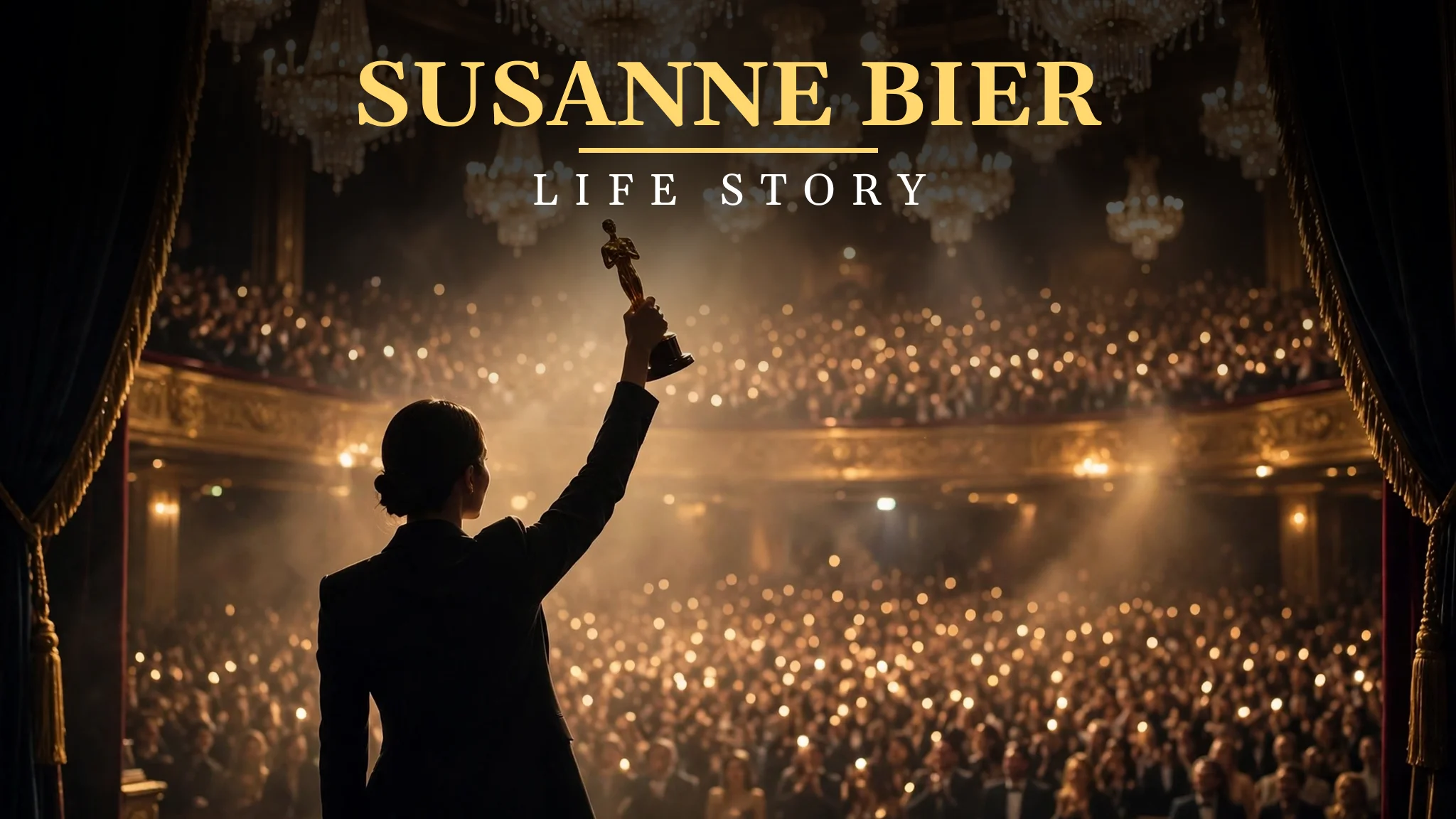
One more thought stays with me. I think about the golden statuette in the image, held high in a grand hall, and how it fits Susanne. She held an Oscar, she held an Emmy, and she held them with grace, not with pride, but with gratitude. She did not win them for herself. She won them for her stories, for her actors, and for the people who believed in her. I hope she keeps holding her stories high, keeps telling them, and keeps showing the world what a Danish director can do. She is a star, but she is a star who never forgot where she came from, and that is the best kind of star.
Frequently Asked Questions
Where was Susanne Bier born and how old is she?
Susanne Bier was born on 15 April 1960 in Copenhagen, Denmark, which makes her 66 years old in 2026. She grew up in Copenhagen, studied art and design in Israel, and graduated from the Danish National Film School in 1987.
What is Susanne Bier most famous for?
She is most famous for directing In a Better World, which won the Academy Award for Best Foreign Language Film in 2011, and for directing Bird Box in 2018 and The Night Manager in 2016, for which she won an Emmy for directing.
What films did Susanne Bier direct in Denmark?
Her Danish films include Brothers in 2004, After the Wedding in 2006, and In a Better World in 2010. Brothers is about two brothers and the war in Afghanistan, while After the Wedding is about a man who returns to Denmark and discovers a family secret.
Did Susanne Bier win an Oscar?
Yes, she won the Academy Award for Best Foreign Language Film in 2011 for In a Better World. She was the first Danish woman to win an Academy Award for directing, and the film also won the Golden Globe for Best Foreign Language Film.
What is Bird Box about?
Bird Box, released in 2018 on Netflix, is a thriller with Sandra Bullock as a woman who must survive in a world where a mysterious force drives people to kill themselves if they see it. It was watched by millions of people and became one of the most talked-about films of the year.
What is The Night Manager?
The Night Manager is a British television series from 2016, based on the novel by John le Carre, about a hotel manager who becomes a spy. Susanne directed it, won the Emmy for directing, and became the first woman to win that Emmy award.
Where did Susanne Bier study?
She studied art and design at the Bezalel Academy in Jerusalem, Israel, and then studied film at the Danish National Film School in Copenhagen, graduating in 1987. She worked as a designer before she turned to film directing.


