The Prodigy: The Life Story Behind the Firestarter Band
In this post
- Liam Howlett and the Raves of Essex
- Experience and Music for the Jilted Generation
- The Fat of the Land, Firestarter and Breathe
- Always Outnumbered, Invaders Must Die and the Return
- The Death of Keith Flint and a Band in Grief
- The Sound of Rave, Punk and Pure Energy
- Still Loud, Still Remembering Keith Flint
- The Festival Headliners: Reading, Glastonbury and the Big Fields
- My Take:
The Prodigy make music that sounds like a riot in a good way: loud, fast, wild and full of energy that makes a whole crowd jump at the same time. Their songs mix rave, punk, hip hop and electronic beats, and they have filled arenas and festival fields for more than thirty years. When their song Firestarter exploded in 1996, with Keith Flint shouting and dancing like a wild man, it changed British music. It showed that a dance band could also be a rock band, and that a rave track could become a number one hit.
The band formed in Braintree, Essex, in 1990, and its founder was Liam Howlett, a producer and keyboard player who loved the rave music of the time. He was joined by Keith Flint, a dancer who became the band’s wild frontman, Maxim, a rapper and MC, and Leeroy Thornhill, a dancer and keyboard player who left in 2000. Together, they made music that was faster, louder and more aggressive than anything else in dance music, and they became one of the most famous electronic bands in the world.
Their journey has brought them number one albums, hit singles like Firestarter, Breathe and Smack My Bitch Up, and a reputation as one of the best live acts in the world. Their albums are Experience from 1992, Music for the Jilted Generation from 1994, The Fat of the Land from 1997, Always Outnumbered, Never Outgunned from 2004, Invaders Must Die from 2009, The Day Is My Enemy from 2015, and No Tourists from 2018. The story also carries a sad loss: Keith Flint died in March 2019, and the band have had to learn how to carry on without their wild frontman.
Liam Howlett and the Raves of Essex
Liam Howlett grew up in Braintree, a town in Essex, east of London, and he loved music from a young age. He learned to play keyboards, he listened to hip hop, punk and electronic music, and he became a DJ at rave parties in the late 1980s. Raves were wild, all night dance parties, held in fields, warehouses and clubs, and they were the heart of British youth culture at the time. Howlett loved the energy of those nights, and he began to make his own tracks for the rave scene.
In 1990, Howlett formed The Prodigy, taking the name from a synthesiser he owned, the Moog Prodigy. He began to make tracks that mixed the fast beats of rave with the sounds of hip hop and punk, and he released them on small labels. The early tracks were heard at raves, on pirate radio, and in clubs, and DJs began to play them. Howlett was a producer, not a singer, and his music was built on beats, bass and samples, with a feeling of wild energy.
Keith Flint joined the band early on, first as a dancer. He had a wild look, with spiky hair and a fierce energy, and he danced on stage with a power that made the crowd go wild. Maxim joined as an MC, rapping over the beats in a deep voice, and Leeroy Thornhill joined as a dancer and keyboard player. Together, the four of them made a live show that was unlike anything else in dance music. It was not a DJ standing behind decks. It was a band, jumping, shouting and dancing, with the crowd jumping along.
The early years were hard in the ordinary way that young bands find hard. They had little money, they played small venues, and they travelled in cheap ways. But they also had something that money cannot buy: a sound that was new, a live show that was wild, and a belief that their music could be bigger than the rave scene. That belief kept them going through the small shows and the long nights, and it gave them the patience to build their sound slowly.
Experience and Music for the Jilted Generation
The Prodigy’s debut album, Experience, was released in 1992, and it was a record that captured the feeling of the rave scene. The album included songs like Charly, Everybody in the Place and Out of Space, tracks that were fast, fun and full of energy. Charly used a sample from a children’s television show, and it became a hit, even though some people in the rave scene thought it was too playful. The album showed Howlett’s skill as a producer, and it won the band a loyal following.
Music for the Jilted Generation, their second album, was released in 1994, and it was a darker and angrier record. The album was a response to a new law in Britain that tried to stop rave parties, and the songs carried a feeling of rebellion. Tracks like No Good (Start the Dance), Voodoo People and Poison were harder and more aggressive than the first album, and they showed a band that was not afraid to be loud and angry. The album was praised by critics, and it became a favourite with fans who loved the energy of the rave scene.
The album’s title, Music for the Jilted Generation, pointed to a generation of young people who felt left out, who felt that the world did not understand them. The Prodigy gave that generation a voice, a sound that was fast, loud and defiant. Their music was not polite. It was a shout, a scream, a dance, and it made young people feel less alone. That feeling is part of why the band became so loved, not just in Britain, but around the world.
Touring for the second album took them to bigger stages, and their live shows became famous for their wild energy. Flint danced like a man possessed, Maxim rapped with power, and Howlett played keyboards behind them, driving the beat. The shows were loud, chaotic and joyful, and the audiences loved them. The Prodigy had become more than a rave act. They had become a band, and a very loud one.
The Fat of the Land, Firestarter and Breathe
The Fat of the Land was released in 1997, and it became the album that made The Prodigy world famous. The record reached number one in Britain and in America, and it included three of their most famous songs: Firestarter, Breathe and Smack My Bitch Up. Firestarter was the first single, and it became a number one hit in Britain. The song featured Keith Flint singing for the first time, shouting the words in a wild and fierce voice, and the music video, with Flint dancing in a dark tunnel, became famous around the world.
Breathe was the second single, and it was another number one hit. The song had a heavy beat, a deep bass line, and a feeling of menace that made it perfect for large stages. Smack My Bitch Up was the third single, and it became famous for its controversial title and its wild music video. The song was banned from some radio stations, but it became a favourite at live shows, where the crowd shouted along. The album was a huge success, and it made The Prodigy one of the biggest bands in the world.
The success of The Fat of the Land changed the band’s life. They were now playing arenas and festivals around the world, and their shows were full of fire, light and noise. Flint had become a star, with his spiky hair and his wild dancing, and Maxim had become a respected MC. Howlett remained the quiet producer behind it all, making the beats that drove the band’s sound. The three of them, with Thornhill until 2000, were a team, and their teamwork made the band’s success possible.
The album also showed that electronic music could be as big as rock music. Before The Prodigy, dance acts rarely topped the album charts or headlined rock festivals. After The Fat of the Land, they did. The band had broken down the wall between dance and rock, and they had done it with a sound that was unmistakably their own. That achievement is part of why they are still remembered as one of the most important British bands of the 1990s.
Always Outnumbered, Invaders Must Die and the Return
After The Fat of the Land, the band took a break. Howlett worked on other projects, Flint and Maxim worked on their own music, and the band’s next album took seven years to arrive. Always Outnumbered, Never Outgunned was released in 2004, and it was a record made mostly by Howlett alone, with guest singers and without Flint and Maxim on many tracks. The album included Girls and Hotride, and it showed Howlett’s skill as a producer, but it felt different from the band’s earlier records, because the full band was not there.
The band returned as a full live act with Invaders Must Die, released in 2009. The album was a return to the loud and fast sound of their early years, and it became a number one album in Britain. The title track, Invaders Must Die, was a fierce and joyful song about standing your ground, and Omen, another track from the album, became a favourite at live shows. The album showed that The Prodigy could still make a big and wild record after many years, and that their audience had stayed with them.
The tour for Invaders Must Die took them to festivals around the world, and their shows were as wild as ever. Flint danced, Maxim rapped, and Howlett played keyboards, and the crowd jumped along. The band had been away for a while, but they had not lost their energy. If anything, they had more of it, because they were glad to be back on stage together. The album was a reminder that The Prodigy were not a band of the past. They were a band of the present, and their music still mattered.
The Day Is My Enemy, their sixth album, was released in 2015, and it was another loud and aggressive record. The album included Nasty, The Day Is My Enemy and Wild Frontier, and it showed the band still making music with the same fire as before. No Tourists, their seventh album, was released in 2018, and it was a record about travel, about the feeling of being on the road, and about the world outside the tour bus. It was the last album the band made with Keith Flint, and it is now remembered as a final chapter in their story together.
The Death of Keith Flint and a Band in Grief
In March 2019, Keith Flint died, at the age of 49. His death was a shock to the music world, and tributes came from fans, from musicians, and from people around the world who had danced to his music. Flint had been the wild heart of The Prodigy, the dancer who became a singer, the man with spiky hair who shouted Firestarter and made a whole generation jump. His loss was felt deeply, not just by his bandmates, but by everyone who had ever seen him on stage.
Howlett and Maxim were left with a hard question: should The Prodigy continue without Flint? They decided that the music should live on, and that Flint would have wanted them to keep playing. They began to work on new music, and they began to play live shows again, with Flint’s memory honoured on stage. It was a brave decision, and it showed the depth of their friendship. They did not want the band to end with Flint’s death. They wanted it to continue as a tribute to him.
The shows after Flint’s death were emotional. The crowd sang Firestarter, they shouted his name, and they remembered the wild dancer who had given them so much joy. Howlett and Maxim stood on stage, playing the songs that Flint had sung, and the audience sang along, keeping his voice alive in the room. It was a sad and joyful feeling at the same time, and it showed the power of music to keep a person alive in memory.
The band have continued to work on new music in the years since, and their fans have waited patiently for a new album. The future of The Prodigy is still open, but the past is clear: they were one of the most important and most exciting bands in British music, and their songs will be played for many years to come.
The Sound of Rave, Punk and Pure Energy
The Prodigy’s sound is built on a simple idea: take the fast beats of rave, the anger of punk, and the rhythm of hip hop, and put them together at full volume. The result is music that is loud, fast and wild, with a feeling of freedom that makes people dance. Howlett’s production is at the centre of it all, with beats that hit hard, bass lines that shake the room, and samples that add surprise. Flint’s voice and Maxim’s rapping gave the tracks a human feeling, and the live show gave them a physical power.
Their live shows are famous for their energy. Flint danced like a wild man, Maxim rapped with power, and Howlett played keyboards behind them, driving the beat. The shows were loud, chaotic and joyful, and the audiences loved them. A Prodigy concert was not a quiet event. It was a physical experience, with the crowd jumping, shouting and dancing together. That power is part of why their fans love them. They do not just play music. They create a feeling of being alive, together, in a loud and joyful room.
Their influence can be heard in many younger electronic and rock artists who learned from them that dance music could be loud and aggressive, and that a dance band could also be a rock band. The Prodigy showed that the wall between dance and rock was not real, and that a band could break it down with a good beat and a wild live show. That lesson has helped a new generation of musicians to be braver about mixing sounds, and to trust that their audience wants energy as well as melody.
Their music videos are also part of their story. The video for Firestarter, with Flint dancing in a dark tunnel, became famous around the world, and it showed the band’s wild image in a way that a radio song could not. The video for Smack My Bitch Up was controversial, and it was banned from television, but it became famous for its daring. The band’s image, with Flint’s spiky hair and wild clothes, became a symbol of 1990s British music, and it is still remembered today.
Still Loud, Still Remembering Keith Flint
In the years since Flint died, The Prodigy have continued to play and to work on new music, and their shows have become tributes to their friend. Howlett and Maxim stand on stage, they play the songs that Flint sang, and the crowd sings along, remembering the wild dancer who gave them so much joy. It is a sad and joyful feeling at the same time, and it shows the power of music to keep a person alive in memory.
Looking back, the story of The Prodigy is a story of rave, punk and pure energy. They started in Braintree in 1990, they made Experience and Music for the Jilted Generation, they became world famous with The Fat of the Land, they returned with Invaders Must Die, and they lost their wild frontman in 2019. Their songs are still played at festivals, in clubs and on the radio, and they still make people jump. That is a good legacy for a band that began with a simple idea: that dance music should be loud, wild and alive.
The Festival Headliners: Reading, Glastonbury and the Big Fields
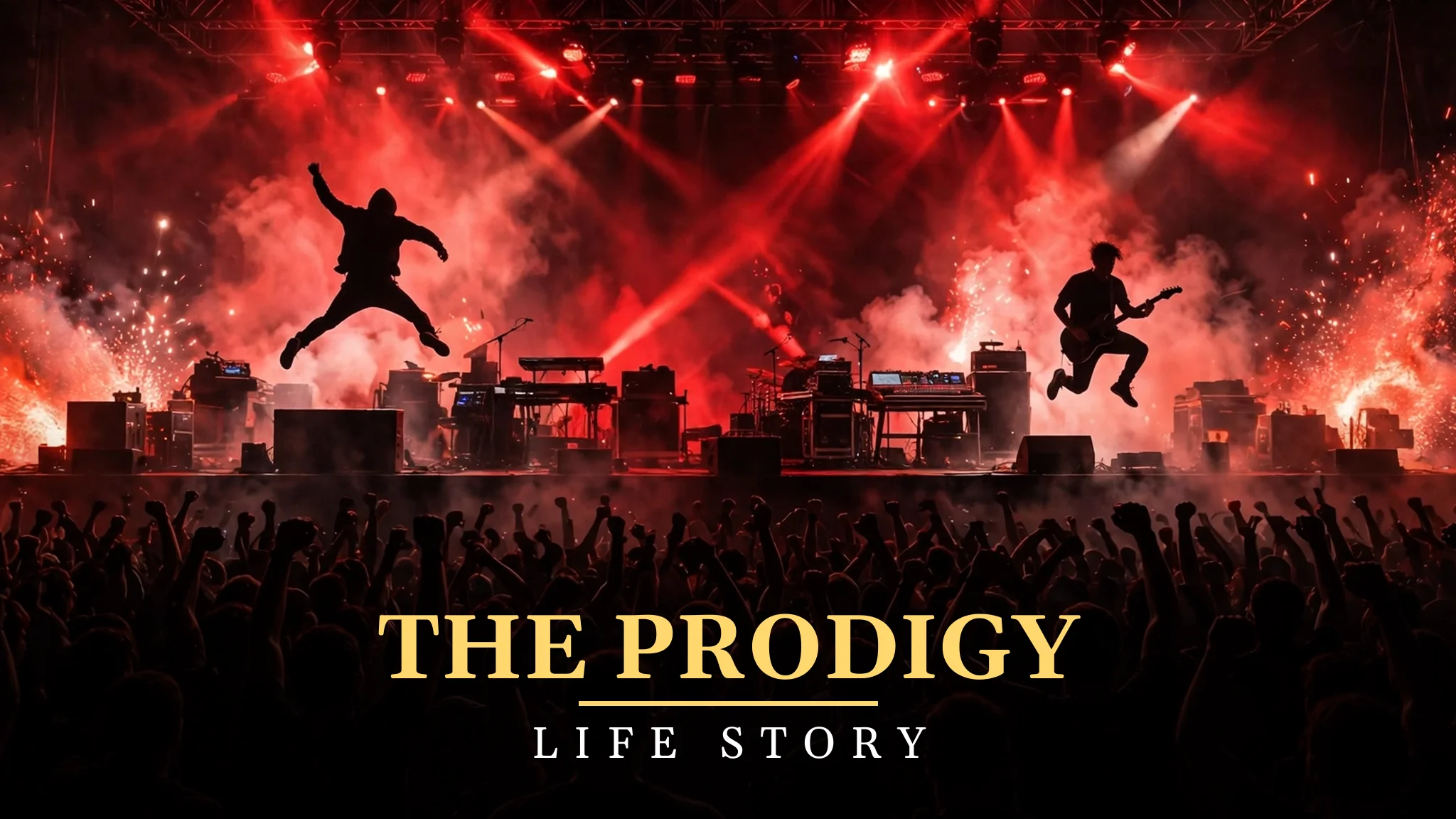
The Prodigy were not just a studio band. They were a festival band, and their live shows at big festivals became legendary. At Reading, at Glastonbury, at festivals around the world, they played to crowds of tens of thousands of people, and those crowds jumped, shouted and danced together. A Prodigy festival set was not a quiet event. It was a physical experience, with the bass shaking the ground, the lights flashing, and Keith Flint dancing like a wild man at the front of the stage. People who saw those shows remember them for years afterwards.
Playing a festival is a different skill from playing a club. A club is small, dark and close, and the crowd is near the stage. A festival field is wide, the crowd is far away, and the band must make their sound travel across open air. The Prodigy solved that problem by playing louder, by moving more, and by making their show a spectacle. Flint danced, Maxim rapped, Howlett played keyboards, and the whole band moved as if they were in a small room, even when the room was a field full of people. That energy carried across the distance, and the crowd responded by jumping along.
Their festival shows also showed how dance music could headline a rock festival. Before The Prodigy, rock festivals were headlined by rock bands, and dance acts played in tents on the edge of the site. After The Prodigy, dance acts headlined the main stage, and the crowd accepted them as equals. That change was important, because it showed that a dance band could be as big, as loud and as exciting as any rock band. The Prodigy broke down that wall, and they did it with a sound that was unmistakably their own.
There is also a practical side to their festival shows that is easy to miss. A band that plays festivals must travel, must set up quickly, must play in rain and wind, and must keep their energy up night after night. The Prodigy did that for thirty years, and they did it with a joy that came from loving the stage. Flint loved to perform, Maxim loved to rap, and Howlett loved to make the beats that drove the show. That love is part of why their festival sets felt so alive. A band that loves playing will always sound better than a band that is only working for money.
What I find most interesting about their festival shows is how they mixed joy and aggression. Their music is loud and fierce, but their shows are joyful, with the crowd smiling, jumping and shouting along. That mix is the heart of The Prodigy: a band that can be angry and happy at the same time, that can make a loud noise and make people feel alive. It is a rare skill, and it is the reason their festival sets are talked about with such warmth by the people who saw them.
The band’s later festival shows, after Flint’s death, have become tributes to him. Howlett and Maxim stand on stage, they play the songs that Flint sang, and the crowd sings along, remembering the wild dancer who gave them so much joy. It is a sad and joyful feeling at the same time, and it shows the power of music to keep a person alive in memory. A festival field full of people singing Firestarter is a fitting tribute to a man who lived for the stage.
My Take:
When I listen to The Prodigy, the first thing I feel is energy. Their music is loud, fast and wild, and it makes me want to move. But underneath that energy, there is always a real feeling, and I think that mix is what makes them special. Firestarter is a wild song, but it is also a song about feeling like a fire that cannot be put out. Breathe is a heavy song, but it is also a song about the feeling of being chased, of needing air. That mix of power and feeling feels honest to me, because real life is often like that: loud on the outside, intense on the inside.
I think the most admirable part of their story is Liam Howlett’s skill as a producer. He built the band’s sound from beats, bass and samples, and he did it with a precision that many people miss because the music is so loud. A Prodigy track is not just noise. It is a carefully built piece of music, with layers, with surprises, and with a feeling of movement that never stops. Howlett is the quiet man behind the wild show, and his work is the reason the band’s songs still sound fresh today. I respect a producer who can make loud music that is also clever.
I also admire Keith Flint, and the way he became a frontman. He started as a dancer, not a singer, and he became one of the most famous voices in British music by shouting Firestarter with a wild energy that no one could copy. That takes courage, because a dancer who becomes a singer is taking a big risk. Flint took that risk, and he became a star. His dancing, his hair, his clothes, his voice: all of it was a performance, and it was a performance that made people feel alive. I think that is a rare gift, and it is the reason he is still remembered with such love.
There is a deep sadness in their story, and it is the death of Keith Flint in March 2019. He was 49, and his loss was felt around the world. When a frontman dies, the songs he sang take on a new meaning, and Firestarter now sounds different to me. It is still a wild and joyful song, but it is also a reminder of a man who is no longer here. I think that is the hardest part of loving music: the people who make it do not live forever, but their songs do. Howlett and Maxim have handled that loss with grace, by keeping the music alive and by honouring Flint in their shows. That is a brave and loving choice.
Another thing I notice is how much their music depends on the live show. A Prodigy record is exciting, but a Prodigy concert is something else: a physical experience, with the crowd jumping, shouting and dancing together. That power is part of why their fans love them. They do not just play music. They create a feeling of being alive, together, in a loud and joyful room. I would love to have been in that crowd, to hear Firestarter played live, and to feel the energy that Flint brought to the stage. That is a rare feeling, and it is one I will never forget, even though I only know it from videos and stories.
I find their album The Fat of the Land especially important, because it showed that electronic music could be as big as rock music. Before that album, dance acts rarely topped the album charts or headlined rock festivals. After it, they did. The Prodigy broke down the wall between dance and rock, and they did it with a sound that was unmistakably their own. I think that is a lasting legacy, and it is why they are still remembered as one of the most important British bands of the 1990s. They did not just make hits. They changed what a dance band could be.
If I have a criticism, it is only that their later albums can sometimes feel less surprising than the first ones. The Fat of the Land was bold and new, while some of the later records felt safer, as if the band were repeating a formula that had worked before. That is not a real fault, though. It is a sign that the band had found a sound they loved, and they wanted to keep it. I would not want them to lose the sound that made them special. I only wish that some of their later songs had taken more risks, the way Firestarter did, and shown more of the strange and daring side of their writing.
I also think about their influence, and how many younger artists learned from them. The Prodigy showed that a dance band could be loud, aggressive and punk, and that a rave track could become a number one hit. That lesson has helped a new generation of musicians to be braver about mixing sounds, and to trust that their audience wants energy as well as melody. I think that is a valuable gift, and it is one that the band gave without ever setting out to be teachers. They just made the music they loved, and the world learned from it.
When I compare The Prodigy with other dance acts of their time, what stands out is their wildness. They were not a polite dance act. They were a loud, chaotic and joyful band, and their shows felt like a riot in a good way. That wildness is rare, and it is the reason their fans love them so much. In a world where so much music is polished and safe, The Prodigy were dangerous, and danger in music can be a good thing, if it is done with joy and with care.
For a young reader, I think the lesson is about energy. The Prodigy took the energy of the rave scene, the anger of punk, and the rhythm of hip hop, and they made something new. That lesson matters far beyond music. It matters for anyone who has different interests and is told to choose one. Their story says you do not need to choose. You can put the different things together, and the result can be better than any one of them alone. That is a hopeful thought, and it is one I will carry with me.
I also take a personal lesson from the way Howlett and Maxim have continued after Flint died. They could have stopped, and no one would have blamed them. Instead, they kept the music alive, they played the songs, and they honoured their friend. That takes courage, because it means facing the loss every time they step on stage. But it also shows the power of friendship. A band is not just a group of people who make music together. It is a family, and a family does not end when one person dies. It continues, carrying the memory forward in the work.
In the end, I think The Prodigy matter because they prove that dance music can be loud, wild and alive. Their songs make people jump, and they also make people feel. When I hear Firestarter today, I still feel the energy, I still feel the wildness, and I still feel the voice of Keith Flint, even though he is gone. That is a good dance song, and it is a good legacy for a band that started in Braintree in 1990 with a simple idea: that rave music should be loud, fast and full of life.
One more thought stays with me, and it is about the future. I do not know what Howlett and Maxim will do next, whether they will make a new album or play more shows, but I trust that whatever they do, they will do it with the same fire and the same joy that they have always brought to The Prodigy. That trust is something a band earns over many years, and The Prodigy have earned it. I will keep listening, not because they are the loudest band in the world, but because they are one of the most alive, and aliveness in music is rarer than it should be.
I also think about what I would say to a friend who had never heard The Prodigy. I would start with Firestarter, because it is their most famous song, and then I would play Breathe, and then Omen, and I would let the friend hear how the band can be wild and precise at the same time. That is the best way to meet this band: through the energy first, and then through the beats that hold that energy together.
There is another lesson in their story that I keep coming back to, and it is about the value of mixing sounds. The Prodigy mixed rave, punk and hip hop, and the result was a new sound. That tells me that a person does not need to choose between different interests. They can put them together, and the result can be better than any one of them alone. That is a hopeful thought, and it is one I will carry with me into my own work.
I also wonder what Howlett and Maxim will do next, and I find that I do not mind not knowing. Some bands make me want to guess, to predict, to follow every rumour. The Prodigy make me want to wait. I trust that whatever they do, they will do it with the same fire and the same joy that they have always brought to the band. That trust is a rare thing to feel, and it is the result of more than thirty years of good work. A band that has never let me down earns the right to be waited for.
When I think about Keith Flint’s dancing, I think about how it has stayed with me, even after his death. His dancing was wild, free and joyful, and it made the crowd feel alive. That dancing is now a memory, but the videos keep it alive, and every time I watch Firestarter, I see him again. That is the power of a performance: a moment can live on, even when the person is gone, and it can still move people who never saw it live. I find that both sad and hopeful, because it shows that a person’s work can outlive them, and that is a kind of immortality.
I also think about the listeners who found this band during hard times. Many people discovered The Prodigy when they were young, when they felt angry, when they needed a song that sounded like their own feelings. Those listeners did not find the band in a quiet room. They found them in a crowd, jumping, and the songs stayed with them when they grew up. That is a special kind of success: not a hit that everyone hears at once, but a song that finds the right person at the right time, and stays.
If I could ask Howlett one question, I would ask him how he builds a track, how he knows when a beat is right, when a bass line is deep enough, when a song is finished. I suspect the answer would be simple: he listens, he feels it in his body, and he trusts his ears. That simplicity is the heart of their story, and it is the reason their music still sounds fresh. A producer who listens to himself will always sound honest, and honesty is the rarest sound in popular music.
In the end, what I carry from The Prodigy is a feeling of aliveness. Their music does not shout, it does not beg, and it does not try to be everything at once. It is a loud, wild sound, made by friends who listened to each other, and it reaches people all over the world. That is enough, and it is more than enough. It is a reminder that alive work, done with care, can still be heard, even in the noisiest of times.
Frequently Asked Questions
Who were the members of The Prodigy?
The Prodigy were founded by Liam Howlett, a producer and keyboard player, with Keith Flint as dancer and later singer, Maxim as rapper and MC, and Leeroy Thornhill as dancer and keyboard player until 2000. Howlett and Maxim have continued the band after Flint’s death.
What is The Prodigy’s most famous song?
Firestarter is their most famous song, a number one hit in Britain in 1996 with Keith Flint singing for the first time. Breathe and Smack My Bitch Up, from the same album The Fat of the Land, are also well known songs.
What happened to Keith Flint?
Keith Flint died in March 2019, at the age of 49. His death was mourned around the world, and Liam Howlett and Maxim have continued The Prodigy as a tribute to him, playing his songs and honouring his memory in their shows.
What albums has The Prodigy released?
Their studio albums are Experience from 1992, Music for the Jilted Generation from 1994, The Fat of the Land from 1997, Always Outnumbered, Never Outgunned from 2004, Invaders Must Die from 2009, The Day Is My Enemy from 2015, and No Tourists from 2018.
Where is The Prodigy from?
The band formed in Braintree, Essex, in 1990, and their music grew out of the rave scene of the time. Liam Howlett was a DJ at rave parties, and the band’s early tracks were heard at raves, on pirate radio and in clubs.
What kind of music does The Prodigy make?
They mix rave, punk, hip hop and electronic beats into loud, fast and wild dance music. Their songs have heavy beats, deep bass and a feeling of energy that makes crowds jump, and their live shows are famous for their power.
Is The Prodigy still together after Keith Flint died?
Yes, Liam Howlett and Maxim have continued The Prodigy after Flint’s death, working on new music and playing live shows that honour his memory. Their fans have waited patiently for a new album from the duo.


