The Ramones: The Life Story Behind Punk's First Band
In this post
The Ramones played fast, loud, and short. Their songs were often less than three minutes long. Their lyrics were simple. Their look was simple too: leather jackets, torn jeans, and long hair. They did not have long guitar solos. They did not have fancy stage shows. They had four men, all using the same last name, and a sound that changed rock music for ever. When people talk about punk rock, they usually start with the Ramones, because the band took rock back to its basics and made it fun again.
They came from Forest Hills, a quiet neighbourhood in Queens, New York. It was not a place known for wild music. It was a place of neat streets, schools, and families. The four young men who formed the band were not rich, and they were not trained musicians in the usual sense. They were friends who loved the Beatles, the Beach Boys, and the loud rock of the 1960s, and they wanted to make music that was just as direct. They played in a garage, they practised until the songs were fast and tight, and they took that sound to a small club called CBGB in Manhattan.
The Ramones never sold as many records as the bands they inspired. They never had a hit single in America. Yet almost every punk band that came after them, from the Sex Pistols to Green Day, learned something from them. Their first album, released in 1976, is now seen as one of the most important rock albums ever made. This is the story of four men who called themselves Ramones, who played more than two thousand shows, and who never gave up on a simple idea: play fast, play loud, and mean every note.
Forest Hills Boys With Big Dreams
Joey Ramone was born Jeffrey Hyman in Forest Hills, Queens, on 19 May 1951. He was tall, thin, and shy, and he had a long face that made him easy to recognise. He grew up in a Jewish family, and he loved music from an early age. He listened to the Beatles, the Who, and the girl groups of the 1960s, and he dreamed of being a singer. He was not a confident child, and he found school hard, but music gave him a place where he could be himself. He played drums in early bands, and he later became the singer of the Ramones because his voice was so unusual and so honest.
Johnny Ramone was born John Cummings in Forest Hills on 8 October 1948. He was the oldest member of the band, and he was the most disciplined. He grew up in a tough, working-class family, and he learned to be practical and hard-working. He was a fan of the Stooges and the New York Dolls, and he wanted to play guitar in a way that was fast and aggressive. Johnny was not a warm person in public, and he was known for being strict about rehearsals, money, and the band’s image. But he was also the person who kept the band going when times were hard, and his discipline was a key part of their success.
Dee Dee Ramone was born Douglas Colvin in Fort Lee, Virginia, on 18 September 1951, and he grew up in Germany and in Forest Hills. His father was in the army, and his childhood was unsettled. Dee Dee was funny, wild, and troubled, and he loved rock music with a passion. He played bass, and he wrote many of the band’s early songs. He was the one who shouted “one, two, three, four” at the start of many songs, and that count became a signature of the band. Dee Dee was also the member who struggled most with drugs, and that struggle would shape his life and his music.
Tommy Ramone was born Tamás Erdélyi in Budapest, Hungary, on 29 January 1949, and he came to America as a child. He grew up in Forest Hills, and he was the most musical of the four in the early days. He played drums on the first albums, and he produced some of their early records. Tommy was thoughtful and quiet, and he understood how to make a record sound good. He left the band as a drummer in 1978, but he stayed involved as a producer and as a friend. The four men were different in almost every way, but they shared a love of simple, fast rock, and that love brought them together.
A New Name and a New Sound
The band took the name Ramones from Paul McCartney, who had used the name Paul Ramon when he was travelling with the Beatles in the early 1960s. Dee Dee liked the sound of the name, and the band decided that all four members would use Ramone as their last name. It was a joke, but it was also a statement. They were not four separate people any more. They were a gang, a family, and a band with one name. The name helped people remember them, and it gave them an identity that was simple and strong.
Their sound was built on speed and simplicity. Johnny played his guitar with fast downstrokes, hitting the strings again and again without a break. Dee Dee played bass lines that were simple but powerful. Tommy played drums that were fast and steady, with no extra fills. Joey sang in a high, nasal voice that sounded like no one else. The songs were about everyday things: going to the beach, watching television, feeling bored, feeling angry, and wanting to have fun. They were not about politics or poetry. They were about life as a young person in New York, and they were written in plain words that anyone could understand.
The band practised in a garage and in small rehearsal rooms, and they worked hard to make their songs tight. They played the same songs again and again until they were fast and clean. They did not want to sound like a band that was still learning. They wanted to sound like a band that knew exactly what it was doing. That hard work paid off when they started playing live. Audiences were surprised by how fast and loud they were, and by how much fun their shows were. The Ramones did not stand still on stage. They played, they moved, and they finished one song and started the next without a pause.
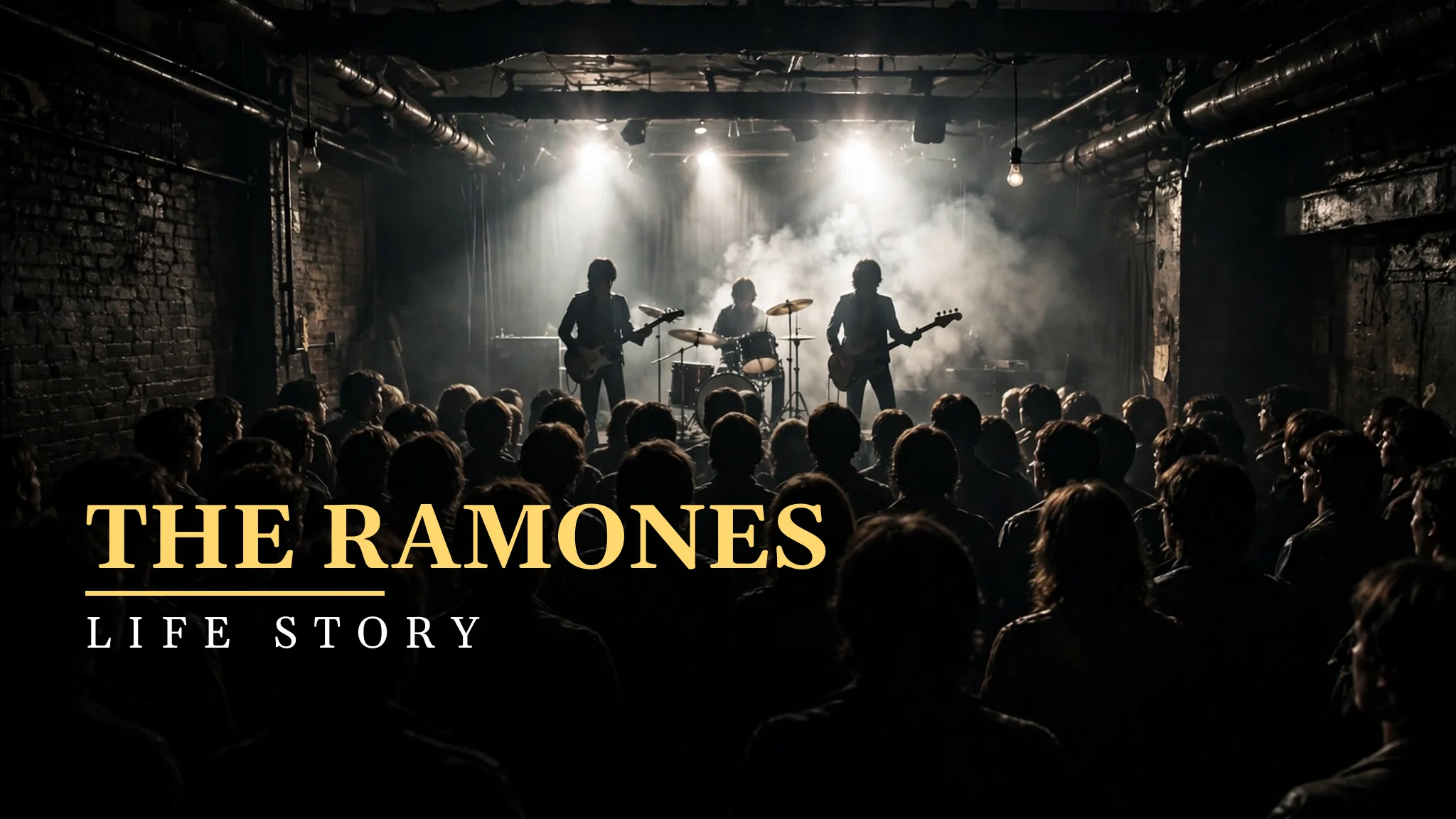
In 1974, the band played their first shows in New York, and they began to build a following. They played at CBGB, a small club on the Bowery in Manhattan that became the home of punk rock in America. CBGB was dirty, dark, and small, but it was the right place for the Ramones. The audience was young, the sound was loud, and the band could play close to the crowd. Those early shows were the start of something big, even if no one knew it at the time.
CBGB and the First Album
CBGB was run by Hilly Kristal, and it became a meeting place for bands that did not fit into the mainstream music world. The Ramones played there often, and they shared the stage with bands like Television, Patti Smith, and Blondie. The club was not glamorous, but it was honest, and it gave new bands a chance to play. The Ramones loved CBGB because the audience understood them. The crowd did not want long solos or fancy clothes. They wanted fast songs, loud guitars, and a good time, and the Ramones gave them exactly that.
In 1976, the Ramones released their first album, Ramones, on Sire Records. It was recorded in a week, and it cost very little to make. The album had fourteen songs, and it was only twenty-nine minutes long. It opened with Blitzkrieg Bop, a song with the famous chant “Hey! Ho! Let’s go!” That chant became one of the most famous in rock music, and it is still shouted at sports events and concerts today. Other songs on the album included Beat on the Brat, Judy Is a Punk, and I Wanna Be Your Boyfriend. The album was not a commercial hit, but critics loved it, and it inspired musicians in Britain and America to start their own punk bands.
The album cover showed the four men standing against a brick wall in New York, wearing leather jackets and jeans. The photograph became one of the most famous band photographs ever taken. It showed the band as they were: four young men from Queens, standing together, looking straight at the camera. There was no glamour, no makeup, and no fancy clothes. There was just the band, and that was enough. The cover told the world what the Ramones stood for: simplicity, honesty, and rock music played fast and loud.
After the first album, the band toured in America and in Britain. In Britain, they played to audiences who were already forming punk bands, and their shows had a huge impact. The Sex Pistols, the Clash, and many other British bands saw the Ramones and realised that they could make music too. The Ramones did not know they were starting a movement. They were simply playing their songs, but their songs gave other people permission to do the same. That is one of the most important things a band can do, and the Ramones did it without trying.
On the Road, Album After Album
The Ramones released their second album, Leave Home, in 1977, and their third album, Rocket to Russia, later that same year. Both albums had the same fast, simple sound, and they included songs that became fan favourites, like Sheena Is a Punk Rocker, Rockaway Beach, and Teenage Lobotomy. Rockaway Beach was a song about a beach in Queens, and it showed that the Ramones could write a happy, catchy song about a place they loved. Sheena Is a Punk Rocker was a song about a girl who loved punk music, and it became an anthem for young fans. The band was writing more songs, and they were getting better at it, even if the records did not sell in large numbers.
In 1978, Tommy Ramone left the band as drummer, and he was replaced by Marc Bell, who became Marky Ramone. Tommy stayed on as a producer, and he helped the band make their next album, Road to Ruin, which came out in 1978. The album included I Wanna Be Sedated, a song about wanting to rest and escape from the pressure of touring. The song became one of their most famous, and it is still played on the radio today. The band was touring almost all the time, and they were tired, but they kept going because they loved playing live and because they needed the money.
The Ramones played more than two thousand shows in their career, and they toured in America, Europe, South America, and other parts of the world. They played in small clubs, in large halls, and in festivals. Their shows were always the same: fast, loud, and short, with little talking between songs. Joey would introduce a song, Dee Dee would count it in, and the band would play. The audience would dance, shout, and sing along. The band did not have a big stage show, but they did not need one. Their music was the show, and it was enough.
The band also worked with famous producer Phil Spector on the album End of the Century, released in 1980. Spector was known for his big, layered sound, and he tried to make the Ramones sound more polished. The album included a cover of Baby, I Love You, and it was a commercial success, but it was not a happy experience for the band. Spector was difficult to work with, and the band did not like the way the album sounded. After that, they went back to their simpler sound, and they continued to make albums in the 1980s, including Pleasant Dreams, Subterranean Jungle, and Too Tough to Die.
Hard Years, New Drummers, and Staying True
The 1980s were hard years for the Ramones. Punk rock had changed, and new bands were playing louder, faster, and more aggressive music. The Ramones were no longer the newest band, and they had to compete with bands that had learned from them. They kept touring, and they kept making records, but the money was tight, and the band members were getting older. Joey and Johnny had a famous falling out over a woman, and they barely spoke to each other for years, even though they played on stage together every night. That tension was painful, but it did not stop the band from playing.
Dee Dee left the band in 1989, and he was replaced by Christopher Joseph Ward, who became C. J. Ramone. Dee Dee tried a solo career, and he wrote songs for the band even after he left. He struggled with drugs for many years, and his health suffered. Marky Ramone also left and returned, and the band had several drummers over the years, including Richie Ramone and Elvis Ramone, who played only a few shows. Through all the changes, Joey and Johnny remained the core of the band, and they kept the Ramones going because they believed in the music and because they had fans who still wanted to hear them.
The band released albums in the 1980s and early 1990s, including Animal Boy, Halfway to Sanity, Brain Drain, Mondo Bizarro, and Acid Eaters. None of these albums were huge hits, but they all had songs that fans loved. The band also became popular in South America, where they played to large, passionate crowds. In Brazil and Argentina, the Ramones were treated like superstars, and their shows were wild and joyful. That love from fans in other countries kept the band going when America had forgotten them. The Ramones were a band that the world loved, even if their own country did not always show it.
The band’s last studio album, Adios Amigos!, was released in 1995. The title meant “goodbye, friends” in Spanish, and it was a fitting name for a band that knew its time was coming to an end. The album included covers and new songs, and it showed that the band could still play fast and loud. After the album, the band decided to retire, and they played their final show in Los Angeles on 6 August 1996. It was the end of a long journey that had started in Forest Hills more than twenty years earlier.
The End of the Band and the Loss of Friends
The final show was emotional, but it was also a celebration. The band played their classic songs, and the audience sang along. Many of their friends and fellow musicians were there, and the show felt like a farewell to a band that had given so much to rock music. After the show, the members went their separate ways. Joey worked on solo music, Johnny retired from playing, and the other members worked on their own projects. The Ramones were over, but their music lived on, and it continued to inspire new bands.
In 2002, the Ramones were inducted into the Rock and Roll Hall of Fame, a recognition that their music had changed rock for ever. Joey, Johnny, Tommy, Dee Dee, Marky, and C. J. were all part of the ceremony, and it was a proud moment for the band. Joey gave a speech, and he thanked the fans who had supported them for so many years. It was one of the last times the original members were together in public, and it showed how much the band meant to the music world.
Sadly, the years after the induction brought loss. Joey Ramone died on 15 April 2001, before the Hall of Fame ceremony, from lymphoma, a form of cancer. He was forty-nine years old. Dee Dee Ramone died on 5 June 2002, from a drug overdose, at the age of fifty. Johnny Ramone died on 15 September 2004, from prostate cancer, at the age of fifty-five. Tommy Ramone, the last surviving original member, died on 11 July 2014, from cancer, at the age of sixty-five. The deaths were a sad end to a band that had given so much joy to others, and they reminded fans how short life can be.
The band’s music, however, did not die with them. Their songs are still played on the radio, in films, and at sports events. Young musicians still learn to play Blitzkrieg Bop as their first punk song. The Ramones’ image, with leather jackets and the same last name, is still copied by bands around the world. The band never had a number one hit, but they had something better: they had an influence that lasted long after they stopped playing. That influence is their true legacy, and it is why they are still remembered today.
The Ramones also changed the way bands thought about touring. They played more than two thousand shows, and they played in small clubs, in large halls, and in festivals all over the world. They did not have a big crew, they did not have fancy hotels, and they did not have a lot of money, but they had a work ethic that was remarkable. They would play a show, drive through the night, and play again the next day. That life was hard, and it took a toll on their health and on their friendships, but it also built their reputation. Audiences knew that the Ramones would always give everything they had, and that they would never cancel a show without a good reason. That reliability is a key part of their legacy, and it is why their fans loved them so much.
Their influence on fashion was also important. The Ramones wore leather jackets, torn jeans, and sneakers, and that look became the uniform of punk rock. Young people in London, in New York, and in many other cities copied that look, because it was simple, cheap, and rebellious. The band did not set out to be fashion icons, but they became them by accident, because their clothes were honest and practical. They wore what they could afford, and what they felt comfortable in, and that honesty resonated with fans who were also young, poor, and angry. The Ramones’ look was not a costume. It was a statement about who they were, and it is still copied today by bands and by fans who want to feel part of punk rock.
My Take:
I think the Ramones are the most important punk band in history, not because they were the best musicians, but because they were the simplest and the most honest. When I listen to their first album, I hear a band that is not trying to impress anyone. They are playing fast, they are playing loud, and they are having fun. That is a powerful thing. Many bands try to be clever, they try to be original, they try to be different. The Ramones did not try to be any of those things. They tried to be themselves, and they played the music they loved. That honesty is why their music still sounds fresh today, almost fifty years after it was made.
I admire Joey Ramone most of all, because he was not a typical rock star. He was tall, shy, and awkward, and he had a voice that was strange and nasal. He did not look like a singer, and he did not act like a singer. Yet when he sang, people listened, because his voice was true. He sang about being bored, about wanting a girlfriend, about going to the beach, and he sang those simple things with real feeling. I think about how brave it must have been for a shy person to stand on stage and sing in front of thousands of people. Joey did it night after night, for more than twenty years, and he never changed his voice to please anyone. That is a kind of courage that I respect deeply.
I also admire Johnny Ramone, even though he was a difficult person. Johnny was strict, he was disciplined, and he was not always kind. He kept the band working when it would have been easier to quit. He made sure they rehearsed, he made sure they toured, and he made sure they did not waste money. Without Johnny, the Ramones might have fallen apart after a few years. With Johnny, they lasted for more than two decades and played more than two thousand shows. I do not agree with everything Johnny did, and I know he had a famous fight with Joey that lasted for years. But I respect the fact that he took the band seriously, and that he treated it like a job as well as a passion. That discipline is something many creative people lack, and it is why the Ramones survived when other punk bands did not.
What makes me sad about the Ramones is how little money and recognition they got while they were alive. They inspired thousands of bands, they changed rock music, and they played for millions of fans, but they never had a hit single in America, and they never became rich. They toured in a van, they stayed in cheap hotels, and they worked hard for little reward. That is unfair, and it makes me think about how the music business works. The bands that change the world are not always the bands that make the most money. The Ramones were one of those bands. They gave everything to their music, and the world took a long time to thank them. The Hall of Fame induction in 2002 was a start, but it came too late for Joey, who had already died.
I also feel sad about the deaths of all four original members. They all died relatively young, and they all died within thirteen years of each other. Joey died of cancer, Dee Dee died of an overdose, Johnny died of cancer, and Tommy died of cancer. That is a lot of loss for one band, and it makes their story feel tragic. I think about the fact that they never got to enjoy their fame together as older men. They never got to sit down and talk about what they had achieved, and to enjoy the respect that came later. They worked hard, they gave their best years to the band, and then they were gone. That sadness is part of why their music matters so much to me. It is music made by people who did not have much time, and who used that time well.
I think the Ramones teach me that you do not need to be perfect to be great. Their playing was not perfect. Joey’s voice was not perfect. Their songs were not perfect. But their music was great because it was honest and because it was fun. I think many young musicians worry too much about being perfect, about playing every note correctly, about sounding like a professional. The Ramones show that it is better to play with energy and feeling than to play perfectly. If you play fast, if you play loud, and if you mean what you play, people will listen. That is a hopeful message for anyone who feels they are not good enough to start a band. The Ramones were not the best musicians in New York, but they were the most important, because they had the courage to start.
I also think about CBGB, and how important small clubs are for music. The Ramones did not start in a big stadium. They started in a small, dirty club on the Bowery, where the audience was close and the sound was loud. That club gave them a chance, and it gave other bands a chance too. I think about how many great bands have started in small clubs, and how important it is to have places where new music can be heard. Without CBGB, the Ramones might never have been heard, and punk rock might have been very different. That makes me appreciate the small venues, the local bands, and the people who run those clubs. They are the heart of music, and they deserve more respect than they get.
If I have a criticism, it is that the Ramones did not always take care of themselves or each other. Dee Dee struggled with drugs for many years, and the band did not always know how to help him. Joey and Johnny stopped speaking to each other, and that silence lasted for years. Those are human failings, and they are sad to read about. I do not blame the band for them, because they were young men under pressure, and they did not have the support they needed. But I wish they had been kinder to each other, and I wish they had found a way to talk about their problems. Their music was about friendship and fun, but their personal lives were often hard and lonely. That contrast is part of their story, and it makes me think about how important it is to look after the people you work with.
Another thing I notice is how much the Ramones influenced music in other countries. In Britain, they inspired the Sex Pistols and the Clash. In South America, they became superstars, and their shows were huge. In Japan, in Europe, and in many other places, young people heard the Ramones and started their own bands. That global influence is remarkable for a band that never had a hit in America. It shows that good music can travel, and that a simple idea can cross borders and languages. Blitzkrieg Bop is a song with only a few words, but people in many countries know it, and they shout “Hey! Ho! Let’s go!” together. That is the power of music, and the Ramones understood it better than most bands.
For a young person reading this, I think the lesson is to start simple and to start now. You do not need expensive equipment, you do not need a record deal, and you do not need to be a perfect musician. You need a few friends, a few chords, and a song to play. The Ramones started with that, and they changed the world. They played more than two thousand shows, they made fourteen studio albums, and they left a legacy that still inspires musicians today. That is a remarkable achievement for four men from Forest Hills who just wanted to play fast rock music. It tells me that a simple idea, played with honesty and energy, can be enough.
In the end, I think the Ramones will always be remembered as the first punk band, the band that showed everyone else how to do it. They were not rich, they were not famous in the usual way, and they did not live long lives. But they were true to themselves, they were true to their music, and they never gave up. When I hear Blitzkrieg Bop, I do not just hear a song. I hear four friends in a garage in Queens, playing as fast as they can, and having the time of their lives. That feeling is still there, in every note, and it will be there for as long as people play rock music. The Ramones may be gone, but their music is not, and it never will be.
I also think about the name Ramone, and how it became a symbol of belonging. When you call yourself a Ramone, you are saying you are part of a family, part of a gang, part of something bigger than yourself. That is a beautiful idea, and it is why fans still wear Ramones shirts, still play their records, and still call themselves part of the punk family. The band gave people a sense of belonging, and that is a gift that goes beyond music. I am grateful for that gift, and I think the world is better because four men from Forest Hills decided to call themselves Ramones and to play fast, loud, and true.
I also think about the way the Ramones wrote songs about everyday life, and how that writing made punk rock accessible to everyone. Their songs were about the beach, about television, about school, and about feeling bored, and those are subjects that any young person can understand. They did not write about politics in a complicated way, and they did not write about philosophy. They wrote about life as they lived it, in Forest Hills, in New York, and on the road. That simplicity is a strength, because it means their songs can be understood by people in many countries, in many languages, and at many ages. A teenager in Brazil can hear Rockaway Beach and understand it, even if they have never been to Queens, because the feeling of wanting to go to the beach with your friends is universal.
Another thing I notice is how the Ramones treated their fans. They were not distant rock stars. They talked to fans after shows, they signed autographs, and they remembered people who came to see them again and again. That closeness was part of punk rock, which was about breaking down the wall between the band and the audience. The Ramones did that by playing in small clubs, by standing close to the crowd, and by being approachable. I think that is a lesson for any band. If you want fans to love you, you need to love them back, and you need to show it. The Ramones showed it by playing more than two thousand shows, by never cancelling, and by always giving their best, even when they were tired or sick.
I also think about Marky Ramone, who joined as drummer in 1978 and who kept the band going for many years. Marky was a skilled drummer, and he played with a speed and a precision that fitted the band perfectly. He was also a loyal member, and he stayed with the band through its hardest years. I respect that loyalty, because it is easy to leave a band when things get hard, and it is harder to stay. Marky stayed, and he helped the Ramones survive the 1980s, when punk rock was changing and when the band’s popularity was fading. His drumming on albums like Road to Ruin and End of the Century is a key part of their sound, and he deserves more credit than he often gets.
In the end, what I take from the Ramones is a simple message: start now, play fast, and mean it. They were not the best musicians, they were not the richest band, and they were not the most famous, but they were the most important, because they showed everyone else how to do it. They proved that four friends with a few chords and a lot of energy could change the world. That message is still true today, for any young person who picks up a guitar and wonders whether they are good enough. The Ramones were not perfect, and they did not need to be. They were honest, they were loud, and they were fun, and that was enough to change rock music for ever.
Frequently Asked Questions
Why are the Ramones called the first punk band?
They formed in 1974 and released a fast, simple debut album in 1976 that stripped rock back to short songs and loud guitars. Bands in Britain and America heard that sound and started their own punk groups, so the Ramones are seen as the starting point for punk.
Who were the original four Ramones?
The original line-up was Joey Ramone on vocals, Johnny Ramone on guitar, Dee Dee Ramone on bass, and Tommy Ramone on drums. All four took the name Ramone, and they were the band for the first albums and tours.
What is Blitzkrieg Bop about?
Blitzkrieg Bop is a fast, joyful song built around the chant Hey Ho Lets Go, and it is about the excitement of a crowd and a show. It was the opening track of the debut album and became the band’s most famous song.
Why did the Ramones never have a big hit single in America?
Their songs were too fast and too raw for mainstream American radio at the time, and their albums sold slowly. They built their following through touring and live shows instead, and their influence grew even without chart hits.
When did the Ramones play their last show?
They played their final show in Los Angeles on 6 August 1996, after more than twenty years and over two thousand concerts. Their last studio album, Adios Amigos, had been released in 1995.
What happened to the original members after the band ended?
Joey died in 2001, Dee Dee died in 2002, Johnny died in 2004, and Tommy died in 2014. They were inducted into the Rock and Roll Hall of Fame in 2002, which recognised their lasting impact on rock music.
Which Ramones album is best for a first-time listener?
The debut album Ramones from 1976 is the best starting point, because it is short, fast, and full of classic songs. Rocket to Russia from 1977 is also a good choice for more polished, catchy punk songs.


